Nixon, Richard M. (President)
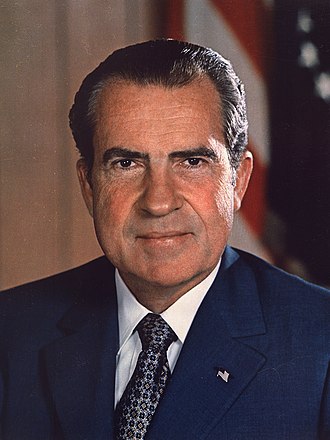
Richard M. Nixon served as the 37th President of the United States from January 1969 until his resignation in August 1974. In February 1971, he ordered the installation of a secret voice-activated taping system in the White House to preserve a historical record of his administration. Until the system's existence was revealed and dismantled in July 1973, the tapes captured Nixon directing major foreign policy initiatives, such as the opening to China, as well as his central role in the Watergate cover-up.
What Nixon talks about on the tapes
White House operations 4,718Presidential scheduling 2,225Public relations 1,784Presidential schedule 1,782Vietnam War 1,693Logistics 1,650Manolo Sanchez 1,626White House communications 1,400White House administration 1,399Presidential communication 1,243Henry Kissinger 1,191Foreign Policy 1,183
Conversations (21,010)
— Page 153 of 211President Nixon met with his aide, Stephen B. Bull, to review and confirm the scheduling of an upcoming meeting with National Security Advisor Henry A. Kissinger. The brief discussion focused on coordinating the President's calendar to facilitate this high-level consultation. Following the brief administrative briefing, Bull concluded the meeting and departed the Oval Office.
President Nixon and Stephen B. Bull met to review and finalize the details of the President’s upcoming schedule. The discussion specifically focused on coordinating Henry Kissinger's availability for an extended budget briefing. The participants sought to clarify the expected duration of this briefing to ensure proper time management for the President.
President Nixon met with his personal aide Stephen B. Bull to coordinate upcoming agenda items. The brief discussion primarily focused on the President's schedule and the arrangements for an impending meeting with Press Secretary Ronald L. Ziegler. No other significant policy matters were addressed during this short administrative exchange.
President Nixon, H. R. Haldeman, and Ronald Ziegler discuss managing press relations and public perception during the ongoing stalemate in Vietnam negotiations. A key focus is correcting the narrative regarding Henry Kissinger's role, specifically addressing the concern that Kissinger is attempting to distance himself from the administration or claim personal credit for peace efforts. Nixon also decides to cancel a scheduled meeting with the Productivity Commission, citing personal fatigue and health concerns, as he balances administrative duties with the pressures of the war and upcoming inaugural preparations.
President Nixon, H.R. Haldeman, and Stephen Bull discussed the President’s upcoming meeting with the Productivity Commission, specifically delegating a brief, non-deliberative appearance to thank labor leaders. Haldeman and the President also reviewed restructuring the White House staff management process, deciding to shift away from daily large staff meetings in favor of a core group of senior advisors coordinating the agenda. Finally, they addressed personnel issues involving Rose Mary Woods and managed the optics regarding Charles “Bebe” Rebozo’s recent real estate investment.
President Nixon met with the National Commission on Productivity, including various labor union leaders and administration officials, to express his appreciation for their voluntary service and to emphasize the necessity of labor-management cooperation in national economic policy. Nixon encouraged the members to offer input beyond labor issues and reaffirmed that his door remains open for direct engagement between the White House and organized labor. The discussion also touched on specific policy concerns, including maritime programs, grain exports, and the challenges faced by local unions.
President Nixon met with H. R. Haldeman and Henry Kissinger to discuss the stalled Vietnam peace negotiations and the intense US bombing campaign north of the 20th parallel. The conversation centered on the continued intransigence of South Vietnamese President Nguyen Van Thieu, with the participants evaluating the strategic risks of either forcing Thieu to accept a settlement or pursuing a separate bilateral deal with North Vietnam. Despite mounting casualties from B-52 operations and criticism from some Congressional leaders, Nixon and Kissinger decided to maintain military pressure in hopes of securing a breakthrough in technical talks and achieving a final peace agreement.
President Nixon held a brief, private meeting in his Old Executive Office Building suite to manage his daily schedule. The discussion was limited to logistical arrangements concerning his lunch break. No other substantive policy matters or major decisions were recorded during this brief interaction.
President Richard Nixon met with Zosimo T. Monzon in the Old Executive Office Building to discuss the President's upcoming official schedule. The brief conversation, lasting less than eleven minutes, focused on administrative planning and calendar management. No significant policy decisions were recorded during this brief encounter.
President Nixon met with Stephen B. Bull to coordinate his upcoming daily schedule and logistical arrangements. The discussion focused on managing meetings with George P. Shultz regarding wage, price, and trade policies, as well as organizing a photo opportunity with journalist Saul Pett. Additionally, they reviewed travel plans for the President's upcoming departure to Key Biscayne.
President Nixon initiates a request for the White House operator to contact Charles W. Colson. The primary purpose of the communication is to summon Colson for a meeting at the Executive Office Building. No further substantive policy or political discussions occur during this brief administrative exchange.
President Nixon consulted with the White House operator to facilitate an outgoing call. This routine interaction served as a technical step in managing the President's daily communication needs during his time in the Executive Office Building. No substantive policy discussions or significant political decisions took place during this brief administrative exchange.
President Nixon, H. R. Haldeman, and Stephen Bull discuss a request from Murray Chotiner for a personal meeting with the President. The group reviews Chotiner’s recent history with the administration, specifically noting his past criticisms of the 1972 campaign operations managed by Clark MacGregor. The discussion concludes with the President deciding to accommodate the request for a brief, personal meeting.
President Nixon met with an unknown individual to facilitate communication with his Chief of Staff, H.R. Haldeman. The primary purpose of the encounter was to request that the individual initiate a telephone call to Haldeman. No further substantive details regarding the nature of the requested discussion are available due to the lack of a transcript.
President Richard Nixon and H.R. Haldeman held a brief, inconsequential exchange in the Old Executive Office Building. The conversation primarily consisted of fragmented pleasantries and non-substantive filler, with no policy decisions, strategic planning, or significant directives recorded. The interaction concluded almost immediately without advancing any administration objectives.
President Nixon coordinated with the White House operator to facilitate a telephone call to First Lady Pat Nixon. He also provided logistical instructions regarding a 4:15 helicopter departure and requested that his schedule be cleared to ensure his timely exit. The conversation focused on managing the President's immediate movements and personal communications.
President Nixon met with Charles W. Colson to discuss public perception of the ongoing Vietnam War, specifically the recent escalation of bombing campaigns north of the 20th Parallel. They analyzed the political strategies for managing the 'hawks' and 'doves' in Congress and the media, while emphasizing the administration's commitment to achieving an 'honorable peace' that secures the return of prisoners of war. Nixon expressed his desire to frame the current military actions as a necessary response to North Vietnam's failure to adhere to previously discussed settlement terms.
President Nixon and First Lady Pat Nixon discussed scheduling a brief meeting between the President and Edward V. Jones, a volunteer who worked on White House refurbishing. The First Lady requested the encounter so that the President could meet Jones and his grandchildren. Nixon agreed to accommodate the request in the Oval Office at 2:15 p.m. and requested that a small gift be prepared for the children.
President Nixon contacted the White House operator to facilitate a telephone connection. The primary purpose of this brief interaction was to request that a call be placed to Stephen B. Bull. No further substantive policy matters were discussed during this brief administrative exchange.
President Nixon coordinated his afternoon schedule with Stephen B. Bull to accommodate several appointments in the Oval Office. Nixon finalized plans to meet with Edward V. Jones and his grandchildren to present them with gifts. Additionally, he scheduled an afternoon meeting with journalist Saul Pett to take place at 3:00 p.m.
President Nixon met with his aide, Stephen B. Bull, to review administrative logistics and personal arrangements before his upcoming departure for Florida. They discussed the organization of materials for his briefcase, including documentation related to inaugural addresses and photographs, and coordinated the scheduling of a press conference with Ronald Ziegler. Additionally, the President briefly touched upon a Christmas gift for First Lady Pat Nixon.
President Nixon met with H.R. Haldeman and key staff to coordinate end-of-year administrative tasks, including the scheduling of holiday messages and upcoming inaugural activities. The discussion focused on managing the White House staff's workload, press relations regarding the escalating bombing campaign in Vietnam, and strategic planning for bipartisan congressional outreach in the second term. Nixon also addressed personal correspondence regarding a recent article about his family and coordinated efforts related to the establishment of the Nixon Foundation.
President Nixon and First Lady Pat Nixon hosted Edward V. Jones, the James Balling, Jr. family, and a White House photographer for a brief courtesy visit in the Oval Office. During the session, the President presented the guests with official White House gifts, including Presidential Seal pins and Apollo viewmasters. The group engaged in informal conversation regarding the office's historical furnishings, such as Steuben glass and crewelwork by Julie Nixon Eisenhower, while Nixon expressed appreciation for the guests' contributions to the Committee for the Preservation of the White House.
President Nixon uses his recording system to dictate a letter of appreciation to journalist Ronald Kessler regarding a recent Washington Post article about the First Family. The President reflects on the piece, which featured personal anecdotes from Clifford and Willard Moore about their time with the Nixons. Nixon emphasizes the warmth of these memories and directs that the message be formally transcribed for the reporter.
President Richard Nixon met with his personal secretary, Rose Mary Woods, to manage administrative tasks, including the selection of gifts and the coordination of presidential correspondence. They discussed the distribution of custom-made music boxes and reviewed letters to individuals such as Ronald Kessler. Nixon also decided to reduce the number of congressional birthday calls and events, opting instead to prioritize more impactful outreach.
President Nixon used this session to dictate a letter to journalist Ronald Kessler regarding an article about the Nixon family's history and personal connections. The President reflected on his career in the House, Senate, and Vice Presidency, while also emphasizing his enduring closeness to long-time associates like Clifford and Archie Moore. Furthermore, Nixon finalized arrangements for a future White House visit for Mrs. Moore to coincide with the return of his daughters, Julie Nixon Eisenhower and Tricia Nixon Cox.
President Nixon met with his aide Stephen B. Bull to discuss the scheduling of an upcoming press conference for Press Secretary Ronald L. Ziegler. The brief encounter focused on administrative logistics regarding the press office's activities. The meeting concluded quickly after these scheduling matters were addressed.
President Nixon and his personal secretary Rose Mary Woods briefly discuss the President's upcoming meeting with Associated Press reporter Saul Pett. They weigh the potential value of the interaction, with the President expressing skepticism about Pett's reputation and character. Ultimately, Nixon instructs Woods to gauge the reporter's intentions and determine whether a meeting is advisable.
President Nixon and Press Secretary Ronald Ziegler met to coordinate arrangements for an upcoming interview with journalist Saul Pett, focusing on ensuring Rose Mary Woods participated to provide necessary background context. The discussion transitioned to managing press coverage, specifically approving candid photography by Henry Burroughs to humanize the President's public image. Finally, they reviewed public relations strategies regarding increased U.S. bombing in Vietnam, emphasizing that these actions represented a continuation of existing policy rather than a new escalation or a military defeat.
President Nixon met with H.R. Haldeman and Ronald Ziegler to manage White House operations and staff relations heading into the new year. The discussion centered on limiting unnecessary scheduling demands, specifically the burden of ceremonial photo opportunities, and addressing personnel issues involving Rose Mary Woods and staff dynamics. They also reviewed cabinet appointments, the status of the Watergate investigation, and preparations for the 1973 inaugural address.
President Nixon met with journalist Saul Pett for a reflective interview regarding his health, management style, and the nature of the presidency following his 1972 reelection. Nixon emphasized the importance of physical, mental, and emotional discipline in maintaining the objectivity required to handle intense national crises, such as the Vietnam War. He asserted that being reelected allowed him to govern with greater focus on long-term national interests rather than short-term political gains, while also highlighting his preference for delegation and his detachment from reactive news media.
President Nixon met with key staff and George Shultz to discuss administrative priorities, including the upcoming second-term reorganization, press relations, and economic strategy. Discussions centered on the continuation of wage and price controls, the development of new trade negotiation authority, and managing congressional relations for upcoming legislative initiatives. Additionally, the President reviewed proposals for a scholarly book project by Patrick Buchanan and provided guidance on navigating personnel decisions, specifically regarding energy policy and Federal Reserve appointments.
President Nixon met with political advisor Murray Chotiner to discuss various Republican political maneuvers and personnel strategies for the upcoming term. The conversation centered on potential candidates for California, including Robert H. Finch and Ronald Reagan, as well as the importance of strengthening Republican representation in the House and Senate. Nixon emphasized the need for better quality candidates and active involvement in future electoral efforts to ensure the success of his administration.
President Nixon contacted the White House operator to place an outgoing call to Charles W. Colson. The interaction served strictly as a logistical request to facilitate direct communication with his aide. No substantive policy discussions or policy-related decisions occurred during this brief exchange.
President Nixon and Charles Colson discuss communication strategy regarding the Vietnam War, emphasizing the need for administration officials to remain silent until concrete developments occur. Nixon stresses that public appearances, such as his attendance at President Truman's funeral, serve to project stability without necessitating political commentary. The two also evaluate the appointment of John A. Scali as UN Ambassador and address concerns regarding Henry Kissinger’s sensitivity to press leaks and his unauthorized meeting with Senator Charles Percy.
President Nixon and Charles Colson discussed political strategy, focusing on their desire to maintain a confrontational stance toward the media and political opponents. Nixon expressed frustration over Henry Kissinger’s recent meeting with Senator Charles Percy and directed Colson to coordinate efforts to challenge media bias, particularly through Accuracy in Media campaigns and Clay T. Whitehead’s initiatives. The conversation concluded with Nixon emphasizing the importance of staying firm in their PR efforts and shielding Kissinger from unauthorized political interactions during his upcoming break.
President Nixon contacted the White House operator to determine if H. R. Haldeman had already departed for California. The brief exchange focused on verifying Haldeman's current whereabouts and availability. Nixon ultimately instructed the operator not to initiate further effort to locate him if he had already left.
President Nixon consulted with the White House operator to confirm the current status of H. R. Haldeman’s travel arrangements. The operator verified that Haldeman was currently in transit on a flight to California. This brief check-in served to confirm the Chief of Staff's location following his departure.
President Nixon initiates a request for the White House operator to place a telephone call to Special Counsel Charles W. Colson. This brief administrative exchange serves as the logistical bridge to facilitate direct communication between the President and his advisor. No further substantive policy discussions occur during this brief interaction.
President Nixon instructed Charles Colson to contact H.R. Haldeman to express the President's intense displeasure regarding National Security Advisor Henry Kissinger’s recent meeting with Senator Charles Percy. Nixon demanded that Haldeman strictly warn Kissinger to cease all unauthorized media contacts and meetings while in Palm Springs to protect the administration's image and sensitive Vietnam policy negotiations. The President voiced concerns that Kissinger’s personal vanity and social interactions threatened to undermine his authority and leak classified information.
President Nixon contacted the White House operator to place a direct call to George Allen, the head coach of the Washington Redskins. This brief interaction served solely to facilitate communication between the President and the coach. No further business or political discussions were conducted during this exchange.
President Nixon spoke with Washington Redskins head coach George E. Allen to discuss the team's recent playoff victory over the Green Bay Packers and their upcoming game against the Dallas Cowboys. The two men analyzed player injuries, specifically highlighting the team's physical condition and the importance of maintaining an aggressive game plan against the defending champions. Allen shared his motivational strategies, including his efforts to instill a sense of civic obligation in his players and his personal animosity toward the Cowboys organization to inspire team intensity.
President Nixon met with an unknown female staff member in the Oval Office to facilitate the reproduction of specific administrative documents. During the brief interaction, the President requested copies of memoranda—labeled as 'talking papers'—that were intended for H.R. Haldeman. The meeting concluded once the logistical arrangements for these files were established.
President Nixon and Stephen B. Bull reviewed the President's upcoming schedule, focusing on travel arrangements for the Harry S. Truman memorial service and plans for an end-of-year retreat at Camp David. The discussion covered administrative coordination, including the processing of documents for the President's signature and the scheduling of meetings with staff such as George P. Shultz. Additionally, they coordinated logistical details regarding Pat Nixon’s travel to the Rose Bowl and the status of residence staff.
President Nixon held an informal Oval Office meeting with an unidentified individual, during which they discussed the logistics of his upcoming schedule. The conversation included brief coordination regarding a planned meeting with Colonel Richard T. Kennedy. The participants also shared a brief, lighthearted exchange concerning a Winnie the Pooh-themed item, likely a personal watch.
President Nixon met with Marjorie P. Acker to discuss administrative details regarding the schedule of Rose Mary Woods and the drafting of correspondence to Senator William Stuart Symington. The conversation focused on the appropriate use of first names in the letter, specifically regarding Evelyn Symington and Bryce N. Harlow. Acker was tasked with verifying the preferred nomenclature before finalizing the signature.
President Nixon met with Col. Richard T. Kennedy to discuss the ongoing U.S. bombing campaign over North Vietnam and the status of diplomatic negotiations. They reviewed tactical adjustments intended to reduce aircraft losses and enhance the psychological impact of the strikes, while noting the operational challenges posed by adverse weather and enemy air defenses. Nixon emphasized the importance of sustained military pressure to secure a settlement and expressed frustration with negative media coverage of the bombing operations.
President Nixon met with Stephen B. Bull to coordinate administrative details regarding his daily schedule. The discussion specifically focused on organizing an upcoming meeting with a secretary. This brief exchange served to manage the President's immediate operational agenda and office logistics.
President Nixon met with his aide Stephen B. Bull to dictate comprehensive instructions for managing his schedule and administrative priorities for the first half of 1973. Nixon emphasized the need to preserve his time by deferring meetings, streamlining political calls, and strictly controlling access to the Cabinet Room. He further directed the reorganization of the National Security Council and the intelligence community, specifically tasking Bull with overseeing personnel cuts and empowering James R. Schlesinger to lead intelligence reforms despite potential resistance from Henry Kissinger.
President Richard Nixon met with his aide Stephen B. Bull to seek assistance regarding an unspecified urgent matter. The brief exchange highlights the President's reliance on his staff for immediate support during a period of high-pressure White House operations. No specific policy or administrative decision resulted from this brief recorded interaction.
President Nixon met with Marjorie P. Acker to coordinate formal diplomatic correspondence regarding Tricia Nixon Cox and Edward R. F. Cox’s upcoming trip to Europe and the Soviet Union. Nixon instructed Acker to collaborate with National Security Council staff to ensure that appropriate thank-you letters are drafted for the ambassadors who hosted the couple. Additionally, the pair briefly discussed the logistical handling of an enclosure for a report intended for the West Coast.
President Nixon consulted with a White House operator and staff member Marjorie P. Acker to arrange a secure telephone call with CIA Director Richard M. Helms. The President emphasized strict security protocols, specifying that he only wished to speak with Helms if the communication line was secure and free from risks associated with the Director’s current travel status. The conversation concluded with the President instructing the operator to verify Helms's location and availability before initiating any contact.
President Nixon consulted with his personal aide, Manolo Sanchez, regarding the coordination of his daily schedule. The brief interaction served to confirm the arrival of Patrick J. Buchanan for a subsequent meeting. No major policy decisions were reached, as the discussion focused primarily on logistical arrangements for the President's appointments.
President Nixon consulted with a White House operator and Marjorie P. Acker regarding the scheduling and participation of an individual named Mr. Holmes. The President sought to confirm Holmes's current location and availability, explicitly noting that Holmes could not be included in a planned film project if he were out of the city. No final decision was reached, as the participants worked to verify the subject's immediate accessibility.
President Nixon met with his personal valet, Manolo Sanchez, to discuss the status of an unidentified individual who had not yet awakened. The brief exchange served as a logistical check-in regarding the morning schedule and the readiness of the President's upcoming appointment with Patrick J. Buchanan. No major policy decisions were made during this brief administrative interaction.
President Nixon consulted with the White House operator to confirm the current whereabouts of CIA Director Richard Helms. Upon learning that Helms was traveling in Mexico and unavailable, Nixon instructed the operator to cancel a previously requested telephone call. This interaction served to update the President's schedule regarding his communication with intelligence leadership.
President Nixon consulted with the White House operator to verify the availability of a specific individual. The brief exchange served to coordinate scheduling and clarify the whereabouts of the party in question. No substantive policy matters or major decisions were recorded during this brief administrative communication.
President Nixon met with Patrick J. Buchanan to discuss the framework and themes for a prospective book about the Nixon administration. The conversation focused on framing Nixon’s political career as a narrative of overcoming adversity, specifically highlighting his 1968 comeback and the ideological battles against the "liberal establishment" and the national media. They also analyzed campaign strategies, the importance of maintaining emotional detachment from press criticism, and the effective, strategic use of television to communicate directly with the American public.
President Richard Nixon met with his valet, Manolo Sanchez, in the Oval Office to coordinate logistics for an upcoming departure. The discussion focused on administrative details including the handling of the President's briefcase, his coat, and preparations for walking to the helicopter. These arrangements also involved coordination regarding the schedule for First Lady Pat Nixon.
President Nixon consults with his aide, Stephen B. Bull, regarding the inventory of high-end jewelry items, specifically diamonds and pearls, currently available in White House holdings. The President expresses an intent to potentially utilize these items for personal gifts, though he remains undecided between the two gemstone options. The brief discussion concludes with Bull confirming the availability of a pearl, providing Nixon with the information necessary for a future selection.
President Nixon met with his personal aide, Stephen B. Bull, to verify travel logistics and confirm attendance for an upcoming engagement. The brief exchange served as a final check to ensure Bull was prepared for his role in the President’s impending departure. No policy discussions took place, as the meeting was limited to operational coordination.
President Nixon initiates a brief telephonic communication with the White House operator to facilitate contact with his aide, Stephen B. Bull. This exchange serves as a routine administrative request to establish a connection with a staff member. No substantive policy matters or broader political developments are addressed in this short administrative task.
President Nixon directs Stephen B. Bull to urgently coordinate a visit to Nicaragua to provide earthquake relief and demonstrate personal support for the victims. Nixon intends to arrive with a substantial financial donation and plans to visit devastated areas via helicopter while minimizing press fanfare. He instructs Bull to bypass the State Department and senior staff, tasking only Col. Richard T. Kennedy of the NSC with facilitating the logistics for a departure the following morning.
President Nixon initiated a brief administrative call to the White House operator to request a connection to his aide, Stephen B. Bull. This exchange served solely as an operational step to facilitate further communication with his staff. No substantive policy discussions or decisions were addressed during this short request.
President Nixon and Stephen B. Bull coordinate the logistics for a trip to Nicaragua to provide earthquake relief. Nixon plans to depart immediately following the funeral of Harry S. Truman to ensure he arrives in the region by late afternoon. The President intends to conduct a helicopter tour of the disaster area, interact directly with survivors, and deliver aid.
President Nixon contacted the White House operator to initiate a telephone call to his special counsel, Charles W. Colson. The brief exchange served solely as a logistical request to establish a line of communication with Colson. No further policy discussions or substantive developments occurred during this interaction.
President Nixon and Charles Colson review the administration's public relations efforts following the President's attendance at Harry S. Truman's funeral and ongoing bombing campaigns in North Vietnam. They analyze public sentiment and congressional dynamics, concluding that there is minimal public backlash and strong support within their base. Additionally, they discuss personnel appointments, the potential use of cable television to challenge network media influence, and the positive reception of recent White House and Blair House outreach initiatives.
President Nixon instructed the White House operator to place a call to Henry Kissinger to discuss official matters. He emphasized that the call should not be disruptive, specifically requesting that Kissinger not be interrupted if he was at dinner. Considering the three-hour time difference, Nixon directed the operator to reach out only if the timing was convenient and non-urgent.
President Nixon and Henry Kissinger discussed the status of ongoing peace negotiations with North Vietnam and the strategic impact of the current U.S. bombing campaign. Kissinger reported on a recent message sent to Hanoi, offering a 36-hour window for a bombing halt conditional upon North Vietnamese confirmation of specific meeting dates. Both men expressed confidence in the effectiveness of the military pressure being applied and agreed to remain firm in their negotiating stance regardless of media criticism or domestic public opinion.
President Nixon contacted the White House operator to facilitate a telephone connection with his personal aide, Stephen B. Bull. This brief administrative exchange served solely to initiate the communication link between the two parties. No substantive policy or political matters were discussed during this brief request for assistance.
President Nixon and Stephen B. Bull discuss the feasibility of a presidential visit to Managua, Nicaragua, following a devastating earthquake. Nixon expresses his desire to visit refugee centers to demonstrate American concern, while Bull raises concerns that a high-level visit might disrupt ongoing evacuation efforts. Ultimately, the President directs Bull to coordinate with Ambassador Turner Shelton and provide a definitive recommendation the following morning, with a tentative plan to depart on December 29th.
President Nixon met with Stephen Bull and Col. Richard T. Kennedy to coordinate humanitarian relief efforts following a devastating earthquake in Managua, Nicaragua, and to discuss the ongoing status of the Vietnam War. Regarding Nicaragua, the President reviewed travel logistics for a potential visit and determined that Ambassador-designate John Scali should instead act as his personal representative to manage aid efforts and public relations. The discussion then shifted to Vietnam, where the participants analyzed North Vietnam’s potential responses to recent U.S. bombing campaigns, the state of peace negotiations, and the internal political challenges facing South Vietnamese President Nguyen Van Thieu.
President Nixon initiates a brief telephone request for the White House operator to connect him with First Lady Pat Nixon. The call serves as an administrative bridge to facilitate a private conversation between the President and his wife. No substantive policy matters or further actions are recorded during this brief operator interaction.
President Nixon initiated a brief administrative call with a White House operator to facilitate a telephonic connection. This interaction served purely as a logistical step to reach another party, reflecting the standard operational procedures for initiating communications from the Executive Office Building. No substantive policy discussions or policy-related decisions occurred during this brief exchange.
President Nixon and the White House operator discuss the inability to reach Mrs. Jackson due to her conflicting business appointments. The President acknowledges the situation and instructs the operator to attempt the call again whenever it becomes convenient. No further action or substantive policy decisions occur during this brief exchange.
President Nixon consulted with the White House operator to clarify administrative details regarding office logistics. The brief exchange focused on the necessity of securing a specific sticker for official use. No major policy decisions were made during this routine interaction.
President Nixon met with his secretary, Marjorie P. Acker, to arrange the processing and delivery of a handwritten note he had composed for Bess Truman. He instructed Acker to create a photographic copy of the document for official records before ensuring its proper transmission. The conversation served as a brief administrative task to coordinate the professional handling of the President's personal correspondence.
President Nixon met with his personal valet, Manolo Sanchez, to facilitate the delivery of personal correspondence. The President provided instructions regarding a note intended for Bess Truman, directing Sanchez to ensure it was delivered to Marjorie P. Acker. This brief interaction served as a logistical arrangement for the President's private communication with the former First Lady.
President Nixon recorded a memorandum detailing his reflections on the death and funeral arrangements of former President Harry S. Truman. The President recounted his personal experiences surrounding the transition, including his trip to the Truman Library in Independence, Missouri, to pay respects and meet with the Truman family. He evaluated Truman's character and historical legacy while outlining the logistics of the official mourning process and state proceedings.
President Richard Nixon and First Lady Pat Nixon coordinated their travel logistics for the upcoming funeral of Harry S. Truman. The President informed his wife of his departure plans, and they mutually agreed upon a revised departure time of 4:30 p.m. to accommodate the First Lady's schedule.
President Richard Nixon and First Lady Pat Nixon engaged in a brief, informal check-in regarding the President's upcoming daily schedule. The conversation served as a momentary coordination of their personal plans before departing for later commitments. No major policy decisions were made during this exchange.
President Nixon dictates a memorandum regarding the recent death of former President Harry S. Truman. He reflects on his planned trip to the Truman Library to pay respects, specifically addressing scheduled interactions with Bess Truman and Margaret Truman Daniel. The President also considers the historical parallels of the funeral proceedings in relation to the legacy of Franklin D. Roosevelt.
President Nixon met with his aide, Stephen B. Bull, to coordinate his upcoming schedule and manage communications regarding potential meetings and statements. The discussion focused on locating Maurice J. Williams in West Virginia, facilitating a briefing paper through Colonel Richard T. Kennedy, and preparing for a trip to Camp David. The President emphasized the importance of discretion, specifically instructing that no information regarding these matters be disclosed to the press.
President Nixon initiates a request through the White House operator to place a telephone call to Rex W. Scouten. This brief interaction serves as a logistical bridge to connect the President with a member of his staff. No substantive policy matters were discussed during this brief exchange.
President Nixon dictated a memorandum for his files, covering a broad array of administrative, foreign policy, and domestic concerns following his 1972 reelection. He reflected on the death of Harry S. Truman, assessed international responses to the bombing campaign in Vietnam, and discussed the logistics of relief efforts for the earthquake in Nicaragua. Additionally, the President reviewed plans for second-term staff reorganizations, domestic policy initiatives, and strategies for managing press relations and public opinion.
President Nixon consulted with the White House operator to facilitate a telephonic connection to an unidentified individual. This brief interaction served solely to initiate communication with the requested party. No further policy discussions or substantive administrative decisions were recorded during this exchange.
President Nixon held a brief administrative interaction with a White House operator to facilitate a telephone connection. The conversation serves primarily as a logistical exchange to initiate communication with another party. No substantive policy discussions or significant political decisions were recorded during this brief bridge to a separate call.
President Nixon consulted with Rex W. Scouten regarding proposed renovations to the White House bowling alley and the president's private living quarters. Nixon directed Scouten to scale back the bowling alley project by eliminating unnecessary plumbing and auxiliary facilities, opting instead to relocate a whirlpool installation to his master bathroom. Scouten was tasked with investigating the feasibility of this plan and providing a revised proposal for the upgrades.
President Nixon met with White House Chief Usher Rex Scouten to discuss the logistics and potential modifications for a new facility installation within the Executive Office Building. The two men evaluated the practicality of placing the installation on the third floor versus a basement location, considering accessibility and necessary infrastructure upgrades like air conditioning. They reached a general consensus on selecting a convenient location that avoids the need for extensive plumbing or shower installations.
President Nixon instructed the White House operator to place an outgoing call to Maurice J. Williams. The President specifically requested that the operator reach Williams at his location in West Virginia. This brief administrative interaction served as a logistical step to facilitate direct communication between Nixon and Williams.
President Nixon dictated a memorandum to speechwriter Raymond K. Price, Jr. regarding the preparation and thematic direction of his 1973 inaugural address. He provided specific instructions on the desired length of the speech and emphasized the need to address the status of Vietnam War negotiations in relation to ongoing military operations. The President further directed Price to incorporate international developments into the inaugural themes while managing the production schedule for the first draft.
President Nixon dictated a memorandum to senior aides H. R. Haldeman and John Ehrlichman outlining his strategy for a second-term administrative reorganization. The discussion focused on expanding George P. Shultz's role in economic policy, tax reform, and trade, while also addressing the need to integrate departmental perspectives into a streamlined executive structure. Nixon instructed his staff to coordinate with Roy L. Ash and William E. Timmons to ensure that congressional and political considerations were effectively managed during this transition.
President Nixon dictates a memorandum to H.R. Haldeman regarding administrative reorganizations for his second term, specifically focusing on ambassadorial appointments in the Middle East. The President addresses the performance and suitability of figures such as Joseph S. Farland and Henry J. Tasca, while weighing the influence of Henry Kissinger. Additionally, Nixon instructs Haldeman and John Ehrlichman to manage fallout from recent comments made by Senator Charles Percy regarding the Vietnam War.
President Nixon dictated a memorandum to John D. Ehrlichman regarding the political and public perception of the Family Assistance Program. The discussion focused on evaluating welfare reform strategies, specifically the balance between guaranteed minimum income for welfare recipients and the earnings of the working poor. Nixon directed an analysis of polling data from George Gallup, Louis Harris, and Albert Sindlinger to refine the administration's messaging on the federal government’s role in social welfare.
President Nixon dictated a memorandum to James Keogh regarding the strategic direction and public image of the United States Information Agency (USIA). The President evaluated the agency's credibility and emphasized the necessity of presenting a balanced, positive portrayal of the U.S. in international media. He specifically addressed the balance between transparency regarding national challenges—the "warts and all" approach—and the need for more effective promotional programming.
President Nixon dictated a memorandum for the file regarding his interactions with Judge Florence Shientag, a prominent supporter of the 'Democrats for Nixon' initiative during the 1972 campaign. He noted her recent letter to the editor of The New York Times concerning the issue of crime. The recording documents his effort to formally record these campaign-related associations and endorsements.
President Nixon utilized this time to dictate a letter of appreciation to Franklin D. Murphy, acknowledging Murphy's long-standing support and his recent correspondence following the 1972 election. The President reflected on his historical relationship with the Los Angeles Times, specifically recalling the editorial backing he received from Norman Chandler during his 1950 senatorial campaign. Throughout the recording, Nixon also reviewed past audio segments and extended New Year's greetings.
President Nixon dictated a memorandum to Chief of Staff H.R. Haldeman regarding the post-mortem of the 1972 presidential campaign. He specifically requested that Haldeman’s staff organize and manage the donor lists compiled by Maurice Stans and the Finance Committee. The President sought to leverage these records from the business community and the Business Council to inform future political operations.
President Nixon dictated a memorandum outlining instructions for CIA Director Richard Helms regarding his upcoming transition to the ambassadorship in Iran. The President tasked Helms with conducting a comprehensive analysis of Middle Eastern political stability and the regional oil situation as it pertains to the energy security of the United States, Europe, and Japan. Additionally, the directive addressed Helms' recent communications with John Connally concerning Middle Eastern diplomatic travel and established the framework for their future consultations on these critical national security matters.
President Richard M. Nixon met with his personal aide, Manolo Sanchez, at the Old Executive Office Building to handle private administrative tasks. The discussion primarily focused on the disposition, transcription, and filing of Dictabelt recordings. The session concluded with the two sharing a lunch.