Nixon, Richard M. (President)
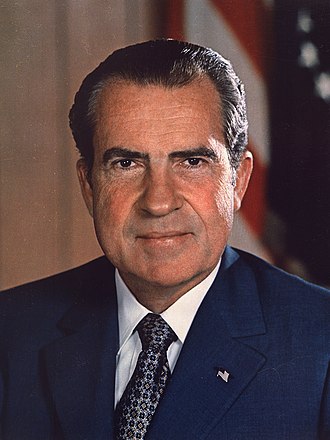
Richard M. Nixon served as the 37th President of the United States from January 1969 until his resignation in August 1974. In February 1971, he ordered the installation of a secret voice-activated taping system in the White House to preserve a historical record of his administration. Until the system's existence was revealed and dismantled in July 1973, the tapes captured Nixon directing major foreign policy initiatives, such as the opening to China, as well as his central role in the Watergate cover-up.
What Nixon talks about on the tapes
White House operations 4,718Presidential scheduling 2,225Public relations 1,784Presidential schedule 1,782Vietnam War 1,693Logistics 1,650Manolo Sanchez 1,626White House communications 1,400White House administration 1,399Presidential communication 1,243Henry Kissinger 1,191Foreign Policy 1,183
Conversations (21,010)
— Page 27 of 211President Nixon and Alexander P. Butterfield met to coordinate logistics for an upcoming dinner honoring Postmaster General Winton M. “Red” Blount. The discussion focused on securing suitable "family-type" entertainment to ensure a light atmosphere for the guests. They also decided that the formal presentation of Blount’s Cabinet Room chair would occur at a future Cabinet meeting rather than during the dinner event.
President Nixon requested that the White House operator place a call to a specific party referred to by the code name 'a bear.' This brief interaction served as a logistical bridge to facilitate an off-the-record or secure communication. No further substantive policy matters were discussed during this request.
President Nixon directs the White House operator to place calls to Congressman Pierre S. du Pont IV of Delaware and Congressman George E. Brown Jr. of California. The President provides specific instructions regarding the contact list, identifying the individuals by name to facilitate communication. No broader policy or strategic discussions occur during this brief administrative exchange.
President Nixon consulted with House Armed Services Committee Chairman F. Edward Hébert and Secretary of Defense Melvin Laird regarding legislative strategies and the security of classified documents. Nixon expressed gratitude for Hébert’s support in the upcoming House-Senate conference on Vietnam withdrawal language, emphasizing the need to prevent legislative mandates that could undermine ongoing peace negotiations. Additionally, the participants discussed the handling of leaked government documents, with Hébert assuring the President that he would implement strict security protocols to prevent further disclosures if the materials were referred to his committee.
President Nixon met with House Armed Services Committee Chairman F. Edward Hébert to express appreciation for his public support during ongoing legislative negotiations. The discussion focused on managing the political challenges posed by the Senate and the imperative of maintaining the security of sensitive government intelligence sources. Nixon emphasized the necessity of preventing leaks to ensure the administration's leverage in diplomatic and military negotiations.
President Nixon called Congressman Pierre S. DuPont to express his appreciation for DuPont’s effective public support of a resolution during recent Vietnam-related hearings. DuPont acknowledged the difficulty of taking such a stance and hinted at ongoing, undisclosed administration efforts regarding the conflict. The brief exchange served to solidify political alignment and boost morale for the Congressman amidst intense congressional debate.
President Nixon met briefly with Alexander P. Butterfield to coordinate the scheduling of General Alexander M. Haig, Jr. The discussion focused on determining Haig's current location and integrating him into the President's immediate agenda. No major policy decisions were reached during this short logistical exchange.
President Nixon met with Pierre S. DuPont to express his gratitude for DuPont’s effective advocacy and support regarding a recent political resolution during a leadership caucus. The brief exchange served as an affirmation of loyalty, with Nixon acknowledging the difficulty of taking a firm stance on contentious issues. Both parties concluded the discussion by noting the successful outcome of the caucus and confirming that follow-up actions were already underway.
President Nixon calls Congressman Charles Gubser to commend his recent performance in a congressional caucus and to express support for his plan to challenge fellow California Representative Paul J. McCloskey, Jr. Gubser outlines his intent to deliver a speech in McCloskey’s district refuting claims that the administration is engaged in an indiscriminate bombing campaign in Laos. Nixon encourages the effort, viewing McCloskey’s behavior as politically motivated and comparing him to Representative Donald W. Riegle, Jr. The two agree that Gubser will provide a copy of his speech to the White House for review.
President Nixon met with Representative Charles S. Gubser to commend his recent legislative efforts in the caucus and discuss political strategy regarding a problematic colleague. Nixon offered tactical advice on managing the internal conflict and encouraged Gubser to coordinate with White House staffer William Sullivan on the drafting of an upcoming speech. The conversation concluded with Nixon requesting a copy of the final remarks to ensure continued alignment on key policy messaging.
President Nixon met with Alexander Haig to discuss ongoing foreign policy challenges, specifically concerns regarding a proposed State Department cable to Cairo and the broader diplomatic strategy in the Middle East. The pair also addressed the political impact of the Pentagon Papers, with Nixon emphasizing the need for firm management of the situation to prevent further division among critics. Additionally, they reviewed military developments in Vietnam and Laos, focusing on the handling of press relations and the status of diplomatic negotiations.
President Nixon called Congressman Garry E. Brown to commend him for his courageous floor speech opposing the Nedzi-Whalen amendment, which sought to limit U.S. military involvement in Vietnam. Nixon praised Brown's performance within the Republican caucus and expressed confidence that Brown's stance would prove politically advantageous by the following year. Brown acknowledged the political sensitivity of the issue in his district, while both men briefly signaled alignment on the broader trajectory of the administration's Vietnam policy.
President Nixon instructed the White House operator to place a telephone call to Senator John C. Stennis. This administrative exchange served as the precursor to an official consultation between the President and the Senator. No further substantive dialogue was recorded during this brief connection.
President Nixon attempted to reach Senator John C. Stennis via the White House operator to discuss an urgent matter. The operator informed the President that Stennis was currently on the Senate floor, leading Nixon to authorize speaking with the Senator’s secretary if the Senator could not be reached directly. This brief exchange served as an administrative effort to facilitate a high-level legislative communication.
President Nixon initiated a brief, perfunctory interaction with the White House operator to place an outgoing call. No substantive policy matters or political strategy were addressed during this brief exchange. The conversation served only as a functional request to connect the President to another party.
President Nixon initiates a brief, cryptic request with the White House operator regarding an unnamed individual. The President explicitly states a desire for the subject to be killed. No further context or follow-up details are provided within the recording.
President Nixon instructed the White House operator to place an outgoing call to J. Phillip Campbell, the Undersecretary of Agriculture. The brief exchange served as a procedural request to initiate communication with the Department of Agriculture official. No further policy discussions or substantive developments occurred during this connection.
President Nixon calls Senator John C. Stennis to express his appreciation for the Senator's legislative support regarding Vietnam policy following a recent vote. Nixon reflects on the negative impact of the Pentagon Papers on administration efforts and discusses the potential formation of a Senate select committee to review the documents. The President explicitly endorses Stennis to chair such a committee, specifically contrasting Stennis's judicial temperament with that of Senator J. William Fulbright.
President Nixon met with Senator John C. Stennis to express his strong appreciation for the Senator's ongoing political efforts and steadfast commitment to their shared legislative agenda. The two men briefly discussed the necessity of staying the course on sensitive matters despite potential controversy, with Nixon offering encouragement for Stennis's current leadership role. This short, cordial exchange served primarily to reinforce political solidarity between the President and the Senator during a period of legislative pressure.
President Nixon instructed the White House operator to place a telephone call to legendary jazz composer and bandleader Duke Ellington. This brief interaction served as a logistical step to facilitate direct communication between the President and Ellington. No further substantive policy matters were discussed during this brief connection.
President Nixon initiates a brief interaction with the White House operator to facilitate a telephonic connection. This recording captures only the preliminary logistical exchange between the President and the switchboard staff. No substantive policy discussions or administrative decisions occur during this brief communication.
President Nixon interacts briefly with a White House operator in the Old Executive Office Building. The recording is incomplete and consists only of an instruction regarding the physical handling of the recording equipment. No substantive policy matters or administrative decisions were documented during this short exchange.
President Nixon consulted with the White House operator to coordinate outreach to two individuals. He inquired about the availability of Under Secretary J. Phillip Campbell, who was traveling in Wisconsin, and requested that the operator locate and connect a call to Michael McGreevey in California. The President established a contingency to speak with Campbell on the following Monday if he could not be reached immediately.
President Nixon initiates a brief, informal communication with the White House operator to discuss an administrative matter regarding Michael McGreevy. The exchange serves as a transition or inquiry to facilitate further telephonic contact, likely to connect the President to a subsequent individual. No substantive policy decisions or high-level political developments are addressed in this short interaction.
President Nixon directed the White House operator to place two outgoing calls to facilitate personal or administrative contacts. He requested that the operator reach William Rinaldi in Dunmore, Pennsylvania, and simultaneously inquired about the current performance location of Duke Ellington in the Philadelphia area. The President indicated that these calls were not urgent, noting that he would remain available for another hour to receive them.
President Nixon directs the White House operator to facilitate a telephone connection with an individual named Rinaldi, located in Dunmore, Pennsylvania. The primary purpose of the brief interaction is to initiate this specific outreach. No further policy discussions or significant political developments are captured in this recording.
President Nixon met to review and dictate revisions to a correspondence previously addressed to R. Anthony Eden, the Earl of Avon. The session focused specifically on finalizing the content and phrasing of this diplomatic communication. No further administrative actions were recorded beyond these editorial adjustments.
President Nixon contacted Undersecretary of Agriculture J. Phillip Campbell to commend his public defense of D.C. Police Chief Jerry V. Wilson during a recent meeting of Southern agricultural secretaries. The President affirmed his own support for Wilson and emphasized the importance of aggressive advocacy for administration figures. They also discussed positive feedback Nixon received regarding Georgia Democrat Doyle Connors, with the President directing John Whitaker to ensure Connors is considered for future White House functions.
President Nixon instructed the White House operator to place a telephone call to Press Secretary Ronald L. Ziegler. The conversation was brief and administrative, serving solely as a request to connect with his primary spokesperson. No substantive policy discussions or policy developments occurred during this interaction.
President Nixon met with Under Secretary of Agriculture J. Philip Campbell to express personal appreciation for his recent performance and regional outreach efforts. During the brief exchange, Nixon encouraged Campbell to increase his administrative visibility and impact within the administration. The President further directed Campbell to communicate specific feedback regarding these outreach efforts to John Ehrlichman.
President Nixon and H. R. Haldeman met briefly in the Old Executive Office Building to coordinate the President's upcoming schedule. The discussion focused on managing the logistics and priorities of the presidential calendar. No specific substantive decisions or further actions were recorded in this brief exchange.
President Nixon and Press Secretary Ronald Ziegler coordinate the administration's public messaging regarding the release of the Pentagon Papers. They emphasize portraying the decision to release the documents as a proactive move made by the President at Key Biscayne rather than a defensive reaction to congressional or judicial pressures. Additionally, they briefly clarify that recent negative news coverage regarding the American Medical Association and health reform was unrelated to the President's recent activities.
President Nixon and Press Secretary Ronald L. Ziegler held a brief check-in to confirm the successful management of a recent media story. The exchange served as a short status update to ensure that a potentially sensitive narrative had been effectively contained. The participants concluded the discussion with mutual confirmation that the matter was handled satisfactorily.
President Nixon met with his personal valet, Manolo Sanchez, to discuss logistical arrangements regarding the President's daily schedule. The brief interaction focused on the practical coordination of Nixon's upcoming movements and internal administrative tasks. No major policy decisions were made during this routine exchange, which primarily served to facilitate the President's immediate operational workflow.
President Nixon met with H. R. Haldeman, Bryce Harlow, Harry Dent, and others to discuss political strategy, specifically regarding the fractured state of the Democratic Party and the potential for voter realignment. The participants analyzed the political fallout of busing, evaluated strategies for the 1972 campaign, and deliberated on how to leverage patriotism and national security to gain public support. Nixon emphasized the importance of projecting strong, aggressive leadership on television to maintain voter confidence and effectively contrast his administration against Democratic opponents.
President Nixon telephoned William Rinaldi, a teacher working with underprivileged students, to personally commend him for his dedication and impactful work in the classroom. During the exchange, the two discussed the importance of teaching U.S. history to foster a sense of national pride and destiny in students during their formative years. Nixon emphasized that such historical education serves as a necessary counterweight to the negative influence of contemporary media coverage.
President Nixon instructs the White House operator to connect him with Senator Mike Mansfield's secretary. This brief administrative interaction serves as a precursor to an intended high-level communication with the Senate Majority Leader. No substantive policy discussions occur during this call, as its sole purpose is to facilitate outreach to congressional leadership.
President Nixon met with professional football players John Mackey and Nick Buonconti, accompanied by their wives and NFL Players Association representative Ed Garvey, to discuss labor-related concerns within the league. Facilitated by Henry C. Cashen II, the session served primarily as an informal meeting to exchange pleasantries and address the state of professional football. The discussion remained largely general, concluding with the President offering well-wishes for the upcoming season.
President Nixon met with his personal aide, Manolo Sanchez, in the Oval Office. The brief interaction focused on the President requesting coffee. No significant policy discussions or major administrative decisions occurred during this brief encounter.
President Nixon called jazz legend Duke Ellington to offer well wishes for his upcoming diplomatic trip to the Soviet Union. The President also provided an update on his administration's efforts to facilitate the logistics for a Youth Symphony project spearheaded by Leonard Garment. The call concluded with an exchange of mutual appreciation regarding the success of a recent White House event honoring Ellington.
President Nixon and H. R. Haldeman met to discuss the administration's response to the Pentagon Papers, focusing on delegating a team to manage the declassification process while emphasizing that the documents originated during the Kennedy and Johnson administrations. Nixon stressed the importance of framing the leaks as a national security risk, using the argument that a single compromised document could reveal codes or endanger lives to justify the administration's legal stance. Additionally, they reviewed scheduling for the President’s upcoming Midwest trip and discussed the necessity of curbing internal leaks and exerting tighter control over White House and Congressional staff regarding policy recommendations.
President Nixon directs the White House operator to place individual telephone calls to Representative Wilbur D. Mills and Representative John W. Byrnes. Additionally, he requests a call to Kenneth R. Cole Jr., noting that Cole is currently hospitalized. These instructions facilitate the President's outreach to key legislative figures and a White House staffer.
President Nixon consulted with the White House operator to facilitate a series of upcoming meetings with key political figures. The discussion centered on coordinating calls or appointments involving Congressman Wilbur Mills, Congressman John Burns, and Ambassador Kenneth Cole. This interaction served as a logistical step in managing the President's legislative and diplomatic outreach efforts.
President Nixon spoke with Representative Wilbur D. Mills to commend his successful efforts in passing H.R.1 through the House and to coordinate legislative strategy for the bill in the Senate. The two discussed welfare reform, including the distinction between current guaranteed welfare payments and the administration’s work-based proposal, as well as potential outreach to Governor Ronald Reagan regarding his concerns. Additionally, Nixon addressed the ongoing controversy surrounding the Pentagon Papers, emphasizing the necessity of protecting government classification systems and the importance of upholding the rule of law against unauthorized leaks.
President Nixon met with Congressman Wilbur D. Mills to commend his leadership in advancing H.R. 1, a significant piece of social welfare legislation. The two discussed legislative strategy and the necessity of maintaining a strong work requirement for benefit eligibility. Furthermore, Nixon articulated his rationale for opposing the unauthorized release of classified documents, framing the Pentagon Papers controversy as a critical issue of national security and the rule of law rather than a partisan cover-up.
President Nixon calls Congressman John W. Byrnes to express appreciation for his collaboration with Wilbur D. Mills in securing legislative support for H.R. 1. The two discuss the political difficulty of rebranding the bill's provisions, specifically refuting public criticism that the legislation constitutes a 'guaranteed annual income' by emphasizing work requirements. Nixon notes his intention to lobby Senator Russell B. Long to ensure the bill's continued progress in the Senate.
President Nixon held a brief, two-second meeting with an unidentified individual in the Oval Office. No substantive policy matters or discussions were captured during this exchange. The encounter concluded immediately following the President's initial greeting.
President Nixon met with Representative John W. Byrnes to express appreciation for the legislative support provided by Byrnes and Wilbur Mills regarding a recent bill. The conversation centered on justifying the administration's welfare reform proposals, with both men emphasizing that the legislation should be framed as a work incentive rather than a guaranteed annual income for the unemployed. Nixon concluded by confirming his intent to lobby Senator Richard Russell to secure further support for the administration's agenda.
President Nixon instructed the White House operator to relay a personal well-wish to Kenneth R. Cole, Jr., who was presumably recovering from an illness or injury. The President requested that Cole be told to return to the golf course as soon as possible, emphasizing the message's personal nature. This brief exchange occurred as Nixon prepared to depart for a televised recording of his Honor America Day speech.
President Nixon instructs the White House operator to relay a personal message of well-wishes to an unidentified individual. He emphasizes his intent to return to the golf course as soon as possible. The interaction concludes quickly as the operator departs for a television appearance.
President Nixon met with Stephen B. Bull to review administrative scheduling matters, specifically concerning a request from Peter M. Flanigan. The discussion addressed Flanigan's inability to attend a scheduled meeting and the necessity of preparing a formal recorded statement. The interaction served to coordinate immediate personnel logistics and administrative tasks for the President.
President Nixon and Stephen B. Bull met briefly in the Oval Office to address administrative matters regarding the President's daily schedule. The exchange was exceptionally brief and served primarily as a logistics check for the morning's activities. No substantive policy discussions or major decisions were recorded during this session.
President Nixon met with his personal aide, Stephen B. Bull, in the Oval Office to conduct a brief review of the President's daily schedule. The conversation focused on the logistical coordination of the President's upcoming appointments and administrative duties. No major policy decisions were recorded during this short meeting, which concluded with routine administrative adjustments.
President Nixon and John D. Ehrlichman coordinated a brief transit to a theater engagement. The conversation served primarily as a logistical check for their upcoming departure from the White House. No substantive policy discussions or administrative decisions were recorded during this short interval.
President Nixon met with Ambassador Anthony D. Marshall and W. Marshall Wright to discuss the deteriorating diplomatic situation in Madagascar, specifically the influence of French official Jacques Foccart in instigating actions against U.S. personnel. The participants evaluated the goals for an upcoming U.S. diplomatic mission, which included rescinding expulsion orders for American officers and preserving vital U.S. interests, such as a NASA tracking station and economic assets. Following this briefing, the President advised Marshall to consult with Peter Flanigan regarding potential future diplomatic assignments in Europe, Australia, or Africa.
President Richard M. Nixon met with his personal aide, Stephen B. Bull, in the Oval Office to coordinate administrative matters and manage the President's daily schedule. The brief interaction served as a logistical check-in to facilitate the workflow of the executive office. No major policy decisions were recorded during this session, as the meeting concluded immediately.
President Nixon met with a group of professional football players and union representatives, including John Mackey and Nick Buonconti, to discuss the importance of competitive spirit and athletic leadership. The President used the meeting as an opportunity to reinforce themes of perseverance, the drive to succeed, and the value of hard work in American life. He connected these athletic virtues to national character, encouraging the athletes to continue serving as positive role models for youth.
President Nixon met with his aide Stephen B. Bull to finalize the logistical arrangements for an upcoming visit from a delegation representing the Police Athletic League of Philadelphia. The discussion centered on the specific format and protocol for the group's presentation to the President. Following this brief coordination, Bull concluded the meeting to proceed with the scheduled itinerary.
President Nixon met with a delegation from the Philadelphia Police Athletic League (PAL) to discuss the importance of their community work and youth programs. During the meeting, the students presented the President with gifts and a petition, while the group discussed topics ranging from the value of sports and music education to the significance of mutual respect in society. The conversation concluded with photographs and the delegation departing for a tour of the White House before the President left for a scheduled trip.
President Nixon met with H.R. Haldeman, Alexander Butterfield, and Ronald Ziegler to coordinate the administration's political and public relations response to the House vote on the Mansfield amendment. The group deliberated on the appropriate wording for presidential statements to effectively manage the amendment's impact on ongoing negotiations. Additionally, the participants briefly touched upon scheduling matters and personnel considerations, including a potential role for Alexander Haig.
President Richard M. Nixon met with Alexander P. Butterfield in the Oval Office for a brief administrative exchange. The purpose of the meeting was to facilitate the delivery of specific physical documents. The interaction concluded immediately after the transfer of the papers.
President Nixon instructed the White House operator to place a telephone call to General Alexander M. Haig, Jr. The interaction served as a brief administrative bridge to facilitate direct communication with the General. No substantive policy matters or further developments were recorded in this short exchange.
President Nixon contacted the White House operator to determine the specific whereabouts of General Alexander M. Haig, Jr. The President requested that the operator locate Haig, who was reported to be in office room 2. This brief exchange served as a logistical inquiry to facilitate direct communication between the President and his military aide.
President Nixon contacted the White House operator to inquire about the arrival status of National Security Advisor Henry Kissinger. The primary purpose of the brief inquiry was to confirm whether Kissinger had returned from his travels, which involved Alexander M. Haig, Jr. No substantive policy decisions were made during this logistical check-in.
President Nixon directs the White House operator to place a long-distance call to Reverend Billy Graham in San Francisco. This administrative exchange facilitates direct communication between the President and his advisor. No further substantive discussion occurs during this brief connection.
President Nixon and Henry Kissinger coordinate a brief, in-person meeting at the Oval Office. During this exchange, the President instructs the White House operator to delay a pending call to Billy Graham in favor of speaking with Kissinger. The discussion concludes with an agreement for Kissinger to arrive at the office shortly.
President Nixon held a brief, informal check-in with an unidentified individual to facilitate a returned telephone call. The dialogue remained limited to clarifying scheduling expectations and general administrative coordination. No substantive policy decisions or political developments were recorded during this brief interaction.
President Nixon and John Ehrlichman discuss the budgetary implications of upcoming domestic policy initiatives, specifically focusing on the costs associated with social programs and aging. The President tasks Ehrlichman with developing a concrete financial strategy to ensure these programs remain manageable within the federal budget. This consultation serves as a follow-up to broader planning sessions previously held at Camp David regarding administration priorities for the fall.
President Nixon dictated a memorandum to John D. Ehrlichman regarding the strategic allocation of federal expenditures in preparation for the 1972 election cycle. The discussion focused on balancing domestic spending, such as environmental initiatives, with the potential economic and employment impacts of defense budget cuts. Nixon tasked the Domestic Council with analyzing these fiscal trade-offs to inform his final budgetary decisions during an upcoming summit in San Clemente.
President Nixon directs John Ehrlichman to cultivate influential local media figures, specifically television commentators and radio talk show hosts, to bypass the perceived hostility of the Washington national press. The President also outlines a strategy for upcoming meetings at Camp David and San Clemente, tasking staff with distilling his leadership image and key political issues into a concise, impactful narrative. This effort aimed to refine public relations and consolidate political support through direct engagement with media personalities who held significant grassroots influence.
President Nixon and Alexander P. Butterfield discussed the logistical arrangements for handling a phone call from Billy Graham, who was traveling in San Francisco. Butterfield briefed the President on his earlier conversation with Graham and coordinated a plan to manage the callback through the White House operator. Ultimately, Nixon decided to postpone the conversation until the following day due to a pressing meeting.
President Nixon and Alexander P. Butterfield met to finalize the guest list and protocol for an upcoming dinner honoring Postmaster General Winton M. Blount. The discussion focused on ensuring that key political allies and assistants, such as Willie J. Usery, Jr., were included while excluding carryover staff. Additionally, they reviewed the upcoming Cabinet meeting agenda, specifically coordinating with John D. Ehrlichman to address sensitive matters regarding document security.
President Nixon dictates a memorandum for George Shultz to solicit Milton Friedman’s professional opinion on a letter from Arthur Burns regarding economic policy. Nixon seeks an evaluation of the administration’s current anti-inflation efforts, specifically questioning whether the current strategy is ineffective and if a six-month wage and price freeze would serve as an appropriate corrective measure. This request reflects the administration’s mounting concerns over inflation and their consideration of more drastic fiscal interventions.
President Nixon initiated a brief contact with the White House operator to facilitate a communication regarding Billy Graham. The discussion centered on Graham's scheduled appearance in San Francisco. The interaction served as a logistical step to coordinate the President's engagement with the evangelist.
President Nixon and Henry Kissinger spoke briefly via telephone to coordinate their locations and ensure a secure line of communication. The exchange served primarily as a logistical check-in to facilitate a subsequent, more substantive discussion. No major policy decisions were reached during this short interaction, which functioned as a precursor to further executive consultation.
President Nixon and Henry Kissinger met to discuss recent developments in the Vietnam peace negotiations, specifically a significant counter-proposal delivered by the North Vietnamese during Kissinger's secret trip to Paris. The two reviewed the North Vietnamese concessions, including the potential for prisoner releases and a formal ceasefire, while strategizing on how to handle the political status of the South Vietnamese leadership. The conversation also touched upon broader foreign policy initiatives, including plans for Nixon's opening to the People's Republic of China and the ongoing impact of the Pentagon Papers on domestic politics and the administration's credibility.
President Nixon met with the Cabinet Committee on Economic Policy to address ongoing issues regarding internal leaks of economic strategy and the lack of a unified administration voice. He stressed the necessity of presenting a cohesive front to the public, designating Secretary of the Treasury John B. Connally as the primary spokesperson for economic policy. The President mandated that all advisors cease unauthorized contacts with the press and align their public statements with the official administration line to restore public trust and policy stability.
President Nixon met with his valet, Manolo Sanchez, in the Oval Office to discuss personal amenities. The brief exchange centered on the President's request for tea. This interaction highlights the routine administrative and domestic support provided by White House staff during the President's workday.
President Nixon met with H.R. Haldeman, Henry Kissinger, and other aides to devise political and legislative strategies to counter a looming Congressional effort to cut off funding for the Vietnam War. The discussion focused on stalling tactics, such as the potential for a Senate filibuster, to buy time for the administration's broader foreign policy initiatives, including upcoming breakthroughs regarding China and the Soviet Union. Nixon and his team aimed to use these diplomatic successes to shift public and Congressional focus away from the war, despite concerns that a legislative fund cutoff remained a significant threat by the autumn.
President Nixon met with Ronald Ziegler and Alexander Butterfield in the Oval Office to conduct a brief administrative session. The participants focused on reviewing the defense budget, utilizing the time for a quick executive briefing. The meeting concluded after approximately one minute without recorded follow-up actions.
President Nixon directs the White House operator to place an outgoing call to Congressman Donald G. Brotzman of Colorado. This brief interaction serves as a logistical bridge to initiate official communication with the Representative. No further policy discussions or substantive developments occur during this brief exchange.
President Nixon met with his longtime valet, Manolo Sanchez, in the Oval Office for a brief encounter. The meeting lasted only seconds and yielded no substantive policy discussion or administrative action. This interaction reflects the routine presence of personal staff within the President's immediate working environment.
President Nixon, H.R. Haldeman, and Henry Kissinger met to discuss administration strategy regarding the upcoming announcement of the President’s planned visit to the People’s Republic of China and the ongoing controversy surrounding the Pentagon Papers. The group focused on coordinating a disciplined message for a forthcoming Cabinet meeting, emphasizing the need to project strength and unity to both Congress and the public. Kissinger provided updates on Vietnam peace negotiations and international diplomatic dynamics, while Nixon finalized plans for the television address to announce the China trip.
President Nixon met with the newly appointed National Urban League Executive Director Vernon E. Jordan, Jr., and administration officials to discuss establishing a productive working relationship. The conversation focused on the administration's support for Urban League initiatives, specifically exploring the feasibility of incorporating the organization into federal drug abuse education and rehabilitation programs. Nixon also emphasized the urgency of passing his welfare reform and revenue-sharing proposals, urging Jordan to support these efforts to aid the poor and improve social conditions.
President Nixon consulted with the White House operator to facilitate an outgoing call. The brief interaction served to establish a connection to a specific location in Oxford Place, Colorado. No substantive policy matters were addressed during this logistical exchange.
President Richard Nixon met with his personal valet, Manolo Sanchez, in the Oval Office for a brief session. The meeting consisted of a short, private exchange, though the specific substance of their discussion remains unavailable due to the withdrawal of the recording content. Consequently, no substantive policy decisions or historical action items were documented for this engagement.
President Nixon and his advisors, including H. R. Haldeman and Henry Kissinger, discussed a recent New York Times leak suggesting Nixon was seeking a diplomatic opening to China. The President expressed frustration with the unauthorized disclosure and its potential impact on his delicate diplomatic strategy, deciding to postpone ambassadorial appointments as a disciplinary measure against leaks. Additionally, the group addressed the necessity of tighter control over presidential travel, the management of personal guests at the President's California home, and the political insights provided by John Connally regarding the President’s public image and the 1972 election strategy.
President Nixon initiated this call to wish Congressman Donald Brotzman a happy 50th birthday and engage in casual conversation regarding Brotzman’s recent golf outing at the Greenbrier. The discussion briefly transitioned to substantive legislative business, with Brotzman informing the President that he and his colleagues were actively working on the administration's revenue sharing program. The President expressed appreciation for these efforts and his optimism regarding the potential passage of a viable bill.
President Nixon, Peter Flanigan, and H. R. Haldeman discuss the retirement of John S.D. Eisenhower and address a misleading New York Times report regarding the appointment of his successor. The President expresses frustration over the lack of initiative from the State Department and Secretary William P. Rogers concerning diplomatic assignments. To address the leaks and administrative delays, Nixon directs Flanigan to have someone follow up with Rogers to clarify the situation regarding personnel appointments.
President Nixon directed the White House operator to place a telephone call to Congressman Jack H. McDonald of Michigan. This brief communication served to facilitate direct contact between the President and the Representative. No further administrative or political context was recorded regarding the purpose of the outreach.
President Nixon contacted the White House operator to request a telephone connection with his aide, Stephen B. Bull. This brief exchange served as a logistical bridge to facilitate direct communication with a member of his staff. No further substantive policy discussions were recorded during this brief administrative interaction.
President Nixon and Representative Jack H. McDonald engaged in a brief, informal telephone conversation to exchange birthday greetings. During the call, the two men discussed their respective ages and joked about the aging process. The President also suggested that McDonald offer his well-wishes to Representative Donald G. Brotzman, who was celebrating his 49th birthday.
President Nixon and Henry Kissinger discuss a sensitive special project intended to curb government leaks and centralize control over security clearances. Nixon instructs Kissinger to coordinate with General Alexander Haig to inventory individuals holding clearances and potentially revoke them, specifically excluding the State and Defense Departments from the deliberation process. The President emphasizes his intention to issue an immediate executive directive without consulting other agencies to ensure strict adherence to these new security protocols.
President Nixon met with his personal valet, Manolo Sanchez, in the Executive Office Building for a brief private discussion. Given the lack of a transcript and the short duration of the recorded segment, the specific subject matter remains confidential or personal in nature. No administrative actions or policy decisions were recorded as a result of this encounter.
President Nixon initiates a call to the White House operator to facilitate a connection with Steve Bowles. The interaction serves as a routine administrative request to place a telephone communication. No further substantive policy matters or political discussions were recorded in this brief exchange.
President Nixon consulted with his aide, Stephen B. Bull, to coordinate his personal and professional schedule for the evening. The President requested that his barber appointment be arranged for 6:00 p.m., specifically following his scheduled meeting with Arthur F. Burns. Bull confirmed he would facilitate the requested adjustments to the President's itinerary.
President Nixon directs his aide, Stephen B. Bull, to coordinate his personal schedule with the White House barber. The brief exchange concludes with instructions to delay the haircut until after the President finishes a meeting with Burns. This interaction reflects the routine logistical management of the President's daily agenda.
President Nixon contacted the White House operator to request a connection to his personal secretary, Rose Mary Woods. The brief call served exclusively as a procedural request to facilitate communication with his staff. No further substantive discussion or policy decisions were recorded during this exchange.
President Nixon consulted with the White House operator to facilitate a telephonic connection. This brief interaction served an administrative purpose to initiate communication with another party. No substantive policy matters or major political decisions were addressed during this short exchange.
President Nixon and his personal secretary, Rose Mary Woods, discuss the potential gesture of sending flowers to Harry and Bess Truman in honor of their 52nd wedding anniversary. Nixon explicitly instructs Woods to forgo sending any floral arrangement. The brief interaction concludes with the President requesting that Woods meet him at the Old Executive Office Building.