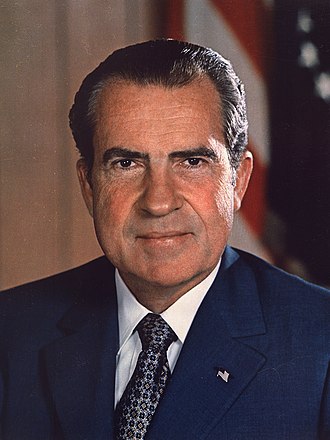
Nixon, Richard M. (President)
Richard M. Nixon served as the 37th President of the United States from January 1969 until his resignation in August 1974. In February 1971, he ordered the installation of a secret voice-activated taping system in the White House to preserve a historical record of his administration. Until the system's existence was revealed and dismantled in July 1973, the tapes captured Nixon directing major foreign policy initiatives, such as the opening to China, as well as his central role in the Watergate cover-up.
What Nixon talks about on the tapes
White House operations 4,718Presidential scheduling 2,225Public relations 1,784Presidential schedule 1,782Vietnam War 1,693Logistics 1,650Manolo Sanchez 1,626White House communications 1,400White House administration 1,399Presidential communication 1,243Henry Kissinger 1,191Foreign Policy 1,183
Conversations (21,010)
— Page 28 of 211President Nixon contacted his personal secretary, Rose Mary Woods, to request her immediate presence at his Old Executive Office Building workspace. This brief administrative interaction served as a coordination effort for the President's logistical workflow. The primary action item was the relocation of Woods to the EOB to facilitate further office operations.
President Nixon and personal secretary Rose Mary Woods met to discuss various administrative and social matters, including guest lists for upcoming White House events and logistics for presidential appointments. The conversation also touched upon the development of communication strategies regarding the Vietnam War, specifically addressing how to explain the history of U.S. involvement to young people. Additionally, they reviewed reports on personnel matters and discussed the involvement of family members in public outreach efforts.
President Nixon initiated a brief communication with the White House operator from his office in the Old Executive Office Building. The interaction primarily functioned as a logistical request to facilitate a phone connection, though the specific details of the intended call remain unintelligible. No substantive policy or political decisions resulted from this brief administrative exchange.
President Nixon and Alexander Butterfield met to review administrative tasks and upcoming scheduling requirements. The discussion focused on the President's signature on sugar legislation, arrangements for a dinner honoring Winton M. Blount, and logistical preparations for a forthcoming presentation involving the press. Additionally, they addressed a request for a meeting regarding a personnel matter.
President Nixon, H.R. Haldeman, and Alexander Butterfield met to coordinate administrative logistics for upcoming White House social functions, including the planning of state dinners and the management of guest lists. The discussion addressed personnel roles regarding these events, specifically touching upon the involvement of Rose Mary Woods and Charles Colson. Additionally, the President reviewed his current schedule and discussed political reactions to staff appointments and potential public responses to the Supreme Court's pending decision on the Pentagon Papers.
President Nixon met with departing economic advisor Henrik S. Houthakker and Council of Economic Advisers Chairman Paul W. McCracken to express appreciation for Houthakker’s service. The meeting primarily served as a farewell, featuring a photograph session and the presentation of gifts. The President concluded the brief engagement by acknowledging Houthakker's contributions to the administration's economic efforts.
President Nixon met with Jane Dart and John D. Ehrlichman, accompanied briefly by a White House photographer, for a social visit to arrange a photograph and exchange gifts. The conversation included brief discussions regarding Dart’s upcoming travel plans to New York and the health and activities of her husband, Justin W. Dart. The meeting concluded cordially after the participants finalized their photographic arrangements.
President Nixon met with Barbara Kilberg and John Ehrlichman to discuss Kilberg’s recent professional experiences and future career plans following her time at the White House. The conversation touched upon the challenges of navigating legal and professional sectors, including anecdotes regarding Supreme Court Justices Abe Fortas and Hugo Black. The meeting concluded with the President presenting a gift to Kilberg as she transitioned to her next professional role.
President Nixon met with Jerome Rosow, James Hodgson, John Ehrlichman, and George Shultz to discuss Rosow's departure and future professional plans. The meeting included the presentation of gifts to Rosow and a brief photograph session with the White House photographer. The participants also touched upon broader administration goals regarding the environment and increasing employment figures.
President Nixon met with his personal aide, Stephen B. Bull, to discuss administrative logistics and the President's upcoming schedule. The brief conversation focused on coordinating appointments with C. Fred Bergsten and Alexander M. Haig, Jr. The meeting concluded quickly after the necessary scheduling details were addressed.
President Nixon met with C. Fred Bergsten, Alexander Haig, and Stephen Bull to discuss Bergsten’s transition out of the White House. The President expressed appreciation for Bergsten's service and encouraged him to maintain professional ties with the administration, specifically mentioning Peter G. Peterson and the Brookings Institution as he prepares to write a book. The brief meeting concluded with the President commending Bergsten’s contributions and past work.
President Nixon met with T. Warren Parker, facilitated by Charles W. Colson, to commend Parker's upcoming plans to attend the University of Maryland and his service in the Marine Corps. The brief meeting included a formal photo opportunity and the presentation of a presidential gift to honor Parker's service. During the exchange, Nixon shared personal reflections on his own World War II military experiences and expressed a desire to keep Parker out of future combat.
President Nixon met with William E. Casselman II and William E. Timmons to discuss Casselman’s transition into a role at the General Services Administration (GSA). The President also consulted with Timmons regarding recent legislative strategy, specifically focusing on a Vietnam-related vote and anticipated outcomes in a House-Senate conference committee. The discussion highlighted the administration's ongoing efforts to influence congressional leadership and committee members on key policy matters.
President Nixon met with William E. Kriegsman, Stephen B. Bull, and John C. Whitaker to facilitate a photo opportunity and sign an autograph for a staff member. During the brief exchange, the participants discussed the ongoing political counsel provided by Bryce N. Harlow. The meeting concluded after these logistical arrangements were settled.
President Nixon met with Alexander P. Butterfield, Stephen B. Bull, and Ronald A. Harley to recognize Harley's twenty-five years of service. During this brief encounter, the President presented Harley with a gift and briefly discussed his professional tenure. The meeting concluded after a formal photograph was taken to commemorate the occasion.
President Nixon met with his aide Stephen B. Bull to coordinate the scheduling of an upcoming meeting with Terry McGinnity. The two confirmed that McGinnity was currently in the White House and prepared to meet with the President and H.R. Haldeman. Bull facilitated the logistics for this immediate appointment, ensuring the President's schedule was adjusted to accommodate the guest.
President Nixon directs Henry Kissinger to aggressively restrict access to classified information by cutting off institutions like the Brookings Institution, RAND Corporation, and the Council on Foreign Relations. The President mandates a 90% reduction in the number of personnel cleared for top-secret documents across the government, including embassies and the Departments of State and Defense. This directive serves as a strategic move to secure sensitive information and limit external exposure to government intelligence.
President Nixon met with Alexander P. Butterfield to discuss adjustments and logistical details regarding the President's upcoming daily schedule. The conversation focused on coordination with staff members H.R. Haldeman and Terry McGinnity. The participants reached an understanding on the handling of schedule-related materials to ensure the President maintained control over his appointments.
President Nixon met with Treasury Secretary John Connally and Federal Reserve Chairman Arthur Burns to coordinate the administration's economic policy and messaging. The discussion focused on establishing a unified stance on wage and price controls, tax legislation, and fiscal stimulation to combat inflation. They emphasized the need for disciplined public communication, specifically designating Connally as the primary administration spokesman to prevent conflicting signals from officials like Burns.
President Nixon met with Treasury Secretary John Connally and Federal Reserve Chairman Arthur Burns to address growing public confusion and political friction caused by conflicting economic signals from the administration. The President emphasized the need for a unified public stance on economic policy, specifically urging Burns to avoid statements that undermine official administration decisions, despite Burns' insistence on his duty to provide independent, candid testimony as an economist. The meeting resulted in a tentative agreement for Burns to clarify in future congressional testimony that his views represent his own, rather than the administration's, while Connally committed to better coordinating the administration's economic messaging.
President Nixon initiates a request to the White House operator to place an outgoing call to George P. Shultz. The brief interaction serves as a logistical bridge to connect the President with his Director of the Office of Management and Budget for a subsequent discussion. No further policy matters or substantive exchanges occur during this connection process.
President Nixon met with his personal valet Manolo Sanchez and aide Stephen B. Bull to address logistical arrangements for a scheduled barber appointment. The brief discussion centered on managing the President's immediate availability and coordinating his personal schedule. The interaction concluded quickly as the participants departed to facilitate the President's next engagement.
President Nixon instructed the White House operator to connect him to the "dirt shop," a colloquial term used by the administration to refer to the Special Investigations Unit. This brief directive highlights the President's direct involvement in tasking the unit, which was responsible for conducting sensitive and covert intelligence-gathering operations. The exchange underscores the secretive communication channels maintained between the Oval Office and the investigative team.
President Nixon and George Shultz discussed a memorandum from Milton Friedman regarding the state of the national economy. The conversation focused on Friedman’s optimistic outlook for economic recovery and his opposition to wage and price controls. They also reviewed the accuracy of preliminary Gross National Product (GNP) figures and the pending availability of revised statistical data expected in mid-July.
President Nixon and H. R. Haldeman discussed administrative staffing, the need for simpler, more direct public communication, and concerns regarding foreign policy secrecy. They reviewed potential speechwriting candidates and criticized current drafts for being too profound or "deep" for the public to grasp. Additionally, they assessed the political implications of Henry Kissinger's clandestine negotiations and managed upcoming legislative challenges concerning Vietnam and the Pentagon Papers.
President Nixon initiates a brief telephone call through the White House operator to contact Congressman Clark MacGregor. The exchange serves as a functional request to connect the President with his legislative liaison. No substantive political or policy discussions occur during this short administrative interaction.
President Nixon communicated with a White House operator to facilitate a telephone connection. The brief exchange served as a functional interaction to initiate an outgoing call. No significant policy discussions or substantive developments occurred during this brief administrative bridge.
President Nixon met with his aide Stephen B. Bull to discuss administrative matters regarding the scheduling of writers. The meeting was brief, lasting less than a minute, and concluded with the arrival of an unidentified individual. No major policy decisions were recorded during this interaction before Bull's departure.
President Nixon and Clark MacGregor discuss the political impact of a recent presidential letter sent to members of Congress regarding Vietnam policy, which helped counteract pressure from groups like Common Cause. They further coordinate the guest list and program for an upcoming White House dinner, specifically planning for the President to personally recognize key congressional allies during the event. Nixon ultimately resolves to thank those legislators who supported his administration's stance and identifies specific guests to call upon during the gathering.
President Nixon met with Alexander P. Butterfield to review administrative details regarding the President's upcoming schedule. The discussion focused specifically on arrangements for the Chowder and Marching Society, with particular attention given to Gerald R. Ford's involvement. This brief exchange served to coordinate protocol and logistics for the group's activities.
President Nixon and Clark MacGregor discuss the political challenges facing members of Congress regarding the Vietnam War, acknowledging the pressure representatives face from constituents to vote for withdrawal. To bolster support and show appreciation, the President decides to personally call several members of Congress, including John Jackson, Glenn Davis, and Keating. The meeting serves as a logistical coordination session for these outreach efforts to key legislative allies.
President Nixon met with Charles W. Colson to discuss the administration's political strategy regarding the ongoing Pentagon Papers controversy and the prosecution of Daniel Ellsberg. Nixon emphasized the importance of keeping the focus on Ellsberg’s theft of government documents to damage the credibility of the Democratic Party and potential 1972 challengers. They also analyzed the political impact of economic performance and polling data, with Nixon deciding to enforce tighter message discipline within his administration to prevent unauthorized leaks from economic advisors.
President Nixon initiates a brief telephone call through the White House operator to contact Rex W. Scouten. The purpose of the communication is to request a connection to an individual named Galton. No further substantive policy discussions occur during this brief administrative interaction.
President Nixon consulted with White House Chief Usher Rex W. Scouten regarding hospitality arrangements for a gathering of the Chowder and Marching Society in the East Room. The President explicitly requested that guests be served ample drinks immediately upon arrival to ensure the group was well-supplied before his scheduled appearance at 8:00 p.m. Scouten acknowledged the directive and confirmed that the staff would manage the refreshments accordingly.
President Nixon met with his aide Stephen B. Bull in the Oval Office for a brief, informal encounter. The exchange was limited to a single exclamation by the President, providing no substantive discussion of policy or administrative action. No developments or decisions were recorded during this brief recording segment.
President Nixon met with his Cabinet to address the persistent problem of unauthorized leaks within the federal bureaucracy and to establish clear expectations for departmental discipline. He emphasized that decision-making must remain internal and closed to prevent political sabotage, specifically citing the negative impact of leaks on economic policy and administrative unity. Nixon announced that H.R. "Bob" Haldeman would oversee efforts to tighten internal controls, while Secretary John Connally was designated to handle the official announcement of upcoming economic policy decisions.
President Nixon initiates a brief telephone request to be connected with Patrick J. Buchanan. The call serves as a logistical bridge to facilitate direct communication with his aide. No substantive policy matters or further developments were recorded in this brief interaction.
President Nixon initiates a brief administrative request to the White House operator to be connected to a specific individual. The exchange serves as a routine logistical step to facilitate a subsequent communication. No substantive policy matters or major decisions were addressed during this short interaction.
President Nixon held a series of meetings with top advisors, including H.R. Haldeman, John Connally, and George Shultz, to discuss political messaging, economic strategy, and staff management. Key developments included a directive to stop administration officials from providing background briefings to the press and a decision to maintain a firm, non-conciliatory stance regarding the prosecution of Daniel Ellsberg. Additionally, the President and Connally strategized on the public communication of economic policy, with the President emphasizing the need for a strong, unified message that highlights economic growth while rejecting wage and price controls.
President Nixon directs Patrick J. Buchanan to provide Representative Jack F. Kemp with strategic talking points and opposition research ahead of Kemp’s upcoming appearance on the David Frost show. Because Kemp is scheduled to debate anti-war critic Paul N. McCloskey Jr., the President emphasizes the need for Kemp to be well-prepared to counter McCloskey’s arguments regarding the administration's Southeast Asia policy. Buchanan is tasked with coordinating this effort, including potential collaboration with Charles W. Colson, to ensure Kemp is equipped to effectively challenge McCloskey.
President Nixon instructed the White House operator to place a follow-up telephone call to Patrick J. Buchanan. This brief exchange served as a logistical coordination to facilitate direct communication between the President and his advisor. No further substantive policy discussions occurred during this brief request for the operator's assistance.
President Nixon directed Patrick J. Buchanan to prepare a concise talking paper for Congressman Jack F. Kemp regarding his political opponent, Paul N. McCloskey, Jr. Rather than providing exhaustive research, Nixon requested a strategic document that outlines specific, impactful points for Kemp to utilize in his messaging. The primary objective of this guidance was to provide Kemp with an effective framework to aggressively challenge McCloskey.
President Nixon directs the White House operator to place a telephone call to Congressman Alvin E. O'Konski of Wisconsin. This brief exchange serves as the administrative initiation of a conversation between the President and the Representative. No substantive policy matters or further directives are discussed beyond the scheduling of this connection.
President Nixon calls Congressman Alvin E. O'Konski to commend him for a recent floor speech supporting the administration’s Vietnam policy. O'Konski proposes a legislative compromise intended to resolve the Congressional impasse over Vietnam by aligning Congressional funding with the Nixon Doctrine, ceasefire objectives, and POW releases. Nixon expresses interest in this approach and directs the Congressman to send a written copy of the proposal to the National Security Council for review.
President Nixon contacted the White House operator to request a telephone connection with his personal secretary, Rose Mary Woods. This brief communication served a purely administrative purpose to facilitate an immediate follow-up conversation between the two. No substantive policy matters were discussed during this brief exchange.
President Nixon and his personal secretary, Rose Mary Woods, discuss the distribution of cigars to political allies, specifically Congressman Alvin E. O'Konski. The President expresses appreciation for O'Konski's recent speech defending the administration's Vietnam policy. Finding that the specific Nicaraguan cigars previously gifted are out of stock, Nixon directs Woods to send a standard box of White House cigars to the Congressman as a token of gratitude.
President Nixon met with the National Commission on Productivity to discuss the evolving state of the global economy and the United States' competitive position in the post-World War II era. The conversation focused on the rapid industrial growth of Japan and Western Europe, the emergence of China, and the necessity for the U.S. to enhance its productivity to maintain economic leadership. Nixon emphasized that while diplomatic and political tensions with the Soviet Union might fluctuate, long-term economic stability and international influence would depend on domestic production and effective global economic engagement.
President Nixon and Press Secretary Ronald Ziegler reviewed the success of Treasury Secretary John Connally's recent performance as the administration's primary economic spokesperson. Ziegler confirmed that Connally effectively communicated the President's stance against wage and price controls and accelerated tax cuts while emphasizing economic recovery. The pair also discussed political strategy regarding public perception, the ongoing controversy surrounding the leaked Pentagon Papers, and the motivations of Daniel Ellsberg.
President Nixon held a brief meeting in the Oval Office with an unidentified woman to review General Alexander M. Haig, Jr.’s professional schedule. The conversation focused on the logistical coordination of the General's upcoming commitments. No further records of the discussion exist, and the visitor departed shortly before the conclusion of the appointment.
President Nixon and H.R. Haldeman discuss an internal crisis at the FBI triggered by Director J. Edgar Hoover’s decision to transfer assistant director Chick Brennan for allegedly violating orders regarding the Daniel Ellsberg investigation. Haldeman warns that the move threatens to spark mass resignations among FBI leadership, prompting a debate over the balance between institutional discipline and effective management. The participants also briefly coordinate the President's upcoming schedule, including meetings with John Ehrlichman, Peter Peterson, and a group of YMCA Youth Governors.
President Nixon initiates a call to Attorney General John N. Mitchell through the White House operator to facilitate a direct communication. The brief exchange serves as a logistical bridge to connect the President with his Attorney General for a subsequent discussion. No substantive policy matters are addressed during this initial connection phase.
President Nixon and Attorney General John Mitchell consulted on how to handle potential internal dissension within the FBI regarding the Daniel Ellsberg case. Nixon directed Mitchell to instruct FBI Director J. Edgar Hoover to avoid any actions that could publicly compromise the Bureau's unity, particularly ahead of the President’s scheduled address at the FBI graduation. The conversation emphasized the administration's firm resolve to prosecute Ellsberg for the Pentagon Papers leak to prevent future government personnel from committing similar acts of theft.
President Nixon and John Ehrlichman discuss the internal handling of the Daniel Ellsberg investigation and their concerns regarding J. Edgar Hoover’s management of the FBI. The President expresses anxiety that internal dissension within the Bureau, exacerbated by the Ellsberg case, could undermine the administration's political standing. Nixon ultimately decides to intervene by coordinating with Attorney General John Mitchell to regain control over the Bureau's direction and ensure the case is managed according to his preferences.
President Nixon and Attorney General John Mitchell discussed the necessity of preventing FBI Director J. Edgar Hoover from engaging in actions related to the Daniel Ellsberg case that could spark internal dissent or embarrass the Bureau. Nixon directed Mitchell to personally intervene with Hoover to ensure a united administrative front, emphasizing that protecting the Bureau's integrity and focusing on the prosecution of Ellsberg were paramount. Nixon authorized Mitchell to use his name to reinforce the importance of these instructions while maintaining a firm stance on the administration's commitment to the Ellsberg litigation.
President Nixon initiates a request to the White House operator to place a telephone call to Charles W. Colson. The interaction serves as a brief administrative bridge to facilitate direct communication with his Special Counsel. No further substantive discussion occurs during this segment of the recording.
President Nixon consulted with a White House operator to facilitate an outgoing telephone communication. This brief interaction served administrative and logistical purposes to connect the President with another party. No policy discussions or significant substantive developments occurred during this short exchange.
President Nixon held a brief meeting with an unidentified individual to confirm the status of a specific, sensitive administrative or tactical task. The participants reached an agreement that the matter had been successfully completed, with the President emphasizing the strategic importance of ensuring the action was finalized. The conversation served primarily as a status update to verify that a particular objective had been executed.
President Nixon met with Peter G. Peterson to discuss broad economic strategies, focusing on trade imbalances with Japan, long-range economic planning, and the need for a tougher, more assertive administrative posture. They addressed the potential for unilateral trade actions to address deficits and debated the utility of government-backed industrial R&D projects to foster job growth. Additionally, they reviewed international trade negotiations, the status of U.S.-Soviet economic relations, and the recruitment of personnel for economic policy roles.
President Nixon met with Pennsylvania labor representatives Fred Gualtier, Frank DeLuca, Carmen Williams, and George T. Bell to cultivate support among the building trades. During the meeting, the participants discussed Pennsylvania politics, including the influence of state Republican chairman Clifford L. Jones and the gubernatorial administration of Milton J. Shapp. Nixon used the occasion to contrast the value of hard-working laborers with welfare recipients and to criticize Daniel Ellsberg. The President concluded the visit by presenting gifts to the group and emphasizing his commitment to the American labor movement.
President Nixon, H.R. Haldeman, and Peter G. Peterson met to discuss personnel appointments, including the potential recruitment of Marty Anderson, and strategic roles within the administration. The conversation focused on the internal structure of the White House, the need for a stronger, politically-minded economic team to support the administration, and the President's vision for long-term economic planning. Nixon explicitly requested that Peterson coordinate closely with John Connally and emphasized a long-term approach to economic policy over short-term political headlines.
President Nixon and Alexander P. Butterfield met briefly to discuss adjustments to the President's daily schedule. The primary focus of the conversation involved coordinating meetings for Stephen B. Bull and his visitors, Mrs. Frank Mason and Mrs. Pam Bull. The discussion concluded with Butterfield facilitating the necessary arrangements for the guests' arrival.
President Nixon met with Stephen Bull, Mrs. Frank Mason, and Pam Bull in the Oval Office for a brief social visit. The encounter focused on facilitating a photo session with a White House photographer and the presentation of presidential gifts. The brief meeting concluded after the photographic arrangements were successfully coordinated.
President Nixon and H. R. Haldeman met to review a broad range of political, administrative, and scheduling matters, including the selection of a 1972 Republican National Convention site and potential outreach strategies involving Billy Graham. The discussion touched upon the management of various personnel appointments, the frustration surrounding unauthorized leaks from agencies like the State Department, and the necessity of maintaining political control over specific projects. Ultimately, the President and Haldeman moved toward a consensus on favoring San Diego for the convention and prioritized maintaining a disciplined, efficient public schedule to avoid being sidelined by unnecessary administrative entanglements.
President Nixon and H. R. Haldeman discuss the damaging impact of administration leaks on public confidence and the necessity for a more decisive, unified executive presence. They assess the reactions of cabinet members, specifically Peter G. Peterson, to the President's recent directives regarding discipline and interdepartmental policy. Haldeman is tasked with briefing the White House staff to reinforce these expectations and ensure a stronger, more confident public posture for the administration.
President Nixon, Charles Colson, and H.R. Haldeman discuss the administration’s strategy for countering political opposition regarding the Pentagon Papers and the Mansfield resolution. They prioritize the aggressive prosecution of Daniel Ellsberg to deter further leaks and discredit anti-war activists, referencing intelligence from Jay Lovestone regarding Ellsberg’s alleged ties to subversive groups. Additionally, the participants express satisfaction with recent favorable newspaper coverage and the positive outcome of a House vote on Southeast Asia policy despite pressure from lobbying groups.
President Nixon and Charles Colson discuss their strategy for handling the controversy surrounding the Daniel Ellsberg case and the publication of the Pentagon Papers. Nixon emphasizes the need to aggressively challenge internal government leakers, framing them as disloyal intellectuals who undermine the country's interests. The President instructs Colson to actively pursue evidence linking these individuals to subversive communist groups to discredit their motivations and control the political narrative.
President Nixon initiates a request to the White House operator to place a telephone call to Alexander M. Haig, Jr. The brief exchange serves as a logistical bridge to facilitate communication between the President and his deputy assistant for national security affairs. No substantive policy discussions occur during this brief administrative interaction.
President Nixon met with members of the National Commission on Productivity, including union leaders, corporate executives, and government officials, to discuss strategies for enhancing American economic productivity and competitiveness. The conversation focused on the role of government-industry cooperation, the importance of basic versus applied research in fostering technological innovation, and the challenges posed by foreign trade competition and environmental regulations. Participants emphasized the need to align private sector investment with national economic goals to ensure long-term stability and job growth in an increasingly global market.
President Nixon and Alexander P. Butterfield met briefly to review the President's upcoming schedule and confirmed the readiness of four key individuals for scheduled engagements. The discussion centered on finalizing arrangements for meetings involving William P. Rogers, George H.W. Bush, and John D. Ehrlichman. The participants confirmed that all necessary preparations for these briefings were in order before concluding the meeting.
President Nixon and Henry Kissinger met to coordinate the delicate logistics and strategic sequencing of potential summits with the Soviet Union and the People’s Republic of China. They discussed the diplomatic risks of managing these two major powers simultaneously, specifically aiming to secure a Soviet summit while maintaining the initiative on China through a high-level emissary. The participants emphasized the need for a major July 15 announcement to exert pressure on North Vietnam and agreed to reconvene later in the week to finalize their approach.
President Nixon initiated a brief exchange with the White House operator to facilitate a direct telephone connection to General Alexander M. Haig, Jr. After the operator requested clarification on the intended recipient, Nixon confirmed the identity of the party he wished to reach. The interaction served strictly as a logistical step to coordinate high-level communication with his deputy assistant for national security affairs.
President Nixon and H.R. Haldeman discussed a wide range of administrative and political concerns, focusing heavily on strategies for addressing the leaking of the Pentagon Papers and tightening government security classification systems. The President emphasized his desire to drastically reduce the number of individuals with top-secret clearances and instructed staff to implement a more restrictive, "Presidential" level of classification. Additionally, they reviewed the President's upcoming schedule, including trips and public appearances, and deliberated on personnel matters such as the appointment of an NLRB counsel and potential roles for Marty Anderson.
President Nixon directs Alexander M. Haig, Jr. to revoke security clearances for personnel at private entities like the Brookings Institution and Rand Corporation, citing a need to tighten the classification system. Nixon expresses alarm upon learning that over a million individuals currently hold top-secret access, demanding a drastic reduction to 10,000 clearances. He requests a legal memorandum on modifying classification executive orders to establish a more exclusive, restrictive hierarchy for sensitive government documents.
President Nixon initiates a call to the White House operator to be connected with Clark MacGregor, who served as the Director of the Office of Congressional Relations. This brief administrative interaction serves as a bridge to facilitate communication between the President and his top legislative liaison. The primary action item is the establishment of this direct line of communication for further discussion.
President Nixon and Clark MacGregor discussed the status of a Congressional conference committee report regarding military pay and the controversial Mansfield Amendment. MacGregor reported a breakthrough on military pay but warned that Representative F. Edward Hébert’s firm opposition to the amendment risked a legislative stalemate through the July 4th holiday. To expedite a compromise that would protect the President's induction authority, MacGregor advised Nixon to call Hébert and advocate for language that avoids setting a terminal date for the draft.
President Nixon instructed the White House operator to place a call to Mary Swann, the secretary for Congressman F. Edward Hébert. The primary objective of the request was to establish direct communication with the Congressman's office. This brief interaction served as a logistical step to facilitate political outreach or coordination between the President and the House Armed Services Committee leadership.
President Nixon requested that Mary Swann relay a message to Congressman F. Edward Hébert while he attended a conference. The President sought to have Hébert step away from his current proceedings to call the White House regarding a time-sensitive matter being discussed at the meeting. This call served as an urgent communication effort to facilitate direct contact between the President and the Congressman.
President Nixon initiates a brief telephonic request for the White House operator to connect him with Attorney General John N. Mitchell. The conversation serves strictly as a procedural bridge to establish direct communication with the Attorney General. No substantive policy matters or tactical discussions are addressed during this short exchange.
President Nixon, John Mitchell, and H.R. Haldeman discuss the ongoing legal strategy regarding the Pentagon Papers case, specifically expressing concern over the Supreme Court's unexpected request for data on U.S. war casualties since World War II. Mitchell confirms that legal action against Daniel Ellsberg will proceed regardless of the Court's pending ruling to prevent future unauthorized leaks. Nixon emphasizes the necessity of framing the prosecution to avoid creating a martyr and to ensure government employees are deterred from similar disclosures.
President Nixon met with James D. Hodgson and George P. Shultz to discuss the National Commission on Productivity, focusing on leveraging the commission to foster support for administration economic and research initiatives. The participants deliberated on strategies to bypass environmental hurdles for major projects, the potential for private-sector research investment, and the appointment of Peter G. Nash as NLRB General Counsel. Nixon emphasized his administration's philosophy regarding the appropriate balance between government intervention and private enterprise, tasking his aides with identifying government functions that could be effectively privatized to improve efficiency and symbolic impact.
President Richard M. Nixon met with Alexander P. Butterfield to facilitate a telephonic communication regarding F. Edward Hébert. The brief discussion served to connect the President with the Representative for an urgent or scheduled call. Following the transition of this information, the meeting concluded immediately.
President Nixon and Congressman F. Edward Hébert coordinated legislative strategy regarding the Mansfield Amendment to ensure the President maintained control over Vietnam negotiations. Hébert updated the President on the status of the House conference committee and his plan to maneuver the resolution on the floor. The two agreed to speak again the following morning to finalize the administration's position before Hébert took further action in Congress.
President Nixon, Henry Kissinger, Alexander Haig, and Representative F. Edward Hébert met to discuss congressional strategy regarding the draft and the influence of legislative language on ongoing Vietnam peace negotiations. The President tasked Hébert with reviewing specific amendment language to ensure it aligned with White House objectives while avoiding problematic deadline constraints. The discussion also addressed the administration's high-stakes diplomatic maneuvering, specifically balancing potential summits with the Soviet Union and China.
President Nixon met with an unidentified woman in the Oval Office for a brief, informal encounter. The meeting was limited to a brief exchange of greetings before the guest departed shortly thereafter. No substantive policy matters or official business were recorded during this brief interaction.
President Nixon held a brief morning meeting in the Oval Office with an unidentified individual. Due to the lack of an available transcript or official record detailing the agenda, the specific subject matter and any resulting policy decisions remain unknown. The interaction concludes without documentation of substantive outcomes or action items.
President Nixon met with his aide, Stephen B. Bull, to coordinate logistics for his daily schedule. The primary objective was to finalize arrangements for an upcoming meeting with Secretary of State William R. Rogers. The conversation centered on ensuring proper protocol and photography coverage for the scheduled engagement.
President Nixon met with Secretary of State William Rogers and Turkish Ambassador Melih Esembel to discuss the strengthening of U.S.-Turkish relations and ongoing cooperation regarding drug production suppression. Following a brief photo session with the press, Nixon and Rogers shifted their focus to the tragic deaths of the Soviet Soyuz 11 cosmonauts. The discussion concluded with plans to draft an official telegram of condolence to the Soviet Union regarding the mystery of the crew's demise.
President Nixon held a brief morning meeting in the Oval Office with an unidentified individual. The interaction lasted for less than one minute, concluding immediately as the participant exited the office at 9:13 am. Due to the lack of available transcriptions or supplementary documentation, the specific subject matter and objectives of this encounter remain historically undocumented.
President Nixon met with H.R. Haldeman, Henry Kissinger, and Representative F. Edward Hébert to discuss legislative strategy, public relations, and foreign affairs. The primary focus was navigating a Congressional resolution on the Vietnam War, with Nixon instructing Hébert to resist firm withdrawal deadlines while attempting to tie any potential concessions to a ceasefire and prisoner exchange. Additionally, the participants reviewed press leaks involving the Supreme Court, planned the President’s upcoming July 3rd appearance, and coordinated a personal response to the tragic deaths of three Soviet cosmonauts.
Henry Kissinger and Alexander Haig coordinate the President's final revisions to a Congressional resolution concerning Vietnam. Kissinger emphasizes that the administration must ensure the resolution is not distributed until finalized and clarifies that the White House is merely acquiescing to, rather than supporting, the measure. Haig is tasked with disseminating these instructions to relevant staff to ensure the administration's stance remains properly framed.
President Nixon, supported by Henry Kissinger, held a telephone conversation with Soviet Ambassador Anatoliy Dobrynin to express his personal condolences following the tragic deaths of Soviet cosmonauts. Nixon emphasized his genuine empathy by sharing a personal anecdote about receiving the news from his daughter, Julie, and drew parallels to the loss of American astronauts in the Apollo 1 fire. The call served to bolster diplomatic relations by conveying a heartfelt, non-routine message of solidarity between the two spacefaring nations.
President Nixon consulted with an unknown individual regarding a planned telephone call to Congressman F. Edward Hébert. The discussion focused on coordinating messaging and refining the President's rhetorical approach for the upcoming interaction. The participants finalized the strategy for the call, emphasizing specific language to be used when addressing the Congressman.
President Nixon and Representative F. Edward Hébert, in consultation with Henry Kissinger, discussed strategies for the Congressional conference committee regarding the Selective Service Act. Nixon provided Hébert with alternative legislative language that the White House could tolerate, while emphasizing his firm opposition to the Mansfield Amendment or any provision containing a withdrawal date. The President insisted that any language must include requirements for a ceasefire and prisoner exchange, directing Hébert to present the White House's preferred language as his own to maintain the appearance of administration distance from the legislative negotiations.
President Nixon instructed the White House operator to place an outgoing telephone call to Senator Barry M. Goldwater. The brief exchange served as a logistical bridge to initiate contact between the President and the Senator. No substantive policy discussions occurred during this operator interaction.
President Nixon consulted with the White House operator to confirm the current location of Senator Barry M. Goldwater. Upon learning that Goldwater had been moved to his office, the President instructed the operator to have the Senator call him directly. This brief exchange facilitated a requested follow-up communication between the President and the Senator.
President Nixon calls Senator Barry Goldwater to express appreciation for Goldwater's recent television appearance supporting the administration's position. The two discuss the political landscape in Congress, specifically praising Representative F. Edward Hébert for his steadfast leadership in the House of Representatives. Nixon emphasizes the importance of Hébert and Senator John Stennis in resisting legislative pressure during upcoming House-Senate conference negotiations.
President Nixon met with Ronald Ziegler to coordinate media strategy regarding a new U.S.-Turkey agreement aimed at curbing the international heroin trade. The conversation focused on utilizing radio and television coverage to emphasize the administration's success in cutting off the primary source of Turkish opium. Nixon directed staff to frame this development as a major breakthrough in his broader worldwide offensive against narcotics, while also discussing efforts to garner political support from congressional allies.
President Nixon consulted with the White House operator to facilitate an outgoing call to Congressman Charles B. Rangel of New York. The brief exchange served as a logistical step to establish communication with the legislator. No substantive policy discussions occurred during this coordination phase.
President Nixon received a brief status update from the White House operator regarding an upcoming appointment. The operator informed the President that Congressman Charles B. Rangel was en route and would arrive at the office in approximately fifteen minutes. Nixon acknowledged the notification and provided instructions for the operator to place a follow-up call once the Congressman arrived.
President Nixon held a brief exchange with the White House operator to facilitate a telephonic connection. The conversation served as a logistical bridge to initiate a subsequent call. No substantive policy matters or administrative decisions were addressed during this interaction.