Nixon, Richard M. (President)
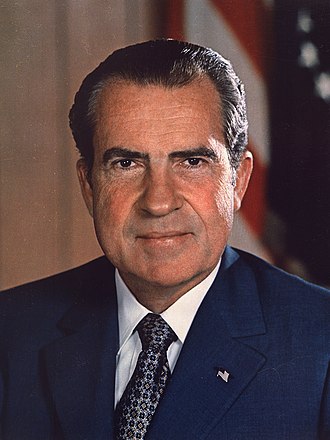
Richard M. Nixon served as the 37th President of the United States from January 1969 until his resignation in August 1974. In February 1971, he ordered the installation of a secret voice-activated taping system in the White House to preserve a historical record of his administration. Until the system's existence was revealed and dismantled in July 1973, the tapes captured Nixon directing major foreign policy initiatives, such as the opening to China, as well as his central role in the Watergate cover-up.
What Nixon talks about on the tapes
White House operations 4,718Presidential scheduling 2,225Public relations 1,784Presidential schedule 1,782Vietnam War 1,693Logistics 1,650Manolo Sanchez 1,626White House communications 1,400White House administration 1,399Presidential communication 1,243Henry Kissinger 1,191Foreign Policy 1,183
Conversations (21,010)
— Page 40 of 211President Nixon met with speechwriter Raymond K. Price, Jr. to finalize the draft of his upcoming September 9 address to Congress regarding economic stabilization. The participants, assisted briefly by Alexander P. Butterfield and Nellie L. Yates, focused on structural edits to the speech, specifically refining sections on Phase II price controls, revenue sharing, welfare reform, and inflation rhetoric. The conversation also touched upon administrative logistics for a forthcoming Kennedy Center event.
President Nixon met briefly with his personal valet, Manolo Sanchez, in the Old Executive Office Building. The discussion centered on the handling of outgoing administrative materials, with the President providing instructions regarding an outbox. The meeting concluded immediately after these brief directions were exchanged.
President Nixon contacted Nellie L. Yates to check on the progress of a draft for his upcoming speech to Congress. Yates explained that she was re-typing the document to correct spacing issues, prompting Nixon to reassure her and advise against rushing the task. They concluded the call by arranging for Yates to deliver the completed draft to the Lincoln Sitting Room later that evening for the President's review.
President Nixon and Alexander P. Butterfield discussed the status of a draft speech intended for delivery to Congress. Nixon instructed Butterfield to wait until the document was fully completed by typist Nellie L. Yates rather than reviewing it in partial segments. The President emphasized that there was no urgency in receiving the draft, opting to review the entire 21-page document once it was ready.
President Nixon and Alexander P. Butterfield coordinated the logistics for the President's upcoming address to Congress. They arranged for the delivery of a speech draft prepared by Nellie L. Yates to be left for the President, and they discussed the necessity of professional makeup services for the event. Nixon ultimately decided against using makeup for the appearance.
President Nixon initiates a brief telephone call to the White House operator to facilitate communication with his Deputy Assistant, Alexander P. Butterfield. The call serves solely as a logistical request to establish a connection with Butterfield. No further substantive policy matters or decisions are discussed in this brief administrative exchange.
President Nixon and Alexander P. Butterfield discussed logistical arrangements for several upcoming White House events, focusing primarily on the guest list for a luncheon with Billy Graham and his family. The conversation also covered the attendee list for a meeting with Japanese Foreign Minister Takeo Fukuda and structural arrangements for a dinner honoring the Apollo 15 astronauts. Nixon sought to strictly manage the number of attendees at these functions, specifically directing Butterfield to limit the inclusion of extended family members and children.
President Nixon contacted the White House operator to facilitate a telephone connection with his Chief of Staff, H.R. Haldeman. This brief administrative interaction served as the necessary bridge to initiate a direct conversation between the President and his top aide. No substantive policy matters were discussed during this brief request for a call transfer.
President Nixon and H.R. Haldeman reviewed the President's upcoming schedule, focusing on labor meetings, congressional functions, and preparations for an upcoming press conference. They also discussed a report praising Carl Albert for his effective advocacy of the administration's position regarding the upcoming China trip during his recent travels to Taiwan and Korea. Additionally, they coordinated plans regarding an upcoming Alaska trip, including considerations for the pipeline project and local political relations.
President Nixon initiates a call to the White House operator to be connected with Charles W. Colson. The exchange serves solely as a brief administrative request to facilitate communication with a key staff member. No further substantive discussion occurs during this short segment of the tape.
President Nixon and Charles Colson discuss strategies for mobilizing Republican senators to publicly support the President’s recent address to Congress. Colson reports on the coordinated effort to stage supportive statements from lawmakers over several days to counter potential media indifference. The two express frustration over the mainstream press, specifically the Washington Post, for failing to adequately report on Republican critiques of Democratic rivals like Edmund Muskie.
President Nixon initiates a brief telephonic request through the White House operator to connect with his special counsel, Charles W. Colson. The exchange serves solely as a logistical administrative step to facilitate a direct conversation between the President and Colson. No further substantive policy matters or tactical discussions are recorded during this brief operator-assisted connection.
President Nixon and H. R. Haldeman review the draft of a forthcoming speech on economic policy, focusing on how to effectively integrate themes of the American spirit, work ethic, and global responsibility. They analyze the impact of specific “cheer lines” that resonated with isolationists and discuss the difficulty of navigating a Congress under Democratic control. The two men conclude by finalizing language intended to frame welfare reform as a transition toward a more positive, work-oriented system.
President Nixon held a brief communication with the White House operator to facilitate an outgoing call. The interaction served as a logistical step to connect the President with another party for official business. No substantive policy discussions or significant political developments occurred during this brief administrative exchange.
President Nixon met with his personal aide, Manolo Sanchez, to discuss personal logistics and upcoming schedule management. The conversation focused on the President's immediate administrative needs, specifically a request for refreshments, and preparations for his upcoming weekend trip to Camp David. Sanchez encouraged the President to utilize the time away to rest and manage his heavy workload.
President Nixon and H. R. Haldeman discuss the reception of the President's recent economic speech and prepare for his upcoming address on domestic policy initiatives, including revenue sharing, government reorganization, and welfare reform. Nixon expresses significant frustration with his speechwriting staff, specifically Raymond Price, for failing to incorporate effective "cheer lines" into his drafts. To rectify this, Nixon considers hiring a specialized "speech doctor" to refine his rhetoric and increase the persuasive impact of his public messaging.
President Nixon and Charles W. Colson discuss the positive reception of the President's recent address to Congress, focusing on the enthusiastic congressional reaction and the effectiveness of his delivery. They highlight specific rhetorical successes, including his lines on welfare reform, the "poker chips" analogy regarding foreign policy, and his partisan challenges to Democrats regarding the investment tax credit. To gauge the broader impact of the speech, Nixon instructs Colson to gather feedback from various observers and report back within twenty minutes.
President Nixon met briefly with his longtime valet, Manolo Sanchez, in the Old Executive Office Building. The interaction served as a casual check-in between the President and his personal staff member. No substantive policy matters or official administrative decisions were recorded during this exchange.
President Nixon and Charles Colson discuss strategies for shaping public perception regarding welfare reform and national economic competitiveness. Nixon emphasizes the necessity of restructuring the welfare system to prioritize labor over government assistance to avoid societal stagnation. The dialogue reflects a broader political messaging effort to frame the administration's economic policies as proactive and competitive rather than isolationist.
President Nixon initiates a request for the White House operator to connect him with Robert H. Finch. This brief administrative exchange serves as the logistical precursor to an intended high-level conversation between the President and his counselor. The primary action item is the successful placement of this call to facilitate further discussion.
President Nixon met with his valet, Manolo Sanchez, to coordinate the remainder of his daily schedule and manage pending telephone calls. The brief interaction focused on organizing the President's immediate administrative commitments before Sanchez departed. No substantive policy matters were discussed during this logistical exchange.
President Nixon consults with the White House operator to facilitate an outgoing telephone connection. The interaction is purely administrative, serving as the logistical precursor to a subsequent, substantive call. No policy matters or significant decisions are addressed during this brief exchange.
President Nixon and Robert H. Finch discuss the positive reception of the President's recent address to Congress, noting the display of leadership and the enthusiastic reaction from members of Congress during an election year. They review the ambitious legislative agenda, which includes revenue sharing, government reorganization, welfare reform, and the new economic policy. A central focus of the discussion is the need to maintain political momentum and exert pressure on Wilbur Mills to ensure progress on the administration's economic and welfare initiatives before the November deadline.
President Nixon and Robert H. Finch discussed the political strategy surrounding the administration's legislative agenda, specifically focusing on revenue sharing and welfare reform. Nixon emphasized the importance of promoting the work ethic to bolster public support for his economic policies heading into an election year. The pair also exchanged personal pleasantries regarding a mutual acquaintance, affirming the individual's qualifications and professional reputation.
President Nixon and H. R. Haldeman discussed the political recruitment of Robert T. Monagan to the administration following a positive assessment from Robert H. Finch. The President expressed strong support for Monagan's abilities and his potential to work effectively with Ronald Reagan, instructing Haldeman to coordinate with Attorney General John N. Mitchell to finalize the appointment. Additionally, the pair touched upon a recent phone call involving Clark MacGregor.
President Nixon and Charles Colson discuss the overwhelmingly positive initial reactions to the President's recent address to Congress. The conversation highlights favorable feedback from congressional members, business leaders, and the public, particularly regarding the administration's new focus on American interests, the work ethic, and economic policy. Colson and Nixon review the speech's reception, noting the effective delivery and the strategic decision to frame national economic policy around freedom and an eventual end to the wage-price freeze.
President Nixon and Charles Colson discuss the political fallout and public reception of a recent, significant speech delivered by the President. Nixon reflects on the balancing act of promoting American interests while managing foreign policy expectations, specifically regarding potential troop withdrawals. The brief exchange concludes with an agreement to coordinate further on these messaging strategies from the Oval Office.
President Nixon contacted the White House operator to initiate a telephone call to Clark MacGregor, who served as the White House Director of Congressional Relations. This brief exchange served exclusively as an administrative request to connect the President with his liaison for legislative affairs. No substantive policy discussions occurred during this specific interaction.
President Nixon initiates a brief interaction with the White House operator, specifically requesting to be connected to an individual named Eric. The exchange serves as a routine administrative task to facilitate a telephonic communication. No further policy-related discussions or significant decisions occur during this short recording.
President Nixon and Clark MacGregor discuss the highly positive congressional and public reception following the President's recent address to Congress. MacGregor reports that key Republican leaders expressed strong support for the speech's bipartisan tone and legislative proposals, particularly regarding revenue sharing and welfare reform. The two also coordinate the logistics and attendee lists for upcoming White House sessions with labor, business, agricultural, and congressional leaders.
President Nixon and Clark MacGregor conducted a brief check-in regarding the current legislative climate and the productivity of congressional members. The discussion focused on the lack of substantive action expected from lawmakers, with Nixon expressing skepticism regarding their willingness to advance the administration's agenda. MacGregor was encouraged to maintain pressure on congressional leadership despite these underlying doubts about legislative progress.
President Nixon initiates a call to his speechwriter, Raymond K. Price, Jr., through the White House operator. The conversation serves as a brief administrative request to establish contact with Price. No further substantive policy matters are discussed during this brief connection.
President Nixon instructed the White House operator to place outgoing calls to two of his key speechwriters and advisors, Patrick J. Buchanan and Raymond K. Price, Jr. This administrative exchange served as the precursor to subsequent substantive discussions with these staffers. No policy matters or further details were addressed during this brief connection.
President Nixon initiated a brief communication with the White House operator to facilitate an outgoing call. Due to the lack of transcript content beyond the initial connection, the specific subject matter of the subsequent conversation remains undocumented. This interaction serves as a routine administrative bridge for the President’s telephonic operations.
President Nixon consulted with a White House operator to facilitate an outgoing call. This brief interaction served as a logistical bridge to connect the President with another party for undisclosed business. No substantive policy discussions or major decisions were recorded during this brief administrative exchange.
President Nixon and Patrick Buchanan discuss the positive public and congressional reception to the President’s recent address to Congress. They specifically note the effectiveness of the speech’s economic nationalism themes and the benefits of its faster, more assertive delivery style. Nixon expresses satisfaction with shifting the legislative burden onto Congress, acknowledging that the sheer volume of his proposals places significant pressure on the opposition.
President Nixon and Patrick J. Buchanan briefly discussed the shifting political climate, characterized by a rise in 'America First' sentiment among the public. They touched upon the political implications of current economic policies and expressed satisfaction regarding the administration's progress in securing legislative funding. No specific policy decisions were reached during this short exchange beyond assessing the favorable reception of their economic agenda.
President Nixon and Raymond Price discussed the positive reception and effective delivery of Nixon's recent address to Congress regarding his new economic policy. They analyzed the congressional climate, specifically noting a concerning trend toward isolationism and the political challenge of securing bipartisan support. Nixon concluded by emphasizing that the burden of action now rests with Congress to pass his legislative priorities, including revenue sharing, welfare reform, and government reorganization.
President Nixon and speechwriter Raymond K. Price, Jr. briefly discuss the political implications of recent economic commentary and the challenges of managing congressional isolationist sentiment. The exchange centers on the strategic framing of economic policies to counter opposition from skeptical lawmakers. Nixon concludes by gauging their readiness for upcoming legislative or rhetorical objectives.
H. R. Haldeman briefed President Nixon on the overwhelmingly positive reception to his recent address to Congress, citing feedback from Cabinet members, national newspaper editors, and political figures. Participants across the spectrum praised the President's leadership, delivery, and ability to capture the public mood regarding economic policy and post-freeze stability. Haldeman confirmed that while some Democrats like Hale Boggs requested more specifics on future economic stabilization, the overall momentum remained strongly in the President's favor.
President Nixon and H. R. Haldeman met briefly in the Old Executive Office Building to review the effectiveness of a recent televised appearance. The two discussed the public reception of the event, with the President offering a candid, if brief, assessment of the performance's quality. No significant policy decisions or further action items were recorded during this short interaction.
President Nixon instructed the White House operator to place a telephone call to his personal secretary, Rose Mary Woods. The brief exchange served as a routine administrative request to facilitate communication between the President and a key member of his staff. No further substantive policy matters were discussed during this brief connection.
President Nixon met with his valet, Manolo Sanchez, to facilitate the acquisition of a specific phonograph record. Nixon requested that Sanchez secure a copy of a musical piece favored by Nellie L. Yates, both for her collection and his own. Sanchez acknowledged the request and committed to carrying out the task.
President Nixon met with an unknown group of women in his Old Executive Office Building suite to discuss administrative matters and his professional schedule. During the brief interaction, the President coordinated with his staff regarding the appointment of Harry S. Dent. No further substantive policy decisions were documented in the surviving audio fragment.
President Nixon met with his aide, Stephen B. Bull, to review and finalize the sequence of his upcoming afternoon appointments. The discussion focused on scheduling meetings with Egil Krogh and Jerome Jaffe. The session concluded with Bull confirming the operational arrangements for the President's remaining schedule.
President Nixon and Egil Krogh discussed preparations for an upcoming meeting with Raymond Shafer, the chair of the Commission on Marijuana and Drug Abuse. The primary objective was to ensure Shafer could manage extremist commission members like Harold Hughes to avoid a dissenting report that the administration would be forced to publicly repudiate. Krogh planned to keep the meeting brief, utilizing a photo opportunity to acknowledge the Commission's work while also incorporating a session on the strategies of the Special Action Office led by Jerome Jaffe.
President Nixon met with Raymond Shafer, Dr. Jerome Jaffe, and Egil Krogh to discuss the ongoing work and public perception of the National Commission on Marijuana and Drug Abuse. Nixon emphasized his firm opposition to the legalization of marijuana while expressing concern that the Commission avoid being perceived as a group of 'do-gooders' or becoming a source of political embarrassment. Shafer assured the President that the Commission would maintain a low profile, avoid controversial stances on legalization, and focus on providing a scientific, objective report that complemented the administration's broader drug abuse policies.
President Nixon and Stephen B. Bull met to coordinate the logistics for an upcoming swearing-in ceremony involving Ezra Solomon and Judge Charles R. Richey. The discussion focused on managing press presence within the Oval Office, specifically ensuring photographers would depart immediately following the oath. They also addressed administrative details regarding necessary supplies, including Bibles for the ceremony and the participation of Frank C. Carlucci, III.
President Nixon met with his aide Stephen B. Bull to discuss a minor physical injury the President had sustained. The brief exchange served as an informal update regarding the President's personal health status. No further policy or administrative actions were taken during this short interaction.
President Nixon, H. R. Haldeman, and John Connally met to discuss public relations strategy, the effectiveness of the President's recent economic speech, and the complex challenges of international trade and monetary policy. The participants expressed deep distrust of the State Department bureaucracy and foreign service establishment, agreeing on the need to bypass traditional diplomatic channels to manage international pressures and trade negotiations. Nixon and Connally decided to form a small, secure, and loyal team of experts to handle secret trade negotiations and global outreach, while maintaining a tough, cynical stance toward foreign partners to protect American interests.
President Nixon met with his personal valet, Manolo Sanchez, in the Oval Office. The brief interaction consisted of informal remarks and personal exchanges. No substantive policy decisions or significant administrative actions were recorded during this segment of the conversation.
President Nixon consulted with the White House operator to facilitate an outgoing call. The interaction served as a routine administrative task to connect the President with another party. No substantive policy discussions occurred during this brief exchange.
President Nixon met with H.R. Haldeman, Henry Kissinger, and other staff to discuss political strategies following his September 9, 1971, economic speech, specifically focusing on managing bureaucratic handling of Japanese trade negotiations and exchange rates. The group addressed concerns regarding the competency of Peter G. Peterson and the necessity of centralizing economic authority within a small White House-led group. Additionally, they reviewed positive public reaction to the President's assertive leadership tone and discussed upcoming scheduling matters, including a potential appearance at the Al Smith dinner and the terminal illness of Senator Winston L. Prouty.
President Nixon and his personal secretary, Rose Mary Woods, discuss the positive public and political reception to the President’s recent economic policy speech. Woods expresses her approval of the President’s performance, the brevity of the address, and the appearance of First Lady Pat Nixon and the Cabinet. The conversation concludes with Nixon tasking Woods to arrange for Bebe Rebozo to attend a Saturday church service featuring Reverend Ben Haden.
President Nixon contacted the White House operator to facilitate a telephone call to the First Lady, Thelma C. “Pat” Nixon. This brief interaction served exclusively as a procedural request to establish a connection with his wife. No substantive political or policy matters were discussed during this brief exchange.
President Nixon held a brief telephone conversation with First Lady Pat Nixon. The primary content of this discussion remains inaccessible to researchers as the recording is classified as a personal, returnable item. Consequently, no substantive policy matters or official developments are documented for this exchange.
President Nixon met with Alexander P. Butterfield to briefly review the scheduling for an upcoming photography session. The conversation also touched upon the necessity of maintaining political momentum regarding Phase II of the administration's economic policy. The President expressed concern about neutralizing potential political attacks against his economic agenda.
President Nixon met with H.R. Haldeman and John Connally to strategize the administration's economic messaging following the initial 90-day wage and price freeze. The participants discussed the need to maintain political momentum and proactively manage public expectations regarding the forthcoming "Phase II" economic program, emphasizing that Nixon should frame the transition as a controlled, deliberate process. They agreed that Connally, acting as chair of the Cost of Living Council, would lead public consultations and prepare for a formal announcement of the follow-up plan by October 7, 1971, to prevent political opponents from seizing the initiative.
President Nixon met with key labor leaders and administration officials to solicit input on the development of 'Phase II' of his economic program, following the conclusion of the initial 90-day wage and price freeze. The discussion centered on transitioning to a more permanent, yet flexible, mechanism for controlling inflation while maintaining the principles of collective bargaining and a free-market system. The participants debated the merits of tripartite boards—modeled after the War Labor Board—versus government-imposed mandates, with labor leaders emphasizing the need for voluntary compliance and equitable standards. Nixon concluded by establishing an October 1 deadline for the group to submit their formal views, underscoring the necessity of labor-management cooperation for the program's success.
President Nixon met with Stephen B. Bull in the Oval Office to discuss logistical details regarding the President's personal schedule and facility management. The conversation focused on the President's return from the family theater and specific instructions concerning lighting adjustments in the office. No major policy developments occurred during this brief administrative briefing.
President Nixon and Secretary of the Treasury John Connally met to coordinate the transition from the Phase I wage and price freeze to the forthcoming Phase II economic program. They discussed the political necessity of setting a firm announcement date to counter public perceptions of administrative inactivity. The two agreed that establishing a specific deadline would demonstrate control and resolve regarding the administration's long-range economic strategy.
President Nixon hosted a brief Oval Office ceremony to honor Brigadier General Albert Redman, Jr. on the occasion of his promotion and to recognize his long-standing military service. Accompanied by his family and members of the White House Communications Agency, Redman received presidential gifts, including cufflinks bearing the presidential seal. The meeting concluded with official group photography to commemorate the event.
President Nixon met with his aide Stephen B. Bull to review logistical arrangements for an upcoming meeting with Rotary International President Ernst G. Breitholtz. The discussion focused on coordinating the scheduling of this encounter and ensuring the necessary administrative preparations were in place. The brief exchange served to finalize the protocol for the President's engagement with the organization's leadership.
President Nixon met with Rotary International leaders Ernst G. Breitholtz, George T. Bell, and Robert R. Mullen to accept a gift of Orrefors crystal and discuss a formal invitation to address the 1972 Rotary Convention in Houston. The participants engaged in a discussion regarding global goodwill, the influence of American economic policy on the world stage, and the potential for the President to use the convention as a platform to reach international audiences. Nixon expressed appreciation for the organization's work and agreed to take the invitation under consideration.
President Nixon and Stephen B. Bull briefly coordinate the President's upcoming schedule, specifically finalizing a meeting with Paul W. McCracken to discuss economic policy. The conversation also touches upon administrative matters regarding a new presidential podium for the residence and a gift for First Lady Pat Nixon. The participants conclude by confirming a later meeting to further clarify their agenda.
President Nixon and H. R. Haldeman convened to discuss administrative logistics, specifically the acquisition of a new presidential podium. The two also reviewed the President’s upcoming calendar, focusing on a scheduled meeting with the President of the Rotary Club. No significant policy shifts were recorded during this brief administrative briefing.
President Nixon and H. R. Haldeman analyzed internal and external polling data to gauge public perception of the administration's economic policies, school busing, and foreign affairs. They discussed the political risks of rising labor union influence and the need to bolster the President's public image as a bold, courageous, and hardworking leader ahead of the 1972 election. Haldeman advised that the administration capitalize on the President’s perceived strength in foreign policy and recent diplomatic breakthroughs while downplaying negative economic sentiments.
President Nixon initiates a brief telephone call to the White House operator to request a connection with Charles W. Colson. This administrative exchange serves as the logistical precursor for an upcoming consultation between the President and his special counsel. No substantive policy discussions occur during this brief interaction.
President Nixon met with an unidentified individual to facilitate the delivery of a specific, unspecified item. The exchange was brief and focused on the physical handover of this material within the Executive Office Building. No further substantive policy discussions or administrative decisions were recorded during this segment.
President Nixon and John Ehrlichman met in the Old Executive Office Building to discuss their scheduling priorities and potential agenda items. The conversation served as a brief administrative coordination to determine whether to proceed with specific business immediately or postpone it for a later time. No major policy decisions were reached during this introductory exchange.
President Nixon held a brief, informal meeting with an unidentified individual in his Old Executive Office Building suite. The dialogue was limited to a routine request for refreshments. No substantive policy matters or official developments occurred during the interaction.
President Nixon met with John Ehrlichman and H.R. Haldeman to discuss several pressing administration issues, including the political implications of offshore oil drilling in the Santa Barbara Channel and the status of his proposed presidential library site. The group also evaluated the public reception of the President's recent economic speech, deliberated on strategies for handling the ongoing Pentagon Papers controversy, and reviewed legislative challenges regarding welfare reform and school busing. The meeting functioned as a broad briefing session, resulting in instructions for staff to monitor specific political opponents and manage ongoing domestic policy initiatives.
President Nixon consulted with a White House operator to facilitate a telephonic connection with an individual identified as Mr. Laurent. The brief exchange served as a logistical bridge to initiate a separate, substantive conversation between the President and the requested party. No policy matters or further developments were addressed during this short administrative interaction.
President Nixon and H.R. Haldeman discuss scheduling a meeting with Donald Rumsfeld to deliberate on political matters. The President directs Haldeman to coordinate the logistics for this session and determine an appropriate location for their discussion. This brief exchange serves to organize internal political strategy and facilitate communication with a key advisor.
President Nixon and Charles Colson reviewed the positive political and public reception of the President's recent speech to Congress, specifically highlighting successful outreach to Republican legislators and labor leaders. They discussed the tactical importance of maintaining control over the narrative regarding the transition from the temporary wage and price freeze to 'Phase II' of the economic program. To mitigate market uncertainty, they decided that Secretary John B. Connally should emphasize the administration's strategic planning and commitment to long-term inflation control during upcoming public communications.
President Nixon and Charles Colson discuss domestic labor issues, public perception of the administration's economic policies, and political maneuvering. The President emphasizes the dignity of manual labor while expressing frustration with current labor contracts and the necessity of maintaining the wage-price freeze to combat inflation. Additionally, the pair touch on potential political prospects for Senator Edward Brooke and internal strategies regarding administrative messaging and public support.
President Nixon and Stephen Bull coordinate the President's upcoming schedule to manage the sequence of various high-level briefings. The discussion focuses on sequencing meetings with Donald Rumsfeld, H. R. Haldeman, Paul McCracken, and Henry Kissinger. Nixon prioritizes these interactions and provides direction to Bull on how to effectively structure these appointments within the available time constraints.
President Nixon and Henry Kissinger met to coordinate administrative and diplomatic priorities, specifically agreeing to exempt Latin American nations from a proposed ten-percent foreign aid cut. They also discussed strategies for an upcoming meeting with Japanese official Takeo Fukuda and deliberated on the political complexities of South Vietnamese elections involving President Nguyen Van Thieu. The discussion further touched upon the administration's stance regarding the People's Republic of China and ongoing Vietnam peace negotiations.
President Nixon met briefly with his personal valet, Manolo Sanchez, in the Old Executive Office Building. While the bulk of the recording is unintelligible, the brief exchange features Sanchez offering remarks regarding an unidentified individual. No substantive policy decisions or administrative actions were recorded during this one-minute encounter.
President Nixon met with Donald Rumsfeld and H.R. Haldeman to discuss domestic political strategy, upcoming speaking engagements, and the administration’s approach to college campuses and youth outreach. The group evaluated Republican standing in key states like Illinois, emphasizing the importance of managing public perceptions of incumbent governors and party unity. Furthermore, they coordinated the logistical planning for the President's upcoming trip to the People's Republic of China, specifically addressing press access, media coverage, and the size of the official delegation.
President Nixon met with his personal valet, Manolo Sanchez, in the Old Executive Office Building to discuss personal matters. The brief interaction focused on Sanchez providing an update regarding an unidentified individual's demeanor and recent activities. No significant policy decisions were made during this informal exchange.
President Nixon met with the Cost of Living Council to assess the implementation and public reception of the 90-day wage-price freeze initiated on August 15, 1971. The council members, including John Connally, George Shultz, and Arthur Burns, reported on the effectiveness of enforcement efforts, current compliance levels, and the complexities of handling exemption requests. The discussion shifted toward strategic planning for Phase II, emphasizing the need for sustainable economic policies, public leadership, and the critical role of securing support from business and labor leaders before the freeze's conclusion.
President Nixon met with his aide, Stephen B. Bull, to coordinate administrative logistics for the day. The discussion primarily focused on the President's daily schedule, including the status and movements of Manolo Sanchez. No significant policy decisions were made during this brief operational briefing.
President Nixon and H. R. Haldeman engaged in a wide-ranging management discussion regarding administrative social events, upcoming travel, and personnel appointments. They specifically focused on diversifying invitations to State Dinners and the strategic use of Presidential boxes at the Kennedy Center to bolster prestige and foster political relationships. Additionally, the President and Haldeman reviewed potential sites for an upcoming Montana trip, evaluated strategies for the administration's economic policy messaging, and discussed potential staff changes for the Office of Emergency Preparedness and military aide positions.
President Nixon met with John Connally and Arthur Burns to strategize on U.S. economic policy and international negotiations regarding the global monetary system and trade. The President emphasized that while he would rely on the technical expertise of his advisors, his primary goal was to project strength and prioritize American national interests ahead of the 1972 election. Nixon instructed Connally and Burns to resist the influence of the established bureaucracy and to maintain a firm, unified front when bargaining with foreign leaders over currency revaluation and import surcharges.
President Nixon instructed the White House operator to place a call to request the immediate attendance of Paul W. McCracken, the Chairman of the Council of Economic Advisers, at the Oval Office. This brief communication served to facilitate an urgent meeting between the President and his senior economic advisor. No further policy discussions or substantive developments occurred during this brief exchange.
President Nixon met with his aide, Stephen B. Bull, to coordinate logistics for an upcoming appointment with economist Paul W. McCracken. The conversation also touched upon the scheduling of a visit by Charles G. “Bebe” Rebozo, who was meeting with First Lady Pat Nixon at the time. The brief exchange focused primarily on internal administrative arrangements and the movement of staff and guests within the White House.
President Nixon and Bebe Rebozo discussed logistical arrangements for an upcoming weekend trip, specifically weighing the merits of the presidential yacht, the Sequoia, against a working retreat at Camp David. Rebozo relayed advice from First Lady Pat Nixon, who encouraged the President to prioritize genuine relaxation at Camp David rather than simply relocating his work duties. The brief meeting concluded with informal updates regarding the President's San Clemente property and the health of staff member Rose Mary Woods.
President Nixon met with Paul McCracken to review the administration's ongoing international and domestic economic policies, specifically regarding currency exchange rates and the wage-price freeze. They discussed the tactical use of the import surcharge as leverage for securing favorable exchange rate adjustments from foreign partners, including Japan. The conversation also touched upon the strategic transition from the current economic freeze into 'Phase II' and the importance of maintaining administrative flexibility regarding McCracken’s potential travel and future scheduling.
President Nixon met with H.R. Haldeman, Stephen Bull, and Charles Rebozo to refine his public schedule and manage ongoing policy initiatives. Key discussions included limiting press access for the upcoming trip to the People's Republic of China, strategies to resolve the ongoing dock strike, and legislative maneuvering regarding the military draft extension. Nixon emphasized the need to prioritize substantive leadership activities over 'cosmetic' public relations events while preparing for Phase II of his economic program.
President Nixon met with Alexander P. Butterfield to coordinate logistical details for an upcoming meeting. The discussion focused on establishing the guest list of participants and finalizing the expected duration of the session. These administrative arrangements were intended to maintain the efficiency of the President's schedule.
President Nixon and Stephen B. Bull met to finalize the logistics for a forthcoming meeting involving Peter Peterson, Albert L. Williams, and Isaiah Frank. Bull outlined the protocol for an initial photo opportunity followed by a transition to the Cabinet Room for the official discussion. The President instructed Bull to await his signal before proceeding with these arrangements.
President Nixon met with Peter G. Peterson, Albert L. Williams, and Isiah Frank to facilitate a brief photo opportunity with the press regarding the Williams Commission. The session served to highlight the commission's recent work through staged photography in the Oval Office. Following the brief media appearance, the group departed to continue their official discussions in the Cabinet Room.
President Nixon and Secretary of Agriculture Clifford M. Hardin discussed Hardin’s potential resignation and transition to a private sector role at Ralston Purina. Nixon encouraged Hardin to make his career move before the 1972 election to ensure a smooth transition for his successor and to secure his personal financial future. The two also addressed current administration economic initiatives, farm policy, and the recent Attica state prison riots, with Nixon expressing support for Governor Nelson Rockefeller's handling of the crisis.
President Nixon met with his aide Stephen B. Bull to discuss the President's upcoming schedule. During this brief interaction, Nixon requested access to the full register of appointments. This administrative discussion centered on coordinating logistics regarding Alexander M. Haig, Jr.'s availability.
President Nixon and Alexander Haig met to discuss the status of ongoing Vietnam War negotiations, specifically focusing on the challenges of achieving a stable withdrawal before the 1972 election. They analyzed North Vietnamese strategies, the political situation in Saigon, and the necessity of managing U.S. public opinion regarding troop levels and POW releases. Nixon expressed skepticism toward Henry Kissinger's optimism regarding diplomatic breakthroughs, urging Haig to maintain a firm, cautious stance. The conversation also briefly addressed an unauthorized media leak concerning a potential 'accidental war' agreement with the Soviet Union.
President Nixon met with an unknown man, identified as a member of his staff, to coordinate the logistics of his Irish setter, King Timahoe. The President requested that the aide facilitate the dog's movement, specifically asking for the door to be opened for the animal. This brief interaction serves as a routine administrative request regarding the President's personal pet.
President Nixon and H.R. Haldeman discuss a wide range of political and administrative strategies, including the use of the IRS to target political enemies and the management of media relations. They review the success of the President's recent economic address and television appearance, noting that such broadcasts serve as effective propaganda against the "liberal establishment" media. Additionally, they discuss personnel appointments, the handling of the Attica prison riot, and the necessity of keeping the President's schedule focused on presidential duties rather than excessive political campaigning.
President Nixon initiates a request through the White House operator to contact special counsel Charles W. Colson. The President provides specific instructions to avoid interrupting Colson if he is attending a social event, while authorizing the use of a pager if he is at home. This brief exchange serves as the logistical coordination required to establish urgent communication with a key staff member.
President Nixon instructed the White House operator regarding the protocol for placing an outgoing call to an unnamed individual. He explicitly directed the operator not to interrupt the recipient if they were currently attending a social event. This brief exchange served as a procedural directive to ensure presidential communication did not cause undue social disruption.