Nixon, Richard M. (President)
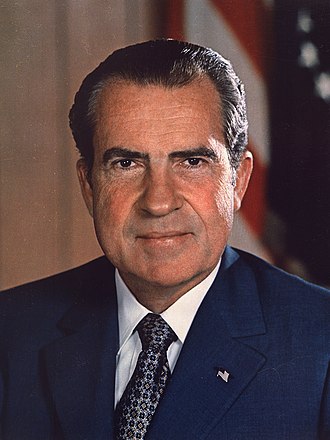
Richard M. Nixon served as the 37th President of the United States from January 1969 until his resignation in August 1974. In February 1971, he ordered the installation of a secret voice-activated taping system in the White House to preserve a historical record of his administration. Until the system's existence was revealed and dismantled in July 1973, the tapes captured Nixon directing major foreign policy initiatives, such as the opening to China, as well as his central role in the Watergate cover-up.
What Nixon talks about on the tapes
White House operations 4,718Presidential scheduling 2,225Public relations 1,784Presidential schedule 1,782Vietnam War 1,693Logistics 1,650Manolo Sanchez 1,626White House communications 1,400White House administration 1,399Presidential communication 1,243Henry Kissinger 1,191Foreign Policy 1,183
Conversations (21,010)
— Page 41 of 211President Nixon and Charles Colson discussed a variety of political and economic issues, focusing on the rising public controversy over school busing and the administration's efforts to promote its economic policies. Colson provided updates on the positive reception of the President's recent speeches on the work ethic and the economy, noting that business leaders and the public are responding with increasing optimism. The two also addressed the progress of the administration's Phase II economic program, with Colson confirming that he has assigned specific staff members to manage the implementation of his proposed plan for public price policing.
President Nixon and Charles Colson met to discuss political strategy and public opinion regarding school busing, foreign policy, and domestic malaise. They evaluated the political impact of busing mandates in cities like Boston, specifically noting the potential for mobilizing Polish-Catholic voters against such policies. Additionally, the conversation touched on the administration's public approval ratings, the perceived moral crisis in America, and the effectiveness of Nixon's recent economic and foreign policy messaging.
President Nixon directed the White House operator to place a call to John D. Ehrlichman. He explicitly instructed the operator to avoid interrupting Ehrlichman if he was currently attending a social event. This brief interaction served as a standard administrative request to facilitate a consultation between the President and his top advisor.
President Nixon contacted the White House operator to determine the whereabouts of John D. Ehrlichman. Upon learning that Ehrlichman had briefly left the premises, the President requested that Ehrlichman return his call upon his return. This brief exchange served as a routine attempt to establish communication with a key domestic policy advisor.
President Nixon instructed the White House operator to limit the inclusion of social functions in his call logs and scheduling. This request reflects his desire to prioritize substantive official business over personal or ceremonial engagements. No further administrative actions were recorded during this brief directive.
President Nixon consulted with the White House operator to facilitate an outgoing call. This brief exchange served as an administrative step to connect the President with another party. The recording concludes immediately after the operator acknowledges the request to remain on the line.
President Nixon requested that the White House operator place a telephone call to either Hobart D. Lewis or Robert H. Finch. The interaction was brief, serving strictly as an administrative request to facilitate communication with one of these two individuals. No further substantive policy matters were discussed during this brief exchange.
President Nixon contacted the White House operator to facilitate a telephone call to Hobart D. Lewis. The interaction served solely as a procedural request to initiate communication with the publisher. No substantive policy discussions or decisions occurred during this brief administrative exchange.
President Nixon initiates a request through the White House operator to be connected with Robert H. Finch. The brief exchange serves as a logistical step to facilitate direct communication between the President and his counselor. No further policy or substantive matters are addressed during this short transition.
The White House operator updates the President on the travel status of Hobart D. Lewis, who is expected to arrive in Washington by 6:00 p.m. Nixon requests that Lewis contact him upon his arrival to facilitate a discussion. Following this update, the operator transitions the call to Robert H. Finch to speak with the President.
President Nixon and Robert Finch discussed a range of political and administrative strategies, including the scheduling of appointments for Mexican-American officials to coincide with Mexican Independence Day. They also coordinated a public relations campaign involving Cabinet wives to promote the administration’s economic initiatives and price controls on television talk shows. Finally, they reviewed recent political successes with the film industry guilds and reaffirmed the administration's stance that court-ordered busing in the North should be distanced from federal policy.
President Richard Nixon and Robert Finch met to discuss political strategy and administrative initiatives, including revenue sharing, environmental policy, and upcoming legislative goals. The conversation also touched upon the necessity of public engagement through media appearances and the anticipated impact of the Vietnam War on the political landscape. They further addressed specific concerns regarding school desegregation mandates in northern states and political maneuvering in California.
President Nixon contacted the White House operator to place a personal telephone call to his daughter, Tricia Nixon Cox. He provided the operator with instructions to reach her at her apartment in Cambridge, Massachusetts. The call served a strictly personal purpose, reflecting the President's efforts to maintain communication with his family.
President Nixon instructed the White House operator to place a personal call, specifically requesting assistance in connecting with an individual. The brief exchange focused on coordinating this communication and managing the logistics of reaching the intended party. No broader policy or administrative developments resulted from this brief interaction.
President Richard Nixon engaged in a brief telephone conversation with his daughter, Tricia Nixon Cox, to discuss personal family matters. The interaction was informal in nature, centering on domestic updates rather than official White House policy or administration business. Given the withdrawn nature of the recording, no substantive political developments or professional action items were documented.
President Richard Nixon met with his daughter, Tricia Nixon Cox, for a brief personal conversation regarding family matters. The discussion centered on social engagements, including a recent church service and lunch with the Connellys and the Grange. No significant policy decisions were made during this informal exchange.
President Nixon contacted the White House operator to initiate an outgoing call. The conversation consisted solely of administrative communication regarding the request for a connection. Ultimately, the attempt to connect to the intended party was unsuccessful.
President Nixon contacted the White House operator to place a long-distance telephone call. He requested to be connected with his personal secretary, Rose Mary Woods, who was in California at the time. The brief exchange served strictly as a logistical request to facilitate communication with a key staff member.
President Nixon and personal secretary Rose Mary Woods discuss the success of the President’s recent church service and the large crowd in attendance. They deliberate on appropriate presidential gifts to present to Dr. Raymond Bell in recognition of his contributions. The conversation concludes with a decision to send Dr. Bell and his wife a selection of items, including cufflinks, a tie pin, a compact, and a decorative Lucite object.
President Nixon and his personal secretary, Rose Mary Woods, discuss the status of an unnamed individual recovering in the hospital and coordinate viewing plans for an upcoming ABC television special. The President directs Woods to ensure his daughters, Trisha and Julie, are informed about the program and requests that Mark assist in reaching out to Julie. The conversation reflects administrative management of the family's personal schedule and social correspondence.
President Nixon instructed the White House operator to place a telephone call to his daughter, Julie Nixon Eisenhower. This brief exchange served as a logistical request to facilitate personal communication between the President and his daughter. No further policy or administrative matters were discussed during the call.
President Nixon and John Ehrlichman discussed defensive strategies regarding inquiries into the President's personal finances and property dealings, agreeing to adopt a firm stance by reiterating that there have been no changes to his financial disclosures. The conversation shifted to internal FBI concerns, with Ehrlichman advising that Nixon meet with J. Edgar Hoover regarding a leadership transition to L. Patrick Gray. Finally, the two reviewed legislative strategy, deciding to maintain a firm position on welfare reform while pressuring Congress to act on a broader package of stalled domestic initiatives, including revenue sharing, health programs, and strike legislation.
President Nixon and John Ehrlichman discuss the handling of potential scrutiny regarding Nixon's real estate dealings, specifically the acquisition of federal property for his presidential foundation and museum. Nixon expresses a desire to proactively disclose information to shut down false rumors or investigative interest, noting that he wants to avoid the level of press intrusion experienced by the Lyndon B. Johnson administration. Additionally, the pair briefly touches upon political strategy for the current congressional session, emphasizing a push for legislative action on health and environmental programs to pressure Congress.
President Nixon directed the White House operator to contact his daughter, Julie Nixon Eisenhower, who was currently aboard the USS Albany. He requested that she be informed of an upcoming ABC documentary airing that evening regarding First Lady Pat Nixon. The President sought to ensure that Julie would be aware of the program and able to view it while at sea.
President Nixon initiates a brief telephone call to White House Chief of Staff H. R. Haldeman through the White House operator. The conversation serves as a logistical request to establish direct communication with Haldeman. No substantive policy discussions or decisions occur during this brief administrative exchange.
President Nixon consulted with the White House operator to facilitate a communication to an unidentified individual currently aboard a ship. He also provided instructions regarding a scheduled 7:00 PM broadcast on ABC. This brief exchange served to coordinate presidential messaging and media engagement.
President Nixon and H. R. Haldeman discuss administrative and logistical adjustments within the White House, including potential staff changes for the President's military aides and the delegation of signing responsibilities to alleviate the burden on Rose Mary Woods. They also review the effectiveness of recent White House church services, with Nixon considering transitioning to a Vesper hour to better manage the President's schedule and avoid excessive handshaking obligations. Additionally, the pair discusses current political friction surrounding busing policies in Boston and the positive reception of the administration’s recent economic initiatives.
President Nixon and H. R. Haldeman engaged in a wide-ranging discussion regarding personnel evaluations and the management of various White House staff and associates. The conversation touched upon the personal challenges and professional effectiveness of specific individuals, including concerns about alcohol-related issues and leadership styles. The two assessed the suitability of potential appointees and staff members for sensitive roles, debating whether certain individuals could successfully navigate administrative burdens and represent the administration effectively.
President Nixon instructed the White House operator to hold all incoming telephone calls until 11:30. This brief administrative communication served to clear the President's schedule for a period of uninterrupted work. No further topics were addressed during the brief exchange.
President Nixon contacted the White House operator to place an outgoing call to journalist and television correspondent John A. Scali. The brief communication served exclusively as a request to initiate contact with Scali. No further substantive policy discussions were recorded during this brief administrative exchange.
President Richard Nixon engaged in a brief telephone conversation with John A. Scali, a journalist and future diplomat. Given the lack of a transcript and the withdrawn status of the primary segment, the specific subject matter remains restricted. No substantive policy decisions or actionable outcomes are reflected in the available documentation.
President Nixon contacted the White House operator to place a telephone call to Chief of Staff H. R. Haldeman. This brief administrative interaction served as a logistical step to initiate a high-level communication. No substantive policy discussions occurred during this exchange.
President Nixon and H. R. Haldeman engaged in a brief telephone conversation to coordinate administrative matters or internal White House business. The majority of the exchange was classified as personal and subsequently withdrawn from public release. No substantive policy decisions or political developments were recorded in the available portion of the transcript.
President Nixon spoke with Hobart D. Lewis to express appreciation for Lewis's leadership of the Business Advisory Commission. The two men discussed the challenges of transitioning from the 90-day wage and price freeze into "Phase II," emphasizing the critical need for public support and self-policing to curb inflation. They also touched upon the necessity of maintaining firm relations with labor groups while promoting themes regarding the dignity of work.
President Nixon initiated a call to Secretary of the Treasury John B. Connally through the White House operator. This brief exchange served solely to facilitate the connection between the President and his Secretary. No substantive policy matters were discussed during this request for assistance.
President Nixon, Pat Nixon, and the Cabinet met with their spouses to discuss the implementation and public perception of the administration’s New Economic Policy. Secretary of the Treasury John Connally led a comprehensive briefing on the wage-price freeze, tax reforms, and international monetary adjustments aimed at curbing inflation. The discussion emphasized the necessity of these economic measures for restoring national growth, managing federal expenditures, and building public and congressional support for the administration's program.
President Nixon met with H. R. Haldeman and Alexander P. Butterfield to finalize logistical arrangements for an upcoming Cabinet meeting. The discussion focused on managing the attendance of officials, including Paul McCracken and George Shultz, and preparing the necessary domestic policy briefings. Nixon directed adjustments to the meeting's order of proceedings to ensure a more efficient presentation of the agenda.
President Nixon and H. R. Haldeman met to review the current legislative climate, specifically focusing on the administration's economic program and the need to mobilize support in Congress against Democratic opposition. They also discussed foreign policy developments, including the perceived success of the President's overtures toward the People's Republic of China and their impact on Soviet relations. The meeting concluded with a brief interlude involving First Lady Pat Nixon regarding her recent television broadcast and production work, alongside administrative scheduling updates for future meetings with John Mitchell.
President Nixon met with Alexander P. Butterfield to briefly coordinate administrative scheduling matters regarding a meeting with Senator Robert J. Dole. The conversation focused on the timing of this appointment and the management of the President's upcoming schedule. Butterfield confirmed he would finalize the necessary arrangements for the meeting.
President Nixon met with Robert Dole, Alexander Haig, and H. R. Haldeman to discuss political strategy, the administration's wage and price freeze, and foreign affairs. A significant portion of the conversation centered on the Attica state prison riots, where Nixon expressed support for Governor Nelson Rockefeller's refusal to grant amnesty to the rioters. Additionally, the participants reviewed Dole's recent trip to the Far East and evaluated potential Democratic opponents and general campaign messaging for the 1972 election.
President Nixon expressed his appreciation to Treasury Secretary John B. Connally for his effective presentation to a business group regarding the administration's economic policies. The two discussed the necessity of managing expectations among business leaders, emphasizing that wage and price controls initiated following the President's September 9 address to Congress were not intended to be permanent. Connally underscored the importance of securing political and business support while framing the temporary nature of these economic interventions.
President Nixon initiates a phone call to New York Governor Nelson A. Rockefeller through the White House operator. The primary purpose of this brief exchange is to facilitate direct communication between the President and the Governor. The operator confirms the request and proceeds to connect the two parties.
President Nixon called New York Governor Nelson Rockefeller to commend his firm handling of the recent prison uprising at Attica. Rockefeller provided an update on the successful tactical operation to retake the prison, confirming that seven hostages and thirty-two prisoners had been killed, while emphasizing the necessity of denying amnesty to maintain order. The two discussed the role of external mediators like Tom Wicker and the potential for a national conspiracy, with Rockefeller confirming his support for the President’s reelection.
President Nixon contacted the White House operator to facilitate an urgent communication with his Chief of Staff, H.R. Haldeman. The brief exchange served as a logistical request to place a phone call to Haldeman. No further substantive policy discussions were recorded during this brief administrative interaction.
President Nixon met with the members of the Commission on International Trade and Investment Policy, led by Chairman Albert L. Williams, to discuss the committee's recently completed report on global economic competition. The conversation focused on the necessity of re-evaluating U.S. trade, monetary, and labor policies in light of increased challenges from a revitalized Europe and a highly organized Japanese industrial sector. Nixon and the commission members explored strategies for restoring U.S. global competitiveness, including the role of investment tax credits, the impact of antitrust laws on industrial mergers, and the long-term implications of the August 1971 economic initiatives.
President Nixon, H. R. Haldeman, and John Ehrlichman discussed the public and media reaction to the Attica Prison uprising, expressing frustration that coverage from networks like NBC focused on supporting the prisoners while failing to credit Governor Nelson Rockefeller. The participants speculated that the racial dynamics of the riot and the involvement of radical figures like the Black Panthers would ultimately turn public opinion against the prisoners. Additionally, Ehrlichman confirmed that the administration had placed federal prisons on standby following threats from outside activists, though the President suggested the outcome at Attica might serve as a deterrent rather than a catalyst for further unrest.
President Nixon, H. R. Haldeman, and John D. Ehrlichman discussed the public perception and press coverage surrounding the recent uprising at Attica State Prison. The participants characterized the situation as a racially charged conflict, specifically noting the division between black inmates and white guards. The conversation focused on interpreting the political implications of the event within the broader context of American racial tensions.
President Nixon contacted the White House operator to place a personal telephone call. The sole purpose of this brief communication was to request that the operator connect him with his longtime personal secretary, Rose Mary Woods. No other policy matters or substantive political topics were discussed during this exchange.
President Nixon and personal secretary Rose Mary Woods discuss the President's demanding schedule and the logistical planning for an upcoming daytime press conference. The conversation touches on the President's desire to manage media access efficiently later in the week. Additionally, Nixon expresses significant frustration regarding AFL-CIO leader George Meany, characterizing his adversarial behavior as particularly troublesome.
President Nixon and his personal secretary, Rose Mary Woods, engaged in a brief, informal check-in regarding the President's daily wellbeing and administrative matters. The discussion touched upon general staff communications and the reception of recent public appearances, characterized by a supportive and collegial tone. No substantive policy decisions were reached, as the brief exchange primarily functioned to maintain personal rapport between the President and his long-time aide.
President Nixon contacted the White House operator to facilitate a telephone connection with his Chief of Staff, H.R. Haldeman. This brief administrative exchange served solely as a logistical request to initiate a high-level communication. No substantive policy matters or tactical decisions were discussed during this interaction.
President Nixon and H. R. Haldeman discussed how the administration should respond to a partisan attack by labor leader George Meany. While Nixon expressed concern about jeopardizing future cooperation with Meany and George Shultz, he concluded that the administration needed to mount a strong public rebuttal. Haldeman agreed that any pushback against Meany must be significant rather than minor.
President Nixon and H.R. Haldeman briefly conferred regarding the review of evidence provided by Charles Colson. The discussion centered on a shared reluctance to engage with Colson’s analysis of the materials at hand. No further action items were established during this brief exchange.
President Nixon instructed an aide to notify Henry Kissinger of his current location in the Old Executive Office Building to facilitate an upcoming meeting. The brief discussion served primarily as a logistical coordination to ensure the two could convene promptly. No policy matters or further substantive decisions were recorded in this brief exchange.
President Nixon met with his personal valet, Manolo Sanchez, to attend to personal matters, including treatment for a skin rash and the care of the President's dog, King. The two men also discussed television programming, specifically a mystery person contest featured on a program hosted by Mr. Keyes. The interaction focuses on private, domestic concerns rather than official government business or policy development.
President Nixon and Henry Kissinger met to discuss the status of the Vietnam War, focusing on the complexities of ceasefire negotiations and the potential for a unilateral withdrawal of American forces. They evaluated the domestic and geopolitical pressures influencing their strategy, specifically weighing the risks of diplomatic engagement with the Soviet Union versus the benefits of independent action. The conversation underscored the administration's struggle to find an honorable exit from the conflict while managing public perception and the volatile nature of the peace talks.
President Nixon and Henry Kissinger met to coordinate the scheduling and public messaging for upcoming high-level summits in Moscow and the People's Republic of China, emphasizing the need to maintain a firm stance on Vietnam during these negotiations. The discussion focused on managing public perception, the potential for troop withdrawals, and ensuring South Vietnamese stability without appearing to abandon the country. Additionally, the President expressed a desire to address the recent Attica Prison riots and emphasized that the administration would maintain its commitment to military protection and foreign policy objectives despite domestic and political pressures.
President Nixon met with a large group of Republican Congressional leaders to solicit support for his administration's economic initiatives, specifically the New Economic Policy and tax reform measures. Key topics included the Job Development Tax Credit, depreciation reform, and strategies to secure bipartisan support for the Economic Stabilization Act as the program entered its second phase. The participants also discussed the necessity of public and business cooperation, as well as the international trade context of the President's economic agenda.
President Nixon met with members of the Committee to Form a National Health Education Foundation to discuss the development of a non-governmental organization focused on public health education and disease prevention. The President emphasized his belief in leveraging the private sector, voluntary initiatives, and public participation to improve the national health system rather than relying solely on monolithic government-run programs. The committee members and the President agreed to coordinate efforts to raise awareness for health initiatives, using the model of successful past voluntary campaigns to address contemporary challenges.
President Nixon met with Senator Gordon Allott and other administration and congressional officials to secure the passage of the military draft extension bill. The discussion focused on overcoming legislative stalemates, specifically the concerns surrounding the Mansfield Amendment and the threat of a Senate filibuster. Nixon emphasized that extending the draft was critical to maintaining the United States' international standing and global leverage, and he committed to personally lobbying Senate Majority Leader Mike Mansfield to reach a resolution.
President Nixon met with U.S. Ambassador to Indonesia Francis J. Galbraith and Alexander M. Haig, Jr. to discuss the political and economic climate in Indonesia under President Suharto. The discussion focused on balancing economic and military aid to ensure Indonesia’s regional stability while navigating concerns regarding the U.S. approach to the People's Republic of China. Nixon emphasized the necessity of maintaining military support for Indonesia despite conflicting views within the Foreign Service, and Galbraith provided an update on Indonesian perspectives regarding the Vietnam War and American withdrawal.
President Nixon met with a delegation of agricultural leaders to discuss the impact of his administration's 90-day wage-price freeze and broader economic policies on the farm sector. The participants, representing groups like the American Farm Bureau and the National Grange, expressed general support for the President's anti-inflationary efforts while highlighting concerns regarding farm income parity, high interest rates, and the risks of long-term price controls. Nixon sought their input for a follow-up economic program, emphasizing that agriculture remains a critical, competitive component of U.S. foreign trade and requesting continued advice as his administration finalized its post-freeze strategy.
President Nixon contacted the White House operator to facilitate a telephone call to First Lady Pat Nixon. The brief interaction served as a functional request to connect the President with his wife. No substantive political or policy matters were discussed during this exchange.
President Nixon met with his senior staff and other officials to coordinate legislative strategy, manage public relations, and oversee administrative appointments. Key discussions included the use of polling data to pressure members of Congress on pending tax and pay legislation, the need for Cabinet members to adopt more aggressive public stances against political opponents like Edmund Muskie, and the management of White House press relations. The President also reviewed personnel matters within the military aide office and logistical arrangements for upcoming events and appearances.
President Nixon met with H. R. Haldeman, Ronald Ziegler, and Patrick Buchanan to discuss strategies for managing press relations, refining speech delivery, and addressing public perception of administration policies. The group debated the frequency and format of presidential press conferences, weighing the benefits of television appearances versus more controlled communication methods. They also reviewed political developments regarding potential Democratic challengers and discussed personnel issues, specifically the political standing and future tenure of J. Edgar Hoover.
President Nixon and First Lady Pat Nixon discussed domestic arrangements regarding an upcoming dinner engagement with Mr. and Mrs. Roger E. Johnson. The conversation focused on logistical details for the meal, including menu options to be served on the balcony and associated shopping needs. The participants briefly coordinated the timing and planning requirements to ensure the event's preparation.
President Nixon and Alexander Butterfield discuss the selection and acquisition of specific photographs, referencing notes provided by Julie Nixon Eisenhower. The conversation centers on clarifying which photos have been designated for purchase versus those previously handled by Rose Mary Woods. Nixon instructs Butterfield to ensure that the specific selections made by his daughter are prioritized and finalized.
President Nixon met with Stephen B. Bull to coordinate protocol and media logistics for the arrival of Prince and Princess Hitachi. They reviewed the formal titles required for addressing the royal couple and finalized arrangements for the presence of photographers during the ceremony. The discussion ensured that the official welcome proceeded according to standard diplomatic expectations.
President Nixon met with Prince and Princess Hitachi of Japan to facilitate diplomatic relations, discuss the Prince's upcoming tour of the United States, and exchange views on international affairs. The conversation covered the importance of U.S.-Japan relations for global peace, the impact of royal visits on foreign diplomacy, and the Prince's interest in cancer research. The meeting also featured personal exchanges regarding their respective families and the President's past visits to Japan.
President Nixon met with Senate leaders Mike Mansfield and Hugh Scott to discuss the legislative agenda and foreign policy, specifically emphasizing the urgent need to extend the military draft. Nixon explained that securing the draft extension was vital for his leverage in sensitive arms control negotiations and maintaining his credibility with the Soviet Union and China. The participants also reviewed the status of major domestic bills, including welfare reform and government reorganization, while discussing the international reaction to Nixon's recent economic policies and the complexities of Middle East diplomacy.
President Nixon met with his personal aide, Stephen B. Bull, to coordinate his late-afternoon scheduling and upcoming appointments. The discussion focused on finalizing arrangements for meetings with Henry A. Kissinger and George P. Shultz. The President also factored in time for a personal grooming appointment with his barber during the briefing.
President Nixon met with Alexander P. Butterfield and Stephen B. Bull to finalize scheduling and logistical details regarding his daughter, Julie Nixon Eisenhower. The discussion centered on the timing of her upcoming visit and the selection of new, professional family portraits to display in the Oval Office. Nixon directed his staff to review and select the best images from the photographer Ollie Atkins for immediate use.
President Nixon and George Shultz discuss administrative staffing, specifically replacing a director at the Office of Management and Budget (OMB) with Paul O'Neill. They also address ongoing labor tensions, specifically a West Coast dock strike and the administration's considerations regarding a potential Taft-Hartley intervention. Additionally, the pair evaluates the effectiveness of the current wage-price freeze and strategies for pressuring banks to lower interest rates to bolster public confidence in the economy.
President Nixon initiates a request for the White House operator to place a telephone call to Secretary of State William P. Rogers. This brief administrative interaction serves as a bridge to formal diplomatic discussions between the President and the Secretary. No further policy-related deliberation occurs during this connection attempt.
President Nixon instructed the White House operator to facilitate a return call from an unnamed individual, noting his impending meeting with Henry Kissinger. The President indicated he would be occupied for a short period and requested to be contacted once the other party was available. This brief exchange served primarily to manage the President's schedule and secure pending communications.
President Nixon met with his aide Stephen B. Bull in the Old Executive Office Building to facilitate a telephonic communication. The brief encounter served as a precursor to an incoming call from Secretary of State William P. Rogers. The meeting concluded quickly to allow for this official exchange between the President and the Secretary.
Secretary of State William P. Rogers briefed President Nixon on a potential legislative challenge regarding the Vietnam War, specifically an amendment proposed by Senator Joseph M. Montoya. The amendment sought to tie military procurement funding to the requirement of contested elections in South Vietnam, a move the administration feared would gain significant support and create pressure for the resignation of South Vietnamese leaders Nguyen Van Thieu and Nguyen Cao Ky. The two agreed to coordinate with National Security Advisor Henry Kissinger and Ambassador Ellsworth Bunker to develop a strategic response to the resolution. They also briefly exchanged positive feedback regarding a recent television appearance by First Lady Pat Nixon.
President Nixon met with H. R. Haldeman, Henry Kissinger, and others to discuss television strategy, public relations for his upcoming foreign summits, and administrative crises. The President emphasized his desire to use live television broadcasts from China to maximize public impact and discussed managing domestic perceptions through news-time appearances. The participants also addressed the Attica Prison riots, coordinating presidential support for Governor Nelson Rockefeller, and discussed policy options regarding Chile and Vietnam, including planning for an upcoming National Security Council meeting.
President Nixon instructed the White House operator to place an outgoing call to New York Governor Nelson A. Rockefeller. The conversation was limited to this administrative request to facilitate communication between the President and the Governor. No further policy discussions or substantive developments occurred during this brief exchange.
President Nixon calls New York Governor Nelson Rockefeller to express his full support for the Governor's handling of the violent Attica State Prison riot. The two discuss the tactical necessity of the police response, acknowledging the tragedy of the casualties while agreeing that firm action was required to maintain order. Nixon confirms that he has rallied legislative leaders behind Rockefeller and advises the Governor to remain steadfast against potential media or political criticism.
President Nixon met with his personal valet, Manolo Sanchez, in the Old Executive Office Building to provide brief, specific instructions regarding household or personal arrangements. The exchange was extremely brief, lasting only seconds, and focused on the practical management of the President's personal affairs. No broader policy or administrative developments were recorded during this interaction.
President Nixon consulted with his personal aide Manolo Sanchez to receive an update on the health of his personal secretary, Rose Mary Woods. Sanchez confirmed that he had recently spoken with California regarding her hospital stay and reported that she was recovering well and resting comfortably. The brief discussion served to reassure the President of Woods' positive health status following her recent procedure.
President Nixon and H. R. Haldeman met with Gerald Ford and staff to review the President's upcoming schedule and discuss the political fallout of the recent Attica State Prison riot. Nixon and Haldeman defended New York Governor Nelson Rockefeller's handling of the situation, specifically praising the use of force and rejecting the necessity of amnesty for the inmates. Additionally, the group briefly critiqued a local Washington, D.C. environmental initiative involving bike lanes on Rock Creek Parkway, dismissing the project as a costly inconvenience to commuters.
President Nixon contacted the White House operator to place an outgoing call to H.R. Haldeman. During the brief exchange, he further requested to be connected with Dr. Holloman. This call reflects the administrative process of coordinating high-level communications within the executive branch.
President Nixon and H.R. Haldeman discuss the importance of strictly enforcing a total ban on administration communication with The New York Times, specifically regarding a request for an interview from journalist James Reston. Nixon expresses frustration that Henry Kissinger met with Reston and suggested the idea, reinforcing that no White House staff should engage with The New York Times or other specific print publications. The President determines that such outlets are inherently hostile and mandates that all interview requests from these organizations be declined without negotiation to maintain a firm, unified stance.
President Nixon initiated a brief telephone request to the White House operator to be connected with Paul W. Keyes. This call served as a logistical step to facilitate communication between the President and Keyes. No substantive political or policy discussions took place during this exchange.
President Nixon calls television producer Paul W. Keyes to congratulate him on the successful season premiere of the comedy program *Laugh-In*. Keyes reports that the show achieved high ratings, outperforming competitors and securing a dominant share of the viewing audience. The conversation also includes a brief discussion regarding public relations strategies for First Lady Pat Nixon, with the President suggesting that media coverage should focus on her interactions with others rather than direct interviews to better showcase her demeanor.
President Nixon and television producer Paul W. Keyes discuss the positive reception and media coverage of a recent television program. Keyes conveys to the President that ABC executives viewed the project as a significant success. The brief exchange focuses on gauging public and network sentiment regarding the broadcast.
President Nixon consulted with Paul W. Keyes, the producer of the television program *Laugh-In*, to discuss the show's reception and viewership metrics. The conversation focused on the program's ratings, audience demographic, and Keyes's perspective on guest appearances, specifically regarding Raquel Welch. This brief exchange highlights the President's personal interest in monitoring popular media influence during his administration.
President Nixon met with television producer Paul W. Keyes to discuss personal matters. The conversation included a brief segment that has been formally withdrawn from the public record. No substantial policy or administrative developments were recorded during this brief encounter.
President Nixon contacted the White House operator to facilitate a telephone connection with Alexander M. Haig, Jr. The brief exchange served as a logistical step to initiate a subsequent high-level discussion between the President and his deputy assistant for national security affairs. No substantive policy matters were addressed during this specific request.
President Nixon and Press Secretary Ronald Ziegler strategized the administration's public relations response to the violent Attica prison riot and its aftermath. Nixon directed Ziegler to maintain a supportive stance toward Governor Nelson Rockefeller, emphasizing that Rockefeller faced a difficult decision under pressure from radical outside influences. Additionally, the pair discussed potential responses to upcoming press questions regarding George McGovern’s overseas travel and personal security concerns.
President Nixon consulted with a White House operator to facilitate an outgoing call. This routine interaction served as a technical step in managing the President's communications during his time in the Executive Office Building. No substantive policy matters or major developments were recorded during this brief administrative exchange.
President Nixon and Alexander Haig discuss a statistical analysis regarding the correlation between U.S. foreign aid recipients and the democratic legitimacy of those nations' leaders. Nixon tasks Haig with refining a previous report to identify which aid-receiving countries lack leaders elected through contested democratic processes. This request reflects the President's desire to evaluate foreign policy commitments against strict democratic standards within a tight thirty-minute deadline.
President Nixon directed Alexander Haig to conduct a detailed review of U.S. foreign aid programs provided to various African nations. The President specifically requested that Haig identify countries based on the status of their leadership and electoral legitimacy, emphasizing a preference for supporting regimes with contested, elected leadership. Haig acknowledged these instructions, setting the stage for a strategic reevaluation of how economic, military, and food assistance is distributed across the continent.
President Nixon instructed the White House operator to place an outgoing call to Alexander M. Haig, Jr. The brief exchange served as a routine administrative request to establish a line of communication with his deputy assistant for national security affairs. No further policy discussions or significant substantive developments occurred during this short interaction.
President Nixon directed Alexander Haig to demand an immediate report from the State Department regarding the legitimacy of current foreign leaders in countries receiving U.S. aid. Nixon expressed frustration with the State Department's interpretation of his request, clarifying that he wanted to specifically identify which leaders had participated in contested elections that met American standards. He ordered Haig to ensure the department delivered this prioritized list within 15 minutes.
President Nixon and Alexander Haig discuss the need for a briefing regarding the democratic legitimacy and election histories of various foreign nations receiving U.S. aid. Nixon expresses frustration with the pace of the administrative staff, directing Haig to ensure the State Department produces a concise fifteen-minute report. The President intends to use this data to evaluate the political background of current foreign leaders in relation to American democratic standards.
President Nixon initiates a brief request for the White House operator to connect him with Alexander M. Haig, Jr. This short exchange serves as a routine administrative coordination to facilitate a direct communication line between the President and his Deputy Assistant for National Security Affairs.
President Nixon directed Alexander M. Haig, Jr. to coordinate with the State Department to produce a report quantifying the impact of conditioning U.S. foreign aid on the requirement that recipient nations hold contested, democratic elections. Nixon requested a simplified categorical analysis showing how many countries would be disqualified from receiving various forms of assistance, including loans, grants, and PL 480 shipments, under such a policy. The President emphasized that this data should be easily obtainable and expressed frustration that the administration had not already prepared such an assessment.