Nixon, Richard M. (President)
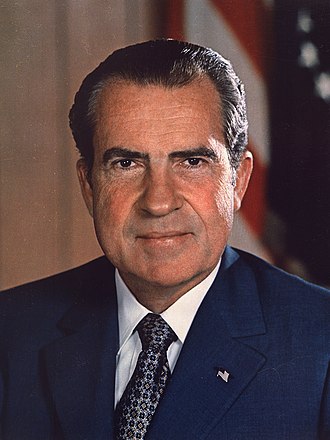
Richard M. Nixon served as the 37th President of the United States from January 1969 until his resignation in August 1974. In February 1971, he ordered the installation of a secret voice-activated taping system in the White House to preserve a historical record of his administration. Until the system's existence was revealed and dismantled in July 1973, the tapes captured Nixon directing major foreign policy initiatives, such as the opening to China, as well as his central role in the Watergate cover-up.
What Nixon talks about on the tapes
White House operations 4,718Presidential scheduling 2,225Public relations 1,784Presidential schedule 1,782Vietnam War 1,693Logistics 1,650Manolo Sanchez 1,626White House communications 1,400White House administration 1,399Presidential communication 1,243Henry Kissinger 1,191Foreign Policy 1,183
Conversations (21,010)
— Page 72 of 211President Nixon and Stephen B. Bull coordinate the logistics for the President's upcoming departure to New York City. The discussion focuses on scheduling adjustments, the coordination of the presidential party at the helipad, and the inclusion of Tricia Nixon Cox in the travel arrangements. Additionally, Nixon weighs the timing of a potential press release and a phone call to John B. Connally, stipulating that plans remain off the record pending further confirmation.
President Nixon consulted with General Alexander M. Haig, Jr. regarding the identity of an individual named John A. Becker. The brief exchange focused on clarifying this person's background or professional status as part of an inquiry into the President's schedule. No further policy decisions were recorded during this short administrative interaction.
President Nixon and Alexander Haig coordinated the messaging and execution of an upcoming U.S. air offensive in Laos to counter intensifying enemy activity against pro-U.S. firebases. They decided to announce the operation from Saigon rather than Washington to minimize public scrutiny while Congress was in recess, ensuring the action was perceived as a routine defensive measure. Additionally, the pair reached a consensus to withhold the public release of a letter from Indira Gandhi, preferring to maintain a firm, private stance on international communications.
President Nixon initiates a call to the White House operator to be connected with Secretary of Commerce Maurice Stans, referred to as Secretary Cotton. The brief interaction serves as a logistical bridge to facilitate an official communication between the President and the Secretary. No further policy discussions or significant substantive developments occurred during this short exchange.
President Nixon and John B. Connally coordinated the President’s arrival at the Group of Ten meeting to mark the successful negotiation of complex international currency realignments. Connally advised the President to congratulate the delegates and escort them to the press to highlight the historic significance of their agreement. The two agreed that the President would deliver brief remarks emphasizing the unprecedented nature and difficulty of the achievement.
President Nixon and John Connally discuss the logistics of an upcoming trip, specifically timing their travel and public engagement to accommodate a press briefing. They coordinate the sequence of events, focusing on how to effectively address the media after thanking their associates. The brief exchange concludes with Connally noting a critical, high-priority matter that requires the President's attention.
President Nixon and Stephen B. Bull met to coordinate logistics for the President's upcoming visit to the Smithsonian Institution's 'Superstar' exhibition. The discussion focused on the departure timing, transportation arrangements, and the involvement of First Lady Pat Nixon. They also established guidelines for communicating with the press regarding the event.
President Nixon and Stephen B. Bull engaged in a brief, informal discussion regarding the outcome of a San Francisco 49ers football game. The conversation centered on confirming the 31-27 final score and expressing general enthusiasm about the result. No significant policy decisions or official business were conducted during this exchange.
President Nixon contacted the White House operator to place an outgoing call to Charles W. Colson. The brief interaction served as a logistical step to facilitate direct communication between the President and his special counsel. No substantive policy matters were discussed during this brief request for the connection.
President Nixon and Charles Colson reviewed the success of John Connally's recent international monetary negotiations and discussed strategies to effectively communicate these economic achievements to the public. They analyzed the current political landscape, including favorable shifts in media coverage and the limitations of critical press reports regarding the administration's economic and war policies. Additionally, the conversation touched upon the administration's ongoing efforts to influence Federal Reserve Chairman Arthur Burns to loosen the money supply to stimulate economic growth heading into the 1972 election cycle.
President Nixon contacted the White House operator to place an outgoing call to Ronald L. Ziegler. The President specifically requested that the operator connect him to an individual identified as Mr. Segbert. This brief exchange served solely as an administrative bridge to facilitate the requested communication.
President Nixon and Press Secretary Ronald Ziegler discuss the positive reception of a recent hour-and-a-half-long interview conducted with Time magazine representatives Jerrold Schecter, Hedley Donovan, and Henry Grunwald. The conversation highlights the magazine staff’s favorable impression of the President’s thoughtful and confident demeanor, particularly regarding his comments on maintaining a non-candidacy stance and his overview of the South Asia situation. Ziegler reports that the interviewers found the session productive, anticipating that the President's remarks will generate significant news coverage.
President Nixon initiates a request through the White House operator to place a personal telephone call to the Reverend Billy Graham. This brief exchange serves as the administrative bridge to establish communication with one of the President's most prominent spiritual advisors. No further substantive policy matters were discussed during this request.
President Richard Nixon and evangelist Billy Graham discussed a range of political, diplomatic, and cultural topics, including the recent International Monetary Agreement and ongoing trade negotiations led by John Connally. The two also addressed geopolitical tensions, specifically U.S. military retaliatory strikes against North Vietnam and the regional instability caused by the India-Pakistan War. Additionally, Graham expressed his support for the Nixon administration, characterizing the current era as a major religious revival in America while commending the President’s leadership.
President Nixon initiates a brief telephone call to the White House operator to request a connection to Treasury Secretary John B. Connally. This exchange serves as the administrative bridge to facilitate a direct policy discussion between the President and his Secretary of the Treasury. No further substantive discourse occurred during this specific interaction.
President Nixon and John Connally discuss the positive public reception of a recently negotiated international monetary agreement and plan Connally's upcoming travel schedule. They also address concerns raised by economist Milton Friedman regarding the money supply, with Nixon urging Connally to leverage his influence over Federal Reserve Chairman Arthur Burns to ensure appropriate policy adjustments. They decide to schedule a formal Quadriad meeting to discuss these monetary issues further.
President Nixon initiates a request to the White House operator to place a telephone call to Arthur F. Burns, the Chairman of the Federal Reserve. This brief interaction serves as the preliminary administrative step required to connect the President with Burns for a private consultation. No substantive policy discussion occurs during this operator-assisted connection request.
President Nixon instructed the White House operator to place an outgoing telephone call to Special Counsel Charles W. Colson. This brief communication served as a routine administrative request to facilitate direct contact between the President and a key advisor. No substantive policy discussions or decisions occurred during this brief interaction.
President Nixon instructed the White House operator to cancel a pending call to Charles W. Colson. He directed the operator to hold the connection, deciding to postpone the communication to a later time. The brief exchange reflects a change in the President's immediate scheduling priorities regarding his outreach to Colson.
President Nixon contacted the White House operator to facilitate a telephone connection with Special Counsel Charles W. Colson. The brief exchange served as an administrative request to reach Colson for a follow-up conversation. No further policy or substantive matters were discussed during this initial contact.
President Nixon met with his aide Stephen B. Bull in the Oval Office to conduct brief administrative or logistical business. The conversation, which lasted less than ten minutes, consists of unintelligible dialogue and polite exchanges before Bull departed. No substantive policy discussions or significant presidential decisions are recorded in the available transcript.
President Nixon consulted with the White House operator to facilitate an outgoing call. This routine interaction served as a technical precursor to the President’s subsequent telephonic communication, designated as Conversation 16-128. No substantive policy discussions occurred during this brief exchange.
President Nixon held an Oval Office meeting with Attorney General John N. Mitchell to discuss unspecified administrative business. The conversation was interrupted by a White House operator, leading to a brief discussion regarding an incoming call. No significant policy decisions or substantive developments are documented in this brief interaction.
President Nixon met with John Mitchell, H.R. Haldeman, and John Ehrlichman to discuss a serious security breach involving a Navy yeoman who was systematically stealing and duplicating classified documents from the National Security Council (NSC) for the Joint Chiefs of Staff. The participants determined that the yeoman had been acting under the instruction of military superiors, specifically Admirals Robinson and Welander, to funnel sensitive foreign policy information to the Pentagon. To address this compromise without triggering a public scandal or a damaging confrontation with the military establishment, they decided to move the military liaison office out of the NSC, replace it with a new security officer, and have the officials involved reassigned.
President Nixon and Charles Colson discussed the reception of an NBC program, "A Day in the Life of the President," focusing on its production quality, political impact, and how it portrayed Nixon's leadership image. They evaluated public reaction to the show, comparing Nixon's style to previous presidents and discussing the necessity of projecting a strong, steady, and active image. Additionally, they touched upon recent successful diplomatic meetings in Bermuda and the Azores, as well as the positive trajectory of the economy, concluding that these factors collectively supported the administration's goals for the 1972 campaign.
President Nixon held a brief two-second encounter in the Oval Office with unidentified individual(s). The interaction was strictly limited to a request for coffee. No substantive policy matters or administrative decisions were addressed during this exchange.
President Nixon and Stephen B. Bull met briefly to coordinate logistical details regarding an upcoming appointment with Federal Reserve Chairman Arthur F. Burns. The discussion focused on scheduling constraints, specifically ensuring Burns departed promptly to accommodate his travel plans. Bull confirmed the necessary timing to ensure the President would meet with him as scheduled.
President Nixon met with H.R. Haldeman, Henry Kissinger, George Shultz, and Arthur Burns to coordinate key administrative priorities, including the upcoming presidential trip to the People's Republic of China, ongoing defense budget negotiations, and personnel appointment procedures. A primary focus was establishing stricter internal control over government leaks—specifically regarding Yeoman Charles Radford—and reaffirming the President's authority over Federal Reserve Board appointments. The participants also discussed the President's recent television documentary, strategies for managing the money supply to address economic concerns, and the administration's stance on federal pay raises.
President Nixon and Stephen B. Bull discussed the logistical arrangements for an upcoming ceremony involving the presentation of commissions to Associate Justices. The President expressed a desire to streamline the event by bypassing formal introductions with attendees he had previously met. Additionally, they briefly touched upon concerns regarding insufficient financial pledges for the associated committee.
Following a formal ceremony in the Oval Office to recognize the commissions of new Supreme Court Justices Lewis F. Powell, Jr. and William H. Rehnquist, President Nixon transitioned into a private session with his staff. The discussion focused on national security concerns, specifically the ongoing investigation into intelligence leaks involving Navy Yeoman Charles E. Radford, the Joint Chiefs of Staff, and Henry Kissinger. Nixon and his advisors resolved to neutralize the threat posed by Radford by utilizing the legal pressure of potential criminal prosecution to ensure his silence, while simultaneously using the incident as a pretext to restructure security operations within the Joint Chiefs and the National Security Council.
President Nixon met with members of the President's Commission on Financial Structure and Regulation to discuss the findings and implementation strategy of their report on domestic financial reform. The discussion focused on the challenges of navigating bureaucracy and congressional committees to enact an omnibus bill aimed at increasing the viability of depository institutions through free-market mechanisms. The President emphasized the need for a cohesive legislative strategy while the group touched upon international economic policy and the recent successful efforts of the Treasury Department in global currency realignments.
President Nixon met with Peter Flanigan and H.R. Haldeman to evaluate potential candidates for various ambassadorships, including Japan, Spain, and Argentina. The discussion focused on balancing political loyalty and competence while addressing specific diplomatic needs in countries undergoing potential leadership transitions. Nixon emphasized his desire to appoint reliable individuals who align with his administration's goals rather than relying on traditional career diplomats or individuals with conflicts of interest.
President Nixon met with departing economic advisor Paul W. McCracken to discuss the administration's economic legacy and international monetary policy. They reviewed the successful implementation of the August 1971 surcharge and the resulting shifts in global currency values, as well as strategies for future negotiations with Japanese and European counterparts. Nixon expressed gratitude for McCracken’s service and solicited final advice regarding the Federal Reserve's monetary policy, reflecting optimism for economic growth heading into 1972.
President Nixon met with his personal valet, Manolo Sanchez, to discuss logistical arrangements regarding the President’s schedule at the Executive Office Building. The brief exchange focused on finalizing the transition and movement between the White House and the EOB. No substantive policy decisions were reached during this short administrative interaction.
President Nixon met with his tailors, Anthony T. Rossi and Acheille Mongelli, to discuss the selection and fitting of clothing for his upcoming international travel to the People's Republic of China and the Soviet Union. The President emphasized a need for lightweight, versatile fabrics suitable for varying climates and the demands of his 1972 campaign schedule. During the session, they reviewed fabric samples, finalized adjustments for his measurements, and the President signed autographs for the staff members who assist with his wardrobe.
President Nixon met with his aide Stephen B. Bull to coordinate a logistical request regarding White House tour arrangements. The discussion specifically focused on facilitating a tour for recent guests to view the executive mansion's holiday decorations. Bull was tasked with overseeing the execution of this request before departing the Oval Office.
President Nixon and H.R. Haldeman met to discuss various personnel matters, executive actions, and the administration's public image. They finalized the terms for James R. Hoffa's clemency, specifically focusing on restrictive conditions regarding his future labor union involvement, and reviewed potential appointments, including a possible Department of Defense role for Peter Flanigan. Additionally, they analyzed the President’s recent public approval ratings, discussed strategies to improve his standing heading into 1972, and reviewed positive public feedback regarding a televised special featuring the President.
President Nixon met with his personal aide, Stephen B. Bull, to provide specific directives regarding Henry A. Kissinger. Although no transcript exists for this brief encounter, the discussion centered on formal instructions for Kissinger. The meeting concluded with Bull departing the Oval Office to carry out these administrative tasks.
President Nixon and his personal secretary, Rose Mary Woods, met to discuss personal scheduling arrangements, upcoming holiday travel to Florida, and administrative tasks for the Christmas season. The conversation focused on managing the President's correspondence, coordinating phone calls, and finalizing logistics regarding Woods's time away. They also exchanged seasonal well-wishes and brief updates concerning mutual acquaintances, including Elmer H. Bobst.
President Nixon met with Stephen B. Bull to coordinate the scheduling of an upcoming meeting with Archbishop Luigi Raimondi. The discussion focused on aligning the Archbishop’s visit with a formal bill signing ceremony to ensure optimal press coverage. Nixon emphasized the need for precise timing to avoid logistical complications or negative optics.
President Nixon met with Apostolic Delegate Luigi Raimondi and White House aide Peter M. Flanigan to receive a personal message of peace from Pope Paul VI. The brief session included a photo opportunity and a general exchange regarding global peace efforts and holiday well-wishes. Nixon acknowledged the Vatican's diplomatic mission, reflecting on the persistent challenges of achieving world peace.
President Nixon and H. R. Haldeman met to discuss logistics and concerns regarding the President’s upcoming trip to the People's Republic of China, specifically expressing frustration over excessive sightseeing and unproductive gaps in the schedule proposed by Henry Kissinger. Nixon directed Haldeman to coordinate revisions to the itinerary—aiming to cut unnecessary travel days and prioritize substance over tourism—while instructing him to handle these changes without directly confronting Kissinger initially. The two also briefly touched upon Henry Kissinger's concerns regarding media leaks and tension with the State Department.
President Nixon contacted the White House operator to facilitate a telephone connection. The primary purpose of the brief interaction was to request a call be placed to Charles W. Colson. No further substantive policy or administrative matters were discussed during this exchange.
President Nixon met with his aide, Stephen B. Bull, to review and finalize details regarding the President's upcoming daily schedule. The conversation focused on managing logistical arrangements for the President's itinerary to ensure his time remained flexible. No major policy decisions were reached, as the discussion was limited to routine administrative planning.
President Nixon met with his aide Stephen B. Bull to review and manage his daily schedule. The primary focus of the discussion concerned the timing and logistics of an upcoming meeting with Henry Kissinger and the Washington Special Actions Group (WSAG). Bull coordinated these appointments to ensure the President's availability for these key foreign policy sessions.
President Nixon met with Alexander P. Butterfield to coordinate logistics for an upcoming trip to Key Biscayne, specifically focusing on dinner arrangements, wine selections, and lodging accommodations with Charles “Bebe” Rebozo. The discussion also touched upon a potential communication from Charles Colson to an unnamed recipient, possibly George Meany. This meeting served to finalize personal travel details and manage pending administrative correspondence.
President Nixon and his personal secretary, Rose Mary Woods, discuss personal holiday arrangements and the welfare of various acquaintances experiencing health issues. The conversation focuses on coordinating the delivery of Christmas gifts and cards, as well as checking on the condition of several mutual friends, including Ben Freeman. Woods concludes the meeting by coordinating the placement of holiday packages under the President's tree.
President Nixon met with H.R. Haldeman and John Ehrlichman to discuss a serious security breach involving a yeoman who leaked classified information to columnist Jack Anderson. The participants addressed the existence of an unauthorized channel between the National Security Council staff and the Joint Chiefs of Staff, which allowed for the improper dissemination of internal decision-making documents. Nixon directed his staff to shut down this channel and strategy was discussed regarding how to handle the leaker and potentially confront Anderson, while carefully avoiding direct involvement from Henry Kissinger in the ongoing investigation.
President Nixon directed the White House operator to close the doors of his office in the Old Executive Office Building. He expressed a desire to proceed with his agenda and complained about the temperature within the room. This brief interaction reflects the logistical management of the President's immediate working environment.
President Nixon met with unidentified individual(s) in his Old Executive Office Building office to discuss adjustments to his official presidential schedule. The brief five-minute encounter focused exclusively on logistical planning and the management of his upcoming appointments. No specific policy decisions were recorded during this session.
President Nixon met with his personal valet, Manolo Sanchez, to coordinate logistics for an upcoming departure. The brief exchange served to finalize the timing of their travel plans, with the President confirming an 8:30 departure. No other policy or administrative matters were addressed during this short scheduling discussion.
President Nixon contacted Charles W. Colson to request a meeting at the Oval Office. Colson confirmed his availability and agreed to travel from his office in the Executive Office Building to join the President. This brief communication served solely as a logistical arrangement to coordinate their upcoming face-to-face discussion.
President Nixon and Charles Colson briefly coordinated plans for an upcoming meeting. The two agreed to reconvene in approximately ten minutes after Colson finished his lunch. No substantive policy matters were addressed during this short scheduling exchange.
President Nixon and Charles Colson reviewed administration strategy for the 1972 presidential campaign, focusing on political messaging, the role of Cabinet officials in media outreach, and improving the President’s public image. They discussed tactical initiatives, including a proposed direct-mail campaign to Democratic voters and strategies for leveraging radio and press coverage to bypass unfavorable headlines. Additionally, the pair touched upon economic indicators, expressing optimism regarding positive holiday sales trends and increasing consumer confidence.
President Nixon met with his aide Stephen B. Bull in the Old Executive Office Building to coordinate his professional schedule. The discussion focused on organizing upcoming meetings with John N. Mitchell and H.R. Haldeman. Bull was tasked with finalizing these arrangements to ensure the President's calendar remained aligned with his priorities.
President Nixon met with Robert Finch and H. R. Haldeman to discuss various administrative and political matters, including the potential financing of Eugene McCarthy as a spoiler candidate in the 1972 election. The group also evaluated the future of the National Center for Voluntary Action and the impact of the National Cancer Act of 1971. Finally, they reviewed the ongoing investigation into the Yeoman Charles E. Radford incident, specifically Henry Kissinger’s reaction to security breaches involving Joint Chiefs of Staff personnel and the complexities of potential prosecutions.
President Nixon initiates a request to the White House operator to place a telephone call to George P. Shultz, who was serving as the Director of the Office of Management and Budget at the time. The brief exchange serves as a procedural step to facilitate a direct conversation between the President and Shultz. No substantive policy matters were discussed during this connection attempt.
President Nixon met with John Ehrlichman and Henry Kissinger to address the fallout from the 'Radford incident,' which involved unauthorized access to sensitive documents by military liaisons. The group discussed the potential resignation of Admiral Thomas Moorer and the need to manage the professional rivalries and perceived disloyalty within the administration, particularly regarding Secretary of State William Rogers and Secretary of Defense Melvin Laird. The President also reviewed legislative priorities, including environmental water quality bills and real estate taxation, while discussing personnel management strategies to maintain stability among his cabinet and senior staff during ongoing foreign policy crises.
President Nixon and George Shultz spoke to coordinate administration strategy on the defense budget, pending water legislation, and Federal Reserve policy. They reached an agreement to secure Melvin Laird's public support for the defense budget and decided that, despite budgetary concerns, the President would sign the water bill to avoid a politically unfavorable veto confrontation. Additionally, Nixon requested that Shultz provide moral support to Henry Kissinger regarding public criticism of U.S. foreign policy during the India-Pakistan War.
President Nixon initiates a brief administrative request for the White House operator to place a telephone call to George P. Shultz. The interaction serves as a functional communication bridge to facilitate a direct discussion between the President and the Director of the Office of Management and Budget. No further policy or substantive matters are addressed during this exchange.
President Nixon and OMB Director George Shultz confer on internal administrative coordination, specifically ensuring that Secretary of Defense Melvin Laird aligns with budget agreements to prevent political friction with conservatives. The President also discusses his skepticism regarding a pending water bill, signaling a desire to avoid a veto conflict while directing staff to manage the implementation cautiously. The conversation concludes with brief remarks on national political sentiment and holiday sentiments.
President Nixon initiates a brief request to the White House operator to place an outgoing call to Major General James D. “Don” Hughes. This administrative communication serves to facilitate direct contact between the President and his military aide. The conversation concludes immediately after the operator acknowledges the request to connect the call.
President Nixon met with Stephen B. Bull to coordinate logistical details regarding official First Family Christmas photographs taken in the Blue Room. The discussion addressed the distribution of these images through wire services and personal photographers. Additionally, Nixon briefly reviewed communication requests from General James D. Hughes concerning Liberia and issued specific instructions for General Walter R. Tkach.
President Nixon contacted the White House operator to facilitate an outgoing call to General James D. “Don” Hughes. The exchange served exclusively as a logistical request to establish this communication link. No further substantive policy matters were discussed during this brief administrative interaction.
President Nixon consulted with Major General James D. Hughes regarding a request for the Grambling College Band to travel to Liberia for an inauguration. Despite concerns about setting a precedent for such transportation, Nixon determined the trip should proceed as a political decision. He instructed Hughes to coordinate with press secretary Ronald Ziegler to ensure the administration received maximum favorable publicity for the gesture.
President Nixon and General James D. "Don" Hughes held a brief, informal meeting in the Old Executive Office Building on Christmas Eve. The exchange functioned as a short holiday greeting and a check-in between the President and his military aide. No substantive policy matters or administrative directives were recorded during this brief interaction.
President Nixon summoned a White House operator to his office in the Old Executive Office Building on Christmas Eve. The brief interaction focused on the President directing the operator to report to his location immediately. No further policy or administrative matters were discussed during this short exchange.
President Nixon initiates a brief request for the White House operator to connect him with Major General James D. “Don” Hughes. This logistical call serves as an administrative effort to establish direct communication with the military aide. The conversation concludes immediately upon the initiation of the operator's task to place the requested call.
President Nixon instructed Major General James D. Hughes to telephone Representative Otto E. Passman to secure his support for a specific presidential initiative. Hughes was directed to convey the President's personal holiday wishes and assure Passman that Nixon trusted his judgment regarding the expenditure of taxpayer funds. By positioning the initiative as an exception and emphasizing mutual confidence, the President sought to cultivate goodwill and influence the congressman's legislative cooperation.
President Nixon met with his military aide, General James D. Hughes, to provide specific instructions regarding a personal favor or exception for an acquaintance. The President directed Hughes to contact a pastor to communicate that an exception had been granted on his behalf. This brief exchange served to facilitate a message of authorization for the individual in question.
President Nixon initiated a brief administrative exchange with the White House operator to manage his outgoing correspondence. During the call, the President specifically requested to be connected with journalist John W. Chancellor. He briefly searched for additional contact information before deciding to conclude the request, deferring further calls to a later time.
President Nixon instructed the White House operator to place a telephone call to John Chancellor. This brief interaction served as a logistical arrangement to facilitate direct communication between the President and the journalist. No further substantive policy matters were addressed during this specific exchange.
President Nixon initiated this call to NBC newsman John Chancellor to express his appreciation for the television documentary 'A Day in the Life of the President.' The conversation transitioned from reflections on the broadcast to a geopolitical discussion regarding the India-Pakistan conflict and the Middle East, noting the influence of major powers. Nixon also shared his personal views on women in leadership roles, arguing that female heads of state like Indira Gandhi often demonstrate greater toughness and risk-taking than their male counterparts.
President Nixon met with NBC news anchor John Chancellor to exchange holiday greetings and commend the network for their production of the documentary "A Day in the Life of the President." The conversation pivoted from feedback on the film to a wide-ranging discussion on global geopolitics, specifically the instability in Pakistan and the Middle East. Nixon also shared personal observations on leadership, positing that women in positions of power often demonstrate greater toughness and a higher willingness to take risks than their male counterparts.
President Nixon initiates a request for the White House operator to place a telephone call to New York Governor Nelson A. Rockefeller. This brief administrative interaction serves as the preliminary step to facilitate a direct conversation between the President and the Governor. No further substantive policy matters were discussed during this connection.
President Nixon directs the White House operator to place a telephone call to New York Governor Nelson A. Rockefeller. This brief administrative interaction serves as the initiation of a communication between the President and the Governor. No further substantive policy matters are addressed in this exchange.
President Nixon calls Nelson A. Rockefeller to exchange Christmas greetings and discuss domestic and foreign policy priorities. Nixon requests that Rockefeller contact a discouraged Henry Kissinger to offer support regarding the administration's handling of the India-Pakistan War. Additionally, they discuss the status of federal revenue sharing legislation, with Nixon encouraging Rockefeller to anticipate its passage when planning the New York state budget.
President Nixon and Nelson Rockefeller exchanged Christmas greetings while discussing pressing political and foreign policy concerns. Nixon sought Rockefeller's support in bolstering the morale of Henry Kissinger, who was reportedly depressed over criticism regarding the administration's handling of the Indo-Pakistani War. The two also touched on political strategy for the upcoming election, specifically regarding John Ashbrook, and reaffirmed their commitment to passing revenue sharing legislation in the new year.
President Nixon contacted the White House operator to place an outgoing call to California Governor Ronald Reagan. This brief exchange served as the administrative request to initiate communication with the Governor on Christmas Eve. No further substantive discussion took place during this specific telephone connection.
President Nixon initiates a request through the White House operator to be connected with California Governor Ronald Reagan. The interaction serves as a routine administrative step to facilitate a direct communication between the President and the Governor. No further substantive discussion occurs during this specific recording segment.
President Nixon met with his personal valet, Manolo Sanchez, to provide specific administrative instructions regarding the handling of outgoing correspondence. The President directed Sanchez to ensure that letters placed in the out-box are processed correctly and mentioned the possibility of recording voice memos. This brief interaction focused on streamlining the President's personal mail workflow.
President Richard Nixon called Governor Ronald Reagan to exchange Christmas greetings and invite him to join a diplomatic golf outing with Japanese Prime Minister Eisaku Sato at Walter Annenberg’s estate. Nixon planned for the January 7, 1972, event to serve as a symbolic gesture to strengthen U.S.-Japan relations following formal policy discussions. Reagan expressed interest in attending, though he noted he would verify his schedule, and Nixon confirmed that political rivals Senators John Tunney and Alan Cranston were explicitly excluded from the invitation.
President Richard Nixon contacted Governor Ronald Reagan to extend holiday greetings and formally invite him to join a diplomatic outing with Japanese Prime Minister Eisaku Satō. The proposed event, scheduled for January 7, 1972, involved a golf outing at the estate of Ambassador Walter Annenberg following official meetings. Reagan accepted the invitation, and the two men concluded the brief discussion with personal remarks regarding the upcoming Washington Redskins versus San Francisco 49ers playoff game.
President Nixon contacted the White House operator to facilitate outgoing calls to two prominent associates, John A. “Jack” Mulcahy and W. Clement Stone. The brief interaction served as a logistical request to initiate these communications on Christmas Eve. No substantive policy discussions occurred during this exchange.
President Nixon contacted the White House operator to facilitate an urgent connection with his Chief of Staff, H.R. Haldeman. This brief interaction served solely as a logistical bridge to initiate a direct line of communication between the President and his top aide. No substantive policy matters or further details were discussed during this exchange.
President Nixon and H.R. Haldeman discussed various administration concerns during the holiday period, including the ongoing friction between Henry Kissinger and Secretary of State William Rogers. The two reviewed recent press coverage of administration officials, the India-Pakistan War, and the release of Jimmy Hoffa, while noting the potential need to limit Kissinger’s future role as a media spokesman. They also coordinated personal scheduling details for upcoming trips to Florida and California, ultimately deciding to proceed with their planned objectives despite internal bureaucratic tensions.
President Nixon consulted with the White House operator to coordinate his holiday schedule and manage incoming communications. The discussion focused on tracking the availability of associates Jack Mulcahy and W. Clement Stone, who were currently unreachable. Nixon provided instructions for his call routing between 4:00 and 5:00 p.m. and explicitly requested that the operator place follow-up calls to Ralph H. Cake and Charles W. Colson.
President Nixon and Charles Colson spoke on Christmas Eve to discuss the political fallout and media reaction regarding recent news, specifically the release of Jimmy Hoffa. They reviewed public and media perceptions of the event, contrasted it with Democratic responses, and touched upon Secretary of State William P. Rogers' effective handling of Vietnam policy in the press. Additionally, they assessed the President's current approval ratings and leadership image, noting that recent actions had successfully strengthened his standing with the public.
President Nixon contacted the White House operator to provide instructions regarding his incoming and outgoing communications on Christmas Eve. He requested that the operator connect him with his brothers, F. Donald Nixon in California and Edward C. Nixon in Seattle. The conversation concluded with the President directing the operator to place these family calls at her earliest convenience.
President Richard M. Nixon met with White House photographer Oliver F. Atkins and others to conduct a formal portrait session in the Oval Office. The participants focused on technical aspects of the shoot, including lighting, film speed, and posing techniques designed to project a relaxed and positive presidential image. The discussion centered on coaching Nixon to provide specific expressions, such as a "campaign look" and a wide-open grin, for the photography team.
President Nixon spoke with his brother, Edward C. Nixon, and Gaye Lynne Nixon to coordinate holiday schedules and family logistics for Christmas Eve and Christmas Day. The discussion covered plans involving the Eisenhower family, Julie Nixon Eisenhower’s recent television appearance, and the President's upcoming international meetings with Willy Brandt and Eisaku Sato. Additionally, they briefly touched upon the status of the India-Pakistan conflict and arrangements for official family photography.
President Nixon contacted the White House operator to initiate a telephone call to Donald Rumsfeld. This brief administrative interaction served as a logistical step to facilitate direct communication between the President and his advisor. No policy matters or substantive discussions occurred during this exchange.
President Nixon and Donald Rumsfeld discuss public perception and political strategy, specifically regarding the success of domestic economic policies and upcoming media appearances. They review the positive impact of wage and price controls while outlining plans to quietly decontrol rent in areas with high vacancy rates to avoid negative press. Additionally, the conversation touches on the President's upcoming international travel, his recent observations on the state of the U.S. economy, and his strong recommendation for Rumsfeld to watch the film 'Brian's Song' for its positive message on race relations.
President Nixon instructed the White House operator to place an outgoing telephone call to journalist Stewart J.O. Alsop. This brief administrative interaction served as the initiation of a direct line of communication between the President and the prominent political columnist. No further discussion occurred during this recording segment.
President Nixon consulted with the White House operator to facilitate official communications while awaiting the availability of journalist Stewart Alsop. Following a report on Alsop's status, Nixon directed the operator to place a call to Secretary of Health, Education, and Welfare Elliot L. Richardson. This exchange functioned primarily as a logistical coordination of the President's late-afternoon outreach efforts.
President Nixon contacted the White House operator to request an immediate phone connection to Alexander M. Haig, Jr. The brief exchange served as a logistical instruction to facilitate communication with his deputy assistant for national security affairs on Christmas Eve. No other substantive matters were discussed during this short administrative interaction.
President Nixon called Alexander Haig to offer Christmas greetings and discuss strategies for managing Henry Kissinger, who was struggling with personal frustration regarding public criticism of the administration's India-Pakistan policy. Nixon emphasized the need for Kissinger to maintain perspective, ignore media commentary, and focus on upcoming foreign policy initiatives like his 'state of the world' report and China diplomacy. Additionally, they addressed the internal investigation of Yeoman Charles Radford, deciding to keep him under surveillance in Washington rather than transferring him out of the area.
President Nixon initiated calls to Attorney General John Mitchell, Secretary Maurice Stans, and Secretary Elliot Richardson before speaking with donor and supporter W. Clement Stone. The brief interaction with Stone primarily served as a holiday exchange, during which the President expressed gratitude for Stone’s ongoing financial and moral support. Nixon specifically praised Stone’s contributions to his administration's accomplishments, citing the ongoing withdrawal of troops from Vietnam as a highlight.
President Nixon instructed the White House operator to place an outgoing call to Secretary of State William P. Rogers on Christmas Eve. The brief exchange served as a logistical coordination to facilitate direct communication between the President and his chief diplomat. No substantive policy discussions occurred during this brief request for assistance.
President Nixon initiated a brief holiday courtesy call to Ralph H. Cake to offer well-wishes and acknowledge Cake's ongoing efforts. The conversation served primarily as a social check-in, with the President praising Cake's resilience and dedication. No specific policy decisions or political actions were transacted during the exchange.