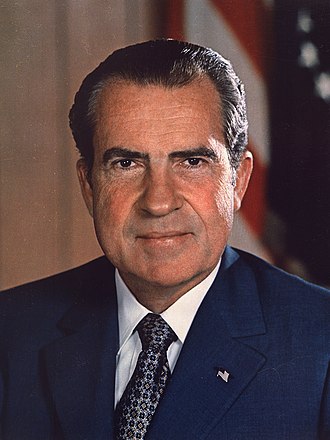
Nixon, Richard M. (President)
Richard M. Nixon served as the 37th President of the United States from January 1969 until his resignation in August 1974. In February 1971, he ordered the installation of a secret voice-activated taping system in the White House to preserve a historical record of his administration. Until the system's existence was revealed and dismantled in July 1973, the tapes captured Nixon directing major foreign policy initiatives, such as the opening to China, as well as his central role in the Watergate cover-up.
What Nixon talks about on the tapes
White House operations 4,718Presidential scheduling 2,225Public relations 1,784Presidential schedule 1,782Vietnam War 1,693Logistics 1,650Manolo Sanchez 1,626White House communications 1,400White House administration 1,399Presidential communication 1,243Henry Kissinger 1,191Foreign Policy 1,183
Conversations (21,010)
— Page 71 of 211President Nixon and Henry Kissinger discuss the ongoing geopolitical crisis between India and Pakistan, specifically addressing reports of atrocities captured on film. They review the potential impact of televised footage and the role of Indian censorship in shaping the narrative. The two agree to maintain a degree of detachment regarding the reported atrocities to manage the administration's public position on the conflict.
President Nixon held a brief, informal meeting in his Old Executive Office Building suite with an unidentified individual. The available archival record provides no substantive information regarding the topics, decisions, or developments associated with this interaction. Due to the lack of transcript content, the primary purpose and outcome of the discussion remain historically undocumented.
President Nixon met with his personal valet, Manolo Sanchez, to discuss household management and logistical details regarding the President's personal environment. Their dialogue focused on the maintenance of tobacco products and the oversight of staff activities within the Executive Office Building. The brief interaction concluded with administrative instructions concerning the movement of personnel in the office vicinity.
President Nixon met with John Mitchell, H.R. Haldeman, John Ehrlichman, and David Young to address the unauthorized removal of sensitive documents from National Security Council (NSC) briefcases by Yeoman Charles Radford. The participants discussed the extent of the security breach, its connection to potential intelligence leaks to columnist Jack Anderson, and the need to contain the fallout to protect the integrity of the White House and military services. Nixon ordered a controlled investigation into the breach while emphasizing the need to maintain security over his own briefcases, particularly during travel.
President Nixon and H. R. Haldeman consulted on adjustments to the President’s schedule to ensure a timely departure for Camp David. Fearing inclement weather, they agreed to move a meeting with Jerrold L. Schecter to 4:30 p.m., following the Revenue Act signing ceremony. Haldeman was tasked with informing Schecter of the revised timing and potential travel uncertainties.
President Nixon met with Alexander P. Butterfield to briefly coordinate the President's schedule. During this short exchange, they specifically discussed upcoming remarks to be delivered by Press Secretary Ronald L. Ziegler. The conversation concluded with administrative confirmation regarding these logistical preparations.
President Nixon met with his personal valet, Manolo Sanchez, in the Oval Office to address a brief personal request. The interaction lasted only a few seconds and concluded with Sanchez exiting shortly thereafter. No significant policy matters or administrative decisions were documented during this short exchange.
President Nixon and his personal secretary, Rose Mary Woods, met to discuss logistical details regarding White House amenities and personal gifts. The conversation focused on procuring specific glassware previously used by the President and reviewing the design and placement of a crystal gift from Ambassador Walter H. Annenberg. Additionally, the pair coordinated the President’s upcoming schedule, including dinner plans with Jack and Helene Drown and potential arrangements at Camp David.
President Nixon met with Stephen B. Bull, Rose Mary Woods, and Manolo Sanchez to coordinate his busy administrative and social schedule. The discussion primarily focused on logistics for signing the Revenue Act of 1971, rearranging office décor, and managing upcoming appointments, including a planned interview with Jerrold Schecter and calls to Ambassador Walter Annenberg and William H. Rehnquist. Additionally, the President reviewed Supreme Court confirmation vote data with staff and finalized arrangements for a dinner and his upcoming trip to Camp David.
President Nixon and Stephen B. Bull met to coordinate the logistics for the upcoming signing ceremony of the Revenue Act of 1971. They specifically discussed the distribution of signing pens to key political figures, including John B. Connally, Wilbur D. Mills, Arthur F. Burns, and Russell B. Long. The President finalized plans for the presentation of these pens to ensure proper recognition of the individuals involved in the legislation's passage.
President Nixon and Alexander P. Butterfield met to coordinate logistical details regarding the signing of the Revenue Act of 1971. Accompanied by Stephen B. Bull, they briefly discussed the administrative requirements for the bill-signing ceremony and the timing of a scheduled call to Ambassador Walter H. Annenberg. The meeting concluded with instructions to finalize the necessary procedural paperwork for these events.
President Nixon met with a bipartisan group of Congressional leaders from the House Ways and Means Committee and the Senate Finance Committee to mark the signing of the Revenue Act of 1971. The President utilized the ceremony to praise the legislators for their cooperation in passing a responsible tax bill, contrasting it with fears that the measure would become an unmanageable 'Christmas tree' of amendments. The discussion highlighted the economic benefits of the legislation, particularly its role in job creation and the stimulation of the automobile industry following the administration's new economic program initiated in August.
President Nixon and John B. Connally reviewed a busy schedule of administrative and geopolitical affairs, including the recent signing of the Revenue Act of 1971 and ongoing international monetary negotiations. The two men discussed strategy for upcoming diplomatic engagements, specifically focusing on how to pressure the French and Japanese for trade concessions while maintaining a diplomatic posture. Additionally, they addressed the escalating India-Pakistan crisis, with the President emphasizing the need to prevent the collapse of West Pakistan and questioning the commitment of the Soviet Union to regional stability.
President Nixon and Treasury Secretary John Connally speak with Ambassador Walter Annenberg to discuss upcoming diplomatic meetings and the status of international monetary negotiations. Annenberg shares his observations on European perceptions of the U.S. economic position, while Connally emphasizes the American effort to secure a fair deal regarding trade and balance of payments. The participants express mutual admiration and exchange holiday greetings as they prepare for the President's scheduled meeting with Prime Minister Edward Heath in Bermuda.
President Nixon initiates a call to Secretary of the Treasury John B. Connally to facilitate a conversation with Federal Reserve Chairman Arthur F. Burns. The primary purpose of the call is to secure an immediate consultation with Burns regarding ongoing economic policy matters. Nixon directs the coordination of this contact to ensure direct communication with the Fed leadership.
President Nixon and Federal Reserve Chairman Arthur F. Burns discussed the Federal Reserve's reduction of the discount rate to 4.5% to signal a more aggressive stance on economic expansion. Burns urged the President to appoint a new Federal Reserve board member to resolve regulatory deadlocks, while Nixon promised to prioritize the matter after his upcoming meeting with French President Georges Pompidou. The two also discussed the need for future consultations regarding concerns that the Pay Board and Price Commission’s current policies were hindering economic recovery.
President Nixon instructed the White House operator to place a telephone call to Senator Robert P. Griffin. This brief administrative exchange served as the precursor to a direct consultation between the President and the Senator. No further substantive policy discussions were recorded during this connection.
President Nixon, H. R. Haldeman, and Alexander Butterfield met to review the President's schedule, coordinate legislative strategies, and assess the status of various administration initiatives. Key discussions included the successful confirmation of William Rehnquist and historical comparisons to other contested Supreme Court appointments, as well as economic outlooks and ongoing negotiations regarding foreign aid and the federal budget. The President specifically requested a confidential review of future aid to India and emphasized the importance of preventing bureaucratic leaks regarding his fiscal priorities.
President Nixon and Senator Robert Griffin discuss the successful Senate confirmation of William Rehnquist to the Supreme Court by a vote of 68 to 26. They compare the margin of Rehnquist's confirmation to the historical records of Justices Brandeis and Hughes to frame the administration's victory. Additionally, Griffin expresses optimism regarding the potential to sustain the President's veto of the Economic Opportunity Amendments of 1971 and credits John Connally for his role in recent tax legislation.
President Nixon initiates a call to William Rehnquist through the White House operator to facilitate a direct conversation. The primary purpose of this contact is to establish communication with Rehnquist, who was then serving as an Assistant Attorney General awaiting confirmation for his appointment to the Supreme Court. No substantive policy matters or further developments are discussed during this brief administrative request.
President Nixon calls William H. Rehnquist to congratulate him following his Senate confirmation to the Supreme Court. The President compares Rehnquist’s confirmation vote tally to that of former Chief Justice Charles Evans Hughes and jokingly references an endorsement by Joe Kraft that nearly jeopardized the nomination. Nixon concludes the call by advising Rehnquist to remain independent and steadfast in his judicial philosophy, urging him not to let political pressure or the Washington social climate influence his future rulings.
President Nixon initiates a brief telephone exchange with the White House operator to request a connection to H.R. Haldeman. This administrative interaction serves to facilitate urgent communication between the President and his Chief of Staff. No further substantive policy matters were discussed during this brief request for a line transfer.
President Nixon and his personal secretary Rose Mary Woods met to coordinate administrative details, including the President's upcoming interview schedule with Jerrold Schecter and logistics regarding Julie Nixon Eisenhower's travel. The pair also discussed a gift, the "Star of the President," received from Ambassador Walter H. Annenberg. Additionally, they reviewed standard protocols for handling gifts to the President and confirmed dinner arrangements.
President Nixon met with Jerrold L. Schecter in the Oval Office to discuss the nature of the presidency, the demands of the office, and the logistical habits required to maintain executive focus. Nixon emphasized his deliberate efforts to avoid distraction by limiting his intake of television news, maintaining a clean workspace, and delegating non-essential tasks to trusted aides. He reflected on the importance of mental discipline and emotional detachment, particularly regarding press criticism, as essential components for making cold, calculated decisions during national crises.
President Richard Nixon provided journalist Jerrold L. Schecter with an informal tour of his Old Executive Office Building (EOB) workspace, highlighting the office's personal significance and historical function. Nixon described the room as a venue for private, high-level discussions with key advisors such as Henry Kissinger, John Mitchell, and Melvin Laird. The discussion emphasized the President's preference for this intimate setting to conduct work and manage administration affairs away from the more formal environment of the Oval Office.
President Nixon and H.R. Haldeman discuss the President's upcoming trip to Camp David and the planning for a television special featuring Julie Nixon Eisenhower. The conversation covers logistical arrangements for potential visits by Henry Kissinger and journalist Jerrold Schecter to discuss administration business, including the ongoing India-Pakistan War. Additionally, they review the President’s recent interview with Schecter, with Nixon emphasizing the importance of managing press perception and ensuring the positive tone of the resulting article.
President Nixon contacted the White House operator to facilitate an outgoing call. The sole purpose of this brief communication was to request that the operator connect him with special counsel Charles W. Colson. No substantive policy discussions or further actions were recorded during this exchange.
President Nixon consulted with the White House operator to determine the whereabouts of special counsel Charles W. Colson. Upon learning that Colson was currently commuting home, the President requested to be connected to him. This brief exchange served as an administrative coordination to facilitate a direct follow-up call between Nixon and Colson.
President Nixon instructed the White House operator to place an outgoing call to George E. Allen, the head coach of the Washington Redskins. This brief exchange served solely as an administrative request to facilitate direct communication between the President and the NFL coach. No further substantive policy matters or tactical discussions were addressed during this interaction.
President Nixon and Press Secretary Ronald L. Ziegler discuss journalist Jerrold L. Schecter’s highly positive reaction to a recent interview, ultimately deciding to cancel a proposed trip for the reporter to Camp David. Ziegler also proposes a strategy for managing press expectations regarding the President’s potential travel to Florida. Nixon approves the plan to keep his upcoming schedule vague to provide flexibility while he focuses on the budget and preparations for international meetings.
President Nixon initiates a brief administrative exchange with the White House operator to manage his ongoing telephone communications. The conversation focuses solely on scheduling logistics, with the President instructing the operator to return a call. No substantive policy matters or major developments are addressed.
President Nixon communicated with the White House operator to follow up on the status of pending telephone calls. The primary focus of the brief exchange was to identify individuals who had attempted to reach him, specifically George E. Allen and Charles W. Colson. No major policy decisions were made during this brief administrative check-in.
President Nixon and George E. Allen engaged in a casual discussion focused primarily on professional football, including the performance of players like Larry Brown and the outlook for upcoming playoff games. The conversation also touched upon the President's scheduled diplomatic trip to the Azores to meet with French President Georges Pompidou. To accommodate the President’s travel, Allen agreed to arrange a private viewing of the game film for Nixon upon his return to Washington.
President Nixon initiates a brief telephonic interaction with the White House operator to request a connection to Charles W. Colson. The call serves as an administrative bridge to facilitate direct communication with his special counsel. No further substantive policy matters were discussed during this brief exchange.
President Nixon and Charles Colson review a series of recent political and economic successes, including the Senate confirmation of William H. Rehnquist, positive stock market performance, and strong retail sales data. The conversation highlights the administration's strategic legislative victories, specifically regarding tax bills and the veto of the Day Care Bill. Nixon directs Colson to coordinate with Vice President Agnew to secure support from conservatives for the administration's robust defense budget, emphasizing that these allies should focus their political pressure on the liberal Senate rather than the White House.
President Nixon instructed the White House operator to contact Henry Kissinger and direct him to the Oval Office. This brief administrative call served as a logistical arrangement to facilitate an immediate in-person consultation between the President and his National Security Advisor. No substantive policy matters were discussed during this request.
President Nixon directs the White House operator to place a telephone call to Alvin Snyder. The President specifies that Snyder can be reached at his residence on the second floor of the White House. The brief exchange serves as an administrative instruction to facilitate communication between Nixon and a member of his staff.
President Nixon consulted with Alvin Snyder regarding logistics for a CBS Christmas television special. The discussion focused on coordinating the President’s arrival time to ensure he could receive makeup application before filming began. Nixon ultimately decided to head to the location in five minutes to begin his segment of the production.
President Nixon contacted the White House operator to facilitate an urgent communication with his National Security Advisor, Henry A. Kissinger. The brief interaction served as a formal request to place a telephone call to Kissinger, reflecting the ongoing necessity for direct coordination on foreign policy matters. No further substantive dialogue or policy decisions were recorded during this connection.
President Nixon and the White House operator discuss the current availability of National Security Advisor Henry Kissinger. The operator informs the President that Kissinger is occupied with a Soviet-related commitment and requests permission for him to return the call. Nixon approves this brief delay, setting the stage for a follow-up conversation once Kissinger is free.
President Richard Nixon contacted Senator Margaret Chase Smith to offer birthday wishes while inquiring about her health during her stay at Walter Reed National Military Medical Center. The conversation shifted to political matters, with Nixon expressing appreciation for Smith’s legislative support and lamenting the difficulties faced with the continuing resolution. Both parties briefly discussed the exhaustion and partisan maneuvering within Congress, concluding with mutual well-wishes for the upcoming holidays.
President Nixon met with Stephen B. Bull in the Oval Office to coordinate his daily schedule. The primary focus of the brief discussion was the logistics regarding an upcoming meeting with an unidentified individual. Nixon sought to clarify his availability and readiness for this engagement.
President Nixon initiated a brief communication through the White House operator to facilitate an outgoing call. The interaction served as a procedural step to connect the President with another party for official business. No substantive policy matters or specific decisions were recorded during this brief exchange.
President Nixon met with an unknown individual to coordinate a brief, immediate briefing with Henry Kissinger. The primary objective was to ensure Kissinger’s prompt arrival at the Oval Office for an urgent consultation. The conversation concluded with instructions to expedite Kissinger's entry.
In this meeting, President Nixon and his senior advisors, including H. R. Haldeman and John B. Connally, finalized their strategy regarding the recently negotiated international monetary agreement, often referred to as the "Azores Doctrine." The participants focused on managing public perception of the deal, emphasizing that it represented a successful and fair realignment of currencies rather than a unilateral devaluation of the dollar. Furthermore, they discussed the necessity of coordinating a unified message to the press through the Treasury Department and prepared for a briefing with Congressional leadership to solidify legislative support for their economic initiatives. The conversation also touched upon sensitive foreign policy matters, specifically the India-Pakistan conflict and the need to maintain delicate diplomatic relations with the Soviet Union and France.
President Nixon initiates a brief telephone call to his daughter, Julie Nixon Eisenhower. The exchange serves as a personal communication request placed through the White House operator. No policy or political matters are discussed, as the operator immediately facilitates the connection to the President's family member.
President Nixon and his daughter, Julie Nixon Eisenhower, spoke to coordinate personal scheduling and travel plans for the upcoming weekend. The discussion centered on logistics for a family trip to New York City, including arrangements for attending a play and dining at the “21 Club.” They also briefly reviewed the President’s official schedule, specifically regarding upcoming meetings with legislative leaders.
President Nixon met with his personal secretary, Rose Mary Woods, and later aide Alexander P. Butterfield to discuss a range of personal, administrative, and political matters. The conversation covered the President's upcoming schedule and need for relaxation, the political threat posed by Democratic candidates—specifically Ted Kennedy and Edmund Muskie—and the ongoing efforts to secure Nixon's reelection. Nixon also discussed the importance of the Azores summit regarding international economic policy and authorized various administrative tasks, including follow-up meetings and correspondence with foreign dignitaries.
President Nixon met with Alexander P. Butterfield to coordinate logistical arrangements for his upcoming schedule. The discussion centered on managing the timing for a bill signing and preparing for a forthcoming meeting and helicopter trip. The President opted to postpone certain administrative tasks to ensure adequate time for meeting preparation.
President Nixon met with his Deputy Assistant Alexander P. Butterfield to review the logistics of the President's upcoming schedule. The brief discussion focused on finalizing arrangements for a forthcoming meeting. No further substantive policy matters were recorded during this session.
President Nixon and H.R. Haldeman discussed press strategy regarding the Washington Redskins, specifically focusing on the team's turnaround and potential media coverage. They also coordinated the President's upcoming trip to the People’s Republic of China, evaluating various stopover options to minimize fatigue. Ultimately, they decided to prioritize a stay in Hawaii—potentially Maui—over California or Guam to allow for better relaxation and climate, while shifting the formal departure ceremony to Washington, D.C.
President Nixon and Stephen B. Bull discussed logistics regarding an upcoming trip, focusing on travel schedules and transit times to Hawaii and Guam. The brief exchange centered on managing the timing of departures and arrivals to ensure the President's itinerary was efficient. No major policy decisions were reached during this administrative review of travel arrangements.
President Nixon met with his aide Stephen B. Bull to coordinate an urgent administrative task. The primary purpose of the meeting was to facilitate a direct communication channel with the Treasury Department. Nixon directed Bull to summon Under Secretary of the Treasury Paul A. Volcker to the Oval Office for an immediate consultation.
President Nixon met with an unidentified individual in the Oval Office for a brief session lasting less than four minutes. Due to the absence of audible dialogue or a transcript, the specific substance, objectives, and any potential action items from this encounter remain unknown. Archival review has determined that no discernible conversation occurred during this segment.
President Nixon consulted Paul Volcker to determine an appropriate figure for the number of major monetary crises experienced over the previous decade to cite in an upcoming speech. Volcker and others provided estimates ranging from three to seven, prompting Nixon to settle on the higher figure of seven to bolster his narrative. The discussion concluded with the President deciding to attribute this statistic directly to Volcker's expertise.
President Nixon met with a bipartisan group of Congressional leaders to brief them on his recent diplomatic discussions with French President Georges Pompidou and the status of U.S. international economic policy. The conversation focused on efforts to address the global monetary crisis, the necessity of realigning exchange rates to restore the competitive position of American goods, and the importance of burden-sharing among trade partners. Nixon highlighted the recent breakthrough in negotiations with France as a critical step toward stabilizing the international monetary system and advancing domestic economic goals like job creation and inflation control.
President Nixon met with his senior advisors, including Charles Colson and John Ehrlichman, to discuss a broad range of political, administrative, and strategic matters. The participants reviewed ongoing public relations efforts regarding economic performance and unemployment data, coordinated their stance on potential legislation such as H.R. 1, and touched upon personnel concerns. The conversation also included informal commentary on recent Washington Redskins football games and general holiday planning, highlighting a mix of high-level political maneuvering and casual staff engagement.
President Nixon initiates a request for the White House operator to connect him with Press Secretary Ronald L. Ziegler. The brief interaction serves solely as a logistical communication to facilitate official contact between the President and his press aide. No policy discussions occur during this exchange.
President Nixon met with Alexander P. Butterfield to coordinate administrative logistics regarding his official schedule. The discussion focused on arrangements for an upcoming press photo opportunity and a follow-up communication Butterfield was tasked to conduct with Press Secretary Ronald L. Ziegler. This interaction served to finalize brief scheduling adjustments required for the President's public engagements.
President Nixon initiates a brief communication with the White House operator to facilitate an outgoing call. The interaction serves as a routine administrative request to connect the President with an external party. No significant policy discussions or substantive decisions occur during this brief exchange.
President Nixon and his personal secretary, Rose Mary Woods, met briefly in the Oval Office to coordinate his official schedule. The discussion focused on administrative logistical arrangements regarding upcoming appointments and presidential obligations. No major policy decisions were recorded during this short exchange.
President Nixon and Press Secretary Ronald Ziegler discussed the protocol for an upcoming meeting with Pakistani leader Zulfikar Ali Bhutto. Nixon instructed Ziegler to maintain a low-key approach regarding media presence, specifically requesting that the press not be granted access for a formal photo opportunity. Instead, they decided that White House photographer Oliver Atkins would take the picture, which would be released to the press later to avoid elevating Bhutto's political standing in Pakistan.
President Nixon and Press Secretary Ronald Ziegler coordinated the public messaging for an upcoming courtesy call to ensure the event remained low-key. Nixon explicitly instructed Ziegler to manage media expectations by limiting press coverage and declining requests for official photographs to prevent a build-up of publicity. The two agreed on a strategy to control the narrative by providing specific talking points to the press.
President Nixon contacted the White House operator to facilitate a personal telephone call to First Lady Pat Nixon. The exchange served as a routine administrative request to connect the President with his wife. No substantive political or policy matters were discussed during this brief communication.
President Nixon met with Rose Mary Woods, Alexander Butterfield, and other staff members to finalize administrative tasks and discuss his upcoming holiday schedule. The conversation centered on the President's personal plans for Christmas, including weather concerns, football, and potential travel to Florida or Bermuda. Additionally, the group addressed office operations, such as signing paperwork, managing Christmas card messages, and approving a holiday financial gift for a staff member's wife in recognition of her assistance with data organization.
President Nixon and First Lady Pat Nixon briefly coordinated logistical arrangements regarding the President's upcoming schedule. Their discussion focused on coordinating the timing and appropriate attire, specifically the requirement for a suit, for an impending international meeting. This short exchange served to align their plans ahead of the President's official commitments.
President Nixon initiates a request through the White House operator to place a telephone call to Secretary of the Treasury John B. Connally. This brief interaction serves as a logistical bridge to facilitate direct communication between the President and his cabinet member. No further policy discussions or substantive matters occur during this exchange.
President Nixon and H. R. Haldeman met to coordinate upcoming administrative logistics, specifically focusing on the scheduling of a Cabinet dinner and holiday-related press engagements. The discussion touched upon the guest list for the dinner, including former administration members and various political figures, alongside planning for a CBS Christmas message and year-end media appearances. Haldeman also facilitated communication regarding John B. Connally’s schedule and return, while the participants finalized strategies for balancing these high-level social and public relations commitments.
President Richard M. Nixon met with Alexander P. Butterfield in the Oval Office for a brief, two-minute exchange. The specific content of this discussion remains unavailable due to the lack of an existing transcript and the unintelligible nature of the recording. No definitive policy decisions or significant administrative actions were captured during this brief encounter.
President Nixon and his personal aide Stephen B. Bull met briefly in the Oval Office to coordinate logistics for an upcoming discussion with General Alexander M. Haig, Jr. The primary purpose of the brief interaction was to facilitate Haig's arrival and manage the President's schedule. Bull departed immediately after addressing these preparatory matters.
President Nixon met with Alexander Haig and later H. R. Haldeman to review ongoing geopolitical crises and international economic negotiations. The discussion addressed the recent ceasefire in the Indo-Pakistani War, the administration's strategic posture toward the Soviet Union and China, and a delayed military response in Vietnam to avoid escalation during the Christmas period. Additionally, the President received an update from Secretary of the Treasury John Connally regarding stalled international monetary talks, focusing on recalcitrant stances from Italy, Japan, and Canada.
President Nixon held a brief, two-minute meeting in the Oval Office with an unidentified individual. The interaction was limited to a single administrative exchange regarding the movement of people within the room. No substantive policy discussions or significant decisions were recorded during this brief encounter.
President Nixon met with Zulfikar Ali Bhutto to discuss the aftermath of the Indo-Pakistani War and the ongoing territorial integrity of Pakistan. The conversation focused on the geopolitical implications of the conflict, specifically regarding the influence of the Soviet Union and India in South Asia, as well as the importance of maintaining international norms against aggression. Nixon offered general support for Pakistan's recovery while emphasizing the necessity for internal reform and self-reliance under the Nixon Doctrine, ultimately advising Bhutto to pursue a peaceful, negotiated path to restore regional stability.
President Nixon and Treasury Secretary John B. Connally discussed the status of delicate international monetary negotiations occurring at a Group of Ten meeting at the Smithsonian Institution. Connally briefed the President on the difficulty of reaching a multilateral agreement regarding currency revaluations, specifically noting holdouts from Canada, Italy, and tensions between French and German positions. They agreed that if a final settlement could not be reached within hours, Connally should issue a positive public statement emphasizing progress and scheduling a follow-up meeting for January, while also establishing that trade negotiations must be finalized before the President’s January 20 deadline with Congress.
President Nixon instructed the White House operator to place a call to Muriel L. Hartley, who served as General Alexander Haig’s secretary. The President initiated the contact specifically to inquire about Hartley's well-being, noting his understanding that she was currently ill at home. The call was placed to facilitate communication with her despite her reported health issues.
President Nixon met with his personal valet, Manolo Sanchez, in the Oval Office for a brief, informal interaction. The discussion primarily involved routine administrative tasks and the President checking on the status of incoming communications. The brief exchange concluded shortly after without any significant policy developments or major decisions.
President Nixon and Stephen B. Bull met briefly in the Oval Office to coordinate the President's upcoming schedule. The primary purpose of the discussion was to arrange a subsequent meeting between the President and General Alexander M. Haig, Jr. Following these brief administrative instructions, Bull departed the office.
President Nixon and Alexander Haig discussed the geopolitical fallout of the Indo-Pakistani War, focusing on the roles of the Soviet Union, the People's Republic of China, and the United States. They evaluated the effectiveness of recent diplomatic maneuvers and military posturing, agreeing that the U.S. successfully demonstrated resolve to both global powers despite the conflict's outcome. The conversation also shifted to Vietnam, where the President authorized a military strategy involving air strikes against North Vietnamese targets to counter enemy aggression and address frustrations regarding the stalled Paris peace talks.
President Nixon met with his personal valet, Manolo Sanchez, in the Old Executive Office Building. The brief interaction consisted primarily of personal matters, as indicated by the withdrawal of the discussion from the public record for being personal and returnable. No significant policy decisions or administrative actions were recorded during this engagement.
President Richard Nixon met with his valet, Manolo Sanchez, in the Old Executive Office Building to conduct private or personal business. The majority of the interaction was designated as a personal, returnable segment, resulting in no official record of the discussion. Sanchez departed shortly after the brief exchange, leaving no documented policy decisions or administrative actions.
President Nixon met with his personal aide, Manolo Sanchez, in the Old Executive Office Building to address a specific personal or professional request. The brief encounter focused on the fulfillment of this task, which Sanchez carried out before departing shortly thereafter. The discussion highlights the routine, informal interactions between the President and his dedicated staff member.
President Nixon met with his personal valet, Manolo Sanchez, in the Old Executive Office Building. The brief interaction focused on the President's personal attire, specifically his dissatisfaction with the appearance of a pair of pants. No major policy discussions or administrative decisions were recorded during this exchange.
President Nixon met with his personal valet, Manolo Sanchez, in the Old Executive Office Building. While the official transcript is unavailable, the brief recorded exchange centered on the procurement of pens. This interaction highlights the routine administrative and personal tasks facilitated by Sanchez during his tenure as a member of the President's domestic staff.
President Nixon met with his personal valet, Manolo Sanchez, in the Old Executive Office Building to facilitate the delivery of specific documents to his secretary, Rose Mary Woods. The conversation focused on the administrative transfer of copies and requested changes to these materials. The meeting concluded shortly after these instructions were relayed to ensure the prompt handling of the President's correspondence.
President Nixon met with his personal aide, Manolo Sanchez, to coordinate administrative logistics regarding his professional schedule. The discussion focused on ensuring that Secretary of the Treasury John B. Connally would be prepared to place a scheduled phone call to the President. Nixon issued specific instructions to Sanchez to facilitate this communication and verify the status of the call.
President Nixon consulted with the White House operator to facilitate a telephone connection with Muriel L. Hartley. The operator provided assistance in locating Hartley, who was reportedly still in her room at the time of the request. This brief interaction served as a logistical coordination to initiate a private communication.
President Nixon consulted with the White House operator to facilitate a phone call with Muriel L. Hartley. Upon learning that Mrs. Hartley was unavailable at her current location, the President instructed the operator to attempt the connection again in one hour. The brief exchange served as a logistical coordination to manage the President's personal or professional communications.
President Nixon initiates a brief communication through the White House operator to reach John Ehrlichman. The interaction serves as a functional bridge to facilitate a subsequent, more substantive discussion between the President and his domestic policy advisor. No significant policy decisions were reached during this short connection.
Treasury Secretary John B. Connally briefed President Nixon on the ongoing international negotiations to address the global monetary crisis and the devaluation of the dollar. Connally reported significant progress in securing a 16.9% devaluation agreement with the Japanese while detailing the status of negotiations with European partners, Canada, and Sweden. The two discussed the difficulty of finalizing a formal memorandum of agreement, with Connally stressing that the interconnected nature of these currency adjustments required a delicate, high-pressure approach to ensure a successful resolution.
President Nixon and John B. Connally held a brief administrative coordination meeting to align their respective schedules for the remainder of the evening. The conversation functioned primarily as a logistical check-in to confirm their immediate availability and planned locations. No substantive policy matters were addressed during this short exchange.
President Nixon instructed the White House operator to initiate a telephone call to Muriel L. Hartley. The brief interaction served solely to facilitate this specific communication. No further policy or administrative matters were discussed during the exchange.
President Nixon consulted with the White House operator to facilitate a personal phone call. The brief interaction served as a logistical request to connect the President with Muriel L. Hartley. No further substantive policy or political discussions were recorded during this exchange.
President Nixon called Muriel L. Hartley to personally express his appreciation for her thirty years of government service upon her retirement. He specifically highlighted her essential contributions to the work of Alexander Haig and Henry Kissinger within the National Security Council. The brief exchange served as a formal gesture of gratitude for her long-standing dedication in a high-pressure environment.
President Nixon initiated this brief call to Muriel L. Hartley to personally acknowledge and thank her for thirty years of federal service. He specifically highlighted her essential contributions to the work of Alexander Haig and Henry Kissinger during her tenure. The conversation served as a professional gesture of appreciation upon her retirement from the White House staff.
President Nixon initiates a request through the White House operator to place a telephone call to Treasury Secretary John B. Connally. The brief exchange serves as a logistical bridge to facilitate direct communication between the President and the Secretary. No further policy discussion takes place during this brief interaction.
President Nixon met with his aide Stephen B. Bull to coordinate logistical arrangements for an upcoming interview with Time magazine. The discussion centered specifically on the placement and presence of cameras during the session. No further actions or major policy decisions were recorded during this brief administrative meeting.
President Nixon met briefly with an unidentified individual in the Oval Office. The conversation consisted of a casual, logistical exchange regarding the maintenance of the fireplace. No substantive policy matters or official developments were recorded during this brief interaction.
President Nixon met with Stephen B. Bull in the Oval Office to discuss administrative logistics regarding the President's upcoming schedule. The primary focus of the brief meeting was the preparation and coordination required for a forthcoming interview. No major policy decisions were reached, as the discussion remained centered on routine scheduling arrangements.
President Nixon met with journalists from Time magazine—Jerrold L. Schecter, Hugh S. Sidey, Hedley W. Donovan, and Henry A. Grunwald—to discuss the state of his presidency and his administration’s foreign and domestic agendas. The conversation covered a wide range of topics, including U.S. economic policy, the Vietnam War, the ongoing India-Pakistan conflict, and his strategic overtures toward the People's Republic of China and the Soviet Union. Nixon used the meeting to articulate his vision for a global balance of power and to express his confidence in his leadership style as he looked toward the 1972 election.
President Nixon met with Stephen B. Bull in the Oval Office to discuss administrative logistics and adjustments to the President's upcoming schedule. The conversation focused on coordination efforts regarding official engagements and internal appointments. No significant policy decisions were recorded during this brief administrative briefing.