Nixon, Richard M. (President)
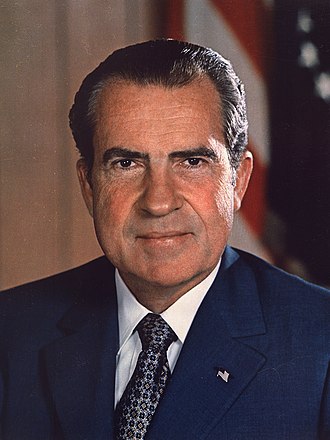
Richard M. Nixon served as the 37th President of the United States from January 1969 until his resignation in August 1974. In February 1971, he ordered the installation of a secret voice-activated taping system in the White House to preserve a historical record of his administration. Until the system's existence was revealed and dismantled in July 1973, the tapes captured Nixon directing major foreign policy initiatives, such as the opening to China, as well as his central role in the Watergate cover-up.
What Nixon talks about on the tapes
White House operations 4,718Presidential scheduling 2,225Public relations 1,784Presidential schedule 1,782Vietnam War 1,693Logistics 1,650Manolo Sanchez 1,626White House communications 1,400White House administration 1,399Presidential communication 1,243Henry Kissinger 1,191Foreign Policy 1,183
Conversations (21,010)
— Page 99 of 211President Nixon and H. R. Haldeman discuss the urgent need to select a successor following the death of FBI Director J. Edgar Hoover. They weigh the political implications and potential confirmation hurdles of appointing an acting director versus a permanent successor immediately. The conversation focuses on avoiding a contentious Senate confirmation process during an election year, ultimately weighing the benefits of appointing a capable interim leader to maintain stability at the Bureau.
President Nixon and Patrick J. Buchanan met to coordinate the official administration response to the death of FBI Director J. Edgar Hoover. They discussed the drafting and release of a formal statement to honor Hoover's 48-year tenure and legacy of service. The conversation focused on ensuring the public tribute appropriately reflected the President's appreciation for Hoover's loyalty.
President Nixon and H. R. Haldeman coordinate the public announcement of FBI Director J. Edgar Hoover's death. Nixon rejects an initial recommendation for Attorney General Richard G. Kleindienst to break the news, insisting that he personally make the announcement to reflect the national significance of the position. They discuss the circumstances of Hoover's passing, including the timing and natural causes, while finalizing logistics for the President's upcoming television statement.
President Nixon and H. R. Haldeman discuss the management and timing of the public announcement regarding the death of FBI Director J. Edgar Hoover. Nixon expresses concerns about the optics of the situation, insisting that the announcement be handled in a way that maximizes his own presidential impact. He directs Haldeman to bypass bureaucratic formalities and expedite the process to ensure he can deliver his statement on his own terms.
President Nixon met with Patrick J. Buchanan to discuss the handling of a statement regarding the recently deceased FBI Director, J. Edgar Hoover. The conversation focused on the timing and strategic release of this official statement. No further actions were recorded before the brief meeting concluded.
President Nixon, H. R. Haldeman, and Patrick Buchanan coordinated the timing of the President’s public announcement regarding the death of J. Edgar Hoover. Nixon insisted that the announcement of Hoover's death and his own subsequent television statement occur in immediate succession to avoid speculation or media delays. The participants finalized a strategy to ensure Nixon’s remarks served as the definitive lead story of the evening news cycle.
President Nixon and H. R. Haldeman coordinate the protocol for a highly sensitive, impending death announcement to ensure minimal public delay. Nixon insists on immediate notification so he can deliver a prepared statement to the press within five minutes of the news being made public. This swift turnaround is intended to control the narrative and minimize the window for speculative reaction.
President Nixon and Press Secretary Ronald L. Ziegler held a brief, unscheduled meeting to coordinate the release of an official statement. Although the recording captures only a fragment of the discussion, the exchange centers on the administrative handling and public issuance of this document. The conversation concluded after one minute, marking a routine effort to manage the President's public communications.
President Nixon instructs the White House operator to place a telephone call to First Lady Pat Nixon. The brief interaction serves as a routine administrative request to facilitate communication with his wife. No substantive political or policy discussions occur during this exchange.
President Nixon initiates a brief request to the White House operator to place a phone call to Mrs. Dexter. This administrative interaction serves as a routine directive to connect the President with an outside party. No further substantive policy matters or historical developments occur during this brief communication exchange.
President Nixon spoke with First Lady Pat Nixon to inform her of the passing of FBI Director J. Edgar Hoover. The conversation focused on the timing of Hoover’s death earlier that morning. Nixon signaled the need to prepare for the forthcoming official announcement regarding the vacancy and the loss of the longtime bureau head.
President Nixon informs First Lady Pat Nixon of the passing of FBI Director J. Edgar Hoover, who died in his sleep the previous night. The brief exchange confirms the news and serves to ensure the First Lady is personally apprised of the death before it is publicly acknowledged. No further official actions or strategic decisions were discussed during this short interaction.
President Nixon consulted with the White House operator to facilitate an outgoing telephone communication. The brief exchange focused on establishing a connection with an unspecified party. The conversation concluded with the President confirming his request for the operator to place the call immediately.
President Nixon instructed the White House operator to facilitate a telephone call with former President Lyndon B. Johnson. He requested that the operator track Johnson’s availability and ensure the connection was made upon his return. In the event Nixon became unavailable, he authorized the operator to route the call to his personal secretary, Rose Mary Woods.
President Nixon directs the White House operator to manage his incoming communications by routing calls to Rose Mary Woods if he is unavailable. This brief interaction establishes protocol for handling priority calls during the President's potential absence from the office. No further policy or strategic developments were recorded during this brief administrative exchange.
President Nixon consulted with his personal secretary, Rose Mary Woods, regarding the immediate need to notify former President Lyndon B. Johnson of J. Edgar Hoover’s passing prior to the official public announcement. Nixon instructed Woods to handle the incoming return call from Johnson if he remained unavailable, ensuring the former president learned the news directly from the administration. This coordination served to maintain protocol and personal courtesy regarding the death of the longtime FBI director.
President Nixon and Press Secretary Ronald L. Ziegler held a brief meeting to coordinate the official public response following the death of FBI Director J. Edgar Hoover. The two reviewed the administration's messaging and finalized the President's planned public statement regarding Hoover's passing. This discussion ensured that the White House's public stance was prepared immediately following the news of the Director's death.
President Nixon initiated this brief call to inform Lyndon B. Johnson of the death of FBI Director J. Edgar Hoover. Nixon expressed his commitment to maintaining Hoover’s position despite intense political pressure to remove him, noting that he had protected the Director to avoid a divisive confirmation fight in the Senate. Johnson lamented the loss, affirming his long-standing professional and personal regard for Hoover.
President Nixon and former President Lyndon B. Johnson engaged in a brief discussion regarding the political risks of replacing leadership within a specific government agency during a contentious legislative period. Nixon expressed his reluctance to remove the current director, citing the need for institutional stability while facing a significant political struggle in the Senate. The conversation served as a moment of informal political alignment between the two presidents regarding the management of federal appointments.
President Nixon directs the White House operator to facilitate a meeting with General Alexander M. Haig, Jr. by instructing her to send him into the Oval Office. This brief administrative exchange serves to coordinate immediate access for Haig to confer with the President. No further substantive policy matters are discussed during this call.
President Nixon met with his aide, Stephen B. Bull, to facilitate the transition between scheduled appointments in the Oval Office. The primary purpose of this brief encounter was to coordinate the arrival of White House Press Secretary Ronald L. Ziegler. Following this administrative exchange, Bull departed to allow the President to proceed with his next meeting.
President Nixon met with his senior aides and Alexander Haig to address the immediate logistical arrangements following the death of J. Edgar Hoover and to deliberate on the critical military and diplomatic situation in Vietnam. The group finalized plans for Hoover’s burial at Arlington National Cemetery and discussed the failure of recent negotiations with North Vietnam. Consequently, Nixon directed the intensification of U.S. military strikes, including B-52 operations, while planning to issue a statement to South Vietnamese President Thieu to reaffirm American support and dismiss rumors regarding a potential coalition government.
President Nixon met with Stephen B. Bull to coordinate administrative logistics regarding an upcoming appointment with Vernon A. Walters. The discussion centered on managing the President's schedule and ensuring the proper arrival protocols for Walters and his guest, Mrs. Laureen Jones. The brief interaction served as a logistical briefing to facilitate the President's immediate meetings.
President Nixon hosted a ceremony in the Oval Office for Vernon A. Walters to mark his promotion and official swearing-in as Deputy Director of the Central Intelligence Agency. Joined by Walters's family, Judge Edward Tamm, and CIA Director Richard Helms, the President administered the oath of office and acknowledged Walters's 31 years of military service. The meeting concluded with a photography session and the distribution of presidential gifts to the attendees.
President Nixon met briefly with aides Alexander P. Butterfield and Stephen B. Bull to address logistical matters following the death of FBI Director J. Edgar Hoover. The discussion touched upon the ceremonial handling of the White House flag and the arrangement of materials to be provided to Clyde Tolson. The participants also briefly coordinated upcoming scheduling requirements for Henry Kissinger.
President Nixon and H. R. Haldeman discuss the urgent need to install loyalist oversight at the FBI following J. Edgar Hoover’s death to secure sensitive government files. They weigh the appointment of L. Patrick Gray as an interim presence against the alternative of promoting internal administrators like John Moore. Stephen B. Bull briefly joins to coordinate the logistics for a scheduled meeting with the Rebild National Park Society of Denmark.
President Nixon met with a Danish delegation led by Erik Emborg and accompanied by U.S. Representative Ancher Nelsen to foster international goodwill and discuss American-Danish relations. The meeting, which included a formal photo session, focused on the President's personal memories of Denmark, including the country's farming culture and its people. Nixon concluded the visit by presenting the delegates with presidential mementos and arranging for a tour of the White House grounds.
President Nixon met with his aide Stephen B. Bull in the Oval Office to conduct a brief review of the President's daily schedule. The conversation focused on managing administrative arrangements and the logistics of upcoming appointments. No significant policy decisions were recorded during this brief logistical check-in.
President Nixon met with his aide Stephen B. Bull to conduct a brief administrative review of his daily schedule. The primary focus of the discussion was the cancellation of a previously planned meeting between the President and Charles W. Colson. Following this brief briefing, Bull concluded the meeting and departed the Oval Office.
President Nixon met with H. R. Haldeman and Stephen Bull to coordinate logistics for J. Edgar Hoover's funeral and discuss the administration's strategic response to the ongoing North Vietnamese offensive. Nixon decided to consider postponing the upcoming Soviet Summit rather than canceling it outright, framing the potential move as a response to continued communist aggression. The group also evaluated public relations strategies, weighing the risks of overexposure against the need to counter negative media narratives regarding Vietnam and economic concerns like unemployment and food prices.
President Nixon and Alexander Haig met to discuss the precarious military situation in Vietnam, specifically the South Vietnamese defense against a major North Vietnamese offensive. Nixon expressed deep skepticism regarding the upcoming Moscow summit, questioning the morality and political viability of hosting Soviet leaders while their military aid fueled the ongoing assault on U.S. allies. The two men evaluated the strategic options, including a potential intensification of American air strikes and the possibility of canceling the summit entirely to demonstrate resolve. Ultimately, Nixon emphasized that the primary objective was to bolster the South Vietnamese military's will to fight while acknowledging the significant risks and political fallout associated with their military response.
President Nixon contacted the White House operator to facilitate a direct communication with his personal aide, Stephen B. Bull. The brief call served solely as a logistical request to initiate this connection. No further policy matters or substantive discussions were recorded during this exchange.
President Nixon met briefly with his personal valet, Manolo Sanchez, in the Old Executive Office Building. The primary purpose of this brief interaction was to address a request for refreshments. No other substantive policy or political matters were discussed during this short exchange.
President Nixon met briefly with Alexander P. Butterfield to discuss a specific book. The conversation was extremely short, lasting only one minute, and lacked substantive policy deliberations. Butterfield departed immediately after the brief exchange regarding the volume.
President Nixon and H. R. Haldeman met to discuss funeral arrangements for J. Edgar Hoover and the political strategy for appointing his successor. Nixon decided to participate in the funeral services while opting to delay the nomination of a new FBI director until after the upcoming presidential election to avoid political fallout. They concluded that L. Patrick Gray should be installed as an interim appointment without a formal long-term commitment. The two also coordinated the preparation and release of an official public statement regarding these decisions.
President Nixon held an undocumented meeting with an unidentified individual in his Old Executive Office Building suite. Due to the lack of a transcript or supplemental documentation, the specific subject matter and any potential policy decisions remain unknown. The recording serves as a historical placeholder for private deliberations occurring during a critical period of the Nixon presidency.
President Nixon held a brief meeting with his personal valet, Manolo Sanchez, in the Old Executive Office Building. Given the brevity of the recording and the absence of a transcript, the interaction pertains to personal staff duties or administrative requests. No substantive policy discussions or significant political developments are documented in this segment.
President Nixon dictates a memorandum for the file regarding the positive public reception of his recent speech. He specifically notes the favorable feedback received by H. R. Haldeman from those who heard the address. The discussion briefly touches upon the impact of ongoing bombing operations in relation to his public messaging.
President Nixon dictated a memorandum for his personal files regarding a speech he had recently delivered. During this brief session, he also noted the receipt of a book authored by Allen S. Drury. This recording served primarily as a formal record-keeping activity for the President's administrative records.
President Nixon dictates a memorandum for the file regarding a specific administrative or diplomatic matter, referencing internal records and procedural details. The brief exchange involves the President reviewing documentation, specifically noting a reference to Canada and an unpopular act or decision. This recording serves as an official record of the President's internal directives and administrative notes.
President Nixon dictates a memorandum for the file to summarize recent events and internal administrative considerations. He reviews a dinner involving John B. Connally, discusses the involvement of entertainers like Bob Hope in Vietnam, and touches upon military matters including drug use and dishonorable discharges. Additionally, the President briefly reflects on the activities of defense officials Melvin R. Laird and Thomas H. Moorer regarding the escalation of the Vietnam War.
President Nixon dictated a memorandum for his personal file covering several administrative and policy matters. The recording addresses logistical details regarding visits to Camp David, the military situation in Vietnam, and the recent memorial service for J. Edgar Hoover. These reflections serve as an internal record of the President's priorities and activities during a period of significant international and domestic political focus.
President Nixon met with his valet, Manolo Sanchez, to discuss the organization of private files and the maintenance of a malfunctioning tape recorder. The President directed Sanchez to handle specific documents for his personal records while noting that the recording equipment was experiencing mechanical failures. Consequently, Nixon requested that the device be sent for professional repairs to restore its functionality.
President Nixon dictates a memorandum for the file regarding the ongoing Vietnam conflict and current military strategy. The President evaluates the potential for a communist collapse and reviews the effectiveness of recent air strikes under existing administration policies. He also references internal communications, including a letter from a first-grade teacher and correspondence involving H. R. Haldeman and John B. Connally.
President Nixon held an informal meeting in the Old Executive Office Building with an unidentified individual. The brief exchange focused on transitioning back to professional duties after a pause in the workday. No substantive policy decisions or political developments were recorded during this segment of the conversation.
President Nixon met with his valet, Manolo Sanchez, in the Old Executive Office Building to discuss logistical arrangements. The brief interaction focused on the current weather conditions and the scheduling of a departure time for a planned excursion aboard the presidential yacht, Sequoia.
President Nixon held a brief, unidentified discussion with an unknown participant following a previous exchange. The interaction focused on the return of a phone call, though the transcript provides no further details regarding the substance of the meeting. No substantive policy decisions or developments are documented in this brief recorded segment.
President Nixon contacted Stephen B. Bull to modify his afternoon agenda. He requested that a scheduled meeting with John Ehrlichman be rescheduled from 5:00 p.m. to 5:30 p.m. Bull acknowledged the request and committed to adjusting the President's calendar accordingly.
President Nixon met with his aide, Stephen B. Bull, to discuss the management of specific individuals or logistical arrangements. While the brief transcript is fragmentary, the exchange confirms that Bull successfully secured the parties in question according to the President's instructions. The conversation functioned as a quick status update regarding these subjects.
President Nixon and Alexander Haig coordinate the logistics for Henry Kissinger’s arrival in Washington and a subsequent private meeting. They confirm that Kissinger will be met by Haig upon landing and transported via helicopter to the presidential yacht, the Sequoia. The participants finalize the schedule for this three-way meeting to take place at 6:30 pm.
President Nixon and Alexander Haig coordinate the logistics for a private evening meeting aboard the presidential yacht, the Sequoia. They confirm a 6:30 p.m. arrival time to meet with an unnamed third participant. The discussion focuses exclusively on finalizing these arrangements for the small, confidential gathering.
President Nixon met with H. R. Haldeman, John Ehrlichman, and others to manage the political fallout and transition following the death of FBI Director J. Edgar Hoover. The group discussed the necessity of appointing an interim director to avoid a controversial Senate confirmation process during an election year. Additionally, they coordinated a strategy for the President's upcoming trip to Annapolis, emphasizing planned interactions with young people and potential public appearances to bolster his public image.
President Nixon and Alexander Haig discuss the deteriorating military situation in South Vietnam, specifically focusing on the evacuation of officials from Hue and the status of defensive forces. Nixon directs Haig to reconsider the tactical distribution of U.S. air power, urging a shift in concentration toward critical battlefronts rather than peripheral skirmishes. Furthermore, Nixon establishes a clear policy that North Vietnamese shelling of Hue will trigger an immediate removal of restrictions on bombing North Vietnamese dikes.
President Nixon contacted the White House operator to facilitate a telephone call to his daughter, Tricia Nixon Cox. The conversation served strictly as an administrative request to connect the President with his family member. No policy matters or substantive political issues were discussed during this brief exchange.
President Richard Nixon spoke with his daughter, Tricia Nixon Cox, to discuss his inability to return to Camp David and the passing of FBI Director J. Edgar Hoover. The two addressed Tricia's reaction to Hoover's death and potential memorial arrangements. Additionally, the President updated Tricia on First Lady Pat Nixon’s travel schedule regarding her trip to Miami Beach to receive an award from the National Retired Teachers Association.
President Nixon contacted the White House operator to place an outgoing call to Clyde Tolson, the Associate Director of the FBI. The brief exchange focused on clarifying the intended recipient of the call, as the President initially confused the name with White House aide Charles Colson. The interaction served strictly as a procedural request to connect the President with high-level FBI leadership.
President Nixon called Clyde A. Tolson to express his personal condolences following the recent death of J. Edgar Hoover. The two men discussed the profound impact of the loss, with Nixon affirming his intent to attend the funeral and deliver remarks honoring the late FBI Director. During the exchange, Nixon also acknowledged Hoover's professional legacy, asserting that history would diminish the significance of his critics.
President Nixon contacted the White House operator to facilitate an urgent connection with his Press Secretary, Ronald L. Ziegler. This brief exchange served as a logistical step to initiate a direct line of communication between the President and his primary spokesperson. The call confirms the President's immediate need for coordination regarding ongoing administrative affairs or press messaging.
President Nixon, through John D. Ehrlichman, directs Press Secretary Ronald L. Ziegler to brief the press regarding the upcoming appointment of an acting FBI director. The primary goal is to manage media speculation by confirming the pending announcement while avoiding premature commitments regarding a permanent nominee. Ultimately, the administration decides against pre-emptively closing off the option of a full-time appointment, opting instead to limit public messaging to the announcement of an acting director.
President Nixon initiates a request to the White House operator to place a telephone call to Helen Gandy, the longtime personal secretary to FBI Director J. Edgar Hoover. This contact reflects the President's effort to reach Gandy directly following the recent death of Hoover. No substantive policy matters are discussed as the conversation is limited to the procedural request to connect the call.
President Nixon called Helen Gandy to offer his personal condolences following the recent death of J. Edgar Hoover. The President emphasized the deep respect and close friendship he and his family held for the late FBI Director. During the brief exchange, Nixon also acknowledged Gandy's indispensable role as Hoover's longtime secretary, affirming the high regard in which the Director held her.
President Nixon contacted the White House operator to facilitate a direct communication link. The primary purpose of the brief telephone interaction was to request a call to Chief of Staff H. R. Haldeman. This action served as a routine administrative step for the President to initiate high-level coordination regarding White House business.
President Nixon contacted the White House operator to determine the current location of H. R. Haldeman. Following this inquiry, he requested that the operator place a call to John K. Andrews, Jr. This brief administrative exchange served to facilitate direct communication with his staff.
President Nixon directs John K. Andrews, Jr. to incorporate a specific theme regarding law enforcement into an upcoming speech, emphasizing the importance of respect for J. Edgar Hoover. Nixon requests that the material be drafted and delivered by 1:00 p.m. the following day, noting that input from Patrick J. Buchanan should be utilized in the development of the draft.
President Nixon contacted the White House operator to facilitate a telephone connection with Harry S. Dent. The brief exchange served as a routine administrative request to place a call to Dent. No further substantive policy matters or decisions were discussed during this communication.
President Nixon consulted with advisor Harry Dent regarding ongoing North Vietnamese military offensives and their potential impact on his upcoming diplomatic trip to Moscow. They evaluated the political risks of visiting the Soviet Union while Soviet-supplied weaponry was being used against South Vietnamese forces, specifically considering the possibility of postponing the summit. The conversation also touched upon the status of current Democratic primary races and Nixon's efforts to maintain public support for a firm military response in Vietnam.
President Nixon contacted the White House operator to facilitate a telephone connection with National Security Advisor Henry A. Kissinger. This brief administrative interaction served as the necessary logistical step to initiate a high-level discussion on foreign policy matters. The exchange concluded once the operator began the process of locating and patching through the call to Kissinger.
President Nixon and Henry Kissinger discuss the tactical status of the ongoing North Vietnamese offensive and the resulting strategic necessity of authorizing air strikes. They deliberate on the timing of potential bombing campaigns, ultimately deciding against immediate action for the upcoming weekend. The conversation confirms that the administration maintains responsibility for these critical military decisions, notwithstanding ongoing negotiations involving Leonid Brezhnev.
President Nixon and H. R. Haldeman met to review media coverage of the late J. Edgar Hoover’s funeral and discuss the administration's public relations strategy regarding the Vietnam War. They analyzed the recent fall of Quang Tri and the domestic impact of potentially canceling the upcoming Soviet Summit in response to North Vietnamese aggression. The President decided to cancel an appearance at the U.S. Naval Academy in Annapolis to maintain flexibility during this period of geopolitical tension.
President Nixon met with Republican congressional leadership to coordinate strategy on key domestic and foreign policy issues during an election year. The discussion focused on distributing fact sheets regarding economic improvements, crime reduction, and unemployment to bolster support, while also strategizing to defeat restrictive anti-war amendments in Congress. Additionally, the President announced his decision to appoint an acting FBI director to ensure institutional stability following the death of J. Edgar Hoover, aiming to shield the bureau from partisan political controversy.
President Nixon met with H. R. Haldeman and Henry Kissinger to coordinate the administration's messaging and response to the ongoing North Vietnamese offensive. The discussion centered on managing the press, specifically regarding public statements by Secretary of Defense Melvin Laird, and reviewing the viability of South Vietnamese military defenses. Kissinger briefed the President on his diplomatic communications with Soviet official Anatoliy Dobrynin and upcoming military planning sessions, leading to a decision to finalize bombing strategy for Haiphong in a subsequent private meeting.
President Nixon and John Ehrlichman discuss the messaging strategy for Press Secretary Ronald Ziegler regarding upcoming political appointments and the selection of an Acting FBI Director following J. Edgar Hoover’s recent death. They emphasize the need to distinguish between permanent Supreme Court appointments and temporary political assignments to deflect public criticism. The pair concludes by coordinating the logistics for an afternoon meeting with a prospective candidate.
President Nixon and H. R. Haldeman met to discuss the political implications of the Vietnam War, specifically debating whether to cancel the upcoming Soviet Summit in response to North Vietnamese aggression. They analyzed Henry Kissinger's advice regarding the potential for a short-term boost in domestic support against the long-term risk of damaging U.S. foreign policy and inviting intense international propaganda. Additionally, they reviewed administrative matters, including the handling of recent press leaks regarding SALT negotiations and the strategy for managing the FBI transition and leadership confirmations following the death of J. Edgar Hoover.
President Nixon and John Ehrlichman discuss public messaging strategies regarding the school enrollment choices of White House correspondents. They deliberate on how to frame survey data to minimize controversy, while also addressing scheduling conflicts related to a funeral. Ultimately, the President decides to abandon a specific plan of action to avoid potential political friction.
President Nixon met with Alexander P. Butterfield to coordinate the scheduling of J. Edgar Hoover’s funeral services. They specifically discussed the timing of the funeral in relation to the President’s other standing speaking commitments. The brief discussion focused on ensuring the funeral arrangements could be accommodated within the President's existing calendar.
President Nixon and Stephen B. Bull met to finalize scheduling details regarding the President’s upcoming diplomatic visit to the Soviet Union. The primary focus of the discussion was the confirmation of the departure date for the summit. This interaction served to ensure coordination for the logistics of the high-stakes international trip.
President Nixon met with Stephen B. Bull to finalize logistical details regarding his upcoming trip to the Soviet Union, specifically focusing on the departure schedule via Salzburg. During the discussion, the President expressed significant frustration with Secretary of Defense Melvin Laird's involvement in military briefings. Nixon decided to bypass Laird in future meetings to prevent perceived interference, opting instead to receive direct briefings from military personnel.
President Nixon and Henry Kissinger discussed the deteriorating situation in Vietnam due to the North Vietnamese offensive and the potential for a U.S. response, including increased bombing or the cancellation of the upcoming Soviet summit. They analyzed the political risks of the summit, particularly regarding how appearing to accommodate the Soviet Union while Soviet-supplied weaponry was being used against U.S. forces would impact presidential credibility and domestic support. Nixon instructed Kissinger to prepare a draft speech that would allow for flexibility in the U.S. response, opting to delay final decisions on the summit and military actions until early the following week.
President Nixon and Stephen B. Bull discuss the urgent preparation of a high-stakes speech, with Nixon demanding a draft by the following evening to clarify his strategic thinking. The conversation touches upon the necessity of decisive action, weighing the risks and perceptions of a potential military strike. Nixon emphasizes the limited options available to the administration and mandates a final decision to avoid the appearance of hesitation.
President Nixon met with aides Stephen B. Bull and Alexander P. Butterfield to coordinate scheduling, including an appointment with his barber and potential phone calls recommended by Charles Colson. The participants also discussed administrative details regarding office temperature and the compilation of materials for a project honoring astronauts in Hawaii. The President reviewed these materials to determine their purpose and ultimately granted approval for the initiative.
President Nixon met with his personal aide Manolo Sanchez and secretary Rose Mary Woods to discuss Sanchez’s upcoming knee surgery and recovery timeline. The President and Woods also reviewed various administrative tasks, including correspondence regarding gifts from John Connally, letters from schoolchildren, and condolence messages for the families of J. Edgar Hoover and others. Additionally, they coordinated the preparation of the President’s eulogy for Hoover and addressed general White House scheduling and office logistics.
President Nixon instructed the White House operator to place a telephone call to his Deputy Assistant, Alexander P. Butterfield. The brief exchange served as a routine procedural request to initiate communication with a key staff member. No further policy or administrative matters were discussed during this short connection.
President Nixon initiates a brief exchange with the White House operator to secure a draft of an unspecified eulogy. This request highlights the President's personal involvement in reviewing formal commemorative documentation. No further substantive discussion or policy decisions are recorded during this interaction.
President Nixon followed up with Alexander P. Butterfield regarding the status of the draft eulogy for the late FBI Director J. Edgar Hoover. Nixon instructed Butterfield to have the document delivered and left for him to review privately, specifying that he wanted to study it before any further discussion. Butterfield confirmed he would expedite the delivery of the draft via Zosimo T. Monzon by the 1 o'clock deadline.
President Nixon met with Alexander P. Butterfield to coordinate the delivery of unspecified materials to the Old Executive Office Building. Nixon instructed that these items be left outside the office to avoid direct interaction with the couriers. The exchange reflects the President's desire to maintain confidentiality regarding sensitive operational or personal details during the delivery process.
President Nixon initiates a request for the White House operator to connect him with Charles W. Colson. This brief communication serves as a standard administrative action to facilitate direct contact between the President and his Special Counsel. No further policy discussions or significant decisions occur during this exchange.
President Nixon and Charles Colson discuss the political landscape following the recent Ohio and Indiana primaries, focusing on the Democratic Party's internal divisions and the perceived public support for Nixon amidst the Vietnam War. They analyze how to leverage the death of FBI Director J. Edgar Hoover to reinforce Nixon’s reputation for loyalty and law-and-order leadership. Colson receives instructions to leak stories regarding Nixon’s past defense of Hoover against staff pressure to bolster the President’s image and undermine the credibility of critical media outlets.
President Nixon held a brief interaction with the White House operator to facilitate a telephonic connection. This administrative exchange served as the precursor to a subsequent, more substantive discussion documented in a separate recording. No policy decisions or policy-related developments occurred during this brief procedural communication.
President Nixon and Charles Colson discuss the political fallout and public perception of ongoing military engagements, specifically addressing the risk of potential battlefield losses impacting the President's scheduled trip to Moscow. Nixon emphasizes the necessity of maintaining resolve despite negative projections, drawing a parallel to his steadfast support for J. Edgar Hoover. The conversation highlights the administration's efforts to manage both foreign policy objectives and domestic law-and-order optics during a period of strategic uncertainty.
President Nixon initiates a brief telephone call to White House operator services to facilitate a direct line to Alexander P. Butterfield. The conversation serves solely as a logistical request to establish communication with a key staff member. No policy matters or further developments occur during this brief administrative exchange.
President Nixon consults with an associate, identified as Alex, regarding a specific matter involving an individual named Quintage. The brief exchange centers on assessing the merits of a particular strategy or proposal currently under consideration. The discussion concludes with an acknowledgement that further coordination or in-person meetings may be necessary to finalize the approach.
President Nixon consulted with the White House operator to address administrative difficulties regarding the routing or handling of specific communications. The brief exchange reflects a frustration with logistical inefficiencies, though the transcript remains incomplete regarding the specific nature of the technical or procedural failure. No major policy decisions resulted from this interaction, as it focused primarily on internal operational oversight.
President Nixon and Alexander P. Butterfield coordinate the logistics for a private meeting with Attorney General Richard Kleindienst. They agree to relocate the session from the White House to the Executive Office Building to improve the President’s time management. Butterfield confirms that the encounter will remain unpublicized and excludes a photograph opportunity.
President Nixon and Alexander Butterfield met to coordinate public relations strategy following a separate meeting. The President instructed Butterfield on the necessity of addressing the press immediately after the conclusion of that session. This brief exchange served to ensure unified messaging and timely media engagement regarding the administration's ongoing activities.
President Nixon met with Alexander P. Butterfield to coordinate logistical arrangements for his upcoming appointment with Attorney General Richard G. Kleindienst. The discussion focused on scheduling a subsequent photo opportunity and press availability following their meeting. Nixon instructed Butterfield to summon John Andrews to the Executive Office Building to facilitate these administrative tasks.
President Nixon instructed the White House operator to contact John K. Andrews, Jr. regarding an immediate meeting. He requested that Andrews be directed to his office in the Executive Office Building. No further details regarding the substance of the meeting were discussed during this brief administrative request.
President Nixon instructed the White House operator to place an outgoing call to an unnamed individual upon their arrival. He emphasized that the connection should not be initiated until he had completed other pending tasks. This brief exchange served to coordinate the President's immediate schedule and communication priorities.
President Nixon held a brief administrative interaction with an unidentified individual, addressed as Mr. Reynolds, to coordinate a return phone call. The conversation focused on logistical scheduling, with the President indicating he would postpone the follow-up until the other party was prepared to respond. No substantive policy matters were discussed during this brief exchange.
President Nixon and speechwriter John K. Andrews, Jr. met to edit the draft of the President’s eulogy for J. Edgar Hoover. They discussed the tone and content of the speech, agreeing to keep it brief while emphasizing Hoover’s historical stature and his role in maintaining law and order. The pair also addressed the political climate surrounding Hoover's legacy, specifically addressing criticisms from figures like Benjamin Spock and Jerry Rubin while refining the text for the President’s final delivery.
President Nixon held a brief meeting in the Old Executive Office Building, potentially to coordinate with Press Secretary Ronald L. Ziegler. Due to the lack of an available transcript and the extremely short duration of the recording, the specific subject matter and any resulting directives remain undocumented. The interaction serves as a record of administrative logistics rather than a substantive policy discussion.