Nixon, Richard M. (President)
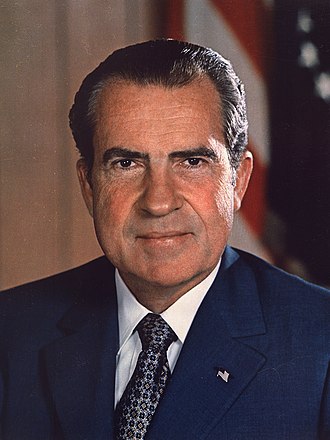
Richard M. Nixon served as the 37th President of the United States from January 1969 until his resignation in August 1974. In February 1971, he ordered the installation of a secret voice-activated taping system in the White House to preserve a historical record of his administration. Until the system's existence was revealed and dismantled in July 1973, the tapes captured Nixon directing major foreign policy initiatives, such as the opening to China, as well as his central role in the Watergate cover-up.
What Nixon talks about on the tapes
White House operations 4,718Presidential scheduling 2,225Public relations 1,784Presidential schedule 1,782Vietnam War 1,693Logistics 1,650Manolo Sanchez 1,626White House communications 1,400White House administration 1,399Presidential communication 1,243Henry Kissinger 1,191Foreign Policy 1,183
Conversations (21,010)
— Page 98 of 211President Nixon met briefly with his personal aide, Stephen B. Bull, to coordinate logistics for a scheduled departure or transportation arrangement. The conversation focused on confirming the readiness of a ride for the President. The meeting concluded once Bull provided the necessary confirmation.
President Nixon contacted the White House operator to request an urgent return call from Press Secretary Ronald L. Ziegler. The President specified that if Ziegler was currently conducting a press briefing, he should be instructed to call the President immediately upon its conclusion. This brief exchange served solely to facilitate a direct line of communication between the President and his press secretary.
President Nixon held a brief, informal meeting with unknown individuals in the Old Executive Office Building. The conversation primarily concerned the President's daily schedule and logistical arrangements regarding current commitments. No substantive policy decisions or historical actions were recorded during this two-minute exchange.
President Nixon instructed the White House operator to avoid contacting Mr. Signer under any circumstances. This brief directive served to filter incoming communications and exclude the individual from the President's schedule. The interaction functioned primarily as an administrative management task regarding the President's accessibility.
President Nixon received a brief status update from the White House operator regarding Press Secretary Ronald L. Ziegler. The communication was intended to inform the President that Ziegler was currently occupied with a press briefing. It was established that Ziegler would initiate a return call to the President immediately upon the conclusion of his duties.
President Nixon held a brief administrative interaction with the White House operator to facilitate a telephone connection. The communication served to initiate an outgoing call, highlighting the routine logistical functions of the presidential switchboard. No substantive policy matters or historical developments were addressed during this exchange.
President Nixon and H. R. Haldeman met to discuss strategic communication regarding the Vietnam War, focusing on the potential release of documents involving Averell Harriman to expose North Vietnamese duplicity. They also evaluated press and public reactions to Henry Kissinger's recent diplomatic missions to Moscow and China, dismissing media skepticism while reaffirming their intent to control the public narrative. Additionally, the President addressed scheduling logistics for an upcoming dinner with congressional leaders and provided feedback on recent speechwriting contributions.
President Nixon and Press Secretary Ronald L. Ziegler discuss the administration's strategy for managing press inquiries regarding Henry Kissinger's secret mission to Moscow and upcoming decisions on Vietnam troop levels. Ziegler reports on his efforts to deflect media criticism by emphasizing the importance of diplomatic secrecy and clarifies that the President's troop level decisions were made independently of Kissinger's trip. The two finalize plans for Ziegler to conduct further press briefings once he receives additional materials from the National Security Council.
President Nixon contacted the White House operator to facilitate an urgent communication with National Security Advisor Henry A. Kissinger. This brief interaction served solely as a logistical request to establish a secure telephone line. No substantive policy matters or further decisions were discussed during this exchange.
President Nixon contacted the White House operator to facilitate a telephone connection with his National Security Advisor, Henry Kissinger. The President requested information regarding Kissinger's current location and instructed the operator to have him return the call. This brief exchange served as a logistical step to secure a direct line for policy deliberations between the two men.
President Nixon contacted the White House operator to facilitate an urgent connection with his Special Counsel, Charles W. Colson. The call served as a brief administrative step to initiate a private consultation between the President and a key political aide. No further policy discussions or substantive dialogue occurred during this exchange.
President Nixon and Charles Colson discuss strategies for exploiting the ongoing turmoil within the 1972 Democratic presidential primaries, specifically focusing on the vulnerabilities of candidates like George McGovern and Edmund Muskie. They also evaluate political messaging regarding the Vietnam War, emphasizing the necessity of secret negotiations and coordinating a robust public relations response to challenge Democratic critics. Nixon directs Colson to intensify political attacks, tasking administration surrogates and Republican candidates with forcing their opponents to answer for their positions on the war.
President Nixon held a brief, two-minute meeting with an unidentified individual in his Old Executive Office Building suite. The brief interaction focused on the President's daily schedule and logistical planning. No substantive policy decisions or additional details were captured during this short exchange.
President Nixon held a brief, two-minute meeting with an unidentified individual to address a technical matter regarding the office audio equipment. The President requested that the participant locate the speaker system within the room. No further policy or administrative matters were discussed during this interaction.
President Nixon met briefly with Alexander P. Butterfield in the Old Executive Office Building to facilitate the receipt of an unspecified item. The interaction was limited to this brief exchange of materials, concluding immediately after the transfer. No further substantive policy matters or strategic discussions were recorded during this brief encounter.
President Nixon met with John K. Andrews, Jr. to coordinate the urgent preparation and review of a speech draft. The President requested an immediate word count and a copy of the document to facilitate his editorial process. This meeting served as a brief administrative session focused on drafting priorities and production deadlines.
President Nixon met with John K. Andrews, Jr. to review and refine a draft of an upcoming speech. The conversation focused on editorial adjustments, specifically centering on the document's word count and overall length. No further major policy decisions were recorded during this brief administrative session.
President Nixon and Henry Kissinger met briefly in the Old Executive Office Building to coordinate their daily agendas. The discussion focused on synchronizing their respective schedules to ensure sufficient time for high-level consultations. No major policy decisions were reached during this administrative exchange.
President Nixon and Henry Kissinger met to refine the President’s upcoming Vietnam speech and discuss the ongoing military and diplomatic situation. Nixon expressed frustration over bureaucratic delays in executing his military orders and emphasized his determination to bypass Secretary of Defense Melvin Laird. The two also analyzed the political impact of the North Vietnamese offensive, the potential effects of Nixon's upcoming summit in Moscow, and the administration's need to maintain a projection of strength against domestic critics.
President Nixon met with H.R. Haldeman to coordinate strategy regarding his upcoming public address on the Vietnam War, focusing on the need for the President to project a personal, authoritative image of the office. They discussed the administration's frustration with media coverage, the necessity of effectively managing public support, and the political implications of the ongoing Democratic primary contests. Nixon directed Haldeman to ensure robust follow-up on the speech and to continue monitoring the activities of Democratic candidates, particularly George McGovern and Edmund Muskie.
President Nixon directs the White House operator to place an urgent telephone call to former President Lyndon B. Johnson. The brief interaction serves solely to initiate this communication channel between the two leaders. No further policy discussions or substantive developments occur during this exchange.
President Nixon met with South Korean officials Kim Yong-sik and Dong Jo Kim, along with Alexander Haig, to reaffirm U.S. security commitments to the Republic of Korea (ROK) amidst the ongoing North Vietnamese invasion. The discussion centered on maintaining a strong defense posture, the modernization of ROK forces, and coordinating strategy ahead of Nixon's upcoming summit in Moscow. Nixon assured the delegation of continued U.S. support despite domestic congressional opposition and emphasized the strategic importance of resisting communist aggression in both Vietnam and Korea.
President Nixon and H.R. Haldeman met to discuss the press strategy and distribution of materials regarding an upcoming televised speech on Vietnam. They decided against releasing the full text of the speech in advance to avoid critical early reporting, opting instead to provide journalists with a summary of key decisions to shape the media narrative. The discussion also touched on the role of Henry Kissinger, the influence of columnist James Reston, and the administration's policy toward dealing with anti-war demonstrators and campus unrest.
President Nixon met with Assistant Secretary of Transportation Herbert F. DeSimone and special counsel Charles W. Colson to express appreciation for DeSimone's service and conduct a brief photograph session. The discussion shifted toward political strategy, specifically leveraging DeSimone’s background to court ethnic voters and mobilize support for the Republican Party. Nixon encouraged DeSimone to campaign in states like New Jersey and New York to help secure electoral success and broaden the party's appeal among traditionally Democratic-leaning demographics.
President Nixon met with Alexander Butterfield and Henry Kissinger to manage his immediate schedule and finalize administrative tasks, including the signing of official documents. The participants coordinated logistics for upcoming appointments, such as a meeting with George Shultz and Herbert Stein, and discussed preparations for a congratulatory call to the Apollo XVI astronauts. This brief session served to organize the President’s agenda and facilitate communication with key staff and external officials.
President Nixon, Henry Kissinger, and H.R. Haldeman met to coordinate the media strategy and final preparations for the President’s upcoming speech on the Vietnam War. They discussed the administration's decision to withhold advance copies of the speech from the press, opting instead to have Kissinger personally brief television networks to ensure control over the narrative regarding North Vietnamese aggression and South Vietnamese resilience. Additionally, the participants reviewed the status of Soviet diplomatic relations, including the status of strategic arms limitation talks and the logistics for the President's upcoming Moscow summit.
President Nixon initiates a brief telephone exchange with the White House operator to request a connection with Charles W. Colson. The call serves as a logistical bridge to facilitate direct communication with his aide. No further policy or substantive matters are addressed during this brief request.
President Nixon held an brief, undocumented meeting with an unidentified individual in the Old Executive Office Building to consult on personal or administrative matters. The discussion remained highly elliptical, with the President seeking the participant's opinion on an unspecified subject. Due to the lack of context and the ambiguity of the transcript, no specific policy decisions or significant administrative actions were recorded.
President Nixon and his personal secretary, Rose Mary Woods, review and refine the draft of an upcoming presidential speech. They discuss specific editorial revisions, including the removal of certain sections concerning South Vietnam to improve the clarity and length of the address. The conversation concludes with a plan for Woods to finalize the edits and submit the draft to the President for a final review.
President Nixon and Henry Kissinger discuss the endgame for U.S. military involvement in Vietnam, debating whether to fully withdraw all personnel or maintain a presence of advisors and civilians. Nixon expresses concern over domestic political pressures and the perception of American weakness, framing the conflict's mounting casualties in the context of historical wars. The discussion centers on maintaining resolve against political critics and the potential impact of the ongoing battle at Kontum on U.S. policy decisions.
President Richard M. Nixon met with his aide, Stephen B. Bull, in the Old Executive Office Building to review and coordinate the President's daily schedule. The discussion focused on administrative planning and the management of his upcoming appointments. No significant policy decisions were recorded during this brief logistical consultation.
President Nixon instructed his personal secretary, Rose Mary Woods, to produce copies of a final speech draft for review. He requested that one copy be sent to Henry Kissinger while another was provided to him for last-minute revisions. This process was intended to finalize the text before Woods prepared the ultimate version of the speech.
President Nixon and his personal secretary, Rose Mary Woods, discuss the staffing requirements for an upcoming presidential trip. The President expresses a preference for recruiting a specific individual, Nellie L. Yates, to join the travel party. He instructs Woods to approach her on the basis of operational necessity, while also authorizing her to seek an alternative candidate should Yates be unavailable.
President Nixon consulted with the White House operator to facilitate an outgoing telephone connection. The brief interaction served as a logistical bridge to initiate a separate, recorded conversation. No substantive policy discussions or significant administrative decisions occurred during this brief exchange.
President Nixon and Charles Colson discuss strategies for managing public perception of the administration's Vietnam policy, focusing on generating support from religious leaders like Cardinal Krol and discrediting political opponents. They emphasize a high-pressure public relations campaign, including coordinated efforts by the Vice President and Senate allies to frame critics as being aligned with communist interests. Additionally, Nixon instructs Colson to formalize a system for generating organized pressure on local television stations to counter critical network news coverage.
President Nixon and Charles Colson discuss campaign strategy regarding the 1972 Democratic presidential primary, focusing on the perceived threat posed by George McGovern and the political maneuvering of other candidates. Nixon instructs Colson to initiate a campaign to pressure major local television network stations in key cities, such as Los Angeles, Chicago, and Miami, to counter media narratives. The two agree on a strategic approach of characterizing political opponents as serious threats to avoid appearing dismissive while maximizing campaign leverage.
President Nixon directs the White House operator to place a telephone call to Admiral Thomas H. Moorer, then serving as Chairman of the Joint Chiefs of Staff. The brief interaction serves as a routine administrative request to facilitate communication between the President and military leadership. No further substantive discussion occurs during this exchange.
President Nixon interacted with the White House operator in the Executive Office Building to facilitate a connection. The brief exchange served as an administrative bridge to initiate a separate, planned communication recorded elsewhere. No substantive policy discussions or decisions were documented during this short operational contact.
President Nixon consulted Admiral Thomas H. Moorer regarding the escalation of bombing campaigns in North Vietnam, specifically authorizing strikes up to Haiphong. The President expressed significant concern regarding the vulnerability of U.S. destroyers to Soviet-supplied gunboats and shore-based rocket attacks. Additionally, Moorer updated Nixon on the deployment schedule of the USS Newport News and the strategic use of destroyers to provide fire support for South Vietnamese ground troops in Military Region Two.
President Nixon and Admiral Thomas H. Moorer held a brief check-in to discuss military readiness following a reported accident. The President sought assurance that personnel were properly prepared to handle the situation, though specific details regarding the nature of the incident remain vague in the transcript. Moorer confirmed the status of ongoing preparations before the call concluded.
President Nixon met with his personal valet, Manolo Sanchez, in the Old Executive Office Building to handle a private matter. The brief interaction focused on the retrieval of an unidentified personal item. No significant policy discussions were recorded during this brief exchange.
President Nixon met with his personal valet, Manolo Sanchez, in the Old Executive Office Building to discuss personal matters. The primary purpose of the brief interaction was for the President to request consommé. No significant political or policy developments occurred during this exchange.
President Nixon and Henry Kissinger met to review and finalize the text of a forthcoming nationally televised address regarding the Vietnam War. They discussed strategic revisions to the speech, emphasizing the prevention of a potential communist bloodbath and the necessity of maintaining U.S. credibility. Kissinger also coordinated with Senator Robert C. Byrd to delay a scheduled Democratic caucus vote on Vietnam policy, aiming to avoid public dissent that could undermine sensitive, ongoing diplomatic efforts in Paris and Moscow.
H. R. Haldeman, Henry Kissinger, and President Nixon coordinated regarding the scheduling of a Senate Democratic caucus, which had been a point of concern for the administration's Vietnam policy strategy. Kissinger reported that Senator Robert C. Byrd successfully delayed the caucus from the following day until the next Wednesday by requiring a formal written request. The group expressed satisfaction with this development, concluding that the delay had been effectively secured through Byrd's intervention.
President Nixon directs his personal secretary, Rose Mary Woods, to prioritize the immediate completion and delivery of his personal copy of an upcoming speech regarding Vietnam. The brief exchange highlights the administrative urgency surrounding the distribution of the text. Beyond the personal copy, the discussion touches on the logistical handling of materials intended for the press.
President Nixon and H. R. Haldeman coordinate the final preparations for an upcoming presidential address regarding the Vietnam War. They clarify a scheduling confusion involving a Democratic caucus and confirm that Henry Kissinger will manage press and television briefings. The discussion concludes with the President insisting on maintaining specific rhetoric within the speech despite internal staff reservations.
President Nixon and H. R. Haldeman discuss the coordination of administration surrogates to manage public perception following the President's recent rhetoric. They address potential scheduling conflicts for key staff members while emphasizing the need for a unified message in response to ongoing political developments. The pair expresses concern over public reaction to the President's previous night's performance and strategizes on how to effectively deploy Henry Kissinger and other officials to reinforce the administration's stance.
President Nixon consulted with an associate regarding the administration’s public response to Democratic opposition concerning the Vietnam War. They discussed how to frame upcoming press interactions to counter political pressure while emphasizing the sensitivity of ongoing peace negotiations. Nixon instructed his aide to advocate for national unity by cautioning that political undercutting could jeopardize delicate diplomatic efforts.
President Nixon held a brief, informal meeting with an unidentified individual in H.R. Haldeman’s office to address a request for a return telephone call. The conversation was limited to logistical coordination regarding this communication. No substantive policy matters or administrative decisions were recorded during this exchange.
President Nixon and Henry Kissinger met to coordinate the handling of Secretary of State William P. Rogers regarding sensitive Vietnam policy and Strategic Arms Limitation Talks (SALT). The two men expressed frustration with Rogers's attempts to claim credit for diplomatic breakthroughs and his potential to leak or interfere with upcoming presidential announcements. To mitigate these concerns, they decided to withhold full drafts of the President’s speech and technical SALT proposals from Rogers until the last possible moment to prevent unwanted revisions or unauthorized disclosure.
President Nixon met with his personal secretary, Rose Mary Woods, to finalize the revisions and word count of a brief but significant speech regarding Vietnam. The discussion touched upon the delicate diplomatic landscape, specifically referencing covert private negotiations in Paris that the administration aimed to obscure from public discourse. Nixon emphasized the speech's strategic ambiguity, noting that while it addressed the implications of ongoing bombing campaigns and Soviet involvement, key diplomatic maneuvers remained intentionally omitted.
President Nixon held a brief, informal meeting with an unidentified individual in Henry Kissinger's office. The conversation consisted primarily of casual social pleasantries regarding personal errands rather than matters of state. No policy decisions, political deliberations, or substantive administrative actions were recorded during this exchange.
President Nixon and H. R. Haldeman briefly coordinate their upcoming movements, intending to conduct a walking meeting through the White House grounds. The discussion focuses on maintaining privacy for a sensitive conversation regarding ongoing military engagements. The participants utilize this walk as a deliberate strategy to ensure the confidentiality of their discourse on the war effort.
President Nixon utilized this session to rehearse his upcoming televised address regarding the intensified North Vietnamese invasion of South Vietnam. The recording captures the President practicing his rhetoric intended to justify the administration's military response to the recent enemy offensive. Following the rehearsal, Nixon briefly took an incoming telephone call, though the conversation appears to have been a mistaken connection.
President Nixon met with H. R. Haldeman and Billy Graham to discuss the upcoming televised address regarding the Vietnam War. Graham offered personal encouragement and political support for the President’s handling of the conflict and his planned trip to Moscow. The President used the time to rehearse the speech, soliciting feedback from Haldeman on its tone and messaging to ensure it projected strength and resolve while avoiding the appearance of defeatism.
President Nixon and H. R. Haldeman met to coordinate messaging regarding upcoming foreign policy developments, specifically focusing on the Strategic Arms Limitations Talks (SALT) and the President's planned visit to Moscow. They discussed managing public and press perception of the administration’s Vietnam strategy and reviewed the internal dynamics of the State Department versus the White House. The conversation also included a critique of Henry Kissinger’s media interactions and his efforts to cultivate a public image amidst high-stakes international diplomacy.
President Nixon contacted the White House operator to facilitate a telephone call to First Lady Pat Nixon. The brief interaction served as a logistical arrangement to connect the President with his wife. No substantive policy matters or further actions were discussed during this brief communication.
President Nixon initiated a brief administrative call through the White House operator to request a connection with Mrs. Jackson. This interaction served solely as a functional step to facilitate personal or official communication. No further policy discussions or substantive developments occurred during this brief exchange.
President Richard Nixon and First Lady Pat Nixon spoke briefly to coordinate their evening arrangements and travel logistics. The conversation centered on the President's upcoming speech preparation and his planned helicopter departure for a trip to Florida. Additionally, the First Lady confirmed her plans to spend the evening with their daughter, Tricia Nixon Cox.
President Richard Nixon and First Lady Pat Nixon held a brief administrative exchange regarding the President's dining plans and upcoming travel schedule. The conversation centered on the President's decision to eat elsewhere before departing for a trip to Florida. The exchange concluded with mutual confirmation of these personal logistical arrangements.
President Nixon held a brief, informal meeting with an unidentified individual in the Old Executive Office Building. The conversation consisted primarily of preliminary greetings and social pleasantries. No substantive policy discussions, political strategy, or official decisions were recorded during this brief encounter.
President Richard Nixon met to rehearse a televised address regarding the North Vietnamese invasion of South Vietnam and the status of the ongoing conflict. He outlined a strategy of continued Vietnamization, authorizing the withdrawal of an additional 20,000 U.S. troops while maintaining air and naval strikes against North Vietnamese military targets. The President also confirmed that Ambassador Porter would return to the Paris peace negotiations with the specific objectives of securing a ceasefire and the release of American prisoners of war.
President Nixon held a brief, informal discussion with an unidentified participant in the Executive Office Building. The recording is largely unintelligible, consisting primarily of casual acknowledgments and short phrases that fail to provide substantive insight into administration policy or decision-making. No identifiable actions, directives, or historical developments were captured in this exchange.
President Nixon met to rehearse a televised address to the nation regarding the ongoing military conflict in Vietnam. He reviewed the progress of his Vietnamization policy, specifically highlighting the significant reduction in American troop levels and combat casualties. The speech was intended to justify his administration's continued military approach while emphasizing efforts to negotiate peace and the eventual withdrawal of U.S. forces.
President Nixon and Henry Kissinger discuss internal administrative friction regarding ongoing arms control negotiations with the Soviet Union, specifically targeting the obstructionist behavior of Gerard C. Smith. Kissinger reports that Smith is attempting to undermine the inclusion of submarine provisions in the potential treaty, a move the Joint Chiefs of Staff strongly oppose. Nixon and Kissinger affirm their decision to proceed with a public statement on the progress of these negotiations to ensure they receive credit and to prevent the Soviets from controlling the narrative via leaks.
President Nixon and Henry Kissinger discuss tactical concerns regarding a forthcoming meeting with an individual identified as Jerry and the navigation of diplomatic or military agreements. The conversation focuses on potential friction points with the Joint Chiefs of Staff and the strategic distribution of credit for ongoing negotiations. They ultimately weigh the risks of withholding information or specific elements of an agreement to maintain control over the policy process.
President Nixon initiates a brief request for the White House operator to connect him with his Chief of Staff, H.R. Haldeman. This administrative interaction serves as a logistical bridge to facilitate direct communication between the President and his primary aide. No further policy or substantive discussion occurs during this short exchange.
President Nixon rehearsed a televised address to the nation regarding the status of the Vietnam War and the ongoing North Vietnamese Easter Offensive. During this session, he outlined three major policy decisions: continuing the withdrawal of American troops with an additional 20,000 men coming home, resuming negotiations in Paris, and maintaining air and naval strikes against North Vietnam until the invasion of the South ceased. The rehearsal served to refine his message of 'peace with honor' while emphasizing the strategic necessity of supporting the South Vietnamese government.
President Nixon consulted with a White House operator to facilitate an outgoing call. The brief exchange focused on establishing a connection with a specific individual, though the target of the call remained unidentified in the available transcript. The conversation serves primarily as a procedural interaction to manage the President's telecommunications.
President Nixon consulted with the White House operator to locate H. R. Haldeman. Upon learning that Haldeman was currently occupied in a briefing in the Roosevelt Room, the President instructed the operator not to interrupt the meeting. No further action was taken regarding the call.
President Nixon contacted the White House operator to cancel a previously requested phone call to his National Security Advisor, Henry Kissinger. He determined that the communication was no longer necessary, noting that he would meet with Kissinger in person later. The call served solely as a brief administrative adjustment to the President’s schedule.
President Nixon held a brief, informal exchange with a White House operator. The conversation appears to be a minor procedural interaction or a technical check regarding phone connectivity. No significant policy decisions or substantive administrative actions were recorded during this brief contact.
President Nixon consulted with the White House operator regarding a scheduled phone call with Dr. Henry Kissinger. The President decided to cancel the arrangement, noting that the call was no longer necessary. He concluded the exchange by opting to meet with Kissinger at a later time.
President Nixon rehearsed his televised address to the nation regarding the ongoing North Vietnamese invasion of South Vietnam. He outlined the administration's military response, the status of the Vietnamization program, and the intent to resume peace negotiations in Paris. The speech reaffirmed his decision to continue air and naval strikes against North Vietnam while simultaneously authorizing the withdrawal of an additional 20,000 American troops.
President Nixon and Henry Kissinger spoke briefly to coordinate upcoming travel plans and discuss diplomatic strategy regarding Gerard C. Smith and ongoing US-Soviet relations. Kissinger updated the President on his staff interactions and upcoming media responsibilities. The President encouraged Kissinger to remain firm in his upcoming public appearances while deferring further tactical discussions until their next meeting.
President Nixon and Henry Kissinger held a brief, informal check-in regarding upcoming travel arrangements and the management of staff operations. Kissinger touched upon an idea concerning an individual named Smith, while the President encouraged Kissinger to prioritize his current workload and documentation. The exchange served primarily as a logistical synchronization before the two departed for separate engagements.
President Nixon delivered a televised "Address to the Nation on Vietnam" from the Oval Office to brief the public on the ongoing conflict and U.S. strategy. During the speech, he condemned the North Vietnamese invasion, announced the continued withdrawal of 20,000 American troops, and reaffirmed his commitment to the Vietnamization program while resuming Paris peace talks. Following the broadcast, the President engaged in casual conversation with the press and television crew, distributing gifts such as cufflinks and pens.
President Nixon held a brief, unscheduled meeting in the Old Executive Office Building with an unidentified individual. The discussion was limited to logistical arrangements, specifically concerning the scheduling of a return phone call. No substantive policy matters or major administrative decisions were recorded during this brief encounter.
President Nixon met with his valet, Manolo Sanchez, in the Old Executive Office Building for a brief, informal encounter. The conversation focused on the President's upcoming schedule and his perspective on his current obligations. The discussion remained personal and administrative in nature, serving as a check-in between the President and a member of his close support staff.
President Nixon and Henry Kissinger met to discuss managing public and media perceptions regarding ongoing Vietnam peace negotiations and the progress of the Strategic Arms Limitation Talks (SALT). Nixon expressed frustration with leaks originating from the State Department, which he believed were inaccurately portraying the administration's stance on cease-fire offers. Kissinger briefed the President on the necessity of controlling the narrative surrounding SALT negotiations to avoid appearing to accept strategic inferiority, specifically regarding submarine limitations. The two agreed on a strategy to maintain a unified public position while downplaying recent press speculation about breakthrough agreements.
President Nixon met with Ronald Ziegler, Stephen Bull, and Rose Mary Woods to coordinate logistical and administrative matters regarding his daily schedule. The discussion involved planning for a meeting with White House secretaries and the preparation of photographs. The participants also touched upon internal staffing details, specifically mentioning Richard Helms and Alexander Butterfield.
President Nixon met with his national security team, including Henry Kissinger, Admiral Thomas Moorer, and Secretary of Defense Melvin Laird, to receive a comprehensive military briefing on the ongoing North Vietnamese Easter Offensive. Admiral Moorer provided a detailed regional analysis of the conflict, noting that while South Vietnamese forces were facing intense pressure and heavy casualties, they were holding key positions with the crucial assistance of U.S. air power and naval support. The President emphasized that the conflict would remain difficult but reaffirmed his commitment to maintaining air support and striking military targets in North Vietnam until the offensive subsided.
President Nixon met with Henry Kissinger, William Rogers, and several senior staff members to coordinate U.S. strategy regarding the upcoming Soviet Summit, the Strategic Arms Limitation Talks (SALT), and the ongoing North Vietnamese offensive. The discussions focused on ensuring a firm stance against Soviet-backed North Vietnamese aggression while maintaining diplomatic progress toward a SALT agreement. Nixon directed staff to prepare specific messaging for Ambassador Gerard Smith to ensure that U.S. negotiating positions were clearly defined as presidential directives, and he emphasized the need for a decisive military response—including a significant B-52 strike—should the North Vietnamese fail to halt their offensive operations.
President Nixon and Henry Kissinger met to discuss strategy for the upcoming negotiations with North Vietnamese representative Le Duc Tho, emphasizing a firm stance against the ongoing North Vietnamese offensive. They analyzed the effectiveness of the South Vietnamese military, noting significant tank losses attributed to heavy Soviet-supplied artillery, and debated the risks and potential PR fallout of intensified U.S. bombing campaigns. The President directed Kissinger to convey a clear, unwavering resolve to the North Vietnamese, asserting that the U.S. would not accept defeat or reward aggression.
President Nixon, H. R. Haldeman, and Henry Kissinger met to discuss critical updates regarding the North Vietnamese offensive and upcoming diplomatic negotiations, including the status of the Soviet summit. They analyzed recent military reports from General Creighton Abrams regarding the Army of the Republic of Vietnam's (ARVN) wavering performance and morale, while debating the necessity of intensified U.S. bombing in North Vietnam. The participants also reviewed strategic disagreements within the administration—specifically regarding Secretary of State William P. Rogers—concerning the Strategic Arms Limitation Talks (SALT) and the handling of Soviet submarine limits.
President Nixon met with Alexander P. Butterfield to finalize administrative details regarding the President's upcoming schedule. The discussion centered on securing the President’s approval for a specific agenda item, specifically addressing a scheduled appearance by Henry Kissinger. The brief interaction concluded with the confirmation of these logistical arrangements.
President Nixon contacted the White House operator to facilitate a telephone connection with his National Security Advisor, Henry A. Kissinger. This interaction served purely as an administrative step to reach a key foreign policy official during a critical period. No substantive discussion occurred between the President and the operator beyond the request to initiate the call.
President Nixon and Henry Kissinger discuss high-stakes negotiations regarding the Vietnam War, focusing on the potential for renewed bombing of Hanoi and Haiphong to strengthen the U.S. bargaining position. They assess military leadership under General Creighton Abrams and evaluate strategies for communicating resolve to both the North Vietnamese and the Soviet Union. Nixon emphasizes his preference for a firm, disciplined negotiating approach, comparing his method to a poker player who refuses to bluff, while also touching on the importance of maintaining public and political support for these hard-line policies.
President Nixon initiated a brief administrative request to the White House operator to place a telephone call to National Security Advisor Henry A. Kissinger. This interaction reflects the standard procedural workflow for the President to secure private communication lines with his key foreign policy advisor. No substantive policy discussions occurred during this brief request for connection.
President Nixon directs Henry Kissinger to adopt a specific strategic posture during ongoing Vietnam negotiations by projecting an image of the President as being unpredictable and beyond control. By conveying a sense of despair regarding his own lack of influence over Nixon's future actions, Kissinger is instructed to pressure the North Vietnamese negotiators into offering substantive concessions. This tactical maneuver aims to leverage the threat of unspecified presidential retaliation to force a breakthrough in the diplomatic deadlock.
President Nixon contacted the White House operator to facilitate an immediate call to his Press Secretary, Ronald L. Ziegler. The brief exchange served strictly as a procedural request to initiate communication with a key staff member. No further substantive policy matters were discussed during this connection.
President Nixon consulted with Press Secretary Ronald Ziegler to evaluate the reception of a recent administration announcement regarding high-level diplomatic channels. Ziegler confirmed that the networks successfully grasped the significance of confidential exchanges between Nixon and Leonid Brezhnev, as well as Henry Kissinger's facilitating role. Nixon expressed frustration with negative press coverage, specifically targeting Howard K. Smith, before directing Ziegler to summon Kissinger for a follow-up meeting.
President Nixon contacted the White House operator to facilitate a telephone connection with his National Security Advisor, Henry Kissinger. This brief administrative interaction served as a formal request to initiate communication regarding time-sensitive national security or diplomatic matters. No further substantive details are available due to the absence of a recorded transcript.
President Nixon and Henry Kissinger discuss the logistics and urgency of a pending trip, contingent upon progress in secret negotiations. They confirm the necessity of utilizing secure channels to send communications immediately to meet a specific deadline. The conversation serves to ensure that the necessary arrangements are underway to facilitate a potential departure on Friday.
President Nixon met with his aide Stephen B. Bull to coordinate the scheduling of his upcoming appointments and administrative announcements. The discussion focused on establishing a specific timeframe for a scheduled meeting, including potential adjustments based on the availability of Alexander M. Haig, Jr. They concluded by agreeing that 5:00 p.m. would serve as the firm deadline for these commitments.
President Nixon met with Alexander M. Haig, Jr. to coordinate scheduling and logistical arrangements for upcoming executive meetings. The brief exchange focused primarily on confirming the President's availability and managing his immediate briefing agenda. No major policy decisions were reached, as the discussion was confined to administrative movement and sequence of appointments.
President Nixon met with H. R. Haldeman and Alexander Haig to discuss the death of J. Edgar Hoover and the ongoing military crisis in Vietnam. The group addressed administrative arrangements for Hoover's funeral while focusing heavily on the deteriorating situation in Quang Tri and the performance of South Vietnamese forces. Nixon pushed for intensified U.S. air strikes against Hanoi and Haiphong, rejecting recommendations for caution from his advisors and insisting that such action was vital to restore domestic support and strengthen the U.S. bargaining position ahead of upcoming international summits.
President Nixon and H.R. Haldeman discuss the immediate administrative aftermath following the death of FBI Director J. Edgar Hoover. The conversation focuses on managing the public announcement of Hoover's passing, coordinating memorial services, and determining the leadership transition at the FBI. Nixon expresses his desire to publicly praise Hoover’s career and legacy while considering the viability of Clyde Tolson as a temporary successor, despite concerns regarding Tolson’s health.
President Nixon and H. R. Haldeman discussed the leadership transition at the FBI following the death of J. Edgar Hoover, including the strategic timing of the official announcement. The conversation also touched upon the appointment of Lt. Gen. Vernon A. Walters to the CIA, focusing on his Senate confirmation prospects and personal loyalty. Nixon expressed concerns regarding the delay in managing the public announcement of Hoover's passing, tasking staff with expediting the process.
President Nixon met with his personal valet, Manolo Sanchez, in the Old Executive Office Building. The brief discussion centered on scheduling logistics and a request for a meeting. No significant policy developments or major political decisions were recorded during this interaction.