Brennan, Peter J.
Peter J. Brennan began the Nixon taping period as president of the Building and Construction Trades Council of Greater New York, a role he held from October 1957 until January 1973. After organizing pro-administration "Hard Hat" rallies and securing crucial union support for Nixon's 1972 reelection, Brennan transitioned from a regional labor leader to a federal cabinet official. He was appointed U.S. Secretary of Labor, serving in this position from February 1973 until March 1975, which covered the remainder of the White House taping period.
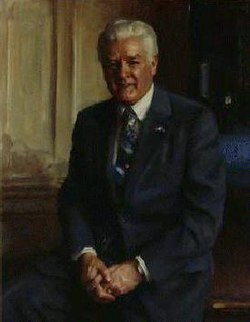
President Nixon met with Charles Colson and labor leader Peter Brennan to discuss strengthening political support from construction unions, specifically regarding the administration's foreign policy and the Vietnam War. They addressed the controversy surrounding the recent publication of the Pentagon Papers and the perceived bias of mainstream media outlets. Additionally, the group reviewed domestic challenges including union frustrations with minority hiring initiatives, the management of urban issues in New York City, and the economic impact of environmental regulations on major construction projects.
President Nixon directs Patrick J. Buchanan to secure a formal response from Henry Kissinger regarding the administration's stance on East-West trade. The conversation focuses specifically on the Kama River project, with the President emphasizing the need for a positive public relations strategy to highlight existing progress. Buchanan confirms the request and notes that Kissinger has already prepared relevant talking points regarding current trade developments.
President Nixon and labor leader Peter J. Brennan discussed the potential appointment of a candidate to a Department of Labor position, for which the President offered his personal endorsement. The conversation also touched upon the political climate, including Brennan's favorable impression of Teamster official Joseph Trerotola. Finally, Nixon briefed Brennan on the escalating military situation in Vietnam and solicited his support for anticipated, stronger U.S. actions intended to secure the release of American POWs.
President Nixon met with Henry Kissinger and H.R. Haldeman to finalize the decision to initiate a naval blockade and intensified bombing campaign against North Vietnam, a move Nixon viewed as essential to prevent a defeat in the war and preserve American credibility. The discussion focused on coordinating the strategy to ensure secrecy, managing potential friction with Secretary of Defense Melvin Laird and Secretary of State William Rogers, and addressing the geopolitical implications of a confrontation with the Soviet Union. Nixon directed his team to maintain a facade of normalcy to mask the impending escalation while simultaneously emphasizing the necessity of absolute loyalty and silence from his staff to prevent leaks.
President Nixon met with Patrick J. Buchanan to discuss campaign strategy, press relations, and managing the political fallout from the 1972 presidential election. The two focused on countering the perceived double standards of the liberal media, which they argued were shielding George McGovern from accountability while unfairly attacking the Nixon administration. Nixon directed Buchanan to orchestrate a public counterattack, emphasizing the need to frame the election as a repudiation of radical ideologies—such as busing, welfare, and permissive social policies—rather than just a critique of the McGovern campaign's style.
President Nixon met with Patrick J. Buchanan at Camp David to discuss administrative matters, specifically focusing on the handling of form letters. The conversation touched upon the involvement of Rose Mary Woods in these correspondence processes. No further significant policy decisions were recorded during this brief exchange.
President Nixon met with aide Patrick J. Buchanan to discuss the President's health and coordinate political strategy regarding recent press coverage of the 1972 campaign. They reviewed a critical New York Times article and analyzed the internal divisions within the Democratic Party. Nixon specifically instructed Buchanan to continue emphasizing the association between George McGovern and Edward M. Kennedy to prevent the latter from distancing himself from the failed campaign.
In this extensive Oval Office meeting, President Nixon, H.R. Haldeman, Henry Kissinger, and other key advisors discussed the administration's second-term reorganization, personnel appointments (including John Scali as UN Ambassador), and public relations strategies. A significant portion of the conversation focused on the status of Vietnam peace negotiations, with Nixon emphasizing a hardline approach, including the escalation of bombing and mining operations to pressure North Vietnam. The President also provided specific directives for handling the press and managing the White House social schedule, including the exclusion of certain media outlets and the coordination of internal White House renovations.
Herbert Stein, Donald Rumsfeld, and George Shultz met with prominent labor union leaders to discuss the state of the economy and federal productivity initiatives. The discussion touched upon current economic indicators, including farm prices, and featured planning for an upcoming productivity exhibit at the Smithsonian Institution. The meeting served as a consultative session between the administration and labor representatives regarding ongoing economic policy and the Productivity Commission's objectives.
President Nixon met with the National Commission on Productivity, including various labor union leaders and administration officials, to express his appreciation for their voluntary service and to emphasize the necessity of labor-management cooperation in national economic policy. Nixon encouraged the members to offer input beyond labor issues and reaffirmed that his door remains open for direct engagement between the White House and organized labor. The discussion also touched on specific policy concerns, including maritime programs, grain exports, and the challenges faced by local unions.
President Nixon met with Patrick J. Buchanan to discuss the framework and themes for a prospective book about the Nixon administration. The conversation focused on framing Nixon’s political career as a narrative of overcoming adversity, specifically highlighting his 1968 comeback and the ideological battles against the "liberal establishment" and the national media. They also analyzed campaign strategies, the importance of maintaining emotional detachment from press criticism, and the effective, strategic use of television to communicate directly with the American public.
President Nixon met with Col. Richard T. Kennedy and Peter J. Brennan to strategize the final stages of the Vietnam peace negotiations, emphasizing that the U.S. would move forward with an agreement regardless of South Vietnamese President Nguyen Van Thieu's reservations. Nixon instructed that information regarding these sensitive talks be tightly controlled to prevent interference from State Department staff or other officials. The group also discussed the timing of a potential ceasefire announcement, the management of international relations with foreign heads of state, and the necessity of maintaining pressure on South Vietnamese leadership to ensure a successful outcome.
President Nixon called Secretary of Labor-designate Peter J. Brennan to offer encouragement and support regarding his ongoing confirmation process. The two discussed the challenges Brennan faced during the hearings, specifically noting the critical coverage by The Washington Post. Nixon dismissed the negative press as predictable, affirming his confidence in Brennan’s ability to navigate the scrutiny successfully.
In this meeting, President Nixon met with his Vice President, Cabinet, and senior staff to provide a briefing on the impending Vietnam cease-fire agreement, scheduled for signing on January 27, 1973. National Security Advisor Henry Kissinger detailed the arduous negotiation process, emphasizing that the agreement achieved key U.S. objectives including the return of POWs, the withdrawal of American forces, and the right of South Vietnamese self-determination. Following the Vietnam discussion, the President transitioned to a briefing on the fiscal year 1974 budget, where Director Caspar Weinberger presented plans for spending cuts and program terminations designed to maintain a full-employment balance and avoid tax increases.
President Nixon met with his Vice President, Cabinet members, and senior staff to conduct a briefing on the upcoming federal budget. The discussion focused on the necessity of fiscal restraint, including the reduction and termination of certain government programs, to avoid tax increases and curb inflationary pressures while maintaining an expanding economy. Cabinet members analyzed projections for the 1974 and 1975 budgets, emphasizing the shift in spending priorities from defense toward human resources and the importance of presenting the budget to Congress and the public as a responsible alternative to higher taxation.
President Nixon and his Cabinet members strategized on how to promote the administration’s 1974 budget and defend proposed spending cuts against inevitable Congressional and lobbying opposition. The participants emphasized shifting from a constituency-based political strategy to a national message centered on fiscal responsibility, specifically using the themes of 'jobs' and 'taxes' to appeal to working-class voters. Nixon underscored the necessity of forcing Congress to accept accountability for spending, ultimately positioning the administration to blame Democrats if tax increases become required to fund legislative priorities.
President Nixon consults with Patrick J. Buchanan regarding the manuscript for Buchanan's upcoming book. Nixon expresses strong disapproval of a passage describing the anti-war peace movement as possessing moral courage and conviction. Buchanan quickly agrees to remove the controversial language from the text, successfully satisfying the President's demand.
President Nixon held a brief, informal check-in with Patrick Buchanan, though the transcript provides insufficient context to determine the specific subject matter discussed. The exchange suggests a casual administrative update or a follow-up to previous ongoing business. No substantive policy decisions or action items were captured during this extremely short interaction.
President Nixon speaks with Patrick J. Buchanan to coordinate the preparation of briefing materials for Press Secretary Ronald L. Ziegler. The President emphasizes his desire to incorporate Henry Kissinger's specific perspectives into responses for upcoming inquiries. Buchanan confirms that the necessary information is being gathered and arranges to consult with Kissinger that evening.
President Nixon held a brief introductory meeting with Secretary of Labor Peter J. Brennan following Brennan's confirmation. The discussion served as a formal greeting between the President and his new cabinet member. No substantive policy decisions or action items were addressed during this minute-long exchange.
President Nixon directed Patrick J. Buchanan to gather data on civilian casualties attributed to North Vietnamese and Viet Cong forces during the Vietnam War. This request was intended to counter what the President perceived as biased and distorted reporting by the New York Times regarding war atrocities. Nixon specifically sought evidence of deliberate targeting and assassinations to highlight the enemy's disregard for civilian life.
President Nixon requested an urgent assessment concerning civilian casualties and infrastructure destruction resulting from recent military operations. He sought specific data on the number of non-combatant deaths and associated collateral damage to inform his ongoing briefings. This brief exchange prioritized the compilation of accurate casualty figures for administrative review.
President Nixon consulted with Patrick J. Buchanan to prepare for an upcoming press conference regarding the Watergate scandal. Nixon expressed concerns that previous public statements by John Ehrlichman were unhelpful and directed Buchanan to coordinate with John Dean and H.R. Haldeman to develop a strategy. The President decided to adopt a position of silence on the Watergate case due to pending litigation, while also formulating specific responses to anticipated questions regarding executive privilege, staff involvement, and the scope of internal White House investigations.
President Nixon consults with Patrick J. Buchanan to strategize responses to potential media inquiries regarding the ongoing Watergate scandal. The discussion focuses on maintaining a consistent public stance, specifically distancing the administration from the burglary while reinforcing confidence in the internal investigation conducted by John Dean. Nixon emphasizes the need for a restrained, unified messaging approach when addressing questions from the press or Congress.
President Nixon met with Ronald Ziegler, Peter Brennan, and Henry Kissinger to prepare for an upcoming press conference. The discussion focused on crafting responses to inquiries regarding the Vietnam peace settlement, postwar diplomatic and economic relations, and the Watergate scandal. The participants evaluated how to address potential questions about Watergate investigations while maintaining a stance of cooperation with Congress and avoiding premature comments on ongoing legal proceedings.
President Nixon and Patrick J. Buchanan discuss the public and political reception of the President's recent press conference, focusing specifically on the administration's hardline stance against amnesty for Vietnam draft evaders. Nixon emphasizes his commitment to achieving "peace with honor" in Vietnam, expressing frustration that critics and the media have failed to acknowledge the achievement. Both men agree that those who avoided service should face legal consequences rather than perform alternative service in the Peace Corps, and they note with surprise the absence of questions regarding the Watergate scandal.
President Nixon and Peter J. Brennan discuss the political implications and public perception of a potential amnesty policy for Vietnam War-era draft evaders. Nixon proposes an alternative to simple pardons, suggesting that individuals could fulfill a service requirement, such as police work, rather than being sent away. The brief exchange highlights the administration's search for a viable, socially acceptable resolution to the contentious amnesty issue.
President Nixon met with Vice President Agnew, Cabinet members, and key staff to discuss recent foreign policy developments and economic strategy. Vice President Agnew briefed the group on his recent tour of Southeast Asian nations, while Treasury officials and Cabinet members deliberated on international monetary policy, trade barriers, and the need for a more competitive U.S. industrial posture. The President emphasized the importance of maintaining international engagement, securing legislative tools for trade negotiations, and justifying reconstruction aid for Vietnam as a strategic security necessity rather than purely humanitarian relief.
President Nixon and Patrick J. Buchanan coordinate the scheduling of an upcoming presidential press conference to avoid conflict with major announcements regarding Henry Kissinger’s briefings on China and North Vietnam. Nixon determines that delaying the press conference until the following Tuesday will allow time for developments with Egypt and ensure he can effectively address domestic and foreign policy concerns, particularly Vietnam. During the call, Nixon emphasizes the importance of framing the Vietnam War as a matter of national credibility rather than solely focusing on the return of prisoners of war.
President Nixon met with Secretary of Labor Peter J. Brennan to discuss administrative scheduling and the coordination of departmental activities. The discussion touched upon the heavy workload facing the administration and the need to streamline internal communications and test procedures. Additionally, the President briefly emphasized the importance of addressing the status and welfare of prisoners, suggesting a need for increased attention toward this issue.
President Nixon met with Secretary of Labor Peter J. Brennan and members of the National Committee of Jobs for Veterans to discuss the status of veteran employment programs and strategies for their eventual phase-out. The participants reviewed progress on job placement goals, addressed concerns regarding the competition between returning veterans and draft evaders, and finalized plans for an "Honor Veterans Week" to coincide with the return of the final POWs. Nixon emphasized the importance of a robust economy and addressed potential tensions surrounding affirmative action and minority hiring programs in the private sector.
President Nixon and Patrick J. Buchanan coordinated the delivery of a briefing memorandum intended to help the President prepare for an upcoming press conference. The discussion focused on streamlining responses to expected questions, particularly regarding the status of Prisoners of War (POW). Additionally, Buchanan provided an update on the current media coverage and political setbacks facing the Equal Rights Amendment (ERA).
President Nixon met briefly with Secretary of Labor Peter J. Brennan to coordinate scheduling and discuss the progress of an unspecified administrative project or report. Nixon directed Brennan to limit the scope of his work on the update, suggesting that there was little substantive value to be gained from further elaboration. The brief exchange concluded with an agreement to meet again at 6:30 or 7:00.
President Nixon and Patrick J. Buchanan coordinate preparations for an upcoming press conference by reviewing potential questions and developing strategic responses. They discuss handling sensitive political topics, including the monetary crisis, the Wounded Knee occupation, campaign fundraising controversies, and inquiries stemming from L. Patrick Gray’s ongoing FBI testimony regarding Watergate. The President decides to adopt a non-committal stance on active investigations, specifically regarding the Watergate and Gray hearings, to avoid prematurely addressing evolving controversies.
President Nixon met with Secretary of Labor Peter J. Brennan to discuss current political optics and personnel management strategies. The dialogue centered on the administration's approach to labor and economic leaders, specifically regarding the handling of individuals like Shelton and the broader implications of currency fluctuations. The discussion concluded with the President indicating a relaxed stance toward certain administrative staffers, suggesting a desire to move past recent controversies.
President Nixon met with Secretary of Labor Peter Brennan to discuss a recent industrial accident and the administration's response to it. Nixon encouraged Brennan to personally visit the site to demonstrate federal concern for worker safety and to emphasize the administration's commitment to safety regulations. Brennan was directed to investigate whether any federal safety violations occurred and to report his findings back to the President.
President Nixon and Patrick Buchanan discuss the positive press coverage surrounding the President's recent radio address on crime and law enforcement. The two agree that advocating for the death penalty and criticizing lenient judges and probation officers is a politically advantageous strategy that resonates with both their base and urban Democrats. Additionally, the President outlines his plan to deflect inquiries regarding the Watergate scandal during upcoming press conferences by refusing to comment on ongoing Senate committee hearings.
President Nixon and Patrick J. Buchanan discuss the positive public reception and strategic messaging of the President’s March 29 televised speech regarding Vietnam and the return of POWs. The two emphasize the importance of framing the conflict as a success brought about by presidential resolve, while criticizing political opponents for their stance on the war and proposed defense budget cuts. Nixon also addresses the Watergate scandal, noting his deliberate decision to omit the topic from the speech to avoid becoming bogged down in controversy.
President Nixon consults with Patrick J. Buchanan regarding a recent speech he personally drafted to address public divisions, military policy, and the administration's legislative agenda. Nixon expresses frustration with political opponents and emphasizes the necessity of taking a firm, combative stance against critics of his defense budget and military actions in Southeast Asia. The discussion also touches on the President's internal debate over how to publicly address the Watergate controversy and whether he should rely on staff affidavits to defend his administration's integrity.
President Nixon met with Secretary of Labor Peter J. Brennan and Kenneth R. Cole, Jr. to discuss political strategy regarding organized labor, specifically the administration's ongoing tensions with AFL-CIO leader George Meany. They reviewed the administration's legislative agenda, including the minimum wage, unemployment insurance for strike victims, and the Alaska Pipeline, while emphasizing the need to maintain strong support from the Building Trades unions. The discussion concluded with a focus on managing the President's upcoming appearance before labor groups and balancing the competing economic interests of labor and the business community.
Secretary of Labor Peter J. Brennan met with Stephen B. Bull and an unidentified individual in the Oval Office to discuss administrative logistics and scheduling. The brief interaction focused on organizing the President's upcoming agenda and facilitating introductions. The meeting concluded quickly without recorded policy deliberations.
President Nixon met with his Cabinet and key staff to coordinate messaging and strategy on pressing administration priorities, specifically energy policy, economic inflation, and the ongoing Watergate investigations. Nixon urged his officials to actively support the administration's legislative agenda, particularly in the face of rising economic concerns and energy supply challenges. He emphasized the necessity of a unified, firm stance against political pressure, framing the current crises as manageable problems rather than catastrophic failures. Additionally, Nixon underscored his commitment to a thorough investigation into Watergate, stressing the need to maintain public order and confidence while the legal process unfolded.
President Nixon consulted with Pat Buchanan regarding the administration's response to the intensifying Watergate scandal, which they characterized as a 'hell week.' Buchanan confirmed he had submitted written recommendations to Press Secretary Ron Ziegler concerning a necessary public relations strategy to manage the political fallout and damaging leaks. The two also briefly discussed the unfortunate involvement of John Mitchell as he prepared for his grand jury appearance.
President Nixon and Secretary of Labor Peter J. Brennan met briefly to discuss the administration's ongoing struggle with the intensifying Watergate scandal and the negative impact of unauthorized leaks. Nixon emphasized the necessity of surviving the political crisis and outlined the need for a more coherent public relations strategy to protect innocent staff members from unfair allegations. The two men also confirmed that Brennan had submitted his policy recommendations for upcoming initiatives.
In this meeting, President Nixon addressed his Cabinet and senior staff regarding the recent departures of top aides H.R. Haldeman and John Ehrlichman, framing the transition as a necessary move to restore stability amidst the escalating Watergate investigation. Nixon emphasized the importance of maintaining public trust, directed the staff to cooperate fully with investigators, and insisted that the White House avoid any appearance of a cover-up. Cabinet members and staff discussed the administration’s focus on governance, foreign policy, and economic management, reaffirming their collective commitment to the President's agenda despite the political crisis.
President Nixon met with Vice President Agnew and his Cabinet to discuss the ongoing impact of the Watergate scandal on the administration, personnel changes, and the need to maintain governmental stability. Key topics included the appointment of a special prosecutor, the selection of Elliot Richardson, and the importance of professional coordination between the White House and Cabinet departments to ensure the administration's 1972 election mandate remained the primary focus. Nixon emphasized the necessity of improving Congressional relations and maintaining morale within the bureaucracy despite the political distractions caused by the Ervin Committee hearings.
President Nixon and Vice President Agnew met with the Cabinet and senior staff to discuss major foreign and domestic policy priorities and internal administration management. The discussion centered on upcoming diplomatic summits with Leonid Brezhnev and Georges Pompidou, negotiations with North Vietnam regarding the ceasefire, and economic challenges including inflation and energy policy. Additionally, General Alexander Haig briefed the Cabinet on the administration's efforts to stabilize internal governance, improve relations with Congress, and manage the ongoing political fallout from the Watergate scandal.
President Nixon met with his Cabinet and key legislative leaders to discuss the restructuring of domestic policy operations, the appointment of Clarence M. Kelley as FBI Director, and strategies for improving congressional cooperation. Nixon emphasized a team-based approach to policy formulation, delegating significant oversight to Mel Laird, and urged Cabinet members to actively engage with Congress to pass the administration's legislative agenda. The discussion also addressed the administration's response to inflation, the importance of maintaining public morale amidst the Watergate crisis, and the necessity of presenting a unified, forward-looking policy front to the American people.
President Nixon met with Vice President Agnew and his Cabinet to discuss the transition from the current wage and price freeze to a "Phase IV" economic policy. The President emphasized the need to balance controlling inflation with maintaining domestic production, while acknowledging the political difficulty of removing controls due to congressional and public pressure. Key developments included the administration's resolve to move toward a free-market economy as quickly as possible, coupled with a renewed commitment to fiscal austerity and a balanced federal budget to bolster economic confidence.