Nixon, Richard M. (President)
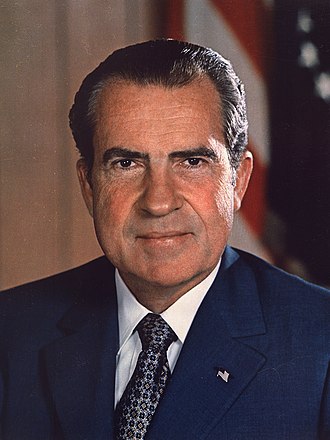
Richard M. Nixon served as the 37th President of the United States from January 1969 until his resignation in August 1974. In February 1971, he ordered the installation of a secret voice-activated taping system in the White House to preserve a historical record of his administration. Until the system's existence was revealed and dismantled in July 1973, the tapes captured Nixon directing major foreign policy initiatives, such as the opening to China, as well as his central role in the Watergate cover-up.
What Nixon talks about on the tapes
White House operations 4,718Presidential scheduling 2,225Public relations 1,784Presidential schedule 1,782Vietnam War 1,693Logistics 1,650Manolo Sanchez 1,626White House communications 1,400White House administration 1,399Presidential communication 1,243Henry Kissinger 1,191Foreign Policy 1,183
Conversations (21,010)
— Page 12 of 211President Nixon and H. R. Haldeman discussed adjusting the President's public appearance schedule, specifically weighing potential engagements with the American Legion and the Veterans of Foreign Wars for the 1971 and 1972 calendar years. The President also outlined a strategic objective regarding international trade policy, directing that trade relations with the People's Republic of China be normalized to the same status as those held with the Soviet Union and other communist nations. These directives served as key instructions for the administration's upcoming domestic and foreign policy communications.
President Nixon met with Betty Graham to dictate a memorandum focused on managing the administration's outreach to various religious factions. The President sought to balance engagement between conservative religious leaders and liberal groups, acknowledging the challenges of maintaining support across the ideological spectrum. This directive aimed to formalize a strategy for consistent White House communication and service to these disparate religious communities.
President Nixon and George P. Shultz met to discuss the management of budgetary constraints and the administration's fiscal policy in relation to key congressional figures like Russell B. Long. The President sought to navigate complex appropriations challenges by re-examining current policies to better support political allies. Additionally, they touched upon scheduling matters involving Emil Mosbacher, Jr., the Coral Sea project, and coordination efforts with Gerald R. Ford.
President Nixon and Henry Kissinger met to deliberate on the administration's public relations strategy regarding the ongoing conflict in Vietnam. The discussion focused on addressing negative press coverage and managing the political implications of critical reports. Nixon initiated the session to dictate a memorandum outlining potential administrative responses to dampen public opposition and control the narrative surrounding the war effort.
President Nixon dictated a memorandum to his personal secretary, Rose Mary Woods, regarding logistical adjustments to his upcoming schedule, including an invitation for Alice Lewis to attend church services. The discussion also addressed a proposal to purchase a church, which Nixon authorized contingent upon ensuring no adverse foreign policy implications. Additionally, the President reviewed his stance on the Turkish poppy crop, contrasting his position with the views of an unidentified individual.
President Nixon met with his personal secretary, Rose Mary Woods, to dictate administrative directives concerning his upcoming schedule and specific policy initiatives. The President requested arrangements for meetings with George Allen, regarding Dwight D. Eisenhower, and railroad executives, with Peter M. Flanigan tasked to coordinate. Additionally, Nixon issued instructions to prioritize the withdrawal of the Peace Corps from the Marianas Islands.
President Nixon met briefly with his personal aide, Stephen B. Bull, to review the President’s morning schedule. The primary focus of the discussion was the upcoming arrival of H.R. “Bob” Haldeman. The meeting concluded immediately after these logistical arrangements were addressed.
President Nixon met briefly with an unidentified individual to coordinate his morning schedule. The discussion focused on logistical arrangements regarding a planned meeting with Vice President Spiro T. Agnew, specifically concerning Agnew's current location. The encounter concluded after one minute, with the unknown visitor departing immediately thereafter.
President Nixon met briefly with Alexander P. Butterfield in the Oval Office to address logistical details regarding the President's daily schedule. The discussion was restricted to administrative coordination of upcoming appointments and obligations. No further substantive policy matters were recorded during this brief encounter.
President Nixon, Vice President Agnew, and H. R. Haldeman discuss the recent disruptions by anti-war demonstrators in the Senate galleries and the media's biased coverage of the event. The group analyzes the tactical behavior of protesters, including their plans to target Selective Service offices and train for future demonstrations. Nixon expresses frustration with the news media's portrayal of Republican senators' roles in clearing the galleries while Agnew updates the President on protest activity near government facilities.
President Nixon met with his Cabinet and key staff to coordinate legislative strategies and manage domestic policy agendas. The discussion focused on securing passage for welfare reform and other administration priorities by engaging directly with congressional leadership and balancing competing interests within the labor market. Participants assessed the challenges of mobilizing support among both Democrats and Republicans and emphasized the necessity of persistent lobbying and effective communication with legislative committees.
President Nixon met with H. R. Haldeman, Stephen B. Bull, and an unidentified individual to coordinate the logistics for an upcoming swearing-in ceremony. The discussion focused on scheduling the arrival of guests, including James C. Fletcher and James A. Belson, to ensure the event proceeded according to the President's itinerary. Following these administrative arrangements, the President and his staff departed the Oval Office.
President Nixon and H. R. Haldeman convened to coordinate the executive schedule, focusing specifically on upcoming appointments. The discussion centered on arrangements for meetings with Attorney General John N. Mitchell and National Security Advisor Henry A. Kissinger. This brief administrative consultation served to organize the President’s priorities and manage key staffing interactions for the day.
President Richard M. Nixon met with his aide Stephen B. Bull in the Oval Office to coordinate his daily schedule. The primary purpose of the brief interaction was to manage logistics regarding an upcoming appointment with National Security Advisor Henry A. Kissinger. No significant policy decisions were recorded during this brief administrative exchange.
President Nixon met with Henry Kissinger and subsequently with Henry Ford II and Lee Iacocca to discuss major policy and political concerns. The conversation with Kissinger focused on Vietnam strategy, including the management of public perception, the administration's frustration with the 'establishment' and anti-war activists, and the President's diplomatic initiatives regarding the People's Republic of China. Later, Ford and Iacocca briefed the President on the economic and logistical burdens placed on the auto industry by Department of Transportation and environmental regulations, specifically regarding safety, emissions, and bumper standards. Nixon acknowledged the industry's concerns, emphasizing the need to balance safety and environmental goals with the economic realities of maintaining a competitive U.S. automotive sector.
President Nixon met with Postmaster General Winton Blount and George Shultz to discuss ongoing U.S. Postal Service labor negotiations and the administration's strategic focus on restoring management rights in exchange for wage increases. The participants also explored strategies for hiring retired military personnel to fill high-level postal reorganization roles, leveraging their organizational discipline. Finally, they touched upon the 1972 election landscape, specifically the potential political impact of George Wallace’s candidacy on Nixon’s electoral prospects in the South and among Northern blue-collar voters.
President Nixon hosted William Perkins, Gary Perkins, and John S. Davies in the Oval Office for a brief, informal meeting. The discussion focused on the room's decor, specifically the presidential seal, and Nixon’s daily schedule regarding diplomatic ceremonies and the reception of foreign ambassadors. The meeting concluded with Nixon presenting his guests with commemorative gifts, including cuff links and golf balls.
President Richard M. Nixon met with his personal aide, Stephen B. Bull, to review and finalize scheduling logistics. The discussion focused on managing the President's upcoming commitments and logistical arrangements for his daily agenda. Following the brief consultation, both individuals departed the Oval Office to proceed with the scheduled activities.
President Nixon met with his personal valet, Manolo Sanchez, in the Old Executive Office Building to discuss administrative details regarding the President's upcoming schedule. The brief conversation primarily focused on logistical arrangements for the President's personal movements. No major policy decisions were recorded during this interaction.
President Nixon met with his personal valet, Manolo Sanchez, in the Old Executive Office Building to discuss general matters regarding the President's daily schedule. The conversation was informal and brief, primarily centering on the unseasonably cold weather and its impact on the President's personal comfort. No major policy decisions or significant administrative actions were recorded during this interaction.
President Nixon met with his personal valet, Manolo Sanchez, in the Old Executive Office Building to discuss administrative details regarding the President's daily schedule. This brief encounter centered on logistical coordination of official appointments and personal arrangements. No major policy developments or significant decisions were recorded during this session.
President Nixon met with his personal valet, Manolo Sanchez, in the Old Executive Office Building to review logistical details regarding the President's daily schedule. The brief discussion centered on personal administrative arrangements and operational needs for the President’s agenda. No significant policy decisions were recorded during the interaction.
President Nixon held a private meeting with an unidentified individual in the Executive Office Building to conduct official business. While a fourteen-second segment of the recording remains restricted under federal statute, the remainder of the interaction occurred within a 74-minute window. No specific details regarding the agenda or subsequent action items are available due to the absence of a transcript and the redacted portion of the tape.
President Nixon met with his personal valet, Manolo Sanchez, in the Old Executive Office Building to handle a minor administrative matter. The discussion centered on a request for refreshments, specifically an order for tea. This brief interaction concluded quickly as Sanchez attended to the President's personal needs.
President Nixon met with senior staff and Cabinet members to address various domestic policy challenges, including automobile safety regulations, school desegregation strategies, and environmental initiatives. A significant portion of the discussion focused on managing the administration's economic message and the internal friction regarding withholding federal funds from Congress. The President also emphasized the need for a unified voice on economic policy and directed staff to improve the administration's political coordination on projects like the Alaska pipeline and public parks.
President Nixon met with H.R. Haldeman and John Ehrlichman to discuss a range of administrative and political appointments, including potential roles for Donald Rumsfeld and a successor for George A. Lincoln at the Office of Emergency Preparedness. The group evaluated current government reorganization proposals, economic policy messaging coordinated by John Connally, and the political implications of upcoming automobile safety regulations concerning air bags. They also touched on cabinet-level personnel strategies, specifically addressing the need to improve public relations and increase representation of specific demographic groups.
President Nixon and Stephen B. Bull coordinate the scheduling and logistics for an upcoming meeting with the National Voluntary Action Committee leadership, including Henry Ford II. The discussion centers on preventing excessive wait times for attendees at an evening reception. Bull is tasked with verifying the arrival times of participants to ensure the President's schedule remains efficient.
President Nixon met with various staff and associates, most notably Elmer H. Bobst, to discuss administrative matters, the President's upcoming travel schedule, and, primarily, the strategic management of federal cancer research. Bobst, a long-time advocate in the field, offered sharp criticisms of the National Institutes of Health (NIH), arguing that the organization suffers from excessive bureaucracy and a lack of accountability in allocating research grants. Nixon and John D. Ehrlichman consulted with Bobst regarding potential leadership for a new cancer program, specifically discussing the qualifications of candidates like Dr. Henry S. Kaplan to lead the initiative more effectively than existing bureaucratic structures.
President Nixon instructed the White House operator to place an outgoing telephone call to Kenneth R. Cole, Jr. The brief exchange served as a logistical coordination to facilitate direct communication between the President and a member of his domestic policy staff. No policy matters or substantive political issues were discussed during this request.
President Nixon initiates a routine administrative request through the White House operator to be connected with domestic affairs advisor John D. Ehrlichman. The brief exchange serves as a logistical bridge to facilitate a direct discussion between the President and a key staff member. No policy matters or substantive decisions are addressed during this short request for assistance.
President Nixon and John D. Ehrlichman discussed the professional credentials of Dr. Henry S. Kaplan, a researcher from Stanford University. Ehrlichman briefed the President on Kaplan’s recent interview with Elliot Richardson and Dr. Edward E. David, Jr., noting that both officials were impressed by the doctor. The brief conversation served to confirm the President's approval of the assessment provided by his subordinates regarding Kaplan.
President Nixon met with Edwin D. Etherington and a group of prominent business and civic leaders to discuss the National Voluntary Action program. The President emphasized his full administrative support for the initiative and urged the leadership to develop a pragmatic, goal-oriented plan to ensure the success of volunteer action centers. The discussion focused on leveraging private sector resources, coordinating existing organizations, and using high-profile figures to generate public enthusiasm and demonstrate tangible results.
President Nixon initiated a brief telephone request to the White House operator to be connected with National Security Advisor Henry A. Kissinger. The interaction served solely as a procedural step to facilitate a private communication between the President and his top foreign policy aide. No substantive policy matters or decisions were discussed during this brief exchange.
President Nixon consulted with the White House operator to determine the availability of National Security Advisor Henry Kissinger. Upon learning that Kissinger was currently occupied in the barber chair, the President requested to be notified once he finished. This brief interaction served as a logistical coordination to facilitate an upcoming discussion between the two men.
President Nixon and Henry Kissinger discuss the delicate diplomatic opening with the People's Republic of China, specifically debating the merits of sending a high-profile, non-government emissary like Nelson Rockefeller to lead negotiations. They analyze the impact of their broader 'linkage' strategy, which has successfully connected issues like Berlin, SALT, and Vietnam into a cohesive diplomatic framework. To manage public and political expectations, they agree to hold official inquiries in abeyance while maintaining an enigmatic public posture until a more formal, constructive response to the Chinese can be prepared.
President Nixon met with H. R. Haldeman and Henry Kissinger to strategize on domestic political messaging, cabinet management, and sensitive foreign policy initiatives. The discussion focused on preparing for an upcoming press conference, the need for more aggressive public relations regarding the Administration's programs, and organizational changes within the Cabinet. Additionally, Kissinger provided a detailed briefing on the status of secret diplomatic communications with the People’s Republic of China mediated through Pakistan.
President Nixon, H.R. Haldeman, and Henry Kissinger met to coordinate administrative strategy regarding the President’s upcoming press conference and ongoing foreign policy initiatives, specifically China and the Strategic Arms Limitation Talks (SALT). Kissinger provided intelligence on Chinese communications regarding Taiwan and discussed the potential for a breakthrough in SALT negotiations with the Soviet Union. Nixon expressed a desire to project a firmer, more controlled image, vowing to confront his critics and political opponents more aggressively while maintaining strict secrecy around these diplomatic efforts.
President Nixon consulted with H. R. Haldeman and First Lady Pat Nixon regarding the viability of a scheduled congressional wives luncheon amidst planned anti-war protests expected to disrupt Washington traffic. The President resolved to proceed with the event to avoid appearing intimidated by demonstrators, emphasizing a policy of conducting business as usual. To ensure the luncheon occurred as planned, Nixon directed that White House staff coordinate with Rex Scouten to billet necessary service personnel overnight, ensuring they would be available despite potential road closures.
President Nixon and Stephen B. Bull met to finalize scheduling logistics for an upcoming meeting and an associated press photograph. They coordinated the timing of these events to ensure they concluded within a strict ten-minute window. Bull confirmed the operational plan to manage the President's schedule effectively for the afternoon.
President Nixon met with Melvin Laird, James Johnson, and other officials to discuss personnel appointments, specifically the nomination of James Johnson and the broader administration policy regarding minority representation in the military. The group reviewed the qualifications of black officers, including Admiral Samuel Gravely and General Daniel 'Chappie' James, while emphasizing that selection criteria were based on merit rather than race. The discussion also covered the President's recent speech on welfare reform and strategic scheduling for upcoming appearances by Navy officials.
President Nixon and aide Stephen B. Bull briefly met to coordinate the President's upcoming schedule, specifically regarding a meeting with West German politician Gerhardt Schroeder. The discussion focused on logistical arrangements for this diplomatic encounter. The interaction concluded quickly, with no substantive policy decisions recorded beyond the initial scheduling update.
President Nixon met with his daughter, Tricia Nixon Cox, press secretary Ronald Ziegler, and photographer Howell Conant to coordinate a photoshoot for an upcoming magazine feature. Much of the discussion focused on the technical logistics of the session, including lighting, poses, and the selection of office locations to ensure high-quality, controlled imagery. Amidst these arrangements, the group engaged in casual conversation regarding White House personnel, the President's schedule, and the appointment of James E. Johnson to a high-ranking position within the Navy.
President Nixon met with his daughter, Tricia Nixon, along with Ann Coffin and photographer Howell Conant, to exchange gifts and discuss logistics for upcoming wedding photography. The group engaged in casual conversation regarding urban life in major American cities and the President's upcoming travel schedule. The discussion primarily served as a social prelude to planning portrait sessions for Tricia’s wedding, weighing the aesthetic and practical benefits of settings in California versus the White House.
President Nixon met with West German politician Gerhardt Schroeder, Henry Kissinger, and Helmut Sonnenfeldt to discuss international security and the shifting global balance of power. The participants engaged in a wide-ranging dialogue regarding the ongoing Berlin negotiations, East-West relations, the importance of British entry into the European Economic Community, and the potential impact of Chinese diplomacy on the Vietnam War. Nixon emphasized the necessity of a multipolar world order where strong, independent power centers—including a unified Europe, Japan, and the United States—serve to maintain global stability.
President Nixon met with H.R. Haldeman and Ronald Ziegler to discuss a wide range of administrative, public relations, and personnel matters, including media strategy for upcoming events. The group evaluated potential photographers for official portraits, planned the logistics for Tricia Nixon's televised tour, and discussed the President’s approach to an upcoming press conference. Additionally, Nixon addressed staffing changes, the handling of anti-war protests, and the political branding of government initiatives like the national cancer program.
President Nixon met with his Deputy Assistant Alexander P. Butterfield to discuss a pending wilderness statement and related legislative correspondence. The brief exchange centered on the President's approval of the proposed wilderness area designations and a decision regarding potential communication with Senator Jacob K. Javits. Nixon ultimately instructed Butterfield to remove specific language from the documents, finalizing the administration's administrative approach to the matter.
President Nixon initiates a brief exchange with the White House operator after confusion regarding an incoming telephone call to his line. The operator clarifies that the console had not actually signaled the President's phone, revealing a technical misunderstanding regarding the connectivity of the line. No further policy or administrative actions were taken during this short administrative interaction.
President Nixon initiates a brief telephone call to the White House operator to request a connection to Charles W. Colson. This communication serves as an administrative bridge to facilitate a direct conversation between the President and his Special Counsel. No policy matters or substantive political topics are discussed during this brief exchange.
President Nixon interacts with the White House operator in the Old Executive Office Building to facilitate telephonic communication. This brief engagement serves as a routine administrative coordination to place a call. No substantive policy matters or political strategy were captured in this exchange.
President Nixon held an informal meeting with his personal valet, Manolo Sanchez, in the Old Executive Office Building. The brief interaction, which included a short segment of withdrawn material, served as a private exchange between the President and his longtime staff member. No policy matters or official business were recorded in this brief encounter.
President Nixon and Charles Colson discussed strategies for countering negative media coverage and handling anti-war demonstrations, particularly in light of recent testimony before the Senate Foreign Relations Committee. They reviewed tactics for exerting pressure on news networks, including utilizing antitrust concerns and leveraging internal allies like John Scali to influence reporting. Additionally, the President expressed satisfaction with the political resolve of Republican senators against demonstrators and emphasized the importance of maintaining a firm public stance on the Vietnam War and the economy.
President Nixon and Charles Colson met to discuss media strategy and public relations efforts in the face of ongoing political criticism. The conversation touched upon the necessity of maintaining a firm public stance and managing information provided to major news outlets like CBS. Nixon emphasized the importance of utilizing presidential authority to influence public perception and underscored the need for continued, persistent communication to counteract opposing political narratives.
President Nixon consulted with an unknown individual regarding the final details of his upcoming schedule. The brief discussion focused on reviewing essential matters before the President proceeded with his itinerary. No definitive policy decisions were reached during this short administrative exchange.
President Nixon and H. R. Haldeman coordinate upcoming scheduling and policy preparations, including a discussion on whether to formulate an official administration position regarding a proposed $2 minimum wage. Nixon expresses clear opposition to the increase, suggesting he would prefer to avoid a definitive stance if possible. Additionally, the pair discusses recent confrontational testimony by Republican senators Hugh Scott and George Aiken against anti-war protest organizers, noting the favorable media coverage this generated.
President Nixon and H. R. Haldeman meet briefly to coordinate strategy regarding an upcoming report on crime. The discussion focuses on the administration's public stance, with Nixon expressing concern that the report’s recommendations may be inflationary. They briefly deliberate on whether the administration should distance itself from the document to avoid political repercussions.
President Nixon, Henry Kissinger, and H. R. Haldeman met to strategize the opening of diplomatic relations with the People's Republic of China (PRC), focusing on the logistics of a secret emissary mission to arrange a potential presidential summit. They debated the merits of using public versus private envoys, ultimately favoring a clandestine approach to maintain leverage and control over sensitive issues like Taiwan and the Vietnam War. The President emphasized his desire to manage these negotiations personally through Kissinger to ensure the initiative remained under strict White House control rather than through the State Department.
President Nixon and H.R. Haldeman discuss the management of diplomatic communications regarding the People's Republic of China and Vietnam, specifically emphasizing the need to avoid sensitive written cables to Secretary of State William Rogers. The President plans to address these foreign policy matters and potential diplomatic initiatives during an upcoming press conference rather than disclosing them prematurely to subordinates or the media. Additionally, the pair briefly reviews current domestic news, including developments in a Capitol bombing case and ongoing narcotics-related media reports.
President Nixon initiates a brief telephone request to be connected with his Chief of Staff, H. R. Haldeman. This administrative interaction serves as a procedural step to facilitate an urgent discussion between the President and his top aide. No substantive policy matters are addressed during this brief connection attempt.
President Nixon and H.R. Haldeman discussed potential personnel adjustments involving Robert F. Ellsworth and General George A. Lincoln. The President proposed a job exchange between the two men, seeking Haldeman's assessment of the viability of such a move. Haldeman was instructed to further evaluate the logistics and feasibility of this administrative reassignment.
President Nixon consulted with H. R. Haldeman regarding a potential cabinet-level job offer for Robert F. Ellsworth. The discussion confirmed that Ellsworth had been approached about the position and had expressed a willingness to accept it. This exchange served as a brief verification of Ellsworth's receptiveness to joining the administration in a high-level capacity.
President Nixon initiates a brief telephone call through the White House operator to be connected with John D. Ehrlichman. The exchange serves solely as a logistical request to facilitate communication between the President and his Assistant for Domestic Affairs. No further policy discussions or substantive developments occur during this brief interaction.
President Nixon met with his personal valet, Manolo Sanchez, in the Old Executive Office Building to review a specific book associated with H. R. Haldeman. The brief exchange focused on administrative or personal preparations involving the Chief of Staff's materials. No further policy-related developments were recorded during this informal engagement.
President Nixon consulted with a White House operator to facilitate an outgoing telephone connection. This brief interaction served administrative purposes to establish a line for the President's official communication. No substantive policy discussions or complex deliberations took place during this brief exchange.
President Nixon consulted with the White House operator to determine the whereabouts of John D. Ehrlichman. Upon learning that Ehrlichman was currently in New York City, the President decided against initiating immediate contact. Nixon concluded the brief exchange by stating he would reach out to his advisor the following day instead.
President Nixon contacted the White House operator to place an outgoing call to Chief of Staff H. R. Haldeman. This brief administrative interaction served as the necessary bridge to facilitate a direct conversation between the President and his senior aide. No substantive policy discussions occurred during this specific exchange.
President Nixon consulted with the White House operator following a late-evening alert from the clock system in his office. The interaction was brief and administrative in nature, focusing on the mechanical malfunction or alarm trigger that interrupted the President’s work. No policy decisions or substantive political discussions occurred during this exchange.
President Nixon held a brief meeting with his personal valet, Manolo Sanchez, in the Old Executive Office Building. The recording of this encounter is limited by a short duration and the withdrawal of personal material, indicating the interaction was focused on private, non-substantive tasks or personal service. No policy discussions or significant administrative decisions were recorded during this brief exchange.
President Nixon and H. R. Haldeman consulted on logistical preparations for an upcoming press conference, specifically discussing stage setup, podium positioning, and the President's preference to avoid makeup. They also strategized on how to deflect a proposal from Gerald Ford regarding the reinstatement of a Republican coordinating committee, with Nixon expressing concern that such a body would interfere with White House policy-making. Finally, they reviewed efforts to manage public perception regarding Vietnam veterans and agreed to have Alexander Haig coordinate with Maj. Gen. James Hughes to ensure consistent, firm messaging regarding POW negotiations.
President Nixon and H. R. Haldeman met to discuss technical logistics regarding a camera setup and platform arrangements for an upcoming visual recording or presentation. The conversation focuses on the physical placement of equipment and the aesthetic concerns surrounding the President's positioning relative to the recording apparatus. No substantive policy or political decisions were reached, as the dialogue remained focused on these operational and visual configurations.
President Nixon initiates a brief request for the White House operator to connect him with his Chief of Staff, H. R. Haldeman. This administrative communication serves to facilitate an urgent discussion between the President and his top aide. No further policy or substantive matters were addressed during this specific exchange.
President Nixon initiated a brief interaction with the White House operator to facilitate a telephonic connection. The President requested that the operator place a call to an unidentified party, continuing his standard administrative procedure for managing official communications. This exchange served as a logistical step in the President's evening workflow.
President Nixon and H. R. Haldeman discussed the logistics and optics of an upcoming press conference, specifically focusing on the President's physical positioning relative to the media. Nixon expressed concern about camera angles and the potential for a downward angle to diminish his appearance of authority. Ultimately, they decided to maintain the existing stage platform to preserve the presidential "mystique" and avoid a lower vantage point.
President Nixon and H. R. Haldeman engaged in a brief, one-minute meeting in the Old Executive Office Building. Given the lack of a transcript or detailed record, the specific substance of their discussion remains undocumented. This interaction serves as a placeholder in the White House archival record, indicating a direct consultation between the President and his Chief of Staff.
President Nixon held a private meeting in the Old Executive Office Building with an unidentified individual to discuss matters concerning the President’s official schedule. Due to the lack of available transcripts or descriptive metadata, the specific content of these deliberations remains unknown. The meeting concluded late in the evening without any publicly recorded outcomes or further documented actions.
President Nixon met with his personal aide, Manolo Sanchez, in the Old Executive Office Building to discuss the President's upcoming schedule. The brief interaction was punctuated by the audible presence of anti-war demonstrators protesting outside the building. No major policy decisions were recorded during this brief administrative check-in.
President Nixon met with his valet, Manolo Sanchez, in the Old Executive Office Building to attend to personal administrative tasks. The brief interaction focused on the delivery of newspapers for the President's review. No major policy decisions were recorded during this routine meeting.
President Nixon initiates a brief telephone call through the White House operator to contact his personal secretary, Rose Mary Woods. The conversation is strictly functional, serving only to request that the operator connect him to her office. No further policy or administrative matters are discussed during this exchange.
President Nixon held a brief, procedural interaction with a White House operator to facilitate a phone connection. The exchange served as a logistical step to initiate contact with another party. No substantive policy discussions or significant political developments occurred during this brief interaction.
President Nixon held a brief, informal meeting with an unidentified individual in his Old Executive Office Building suite. The recording lasts only seven seconds and consists of an exchange regarding refreshments. No substantive policy discussions or administrative decisions are captured in this segment.
President Nixon and his personal secretary, Rose Mary Woods, coordinate the delivery of sensitive administrative materials. The President requests that Woods forward his personal notes regarding the Securities and Exchange Commission, which are contained within a specific folder. Woods confirms the location of these documents and agrees to transmit them to the President immediately.
President Nixon met with his personal secretary, Rose Mary Woods, to coordinate the handling of sensitive documentation. The brief exchange focused on the delivery of specific files, referred to as "yellow sheets," and the status of final notes prepared by Woods. This interaction underscores the administrative management of executive records during the Nixon presidency.
President Nixon met with his personal valet, Manolo Sanchez, in the Old Executive Office Building to coordinate the management of personal effects and clothing. The discussion focused on the practical arrangement and relocation of items within the President's office space. No major policy developments occurred during this brief administrative exchange.
President Nixon met with General Alexander Haig and an unidentified staffer to review a wide range of foreign policy and administrative matters, including the status of POW statements and military operations in Vietnam. The discussion addressed the diplomatic complexities of potential aid to Indian refugees from Pakistan, the desire to maintain a flexible policy regarding Middle East peace prospects in the Suez region, and concerns over media speculation regarding U.S.-China relations. Nixon requested updated, verifiable casualty figures for North and South Vietnam to better inform his upcoming public messaging.
President Nixon met with Alexander P. Butterfield to discuss the logistics and timing regarding a potential public announcement by Secretary of the Treasury John B. Connally. The brief discussion focused on evaluating the strategic implications of the proposed announcement and determining who would be responsible for initiating it. No formal consensus was reached during this short interaction before Butterfield departed.
President Nixon and Alexander Haig coordinate the review and handling of a newly arrived memorandum from Henry Kissinger. Nixon directs Haig to ensure the document is processed efficiently without duplicating efforts. The President emphasizes his intention to personally manage the handling of the memo to ensure a favorable outcome.
President Nixon and H. R. Haldeman met to coordinate administration messaging and logistics, specifically focusing on the Paris peace talks, public relations regarding refugee statements, and the President's upcoming appearance at Camp Pendleton. Nixon expressed frustration with the lack of organization among his staff and emphasized the need for strict adherence to official messaging, particularly regarding foreign policy rhetoric involving the USSR and China. The discussion concluded with tactical decisions on staffing assignments and instructions for Clark MacGregor to handle sensitive political outreach.
President Nixon consulted with General Alexander M. Haig, Jr. to request comparative data on Vietnam War casualties, specifically seeking figures from the current week contrasted with those from one and two years prior. Additionally, the President requested information regarding the size and composition of the 1st Marine Division. This inquiry reflected Nixon’s effort to contextualize current military losses and force structure as part of his ongoing assessment of the Vietnam conflict.
President Nixon and H.R. Haldeman met to coordinate the President's upcoming daily schedule and administrative availability. The brief discussion served to verify the President's immediate freedom to address pending matters. No major policy decisions were recorded during this brief logistical exchange.
President Nixon and H.R. Haldeman met to discuss a range of administrative and political concerns, including personnel vetting for appointments and the management of media relations. They touched upon strategic matters regarding Vietnam withdrawal rates and the handling of anti-war protests and civil unrest. Additionally, they analyzed the importance of economic psychology, focusing on how stock market performance influences consumer confidence and investment behavior.
President Nixon and John Ehrlichman discussed political coordination, the handling of the 'Blackjack' housing case, and the administration's stance on a proposed Domestic Intelligence Review Board. Regarding the Blackjack case, the two agreed to stall federal intervention by citing recent court decisions as a basis to re-evaluate potential discrimination, while also planning to terminate the HUD official responsible for initiating the action. They further clarified the administration's neutral position on the Intelligence Review Board to avoid direct political entanglements with FBI oversight debates.
President Nixon and John Ehrlichman discussed how the administration should publicly address the complexities of Supreme Court rulings on school busing and racial balance. They strategized on how to frame the executive branch’s role in complying with court decisions—emphasizing evenhandedness in both the North and South—while downplaying direct federal intervention. The conversation also clarified the administration’s tactical opposition to the Ribicoff and Stennis amendments, attributing their stance to legislative timing rather than a rejection of the principles of equal application of the law.
President Nixon consulted with the White House operator to address a technical malfunction regarding a disconnected telephone line. The brief exchange focused on resolving the connectivity issue so the President could continue his communication efforts. The operator committed to redialing the line to re-establish the connection.
President Nixon and John Ehrlichman discuss political strategy regarding the Republican Coordinating Committee and the administration's stance on the Blackjack housing discrimination case. Nixon rejects the idea of participating in the committee to avoid political entanglements with figures like Reagan and Rockefeller. Regarding the Blackjack case, they decide to frame the administration's position based on recent court precedents, emphasizing that referendum actions are constitutional unless there is clear evidence of intent to discriminate.
President Nixon interacts with a White House operator in his office, issuing brief, authoritative commands for the individual to be seated. The exchange consists primarily of direct verbal instructions and short, cryptic remarks rather than substantive policy discussion. No formal decisions or administrative actions are recorded in this brief encounter.
President Nixon met with General Alexander M. Haig, Jr. to address sensitive national security matters involving Japan. Due to the classified nature of the discussion, the specific details remain redacted under national security exemption guidelines. The consultation reflects ongoing executive-level oversight of U.S.-Japan diplomatic and strategic relations during this period.
President Nixon and John Ehrlichman consult on the legal interpretation of Supreme Court rulings regarding racial balance, specifically distinguishing between government-mandated discrimination and individual choices. Nixon seeks clarity on how to frame these legal precedents in public rhetoric, focusing on the limitation of government action versus personal decision-making. The discussion serves to refine the administration's stance on school desegregation and housing policies to ensure a politically advantageous position for the Republican party.
President Nixon met with his personal valet, Manolo Sanchez, in the Old Executive Office Building. The brief interaction focused on the delivery of refreshments to the President's office. No significant policy discussions or administrative decisions were recorded during this brief encounter.
President Nixon met with his aide, Stephen B. Bull, in the Oval Office to address administrative matters and logistics regarding the President's daily schedule. The conversation focused on managing presidential workflow and prioritizing upcoming appointments. No major policy shifts or substantive developments were recorded during this brief administrative briefing.
President Nixon met with a group of female appointees and staff members to discuss the role of women in government, the importance of equal opportunity, and the necessity of incorporating diverse viewpoints into his administration. During the discussion, Nixon emphasized his preference for professional, pragmatic female voices who maintain their distinct identity rather than emulating men. The latter portion of the meeting involved coordinating logistics for a *Look* magazine cover photo shoot featuring Tricia Nixon and adjusting the President's upcoming travel schedule to California.
President Nixon met with professional photographer Howell Conant in the Oval Office for a brief farewell session. This interaction served as a concluding engagement for Conant before his departure from the White House. No policy matters or substantive political decisions were addressed during this social meeting.