Nixon, Richard M. (President)
Richard M. Nixon served as the 37th President of the United States from January 1969 until his resignation in August 1974. In February 1971, he ordered the installation of a secret voice-activated taping system in the White House to preserve a historical record of his administration. Until the system's existence was revealed and dismantled in July 1973, the tapes captured Nixon directing major foreign policy initiatives, such as the opening to China, as well as his central role in the Watergate cover-up.
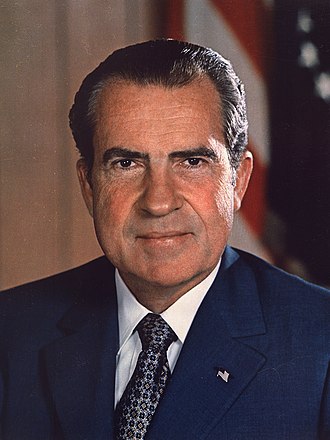
What Nixon talks about on the tapes
White House operations 4,718Presidential scheduling 2,225Public relations 1,784Presidential schedule 1,782Vietnam War 1,693Logistics 1,650Manolo Sanchez 1,626White House communications 1,400White House administration 1,399Presidential communication 1,243Henry Kissinger 1,191Foreign Policy 1,183
Conversations (21,010)
— Page 13 of 211President Nixon met briefly with Alexander M. Haig, Jr. in the Oval Office to coordinate his official daily schedule. The conversation focused on logistical arrangements regarding upcoming presidential meetings. No further policy developments or complex issues were addressed during this short interaction.
President Nixon met with Alexander Haig and H.R. Haldeman to coordinate strategy for an upcoming press conference, focusing heavily on countering North Vietnamese propaganda regarding Prisoners of War (POWs) and ceasefire proposals. They discussed correcting public misinterpretations of Secretary of State William Rogers' recent statements on China, emphasizing the need to keep diplomatic rhetoric low-key to avoid unnecessary friction. Additionally, the President and his staff reviewed concerns over television production techniques and public image management, balancing the importance of authentic substance over staged performance.
President Nixon met with his personal valet, Manolo Sanchez, in the Old Executive Office Building for a brief, informal interaction. The exchange focused on minor personal amenities, specifically involving refreshments and a discussion regarding the current weather conditions. No substantive policy matters or administrative decisions were addressed during this brief encounter.
President Nixon met with his personal valet, Manolo Sanchez, in the Old Executive Office Building for a brief, informal interaction. The primary purpose of this encounter involved the service of refreshments to the President. No substantive policy discussions or administrative decisions were recorded during this five-second exchange.
President Nixon met with Alexander P. Butterfield to coordinate the dissemination of information through news wires. The discussion centered on involving Alexander M. Haig, Jr. and Patrick J. Buchanan in the strategic timing of these releases. This brief interaction served to align staff efforts regarding media management and internal communications protocols.
President Nixon initiates a brief telephone call through the White House operator to connect with his personal secretary, Rose Mary Woods. The conversation serves strictly as a logistical request to facilitate communication with his staff. No substantive policy matters or political issues are discussed during this administrative exchange.
President Nixon and General Alexander Haig met to clarify the strategic implications and specific conditions of a recent unilateral offer regarding the repatriation of enemy prisoners of war. They assessed how this proposal differed from previous U.S. positions and discussed the numerical disparity between the 576 enemy prisoners offered for release and the approximately 430 Americans held in North Vietnam. The discussion focused on establishing a firm, consistent administrative stance to ensure the President could clearly articulate U.S. policy in future public or diplomatic inquiries.
President Nixon initiated a brief interaction with the White House operator to facilitate an outgoing call. The conversation served strictly as an administrative exchange to connect the President with a desired party. No substantive policy matters or political discussions were recorded during this brief connectivity process.
President Nixon consulted with Marjorie P. Acker regarding the departure of his personal secretary, Rose Mary Woods, for Kentucky. Nixon issued specific instructions to restrict incoming telephone calls for the evening so he could focus on family matters, including preparations for Tricia Nixon’s wedding. He directed Acker to screen his calls and route any urgent matters to H. R. Haldeman.
President Nixon met briefly with Marjorie P. Acker to discuss travel arrangements and manage incoming communications. Nixon confirmed that an individual had successfully departed for Kentucky and instructed Acker to manage the White House switchboard accordingly. The meeting concluded with a direct order to restrict all telephone calls for the remainder of the evening.
President Nixon and Alexander Butterfield briefly discussed campaign financing efforts and external assistance from individuals identified as Hagen and Ray Warren. The discussion focused on securing additional resources and maintaining accountability regarding campaign expenditures. The President acknowledged the report, suggesting that further support would be forthcoming to address the campaign’s financial needs.
President Nixon and Alexander Haig reviewed the administration's strategic messaging regarding North Vietnamese Prisoners of War (POWs) to ensure that the term "reciprocity" was avoided in official negotiations. Haig clarified that while the proposed prisoner releases were conditional upon agreement regarding neutral host countries, the U.S. remained flexible regarding specific numbers and inspection arrangements. The discussion focused on differentiating new proposals, such as expanded inspection rights for neutral organizations, from prior public statements to maintain tactical clarity with North Vietnamese counterparts.
President Nixon and Alexander Haig briefly discuss the semantics of differentiating between "modern" and "grand" in an unspecified administrative context, with Nixon expressing frustration over the distinction. Haig confirms that he and Henry Kissinger are working to restore certain traditions. The conversation concludes with a brief check on other outstanding issues, which Haig indicates are well-covered.
President Nixon met with an unknown individual to briefly coordinate the delivery of a meal. The discussion was limited to logistical arrangements regarding supper, with no substantive policy or political matters addressed. The brief interaction concluded with the participant confirming they would handle the task before exiting the office.
President Nixon and Alexander Haig review the specific terms of a new proposal regarding American prisoners of war in Vietnam. They clarify that the United States remains willing to pursue unilateral repatriation of prisoners regardless of the enemy's response. Additionally, they discuss the introduction of a new bilateral proposal involving the internment of POWs in a neutral country.
President Nixon held a brief, informal meeting with an unidentified individual, potentially a social worker, to discuss private family matters. During the exchange, the President provided directive advice regarding the maintenance of distance between two brothers. The conversation remained limited to these personal concerns and did not involve broader policy or administrative developments.
President Nixon met with his personal valet, Manolo Sanchez, in the Old Executive Office Building. The brief interaction focused on the provision of refreshments. No major policy developments or significant political discussions were recorded during this brief encounter.
President Nixon and Alexander Haig confer regarding the sensitive diplomatic channels utilized for the release of prisoners of war (POWs). The discussion focuses on clarifying the administration's stance on the involvement of third-party nations and outside organizations in facilitating these negotiations. Nixon emphasizes the importance of maintaining direct control over these interactions to ensure that no unauthorized assurances are conveyed to external parties.
President Nixon and Henry Kissinger discussed the high-stakes negotiations regarding American prisoners of war (POWs) in Vietnam. They assessed the potential for a formal offer from the North Vietnamese and explored the necessity of a public presidential response or speech should negotiations stall. The two agreed that they must maintain a firm position to avoid being outmaneuvered, even if it meant risking an public rejection of the administration's own ceasefire proposals.
President Nixon and Henry Kissinger discuss the strategic challenges posed by the impending prisoner of war (POW) negotiations and the potential for a public relations crisis. They analyze intelligence suggesting that outside actors are coordinating with the North Vietnamese, which threatens to undermine the administration’s existing proposal. Nixon expresses concern over the timing of their offer and concludes that they must maintain discipline while preparing for the possibility that the current diplomatic approach will be rejected.
President Nixon met with his valet, Manolo Sanchez, in the Old Executive Office Building to provide personal instructions. The discussion centered on the handling of specific materials, notably a briefcase, which the President directed Sanchez to ensure were completed. This brief interaction underscores the administrative and logistical coordination maintained by Nixon's personal staff regarding his daily professional effects.
President Nixon attempted to reach Speaker of the House Carl B. Albert via the White House operator to discuss an unspecified matter. Upon learning that Albert was attending a Chamber of Commerce dinner and unavailable at home, the President opted not to leave a message. He instead directed the operator to connect him with H.R. Haldeman to continue his evening communications.
President Nixon and H. R. Haldeman reviewed public and media reaction to the President's recent televised news conference. They discussed positive feedback regarding his performance on contentious domestic and foreign policy issues, including the Vietnam War, busing, and diplomatic overtures toward the People's Republic of China. The conversation concluded with a discussion on the frequency of future presidential press conferences, with Nixon expressing a desire to maintain a consistent, effective media presence.
President Nixon initiated a telephone call to contact his special assistant, Patrick J. Buchanan, via the White House operator. This brief exchange served primarily as a logistical step to facilitate direct communication between the President and a key staff member. No substantive political or policy discussions took place during this brief interaction.
President Nixon contacted the White House operator to initiate an outgoing call to Charles W. Colson. The brief exchange served as a administrative connection to reach the Special Counsel to the President. No further substantive policy matters were discussed during this specific transmission.
President Nixon contacted the White House operator to facilitate a telephone connection to his Chief of Staff, H.R. Haldeman. The exchange served primarily as a brief administrative request to initiate a high-level communication. No substantive policy discussions or decisions were recorded during this short bridging call.
President Nixon consulted with the White House operator to determine the current location of Chief of Staff H. R. Haldeman. The President requested that a message be left for Haldeman with Marjorie P. Acker, who was attempting to reach him. This brief exchange served as a logistical coordination effort to facilitate communication between the President and his top aide.
President Nixon and Patrick J. Buchanan reviewed the President’s recent news conference, focusing on the effectiveness of his messaging regarding anti-war demonstrations and foreign policy. Nixon emphasized his goal of projecting confidence and signaling that the administration would not be deterred by protesters, while specifically highlighting his remarks on “peace in their time” and the recent opening of relations with China. The conversation concluded with Nixon praising Buchanan and the White House staff for their preparation for the event.
President Nixon and Marjorie Acker discussed the handling of incoming calls from Cabinet members following a recent presidential press conference. Acker clarified that Chief of Staff H.R. Haldeman was managing the communications, leading the President to direct her to reach out to Haldeman via radio phone to ensure that any messages from Cabinet officials were properly flagged for his personal return. The conversation concluded with Acker expressing support for the President’s political performance and his assertive stance against critics.
President Nixon and Charles Colson discuss the aftermath of a recent press conference, focusing on the President’s assertive stance against media critics and anti-war protesters. Nixon emphasizes his commitment to upholding the rule of law while clarifying his position on peaceful versus unlawful demonstrations. To maintain momentum, the President instructs Colson to coordinate with supportive Republican senators, such as Hugh Scott and Robert Griffin, to publicly validate his performance and policy agenda.
President Nixon and Alexander Butterfield discuss the positive reactions of various Cabinet members, including John Connally, John Mitchell, and Winton Blount, to the President's recent press conference. Butterfield provides an update on the availability of Cabinet officials, noting that many are currently traveling or overseas. Additionally, the pair coordinates the signature of a legislative bill, with the President instructing Butterfield to bring the document to him for review.
President Nixon requested that the White House operator place a call to Treasury Secretary John B. Connally. This brief administrative interaction served as a logistical step to initiate a direct conversation between the President and his cabinet official. No substantive policy discussions took place during this exchange.
President Nixon instructed the White House operator to place an outgoing call to Secretary of Health, Education, and Welfare Elliot L. Richardson. The brief exchange served as a logistical coordination to connect the President with a high-level cabinet official for an unspecified matter. No substantive policy discussions occurred during this brief request for operator assistance.
President Nixon and Elliot Richardson discuss messaging for an upcoming press conference, focusing on sensitive foreign policy objectives regarding China and the USSR, as well as the administration's stance on Supreme Court busing rulings. The two coordinate the government's legal position on housing discrimination cases and address the complexities of the Vietnam War, specifically regarding POW negotiations and U.S. credibility. The conversation concludes with administrative scheduling and the potential hiring of a new personnel candidate.
President Nixon and John B. Connally discussed Connally’s recent public speaking engagements and shared perspectives on managing criticism, including reaction from political cartoonist Herblock. The conversation transitioned to the administration’s Vietnam strategy, where Nixon emphasized his commitment to ending the war while simultaneously asserting his resolve to utilize air power against North Vietnam if negotiations fail to secure the release of prisoners of war. Additionally, the President encouraged Connally to attend the upcoming opening of the Lyndon B. Johnson Library to maintain a bipartisan appearance regarding the history of the war.
President Nixon and H. R. Haldeman met to discuss the status of anti-war protests and arrests in Washington, D.C., alongside the performance of the stock market. The President also reviewed procedures for an upcoming meeting with Republican congressional leadership, expressing a desire to avoid lengthy, unproductive sessions in favor of efficient, agenda-driven discussions. Nixon drew on his past experience with the Eisenhower administration to structure these meetings, aiming to maintain rapport with leadership while minimizing wasted time.
President Nixon met with Vice President Agnew, Treasury Secretary John Connally, and Republican Congressional leaders to address critical economic and legislative challenges. The primary focus was the potential bankruptcy of the Lockheed Corporation and the necessary legislative strategy to secure government loan guarantees to prevent a ripple effect of industrial failures and job losses. Additionally, the group reviewed the administration's legislative priorities, including welfare reform, general and special revenue sharing, and the status of various appropriations bills.
President Nixon met with Republican congressional leadership, including Hugh Scott and Gerald Ford, to coordinate the administration’s messaging on key domestic and economic issues. The discussion focused on framing the recent mass arrests of anti-war protesters as a necessary measure to maintain public order against vandalism. Additionally, the President urged the leaders to publicly support the Lockheed loan guarantee as a critical initiative for protecting peacetime jobs, aiming to preempt political opposition from Democratic rivals.
President Nixon and H.R. Haldeman discuss the political fallout and public reception of the ongoing anti-war demonstrations in Washington, D.C. They express satisfaction with the perceived public backlash against the protesters' disruptive tactics and the firm handling of the situation by the local police. The President and Haldeman analyze the strategic benefit of highlighting the extremism of the demonstrators to bolster public support for the administration's policies.
President Nixon met with members of the President's Commission on School Finance and the President's Panel on Nonpublic Education to discuss the urgent financial crises facing both public and private school systems across the country. The participants examined challenges such as the reliance on property taxes for funding, the decline of parochial school enrollment, and the necessity of maintaining educational quality and equality in inner-city and rural schools. Nixon emphasized the importance of a viable private education sector and tasked the Commission with providing actionable recommendations that focus on systemic reform, local responsibility, and restoring public confidence in the educational system.
President Nixon met with Admiral Thomas H. Moorer, David Packard, and Alexander M. Haig, Jr. to discuss the proposed reorganization of U.S. military command structures, specifically the potential dissolution of the U.S. Southern Command (SOUTHCOM) in Panama. Nixon argued that moving responsibilities to Washington would better align with his goal of reducing the U.S. military footprint in South America, while Moorer and the Joint Chiefs expressed concerns that such a shift could signal weakened regional ties and harm diplomatic rapport. The conversation also touched upon the need for the administration to publicly defend the military against media criticism regarding the conduct of officers in Vietnam and investigations like My Lai.
President Nixon met with his personal valet, Manolo Sanchez, in the Oval Office for a brief, one-second exchange. The interaction consisted of a short verbal instruction from the President to his aide. No substantive policy matters or administrative decisions were documented during this encounter.
President Nixon met with H.R. Haldeman and Charles Colson to discuss the administration's political strategy regarding recent anti-war protests and civil demonstrations in Washington, D.C. They focused on discrediting Democratic rivals—specifically Hubert Humphrey, Ted Kennedy, and Edmund Muskie—by highlighting their earlier endorsements of these movements, which the President characterized as hypocritical in light of the resulting violence and disorder. Additionally, the participants reviewed the effectiveness of local police leadership, discussed Rose Mary Woods’ recent trip to the Kentucky Derby, and touched upon logistical details for an upcoming meeting with Jeane Dixon and a gift donation from Walter Annenberg.
President Nixon met with renowned astrologer Jeane L. Dixon and his personal secretary Rose Mary Woods to discuss Dixon's recent evangelical and outreach activities among American youth. Dixon recounted her interactions with student protesters and shared her views on political leadership, spirituality, and the President's public image. The conversation concluded with discussions regarding Dixon's professional schedule, her connections to media figures like the Wallaces of Reader's Digest, and the President expressing appreciation for her patriotic efforts.
President Nixon met with his personal valet, Manolo Sanchez, in the Oval Office to address administrative logistics. Their discussion centered on the President’s daily agenda, specifically concerning his upcoming movements to and from the Executive Office Building. The two also exchanged brief remarks regarding the current weather conditions before departing together.
President Nixon directs the White House operator to place an outgoing call to William B. Macomber, Jr., the Assistant Secretary of State. The exchange serves as a procedural request to facilitate communication between the President and the State Department official. No further policy discussions or substantive developments occur during this brief administrative interaction.
President Nixon directed the White House operator to contact William B. Macomber, Jr., who was currently eating lunch at the State Department. The operator acknowledged the request and committed to attempting to reach Macomber at that location. This brief exchange served as a logistical attempt to establish contact with the official for the President.
President Nixon consulted with his valet, Manolo Sanchez, and a White House operator to coordinate logistics for Bebe Rebozo and Robert Abplanalp. The discussion centered on scheduling their activities, specifically addressing a reservation delay and confirming their departure time. No significant policy decisions were made, as the exchange focused purely on the President's personal administrative arrangements.
President Nixon initiates a brief administrative request to the White House operator regarding an incomplete telecommunications connection. He instructs the operator to terminate the current attempt and place a follow-up call. The interaction concludes without further substantive policy discussion.
President Nixon met briefly with his personal valet, Manolo Sanchez, to provide him with specific instructions. The exchange serves as a moment of routine staff management, concluding with the President commending Sanchez for his work. No major policy developments occurred during this brief interaction.
President Nixon called William B. Macomber, Jr. to personally commend him for his actions the previous day in physically preventing protesters from removing an American flag. During the brief exchange, Nixon expressed his appreciation for Macomber's resolve against the demonstrators and characterized the protesters as cowardly. The President also requested that Macomber extend his gratitude to the other guards who assisted in the confrontation.
President Nixon called William B. Macomber, Jr. to personally commend him for his intervention during a protest the previous day where he physically prevented demonstrators from removing an American flag. Nixon expressed strong support for Macomber's actions, framing the incident as a defense of national symbols against agitators seeking only to cause damage. The brief exchange served to bolster morale and demonstrate presidential approval for Macomber's confrontational approach to the protesters.
President Nixon met with his personal valet, Manolo Sanchez, to briefly discuss the President's upcoming schedule. The conversation was exceptionally brief, consisting of a short inquiry regarding the timing of an engagement. No major policy decisions or significant administrative actions were recorded during this interaction.
President Nixon met with staff members Stephen Bull and Alexander Butterfield to discuss logistical arrangements and administrative details regarding his upcoming schedule. The conversation focused on the maintenance of the Oval Office, specifically addressing concerns about a window, and reviewed protocols for an upcoming document signing ceremony with Roy Ash. Additionally, the group clarified the prestige of an upcoming federal civilian service award presentation.
President Nixon met with his senior advisors, including Ronald Ziegler and H. R. Haldeman, to discuss managing public opinion regarding anti-war demonstrations, the potential release of North Vietnamese prisoners of war (POWs), and upcoming administration events. Nixon emphasized the need for a more aggressive public relations strategy, specifically suggesting the use of television coverage to highlight the voluntary return of 507 sick and wounded POWs across the demilitarized zone. The participants also explored strategies to frame the recent mass arrests of protesters as a necessary maintenance of law and order, while aiming to politically damage Democratic candidates who supported the demonstrations.
President Nixon met with his aide Stephen B. Bull in the Oval Office to conduct a brief administrative review of the presidential schedule. This encounter focused primarily on logistical arrangements and the management of Nixon's upcoming appointments. The brief interaction concluded as Bull departed immediately following the synchronization of the day's agenda.
President Nixon convened an extensive afternoon meeting in the Oval Office with his key economic advisors, including George Shultz, John Connally, Arthur Burns, and Paul Volcker, to deliberate on pressing fiscal and monetary policy issues. The discussion focused on addressing the nation's ongoing economic instability, involving high-level strategy sessions with administration officials and cabinet members. These deliberations were critical in shaping the Nixon administration's approach to inflation and international monetary concerns, ultimately informing the direction of domestic economic policy.
President Nixon initiates a call to Walter E. Washington, the Mayor of Washington, D.C., through the White House operator. This brief interaction serves as a routine administrative request to connect the President with local municipal leadership. No substantive policy discussions occur within this segment as the exchange is limited to the operator successfully placing the call.
President Nixon calls D.C. Mayor Walter E. Washington to commend the city's leadership and the conduct of municipal employees during recent anti-war protests. The two discuss the economic impact of the unrest, specifically noting a significant decline in tourism during the cherry blossom season. Nixon expresses his gratitude for the employees' professionalism and instructs the Mayor to publicize the administration's appreciation for their commitment to keeping the city operational.
President Nixon instructs the White House operator to place a telephone call to Deputy Attorney General Richard G. Kleindienst. This brief exchange serves as a procedural step to facilitate a direct conversation between the President and a key Justice Department official. No substantive policy discussions or decisions occur during this short administrative interaction.
President Nixon and Deputy Attorney General Richard Kleindienst discussed the ongoing mass anti-war protests in Washington, D.C., and the government's strategy for managing demonstrators. Kleindienst reported on the successful, orderly arrest of thousands of protesters for unlawful assembly, noting that the coordinated effort between police and military forces allowed for improved identification procedures. The President praised the government's operational cohesion and expressed his intention to formally commend the police department and National Guard for their handling of the situation.
President Nixon directs the White House operator to place an outgoing telephone call to Secretary of the Treasury John B. Connally. The interaction serves as a brief administrative request to initiate official communication with a key cabinet member. No further substantive policy matters are discussed in this brief exchange.
President Nixon and Secretary of the Treasury John Connally coordinated the release of an official U.S. statement regarding international monetary policy in response to speculative currency movement in West Germany. The discussion focused on maintaining existing exchange parities and reasserting U.S. commitment to international economic stability and balance of payments objectives. Connally confirmed that the statement would be issued regardless of ongoing efforts to reach German officials.
President Nixon initiates a call to his Chief of Staff, H. R. Haldeman, through the White House operator. The brief exchange serves as a routine administrative request to facilitate communication with a key staff member. No substantive policy discussions or major decisions occur during this brief operational task.
President Nixon and H.R. Haldeman discuss the administration’s strategy for responding to ongoing civil unrest and related legal issues, specifically advising a steadfast, "hard line" approach. Nixon emphasizes his refusal to yield to domestic critics or "do-good" lawyers, maintaining that the administration must prioritize public order over political optics. The conversation serves to reinforce internal resolve and ensure that subordinates remain committed to this firm stance despite negative media coverage.
The White House operator informs President Nixon that Federal Reserve Chairman Arthur F. Burns is attempting to reach him by telephone. Nixon acknowledges the notification, authorizing the operator to facilitate the connection. This brief interaction serves as a preliminary administrative step to bridge a direct communication line between the President and the Chairman.
President Nixon and Federal Reserve Chairman Arthur F. Burns discussed the escalating international monetary crisis and the need for the administration to formalize a concrete policy strategy. Nixon pushed Burns, Paul Volcker, and Paul McCracken to develop a proactive plan rather than continuing to delay action, despite Burns' preference for postponing significant changes until later in the year. The President directed Burns to coordinate with Treasury Secretary John B. Connally regarding their ongoing communication with foreign officials.
President Nixon and H.R. Haldeman reviewed the President's upcoming schedule, prioritizing discussions on trade strategy with Peter Peterson and managing the political fallout from ongoing anti-war demonstrations. Nixon expressed frustration with the bureaucratic process regarding sugar quotas and requested tighter control over the administration's interactions with the Business Council. Furthermore, they discussed the government's firm response to recent mass arrests of protesters and the potential to leverage public support for the police and administration.
President Nixon initiates a request for the White House operator to place a telephone call to Senator Harry F. Byrd, Jr. The brief exchange serves as a logistical bridge to facilitate direct communication between the President and the Senator. No further substantive policy matters are discussed in this recording.
President Nixon and Senator Harry F. Byrd, Jr. discussed the administration's recent handling of anti-war demonstrators in Washington, D.C., expressing mutual agreement on the necessity of clearing protest camps to maintain government operations. Byrd offered his support for the President’s Vietnam policy, and Nixon thanked the Senator for his vocal backing during a period of political scrutiny. The conversation served to reinforce the political alignment between the two men regarding law enforcement and foreign policy.
President Nixon directs the White House operator to place a telephone call to Secretary of Defense Melvin R. Laird. The brief exchange serves as an administrative bridge to facilitate direct communication between the President and the Secretary. No substantive policy discussions occur, as the conversation focuses exclusively on establishing the connection.
President Nixon initiated a brief communication through the White House operator to facilitate a connection with another party. This exchange served as a routine administrative step in the President's daily workflow, likely to coordinate a scheduled call or meeting. No substantive policy or political matters were discussed during this brief interaction.
President Nixon met with Senator Harry F. Byrd, Jr. to discuss the administration's firm handling of anti-war demonstrators in Washington, D.C. Nixon expressed his resolve to maintain order, citing his recent support for local police to clear protesters from government spaces. The two also exchanged political pleasantries regarding upcoming administrative announcements and mutual legislative support.
President Nixon requested that the White House operator place a call to an individual referred to as a "spectator." This brief administrative interaction served as a logistical step to initiate a communication or meeting with an external party. No substantive policy discussions occurred during this brief exchange.
President Nixon met briefly with an unidentified woman in the Oval Office to coordinate his immediate schedule. Following their discussion, he arranged for Alexander M. Haig, Jr. to be brought in for a meeting. This exchange served primarily as a logistical transition to facilitate the President's subsequent appointment with Haig.
President Nixon met with an unknown woman in the Oval Office to briefly discuss administrative and scheduling matters. During the session, the conversation touched upon the current location of Alexander M. Haig, Jr. and activities related to the Central Intelligence Agency. The meeting concluded shortly thereafter with no major policy decisions recorded.
President Nixon and Secretary of Defense Melvin Laird discuss the recent handling of anti-war demonstrations in Washington, D.C., as well as the proposed restructuring of the U.S. Military Command in South America (ComSouth). Nixon commends the security response to the protests and emphasizes the need to avoid any public perception that U.S. military engagement in Latin America is being downgraded. The two agree to postpone a final decision on the ComSouth command structure and staffing until Laird returns to the office, at which point they will convene a small group to evaluate the foreign policy implications.
President Nixon and Secretary of Defense Melvin Laird discuss the successful handling of recent anti-war demonstrations in Washington, noting the effective performance of law enforcement and military personnel. They transition to discussing the timing of proposed military command changes, specifically regarding the Nixon Doctrine and military assistance programs in Latin America. Nixon decides to postpone a final decision on these structural reorganizations until he can consult with a select group of advisors, including Laird, Henry Kissinger, and David Packard, to ensure the policy does not signal an unwanted withdrawal from foreign commitments.
President Nixon and John Mitchell discuss the security management of ongoing anti-war demonstrations in Washington, specifically focusing on the coordination between military and civilian authorities. They address the role of the Capitol Police in handling protesters on congressional grounds and express a cynical willingness to let law enforcement use force if necessary. The President emphasizes the importance of maintaining clear jurisdictional responsibility for the crowd control operations to ensure the demonstrations proceed according to the administration's plan.
President Nixon met with his aide, Stephen B. Bull, in the Oval Office to coordinate administrative matters. The brief discussion focused primarily on managing the President's upcoming schedule and arranging necessary meetings. No significant policy decisions were recorded during this logistical exchange.
President Nixon met with Peter G. Peterson and Peter M. Flanigan to discuss a more aggressive U.S. economic and trade strategy, specifically targeting Japan's trade barriers and undervalued yen. The participants explored long-term economic planning, including the potential for protective measures in key industries like automobiles, while addressing the ongoing international monetary crisis and the relative strength of the dollar. The group decided to position Treasury Secretary John B. Connally as the primary administration spokesperson for these economic issues, with an emphasis on signaling a tougher stance to both domestic audiences and foreign governments.
President Nixon hosted Pat Nixon and Tricia Nixon in the Oval Office to discuss the aesthetic and functional updates to the room. The conversation focused on the office's new layout, specifically highlighting the improved atmosphere and the changes to the window views that obscured public foot traffic. The brief meeting concluded with the participants confirming their plans to meet again later that evening.
President Nixon and Press Secretary Ronald Ziegler met to coordinate the White House's public response to the first anniversary of the Kent State and Jackson State shootings, specifically addressing how to handle critical CBS media coverage. Nixon directed Ziegler to maintain a firm, low-profile posture regarding these events while reiterating previous statements of sorrow to avoid inciting further media agitation. They also discussed debunking rumors of a meeting between the President and Judge Reid Kennedy regarding the William Calley case and reviewed the status of a potential invitation for the President to speak before the American Bar Association.
President Nixon and Alexander P. Butterfield met to coordinate the logistics for upcoming Federal Civilian Service awards. They specifically discussed the need to calculate the aggregate number of years of service represented by the award recipients. This brief meeting served to ensure the accuracy of biographical data for the recognition ceremony.
President Nixon met with Paul W. McCracken, Ezra Solomon, and George P. Shultz to discuss the appointment of Ezra Solomon to the Council of Economic Advisers and to solicit his expertise for long-term economic planning. The participants analyzed the state of the American economy, focusing on consumer confidence, retail sales, and the competitive challenges posed by international trade, particularly regarding Japan. Nixon emphasized the need for a strategic, forward-looking economic approach that considers geopolitical trends and maintains U.S. competitiveness in a globalized market.
President Nixon and Stephen B. Bull met to finalize logistical arrangements for an upcoming Federal Civilian Service awards ceremony. They reviewed the precise protocol for the event, including press positioning, the sequence for introducing honorees such as Samuel M. Cohn, and the choreography for the presentation of awards and photographs. This coordination served to streamline the event's flow and minimize potential disruptions.
President Nixon hosted a Federal Civilian Service Awards ceremony in the Oval Office to honor distinguished public servants, including Samuel M. Cohn, U. Alexis Johnson, Edward F. Knipling, Fred Leonard, and George H. Willis. During the event, the President presented medals and recognized the recipients for their significant contributions to fiscal policy, diplomacy, entomology, medical research, and international monetary systems. Following the formal presentations and a group photograph, the President engaged in general conversation with the attendees regarding the Oval Office décor, his daily schedule, and his auxiliary office in the Executive Office Building.
President Nixon met with Senator John G. Tower and associates to discuss federal assistance for the severe drought affecting Texas, Oklahoma, and New Mexico. The participants strategized on legislative relief measures, including loan forgiveness and expanded Small Business Administration support, to address the political risks the drought posed to the administration. Additionally, Nixon agreed to record a 30-40 second video message for Tower's upcoming decade-of-service dinner in Dallas and discussed the broader political optics of his administration's response to the crisis.
President Nixon directed the White House operator to place a telephone call to John W. Dean, III. This brief exchange served as an administrative bridge to facilitate direct communication between the President and his White House Counsel. The conversation concluded once the connection to Dean was successfully initiated.
President Nixon and John Dean discuss the status of anti-war protests in Washington, D.C., specifically focusing on a planned demonstration at the Capitol. Dean informs the President that approximately 2,000 protesters intend to march on the Capitol, but confirms that local authorities are prepared to handle the situation without federal intervention. The conversation concludes with an assessment that the protesters' movement is losing momentum due to internal tactical disagreements among leadership figures like Rennie Davis.
President Nixon met briefly with his personal valet, Manolo Sanchez, in the Oval Office. The exchange consisted of mutual well-wishes as Sanchez prepared to depart. No substantive policy matters or administrative decisions were addressed during this brief encounter.
President Nixon, H.R. Haldeman, and John Dean met to discuss political strategy regarding regional economic challenges, specifically the drought situation and unemployment in key states like California. They evaluated the effectiveness of recent administration outreach and media tactics, including utilizing the President’s press conferences to bypass critical coverage and shape public opinion. The participants also discussed coordinating with congressional leadership to build support among Southern Democrats for the administration’s legislative agenda.
President Nixon initiates a request through the White House operator to be connected with presidential aide Peter M. Flanigan. The brief exchange serves as a procedural step to facilitate a direct conversation between the President and Flanigan regarding administrative or policy matters. No substantive policy discussions occur during this brief administrative request.
President Nixon instructed Peter M. Flanigan to coordinate a meeting with Caspar Weinberger to discuss the political implications of various federal projects. Nixon emphasized that Weinberger’s involvement was essential given his control over project funding. The two agreed to finalize the scheduling details for a follow-up meeting to review the program previously submitted to H.R. Haldeman.
President Nixon initiates a brief telephone call to request that the White House operator connect him with his aide, Stephen B. Bull. The purpose of this exchange is strictly limited to facilitating this connection for the President. No further substantive policy matters or decisions are discussed during this brief administrative interaction.
President Nixon coordinated his afternoon schedule with aide Stephen B. Bull to finalize a series of high-level meetings. The discussion centered on confirming appointments with Peter M. Flanigan and Caspar W. Weinberger, followed by meetings with Attorney General John N. Mitchell and Lee R. Nunn. Nixon specifically directed the scheduling of a briefing with Mitchell and Nunn to precede a subsequent meeting with John B. Connally.
President Nixon directs the White House operator to place a telephone call to Al Snyder. This brief administrative exchange serves as the logistical initiation of official communications between the President and the White House staff member. No further policy or substantive discussion occurs during this interaction.
President Nixon instructed the White House operator to place a series of outgoing telephone calls to several individuals, including John F. Griner of the American Federation of Government Employees, J. Peter Grace, and Dr. Charles Chasler. He also requested assistance in locating Alvin Snyder, who had recently departed the White House mess. The conversation served primarily as an administrative coordination effort to facilitate these scheduled communications.
President Nixon calls Alvin Snyder to express personal appreciation for his effective efforts in managing relationships with television networks. The discussion highlights Snyder's role in disseminating information and challenging perceived media bias against the administration. Nixon encourages Snyder to maintain his aggressive approach, noting that persistent engagement with broadcasters is essential to securing fairer coverage.
President Nixon communicated with the White House operator to facilitate a call to J. Peter Grace. Upon learning that Grace was traveling in England and unavailable until May 7, the President instructed the operator to delay the outreach. Nixon emphasized that the matter was not urgent and requested that the call be scheduled upon Grace's return to the country.