Nixon, Richard M. (President)
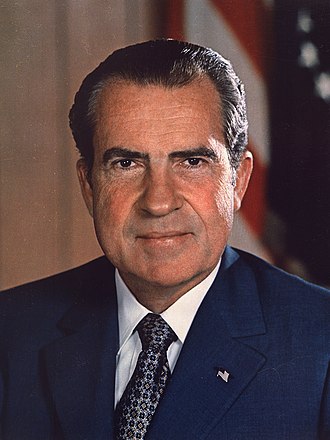
Richard M. Nixon served as the 37th President of the United States from January 1969 until his resignation in August 1974. In February 1971, he ordered the installation of a secret voice-activated taping system in the White House to preserve a historical record of his administration. Until the system's existence was revealed and dismantled in July 1973, the tapes captured Nixon directing major foreign policy initiatives, such as the opening to China, as well as his central role in the Watergate cover-up.
What Nixon talks about on the tapes
White House operations 4,718Presidential scheduling 2,225Public relations 1,784Presidential schedule 1,782Vietnam War 1,693Logistics 1,650Manolo Sanchez 1,626White House communications 1,400White House administration 1,399Presidential communication 1,243Henry Kissinger 1,191Foreign Policy 1,183
Conversations (21,010)
— Page 126 of 211President Nixon held an informal meeting with his personal valet, Manolo Sanchez, at the Aspen Lodge study at Camp David. While the official record indicates a brief encounter, the entirety of the discussion was withdrawn from the public archive as a personal, returnable item. Consequently, no substantive policy decisions or administrative topics are preserved in the historical record for this interaction.
President Nixon contacted the Camp David operator to facilitate an outgoing call to White House special counsel Charles W. Colson. This brief administrative interaction served as the necessary logistical step to connect the President with his advisor. The call highlights the President’s reliance on internal staff operators to manage his communications while stationed at Camp David.
President Nixon initiates a brief administrative request to the Camp David operator to place a telephone call. The exchange serves primarily as a logistical instruction to connect the President with an outside party. No substantive policy discussions or significant political developments occurred during this short communication.
President Nixon and Charles W. Colson engage in a detailed strategic assessment of the 1972 presidential campaign, focusing on the perceived weaknesses and political challenges facing George McGovern. They analyze McGovern’s campaign mechanics, including his struggles with endorsements, media coverage, and the influence of Ted Kennedy, while contrasting these with Nixon’s own electoral strategies. The conversation serves as an analytical exercise to identify vulnerabilities in the Democratic platform and to optimize the effectiveness of the Nixon reelection effort.
President Nixon met with special counsel Charles Colson at Camp David to strategize on political affairs during the 1972 reelection campaign. The two men discussed tactics for managing political fallout and addressing ongoing pressures facing the administration. While specific details of their deliberation remain shielded by the withdrawal of one segment of the record, the discussion reflects the high-level coordination between the President and his key political aide during a critical phase of the campaign.
President Nixon and H. R. Haldeman met at Camp David to discuss campaign strategy, potential administrative shake-ups for a second term, and the handling of the Watergate scandal. Nixon emphasized shifting his administration toward a more partisan, loyalist approach, specifically planning to remove political opponents from executive departments and the Foreign Service while rewarding loyal media outlets with exclusive access. They also strategized on utilizing John Connally to challenge George McGovern on foreign policy and national defense issues to strengthen the President's reelection platform.
President Nixon met with his aide Stephen B. Bull to coordinate upcoming appointments and review the daily schedule. The discussion focused on managing visits with Nelson A. Rockefeller and John D. Ehrlichman. The session served to finalize logistical arrangements and priorities for these meetings.
President Nixon and Alexander P. Butterfield met to coordinate the President's upcoming schedule, specifically focusing on a proposed meeting with musician Ray Charles. The discussion centered on managing the publicity surrounding this appearance and coordinating the event through H.R. Haldeman, including a potential visit to the National Children's Center. Nixon emphasized his specific preferences regarding the management of these public appearances.
President Nixon and Alexander P. Butterfield discussed the logistical and political merits of potentially hosting musician Ray Charles at the White House. The conversation addressed concerns raised by staff members Dwight Chapin and Charles Colson regarding the optics of the invitation. Nixon ultimately decided to proceed with a brief meeting while explicitly mandating that no official photographs be taken during the event.
President Nixon and Alexander Haig discussed critical foreign policy strategy, focusing primarily on the ongoing Vietnam peace negotiations and upcoming diplomatic initiatives with the Soviet Union. Regarding Vietnam, they agreed to override objections from South Vietnamese President Nguyen Van Thieu concerning the composition of the proposed National Committee for Reconciliation, concluding that the political stakes of a potential breakthrough outweighed Thieu's concerns. Additionally, they planned the coordination of sensitive U.S.-Soviet trade and security negotiations, specifically addressing how to brief Secretary of State William P. Rogers to ensure that the White House maintained control over the messaging and credit for these diplomatic advancements.
President Nixon met briefly with an unidentified woman in the Oval Office. During the short exchange, the visitor made a specific request regarding Stephen B. Bull. The interaction concluded quickly, with the guest departing the office shortly before 10:00 am.
President Nixon met with his aide Stephen B. Bull to review and refine the President's upcoming schedule, specifically focusing on interactions with Philadelphia Mayor Frank Rizzo and various political figures. The discussion centered on managing the timing and logistics of these meetings, including the duration of sessions with Rizzo and appointments involving John Jarman, Tom S. Gettys, and John D. Ehrlichman. Nixon expressed a desire to streamline his engagements, ultimately tasking Bull with logistical adjustments to manage the pace of his meetings.
President Richard M. Nixon met with his valet, Manolo Sanchez, in the Oval Office for a brief morning discussion. While the specific substance of the dialogue remains classified as a personal returnable item, the interaction highlights the routine administrative and personal interface between the President and his long-term household staff. No substantive policy decisions or historical developments are recorded for this brief encounter.
President Nixon met with John Ehrlichman and Nelson Rockefeller to coordinate legislative strategy, particularly regarding revenue sharing, federal government reorganization, and NASA space shuttle contracts. The discussion explored ways to build a legislative mandate for a second term, including potential energy and regulatory reforms and strategies to leverage support from key congressional leaders. Later, Pat Nixon and Secretary of the Interior Rogers C. B. Morton joined the session to discuss the administration's national parks agenda, specifically focusing on promoting the centennial of Yellowstone National Park and Mrs. Nixon's upcoming public appearances.
President Nixon met with John D. Ehrlichman to discuss the public disclosure of his personal financial statement. The conversation centered on the management and presentation of the President's assets as they prepared for upcoming release requirements. No major policy shifts were recorded, as the brief exchange served primarily to coordinate administrative logistics regarding the financial filing.
President Nixon met with his aide Stephen B. Bull to discuss the retrieval and review of a specific document held by John D. Ehrlichman at Camp David. The President directed Bull to expedite the delivery of the document to ensure he could examine its contents personally. This brief exchange served to coordinate the logistical handling of sensitive presidential materials.
President Nixon met with his aide, Stephen B. Bull, to discuss potential staff assignments or meeting requests. The President specifically requested that Bull arrange for a meeting with either Richard K. Cook or William E. Timmons, indicating a preference to see at least one of them. This brief discussion focused on administrative scheduling and ensuring direct communication with key legislative liaison personnel.
President Nixon and William E. Timmons discuss the personal behavior and political standing of House Speaker Carl Albert, expressing concern over his recent public conduct and potential impact on his leadership. The conversation centers on the risks posed by Albert's perceived decline and explores potential ways to handle the situation, including a discreet telephone outreach to address these issues. Nixon ultimately tasks Timmons with coordinating a strategy, potentially involving consultation with others close to the Speaker, to address the vulnerability surrounding Albert's position.
President Nixon met with Representative Thomas S. Gettys, John E. Nidecker, and Max L. Friedersdorf for a brief, informal session that included a photo opportunity. The discussion touched upon the upcoming congressional elections and personal anecdotes regarding the military service and background of J.P. "Dick" Richards. The meeting concluded with the presentation of gifts and exchange of pleasantries between the President and his guests.
President Nixon met with his aide Stephen B. Bull to review and organize the day's upcoming official schedule. The discussion centered on managing appointments with senators, representatives from the Philadelphia Police Athletic League, and a high-profile meeting involving Frank L. Rizzo and John D. Ehrlichman. The primary outcome was ensuring the coordination of these sessions, including a planned photography opportunity.
President Nixon met with Philadelphia Mayor Frank L. Rizzo, White House aides, and various local stakeholders to coordinate campaign strategy for the 1972 election in Pennsylvania. The discussion focused on leveraging the benefits of incumbency, securing federal aid for Philadelphia to bolster political support, and actively undermining the campaign of George McGovern through negative publicity regarding his policy positions and past voting records. The participants also discussed efforts to engage other mayors and business leaders to align with the President's platform against McGovern's perceived socialist agenda.
President Nixon met with his aide, Stephen B. Bull, to coordinate the distribution of a book. The discussion focused on managing acknowledgments for the publication, specifically mentioning Leonard H. Tose and Frank L. Rizzo. The participants also briefly touched upon professional football, referencing the Philadelphia Eagles and the Washington Redskins.
President Nixon and H.R. Haldeman met to discuss a range of administrative and political issues, including the management of the Watergate scandal, the 1972 election campaign, and internal White House personnel matters. A significant portion of the conversation focused on coordinating foreign policy efforts between Secretary of State William P. Rogers and National Security Advisor Henry Kissinger, specifically regarding the handling of Jimmy Hoffa's trip to Hanoi and subsequent press strategies. Additionally, the pair addressed logistical planning for upcoming trips, including an excursion to Camp David, and strategized on media and advertising efforts for the President's reelection campaign.
President Richard Nixon met with his personal valet, Manolo Sanchez, in the Old Executive Office Building. The recorded portion of this interaction consists entirely of a withdrawn item classified as personal and returnable. No substantive policy discussions or administrative actions were captured or documented for the historical record.
President Nixon instructed the White House operator to place a call to Congressman Wayne N. Aspinall. The President specifically requested that Aspinall be informed regarding the logistics of retrieving a vehicle. No further policy or administrative matters were discussed during this brief exchange.
President Nixon and H. R. Haldeman met briefly in the Old Executive Office Building to conduct private business. Given the absence of a transcript and the presence of a withdrawn segment, the discussion likely focused on sensitive administrative or political matters. No substantive policy developments were recorded during this brief exchange.
President Nixon called Representative Wayne N. Aspinall to express personal regrets regarding Aspinall's recent loss in the primary election. The President commended Aspinall for his long tenure of service to the country and encouraged him to focus on his past political achievements rather than the defeat. The brief exchange served as a professional courtesy to acknowledge Aspinall's legislative career.
President Nixon met with his personal aide, Manolo Sanchez, at the Old Executive Office Building to discuss administrative matters. The brief interaction focused primarily on the daily schedule of special counsel Charles W. Colson. No major policy decisions were recorded during this short meeting.
President Nixon and Charles Colson met to strategize on public relations and campaign management during the 1972 election cycle. The conversation focused on countering critical media coverage from outlets like CBS and The Washington Post, including potential challenges to the latter's television license, and managing the political fallout from Watergate-related hearings. They also discussed administration efforts to discredit opponent George McGovern and the campaign's surrogate communication strategy.
President Nixon met with an unidentified woman in the Oval Office to address logistical coordination regarding John D. Ehrlichman's schedule. The discussion focused specifically on determining the appropriate timing for a future meeting between Ehrlichman and the President. No further developments were recorded before the visitor departed.
President Nixon met with his economic advisors and staff to plan the logistics of an upcoming revenue-sharing bill signing ceremony and to discuss future tax policy and budget strategies. The President emphasized the need for political carefulness regarding tax reform, expressing a strong desire to avoid any perception of a tax increase while seeking ways to provide property tax relief for senior citizens. The participants debated the merits of various tax proposals, including minimum tax adjustments and simplification measures, ultimately focusing on balancing fiscal responsibility with the administration's political objectives leading up to the 1972 election.
President Nixon met briefly with Stephen B. Bull in the Oval Office to coordinate his daily schedule. The discussion primarily focused on reviewing the President’s recent appointments and addressing a follow-up to a recent telephone call from Julie Nixon Eisenhower. The meeting concluded quickly, with no substantive policy decisions recorded.
President Nixon met with Alexander P. Butterfield, Julie Nixon Eisenhower, and Ronald L. Ziegler to coordinate the administration's upcoming public schedule. Primary attention focused on planning a signing ceremony for the National Heart, Blood Vessel, Lung, and Blood Act, specifically addressing the political implications of inviting Senator Edward M. Kennedy to the event. The group also discussed potential press opportunities involving Ray Charles to promote sickle cell anemia research and briefly touched upon status updates regarding Vietnam War negotiations.
President Nixon and H.R. Haldeman reviewed the status of Vietnam peace negotiations and upcoming foreign policy engagements, including visits from Soviet Foreign Minister Andrei Gromyko and British Foreign Secretary Alec Douglas-Home. The discussion touched upon the congressional vote to end the war and the evolving media perception of Secretary of State William Rogers. Nixon and Haldeman further evaluated Henry Kissinger’s negotiation progress, contrasting his effectiveness with the perceived limitations of the State Department.
President Richard M. Nixon met with his personal aide, Stephen B. Bull, in the Oval Office to provide administrative instructions. Although no transcript exists to detail the specific content, the meeting served as a brief directive session regarding the President's daily agenda or operational requirements. Bull departed shortly after receiving these instructions, concluding the exchange.
President Nixon met with his aide Stephen B. Bull to coordinate administrative details regarding the schedule of General Alexander M. Haig, Jr. The primary focus of the discussion concerned Haig’s upcoming obligations, specifically a meeting at the Pentagon. No major policy decisions were recorded during this brief administrative briefing.
President Nixon requested that the White House operator place a call to John B. Connally. This interaction served a purely administrative purpose to facilitate communication between the President and the former Treasury Secretary. No further policy discussions occurred during this brief exchange.
President Nixon met with his personal valet, Manolo Sanchez, in the Oval Office to address routine personal matters. The brief interaction, lasting only eleven seconds, centered on the presence and behavior of a dog within the office. No significant policy discussions or administrative decisions were recorded during this segment.
President Nixon held a series of meetings and calls with H.R. Haldeman, John Connally, and Alexander Haig to coordinate 1972 presidential campaign strategy and discuss pressing foreign policy issues. The discussions focused on finalizing campaign speeches and messaging, reviewing the military situation in Vietnam, and monitoring diplomatic developments regarding U.S.-Soviet relations. Additionally, the participants addressed the political fallout from a recent grain sale to the Soviet Union and investigated suspicious reports of potential electronic surveillance at the Democratic National Committee headquarters.
President Nixon met with U.S. Ambassador to Taiwan Walter P. McConaughy and Alexander Haig to discuss the status of U.S. relations with Taiwan in light of shifting geopolitical dynamics and Nixon’s China policy. The discussion focused on Taiwan's economic resilience, the political transition regarding Chiang Kai-shek, and the challenges of maintaining Taiwan's international standing amid growing diplomatic isolation. Nixon reaffirmed his commitment to the U.S.-Taiwan mutual defense treaty and encouraged McConaughy to continue providing diplomatic reassurance to the Taiwanese leadership.
President Nixon met with Stephen B. Bull and Manolo Sanchez to review and coordinate the President's upcoming daily schedule. The brief discussion focused on logistical planning for the President's appointments and official engagements. No major policy decisions were reached during this administrative briefing.
President Nixon met with an unknown female visitor to inquire about the schedule and activities of his personal secretary, Rose Mary Woods. The visitor informed the President that Woods was absent to visit Kathleen Stans, the wife of former Secretary of Commerce Maurice Stans, who was hospitalized. No policy discussions occurred, as the exchange was limited to a brief personal update.
President Nixon held a brief one-minute meeting with Alexander P. Butterfield to coordinate a telephone call from John B. Connally. This interaction served primarily as a logistical bridge to facilitate direct communication between the President and the former Treasury Secretary. No further policy discussions or significant substantive developments occurred during this brief encounter.
President Nixon contacted the White House operator from the Oval Office to facilitate a telephone connection. The primary purpose of this brief interaction was to initiate a call to John B. Connally. This exchange served as a logistical step to enable direct communication between the President and the former Treasury Secretary.
President Nixon and John B. Connally held a brief, informal meeting in the Oval Office to discuss personal items and current events. The conversation primarily centered on a watch featuring the presidential seal and brief remarks concerning the 1972 election. No substantive policy decisions were made during this exchange.
President Nixon consulted the White House operator to facilitate a personal telephone call to his daughter, Julie Nixon Eisenhower. This interaction was purely administrative, serving to connect the President with his family member. No policy matters or substantive political issues were discussed during this brief communication.
President Nixon consulted with his daughter, Julie Nixon Eisenhower, regarding the logistics for an upcoming social event on the presidential yacht, the Sequoia. They discussed the guest list for the excursion, specifically confirming the inclusion of Rose Mary Woods. The brief exchange served to finalize personal scheduling arrangements for the outing.
President Nixon met with his personal valet, Manolo Sanchez, to discuss logistical arrangements for an upcoming trip aboard the presidential yacht, the Sequoia. The brief conversation focused on scheduling and the inclusion of the President's daughters, Julie Nixon Eisenhower and Tricia Nixon Cox. No major policy decisions were made during this planning session.
President Nixon and Stephen B. Bull reviewed the President's upcoming schedule to organize logistics for various appointments and appearances. They specifically discussed arrangements for a meeting with singer Ray Charles, including plans for a photograph and a discussion regarding the issue of drugs. The participants also touched upon administrative briefings involving Frank C. Carlucci and Henry C. Cashen, II.
President Nixon met with his aide Stephen B. Bull to review his upcoming personal and professional schedule. The discussion focused on coordinating logistics for a forthcoming meeting and photo opportunity with Ray Charles, as well as timing for a visit to the presidential yacht, Sequoia. Additionally, the pair briefly addressed the President's personal appointments, including a scheduled haircut.
President Nixon met with Ray Charles and his associates to discuss the musician's upcoming European tour and his philanthropic efforts, particularly regarding drug abuse and services for children. The conversation touched upon the power of music to bridge cultural divides and the importance of American artists performing internationally, with Nixon expressing support for Charles's work. The meeting concluded with an exchange of pleasantries and the President presenting Charles with commemorative gifts.
President Nixon met with his aide, Stephen B. Bull, to discuss administrative logistics and the President's upcoming schedule. During the brief interaction, the two touched upon the musical style of Ray Charles and reviewed scheduling commitments related to Robert H. Finch. The conversation focused primarily on managing the President's immediate calendar obligations.
President Nixon met with his aide Stephen B. Bull in the Oval Office to discuss the schedule of Robert H. Finch. The brief meeting centered on logistical coordination regarding Finch's upcoming engagements. No further policy or significant political developments were recorded during this short administrative interaction.
President Nixon and Robert Finch discussed campaign strategy for the 1972 election, focusing on undermining George McGovern by highlighting his perceived lack of foreign policy experience and his similarity to the ineffective 1964 Barry Goldwater campaign. They analyzed electoral demographics, including labor and ethnic support, and reviewed media coverage and the influence of campaign surrogates like Frank Rizzo and John Connally. Additionally, the participants touched upon the Watergate investigation, expressing frustration over upcoming FBI indictments and the press's role in keeping the scandal in the headlines.
President Nixon met with representatives from the Veterans of Foreign Wars (VFW), including Patrick E. Carr and Cooper T. Holt, to discuss the organization's steadfast support for his administration's Vietnam War policies. The conversation centered on the military situation in North Vietnam, the status of American prisoners of war (POWs), and the strategic importance of continued bombing and mining operations. Additionally, Nixon and the VFW representatives discussed domestic political challenges, specifically contrasting the President’s firm stance against amnesty for draft evaders with the positions held by Democratic opponent George McGovern.
President Nixon met with his aide, Stephen B. Bull, to facilitate a brief administrative exchange. During this interaction, the President engaged in a telephone conversation with his daughter, Julie Nixon Eisenhower. Following the call, Bull departed the Oval Office.
President Nixon met with his aide Stephen B. Bull in the Oval Office to briefly coordinate the President's immediate schedule. The discussion focused on arrangements for a haircut and a scheduled telephone call to Julie Nixon Eisenhower. The meeting concluded immediately after these logistical items were addressed.
President Nixon met with his daughter, Julie Nixon Eisenhower, to briefly discuss family scheduling matters. The conversation focused on the upcoming schedule for Tricia Nixon Cox and the potential assistance the President could provide regarding her forthcoming speech. No major policy decisions were made during this short personal exchange.
President Nixon and aide Stephen B. Bull met briefly in the Oval Office to coordinate logistics for an upcoming trip aboard the presidential yacht, the Sequoia. The primary focus of the discussion was the selection and finalization of the guest list for the excursion. No further policy decisions were recorded during this short administrative scheduling session.
President Richard Nixon met with his personal secretary, Rose Mary Woods, in the Old Executive Office Building to discuss administrative or personal matters. The majority of the recorded session consists of a withdrawn segment classified as personal and returnable material. No further public record of the discussion remains available to document specific decisions or policy outcomes.
President Nixon held a brief, informal meeting with his personal valet, Manolo Sanchez, in the Old Executive Office Building. The recording of this encounter contains a withdrawn segment marked as a personal returnable item. No substantive policy discussions or significant political decisions were recorded during this brief interaction.
President Nixon met with his aide Stephen B. Bull in the Old Executive Office Building for a brief discussion. Although the majority of the meeting's content was withdrawn due to its personal nature, the interaction serves as a record of administrative communication between the President and his staff. No substantive policy developments were recorded during this brief engagement.
President Nixon met with his personal valet, Manolo Sanchez, in the Old Executive Office Building. The recording consists entirely of a withdrawn segment categorized as personal and returnable, indicating the conversation was not of official policy or public record. No substantive administrative or political decisions were recorded during this brief interaction.
President Richard Nixon met with his personal valet, Manolo Sanchez, in the Old Executive Office Building. The conversation primarily concerned personal matters, as evidenced by the withdrawal of sensitive or private material from the official record. No substantive policy discussions or administrative decisions were documented during this brief interaction.
President Richard Nixon utilized this private session to dictate a memorandum for his personal records. As the recorded portion consists of a withdrawn personal item, the specific substance remains restricted from public review. The meeting served as a formal administrative exercise to document confidential internal matters.
President Nixon met with his personal secretary, Rose Mary Woods, in the Old Executive Office Building for a brief discussion. The recorded segment consists entirely of a withdrawn item designated as personal and returnable. No substantive policy matters or official administrative decisions were captured in the available audio.
President Richard M. Nixon met with his personal valet, Manolo Sanchez, in the Old Executive Office Building. The brief interaction consisted of a personal exchange, as indicated by the withdrawal of sensitive material. No official policy decisions or political discussions were recorded.
President Nixon met with his aide Stephen B. Bull in the Oval Office to discuss the logistics and details regarding Charles W. Colson's upcoming schedule. The conversation focused specifically on coordinating Colson's travel and appearances in New York. No further actions or major policy developments were recorded during this brief administrative exchange.
President Nixon met with his aide Stephen B. Bull to coordinate the scheduling and arrival of Charles W. Colson in Washington. The discussion focused on logistical arrangements regarding Colson's itinerary and status. No major policy decisions were recorded beyond these administrative scheduling updates.
In this meeting, President Nixon and H.R. Haldeman, later joined by Peter Dailey and Ronald Ziegler, discussed campaign strategy for the 1972 election, focusing heavily on media advertising and the effectiveness of surrogates like John Connally and Spiro Agnew. The participants assessed the political impact of the Watergate scandal, with Nixon instructing staff to maintain a public stance of non-involvement while letting the Justice Department handle inquiries. Additionally, they reviewed scheduling for upcoming campaign appearances and evaluated the President's responses to domestic controversies, including the U.S. Olympic team's performance and various public relations opportunities.
President Nixon and H.R. Haldeman reviewed upcoming scheduling commitments, including a dinner for George Shultz and a State Department event. They discussed the political challenges of maintaining traditional social accessibility amidst the constraints of the presidency, with Nixon emphasizing that the nature of his office precludes returning to previous personal interactions. The pair also touched upon personnel matters, specifically regarding Emil Mosbacher’s duties and rewards, and confirmed a scheduled meeting with John Dean.
President Nixon met with H.R. Haldeman and John Dean to discuss the ongoing fallout and public perception of the Watergate investigation, emphasizing the need to keep the affair contained while criticizing potential political opponents. The participants assessed the progress of internal investigations and debated strategies for managing the Democratic National Committee's activities, including potential legislative and legal maneuvers. Nixon expressed a firm determination to reorganize the administration after the election, insisting that political loyalty and control over the federal bureaucracy would be prioritized to eliminate perceived incompetence and disloyalty within the ranks.
President Nixon met with Henry Kissinger and Alexander Haig to review breakthroughs in Soviet-American diplomacy, specifically the consolidation of trade and Lend-Lease negotiations into a single comprehensive package. Kissinger outlined successful efforts to secure Soviet cooperation on commercial agreements and timelines for European Security Conference and Mutual and Balanced Force Reductions (MBFR) talks, effectively bypassing standard State Department channels. The group also discussed the management of these announcements to maximize political credit for the President while minimizing potential leaks from Secretary of State William Rogers or other officials. Additionally, Kissinger provided a brief update on the shift in attitude observed during recent Vietnam peace negotiations.
President Nixon met with Henry Kissinger and Alexander Haig to evaluate the status of ongoing Vietnam peace negotiations following Kissinger’s discussions with North Vietnamese representative Le Duc Tho. The group assessed North Vietnam’s potential willingness to reach a settlement before the 1972 presidential election, while weighing the impact on South Vietnamese President Nguyen Van Thieu and domestic political considerations. Additionally, they reviewed progress on various U.S.-Soviet agreements, including trade, maritime, and arms control issues, to ensure timely coordination and public announcement strategies.
President Nixon met with his aide, Stephen B. Bull, to review and finalize details regarding his upcoming schedule. The primary focus of the discussion concerned arrangements for a meeting with National Security Advisor Henry Kissinger. Following the briefing, Bull exited the Oval Office to facilitate the President's administrative planning.
President Nixon met with his aide Stephen B. Bull to review and organize the daily schedule. The primary focus of the discussion concerned the timing and arrangements for an upcoming meeting with Henry A. Kissinger. This interaction served to coordinate the President's immediate administrative agenda.
President Nixon consulted with the White House operator to initiate a telephone call. The sole purpose of this brief interaction was to facilitate a direct line of communication with Charles W. Colson. No further policy or administrative matters were discussed during this exchange.
President Nixon met briefly with H. R. Haldeman to coordinate the schedule of National Security Advisor Henry Kissinger. This discussion was strictly limited to administrative planning regarding Kissinger’s upcoming itinerary. No other policy matters or significant executive decisions were recorded during this brief two-minute exchange.
President Nixon, H.R. Haldeman, and Ronald Ziegler met to coordinate logistics and media strategy surrounding Henry Kissinger’s recent diplomatic mission to the Soviet Union. The participants specifically discussed the staging and aesthetics for upcoming photography sessions, including lighting and outdoor locations to capture Kissinger’s meetings with the President and Secretary of State William Rogers. Nixon emphasized a desire for natural interaction, moving away from formal, static poses to highlight the significance of the diplomatic briefings.
President Nixon and his advisors met to coordinate upcoming foreign policy announcements, specifically focusing on the timing of SALT II, maritime agreements, and trade deals with the Soviet Union to maximize domestic political impact. The President instructed H.R. Haldeman to identify and fire any staff members responsible for leaking CIA documents, while also assessing potential personnel changes for his second term. Additionally, Henry Kissinger briefed the President on ongoing secret peace negotiations with North Vietnam, discussing the scheduling of talks to avoid undermining the President's public appearances.
President Nixon and Stephen B. Bull met to discuss the logistics of the First Family's upcoming travel plans, specifically regarding departures to Camp David. They reviewed the scheduled arrivals of Pat Nixon, Tricia Nixon Cox, and Julie Nixon Eisenhower to the White House. Additionally, the conversation briefly touched upon matters involving Henry A. Kissinger.
President Nixon consulted with the White House operator to facilitate a telephone call to Harold T. Rigley, the leader of the Utility Workers Union of America. This interaction served an administrative purpose to initiate contact with organized labor leadership. The conversation focused exclusively on the logistical arrangements required to connect the President with Rigley.
President Nixon met with Harold T. Rigley to discuss the Utility Workers Union’s recent convention in Miami and the geographic reach of the union's membership. The conversation touched upon the organization's influence in regions like Detroit and Southern California, specifically referencing Pacific Gas and Electric and Southern California Edison. Nixon expressed a desire to meet with the union leadership, facilitated by Willie J. Usery, Jr., following the conclusion of the 1972 election.
President Nixon met with Alexander P. Butterfield in the Oval Office to review and finalize the President’s upcoming daily schedule. The discussion focused on logistical planning and the management of Nixon's appointments. No further details regarding specific developments were recorded, as the meeting concluded shortly thereafter.
President Nixon met with H.R. Haldeman, Henry Kissinger, and other staff to discuss the messaging for upcoming speeches, particularly regarding international narcotics control and the administration's broader foreign policy achievements. The participants reviewed the status of Vietnam peace negotiations, the implications of Watergate-related news coverage, and the political necessity of contrasting Nixon's record against George McGovern's platform. Furthermore, Nixon and Kissinger strategized on diplomatic maneuvers concerning the Middle East, specifically addressing Israeli military actions in Lebanon and the need to maintain strong U.S. influence in international affairs.
President Richard Nixon met briefly with his longtime valet, Manolo Sanchez, in the Oval Office. The conversation remains undocumented due to the unavailability of a transcript and the presence of a withdrawn personal segment. Consequently, no substantive policy discussions or significant official actions were recorded for this encounter.
President Nixon met with Stephen B. Bull and Manolo Sanchez to coordinate logistical details and daily schedules for the First Family and White House staff. The discussion centered on the specific agendas of Pat Nixon, Tricia Nixon Cox, and Julie Eisenhower, alongside a request regarding Charles Colson’s availability. These arrangements focused on managing lunch appointments and personal itineraries for the President’s inner circle.
President Nixon met with his aide, Stephen B. Bull, to conduct a brief review of his upcoming official schedule. The discussion focused on managing the President's calendar and logistical arrangements for his departure later that afternoon. No significant policy decisions were recorded during this short administrative check-in.
President Nixon and Henry Kissinger met to coordinate the security and public messaging surrounding upcoming secret negotiations with North Vietnamese officials. They discussed the timing of these meetings in relation to Nixon's IMF speech and his re-election campaign, while also considering how to manage media inquiries and leaks regarding these diplomatic efforts. The pair consulted with Stephen B. Bull regarding the President's schedule to ensure these sensitive discussions remained prioritized and secure.
President Nixon consulted with the White House operator to facilitate a telephone connection with his daughter, Julie Nixon Eisenhower. The brief interaction served to manage the President's personal schedule and coordinate the logistics of the requested family communication. No other policy matters or administrative developments were recorded during this brief administrative exchange.
President Nixon met with Charles Colson to discuss political strategy regarding the upcoming election and media relations. The conversation covered attacks on Senator George McGovern’s economic policies, the administration's efforts to influence CBS News coverage, and complaints regarding *The Washington Post*. Colson reported on his interactions with media executives and provided updates on political maneuvering against the opposition.
President Richard Nixon met with First Lady Pat Nixon in the study at Camp David to discuss personal matters. The interaction was private in nature and resulted in no recorded policy developments or administrative decisions. Due to the withdrawal of the audio segments for personal reasons, the substance of their conversation remains unavailable for research.
President Richard Nixon met with his valet, Manolo Sanchez, during a stay at the Aspen Lodge at Camp David. As the session consisted entirely of a withdrawn personal segment, no official policy or administrative matters were recorded. Consequently, the meeting did not result in any substantive developments or executive action items.
President Nixon met with H.R. Haldeman at the Aspen Lodge to dictate a memorandum regarding internal White House administrative matters. The recording consists primarily of this dictation and a withdrawn segment of a personal, returnable nature. No further policy developments or substantive discussions were captured in the available material.
President Richard Nixon met with his personal valet, Manolo Sanchez, at the Aspen Lodge study at Camp David. The discussion, which included a withdrawn segment labeled as a personal returnable item, involved private matters between the President and his long-time aide. No substantive policy developments or administrative actions were recorded during this brief interaction.
President Nixon held a brief administrative interaction with the Camp David operator while stationed at the Aspen Lodge. The exchange centered on routine communication logistics and telephonic connectivity requirements for the President during his stay. No substantive policy matters or major political decisions were recorded during this brief technical coordination.
President Nixon contacted the Camp David operator to facilitate a personal communication. The President requested that the operator connect him to Manolo Sanchez, his longtime personal valet. This brief interaction served as a routine logistical step to establish private contact with a member of his staff.
President Nixon consulted with his personal aide, Manolo Sanchez, regarding the scheduling and logistics of a movie screening. The brief exchange focused on selecting a film for the President to watch, specifically mentioning a desire to see 'The Northwest Train Robbery.' No major policy decisions were made during this casual administrative interaction.
President Nixon held a brief, informal meeting with his personal valet, Manolo Sanchez, at the Aspen Lodge during a stay at Camp David. As a personal interaction between the President and a member of his household staff, the conversation likely addressed routine logistics or immediate personal needs. No major policy decisions or historical developments were recorded during this one-minute exchange.
President Richard Nixon met with his daughter, Julie Nixon Eisenhower, for a brief personal visit at the Aspen Lodge in Camp David. The conversation, which lasted less than half a minute, consisted entirely of personal matters that remain classified. Consequently, no substantive policy discussions or political decisions were recorded during this brief family interaction.