Nixon, Richard M. (President)
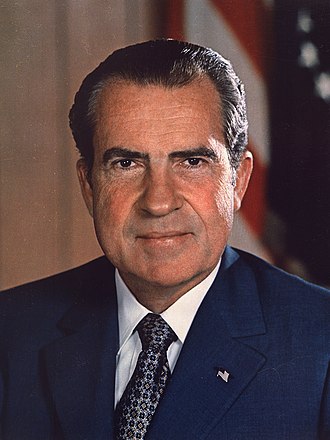
Richard M. Nixon served as the 37th President of the United States from January 1969 until his resignation in August 1974. In February 1971, he ordered the installation of a secret voice-activated taping system in the White House to preserve a historical record of his administration. Until the system's existence was revealed and dismantled in July 1973, the tapes captured Nixon directing major foreign policy initiatives, such as the opening to China, as well as his central role in the Watergate cover-up.
What Nixon talks about on the tapes
White House operations 4,718Presidential scheduling 2,225Public relations 1,784Presidential schedule 1,782Vietnam War 1,693Logistics 1,650Manolo Sanchez 1,626White House communications 1,400White House administration 1,399Presidential communication 1,243Henry Kissinger 1,191Foreign Policy 1,183
Conversations (21,010)
— Page 152 of 211President Nixon met with his aide, Stephen B. Bull, to coordinate his upcoming schedule and logistical movements within the Executive Office Building. Nixon emphasized his desire to avoid group settings while preparing for meetings with H. R. Haldeman and Henry Kissinger. Bull was instructed to facilitate these transitions and provide the President with necessary updates before his departure from the Oval Office.
President Nixon met with Stephen B. Bull to coordinate the scheduling of upcoming meetings, specifically regarding a planned session with H.R. Haldeman. The discussion focused on logistics and timing for these appointments, including the utilization of the Executive Office Building. Additionally, Charles W. Colson was identified as a subject for administrative follow-up during this transition.
President Nixon met with his personal valet, Manolo Sanchez, to address concerns regarding the President's physical well-being. During the brief interaction, Nixon adamantly refused to seek medical attention for an ongoing issue with his foot. The discussion concluded without any resolution to address the injury.
President Nixon initiates a brief telephone exchange with the White House operator to request a connection to Alexander P. Butterfield. The call serves as an administrative bridge to facilitate direct communication with a key staff member. No further policy or substantive matters were addressed during this short routing request.
President Nixon met with Charles Colson to strategize the public relations and implementation of the administration's second-term reorganization. The discussion focused on highlighting a narrative of significant personnel changes, including the appointment of John A. Scali and the replacement of various sub-Cabinet officials, to project strength and managerial control. They also addressed the importance of improving press relations, utilizing political appointees over career bureaucrats, and reinforcing the President’s "New Majority" by reaching out to labor and ethnic constituencies. Finally, the President emphasized the need to maintain public pressure regarding Vietnam negotiations and to aggressively combat media bias.
President Nixon consulted with Alexander P. Butterfield to clarify why John B. Connally and Melvin R. Laird were absent from an upcoming White House dinner. Butterfield was unable to provide a specific reason for Connally’s absence or his current whereabouts. The brief exchange highlights the President's personal attention to guest list management and the logistical uncertainty surrounding the attendance of key political figures.
President Nixon met with Henry Kissinger, Alexander Haig, and Ronald Ziegler to evaluate the stalemated Vietnam peace negotiations and consider military options to break the impasse. The participants discussed the frustrations of dealing with North Vietnamese duplicity and the political challenges posed by South Vietnamese President Nguyen Van Thieu's resistance to a potential settlement. Nixon emphasized the need for a decisive military response, including sustained bombing, to force a breakthrough, while also strategizing how to manage domestic public opinion and pressure from Congressional critics.
President Nixon met with his personal valet, Manolo Sanchez, in the Old Executive Office Building to coordinate the daily schedule. The primary focus of the discussion involved confirming the timing for a potential meeting with domestic policy advisor John D. Ehrlichman. The interaction concluded with Sanchez departing the office, marking the finalization of the President’s immediate agenda.
President Nixon and Alexander P. Butterfield met to coordinate the administrative logistics of upcoming White House events. The discussion focused on scheduling potential meetings with John D. Ehrlichman and refining the guest list and seating arrangements for a Cabinet dinner. The two evaluated potential additions to the dinner, including H.R. Haldeman, Leonard Garment, and Herbert G. Klein, to ensure the appropriate size and composition for the gathering.
President Nixon contacted the White House operator to place an outgoing call. The primary purpose of this interaction was to reach Press Secretary Ronald L. Ziegler. No further substantive discussion occurred during this brief request for assistance.
President Nixon met with an unidentified individual in his office to view a football game on television. The discussion remained informal and focused exclusively on the athletic contest. No substantive policy matters or administrative decisions were recorded during this encounter.
President Nixon met with his personal valet, Manolo Sanchez, in the Old Executive Office Building for an informal discussion. The conversation focused on the Miami Dolphins football game and the team's current score. This brief interaction highlights the President's personal engagement with his staff during the 1972 NFL season.
President Nixon consulted with the White House operator to facilitate a final wrap-up of outgoing communications. The brief interaction focused on concluding administrative tasks and administrative coordination within the Executive Office Building. No substantive policy discussions were recorded during this procedural exchange.
President Nixon consults Press Secretary Ronald Ziegler regarding Henry Kissinger’s public demeanor during a recent television briefing on Vietnam negotiations. The two discuss the importance of managing public expectations for a lasting peace and assess the likely domestic response to renewed U.S. bombing in North Vietnam. Nixon and Ziegler agree to maintain their course of action, dismissing concerns that Hanoi’s predictable outcry or negative media coverage from figures like David Brinkley will significantly alter public support for the administration's endgame.
President Nixon and Press Secretary Ronald L. Ziegler held a brief, informal meeting that focused primarily on casual conversation rather than official government business. The dialogue centered on personal commentary regarding professional football and hockey broadcasts occurring that day. No policy decisions or administrative actions were initiated during this exchange.
President Nixon and John Ehrlichman met to review budgetary priorities, specifically focusing on defense spending and the implementation of revenue sharing programs. They also evaluated costs and funding strategies for the Youth Conservation Corps and various Summer Youth Programs. The discussion centered on balancing these domestic initiatives against federal fiscal constraints.
President Nixon held a brief, informal meeting in the Old Executive Office Building with unidentified individuals. The conversation centered on casual topics, including historical references to past fairs and updates on professional sports, specifically the Miami Dolphins' recent 14-0 victory. No substantive policy decisions or executive actions were recorded during this segment.
President Nixon met with his valet, Manolo Sanchez, to facilitate the delivery of materials to Rose Mary Woods. The conversation focused on the logistics of placing specific correspondence and items on Woods’s desk while she was away in New York. The brief interaction concluded with the President instructing Sanchez to leave the items in her office.
President Nixon met with H.R. Haldeman and other staff to discuss the reorganization of his second-term administration, with a primary focus on appointing Anne L. Armstrong as a Counselor to the President with Cabinet rank. The discussion covered defining Armstrong's responsibilities—including outreach to women, the Bicentennial, and POW/MIA issues—and managing potential media leaks regarding her appointment. Additionally, the participants reviewed the disposition of 1972 campaign surplus funds and addressed various scheduling logistics for upcoming White House events, including a Cabinet dinner.
President Nixon contacted the White House operator to facilitate a personal phone call to his daughter, Julie Nixon Eisenhower. He instructed the operator to attempt to reach her in her room and provided instructions for her to return the call to the Lincoln Sitting Room if she was unavailable. This brief communication served solely as a logistical request for the President's private family correspondence.
President Nixon communicated with the White House operator to confirm the arrival of his daughter, Julie Nixon Eisenhower. The operator provided a status update regarding Julie’s progress in the elevator as she headed toward the President's location. This brief exchange served primarily to facilitate the President's awareness of his daughter's movement within the White House.
President Nixon initiated a brief administrative request to the White House operator to facilitate a telephone connection with his Press Secretary, Ronald L. Ziegler. The interaction served solely as a functional bridge to reach a key staff member during the President’s early morning hours. No substantive policy matters or broader political discussions occurred during this exchange.
President Nixon contacted the White House operator to facilitate a telephone connection with Special Counsel Charles W. Colson. This brief communication served as a formal request to initiate a direct line to Colson. No further substantive discussion or decision-making was recorded during this brief exchange.
President Nixon and Press Secretary Ronald Ziegler discuss press coverage of Henry Kissinger’s recent briefing regarding the stalled Vietnam peace negotiations. They evaluate how the media, particularly the Washington Post, received Kissinger’s portrayal of North Vietnamese intransigence and his explanation of the stalled talks. Nixon emphasizes the importance of framing the negotiations as a deliberate, controlled effort directed by the White House, rather than a process dictated by Kissinger’s personal emotional state or past rhetoric.
President Nixon initiated a call through the White House operator to place an outgoing telephone communication. The attempt was unsuccessful and resulted in an aborted connection. No substantive policy discussions or administrative actions were recorded during this brief exchange.
President Nixon and Charles Colson discuss the success of White House events aimed at building a 'New Majority' by engaging supporters outside the traditional political elite, including labor and Democratic voters. The conversation also addresses the public and media reaction to the recent Vietnam peace negotiations and Henry Kissinger's briefings. Nixon expresses a strategic preference for immediate military escalation, specifically the use of B-52s, arguing that absorbing political heat now is preferable to delaying the conflict.
President Nixon contacts the White House operator to place an outgoing call to H.R. "Bob" Haldeman. The brief exchange serves as a logistical request to establish communication with his Chief of Staff. No further policy or substantive matters are addressed during this transition.
President Nixon and H. R. Haldeman discussed scheduling for upcoming meetings with Maurice Stans and reviewed plans to meet with John Ehrlichman to finalize personnel appointments. They also evaluated the public perception of Henry Kissinger’s recent press briefing regarding the Vietnam peace negotiations, noting that the status of talks with Hanoi appeared stalled. Additionally, the conversation touched on the success of the recent Cabinet dinner, specifically praising the musical performance by Fred Waring and the positive reception of the event by guests.
President Nixon instructed the White House operator to connect him with National Security Advisor Henry A. Kissinger. This brief exchange served as a logistical precursor to a high-level policy discussion between the President and his advisor. The call highlights the established communication procedures used by the President to facilitate direct, secure contact with his top foreign policy official during the height of the Vietnam peace negotiations.
President Nixon and Henry Kissinger discussed the diplomatic and military strategy regarding the Vietnam peace negotiations, specifically focusing on the necessity of resuming air strikes to force Hanoi to settle. Nixon emphasized that taking military action now was critical, as it avoided the constraints of consulting with Congress and created an enforceable agreement before the upcoming inauguration. They also analyzed the lack of cooperation from South Vietnamese President Nguyen Van Thieu and finalized plans for a private dinner with Alice Roosevelt Longworth and other select guests.
President Nixon met with his personal valet, Manolo Sanchez, to discuss the logistics of tuning in to a football game broadcast. The pair specifically addressed the availability of the game through various television channels and radio stations. No significant policy decisions were made during this informal interaction.
President Nixon met with his personal valet, Manolo Sanchez, in the Old Executive Office Building to facilitate administrative tasks. During the encounter, the President prepared a draft of a letter addressed to South Vietnamese President Nguyen Van Thieu. Nixon instructed Sanchez to deliver this document to a secretary for processing.
President Nixon and Alexander Haig coordinated the finalization of a letter addressed to South Vietnamese President Nguyen Van Thieu. The discussion focused on the clerical progress of the draft and the scheduling of a follow-up meeting between Haig and Thieu. Manolo Sanchez was tasked with facilitating these administrative arrangements to ensure the correspondence was completed promptly.
President Nixon and Alexander Haig met to finalize the strategy for Haig's upcoming trip to Saigon, specifically focusing on the delivery of a letter to South Vietnamese President Nguyen Van Thieu. The conversation centered on the delicate negotiations with North Vietnam and the necessity of managing South Vietnamese cooperation while addressing Thieu's concerns regarding a potential bilateral settlement. They also reviewed operational details regarding U.S. bombing campaigns and emphasized the urgency of securing Thieu's agreement to avoid a total cutoff of U.S. funding by Congress.
President Nixon initiates a brief telephone call through the White House operator to contact his daughter, Julie Nixon Eisenhower. The exchange serves solely as a connection request to facilitate a private family conversation. No policy matters or administrative decisions are addressed during this brief interaction.
President Nixon consulted with the White House operator to facilitate an outgoing communication. This brief interaction served as a logistical step for the President to place a telephone call. No further substantive policy or strategic discussions occurred during this brief exchange.
President Nixon and his daughter, Julie Nixon Eisenhower, coordinate the logistical details for an upcoming dinner with Alice Roosevelt Longworth. The discussion focuses on confirming the start time, the dress code, and the guest list, which includes Henry Kissinger. They finalize the arrangements for the small, five-person gathering to ensure it meets the preferences of their guest of honor.
President Richard Nixon met with his daughter, Julie Nixon Eisenhower, to coordinate scheduling for an upcoming event or gathering. The brief discussion focused on confirming specific meeting times, likely involving plans for the evening. The exchange concluded with the parties finalizing the arrangements and exchanging pleasantries.
President Nixon and his daughter, Julie Nixon Eisenhower, discuss potential plans for the First Lady, Pat Nixon, to visit Camp David. The conversation centers on coordinating the First Lady's schedule around a diplomatic reception planned for the following day. Julie agrees to contact her mother to gauge her interest in the trip and report back to the President.
President Nixon met with his daughter, Julie Nixon Eisenhower, to discuss the selection of a commemorative monument or passage. The brief exchange focused on identifying an appropriate memorial or inscription, though the conversation remains fragmented due to withdrawn material. No specific decisions regarding the final choice were recorded during this brief encounter.
President Richard Nixon and his daughter, Julie Nixon Eisenhower, coordinate the logistical details for a planned trip to Camp David. The two discuss departure timing to ensure they arrive early enough to enjoy a swim at the retreat. They ultimately decide to depart at approximately 3:45 pm to maximize their time at the facility.
President Nixon contacted the White House operator to facilitate a communication with the office of military aide Lieutenant Colonel William L. Golden. The brief exchange served as a logistical request to initiate this specific line of contact. No further substantive policy matters were discussed during this brief connection.
President Nixon consulted with Lt. Col. William L. Golden to finalize arrangements for a short trip to Camp David. Nixon requested that departure be expedited, prompting the President to set a departure time for 30 minutes following the call. The logistics were settled with the understanding that the President would return to the White House the following day around noon.
President Nixon contacted the White House operator to place a phone call to his personal aide, Stephen B. Bull. This brief administrative interaction served to facilitate direct communication with a member of the President's immediate staff. No substantive policy discussions or complex decision-making occurred during this short exchange.
President Nixon consulted with the White House operator to arrange contact with his staff regarding scheduling and communication. After learning that Stephen B. Bull was unavailable due to his attendance at a football game, Nixon directed the operator to attempt to reach H. R. Haldeman instead. This brief exchange highlights the President's efforts to maintain administrative connectivity while his aides were away from their posts.
President Nixon and H. R. Haldeman coordinated scheduling logistics regarding the President's upcoming trip to Camp David and his return for a diplomatic reception. Nixon instructed Haldeman to postpone a meeting with Maurice Stans and finalized plans for a 3:00 p.m. meeting with Haldeman and John Ehrlichman upon his return. The conversation ensured administrative alignment for the President's itinerary for December 18 and 19.
President Nixon contacted the White House operator to initiate a call to his National Security Advisor, Henry Kissinger. The brief exchange served as a routine administrative request to facilitate communication between the President and his top foreign policy aide. No further substantive discussions occurred during this brief interaction.
President Nixon and Henry Kissinger coordinated logistics for a dinner event before pivoting to a critical discussion regarding stalled Vietnam peace negotiations. They debated the merits of pursuing a bilateral deal with North Vietnam while assessing the risks of a potential collapse of the South Vietnamese government under President Thieu. The two leaders also analyzed the psychological impact of recent U.S. mining and bombing campaigns on Hanoi, while strategizing how to manage domestic political pressure and potential leaks regarding the failed talks.
President Nixon contacted the Camp David operator to facilitate a telephone call to Marjorie P. Acker. During the brief exchange, he sought to locate Acker at Rose Mary Woods’s office. This routine administrative communication highlights the logistical coordination required for the President's personal and official correspondence while stationed at Camp David.
President Nixon consulted with Marjorie P. Acker to clarify and finalize the guest list for an upcoming dinner party. The discussion centered on confirming the attendance of Anne L. Armstrong and her husband, Tobin, as well as Admiral Thomas H. and Carrie Ellen Moorer. Nixon sought to reconcile conflicting information regarding whether Anne Armstrong's husband would be accompanying her to the event.
President Nixon contacted the Camp David operator to facilitate an outgoing call. The primary purpose of this brief communication was to request that the operator connect him with Marjorie P. Acker. No other substantive policy or political matters were addressed during this short exchange.
President Nixon consulted with Marjorie P. Acker to finalize logistics for an upcoming White House dinner party. The discussion confirmed that all twelve invited guests, including Admiral Thomas H. Moorer and Anne L. Armstrong, had accepted the invitation. The participants also finalized menu selections, specifically agreeing to include a salad course for the event.
President Nixon contacted the Camp David operator to facilitate a telephone connection with White House Press Secretary Ronald L. Ziegler. This brief administrative interaction served as an intermediary step to coordinate direct communication between the President and his press secretary. No further substantive policy matters were discussed during this brief exchange.
President Nixon and Press Secretary Ronald Ziegler discussed messaging strategies regarding the Vietnam War, specifically the ongoing U.S. bombing and mining of North Vietnam as a response to enemy buildup and the breakdown in peace negotiations. The two also addressed the administration's contentious relationship with the Washington Post, with Nixon instructing Ziegler to remain firm in his policy of denying the newspaper special access to White House social events. Nixon encouraged Ziegler to continue distributing press opportunities more broadly to other outlets to diminish the Post's traditional influence in Washington.
President Nixon contacted the Camp David operator to facilitate an urgent communication with his Chief of Staff, H.R. Haldeman. This brief administrative interaction served exclusively as a mechanism to establish a telephone connection between the two officials. No substantive policy matters were discussed during this request.
President Nixon and H.R. Haldeman discuss administrative logistics, including scheduling upcoming meetings with officials such as Richard G. Kleindienst and William D. Ruckelshaus. The conversation covers the management of Camp David, the use of the retreat by cabinet members for social engagements, and the ongoing challenge of curbing media leaks regarding second-term appointments. Additionally, they touch upon managing press relations and the strategic handling of information provided to reporters.
President Nixon contacted the Camp David operator to facilitate a telephone connection with his National Security Advisor, Henry Kissinger. The brief exchange served as a logistical request to initiate this communication. No further policy or substantive matters were discussed during this interaction.
President Nixon and Henry Kissinger discuss the ongoing bombing and mining campaign against North Vietnam, specifically focusing on the operational impact of weather conditions, B-52 losses, and the destruction of North Vietnamese radio facilities. Kissinger provides updates on the progress of the air strikes while noting that the administration has initiated a new round of peace negotiations in hopes of achieving a settlement. The two also address concerns regarding leaked information about the campaign and the broader strategic necessity of maintaining American credibility with allies and adversaries alike.
President Nixon contacted the Camp David operator to facilitate an urgent communication with his National Security Advisor, Henry Kissinger. The primary purpose of the brief interaction was to place an outgoing call through the White House switchboard. This request reflects the standard administrative procedure Nixon utilized to maintain secure, direct lines of communication with his top foreign policy official during his stay at the presidential retreat.
President Nixon and Henry Kissinger discuss the tactical implementation and operational pace of an ongoing bombing campaign, specifically addressing the frequency and targeting of strikes. The conversation centers on maintaining operational intensity and ensuring military effectiveness, with the President explicitly instructing Kissinger to persist with the current offensive strategy. They assess the technical challenges of target selection and the implications of potential collateral damage in populated areas.
President Nixon initiates a brief telephone call to White House Press Secretary Ronald L. Ziegler. The purpose of the exchange is solely to request that the operator connect him to Ziegler. No further substantive policy or strategic discussions occur during this brief interaction.
President Nixon consulted with his personal valet, Manolo Sanchez, while utilizing the White House operator to place an outgoing telephone call. The exchange was brief and focused on logistical coordination regarding the President's immediate schedule or communications. No major policy developments occurred during this brief interaction, which primarily served to facilitate a specific connection for the President.
President Nixon and Press Secretary Ronald L. Ziegler discuss Ziegler’s post-briefing status to coordinate a brief, informal meeting. Nixon invites Ziegler to meet with him at the Executive Office Building following the completion of Ziegler's duties. This brief exchange serves to organize the President’s afternoon schedule and facilitate a direct consultation.
President Nixon and Press Secretary Ronald L. Ziegler met briefly in the Old Executive Office Building to coordinate their midday schedule. The primary focus of the discussion was confirming arrangements for lunch. No significant policy or political matters were addressed during this brief interaction.
President Nixon and Henry Kissinger discuss the successful completion of the second wave of B-52 bombing raids over North Vietnam, noting that only one aircraft sustained damage. Kissinger reports that Soviet news agency TASS has already publicized the strikes on Hanoi’s marshalling yards, confirming the effectiveness of the attack. Both men justify the escalation as a necessary strategic response, concluding that they had no other viable options to force the North Vietnamese to take notice.
President Nixon and Henry Kissinger met briefly to assess the status of ongoing strategic negotiations, characterized by a mix of high expectations and subsequent complications. The participants discussed the uncertainty surrounding current initiatives, ultimately concluding that they had no viable alternative but to proceed with their chosen course of action. This brief exchange served to reaffirm the administration's resolve in the face of unpredictable diplomatic developments.
President Nixon contacted the White House operator to facilitate a meeting with his Special Counsel, Charles W. Colson. This brief administrative interaction served as an official request to coordinate the President's schedule. No substantive policy matters were discussed during this short communication.
President Nixon met with his personal valet, Manolo Sanchez, to discuss mundane logistical matters and the President’s upcoming schedule. The conversation focused on the current weather conditions and the delivery of refreshments. No significant policy decisions were made during this brief, informal encounter.
President Nixon met with Ronald Ziegler and David C. Hoopes to coordinate White House press strategy regarding the administration's second-term reorganization, staff reductions, and ongoing Vietnam War negotiations. Nixon instructed Ziegler to maintain a calm, objective demeanor when handling aggressive media, particularly in light of critical coverage from the Washington Post. They decided to adopt a policy of distributing press access and attention more broadly across national outlets to diminish the influence of the Washington-based press corps, which Nixon viewed as unfairly hostile.
President Nixon and H.R. Haldeman coordinate a brief meeting to take place immediately prior to the President's 2:00 pm appointment. The conversation serves primarily as a logistical check to confirm the availability of both participants before the scheduled engagement. No substantive policy matters or specific directives are addressed in this short exchange.
President Nixon and H. R. Haldeman met to discuss White House management, public relations strategies, and the ongoing Vietnam War negotiations. They reviewed the administration's outreach to their 'New Majority' of supporters through social events and debated how to address the domestic political implications of the Vietnam bombing campaign without projecting an atmosphere of crisis. The conversation also touched on personnel matters, including scheduling, staff assignments, and diplomatic appointments.
President Nixon met with Richard Kleindienst and John Ehrlichman to discuss personnel matters for the second term, specifically the potential nomination of L. Patrick Gray as FBI Director and the political risks associated with his confirmation hearings regarding the Watergate scandal. The participants also evaluated potential government reorganizations, including the consolidation of narcotics enforcement resources and a proposed restructuring of the Customs, Border Patrol, and FBI investigative functions. Additionally, Nixon directed Kleindienst to pressure NFL Commissioner Pete Rozelle to end television blackouts for sold-out playoff games, viewing it as a popular policy move that would benefit the public.
President Nixon and John Ehrlichman discussed the strategic reorganization of the executive branch and federal agencies during the transition into the second term. Key focus areas included leadership prospects for the FBI, specifically regarding Richard Kleindienst and Frank Rizzo, and the consolidation of narcotics oversight within the White House. Ehrlichman confirmed he tasked William Timmons with gauging legislative sentiment as the administration moved to centralize administrative control.
President Nixon held a brief meeting with an unidentified individual to coordinate scheduling for key staff members. The discussion focused on arranging upcoming meetings for H.R. Haldeman, Henry Kissinger, and Charles Colson. These logistical arrangements appear to be the primary purpose of the short encounter.
President Nixon met with his senior aides and advisors to discuss a wide range of personnel appointments, administrative reorganizations, and the ongoing situation in Vietnam. The group strategized on filling key government roles while simultaneously consolidating executive office functions to reduce staff and streamline bureaucracy. Additionally, they reviewed the military status of the Vietnam War, affirming their commitment to continue military pressure until a satisfactory peace agreement could be secured.
President Nixon met with H. R. Haldeman, John Ehrlichman, and Henry Kissinger to discuss the administration's ongoing challenges with press relations, particularly concerning the media's coverage of the Vietnam peace negotiations. The participants analyzed the political sensitivity surrounding Kissinger’s public comments and potential resignation, while also evaluating the President's credibility and the impact of the 1972 election results. Additionally, the conversation addressed the logistical complexities of the upcoming second-term reorganization and the need for effective communication strategies regarding legislative budget priorities.
President Nixon met with an unidentified individual in the Old Executive Office Building to provide specific personal or administrative instructions. The brief interaction, which concluded immediately after beginning, also involved a discussion regarding a wine list. No further details regarding the nature of the instructions or the participant's identity are available.
President Nixon and H.R. Haldeman met to discuss personnel and organizational logistics for the upcoming second term, specifically focusing on the office placement of Counselor Anne L. Armstrong within the White House complex. Nixon insisted that Armstrong be provided with suitable office space inside the White House rather than the Executive Office Building to enhance her profile, even at the expense of office space for other staffers. Additionally, the President received updates on internal leadership disputes within the Republican National Committee regarding finance chair candidates.
President Nixon met with his daughter, Julie Nixon Eisenhower, and key staff members to discuss communications strategies for his second term, with a focus on prioritizing television over traditional print media. The participants reviewed efforts to manage press relations, specifically by limiting the special access afforded to outlets like The Washington Post while promoting regional news coverage. Additionally, the President emphasized the importance of utilizing his office to perform acts of personal outreach, such as phone calls to citizens, and finalized logistical plans for upcoming holiday travel and scheduling.
President Nixon met with H.R. Haldeman, Maurice Stans, and others to discuss second-term administrative reorganizations, press strategy, and Vietnam policy, specifically the impact of renewed bombing. Much of the discussion focused on managing the aftermath of the 1972 campaign, including the handling of surplus funds and the recognition of major donors through social events and potential appointments. Nixon expressed frustration over the perceived political hostility of the press and the impact of the Watergate scandal on his administration's public reputation and fundraising efforts.
President Nixon met with EPA Administrator William D. Ruckelshaus and aide Kenneth R. Cole, Jr. to discuss Ruckelshaus's professional future and the political climate surrounding the administration's second term. The conversation encompassed Ruckelshaus's potential candidacy for the U.S. Senate in Indiana, his administrative performance at the EPA, and the President's broader theories regarding the "softness" of the American intellectual elite. Ultimately, Nixon encouraged Ruckelshaus to take political risks and maintain a firm stance against congressional budget demands, while expressing his appreciation for Ruckelshaus's work at the agency.
President Nixon met with his aide Stephen B. Bull to coordinate the scheduling of an upcoming meeting involving Richard C. Van Dusen and Kenneth R. Cole, Jr. The discussion centered on logistics and the arrangement of White House gift distributions, specifically concerning ashtrays and cuff links. The brief exchange served to finalize these administrative appointments and protocol details.
President Nixon met with Richard C. Van Dusen and Kenneth R. Cole, Jr. to discuss Van Dusen's future career plans following his tenure as Under Secretary of the Department of Housing and Urban Development (HUD). The President expressed appreciation for Van Dusen’s performance in a challenging department and encouraged him to keep various options open, including a potential future political candidacy or a federal judgeship. The conversation concluded with Nixon offering his support and emphasizing that the administration would remain available to assist Van Dusen in his transition back to private law practice in Michigan.
President Nixon instructed the White House operator to initiate a telephone call to Senator-elect Joseph R. Biden, Jr. of Delaware. The objective of this brief administrative request was to establish direct communication with the incoming legislator. No further substantive policy matters were discussed during this connection attempt.
President Nixon met with Stephen B. Bull to coordinate his upcoming schedule, specifically focusing on a meeting with Kenneth R. Cole, Jr. and preparations for a physical examination at Bethesda Naval Hospital. The discussion covered the timing of his hospital departure and necessary dietary arrangements. Additionally, the President briefly noted an interest in Joseph R. Biden of Delaware.
President Nixon met with his senior staff, including H.R. Haldeman and Charles Colson, to coordinate personnel changes for his second term, discuss strategies for managing press relations, and finalize plans for the upcoming inauguration. A major focus was the administration’s aggressive approach toward media outlets like The Washington Post and the television networks, with Nixon encouraging the use of regulatory pressure and cable television technology to bypass traditional information gatekeepers. Additionally, the President reviewed the status of Vietnam peace negotiations, emphasizing the necessity of firm military action to prevent an enemy buildup while maintaining his public posture of seeking peace.
President Nixon called newly elected Senator Joseph R. Biden, Jr. to offer his personal condolences following the tragic automobile accident that claimed the lives of Biden’s wife, Nealia, and their daughter. During the brief exchange, Nixon expressed sympathy for the family's loss and encouraged the grieving Senator to look toward his future career. Drawing on his own experience entering the House of Representatives at a young age, Nixon sought to provide comfort and encouragement to Biden during his period of profound personal crisis.
President Nixon instructed the White House operator to place a telephone call to his Chief of Staff, H.R. Haldeman. This brief administrative interaction served to facilitate direct communication between the President and his senior aide. No further policy or substantive matters were discussed during this brief connection.
President Nixon met with Manolo Sanchez and Stephen B. Bull to coordinate his upcoming personal schedule. The primary focus involved confirming the timing of a planned trip to Florida and verifying the current location of Henry Kissinger. The participants concluded the brief discussion by directing staff to track down Kissinger's whereabouts.
President Nixon met with his aide Stephen B. Bull in the Oval Office to briefly coordinate the President's personal schedule. The discussion centered on arrangements for an upcoming barber appointment. The conversation concluded with a brief, offhand remark regarding a third party's demeanor.
In this Oval Office meeting, President Nixon, Henry Kissinger, H. R. Haldeman, and others discussed the state of Vietnam peace negotiations following a breakdown in talks and North Vietnamese public charges. The participants reviewed the administration's strategic efforts to maintain pressure on Hanoi, including the impact of recent bombing campaigns and the tone of Congressional relations. Additionally, the President and his staff coordinated personnel and administrative matters for the second term, specifically addressing campaign contributor recognition, the vetting of nominees for the Securities and Exchange Commission, and the desire for greater loyalty and political reliability in key appointments.
President Nixon attempted to reach Chief of Staff H. R. Haldeman, who was unavailable while attending an event at the Washington National Cathedral. Upon learning of the delay, the President redirected the operator to initiate a call to Undersecretary of Defense Kenneth Rush. The conversation reflects Nixon’s efforts to conduct official business regarding the Department of Defense during the evening hours.
President Nixon directed Ambassador Kenneth Rush to investigate Gordon Wade Rule, the Director of the Procurement Control and Clearance Division, following the publication of an article by Rule that the President perceived as insubordinate. Nixon demanded an immediate explanation for the piece or for Rule to be removed from his position. Rush was instructed to report back to the President within thirty minutes regarding the status of the official.
President Nixon contacted the White House operator to place an urgent call to Attorney General Richard G. Kleindienst. The conversation served primarily as an administrative request to facilitate this communication. No further substantive policy matters were discussed during this brief exchange.
President Nixon and Attorney General Richard G. Kleindienst coordinate a strategy to persuade NFL Commissioner Pete Rozelle to lift the television blackout on upcoming playoff games. The administration proposes a compromise where regular-season games retain broadcast protection while postseason games are made available to the public, similar to the World Series model. Nixon directs Kleindienst to publicly announce his involvement in these negotiations and personally promises to veto any congressional legislation that would mandate the end of all professional football blackouts.
President Nixon and Deputy Secretary of Defense Kenneth Rush discuss the administrative removal of Gordon Wade Rule, a career civil servant suspected of long-term insubordination. Because Rule holds civil service protections that prevent immediate termination, the President authorizes Rush to strip him of all official responsibilities and initiate formal disciplinary charges. The conversation underscores the administration's determination to discipline Rule despite his established influence among congressional allies.
President Nixon and Henry Kissinger discussed the progress and strategic effectiveness of the ongoing B-52 bombing campaign in Vietnam, noting the disruption of Radio Hanoi and minimal public backlash. Kissinger reported that Alexander Haig would soon provide updates from his meetings with South Vietnamese President Nguyen Van Thieu, with both men agreeing that the military pressure was necessary to enforce a potential peace agreement. Additionally, the President confirmed upcoming diplomatic appointments, including William Sullivan as ambassador to the Philippines and Marshall Green to Australia.
President Nixon and Stephen B. Bull met briefly in the Oval Office to coordinate logistics for upcoming events. The discussion centered on finalizing the President’s schedule, specifically regarding his attendance at a diplomatic children’s party and commitments in the Executive Office Building. No major policy decisions were made during this administrative planning session.
President Nixon met with Zosimo T. Monzon in the Oval Office to discuss logistical arrangements regarding the President’s office in the Executive Office Building. The conversation primarily focused on the retrieval of personal items, specifically a briefcase and eyeglasses. The brief interaction concluded with administrative coordination concerning the President's children.
President Nixon met with H. R. Haldeman, Ronald Ziegler, and Zosimo Monzon to discuss adjustments to his upcoming travel itinerary. The participants focused on coordinating a delay in the President's scheduled trip to Florida. The discussion specifically addressed the logistical impact of this scheduling change on First Lady Pat Nixon.