Nixon, Richard M. (President)
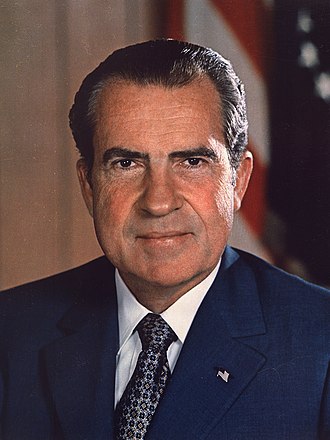
Richard M. Nixon served as the 37th President of the United States from January 1969 until his resignation in August 1974. In February 1971, he ordered the installation of a secret voice-activated taping system in the White House to preserve a historical record of his administration. Until the system's existence was revealed and dismantled in July 1973, the tapes captured Nixon directing major foreign policy initiatives, such as the opening to China, as well as his central role in the Watergate cover-up.
What Nixon talks about on the tapes
White House operations 4,718Presidential scheduling 2,225Public relations 1,784Presidential schedule 1,782Vietnam War 1,693Logistics 1,650Manolo Sanchez 1,626White House communications 1,400White House administration 1,399Presidential communication 1,243Henry Kissinger 1,191Foreign Policy 1,183
Conversations (21,010)
— Page 164 of 211President Nixon held a brief communication with the White House operator to facilitate an outgoing call. The interaction functioned as a logistical bridge to initiate further telephonic contact with another party. No substantive policy discussions or significant executive decisions occurred during this brief exchange.
President Nixon consulted with the White House operator to facilitate a connection with an individual identified as Mr. Hawthorne. The brief interaction served as a logistical bridge to initiate a specific telephone communication. No further policy or administrative matters were addressed during this short exchange.
President Nixon consulted with the White House operator to determine if he should contact John D. Ehrlichman, who was currently attending a meeting at the U.S. News and World Report offices. After confirming Ehrlichman's availability, Nixon decided against interrupting him. Consequently, no call was placed, and the President instructed the operator not to leave a message.
President Nixon consulted with Patrick J. Buchanan to prepare for an upcoming press conference regarding the Watergate scandal. Nixon expressed concerns that previous public statements by John Ehrlichman were unhelpful and directed Buchanan to coordinate with John Dean and H.R. Haldeman to develop a strategy. The President decided to adopt a position of silence on the Watergate case due to pending litigation, while also formulating specific responses to anticipated questions regarding executive privilege, staff involvement, and the scope of internal White House investigations.
President Nixon consults with Patrick J. Buchanan to strategize responses to potential media inquiries regarding the ongoing Watergate scandal. The discussion focuses on maintaining a consistent public stance, specifically distancing the administration from the burglary while reinforcing confidence in the internal investigation conducted by John Dean. Nixon emphasizes the need for a restrained, unified messaging approach when addressing questions from the press or Congress.
President Nixon contacts the White House operator to initiate a telephone call to National Security Advisor Henry A. Kissinger. This brief administrative interaction serves as a bridge to facilitate a direct line of communication between the President and his advisor. No substantive policy discussions occur during this specific request.
President Nixon consulted with the White House operator regarding an unspecified matter that elicited a strong expression of disbelief. The brief exchange reflects the President's immediate frustration, though the specific subject of his inquiry remains undocumented. This interaction serves as a functional communication regarding administrative or logistical support within the Executive Office Building.
President Nixon and Henry Kissinger discussed preparations for an upcoming press conference, focusing on addressing the status of North Vietnamese prisoners of war and recent military activities in Vietnam and Cambodia. They reviewed the implementation of the ceasefire, analyzed the diplomatic statements from the Soviet Union and China, and coordinated their public messaging regarding the efficacy of the peace agreement. Additionally, the pair addressed administrative details, including the potential scheduling of a summit with Leonid Brezhnev and the planned meeting with Nguyen Van Thieu.
President Nixon met with his aide Stephen B. Bull in the Old Executive Office Building to coordinate the President's upcoming schedule. The brief discussion focused primarily on arranging an engagement with Henry A. Kissinger. No further policy actions or significant developments were recorded during this session.
President Nixon and Henry Kissinger met to discuss military strategy and logistical concerns regarding the ongoing conflict, specifically focusing on the supply and replacement of weaponry. The discussion touched upon the restraint exercised in current operations and addressed potential bombing activities related to Cambodia. Nixon reaffirmed his commitment to proceeding with a planned military operation.
President Nixon met with Ronald Ziegler, Peter Brennan, and Henry Kissinger to prepare for an upcoming press conference. The discussion focused on crafting responses to inquiries regarding the Vietnam peace settlement, postwar diplomatic and economic relations, and the Watergate scandal. The participants evaluated how to address potential questions about Watergate investigations while maintaining a stance of cooperation with Congress and avoiding premature comments on ongoing legal proceedings.
President Nixon contacted the White House operator to place an outgoing call to Press Secretary Ronald L. Ziegler. The brief interaction served as a administrative request for telephone connectivity. No substantive policy discussions occurred during this exchange.
President Nixon and Henry Kissinger met to discuss scheduling and logistics related to upcoming travel arrangements. The conversation focused on the coordination of potential presidential trips and the necessary preparations for diplomatic engagement. No definitive outcomes were reached, as the discussion served primarily to sync the President's calendar with his National Security Advisor.
President Nixon and Henry Kissinger met to prepare for an upcoming press conference by anticipating potential questions regarding the administration's past communications with Lyndon B. Johnson. They focused specifically on establishing a clear timeline and confirmation of calls made by Kissinger, H.R. Haldeman, and the President to Johnson following the recent Vietnam peace settlement. The discussion functioned as a briefing to ensure the President could accurately address inquiries concerning these sensitive political contacts.
President Nixon met with his personal valet, Manolo Sanchez, in the Old Executive Office Building to discuss administrative tasks and personal arrangements. The conversation focused on the logistics of a food order and the handling of a portable icebox. No major policy developments occurred during this brief interaction regarding the President's personal services.
President Nixon consulted with the White House operator to facilitate an outgoing call. This routine interaction served as a administrative step to connect the President with another party. No policy discussions or substantive political developments occurred during this brief exchange.
President Nixon met with Herbert Stein and staff from the Council of Economic Advisers in the Cabinet Room to sign the 1973 Economic Report. The discussion touched upon the timing of the report's release in relation to Vietnam policy announcements and media coverage, specifically referencing reporting by Hobart Rowen. The meeting concluded with Nixon distributing pens and commemorative gifts to the attendees while offering lighthearted remarks about the staff's work on the report.
President Nixon met with his aide, Stephen B. Bull, to review logistical details regarding upcoming White House events, including a dinner for Japanese Prime Minister Eisaku Sato and the swearing-in ceremony for Cabinet members. The discussion also addressed planning for a state dinner for King Hussein of Jordan, specifically concerning the selection of entertainment and the inclusion of campaign supporters. The meeting focused on administrative coordination to ensure the smooth execution of these high-profile official and social engagements.
President Nixon met with Press Secretary Ronald L. Ziegler to discuss the selection and management of personnel for upcoming administrative roles. The two conferred on the necessity of choosing individuals who could effectively handle significant responsibilities and carry a substantial workload. They concluded by considering the internal dynamics of these prospective appointees, weighing whether professional friction might actually serve as a constructive mechanism for mutual oversight.
President Nixon directs Press Secretary Ronald Ziegler to have John Ehrlichman and John Dean draft an obfuscatory executive privilege statement to deflect questioning from Clark Mollenhoff. The two also review the success of a recent press conference, with Ziegler noting positive public and media reception regarding the President’s stance on amnesty, North Vietnam, and the impoundment of congressional funds. Nixon expresses his satisfaction with the press conference location and reaffirms his decision to restrict future press access to the Oval Office.
President Nixon contacted the White House operator to facilitate a telephone connection with Patrick J. Buchanan. The brief exchange served as a routine administrative request to initiate communication with a staff member. No further policy or strategic discussions took place during this specific transmission.
President Nixon and Patrick J. Buchanan discuss the public and political reception of the President's recent press conference, focusing specifically on the administration's hardline stance against amnesty for Vietnam draft evaders. Nixon emphasizes his commitment to achieving "peace with honor" in Vietnam, expressing frustration that critics and the media have failed to acknowledge the achievement. Both men agree that those who avoided service should face legal consequences rather than perform alternative service in the Peace Corps, and they note with surprise the absence of questions regarding the Watergate scandal.
President Nixon met with his personal valet, Manolo Sanchez, in the Old Executive Office Building to discuss the President's daily schedule. The brief interaction primarily focused on logistics regarding the President’s lunch plans and the coordination of meetings with staff members such as H.R. Haldeman. The meeting concluded quickly once these administrative arrangements were addressed.
President Nixon and Peter J. Brennan discuss the political implications and public perception of a potential amnesty policy for Vietnam War-era draft evaders. Nixon proposes an alternative to simple pardons, suggesting that individuals could fulfill a service requirement, such as police work, rather than being sent away. The brief exchange highlights the administration's search for a viable, socially acceptable resolution to the contentious amnesty issue.
President Nixon met with his personal valet, Manolo Sanchez, in the Old Executive Office Building. While the specific transcript of the discussion remains undefined, the meeting was centered on the review of H. R. Haldeman’s daily schedule. The interaction concluded with Sanchez departing the office shortly thereafter.
President Nixon met with his personal valet, Manolo Sanchez, in the Old Executive Office Building. The brief interaction focused on the President's personal requirements, specifically the processing of a food order. No other policy matters or administrative developments were recorded during this segment.
President Richard M. Nixon met with his longtime valet, Manolo Sanchez, in the Old Executive Office Building for a private engagement. Given the restricted nature of the recording and the absence of a transcript, the specific substance of their exchange remains classified or unrecorded. The interaction serves as a brief point of contact between the President and his personal staff during the height of the Nixon administration.
President Nixon met with his personal valet, Manolo Sanchez, at the Old Executive Office Building to discuss administrative details regarding his daily schedule and upcoming press conference. The brief exchange touched on logistical preparations and communications involving key staff members and figures such as Henry Kissinger and the late Lyndon Johnson. The conversation served primarily as a coordination session for the President's immediate agenda.
President Nixon met with his valet, Manolo Sanchez, to manage administrative tasks, including the organization of files and personal food orders. Prior to and following the interaction with Sanchez, Nixon dictated internal memoranda regarding upcoming press conferences, the Vietnam peace settlement, and the administration's relationship with Congress. He also coordinated his schedule, noting planned interactions with key advisors such as Charles Colson, Henry Kissinger, John Connally, and William Rogers.
President Nixon met with his personal valet, Manolo Sanchez, in the Old Executive Office Building to discuss administrative details regarding the President's upcoming schedule. The conversation served to coordinate logistics for the President's movements for the remainder of the day. The meeting concluded when the two departed together at 2:40 pm.
President Nixon met with his aide Stephen B. Bull to discuss administrative logistics and correspondence. Their discussion centered on determining the whereabouts of H.R. Haldeman and finalizing the appropriate salutation for a letter intended for heavyweight boxing champion George Foreman. The meeting concluded with Bull departing the Oval Office after addressing these routine operational matters.
President Nixon met with his aide, Stephen B. Bull, to coordinate administrative tasks within the Oval Office. The primary focus of the brief session was to manage the President's daily schedule and facilitate the recording of dictation tapes. No major policy developments occurred, as the conversation centered on internal logistics and workflow management.
President Nixon met with H. R. Haldeman and Stephen B. Bull to strategize on press relations and manage the administration's political image in the wake of the Vietnam peace settlement. The participants discussed handling media inquiries regarding amnesty, scheduling upcoming press conferences, and coordinating with Ronald Ziegler and Henry Kissinger to manage interviews with high-profile journalists like Barbara Walters. The discussion also touched upon internal party dynamics, specifically the prospects of John Connally and potential political shifts within the administration.
President Nixon initiated a brief telephone exchange with the White House operator to verify the current time. This routine administrative interaction served as a logistical check for the President's personal records or scheduling needs. No substantive policy matters or further actions were discussed during this brief communication.
President Nixon met with Stephen B. Bull to review his upcoming schedule, specifically regarding meetings with Ted Stevens, Department of Housing and Urban Development officials, Henry Kissinger, and Japanese leadership. H. R. Haldeman joined briefly to further coordinate the President's calendar and synchronize Kissinger's own schedule with that of the President. The conversation concluded quickly after these logistical arrangements were established.
President Nixon met with former Japanese Prime Minister Eisaku Sato and his delegation to reflect on the strength of the U.S.-Japan alliance and the geopolitical significance of the recently negotiated Vietnam peace settlement. The participants emphasized the necessity of military and diplomatic strength to deter potential aggression and discussed the importance of maintaining international commitments to ensure global stability. Nixon underscored the personal nature of his relationship with Sato and highlighted the vital role that mutual trust and strong, unified alliances play in navigating relations with other global powers.
President Nixon met with his aide Stephen B. Bull to review a tape recording of a previous conversation regarding a visit from Japanese Prime Minister Eisaku Sato. Following the playback, the pair engaged in a brief administrative review of the President's upcoming schedule, which included meetings with John B. Connally, John D. Ehrlichman, and Senator Ted Stevens. The discussion also addressed logistics for the recording of a radio message and meetings involving Charles W. Colson.
President Nixon met with David R. Young, Jr., George H. W. Bush, William E. Timmons, Thomas C. Korologos, Stephen B. Bull, and Senator Ted Stevens to discuss the upcoming Alaskan congressional election and potential candidacy options. The group reviewed campaign strategies, including the use of aviation for outreach and the political landscape regarding taxes, prices, and the Office of Economic Opportunity. The session also served as an opportunity for official photography and brief coordination on legislative matters involving Senator Stevens.
President Nixon met with his aide Stephen B. Bull in the Oval Office to coordinate his daily administrative schedule. The discussion centered on upcoming appointments with key staff members, specifically Charles W. Colson and John D. Ehrlichman. The meeting concluded immediately following these logistical arrangements.
President Nixon met with Charles Colson and later John Ehrlichman to discuss media strategy, the administration's ongoing struggle with press relations, and managing the political fallout from the Watergate scandal. The participants reviewed the President's performance in recent press conferences and evaluated the benefits of more frequent televised appearances to bypass hostile media coverage and directly influence public opinion. They also addressed specific executive privilege concerns, including the A. Ernest Fitzgerald case, and explored strategies for handling upcoming interactions with figures like Edward Heath and John Connally.
President Nixon met with John B. Connally to discuss the growing severity of the U.S. energy crisis and its implications for national security and trade policy. Connally argued that the crisis—driven by supply shortages, rising prices, and foreign control of oil—requires a bold, centralized federal response, including the creation of an energy resources corporation and potential government intervention in overseas oil reserves. They further explored how this energy strategy could be leveraged to address broader trade deficits, particularly regarding Japan, and provide the President with stronger legislative authority to manage international market competition.
President Nixon met with John B. Connally to discuss domestic and international economic strategies, particularly focusing on trade and energy policies. The two analyzed the U.S. competitive position against Japan and Canada, and debated potential protectionist measures and the role of American corporations. Nixon also sought Connally's counsel on staffing key diplomatic positions and navigating political strategy, including Connally's potential switch to the Republican Party following the death of Lyndon B. Johnson.
President Nixon initiates a brief request to the White House operator to be connected with his Press Secretary, Ronald L. Ziegler. This administrative communication serves to facilitate direct contact between the President and his primary spokesperson. No further policy or strategic developments are discussed during this exchange.
President Nixon, H. R. Haldeman, and Stephen Bull met to discuss upcoming public appearances, including the National Prayer Breakfast and a potential press conference. Nixon expressed his intent to emphasize a silent prayer during the prayer breakfast rather than delivering a standard reconciliation speech, while also reviewing plans for a televised Q&A session. They additionally coordinated logistical details regarding an upcoming meeting with Henry Kissinger and the briefing materials Nixon required for his schedule.
President Nixon met with his personal aide, Stephen B. Bull, to discuss administrative logistics and the President's upcoming schedule. The conversation focused on managing potential meetings, specifically regarding Henry A. Kissinger. No major policy decisions were recorded during this brief scheduling update.
President Nixon and Henry Kissinger met to coordinate strategy for upcoming diplomatic engagements, including meetings with British Prime Minister Edward Heath and potential high-level discussions regarding the Middle East, the Soviet Union, and China. They discussed managing economic tensions with Europe, timing future summits to maximize leverage, and maintaining a strategic approach to sensitive issues like Taiwan and nuclear treaties. The conversation also included logistical planning for Kissinger’s upcoming international travel and adjustments to the President's schedule to facilitate these diplomatic goals.
President Nixon, First Lady Pat Nixon, and Manolo Sanchez met in the Oval Office to coordinate logistics for the upcoming arrival ceremony for British Prime Minister Edward Heath. The discussion included brief administrative details regarding the ceremony's arrangement and the positioning of Lady Cromer. The participants also engaged in informal conversation regarding the selection and placement of a new chair within the Oval Office decor.
President Nixon met with British Prime Minister Edward Heath, accompanied by Henry Kissinger and Sir Burke Trend, to discuss international diplomacy and foreign policy objectives. The discussion focused on the recent Vietnam settlement, including the status of Cambodia and Laos, the importance of US reliability as an ally, and the complexities of managing relations with the Soviet Union and China. The participants also touched upon Commonwealth affairs, Indian subcontinent tensions, and the domestic challenges surrounding the intake of Ugandan Asian refugees in Great Britain.
President Nixon met with Ronald Ziegler and Henry Kissinger to strategize on managing press relations and public perception following the recent Vietnam settlement. The discussion focused on reinforcing the President’s tough, decisive image, countering critics of his stance on amnesty, and maximizing the effectiveness of Kissinger’s upcoming television appearances. They finalized a scheduling adjustment for Kissinger to ensure he could fulfill his media obligations while remaining available for a critical upcoming meeting with British Prime Minister Edward Heath.
President Nixon and aide Stephen B. Bull discussed the 22nd anniversary of Rose Mary Woods’s employment at the White House. Bull brought the milestone to the President's attention to ensure appropriate recognition. The President subsequently issued instructions regarding the arrival of staff, including Woods, for a meeting.
President Nixon and Rose Mary Woods met to review upcoming social schedules, including guest lists for an upcoming state dinner for Edward Heath and plans for future White House entertainment. The conversation also touched upon public reaction to the recent Vietnam settlement and the President's firm stance against granting amnesty to those who avoided service. Additionally, the two discussed the President's personal health regimen, specifically referencing his interest in blood chemistry and medical advice regarding his diet and stress management.
President Nixon met with Stephen B. Bull and Rose Mary Woods to coordinate final arrangements for upcoming social events, including a dinner at Camp David and a State dinner. The discussion focused on fine-tuning guest lists, managing seating arrangements at round tables to facilitate mingling, and selecting appropriate menu items and entertainment. Nixon specifically directed the staff to ensure Cabinet secretaries and other key officials were integrated into the events to foster better professional and social relations.
President Nixon met with his personal valet, Manolo Sanchez, to discuss the logistics of his midday meal. The primary focus of the conversation was finalizing the President's lunch order, specifically his preference for salmon accompanied by lemon and tomato. No substantive policy or administrative matters were addressed during this brief interaction.
President Nixon and H.R. Haldeman discussed the President's upcoming schedule, including the visit of British Prime Minister Edward Heath and preparations for the National Prayer Breakfast. They reviewed the President's remarks for the breakfast, noting Senator Hatfield's lack of applause and comparing the event's promotion to other major national events. The conversation also touched on press coverage of the Vietnam settlement, particularly the "peace with honor" aspect, and Henry Kissinger's upcoming television interview.
President Nixon held a brief intercom exchange with an unidentified woman regarding potential scheduling matters. The conversation centered on facilitating a telephone call involving an individual identified as Mr. Bergeron. No substantive policy discussions or major administrative decisions were recorded during this brief administrative interaction.
President Nixon met with his personal aide, Stephen B. Bull, for a brief administrative consultation. The discussion centered on matters regarding the President’s daily schedule and logistical planning. No significant policy decisions or major developments were recorded during this one-minute exchange.
President Nixon consulted with the White House operator to verify the current local time. This brief interaction served a purely administrative purpose to ensure the accuracy of the official record. No further policy or personnel matters were discussed during this exchange.
President Nixon and John Ehrlichman met to discuss the logistics of an upcoming meeting with the Executive Committee of the Republican Governors, specifically focusing on how to elevate the status of Kenneth R. Cole, Jr. within the administration. They also reviewed recent political events, including a critique of Speaker Carl B. Albert's performance at a Time magazine anniversary dinner compared to the more favorable impression made by Gerald R. Ford. Finally, they briefly touched on perceived slights by Senator Mark O. Hatfield during a recent presidential breakfast event.
President Nixon met with a delegation of Republican governors and RNC Chairman George H.W. Bush to coordinate political strategy and intergovernmental communication ahead of the 1974 election cycle. The discussion focused on candidate recruitment, the necessity of professionalizing campaign research, and the need for a more centralized liaison process between state executives and the White House. To improve responsiveness, Nixon established a new procedure for governors to channel their requests directly through Kenneth Cole, Jr., bypassing the Vice President's office to ensure more efficient policy coordination.
President Nixon met with his aide Stephen B. Bull to coordinate the scheduling of upcoming diplomatic engagements. The brief discussion focused on arranging meetings with National Security Advisor Henry Kissinger and British Prime Minister Edward R. G. Heath. The encounter concluded quickly after the necessary logistical details regarding these high-level visits were addressed.
President Nixon and Henry Kissinger coordinate a follow-up meeting to address European-American economic relations. They reach a consensus to include Treasury Secretary George Shultz in these discussions, noting his proximity within the building. The participants finalize plans to relocate the meeting to another office to facilitate a more productive environment.
President Nixon met with British Prime Minister Edward Heath, along with Henry Kissinger, George Shultz, and Sir Burke Trend, to discuss bilateral trade relations and domestic economic challenges. The conversation focused on the political difficulties of agricultural trade policy and the nuances of unemployment statistics as they related to the broader American welfare landscape. The group also touched upon the competitive pressures posed by Japanese manufacturing and the need for ongoing cooperation between the United States and its European allies.
President Nixon met with Treasury Secretary George P. Shultz to review the administration’s economic agenda, specifically focusing on international monetary instability, wage and price controls under Phase III, and proposed labor legislation. They discussed the political necessity of addressing trade imbalances and the potential for a new trade bill to bolster market confidence. Additionally, Nixon and Shultz evaluated energy policy, including the strategic importance of developing a U.S. tanker fleet and increasing domestic oil and natural gas production to reduce reliance on foreign markets.
President Nixon and Stephen Bull reviewed the President's upcoming schedule, including the State of the Union signing and the logistics for a weekend trip to Camp David. They discussed the guest list and timeline for a lunch at the British Embassy and a dinner with Henry Kissinger and Walter Annenberg. The brief session concluded with the President confirming administrative details for the weekend retreat.
President Nixon consulted with the White House operator to facilitate an outgoing call. The brief interaction focused solely on technical assistance with the telephone switchboard system to establish a connection. No substantive policy discussions occurred during this brief administrative exchange.
President Nixon and Press Secretary Ronald Ziegler reviewed the media reception of recent administration activities, including the positive television coverage of the National Prayer Breakfast and the arrival of British Prime Minister Edward Heath. They coordinated the messaging for Nixon’s meetings with Henry Kissinger and Heath regarding international trade and economic policy. Additionally, they discussed a legal matter involving executive privilege and assessed a recent interview given by Kissinger to Marvin Kalb, agreeing to encourage Kissinger to pursue further media appearances.
President Nixon and Press Secretary Ronald Ziegler met to review the success of recent high-level meetings and discuss ongoing administrative priorities. The two focused on managing press arrivals and addressing specific operational challenges from earlier in the day. Nixon emphasized the need for consistent messaging to ensure their political points were effectively communicated moving forward.
President Nixon met with his personal valet, Manolo Sanchez, in the Old Executive Office Building. The discussion focused on routine administrative matters regarding the President's schedule and personal tasks. No significant policy decisions were recorded during this brief encounter.
President Nixon met briefly with a Secret Service agent in his Old Executive Office Building suite to initiate a transit or logistical movement. The conversation consists primarily of a perfunctory opening and immediate departure, with no substantive policy or administrative matters discussed. The exchange serves as a brief operational interaction between the President and his protective detail.
President Nixon held an informal meeting with an unidentified woman in the Oval Office to discuss personal or administrative matters. The brief interaction included casual conversation regarding Stephen B. Bull's current location and weather conditions at San Clemente and Camp David. The discussion concluded with the President advising his guest not to rush before she departed the office.
President Nixon and his personal secretary, Rose Mary Woods, discussed administrative arrangements for an upcoming luncheon featuring Lady Cromer. The President requested that a music box be acquired and delivered as a gift for Lady Cromer prior to the event. Additionally, the pair touched upon the status of misplaced musical items and coordinated Woods’s schedule for later that day.
President Nixon and Stephen B. Bull discussed logistical arrangements concerning travel to Camp David and the Executive Office Building. The conversation touched upon weather conditions and the flight status of individuals including Ray Allen Pierce. Bull confirmed that he would provide further documentation regarding the travel arrangements and potential logistical breakdowns.
President Nixon and Stephen B. Bull met briefly in the Oval Office to address the scheduling of Charles W. Colson. The discussion focused on coordinating Colson's movements and administrative agenda during his final period at the White House. The meeting concluded with Bull exiting the office shortly thereafter to facilitate these arrangements.
President Nixon, H.R. Haldeman, and Charles Colson met to evaluate the administration's public relations strategy following the recent Vietnam cease-fire. The participants analyzed media coverage and public sentiment, specifically discussing how to maintain an aggressive stance against the press while highlighting the President's leadership and character. They also reviewed tactics for upcoming domestic policy battles and debated the political risks of awarding the Nobel Peace Prize to the President versus Henry Kissinger. Ultimately, the group reaffirmed the necessity of using controversy to project strength and maintain public engagement, despite continued hostility from network commentators.
President Nixon met with Edwin L. Harper, his wife, and their daughter, Elizabeth, for a brief social visit accompanied by a White House photographer. The conversation included informal introductions, the presentation of gifts, and a discussion regarding Harper’s health and his future relocation plans to the Philadelphia area. The President also briefly acknowledged Harper’s contributions to revenue-sharing initiatives before the group posed for commemorative photographs.
President Nixon met with Stephen B. Bull to coordinate the distribution of gifts for upcoming official engagements. The discussion focused specifically on the selection and provision of pens to be presented as tokens of appreciation. This brief administrative interaction concluded with Bull receiving instructions regarding the handling of these items for the President's schedule.
President Nixon met with his speechwriting and communications staff to discuss strategies for ensuring their work received greater public and media attention. He emphasized the importance of tailoring messages for specific news cycles to avoid being overshadowed by major events, noting the effectiveness of using radio and selecting strategic release times. Nixon urged the team to adopt more aggressive, clear, and controversial rhetoric, citing the communication techniques used by the Kennedy administration as a model for framing policy achievements effectively. The discussion concluded with instructions for the staff to focus on creating compelling narratives that demand public interest rather than pursuing consensus.
President Nixon met with Stephen B. Bull in the Oval Office to coordinate logistics for an upcoming swearing-in ceremony. The discussion focused on the specific placement and movement of a child participant during the event. The brief meeting concluded with administrative arrangements to ensure the ceremony's proceedings were finalized.
President Nixon met with his aide, Stephen B. Bull, to coordinate and review the President's upcoming daily schedule. The discussion focused on managing the logistics of the President's appointments and administrative agenda within the Oval Office. No major policy decisions were recorded during this brief administrative meeting.
President Nixon met with his aide Stephen B. Bull to review logistical details regarding his upcoming schedule. The discussion focused on coordinating appointments with British Prime Minister Edward R. G. Heath and H. R. Haldeman. This meeting served to finalize arrangements for these key interactions within the President's daily agenda.
President Nixon and H.R. Haldeman met to coordinate upcoming travel schedules, refine official protocol for foreign dignitaries, and address various administrative and staffing appointments. They discussed potential venues for the President's upcoming travel, including Arkansas, and deliberated on the appropriate decorum for the arrival of foreign heads of state. Additionally, they reviewed personnel matters regarding the Secret Service, prospective U.N. delegation appointments, and the status of political supporters and potential ambassadors.
President Nixon and Henry Kissinger met to discuss upcoming diplomatic strategy, specifically focusing on an impending meeting with British Prime Minister Edward Heath regarding trade, monetary issues, and nuclear treaties. The discussion also addressed the administration's global strategy concerning the Soviet Union and China, alongside managing the shifting public sentiment regarding the Vietnam War. Additionally, they reviewed logistical concerns for upcoming travel, including coordinating Kissinger’s schedule and addressing the problematic behavior and public statements of Vice President Spiro Agnew.
President Nixon and his valet, Manolo Sanchez, briefly met in the Oval Office to coordinate logistics for the President's upcoming travel. The discussion focused on the preparation of items to be transported via helicopter for an excursion that included lunch and a visit to the Naval Observatory. The conversation served as a final check to ensure all necessary arrangements were ready for the President's departure.
President Nixon, First Lady Pat Nixon, and Manolo Sanchez gathered at the Aspen Lodge at Camp David to discuss the interior decoration of the residence. The participants reviewed various wall hangings and prints, ultimately deciding which pieces to display in the room and which to move to storage. This informal exchange focused on aesthetic preferences and the logistics of organizing personal items within the lodge.
President Nixon met with an unknown individual and his personal aide, Manolo Sanchez, at Camp David to facilitate a brief logistical exchange. The participants focused on locating specific items and coordinating the details of a future meeting. The discussion remained functional in nature, centering on the management of immediate administrative tasks.
President Nixon and aide Stephen B. Bull reviewed the President's upcoming schedule, focusing on key meetings with economic boards, Republican leadership, and political advisors like Clay T. Whitehead and Charles W. Colson. They discussed preparations for Lincoln Day speeches, the distribution of materials regarding Vietnam, and the evaluation of a new podium for use in the Roosevelt Room. Additionally, the pair coordinated logistics for a trip to Camp David, adjusting the departure time for the President's helicopter.
President Nixon met with his personal aide, Stephen B. Bull, to discuss administrative and logistical matters regarding White House personnel. The conversation focused on the scheduling of Henry A. Kissinger, specifically concerning his upcoming travel plans to New York. Additionally, the President addressed topics related to Press Secretary Ronald L. Ziegler.
President Nixon met with Ronald Ziegler and Barbara Walters to discuss media strategy, specifically focusing on the administration’s handling of the press regarding Henry Kissinger's upcoming trip to Hanoi and the potential for press participation. Nixon emphasized his desire to remain firm against media demands for access, criticized the press's coverage of his recent conference, and expressed his intent to control future press relations by limiting access and maintaining a tough, authoritative posture. Additionally, Nixon directed Ziegler to grant Walters an exclusive interview following Kissinger's return to leverage positive coverage.
President Nixon and Ronald Ziegler call journalist Barbara Walters to provide exclusive advanced notice of Henry Kissinger's upcoming diplomatic trip to Hanoi and Peking. The President seeks to ensure Walters receives preference for her scheduled interview with Kissinger, aiming to coordinate the timing to maximize public impact and preempt potential leaks from congressional briefings. Nixon instructs Walters to coordinate with Ziegler to finalize a broadcast date that best serves both the administration's messaging and the production requirements of the Today show.
President Nixon consulted with Stephen B. Bull and Press Secretary Ronald L. Ziegler regarding the status and return of Henry Kissinger, who was meeting with Elliot Richardson. The participants coordinated the timing of Kissinger’s reappearance at the White House to facilitate a follow-up meeting with the President. Additionally, the group discussed upcoming communications strategy surrounding an official announcement regarding the People's Republic of China.
President Nixon and his secretary, Rose Mary Woods, met to discuss various administrative and political matters, including the handling of official correspondence, guest lists for state dinners, and public relations strategies. They reviewed the President's recent interactions with cabinet members and contributors, specifically focusing on balancing invitees to ensure both political loyalty and donor recognition. Additionally, they touched upon the ongoing political fallout from the Vietnam War, the President’s recent press conference, and the importance of personal communication, such as written notes, in maintaining support among key figures.
President Nixon met with his aide Stephen B. Bull in the Oval Office to coordinate immediate access to key members of his inner circle. During the brief discussion, the President requested that Bull locate and summon either Press Secretary Ronald L. Ziegler, National Security Advisor Henry A. Kissinger, or Special Counsel Charles W. Colson. The meeting served as a logistical instruction to facilitate direct communication with these senior officials.
President Nixon met with Stephen B. Bull in the Oval Office to coordinate administrative logistics regarding White House communications. The discussion primarily focused on preparations for Press Secretary Ronald L. Ziegler’s upcoming press briefing and scheduling details for the President’s meeting with Charles W. Colson. No specific policy decisions were recorded during this brief administrative exchange.
President Nixon met with his personal valet Manolo Sanchez and aide Stephen B. Bull to receive refreshments, specifically coffee intended for Charles W. Colson and consommé. During the brief encounter, the participants coordinated the scheduling and timing of the President's upcoming meeting with National Security Advisor Henry A. Kissinger. The discussion concluded shortly thereafter as Sanchez and Bull exited the Oval Office.
President Nixon and Charles Colson met to strategize on managing press relations, the ongoing Watergate investigations, and the recent Vietnam settlement. The President emphasized a need for an "outside capability" to apply public pressure and instructed Colson to coordinate with John Dean regarding potential counter-investigations into Democratic senators implicated in scandals. They also discussed ways to influence Henry Kissinger's public messaging and debated how to best defend the administration against media hostility and Watergate-related inquiries.
President Nixon instructed the White House operator to contact Charles W. Colson on his behalf. The President requested that Colson return his call as soon as he arrived at his office. This brief administrative interaction served as a logistical arrangement to facilitate a subsequent discussion between the two men.
President Nixon consulted with the White House operator to facilitate a telephonic connection with Charles W. Colson. The operator clarified Colson's current availability, noting that he was likely still working in his office rather than at the police station. This exchange served as a logistical attempt to locate and establish contact with a key advisor.
President Nixon met with his aide, Stephen B. Bull, to facilitate logistical coordination regarding the schedules and activities of Press Secretary Ronald L. Ziegler and National Security Advisor Henry A. Kissinger. This brief session functioned primarily as an administrative check-in to manage the President's immediate access to key members of his inner circle. No major policy developments occurred during the brief exchange, which focused on routine staff management.
President Nixon met with his senior advisors, including Henry Kissinger and Ronald Ziegler, to manage public perception and diplomatic strategy following the announcement of Kissinger's upcoming trip to North Vietnam. The discussion focused on maintaining strict control over press coverage to ensure the secrecy and productivity of the negotiations, while simultaneously addressing the sensitive reintegration of returning POWs and the ongoing cease-fire efforts in Laos and Cambodia. Additionally, the President engaged in a wide-ranging geopolitical review, discussing potential appointments to the Arms Control and Disarmament Agency, strategies for dealing with European allies like Great Britain, and the administration’s mounting frustration with the United Nations.
President Nixon instructed Charles Colson to brief Alexander Haig regarding recent developments and to coordinate with Rose Mary Woods concerning a telephone call to Senator John Stennis. Colson also informed the President that he had met with Henry Kissinger, noting that the National Security Advisor would likely appear unsettled during his upcoming meeting with Nixon. The President concluded by directing Colson to provide a follow-up report on these matters later in the day.