Nixon, Richard M. (President)
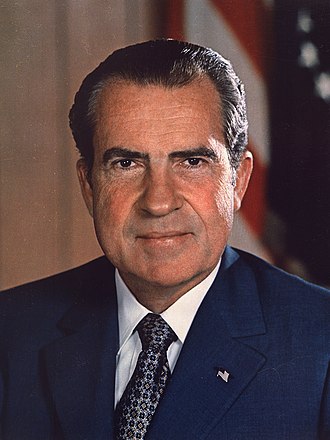
Richard M. Nixon served as the 37th President of the United States from January 1969 until his resignation in August 1974. In February 1971, he ordered the installation of a secret voice-activated taping system in the White House to preserve a historical record of his administration. Until the system's existence was revealed and dismantled in July 1973, the tapes captured Nixon directing major foreign policy initiatives, such as the opening to China, as well as his central role in the Watergate cover-up.
What Nixon talks about on the tapes
White House operations 4,718Presidential scheduling 2,225Public relations 1,784Presidential schedule 1,782Vietnam War 1,693Logistics 1,650Manolo Sanchez 1,626White House communications 1,400White House administration 1,399Presidential communication 1,243Henry Kissinger 1,191Foreign Policy 1,183
Conversations (21,010)
— Page 165 of 211President Nixon directs the White House operator to place a telephone call to Senate Majority Leader Michael J. Mansfield. This brief administrative interaction serves as the initiation of communication between the President and the Senate leader. No further discussion occurs during this segment of the recording.
President Nixon and Stephen Bull met to coordinate the President’s logistical schedule, including arrangements for a helicopter trip to Camp David with First Lady Pat Nixon. Bull also relayed a request from First Lady Nixon for advance notice regarding their departure time to ensure she would be ready. Additionally, Bull informed the President that Senator Mike Mansfield had requested a phone call to discuss a personal matter following Nixon's meeting with Henry Kissinger.
President Nixon initiates a brief request for the White House operator to place an outgoing call. This short interaction serves a purely administrative function to facilitate telecommunications from the Oval Office. No substantive policy matters or political developments are addressed during the brief exchange.
President Nixon met with his aide Stephen B. Bull to briefly discuss logistics regarding an upcoming meeting with Charles W. Colson. The conversation focused on the current whereabouts of William E. Timmons to coordinate the scheduling of administration officials. The brief exchange concluded with final instructions as the participants prepared to depart the office.
President Nixon and Senate Majority Leader Mike Mansfield discussed upcoming foreign policy developments, including Henry Kissinger’s diplomatic missions to Hanoi and Peking and the potential for a future trip to China for Mansfield. They also coordinated on appointing members to the Committee for the Study of Foreign Policy, with Nixon expressing a desire to select high-profile individuals like Nelson Rockefeller. Finally, the two reviewed the status of ceasefires in Southeast Asia, with Nixon justifying continued U.S. bombing in Laos as an incentive to finalize peace agreements.
President Nixon and Senate Majority Leader Mike Mansfield met to coordinate on administrative appointments and foreign policy developments. The two discussed potential candidates for a congressional committee, with Nixon expressing a preference for experienced figures like governors who could provide significant contributions. Additionally, Nixon provided a status report on the ongoing ceasefires in Vietnam, Cambodia, and Laos, noting that current U.S. air operations serve as an incentive for continued compliance.
President Nixon directed the White House operator to place a telephone call to former First Lady Claudia “Lady Bird” Johnson. The request specifically identified her location as Texas to facilitate the connection. This brief administrative interaction served as the initiation of communication between the President and Mrs. Johnson.
President Nixon consulted with staff regarding legislative strategy and foreign policy coordination, specifically concerning Senate Majority Leader Mike Mansfield's interest in visiting the People's Republic of China. Nixon directed Bill Timmons to contact Mansfield to discuss the potential trip and to address the appointment of nominees to an unspecified foreign policy board. Additionally, the President reviewed a list of potential board candidates provided by George H.W. Bush, emphasizing the need for loyal supporters, and prepared for an upcoming meeting with Charles Colson.
President Nixon directed the White House operator to place a telephone call to Mrs. Johnson in Texas. The interaction was strictly administrative, focusing on the logistical coordination of a communication between the President and the former First Lady. No further policy or political discussions were recorded during this brief exchange.
President Nixon met with Charles Colson and others to discuss administrative appointments, the management of Henry Kissinger, and the fallout from recent media relations. The group reviewed low television ratings for a recent Kissinger appearance and discussed the necessity of keeping Kissinger under tighter control, including having Colson oversee his foreign policy project appointments to ensure ideological alignment. The President also emphasized the importance of securing conservative-leaning personnel for future advisory committees and reiterated his strategy of maintaining personal oversight to counteract Kissinger’s perceived tendency to play both sides with the media.
President Richard M. Nixon placed a courtesy call to former First Lady Claudia "Lady Bird" Johnson to offer his condolences following the death of Lyndon B. Johnson. During the conversation, Nixon praised her dignified conduct during the bereavement period and discussed the administrative challenges she faced managing estate matters and correspondence. The President concluded by suggesting she consider a future short-term appointment to the United Nations delegation, explicitly requesting that she defer any decision until she had time to recover from her recent loss.
President Nixon utilized the seclusion of Camp David to dictate personal notes and memorandum contents for future administrative use. The recording captures the President working in solitude to organize his thoughts and strategic directives. The primary focus of this session was the structured dictation of official records, though the majority of the content remains unintelligible or withdrawn.
President Richard Nixon met with First Lady Pat Nixon in the study at Camp David to discuss personal or private matters. Due to a withdrawn segment and the absence of a transcript, no substantive policy or political developments can be determined from the recording. The brief interaction concluded with the First Lady departing the study prior to the termination of the taping period.
President Nixon met with his valet, Manolo Sanchez, at Camp David to discuss personal matters and administrative arrangements. The dialogue focused on the logistics surrounding dictation equipment and the physical placement of documents. The brief exchange reflects the intimate nature of their working relationship and the private administrative tasks managed by the President's personal staff.
President Richard M. Nixon and First Lady Pat Nixon met privately at the Aspen Lodge in Camp David to discuss personal matters. The conversation was largely recorded as a withdrawn item due to its private, personal nature. No significant policy decisions or administrative actions were documented in the available record.
President Richard Nixon met with First Lady Pat Nixon in the Aspen Lodge study at Camp David to discuss personal matters. The conversation was designated as a personal returnable item and was subsequently withdrawn from public release. No substantive policy or political developments were recorded in the available public record.
President Nixon and his daughter, Julie Nixon Eisenhower, met informally at Camp David to coordinate personal logistics. The conversation primarily addressed the President's schedule and planned recreational activities, specifically his use of the swimming pool. No significant policy decisions were discussed during this brief exchange.
President Nixon held a private meeting at the Aspen Lodge in Camp David with an unidentified individual to discuss matters related to his professional schedule. While the specific identity of the participant and the detailed substance of the dialogue remain undocumented due to the brevity and nature of the provided record, the discussion focused on administrative planning. No specific policy decisions or consequential action items were recorded during this segment of the tape.
President Nixon contacted the Camp David operator to request a telephone connection with his daughter, Tricia Nixon Cox. The operator informed the President that Tricia was currently unavailable, possibly due to her being in Georgia. Nixon accepted the situation and thanked the operator for attempting the call.
President Nixon contacted the Camp David operator in an attempt to reach his daughter, Tricia Nixon Cox. Upon learning she was unavailable, he requested that the operator facilitate the call once she returned. The exchange served exclusively as a brief administrative coordination to establish contact with his daughter.
President Nixon consulted with the Camp David operator in an attempt to locate a woman named Christian. The brief exchange focused on determining her current whereabouts, with the operator suggesting she was likely in Georgia. No major policy or administrative decisions were made during this brief search for a personal contact.
President Nixon communicated with the Camp David operator to address logistical or operational matters during his stay at the Aspen Lodge. This brief interaction served to facilitate the President's immediate administrative needs within the presidential retreat. No substantive policy discussions or significant political decisions were recorded during this brief exchange.
President Nixon met with Manolo Sanchez and Tricia Nixon Cox at Camp David to reflect on recent administrative challenges, presidential communication, and foreign policy. Nixon discussed his frustrations with the press, the necessity of maintaining a firm public stance against critics, and his ongoing work regarding energy, trade, and international relations. The conversation also touched upon personal reflections regarding his predecessors and the importance of documenting his own historical record through tape recordings and notes.
President Richard Nixon and his daughter, Tricia Nixon Cox, discuss their recent movements to and from Camp David and confirm their family's arrival at the retreat. The primary focus of the call involves a domestic update regarding a tame deer kept at the site and the family's efforts to introduce it to their dog, King. The participants exchange lighthearted advice on feeding the animal and express optimism about the two animals coexisting.
President Nixon and Stephen B. Bull met to coordinate the President's upcoming schedule, specifically focusing on a meeting with Congressional leaders. The two discussed the necessary timing for this engagement and evaluated the logistics of rescheduling the session. The brief interaction concluded with a directive for further follow-up on these planning arrangements.
President Nixon and Stephen B. Bull discussed logistical arrangements for honoring the late Colonel William B. Nolde, the last American combat casualty of the Vietnam War. They weighed the options of the President personally attending the funeral service at Arlington National Cemetery versus sending General Alexander M. Haig, Jr. as a representative to meet the family at the White House. The discussion also addressed the administration's efforts to facilitate a Washington tour for the Nolde family, coordinated in part by Senator Robert P. Griffin.
President Nixon met with his aide Stephen B. Bull to coordinate the scheduling of upcoming meetings and establish strict protocols for Oval Office usage. Nixon mandated that specific group meetings be held in the Oval Office while simultaneously emphasizing that he did not want any photographs taken during these sessions. Additionally, the President inquired about the availability of Press Secretary Ronald L. Ziegler to assist with these logistical arrangements.
President Nixon met briefly with an unidentified woman in the Oval Office before transitioning to a discussion with legislative aides Thomas C. Korologos and William E. Timmons. The conversation focused on the administration's interactions with the House of Representatives, specifically mentioning Richard K. Cook. Due to the fragmented nature of the recording, no specific policy decisions or significant action items were finalized during this brief exchange.
President Nixon met with his personal secretary, Rose Mary Woods, and assistant Stephen B. Bull to coordinate administrative tasks and social planning. The discussion focused on managing the President's personal correspondence with celebrity acquaintances like Jane Wyman, delegating the handling of incoming telephone calls, and finalizing the guest list for an upcoming state dinner for King Hussein of Jordan. Nixon emphasized the need for a more structured approach to managing his communications to ensure effective engagement with his contacts.
President Nixon met with William E. Timmons and Thomas C. Korologos to discuss legislative strategy, focusing on upcoming budget vetoes and garnering congressional support. The group examined messaging tactics, specifically regarding the Vietnam War, and the development of a 'loyalist list' of both Republican and Democratic members to cultivate for future legislative fights. Nixon emphasized the need for an aggressive, unified stance against the opposition's budgetary agenda and discussed plans for a White House reception to reward supportive legislators.
President Nixon held a brief, six-minute meeting in the Oval Office with an unidentified individual. The discussion was limited to the President extending his personal expression of thanks to the participant. No further substantive policy matters or specific administrative decisions were recorded during this brief encounter.
President Nixon, H. R. Haldeman, and Henry Kissinger discussed the ongoing Southeast Asia trip of Vice President Spiro Agnew, specifically focusing on scheduling his return and managing his public itinerary to avoid negative optics. The President and his advisors expressed concern that Agnew's potential visits to military commands or unauthorized stops in Hawaii could undermine peace efforts during a sensitive period involving Kissinger's travel to Hanoi. Ultimately, Nixon decided that Agnew should bypass sensitive military sites and proceed to California rather than returning immediately to Washington, effectively controlling the Vice President's narrative and ensuring his activities remained aligned with administration policy.
President Nixon met with members of the Pay Board and Price Commission to review the accomplishments of the Economic Stabilization Program's Phase II and discuss the transition into Phase III. The group evaluated the program's success in curbing inflation and managing the economy, while addressing challenges such as rising food prices, the global energy crisis, and the necessity of maintaining labor and business cooperation. Nixon expressed his appreciation for the board members' service and dedication, formally signaling the shift in responsibility for the next phase of economic policy.
President Nixon met with his aides and outside consultants to discuss the administration's telecommunications policy and a new strategic approach to public opinion. The discussions focused on centralizing control over broadcasting regulation, managing public perception regarding the press, and the need for internal unity among White House staff. Nixon and his advisors also reviewed polling data with Albert Sindlinger to better understand shifting voter sentiments, particularly among Democrats, regarding Vietnam, inflation, and law-and-order issues. The President emphasized that his administration must act decisively in these areas and maintain a unified public front to avoid being undermined by bureaucratic infighting or negative media coverage.
President Nixon and Stephen B. Bull met to briefly review the President's upcoming daily schedule, specifically coordinating meetings with Commander Alexander R. Larzelere and Robert J. Brown. The discussion focused on personnel changes involving the Coast Guard representative at the White House and the logistics of providing an ashtray for the respective appointments. The brief interaction concluded with Bull confirming the arrangements for the upcoming meetings.
President Nixon met with Cmdr. Alexander R. Larzelere and his family in the Oval Office, accompanied by Gen. Brent G. Scowcroft and Stephen B. Bull, to conduct a brief social visit and photo session. During the meeting, the President expressed his appreciation for the Commander's professional performance and discussed his transition into a new role within the Congressional affairs office. The conversation also touched upon the Coast Guard’s participation in the recent Inaugural Parade and the distribution of small gifts to the Larzelere children.
President Nixon met with Robert J. Brown and John D. Ehrlichman to discuss Brown's departure from his White House role and his future professional plans. The discussion covered Brown's potential involvement in international marketing programs and public broadcasting, as well as addressing the broader challenges of the American public image regarding political violence and radicalism. Following the Browns' departure, Nixon and Ehrlichman briefly addressed staffing concerns at the Department of Health, Education, and Welfare, specifically regarding administrative appointments and regionalization policies.
President Nixon met with the Nolde family, including the widow and children of a fallen soldier, to express his condolences and gratitude for their sacrifice during the Vietnam War. During the visit, Nixon presented the family with gifts, discussed the importance of peace and the dignity of military families, and arranged for them to receive a private tour of the White House and Capitol. The meeting served as a gesture of presidential support, honoring the service member's legacy while providing his family with a personal encounter with the administration.
President Nixon met with John Ehrlichman to discuss various administrative, economic, and staffing challenges facing the White House. The participants addressed personnel matters, including the potential departure of Patricia Hitt from HEW and organizational issues involving Herbert Klein and Peter Peterson. They also reviewed economic policy, particularly Phase III controls, and strategized on how to manage Cabinet officers and Congressional relations by utilizing decision papers to streamline presidential involvement. Additionally, the conversation touched upon the complexities of the national energy policy and the upcoming preparation for foreign policy discussions, including SALT.
President Nixon initiates a brief telephone request for the White House operator to connect him with Stephen B. Bull. The conversation serves solely as a logistical administrative step to facilitate direct communication with his aide. No substantive policy discussions occur during this brief interaction.
President Nixon contacted the White House operator to facilitate a telephone connection with his aide, Stephen B. Bull. This brief administrative interaction served exclusively to initiate the transfer for the President's subsequent business. No substantive policy matters or further developments were addressed during this specific communication.
President Nixon met briefly with White House aide Stephen Bull and personal aide Manolo Sanchez in the Oval Office. The discussion was limited to personal pleasantries and minor administrative instructions regarding the office door. The brief exchange concluded within one minute without significant policy implications.
President Nixon met with his personal valet, Manolo Sanchez, in the Old Executive Office Building to discuss the President's daily schedule and arrangements for refreshments. The brief interaction focused on logistical support and the immediate service needs of the President within his office environment. No significant policy decisions or strategic developments were recorded during this routine meeting.
President Nixon met with his valet, Manolo Sanchez, in the Old Executive Office Building to review the President’s upcoming schedule. While the surviving log and transcript fragments are extremely limited, they confirm the meeting served to coordinate personal and official logistical matters. The brief record concludes with the President addressing security concerns regarding potential threats.
President Nixon met with key officials, including Earl Butz, James Lynn, Caspar Weinberger, and John Ehrlichman, to coordinate administration policy on housing, welfare reform, and government reorganization. The discussion focused on addressing the ineffectiveness of subsidized housing programs, the potential for a housing moratorium, and the need to craft a cohesive legislative agenda before the upcoming Congressional recess. Nixon emphasized the importance of presenting an aggressive, bipartisan posture to Congress and strategically managing Cabinet relations to ensure unified messaging on domestic policy.
President Nixon requested that the White House operator place a telephone call to his aide, Stephen B. Bull. The brief interaction focused entirely on facilitating this administrative connection. No further policy or substantive matters were discussed during this short exchange.
President Nixon and Stephen B. Bull coordinated a brief scheduling adjustment for an upcoming meeting. The President instructed Bull to push back the start time of the next appointment in the Oval Office to 4:45 pm to accommodate a prior engagement. Bull acknowledged the change, confirming the revised time and location.
President Nixon and Stephen B. Bull briefly coordinate the President's immediate schedule following a meeting in the Old Executive Office Building. Bull confirms that he will attend the upcoming session to ensure the President is able to return to the Oval Office. This exchange serves as a logistical transition to manage the President's movement between locations.
President Nixon requested that the White House operator place a telephone call to his daughter, Julie Nixon Eisenhower. The brief interaction served as a logistical bridge to facilitate this personal communication. No policy matters or significant administrative decisions were discussed during the exchange.
President Nixon met briefly with his personal aide, Manolo Sanchez, in the Old Executive Office Building. The primary focus of the discussion concerned the President's upcoming schedule, specifically an impending meeting with Charles W. Colson. The exchange served as a logistical coordination session before the commencement of official business.
President Nixon met with Charles Colson to discuss Colson's upcoming trip to the USSR, focusing on the potential for strategic speech material, public relations, and trade negotiations. The conversation shifted to an extensive review of polling data provided by Albert E. Sindlinger, which Nixon and Colson used to analyze public sentiment on the Vietnam War settlement, economic issues, and shifting social values. Finally, the two discussed public relations strategies for managing the media, emphasizing the need for the administration and its supporters to more aggressively combat negative press coverage regarding Watergate and domestic policy.
President Nixon coordinates with his daughter, Julie Nixon Eisenhower, to arrange a meeting before they attend dinner together. The two finalize plans to meet at the Oval Office before walking to their evening engagement. This brief interaction serves as a personal scheduling logistics call between family members.
President Nixon met with his key economic advisors—George Shultz, Herbert Stein, Roy Ash, and John Ehrlichman—to assess the administration's economic policy, particularly the transition to Phase III of the wage and price controls. The group discussed the political and economic challenges of managing inflation, maintaining a $250 billion budget ceiling, and navigating potential labor strikes, with Nixon emphasizing the need for a unified strategy and public confidence. The participants also addressed international trade tensions, the devaluation of the dollar, and the necessity of managing Congressional relations to sustain the administration's fiscal objectives.
President Nixon met with unidentified individuals in the Oval Office for a brief, informal encounter. The discussion focused on the President's coat and included an exchange of gratitude between the parties. The meeting concluded quickly with the departure of the guests.
President Nixon and Julie Nixon Eisenhower met briefly in the Oval Office to coordinate logistics for an upcoming dinner. The participants confirmed the 7:30 pm start time and finalized plans for their subsequent meeting. The discussion served primarily as a personal check-in regarding the evening's schedule.
President Nixon contacted the White House operator to initiate a telephone call to National Security Advisor Henry A. Kissinger. This brief interaction served solely as a logistical request to establish a line of communication with Kissinger. No further policy discussions or substantive developments occurred during this exchange.
President Richard Nixon met with his daughter, Julie Nixon Eisenhower, in the Oval Office for a brief private discussion. As the entirety of the conversation has been withdrawn as a personal returnable item, no substantive records regarding the dialogue or specific outcomes exist. The interaction remains classified as a private family exchange rather than an official policy deliberation.
President Nixon and Henry Kissinger coordinated logistics for upcoming travel schedules, including Vice President Agnew's itinerary and Kissinger's planned return from Asia. They discussed the Vietnam peace process, specifically authorizing Ronald Ziegler to announce negotiations for a ceasefire in Paris, and agreed that Kissinger should visit Laos to leverage a ceasefire there. Additionally, they deliberated on diplomatic strategy regarding King Hussein of Jordan and how to manage a potential secret meeting with Egyptian representatives without triggering excessive interference from the State Department.
President Nixon contacted the White House operator to place an urgent call to Chief of Staff H. R. Haldeman. Upon learning that Haldeman was unavailable until late evening, the President declined the operator’s offer to page him. The exchange ended without further action regarding the call.
President Nixon initiates a brief request for the White House operator to place a telephone call to William E. Timmons. The exchange serves solely as an administrative bridge to connect the President with his Assistant for Legislative Affairs. No substantive policy discussions or decisions are recorded during this brief communication.
President Nixon instructed the White House operator to cancel a planned call to William E. Timmons, who was attending a reception at the Capitol Hill Club. The President decided not to pursue the contact, choosing to let the matter go for the evening. No further actions or significant developments resulted from this brief communication.
President Nixon and Press Secretary Ronald Ziegler met to discuss administrative messaging, media strategy, and responses to recent congressional and public relations challenges. They reviewed the status of legislative impoundment, personnel moves involving Herbert G. Klein, and press coverage of Vice President Spiro Agnew’s travels and the Vietnam cease-fire. Nixon emphasized the need for a firm, coordinated stance against critics of his administration’s amnesty policy while instructing Ziegler on how to manage personal media inquiries and cultivate favorable press relationships.
President Nixon and Stephen B. Bull reviewed the President’s daily schedule, including arrangements for a meeting with King Hussein of Jordan and a briefing with Henry Kissinger regarding his upcoming trip to Southeast Asia. The discussion also addressed press strategy regarding the administration's impoundment of funds, specifically highlighting the need to frame these actions as consistent with previous presidencies. Nixon directed Bull to clear the afternoon agenda and organize talking points for an upcoming meeting with Republican Congressional leadership concerning federal spending.
President Nixon met with an unknown individual and Stephen B. Bull to coordinate compassionate assistance for a White House staffer named Fate Suber. Nixon expressed concern over Suber’s ongoing health struggles and mental state following a heart attack. The President directed Bull to finalize arrangements for Suber and his wife to spend time at Camp David, specifically tasking him with coordinating military support and lodge accommodations.
President Nixon met with his aide Stephen B. Bull to review preparations for an upcoming meeting with King Hussein of Jordan. Nixon expressed dissatisfaction with the length of the provided briefing materials and directed Bull to condense the reports into a more manageable two-page summary. This interaction highlights Nixon's specific requirements for executive briefing documents and his time-constrained approach to managing his daily schedule.
President Nixon and Rose Mary Woods met to coordinate administrative details for upcoming White House events, including seating arrangements and guest lists for state dinners honoring the King of Jordan and Golda Meir. They discussed the potential inclusion of various political figures and guests, as well as scheduling a tea for Alice Roosevelt Longworth. Additionally, the President expressed frustration regarding the delayed Navy discharge of David Eisenhower, accusing Secretary of the Navy John Warner of politicizing the process.
President Nixon met with H. R. Haldeman and John Ehrlichman to discuss the potential mishandling of David Eisenhower's Navy discharge and the broader political performance of Secretary of the Navy John Warner. The participants also strategized on how to counter the Ervin Committee's Watergate investigation by broadening its scope to include past political campaigns, and they coordinated a messaging plan to defend the administration's impoundment of budget funds. Finally, the group reviewed legislative priorities and briefing materials for an upcoming meeting with Republican Congressional leaders.
President Nixon met with Republican congressional leaders to discuss his administration's legislative priorities, focusing primarily on securing support for a fiscally responsible budget. He emphasized the necessity of cutting spending and utilizing presidential vetoes to combat inflation and avoid tax increases, framing these actions as essential for the nation's economic stability. Additionally, the President and the leaders engaged in an extensive review of recent foreign policy, specifically highlighting the significance of the Vietnam cease-fire and the strategic importance of U.S. global leadership.
President Nixon met with Press Secretary Ronald L. Ziegler to provide specific tactical instructions regarding the administration's messaging on impoundment. Nixon emphasized the necessity of leading press conferences with a clear articulation of the administration's stance on withholding funds. This directive aimed to ensure Ziegler maintained a consistent and assertive public narrative during upcoming media engagements.
President Nixon met with Stephen B. Bull to coordinate his upcoming schedule with King Hussein of Jordan before consulting with Press Secretary Ronald L. Ziegler. The discussion focused on Ziegler’s recent press briefing regarding presidential impoundment of budget funds and the administration's frustration with media coverage. Nixon and Ziegler strategized on how to better communicate the administration's fiscal policy to the press by drawing direct comparisons to the practices of previous administrations.
President Nixon, King Hussein of Jordan, Henry Kissinger, and Zaid al-Rifai met to discuss the Middle East peace process and bilateral US-Jordanian relations, including military and economic aid requirements. The participants analyzed the regional security environment, specifically the influence of the Soviet Union, the threat posed by Iraq and Syria, and the potential for private, rather than public, negotiations between Jordan and Israel. Nixon committed to reviewing Jordan's urgent budgetary and military aid requests sympathetically, while Kissinger coordinated follow-up channels to maintain progress on peace negotiations.
President Nixon and Stephen B. Bull reviewed various administrative matters, focusing on establishing a standard practice for preparing summaries of the President's meetings with foreign dignitaries to improve efficiency. They discussed scheduling for upcoming White House events, including the swearing-in ceremony for John T. Dunlop and meetings regarding tax policy. Additionally, the President issued instructions for streamlining correspondence and handling personnel matters and nominations, including those of Jack O. Horton and John H. Kyl.
President Nixon and Stephen B. Bull discussed protocol and security arrangements for an upcoming state dinner hosting King Hussein of Jordan. The pair focused on logistics regarding vehicle transport and seating for the official party to avoid potential security risks and crowd management issues. Nixon directed Bull to handle these instructions carefully so that the guests would not be offended by the revised itinerary.
President Nixon and H. R. Haldeman discussed several administrative and political matters, including the handling of David Eisenhower's military service discharge and strategies for managing the upcoming Senate Watergate hearings. Nixon emphasized the need for simpler, more effective public relations messaging regarding the federal budget and impoundments, criticizing current staff for failing to communicate in concise, "grabby" terms. They also assessed the legislative landscape and the potential for a more bipartisan approach to the Watergate committee structure while planning future Cabinet engagement and press strategies.
President Nixon requested that the White House operator place a telephone call to his daughter, Julie Nixon Eisenhower. The operator promptly facilitated the request to connect the President with Julie at Camp David. The brief exchange served exclusively as a logistical coordination to initiate this personal communication.
President Nixon speaks with the White House operator to facilitate an outgoing call. The interaction serves as a brief logistical exchange to initiate communication with another party. No substantive policy or political discussions occur during this short administrative connection.
President Nixon met with his personal aide, Manolo Sanchez, to discuss logistics regarding an upcoming trip to California. The brief conversation focused on scheduling arrangements and the specific needs of Sanchez's family, including travel plans for their dogs and his wife, Fina Sanchez. The exchange functioned primarily as a logistical check-in to coordinate these personal travel details.
President Nixon met with aide Stephen B. Bull to coordinate logistical arrangements for his daily schedule and upcoming meetings. The discussion centered on adjusting the President’s itinerary following the heart attack suffered by Rex W. Scouten. They finalized the timing and location for briefings involving Henry Kissinger and potentially Charles Colson.
President Nixon met with his personal valet, Manolo Sanchez, in the Old Executive Office Building to review the President’s upcoming schedule. The conversation focused on administrative coordination and the logistical planning of Nixon's appointments. No further substantive policy matters were recorded during this brief encounter.
President Nixon consulted with a White House operator to facilitate an outgoing call. The conversation was brief and administrative in nature, focusing on the operator's difficulty in reading a specific request or number provided by the President. No substantive policy matters were addressed as the interaction remained limited to routine telecommunications support.
President Nixon and Secretary of State William P. Rogers discuss the guest list and scheduling logistics for an upcoming state dinner honoring King Hussein of Jordan. The dialogue focuses on clarifying potential timing conflicts and verifying that controversial or inappropriate invitees are excluded from the event. The conversation concludes with a consensus that the proposed scheduling concerns are likely unfounded.
President Nixon and his daughter, Julie Nixon Eisenhower, coordinate logistics for an upcoming trip to Camp David involving family and friends. The conversation focuses on scheduling travel plans, arranging for Charles “Bebe” Rebozo to join them on Saturday, and confirming that an invitation to Camp David has been extended to Fate Suber upon his discharge from the hospital. They also briefly discuss the current weather conditions at the retreat and local wildlife sightings.
President Nixon held a brief, informal check-in with his daughter, Julie Nixon Eisenhower, to discuss her upcoming travel and social plans. The conversation primarily focused on logistics for a visit, including travel timing to avoid work conflicts and general inquiries regarding her well-being. No significant policy or administrative decisions were made during this personal exchange.
President Nixon consulted with the White House operator regarding the necessity of a specific communication or connection. He concluded that an immediate follow-up was not required, expressing his expectation that the other party would initiate a return call. The brief exchange served to manage the President's incoming telecommunications and outreach efforts.
President Nixon met with an unidentified individual in the Executive Office Building for a brief, informal encounter. The recorded interaction consists primarily of a numeric count, suggesting a technical test of the recording equipment rather than a substantive policy discussion. No significant administrative decisions or political topics were addressed during the brief duration of the meeting.
President Nixon consulted with the White House operator regarding connectivity issues on his telephone line to Camp David. After deciding not to pursue an alternative connection, the President instructed the operator to summon Charles W. Colson to his office in the Old Executive Office Building for a scheduled meeting.
President Nixon instructed the White House operator to place a call to his physicians, either Dr. Walter R. Tkach or Dr. William M. Lukash. He explicitly clarified that the request was not related to a medical emergency. The conversation concluded with the operator confirming the attempt to reach the doctors.
President Nixon met with Charles W. Colson and later Henry Kissinger to discuss White House political strategy, administration appointments, and foreign policy objectives. The discussions focused on managing labor union relations, controlling the narrative through press and polling, and navigating congressional opposition to the administration's budget and reconstruction aid plans for North Vietnam. The President emphasized his desire to implement reorganization in his second term by replacing bureaucrats with political appointees and solidified plans for his upcoming diplomatic initiatives.
President Nixon and Stephen B. Bull reviewed and reorganized the President's upcoming schedule to accommodate administrative priorities, including economic policy and legislative strategy. They specifically coordinated meetings with figures such as Wilbur Mills and the National Association of Manufacturers while finalizing the timing for a scheduled radio address. Nixon emphasized the need for thorough talking papers to prepare for high-level discussions, ultimately opting for a one-on-one meeting with Mills to avoid unnecessary staff involvement.
President Nixon dictates a personal letter to actress Jane Wyman to express his admiration for her performance in the film "So Big." During the dictation, Nixon critiques the declining quality of contemporary Hollywood and European cinema, contrasting it with the superior artistry of older films. He notes that he and First Lady Pat Nixon frequently rely on older movie catalogs for entertainment during their weekends at Camp David.
In this meeting, President Nixon met with Rose Mary Woods and H. R. Haldeman to address various administrative and political matters, including the guest list protocols for White House events and potential personnel changes for administration appointees. The discussion also covered the logistical planning for an upcoming radio address, where the President expressed frustration over inadequate preparation time and the poor quality of recent briefings provided by his staff. Additionally, they reviewed details regarding the 1973 inaugural ceremonies and the military discharge status of David Eisenhower, reaching consensus on how to manage these sensitive issues.
President Nixon met with Arthur Burns and George Shultz to coordinate the administration's economic response to a worsening international monetary crisis and trade deficit. The group finalized plans for a 6.5% dollar devaluation and discussed strategies to secure trade revaluation agreements with Japan and European partners. Additionally, they reviewed talking points for upcoming congressional testimonies, emphasized the need for continued wage and price control efforts, and addressed the potential bankruptcy of a railroad company.
President Nixon and H. R. Haldeman engaged in a comprehensive discussion regarding the management of the administration's public image and the strategic control of presidential communication. They debated the efficacy of state dinners and ceremonial functions, concluding that these activities often yield low political return, and evaluated the best media outlets for communicating economic policy. Additionally, they critiqued the organizational structure of White House staff, analyzed public opinion on amnesty for Vietnam War deserters, and addressed the psychological transition of Henry Kissinger following the Vietnam peace settlement.
President Nixon contacted his physician, Dr. Walter R. Tkach, to request an urgent update regarding the deteriorating medical condition of Senator John C. Stennis. Concerned by reports that the Senator’s health had declined, the President directed Tkach to immediately obtain and report back the latest status. This brief interaction served as a formal administrative request to verify the Senator's well-being following reports of his worsening situation.
President Nixon consulted with his physician, Dr. Walter R. Tkach, regarding the critical post-surgical condition of Senator John C. Stennis. Despite slight improvements in the Senator's lucidity and vital signs, Dr. Tkach offered a grim prognosis, suggesting that the Senator was unlikely to survive for more than a few days. Consequently, the President made plans to visit Stennis the following morning, pending medical clearance.
President Nixon met with his personal aide, Stephen B. Bull, to discuss administrative logistics regarding the President’s daily agenda. The primary focus of the brief interaction was the scheduling of an upcoming appointment. Nixon concluded the discussion by finalizing plans to call an unidentified individual the following day.
President Richard M. Nixon met with his valet, Manolo Sanchez, in the Oval Office to receive personal service. The brief encounter focused on the routine provision of refreshments, specifically coffee, for the President. No policy matters or significant administrative decisions were addressed during this interaction.
President Nixon met with his aide Stephen B. Bull to coordinate the scheduling of Henry Kissinger. The discussion focused on finalizing the logistics and timing for Kissinger’s upcoming appointments. Bull acted to ensure that the meeting arrangements were properly facilitated according to the President's instructions.
President Nixon met with his personal aide, Stephen B. Bull, to discuss administrative logistics. The brief consultation focused primarily on the travel arrangements and scheduling for National Security Advisor Henry A. Kissinger. No further policy developments were recorded during this short appointment.
President Nixon and Henry Kissinger met to discuss strategy for Kissinger’s upcoming trip to Hanoi and the People’s Republic of China, as well as the ongoing effort to secure economic aid for North Vietnam. They addressed the necessity of managing Congressional resistance by emphasizing international participation in reconstruction funds and agreed on a firm, controlled approach toward critics and foreign leaders like Indira Gandhi. Nixon also expressed a desire to pivot his administration’s public focus toward a new diplomatic initiative for Europe once the Vietnam settlement was finalized.