Nixon, Richard M. (President)
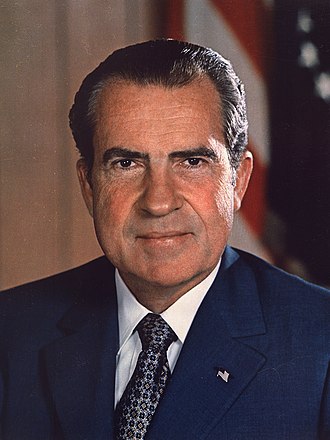
Richard M. Nixon served as the 37th President of the United States from January 1969 until his resignation in August 1974. In February 1971, he ordered the installation of a secret voice-activated taping system in the White House to preserve a historical record of his administration. Until the system's existence was revealed and dismantled in July 1973, the tapes captured Nixon directing major foreign policy initiatives, such as the opening to China, as well as his central role in the Watergate cover-up.
What Nixon talks about on the tapes
White House operations 4,718Presidential scheduling 2,225Public relations 1,784Presidential schedule 1,782Vietnam War 1,693Logistics 1,650Manolo Sanchez 1,626White House communications 1,400White House administration 1,399Presidential communication 1,243Henry Kissinger 1,191Foreign Policy 1,183
Conversations (21,010)
— Page 19 of 211President Nixon consulted with the White House operator to facilitate a planned communication. He instructed the operator to place an outgoing call once the recipient arrived at their destination. No further policy or administrative business was conducted during this brief exchange.
President Nixon and Henry Kissinger discuss the strategic importance of U.S. relations with the People's Republic of China, emphasizing the Chinese leadership's long-range geopolitical thinking. Nixon contrasts this perspective with the more tactical approach of the Soviet Union while advising Kissinger on logistical arrangements for his potential upcoming trip to Asia. The brief consultation serves as a high-level assessment of the diplomatic climate regarding the administration's outreach to Beijing.
President Nixon and H. R. Haldeman discuss various administrative priorities, focusing on the successful defeat of the Harold Hughes pay amendment and positive economic indicators. They review legislative progress, including federal efforts regarding New York City police, and coordinate upcoming meetings on drug policy involving John Ehrlichman and J. Edgar Hoover. Additionally, they finalize the decision to postpone the President's press conference to a Tuesday to maximize Nielsen ratings.
President Nixon and H.R. Haldeman discuss administrative updates, including a scheduled meeting with Congressman Glenn Earthman regarding drug policy and the progress of internal efforts involving J. Edgar Hoover and John Mitchell. They also evaluate the political impact of recent foreign policy stances on NATO and the Soviet Union, with Haldeman noting potential influence on congressional support. The conversation concludes with a brief assessment of current market trends and upcoming scheduling logistics.
President Nixon and Henry Kissinger met to discuss diplomatic personnel, legislative strategy, and the administration's broader foreign policy messaging. Nixon praised the integrity of Ambassador David K. E. Bruce, specifically highlighting him as the ideal candidate for potential future negotiations regarding the People's Republic of China. Additionally, the two discussed the administration's recent victory in defeating the Harold E. Hughes pay amendment in the Senate and Nixon's desire to shift the public narrative away from Vietnam to focus on the future of U.S. relations with the USSR, China, and the domestic economy.
President Nixon initiates a call to FBI Director J. Edgar Hoover via the White House operator to discuss the recent killing of New York City police officers. The conversation centers on the ongoing investigation, potential motives behind the attacks, and the administration's planned appearances at upcoming law enforcement conferences. Nixon and Hoover coordinate on the federal response and information gathering efforts regarding the perpetrators.
President Nixon and Alexander Butterfield met to discuss administrative scheduling, specifically evaluating whether the President should attend an Office of Strategic Services (OSS) convention event honoring David K. E. Bruce. Nixon declined to attend the award ceremony but expressed interest in other potential engagement opportunities. Additionally, the pair coordinated an upcoming phone call to J. Edgar Hoover and discussed personnel appointments, including the invitation of Donald L. Jackson to the Interstate Commerce Commission.
President Nixon and FBI Director J. Edgar Hoover discussed the need for an aggressive legal and investigative strategy regarding individuals apprehended for violent acts against police officers. Expressing frustration over lawlessness, the President directed the Attorney General to prioritize the collection of unlimited security information and confirmed plans for a meeting with law enforcement leaders. Nixon also signaled his intention to address a police academy as part of a broader effort to emphasize a tough stance on crime, explicitly rejecting sociological justifications for criminal behavior.
President Nixon and FBI Director J. Edgar Hoover discussed the recent targeted killings of New York City police officers and the strategy to apprehend the perpetrators. Nixon directed Hoover to utilize unlimited intelligence-gathering resources and coordinate with Attorney General John Mitchell to ensure full FBI cooperation. Additionally, Hoover outlined plans for upcoming conferences with national police leadership to address the violence and bolster law enforcement response.
President Nixon and J. Edgar Hoover discussed strategies for strengthening public support for law enforcement and the military amidst ongoing anti-war protests and civil unrest. The President emphasized the need for a national narrative that frames service and law enforcement as pillars of societal stability, contrasting this with the negative portrayal of such institutions by media and protest movements. They further explored legislative ideas, including potential federal benefits for the families of slain police officers, as part of an effort to bolster morale and public respect for those in uniform.
President Nixon initiates a call to the White House operator to be connected with Nancy Hanks, the Chairwoman of the National Endowment for the Arts. The brief exchange serves as a logistical step to facilitate direct communication between the President and Hanks regarding arts policy or administration business. No further substantive discussion occurs during this short segment of the telephone recording.
President Nixon instructed the White House operator to place a telephone call to Nancy Hanks, the Chair of the National Endowment for the Arts. This brief interaction served as a logistical request to initiate communication with the administration official. No further substantive policy discussion or policy directives were recorded during this exchange.
President Nixon met with his personal valet, Manolo Sanchez, in the Old Executive Office Building for a brief informal exchange. The conversation focused on the President's personal dining preferences and his enjoyment of a recent meal. No significant policy developments or official administrative decisions were addressed during this short interaction.
President Nixon consulted with the White House operator to locate Nancy Hanks, the Chair of the National Endowment for the Arts. After being informed that she was visiting the National Collection of Fine Arts, the President decided against attempting to reach her at that location or her home. No further actions were taken, and the brief inquiry concluded without a connection being made.
President Nixon directs the White House operator to redirect a call for Nancy Hanks, Chairperson of the National Endowment for the Arts, to her current location at the National Collection of Fine Arts. The President clarifies that he expects Hanks to be pleased by the reach-out, prompting the operator to facilitate the connection. This exchange serves as a logistical coordination to ensure the President reaches Hanks for their scheduled conversation.
President Nixon contacted the White House operator to discuss an outgoing call request. Upon realizing the necessity of the call had changed, he promptly instructed the operator to cancel the connection. No further administrative or political business was conducted during this brief exchange.
President Nixon consulted with the White House operator to coordinate a telephonic communication with Ms. Hanks. The President directed the operator to locate and connect him to her at the National College of Fine Arts. The conversation functioned solely as a logistical request to facilitate this specific outreach.
President Nixon met with his personal valet, Manolo Sanchez, in the Old Executive Office Building to discuss administrative tasks and personal arrangements. During the brief interaction, the President requested that his Irish Setter, King Timahoe, be brought to his office. The conversation also included a minor exchange regarding the location of prepared jokes.
President Nixon met with his personal valet, Manolo Sanchez, in the Old Executive Office Building for a brief, informal check-in. The discussion primarily centered on routine household and personal management, including commands for the President’s Irish Setter, King Timahoe, and a request for television access to watch a baseball game. The two also briefly touched upon logistics regarding an upcoming Florida trip and Sanchez’s personal work schedule.
President Nixon contacted National Endowment for the Arts Chairperson Nancy Hanks to congratulate her following his recent speech at an arts event. Hanks reported a highly positive reception from the audience regarding the President’s remarks and her own leadership. Nixon emphasized that the primary challenge moving forward is the effective implementation and distribution of arts funding rather than simply securing the budget.
President Nixon consulted with his valet, Manolo Sanchez, before placing a brief administrative call to Nancy Hanks, the Chairwoman of the National Endowment for the Arts. The brief exchange highlights the logistics of Nixon’s internal communications as he coordinated through his staff to reach Hanks. No substantive policy matters were recorded during this brief transition between meetings.
President Nixon spoke with National Endowment for the Arts (NEA) Chair Nancy Hanks to congratulate her on the successful outcome of her day's activities. The discussion centered on the importance of effectively distributing NEA funding rather than simply securing appropriations. Nixon expressed his full support for the agency’s efforts, emphasizing that while he provides the resources, Hanks deserves the credit for the program's success.
President Nixon consulted with an unidentified individual regarding an unspecified philosophical observation about life being "like rotating." The brief exchange, which included a call to Henry Kissinger, appears to be informal and lacks substantive policy discussion. No significant administrative actions or strategic decisions were recorded during this segment of the meeting.
President Nixon met with his personal valet, Manolo Sanchez, to attend to routine domestic tasks and the care of the President's dog, King. The discussion focused on managing the logistics of the President's personal environment and animal care. No significant policy or administrative decisions were made during this brief interaction.
President Nixon met with his aide Stephen B. Bull in the Oval Office to coordinate the day's agenda. The discussion focused on managing the President's daily schedule, specifically concerning an upcoming meeting with an unidentified individual. No further policy-related actions were recorded, as the brief exchange was primarily administrative.
President Nixon met with H. R. Haldeman, Henry Kissinger, and others to discuss administrative matters, including the President's recent Southern trip, press strategy, and upcoming state visits. The group reviewed the success of the President's recent tour, debated the merits of using certificates of appreciation to bolster local support, and strategized on how to better leverage public relations for administration priorities like the drug crisis. Furthermore, the President and Kissinger discussed the ongoing Strategic Arms Limitation Talks (SALT), with Nixon emphasizing the need to adopt a hardline stance toward the Soviet Union to ensure progress before any potential summit.
President Nixon, First Lady Pat Nixon, and Alexander Butterfield met briefly in the Oval Office to coordinate the placement of a gift received from King Faisal of Saudi Arabia. The participants discussed whether the item should be displayed in the White House or transferred to the presidential library. They ultimately concluded the session by formalizing plans for the gift's handling and display.
President Nixon met with King Faisal of Saudi Arabia to discuss bilateral relations and the escalating instability in the Middle East. The King expressed deep concern regarding the influence of Zionism and Communism in the region, arguing that they often act as destabilizing forces that threaten U.S.-Saudi interests. Nixon reiterated his commitment to an even-handed Middle East policy, emphasizing that his administration sought to normalize relations with all regional states and pursue a durable peace settlement rather than just interim measures like the proposed reopening of the Suez Canal.
President Nixon met with his personal aide, Manolo Sanchez, to discuss a gift of a sword received from King Faisal of Saudi Arabia. Their brief exchange touched upon the political perspectives of a third party, characterized by the President as harboring negative views toward Saudi Arabia and Jewish people. The conversation primarily served as a casual interaction regarding diplomatic gifts and the interpersonal impressions of various individuals.
President Nixon hosted a series of brief meetings in the Oval Office to recognize the service of several individuals, including Admiral R. C. Robinson, Jack T. Cole, and long-serving government employee Carson Howell, often presenting them with commemorative gifts. During these sessions, the President discussed his opposition to the legalization of marijuana and orchestrated various photo opportunities for his guests. Additionally, Nixon met with Catherine May Bedell and Peter G. Peterson to discuss her nomination to the U.S. Tariff Commission, emphasizing the need for her to work closely with his administration and maintain direct communication with his key advisors.
President Nixon met with his aide, Stephen B. Bull, in the Oval Office to coordinate administrative details regarding the President's daily schedule. The primary focus of the brief discussion was to organize an upcoming appointment with National Security Advisor Henry A. Kissinger. No major policy decisions were reached during this short logistical consultation.
President Nixon met with H.R. Haldeman and later Henry Kissinger to navigate sensitive political scheduling and high-stakes foreign policy dilemmas. The group discussed managing state visits, including the logistical and political optics of hosting King Faisal and Anastasio Somoza, while also deliberating on the timing of a presidential press conference and potential meetings with congressional leadership. A significant portion of the session focused on the 'Two Chinas' issue, where the President weighed the risk of losing Taiwan's United Nations seat against the diplomatic consequences of shifting U.S. policy toward the People's Republic of China. Ultimately, Nixon directed his team to stall for time, opting for noncommittal consultations with allies while prioritizing the preservation of existing diplomatic postures.
President Nixon and Alexander P. Butterfield met briefly to coordinate administrative logistics regarding upcoming meetings with William P. Rogers and Henry A. Kissinger. The discussion focused on scheduling these high-level briefings and managing internal communication protocols. Butterfield confirmed the status of necessary documentation, ensuring the President's agenda was prepared before departing.
President Nixon and personal secretary Rose Mary Woods briefly consulted regarding the logistics of an upcoming evening engagement, specifically checking on an individual's itinerary and planned activities. Nixon sought clarity on the status of this individual's participation to determine how best to proceed with scheduling or campaign-related involvement. The discussion concluded without a definitive decision, as the President remained uncertain about the appropriate course of action for this person's role.
President Nixon, H. R. Haldeman, and Alexander Butterfield met to coordinate the President's upcoming schedule, specifically balancing congressional social engagements with official duties. They discussed the logistics of a congressional mixer and the necessity of rescheduling certain events to accommodate a visit from Nicaraguan President Anastasio Somoza Debayle. The group decided to shift the congressional event to the following week to ensure proper planning and to account for the President’s travel to California.
President Nixon and Alexander P. Butterfield met briefly in the Oval Office to coordinate the President's upcoming schedule. The primary focus of the discussion was arranging a meeting between Nixon and Secretary of State William P. Rogers. Butterfield exited the office immediately following this brief administrative exchange.
President Nixon and Henry Kissinger met to strategize on two critical foreign policy initiatives: the pursuit of Mutual and Balanced Force Reductions (MBFR) in Europe and the shifting U.S. approach toward the People's Republic of China (PRC) and the United Nations. They discussed the tactical necessity of appearing proactive while maintaining control over the pace of negotiations, specifically regarding a potential 10% troop reduction in Europe and the delicate diplomatic maneuverings required to manage Taiwan's status at the UN. Secretary of State William P. Rogers joined the discussion to refine these strategies, and the President emphasized the importance of consulting with allies before making any final policy declarations to ensure domestic and international stability.
President Nixon and Stephen B. Bull met briefly in the Oval Office to coordinate the President's upcoming schedule. The discussion focused on finalizing arrangements for a subsequent meeting involving Ronald Ziegler, Egil Krogh, and John Ehrlichman. This short exchange served primarily as a logistical check-in to ensure the administration's staff were prepared for their scheduled appointments.
President Nixon met with his senior staff and cabinet members to finalize a new, centralized strategy for combating the heroin epidemic among Vietnam veterans and the general public, including the establishment of a Special Action Office. The President directed that this new office would oversee federal drug rehabilitation, prevention, and enforcement efforts across all departments, emphasizing the urgent need for a cohesive, high-level response to prevent former servicemen from turning to crime. During the discussions, Nixon also pressed for stricter loyalty within the administration, authorized an investigation into intelligence leaks, and evaluated personnel appointments within the CIA and military leadership.
President Nixon contacted the White House operator to facilitate a telephone connection with his Chief of Staff, H.R. Haldeman. The exchange served exclusively as a logistical step to bridge communication between the President and his top aide. No substantive policy discussions or administrative decisions occurred during this brief interaction.
President Nixon and H.R. Haldeman discuss logistical and scheduling arrangements for upcoming White House events, including a dinner for Anastasio Somoza Debayle and preparations for Tricia Nixon’s wedding. They decide to expand the Somoza dinner to include wives to simplify social obligations and reach a consensus on clearing the White House schedule of non-essential events leading up to the wedding to reduce staff strain. Additionally, they coordinate the President’s participation in upcoming Kennedy Center opening events, specifically opting for the symphony concert led by Antal Dorati while choosing to avoid the Leonard Bernstein performance associated with the Kennedy family.
President Nixon contacted the White House operator to place a personal telephone call to First Lady Thelma C. ("Pat") Nixon. The brief interaction served as a logistical request to facilitate communication with his wife. No substantive policy matters or administrative decisions were addressed during this exchange.
President Richard Nixon and First Lady Pat Nixon coordinate logistics for upcoming social obligations at the White House, specifically focusing on the guest list for an upcoming dinner and a reception for the 80th Congress. The couple discusses the venue arrangements for these events, including the First Lady's concerns regarding the logistical management of breakfast service. They ultimately agree on using an alternative space to avoid interference with serving preparations.
President Nixon contacted the White House operator to place a telephone call to John K. Andrews, Jr. The President expressed his satisfaction with a recent project or statement, specifically noting that Andrews had produced a "great pricey one." This brief exchange served primarily as an administrative request to connect the President with a member of Raymond K. Price, Jr.'s staff.
President Nixon calls John K. Andrews, Jr. to commend his work on a draft for a forthcoming presidential speech. The two acknowledge the effectiveness of their previous collaborative sessions and establish a timeline for finalizing the document. Nixon concludes the brief exchange by confirming that no further revisions are required until the following afternoon.
President Nixon initiates a request to the White House operator to place an outgoing telephone call to James Cardinal McIntyre in Los Angeles. The brief exchange serves as a logistical coordination for the President to reach the Cardinal for an unspecified purpose. No further substantive discussion occurs during this interaction beyond the initial placement of the call.
President Nixon contacted the White House operator to place an outgoing call to Michael McGreevey. The President provided the specific spelling of McGreevey's name and directed the operator to locate him at a San Francisco number. This brief administrative exchange served solely to facilitate a personal or professional connection between the President and McGreevey.
President Nixon directed the White House operator to place two urgent telephone calls to high-profile figures. He requested contact with Leonard Goldenson, the head of ABC, followed by a separate connection to Cardinal Patrick O'Boyle, the Archbishop of Washington. The brief exchange served purely as a request for administrative assistance in facilitating these communications.
President Nixon met with his personal valet, Manolo Sanchez, to coordinate logistics for an upcoming engagement. The President instructed Sanchez to be prepared for a nine o'clock departure or event. The brief exchange concluded with the exchange of a card and final instructions regarding timing.
President Richard M. Nixon met with his personal valet, Manolo Sanchez, in the Oval Office. The brief interaction consisted of informal personal conversation and personal matters. No significant policy decisions or official administrative actions were recorded during this exchange.
President Nixon uses this brief session to dictate a formal response to a May 21 letter he received from John J. McCloy. The President expresses his appreciation for McCloy’s generous correspondence and supportive sentiment regarding his presidency. This interaction serves as a routine administrative act to maintain diplomatic relations with a prominent advisor.
President Nixon consulted with his staff regarding the drafting of a letter to Thomas W. Fletcher, the former Deputy Mayor of Washington, D.C. The discussion focused on confirming the first name of Senator Sam Ervin to ensure the appropriate level of formality in the correspondence. Nixon ultimately decided that addressing the recipient by his first name was the preferred tone for the letter.
President Nixon instructed the White House operator to place an outgoing telephone call to Cardinal James Francis McIntyre in Los Angeles. The primary purpose of this interaction was to facilitate direct communication between the President and the prominent religious leader. The request was executed immediately following the President's brief directive to the operator.
President Nixon called Cardinal Patrick O'Boyle to personally congratulate him on the fiftieth anniversary of his ordination. During the discussion, O'Boyle expressed his support for the President’s policies on Vietnam and offered prayers for his leadership amid political opposition. The two also discussed the recent surge in police killings, with both men agreeing on the necessity of taking a firm stance against such violence.
President Nixon instructed the White House operator to connect him with Leonard Goldenson, the head of ABC, despite being informed that Goldenson was currently hospitalized for a medical checkup. Nixon confirmed his intent to proceed with the call regardless of Goldenson's location. The operator agreed to facilitate the connection to the hospital.
President Nixon called ABC executive Leonard Goldenson to express his gratitude for the performance of John Scali and to confirm that Charles Colson was managing a pending cable television issue. The two discussed the importance of balanced network news coverage, with Nixon expressing satisfaction with ABC’s reporting and his own press conference strategy. Nixon also checked on Goldenson’s health during his hospital stay and encouraged him to maintain a positive outlook.
President Nixon contacted the White House operator to place a telephone call to James Cardinal McIntyre. The conversation served strictly as an administrative bridge to connect the President with the high-ranking Catholic prelate. No substantive policy discussions or further actions were recorded during this brief logistical exchange.
President Nixon consulted with the White House operator to facilitate a telephone call to James Cardinal McIntyre. The primary purpose of the communication was to establish contact with the Cardinal at his current location. No substantive political discussion occurred as the exchange was limited to the logistics of connecting the call.
President Nixon held a brief telephone conversation with James Cardinal McIntyre to exchange personal well-wishes and discuss recent events. The two addressed the Cardinal’s health, his fiftieth anniversary of ordination, and a potential hospital construction project involving the President’s support. Additionally, they touched upon the upcoming wedding of Tricia Nixon and a related letter previously sent by McIntyre.
President Nixon contacted the White House operator to facilitate a telephone call to Secretary of State William P. Rogers. This brief administrative interaction served as a logistical step to initiate direct communication with the Secretary. No further policy discussions or substantive developments are recorded in this brief exchange.
President Nixon and H. R. Haldeman met in the Oval Office to facilitate the presidential dictation of an official memorandum. The discussion focused on the drafting of this specific document to record executive instructions or observations. No further policy deliberations or significant administrative actions were recorded during this brief encounter.
President Nixon held a meeting in the Oval Office with an unidentified individual, the majority of which remains restricted or withdrawn from the public record. Due to the lack of a transcript and the presence of personal material in the record, the specific subject matter and any actionable outcomes of this brief engagement are currently inaccessible to researchers. The interaction concluded prior to 9:08 am.
President Nixon and Secretary of State William P. Rogers discuss shifting diplomatic strategies regarding the Middle East and the fallout from a sensitive media leak concerning the People's Republic of China. The conversation addresses the influence of Soviet leadership on Egyptian President Anwar el-Sadat and examines statements made by King Faisal regarding Israel. Nixon and Rogers coordinate their response to the Washington Post report, evaluating the roles of Henry Kissinger and administration press secretaries in managing the potential security breach.
President Nixon and Secretary of State William P. Rogers met to coordinate their public messaging strategy ahead of an upcoming presidential press conference. They discussed the political implications of recent comments regarding Middle East policy and the administration's stance toward Israel. Nixon instructed Rogers to maintain a low-key approach regarding these diplomatic sensitivities to ensure consistent communication.
President Nixon met with H.R. Haldeman, Henry Kissinger, and other staff members to strategize on administration messaging, foreign policy initiatives, and political tactics. The conversation centered on managing the upcoming press conference, refining the administration's stance on drug policy by shifting focus toward youth rather than just veterans, and monitoring polling data regarding China and the United Nations. Nixon and his advisors also reviewed plans for an upcoming speech at West Point and discussed sensitive diplomatic maneuvering regarding potential summits and China-related negotiations.
President Nixon initiated a telephone call through the White House operator to contact FBI Director J. Edgar Hoover. The conversation served as a logistical bridge to facilitate direct communication with the bureau. No further substance regarding the nature of the call to Hoover is available due to the lack of an official transcript.
President Nixon initiates a call to FBI Director J. Edgar Hoover through the White House operator. This brief interaction serves as a logistical step to establish communication with the Director for an unspecified purpose. No further dialogue or substantive policy decisions are recorded during this connection.
President Nixon and FBI Director J. Edgar Hoover discussed coordinating a public relations strategy to counter legislative efforts, specifically the Schweiker bill, which sought to expand federal jurisdiction over the investigation of police killings. They aimed to oppose these bills by highlighting the effectiveness of local law enforcement while reaffirming the FBI's existing, flexible authority to intervene in specific cases involving national conspiracies or political groups like the Black Panthers. Hoover agreed to meet with police chiefs to align them against the proposed legislation and planned to work with Attorney General John Mitchell to draft a refreshed public statement regarding FBI procedures for the upcoming week.
President Nixon and John Ehrlichman discuss the administrative restructuring of water policy and a strategic pivot in the administration's drug abuse program. Nixon instructs Ehrlichman to frame the new drug initiative around youth addiction rather than specifically focusing on veterans to avoid negative political associations with the war. They also plan to use an 'inspired leak' to journalist Stewart Alsop to preemptively control the narrative and discuss moving oversight of the program away from the National Institute of Mental Health to a team led by Egil Krogh.
President Nixon contacts the White House operator to place a direct phone call to John K. Andrews, Jr. The President specifically requests that the connection be made to the office of Raymond K. Price, Jr. This brief administrative interaction serves solely to facilitate communication between the President and members of his speechwriting staff.
President Nixon instructed John K. Andrews, Jr. to revise the conclusion of an upcoming speech by incorporating an anecdote or a letter to provide an emotional rather than intellectual closing. Nixon suggested utilizing correspondence from prisoners of war, parents of servicemen, or Vietnam veterans to frame the theme of service. Andrews was tasked with gathering two or three potential options for the President to review by late afternoon.
President Nixon contacted the White House operator to place a personal telephone call to his daughter, Julie Nixon Eisenhower. The brief interaction served as a logistical bridge to connect the President with his family. No policy matters or substantive government business were discussed during this request.
President Nixon met with Puerto Rican Governor Luis A. Ferre, accompanied by Rosario Benigno Trigo and John C. Whitaker, to discuss political and economic developments in Puerto Rico and its role as a bridge to Latin America. Governor Ferre highlighted his "North-South Center" initiative, designed to foster democratic cooperation and social technology exchange with neighboring countries, while also addressing challenges related to federal funding, education, and regional stability. Nixon expressed support for Ferre’s efforts to promote Puerto Rico as a model of peaceful democratic transition and pledged continued cooperation regarding the island's Commonwealth status and legislative needs.
President Nixon met with Stephen Hess, Dr. Edward Zigler, and Kenneth R. Cole, Jr. to discuss the government's response to public concerns regarding children, particularly following the White House Conference on Children. Nixon emphasized the necessity of humanizing the administration by genuinely addressing citizen inquiries rather than providing rote form responses, and he tasked the group with establishing a 'Children's Concern Center' to improve government accessibility. Additionally, the President stressed the need for creative policy development outside of established bureaucratic structures, using his administration's cancer research restructuring as a model for achieving actual results.
President Nixon and Henry Kissinger met with the departing Danish Ambassador, Torben Ronne, to mark the conclusion of his six-and-a-half-year tenure. The meeting focused on formal farewells, with Ronne expressing his appreciation for the cooperation he received during his time in Washington. The participants briefly discussed Ronne's transition back to Denmark and his future aspirations to continue his public service.
President Nixon met with Danish representative Torben Ronne and Henry Kissinger to discuss international security, specifically regarding the People's Republic of China, the Soviet Union, and ongoing Vietnam War tensions. The discussion emphasized the need for a coordinated alliance position on arms control and regional stability, while Ronne expressed concerns regarding potential unilateral diplomatic recognition of Hanoi by other Scandinavian countries. Nixon reaffirmed the administration's commitment to consulting with Denmark on sensitive regional matters and acknowledged the Danish government's support regarding troop levels and foreign policy alignment.
President Nixon met with leaders of the Retail Clerks International Association, including James Suffridge, James Housewright, and William McGuire, alongside aide Charles W. Colson for a brief, ceremonial visit. The participants engaged in light conversation, exchanged gifts including golf balls and cuff links, and discussed a prayer shared by a local pastor. The interaction concluded with a photo opportunity and a brief discussion regarding a gift received from Saudi Arabia intended for the presidential library.
President Nixon met with his aide, Stephen B. Bull, to review and finalize arrangements for an upcoming meeting with Harry S. Dent. This brief administrative consultation focused on managing the President's schedule and ensuring the coordination of the appointment. No further policy decisions were recorded during this session.
President Nixon met with H. John Heinz III and Harry S. Dent to discuss Heinz's campaign for a congressional seat in a Democratic-leaning district in Pennsylvania. Nixon provided political advice, emphasizing that Heinz should focus on a personal appeal to voters while addressing economic concerns like jobs and inflation. The meeting concluded with Nixon presenting gifts to Heinz for his family and reflecting on his own early experiences as a young congressman.
President Nixon held a brief, two-minute meeting with an unidentified individual in the Oval Office to discuss scheduling coordination regarding an upcoming appointment with Henry Kissinger. The exchange focused on logistical instructions to ensure a medical professional was available or properly managed during the transition between meetings. No broader policy or strategic decisions were finalized during this short interaction.
President Nixon requested that the White House operator connect him to his daughter, Julie Nixon Eisenhower. This brief interaction served solely as a logistical request to facilitate a personal phone call. No policy matters or administrative business were conducted during this exchange.
President Nixon speaks with his daughter Julie Nixon Eisenhower and son-in-law David Eisenhower to discuss the previous night's event at the Kennedy Center. The conversation focuses on David’s impressions of the evening, the presence of the Kennedy family, and the attendance of Mamie Eisenhower. They also address a circulating rumor regarding the President's potential appearance at the function.
President Nixon met briefly with his daughter, Julie Nixon Eisenhower, to discuss her recent attendance at a social event. The conversation centers on Julie’s role in representing the family at a gathering associated with the Kennedy family. The exchange is informal and serves primarily as a personal check-in between the President and his daughter.
President Nixon initiates a brief telephone call through the White House operator to contact Secretary of State William P. Rogers. The primary purpose of this communication is to facilitate a direct discussion between the President and the Secretary. No further substantive policy matters or decisions are recorded in this brief operator exchange.
President Nixon and Henry Kissinger met to discuss foreign policy initiatives, specifically the delicate handling of the People's Republic of China, and the broader political landscape concerning the administration's re-election prospects. They evaluated the performance of cabinet members, with Kissinger expressing distrust toward Secretary of Defense Melvin Laird’s political ambitions and perceived lack of loyalty. Additionally, they addressed concerns regarding the Vietnam War, emphasizing the necessity of preventing a collapse of Saigon before the 1972 election while noting the military's ongoing struggles with drug abuse.
President Nixon met with his personal valet, Manolo Sanchez, to discuss administrative matters and personal requests. The brief interaction primarily centered on the President's inquiry regarding the procurement of salmon. No significant policy decisions were recorded during this short exchange.
President Nixon and H.R. Haldeman met to coordinate the President’s upcoming travel schedule, which included stops in Indianapolis, California, Midway Island, and Maine. They discussed speech drafting, particularly for an upcoming address to the American Medical Association, and debated the logistics of using helicopters versus airplanes for these trips. Additionally, the pair reviewed recent polling data from Louis Harris and George Gallup regarding public opinion on the People's Republic of China’s admission to the United Nations, noting a shift in Republican sentiment in response to administration policy.
President Nixon met with his valet, Manolo Sanchez, to discuss personal preferences regarding meal service. During the brief exchange, the President specifically requested that lettuce be excluded from his food. The conversation reflects the routine coordination of the President's daily logistics and dietary requirements.
President Nixon met with his valet, Manolo Sanchez, in the Old Executive Office Building to coordinate the President's personal schedule and movements. The brief discussion focused on Nixon's potential plans to transition between office locations. No major policy decisions were reached, as the exchange remained centered on logistical arrangements for the President's afternoon activities.
President Nixon met with his personal valet, Manolo Sanchez, to coordinate logistics for an upcoming engagement. The discussion focused on establishing a specific meeting time and location for later that afternoon. Following these brief instructions, the President directed Sanchez to be prepared to meet at 3:00 p.m.
President Nixon consulted with the White House operator to initiate a call with Secretary of State William P. Rogers. Upon learning that Rogers was currently out to lunch, the President opted to postpone the conversation rather than interrupt him. He instructed the operator to have Rogers return the call once he became available.
President Nixon and Secretary of State William P. Rogers discuss the administration's evolving strategy regarding the People's Republic of China's admission to the United Nations, specifically debating the merits of a two-resolution approach to separate admission from the expulsion of Taiwan. Nixon emphasizes the importance of reassuring Taiwan privately while managing domestic and international perception through Rogers' forthcoming Senate testimony. Additionally, the two touch upon the sensitive status of U.S. combat roles in Vietnam ahead of meetings with South Vietnamese leadership and review the recent visit by King Faisal of Saudi Arabia.
President Nixon initiates a brief telephone call through the White House operator to contact Stephen B. Bull. The primary purpose of this interaction is to establish a connection with his aide for further communication. No substantive policy matters were discussed, as the exchange was limited to the coordination of this administrative request.
President Nixon met with John Ehrlichman, George Shultz, and Peter Peterson to strategize on national economic goals, focusing on research and development (R&D) and long-term industrial planning. The discussion centered on creating a cohesive framework to address U.S. competitiveness, particularly regarding trade and labor, and the potential for a new commission to oversee domestic technological breakthroughs like breeder reactors and desalinization. The participants also explored strategies to communicate these initiatives to the public and political leaders, aiming to frame them as vital for future job growth and national strength.
President Nixon consulted with his aide, Stephen B. Bull, to review and adjust his afternoon schedule. Nixon directed Bull to reschedule his meetings with Peter G. Peterson and Attorney General John N. Mitchell by pushing both appointments back 15 minutes. Additionally, the President confirmed that both meetings should be relocated to the Executive Office Building.
President Nixon contacted the White House operator to facilitate a telephone connection. The primary purpose of the brief communication was to request a call be placed to Alexander P. Butterfield. The transcript provides no further details regarding the substance of the eventual conversation with Butterfield.
President Nixon and Alexander Butterfield coordinate the delivery and review of drafts for an upcoming presidential speech scheduled for May 29, 1971. Butterfield confirms the status of the speech materials, including recently arrived substitute pages for the document. Nixon concludes the call by instructing Butterfield to hold the drafts at his office so the President can review the full text in person.
President Nixon and John Ehrlichman met to discuss the administrative handling of a forthcoming presidential speech and the vetting of potential political appointees. They reviewed the distribution of speech drafts to key staff members, including Henry Kissinger and Alexander Haig, while incorporating revisions based on Kissinger's recommendations. Additionally, Nixon expressed strong reservations about appointing individuals like Charles Schultze or John Gardner due to their perceived ties to Democratic candidates, ultimately deciding against their inclusion.
President Nixon met with Alexander P. Butterfield to inquire about the status and location of specific groups of veterans. The brief exchange focused on locating these individuals, highlighting a concern regarding administrative oversight or accountability. No formal policy decisions were reached, as the discussion remained strictly focused on identifying the whereabouts of the mentioned personnel.
President Nixon met with Henry Kissinger, John N. Mitchell, and other staff to refine a forthcoming speech at West Point and discuss a wide range of domestic and international political strategy. Key topics included the U.S. response to Soviet naval activity in Cuba, the ongoing effort to manage the Vietnam War in the public consciousness, and organizational strategies for the 1972 primaries, specifically concerning Ohio, California, and Texas. Nixon and Mitchell also reviewed potential personnel appointments and cabinet-level changes, including the roles of Leonard Firestone and Louie Nunn, while finalizing the administration's political positioning regarding Democratic challengers.