Nixon, Richard M. (President)
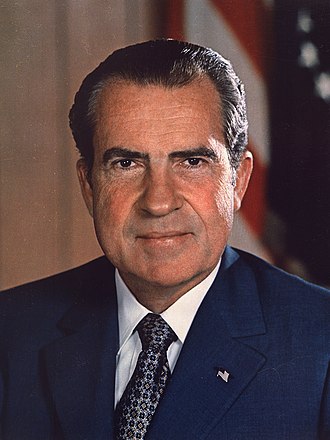
Richard M. Nixon served as the 37th President of the United States from January 1969 until his resignation in August 1974. In February 1971, he ordered the installation of a secret voice-activated taping system in the White House to preserve a historical record of his administration. Until the system's existence was revealed and dismantled in July 1973, the tapes captured Nixon directing major foreign policy initiatives, such as the opening to China, as well as his central role in the Watergate cover-up.
What Nixon talks about on the tapes
White House operations 4,718Presidential scheduling 2,225Public relations 1,784Presidential schedule 1,782Vietnam War 1,693Logistics 1,650Manolo Sanchez 1,626White House communications 1,400White House administration 1,399Presidential communication 1,243Henry Kissinger 1,191Foreign Policy 1,183
Conversations (21,010)
— Page 191 of 211President Nixon consults with Robert H. Finch regarding the political fallout of the Watergate scandal and the departure of key administration officials. Nixon expresses frustration toward critics, particularly Senator Charles Percy, while emphasizing the administration's commitment to self-investigation. He urges Finch to maintain high morale and discourages personnel from resigning immediately to avoid the appearance that such departures are linked to the ongoing scandal.
President Nixon contacted the White House operator to facilitate an outgoing call to Secretary of State William P. Rogers. The brief exchange served as a routine administrative request to establish a line of communication with the Secretary. No substantive policy discussions or decisions occurred during this brief request.
President Nixon contacted the White House operator from his office in the Old Executive Office Building to facilitate an outgoing call. The brief exchange served as a routine administrative request to connect the President to another party. No substantive policy discussions or major decisions occurred during this brief interaction.
President Nixon and Secretary of State William P. Rogers discussed the recruitment of David Packard for an appointment, agreeing that Nixon should personally call Packard to address his reluctance and concerns regarding potential stock conflicts. Rogers confirmed that congressional leaders, including Mike Mansfield and George Mahon, strongly supported Packard as the best candidate for the position. Additionally, Nixon briefed Rogers on a recent meeting with Vice President Spiro Agnew, during which he instructed Agnew to refrain from making public political statements.
President Nixon and Secretary of State William P. Rogers discuss the status of David Packard and potential strategies for addressing his outstanding stock holdings and political involvements. Nixon expresses frustration over Packard’s recent public statements and instructs that he must remain silent regarding sensitive political matters. To resolve the uncertainty, Nixon decides to contact Packard directly to invite him for a meeting to clarify his position and future role.
President Nixon initiated a request through the White House operator to place an outgoing call to David Packard in California. The brief exchange served as a logistical step to facilitate direct communication with the former Deputy Secretary of Defense. No further substantive discussion occurred during this connection beyond the placement of the call.
President Nixon communicated with a White House operator to facilitate a telephonic connection. This brief interaction served an administrative purpose to initiate an external or internal call. No substantive policy discussions or significant decisions were recorded during this exchange.
President Nixon spoke with David Packard to secure his support during the intensifying Watergate scandal, particularly regarding the recent resignations of H.R. Haldeman and John Ehrlichman. Nixon expressed his resolve to fight through the political crisis and thanked Packard for his continued confidence. To explore a potential, undisclosed role for Packard in the administration, the two men arranged a private meeting for Thursday morning to discuss the matter further.
President Nixon held a brief introductory conversation with David Packard to discuss the recent resignations of H.R. Haldeman and John Ehrlichman amid the deepening Watergate scandal. Seeking to leverage Packard's experience, Nixon requested a follow-up meeting to gauge Packard's interest in returning to government service. They scheduled a breakfast meeting for the following Thursday to discuss the potential appointment further, noting that key congressional figures had already expressed enthusiasm for the prospect.
President Nixon communicated with the White House operator to facilitate an outgoing call. This exchange served as a logistical step in the President's personal management of his communications. No substantial policy or political discussions occurred during this brief request.
President Nixon spoke with the White House operator to facilitate an outgoing call. This brief interaction served as a technical bridge for the President to initiate further communication. The conversation concluded with the operator connecting Nixon to his next party.
President Nixon and Henry Kissinger discuss the potential appointment of David Packard to a high-level position, evaluating his qualifications, political alignment, and rapport with Kissinger. The conversation also covers the success of Nixon’s recent meetings with West German Chancellor Willy Brandt and Egon Bahr, including the tone of Nixon's comments regarding the Soviet Union. Nixon concludes by reinforcing the administration's commitment to upcoming Strategic Arms Limitation Talks (SALT), instructing Kissinger to maintain high morale and execute their diplomatic strategy.
President Nixon instructed Thomas Hart to adjust his official schedule to accommodate a meeting with David Packard. Nixon directed that Packard be slotted for a 9:00 a.m. appointment on Thursday, explicitly requesting that Stephen Bull reschedule existing commitments to allow for a 30- to 60-minute duration. The President confirmed he had already concluded his meeting with Roy Ash, clearing the way for the new appointment.
President Nixon directs Thomas Hart to schedule a meeting with David Packard for the following Thursday morning. Additionally, the President requests that Steve remain available to facilitate his transition to the gym. This brief exchange serves primarily as a logistical instruction for managing the President's upcoming calendar and personal fitness routine.
President Nixon consulted his close confidant Bebe Rebozo regarding public and staff reactions to his recent television address concerning the Watergate scandal. Rebozo reported a significant, positive shift in morale and public sentiment, emphasizing that the address successfully portrayed the President as uninvolved and proactive. The two also coordinated plans for the President’s upcoming trip to Florida and the island residence of Robert Abplanalp.
President Nixon and his close associate Bebe Rebozo discussed upcoming weekend plans to visit Florida and the island. During the brief exchange, Nixon inquired about public reception to his recent televised address regarding the Watergate scandal. The President specifically requested that Rebozo gauge the sentiments of average Floridians to assess how the public perceives his administration's handling of the crisis.
President Nixon initiates a request through the White House operator to place a telephone call to John J. McCloy in New York. The conversation serves as a brief logistical exchange to facilitate professional contact between the President and the prominent attorney and diplomat. No substantive policy matters or further decisions are addressed during this short administrative interaction.
President Nixon utilized the White House operator to facilitate a telephonic connection to John Boyle. This brief interaction served as a logistical bridge to initiate a separate communication with an outside party. No further policy discussions or significant strategic decisions were recorded during this specific exchange.
President Nixon met with an unidentified individual in the Old Executive Office Building to facilitate a specific staffing request. During this brief encounter, the President explicitly requested that William J. Baroody, Jr. be brought in to join the discussion. The meeting concluded shortly thereafter, with the guest departing before 7:15 pm.
President Nixon held a brief, routine administrative communication with the White House operator. The conversation served primarily as an instruction for call placement or relaying information regarding a third party. No substantive policy discussions or significant political decisions were recorded during this brief exchange.
President Nixon contacted the White House operator to place a telephone call to Senator Hugh Scott. The request served as a brief administrative interaction to facilitate communication with the Republican leader. No substantive policy discussions or policy developments occurred during this brief exchange.
A White House operator informs President Nixon that Senator Hugh Scott is attending a dinner for Senator Charles McC. Mathias, Jr. at the Civic Center. Upon learning of the Senator's location, the President decides against interrupting the event. He concludes the call by instructing the operator to hold his attempt to reach Scott until the following day.
President Nixon initiates a request through the White House operator to be connected with Secretary of State William P. Rogers. The brief exchange serves as a logistical coordination to facilitate direct communication between the President and the Secretary. No further policy discussion or substantive developments occur during this specific telephone connection attempt.
President Nixon instructed the White House operator to cancel a previously requested call to John J. McCloy. He explained that the cancellation was necessary because he had already successfully contacted McCloy through other means. The operator acknowledged the request and terminated the brief interaction.
President Nixon met with William J. Baroody, Jr. to discuss the administration's internal morale and efforts to cultivate public support following recent Watergate-related pressures. They evaluated the potential departure of staff members connected to the scandal and reviewed positive public reactions to the President's recent televised address, including feedback from ethnic leaders and business groups. Additionally, they touched upon the political implications of a Senate resolution calling for a special prosecutor, with the President advising a cautious, discreet approach toward managing staff personnel and future investigations.
President Nixon communicated with a White House operator to facilitate an outgoing call. No additional substance regarding the conversation is available, as the record indicates this interaction served solely as a technical bridge to connect the President to another party. The event is documented as a brief administrative coordination within the Executive Office Building.
President Nixon consulted with a White House operator to facilitate an outgoing call. This brief interaction served administrative and communication purposes, acting as a precursor to further telephonic business. No substantive policy discussions or major decisions were recorded during this connection.
President Nixon and Secretary of State William P. Rogers discuss how incoming Attorney General Elliot Richardson should respond to Senate pressure regarding the appointment of a special prosecutor for the Watergate investigation. Rogers advises that Richardson should proactively propose consulting with congressional leaders rather than appearing forced by a Senate resolution, a strategy intended to defend Richardson's integrity. Nixon agrees with this approach, noting that the pressure from figures like Senator Charles Percy unfairly undermines the new Attorney General's credibility.
President Nixon consulted Secretary of State William P. Rogers regarding the political pressure to appoint a special prosecutor for the Watergate investigation. Nixon expressed concern over how to advise incoming Attorney General Elliot Richardson on handling the potential Senate resolution. The two agreed to approach the issue cautiously, viewing the push for a special prosecutor as a tactical challenge to the administration’s authority.
President Nixon instructed the White House operator to initiate a telephone call to Elliot L. Richardson. This brief communication served as a logistical request to establish contact with the Attorney General designate. No further substantive policy matters were discussed during this brief administrative interaction.
President Nixon held a brief, informal exchange with a White House operator while in his office in the Old Executive Office Building. The recording captures only a minor, non-substantive remark regarding the office environment. No significant policy decisions or official actions were transacted during this interaction.
President Nixon and Attorney General-designate Elliot Richardson discuss the impending appointment of a Special Prosecutor to investigate the Watergate scandal. They agree that while Richardson should appoint an independent figure to oversee the investigation, he must retain ultimate authority and responsibility as Attorney General rather than fully abdicating oversight. Richardson plans to consult with Senate Judiciary Committee members to ensure his proposed management structure, which includes replacing Henry E. Petersen, maintains his command while satisfying congressional demands for integrity.
President Nixon and Elliot Richardson discuss the ongoing Watergate investigations and the political challenges surrounding the nomination of a new special prosecutor. Nixon emphasizes that as Attorney General, Richardson holds absolute authority over the investigation and suggests replacing Henry Petersen to alleviate public pressure. The two men agree on the importance of Richardson maintaining control while navigating the expectations of the Senate.
President Nixon initiates a brief request for the White House operator to connect him with Press Secretary Ronald L. Ziegler. The call serves as a logistical communication to facilitate direct contact between the President and his key communications advisor during a period of significant political pressure. No further dialogue is recorded beyond this request for a line transfer.
President Nixon and Press Secretary Ronald Ziegler discussed the administration's strategy for addressing mounting pressure regarding a potential Watergate special prosecutor. Nixon emphasized that the President should not appoint the prosecutor directly, insisting that the authority rests solely with the Attorney General to ensure the ongoing investigation is not disrupted. Ziegler provided feedback on the positive public and select press reactions to the President's recent televised address, and Nixon instructed him to maintain a firm, confident posture during future press briefings.
President Nixon instructed the White House operator to place an urgent call to William E. Timmons, who served as his Assistant for Legislative Affairs. The exchange was limited to the President’s directive to initiate this communication, reflecting the administration's ongoing coordination with Congress during a period of high political pressure. No further substantive discussion occurred before the recording concluded.
President Nixon attempts to reach William E. Timmons to discuss administrative or political matters, but learns that Timmons is currently unavailable. Seeking an alternative, the President instructs the operator to connect him with Mr. Siegfried instead. This brief exchange highlights the President's urgent need for consultation during a late-night period of administrative activity.
President Nixon directed Press Secretary Ronald Ziegler to coordinate with William Timmons on an aggressive lobbying strategy targeting members of the House and Senate Judiciary Committees. The primary objective was to secure bipartisan congressional support for Elliot Richardson’s nomination and to push back against legislative scrutiny regarding the special prosecutor’s authority. Nixon emphasized the immediate need for Timmons to move past defensive posturing and proactively cultivate key Democrats, such as James O. Eastland, to stabilize the administration's position amidst the Watergate fallout.
President Nixon initiated a call to the White House operator to place an urgent request for Secretary of State William P. Rogers. Due to uncertainty regarding Rogers' availability at home, the President instructed the operator to have Rogers return the call as soon as possible. This brief communication served as a logistical coordination to facilitate direct contact between the President and the Secretary of State.
President Nixon consults with Secretary of State William P. Rogers to manage the escalating Watergate crisis and the appointment of a special prosecutor. Nixon asks Rogers to coordinate with Elliot Richardson to ensure the executive branch retains control over the appointment process, specifically countering public criticism from Senator Charles H. Percy. Rogers agrees to take charge of the situation and guide administration messaging on the matter while also commending the President’s performance at a recent state dinner.
President Nixon directs William Timmons to coordinate with Congressional leaders to consolidate support for Attorney General nominee Elliot Richardson’s authority regarding the Watergate investigation. Nixon emphasizes the need to convince key Republicans, such as Buckley and Goldwater, and influential Democrats that empowering Richardson to appoint a special prosecutor is preferable to restarting the entire investigative process. Timmons is instructed to make this lobbying effort his top priority to counter Senate pressure and ensure the continuity of the FBI’s existing progress.
Henry Kissinger calls President Nixon to offer praise for a recent toast and to discuss the political fallout from the Watergate scandal. The two reflect on the necessity of the President’s recent televised address and the resignation of top aides H.R. Haldeman and John Ehrlichman. Nixon expresses resolve to shift focus back to national governance, while Kissinger encourages the President to maintain personal support for his outgoing staff.
President Nixon met with the Labor-Management Advisory Committee, including George Shultz, John T. Dunlop, and various labor and business leaders, to discuss the ongoing management of the national economy and inflation. The discussion centered on the successes and challenges of the administration's economic stabilization efforts, particularly the transition from Phase II to Phase III of wage and price controls. Participants deliberated on the importance of maintaining public confidence and business compliance, with the President emphasizing the need for continued cooperation between labor and management to ensure stability without excessive government intervention.
President Nixon held a brief, unscheduled meeting in the Oval Office with an unidentified individual, potentially Press Secretary Ronald L. Ziegler. Due to the lack of an available transcript and the extremely short duration of the recording, the specific subject matter remains undocumented. No formal policy decisions or concrete action items were captured during this three-minute interval.
President Nixon and Press Secretary Ronald Ziegler met to discuss the administration's ongoing public relations and legal strategy regarding the Watergate scandal, specifically focusing on the Ellsberg break-in and subsequent press scrutiny. Nixon emphasized that he maintained the same official position—declining to comment on the break-in to avoid prejudicing ongoing court cases—while Ziegler strategized on how to manage media inquiries and leaks. The pair also discussed the need for Nixon to take a trip to Florida to rest due to the extreme workload and strain caused by the scandal, and explored how future structural changes to the White House staff could help regain control of the narrative.
President Nixon met with Vice President Agnew and his key economic advisors to assess the national economy, focusing on rising inflation and the status of the Phase III wage and price control program. The group evaluated the success of recent industrial wage settlements, particularly in the meatpacking industry, and discussed the potential necessity of fiscal and monetary restraint to avoid a future recession. The President and his team ultimately decided against implementing a new price freeze while considering the political feasibility of a variable investment tax credit with Congressional leaders.
President Nixon met with his personal aide, Manolo Sanchez, in the Oval Office to address administrative matters. The brief discussion primarily concerned the scheduling of National Security Advisor Henry A. Kissinger. No other substantive policy issues or significant developments were recorded during this interaction.
President Nixon met with his aide, Stephen B. Bull, to review administrative logistics regarding his personal schedule and upcoming appointments. During the brief discussion, the President emphasized the need for strict confidentiality, specifically instructing Bull to maintain silence regarding his movements. The meeting concluded with Nixon providing instructions for later coordination, including plans to visit his daughter, Julie Nixon Eisenhower.
President Nixon and Henry Kissinger met to coordinate foreign policy messaging and prepare for upcoming diplomatic engagements, specifically Kissinger’s trip to Moscow to negotiate bilateral agreements and a nuclear treaty. The conversation addressed the logistical handling of a foreign policy report and the necessity of maintaining operational secrecy regarding Vietnam negotiations despite internal bureaucracy. Furthermore, they discussed the political fallout of the Watergate scandal, specifically evaluating the appointment of Elliot Richardson and the public perception of the administration's ongoing investigations.
President Nixon met with his aide Stephen B. Bull to coordinate the timing of a public announcement regarding George H.W. Bush. The conversation centered on relaying information from John B. Connally concerning when this announcement would be released. Nixon sought confirmation of the scheduled timing, reflecting the administration's focus on managing the optics of personnel-related disclosures.
John B. Connally informs President Nixon of his intent to hold a press conference to formally announce his party affiliation change to the Republican Party. Nixon praises Connally's courage and aligns their shared political resolve against ongoing adversity. The two also briefly acknowledge positive public feedback regarding the President's recent televised address concerning the Watergate scandal.
President Nixon met with John B. Connally to discuss the favorable public reception following the President’s recent televised address regarding the Watergate scandal. The exchange served as a brief morale-boosting session, with Nixon commending Connally for his loyalty and steadfast support during a period of intense political pressure. No substantive policy decisions were made, as the interaction focused primarily on personal rapport and mutual encouragement.
President Nixon initiates a brief request for the White House operator to connect him with H.R. Haldeman. This administrative interaction serves as a logistical bridge to facilitate communication with his Chief of Staff during a period of high intensity regarding the Watergate investigations. No substantive policy discussions occur during this short exchange beyond the placement of the call.
President Nixon met briefly with an unidentified individual in the Oval Office to facilitate a meeting with White House Press Secretary Ronald L. Ziegler. The conversation was exceptionally brief, serving primarily to arrange contact between the participant and Ziegler. No further substantive policy discussions were recorded during this short encounter.
President Nixon held a brief communication with a White House operator to facilitate a phone connection. The exchange served as a routine administrative task to manage presidential correspondence or scheduling. No substantive policy discussions or significant political developments occurred during this short interaction.
President Nixon met with Ronald Ziegler and H.R. Haldeman to address the public relations fallout and procedural concerns regarding FBI guards placed in the offices of Haldeman and John Ehrlichman. Ziegler briefed the President on his consultations with Leonard Garment, Elliot Richardson, and William Ruckelshaus, asserting that these actions would bolster the President's image by projecting strength and a commitment to a transparent investigation. The participants also touched upon press arrangements for an upcoming foreign policy briefing and discussed the political courage required for John B. Connally’s impending announcement regarding his party affiliation.
President Nixon and H. R. Haldeman coordinated a meeting for later that afternoon to discuss pending administrative matters. During the call, they celebrated the news that John Connally had officially announced his decision to switch his party affiliation to the Republican Party. Both men characterized this political realignment as a significant and mutually beneficial development for both Connally and the Nixon administration.
President Nixon initiates a request through the White House operator to be connected with his daughter, Julie Nixon Eisenhower. The brief exchange serves as a logistical bridge to facilitate direct personal communication between the President and his daughter. No further policy or administrative matters were addressed during this call.
President Nixon held a brief, informal communication with the White House operator to facilitate an outgoing call. This exchange served a purely administrative purpose to connect the President with another party. No substantive policy discussions or political decisions were recorded during this brief administrative interaction.
President Nixon held a brief morning meeting in the Oval Office with Ronald L. Ziegler and an unidentified man. While the specific substance of the dialogue remains unrecorded, the discussion occurred amidst the escalating pressures of the Watergate scandal. The meeting concluded quickly, with the unknown visitor departing shortly before 10:14 am.
President Nixon held a brief, private telephone conversation with his daughter, Julie Nixon Eisenhower. Due to the personal nature of the discussion, the recording segment was designated as a personal returnable item and has been withdrawn from public access. Consequently, there is no transcript available to determine specific topics, developments, or action items.
President Nixon met briefly with his daughter, Julie Nixon Eisenhower, in the Oval Office to discuss personal family matters. The vast majority of the recording is comprised of a withdrawn segment classified as personal and returnable material. Consequently, no substantive policy or administrative developments were recorded during this brief interaction.
President Nixon and Press Secretary Ronald Ziegler discuss strategies to manage the Watergate narrative, specifically by denying any presidential involvement in or discussions regarding clemency for involved parties. They also address the Daniel Ellsberg psychiatrist break-in, with Nixon asserting he was unaware of the operation until March 1973 and defending his administration's surveillance activities as necessary for national security. Additionally, Nixon instructs Ziegler on how to frame his public interactions to emphasize that the President was focused on governing rather than political maneuvering.
President Nixon initiates a brief administrative call through the White House operator to be connected with Secretary of State William P. Rogers. The primary purpose of this interaction is to facilitate communication between the President and his top diplomat during the height of the Watergate crisis. No further policy discussions or substantive developments occur during this brief exchange.
President Nixon met with Stephen B. Bull to coordinate his upcoming schedule, specifically focusing on remarks for the 'New Majority' dinner and potential travel plans to Florida. They discussed the themes for the dinner speech, with Nixon emphasizing a focus on peace and long-term administrative goals while explicitly excluding mentions of the Watergate scandal. Additionally, the pair reviewed logistical details regarding future church attendance and the possibility of televising a peace service.
President Nixon and Secretary of State William P. Rogers discuss how to manage Senate pressure regarding the appointment of a special prosecutor for the Watergate scandal, particularly focusing on Senator Charles Percy's legislative resolution. Rogers reports that he confronted Percy to ensure support for Elliot Richardson and suggests that the White House should neutralize the resolution by securing endorsements from senior senators rather than forcing a floor vote. Additionally, the two men discuss the need to find a new, experienced, and low-profile White House Counsel to replace Leonard Garment and briefly consider potential candidates like Bryce Harlow.
President Nixon met with Secretary of State William P. Rogers to discuss the need for a new legal counsel to handle mounting administrative and legal pressures. The conversation centered on the importance of expressing confidence in Attorney General Elliot Richardson regarding his dealings with the Senate, as well as the search for a seasoned, trusted individual to serve as a personal legal advisor. Nixon expressed urgency in finding a candidate who could operate independently of White House staff to navigate these sensitive government matters.
President Nixon directs the White House operator to facilitate a meeting with Kenneth R. Cole, Jr. He explicitly requests that Cole join him in the Old Executive Office Building. This brief administrative exchange confirms the scheduling of a direct consultation between the President and a key staff member.
President Nixon held a brief meeting in the Oval Office with an unidentified individual, who appeared to be coordinating personnel matters. The discussion focused primarily on facilitating a meeting between the President and Press Secretary Ronald L. Ziegler. No other substantive policy issues or administrative decisions were captured during this short exchange.
President Nixon initiated a brief communication with the White House operator to facilitate an outgoing call. The interaction served as a routine administrative step to connect the President with another party. No substantive policy discussions or significant political developments occurred during this brief exchange.
President Nixon and Press Secretary Ronald Ziegler coordinate the logistical details for an upcoming meeting with West German officials, including Chancellor Willy Brandt and Foreign Minister Walter Scheel. The discussion focuses on scheduling a photo opportunity to occur at the end of the session to avoid any appearance of conflict. Additionally, the pair briefly touches upon administrative concerns, including the roles of Vice President Spiro Agnew and John Connally, alongside ongoing developments regarding the Watergate scandal and Cabinet-level appointments.
President Nixon and Kenneth R. Cole, Jr. met to discuss potential candidates to replace John W. Dean, III as White House counsel. The conversation focused on the qualifications required for the role, specifically evaluating Edward L. Morgan as a potential candidate due to his reputation as a solid thinker and his limited involvement in campaign activities. Nixon expressed concerns about pulling Morgan from his critical duties as Assistant Secretary of the Treasury, ultimately directing Cole to consult with others regarding Morgan’s suitability and recommendations.
President Nixon met with Thomas Hart to coordinate logistical details for an upcoming visit from West German Chancellor Willy Brandt. The discussion focused on finalizing the meeting schedule and clarifying the roles and attendance of Secretary of State William P. Rogers and National Security Advisor Henry Kissinger. They specifically reviewed the timing of a planned photo opportunity to ensure smooth transitions for the participating officials.
President Nixon met with his personal valet, Manolo Sanchez, to discuss logistical arrangements within the Oval Office. Their brief consultation focused on the removal of an unspecified item and coordination regarding the President's upcoming schedule. The exchange primarily centered on the practical administration of Nixon's private affairs, specifically mentioning a planned interaction with Julie Nixon Eisenhower.
President Nixon met with an unidentified individual in the Oval Office to coordinate logistics regarding a potential meeting with West German Chancellor Willy Brandt. The discussion focused primarily on determining Brandt's current location and scheduling details for a forthcoming encounter. No further administrative or policy decisions were documented during the brief interaction.
President Nixon met with West German Chancellor Willy Brandt, along with their respective foreign ministers and advisors, to discuss geopolitical strategy, international trade, and energy policy. The participants engaged in a detailed review of East-West relations, focusing on Soviet adherence to the Four Power Agreement regarding Berlin, strategies for the Conference on Security and Cooperation in Europe (CSCE), and West Germany’s upcoming entry into the United Nations. Additionally, the group addressed the necessity of coordinating energy and oil policies with Japan and the European Community, while exploring diplomatic paths for a Middle East peace settlement despite the complexities surrounding Israeli elections and Soviet involvement.
President Nixon initiates a request through the White House operator to be connected with Kenneth R. Cole, Jr. This brief administrative interaction serves as a call-routing request to facilitate direct communication between the President and his Deputy Assistant for Domestic Affairs. No further policy discussions or substantive developments occur during this exchange.
President Nixon and Kenneth R. Cole, Jr. coordinated the final approval of an economic statement. Nixon confirmed that he did not need to review the document further, granting Cole authorization to release the statement immediately. Cole was tasked with relaying the President’s approval to the relevant parties to facilitate its dissemination.
President Nixon and William P. Rogers met to discuss the staffing of the White House Counsel position following the resignations of H. R. Haldeman and John Ehrlichman, as well as the ongoing management of the Watergate scandal. The two evaluated potential candidates for Counsel—including George H. W. Bush, John W. Byrnes, and others—emphasizing the need for a candidate with legal expertise who could effectively manage Cabinet and Congressional relations. Furthermore, they reviewed the search for a Special Prosecutor to handle the difficult legal proceedings involving high-level administration officials, ultimately favoring individuals with strong integrity and non-partisan backgrounds.
President Nixon initiates a brief request for the White House operator to place a telephone call to Marjorie P. Acker. This exchange serves as a standard administrative facilitation of presidential communications. No substantive policy matters or further developments are discussed beyond the scheduling of the outgoing call.
President Nixon met with an unidentified male visitor in the Old Executive Office Building to discuss matters related to the President's daily schedule. The brief interaction concluded with the President directing the individual to return to an ongoing meeting or previous engagement. No substantive policy matters were recorded, as the conversation primarily concerned logistical arrangements.
President Richard M. Nixon met with his personal valet, Manolo Sanchez, in the Old Executive Office Building to review the President's upcoming schedule. This brief administrative consultation facilitated the logistical planning of Nixon's professional obligations. The meeting concluded with Sanchez departing the office shortly before 12:48 pm.
President Nixon met with his personal valet, Manolo Sanchez, in the Old Executive Office Building. While the specific nature of their discussion remains classified or redacted due to personal privacy concerns, the interaction involved routine personnel engagement. No significant policy decisions or administrative actions were recorded during this brief encounter.
President Nixon held a brief, private meeting with an unidentified male visitor in his Old Executive Office Building workspace. The session involved the consumption of refreshments, though the lack of an available transcript or archival detail obscures the specific substance of their discussion. Consequently, no substantive policy matters, political decisions, or administrative action items can be verified from this recorded interaction.
President Nixon placed a brief call to the White House operator to facilitate an outgoing connection to an unnamed party. The conversation served a purely administrative purpose to initiate external communication. No substantive policy discussions or decisions were recorded during this brief administrative interaction.
President Nixon spoke with Marjorie P. Acker to arrange the delivery of pending messages and folders currently held by Rose Mary Woods to his office in the Executive Office Building. Nixon instructed Acker to drop off the materials without personal meetings, as he intended to use his limited midday break to rest. This brief interaction focused solely on the logistics of managing administrative paperwork while the President attempted to secure some downtime.
President Nixon consulted with Marjorie P. Acker regarding the handling of incoming messages and correspondence. He requested that Acker bring a folder of items to his office in the Old Executive Office Building for his review. Nixon indicated he intended to rest and instructed her to leave the materials without requiring a formal meeting.
President Nixon and Stephen B. Bull met to finalize logistical arrangements for the President's upcoming visit to Julie Nixon Eisenhower’s residence. The discussion focused on coordinating transportation security and ensuring a discreet departure from the White House grounds to avoid public attention. Additionally, the pair briefly touched upon the President's broader schedule, including upcoming meetings in the Oval Office and engagements with the Labor-Management Advisory Committee.
President Nixon initiates a brief communication through the White House operator to place an outgoing call. The interaction serves as a routine administrative step to facilitate a connection for the President. No substantive policy discussions or significant political developments are captured in this brief exchange.
President Nixon initiates a brief request for the White House operator to connect him with Stephen B. Bull. This exchange serves as a standard administrative action to facilitate communication between the President and his staff. No further substantive policy matters or decisions are discussed during this brief connection.
President Nixon consulted with his aide, Stephen B. Bull, to coordinate adjustments to his afternoon schedule. Nixon instructed Bull to ensure he departed from a 3:00 p.m. meeting on time to maintain his planned itinerary. The exchange concluded with the President directing that no further changes be made to the established schedule.
President Nixon held a brief, informal communication with the White House operator shortly before noon. The exchange did not involve substantive policy or administrative discussions and serves primarily as a brief procedural check-in between the President and staff. No significant political decisions or developments were recorded during this interaction.
President Nixon met briefly with his personal aide, Stephen B. Bull, to coordinate the timing of an upcoming meeting. The discussion focused on confirming that a group was scheduled to convene at 3:00. The conversation concluded with Bull tasked to report back to the President with further updates.
President Nixon instructed the White House operator to place a telephone call to Press Secretary Ronald L. Ziegler. This brief administrative exchange served as a logistical step to facilitate direct communication between the President and his top spokesperson. No substantive policy discussions occurred during this connection.
President Nixon and Press Secretary Ronald Ziegler reviewed the outcome of Ziegler's recent press briefing, which focused heavily on the Watergate scandal and ongoing legal proceedings. They specifically discussed media inquiries regarding potential White House involvement in the break-in and whether the President withheld information during recent public addresses. Additionally, Nixon directed Ziegler to arrange a photo opportunity during a scheduled meeting with the Labor-Management Advisory Board to highlight the administration's focus on economic policy.
President Nixon and Press Secretary Ronald Ziegler met briefly to coordinate their response to intensifying scrutiny regarding the Watergate break-in. They discussed allegations that Nixon withheld information during a recent speech, with the President explicitly denying prior knowledge of the criminal activity. The pair prepared for upcoming inquiries and set a schedule for further discussion later that afternoon.
President Nixon directs the White House operator to place a telephone call to Press Secretary Ronald L. Ziegler. The conversation serves purely as an administrative request to facilitate communication between the President and his primary spokesperson. No substantive policy matters or tactical decisions are discussed during this brief exchange.
President Nixon held a brief administrative interaction with the White House operator to facilitate an outgoing call. The discussion served as a logistical bridge to connect the President with another party, as indicated by the reference to a subsequent conversation. No substantive policy matters or political developments occurred during this brief exchange.
President Nixon and Press Secretary Ronald Ziegler briefly discussed the status of a scheduled meeting between Ziegler and journalist Stewart Alsop. Ziegler informed the President that he had not yet met with Alsop due to his prior obligations conducting press briefings. The two agreed to postpone their discussion regarding the meeting until a later time.
President Nixon and Press Secretary Ronald L. Ziegler engaged in an extremely brief, informal exchange following a meeting regarding the Stuart Hall matter. The discussion centered on confirming Ziegler's ability to handle the specific task or public statement related to Hall. No formal policy decisions or substantive strategic actions were recorded during this one-minute interaction.