Nixon, Richard M. (President)
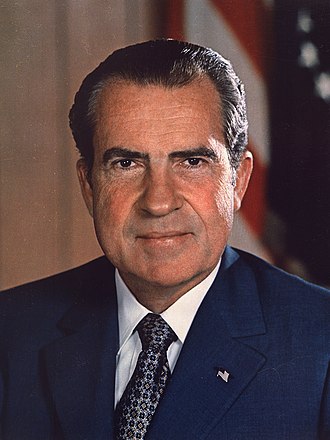
Richard M. Nixon served as the 37th President of the United States from January 1969 until his resignation in August 1974. In February 1971, he ordered the installation of a secret voice-activated taping system in the White House to preserve a historical record of his administration. Until the system's existence was revealed and dismantled in July 1973, the tapes captured Nixon directing major foreign policy initiatives, such as the opening to China, as well as his central role in the Watergate cover-up.
What Nixon talks about on the tapes
White House operations 4,718Presidential scheduling 2,225Public relations 1,784Presidential schedule 1,782Vietnam War 1,693Logistics 1,650Manolo Sanchez 1,626White House communications 1,400White House administration 1,399Presidential communication 1,243Henry Kissinger 1,191Foreign Policy 1,183
Conversations (21,010)
— Page 201 of 211President Nixon initiates a brief telephone call to the White House operator to be connected with Attorney General Elliot L. Richardson. The primary purpose of this contact is to facilitate direct communication with the recently confirmed head of the Department of Justice. No further substantive policy matters or specific instructions are captured in this brief exchange.
President Nixon calls Elliot L. Richardson to congratulate him on his Senate confirmation as Attorney General, commending his skill in navigating the difficult confirmation process. The conversation shifts to the Watergate investigation, specifically addressing the role of Special Prosecutor Archibald Cox and concerns regarding the continuity of ongoing work by U.S. Attorneys. Nixon emphasizes the importance of the administration’s recent public statement on the scandal and confirms logistics for Richardson’s upcoming swearing-in ceremony at the Department of Justice.
President Nixon met with Alexander Haig to discuss the ongoing fallout from the Watergate scandal, specifically focusing on managing the White House staff's morale, press relations, and the administration's strategic response. They coordinated the upcoming swearing-in ceremony for Attorney General Elliot Richardson and discussed utilizing cabinet members like Henry Kissinger to handle press briefings to shield the President from direct confrontation. Additionally, the President reviewed his schedule, including planned meetings with Congressional leaders and potential public appearances to project stability and strength during the crisis.
President Nixon contacted the White House operator to request a connection to Stephen B. Bull. The brief call served as a routine administrative request to facilitate further communication with a member of the President's staff. No substantive policy matters or historical developments occurred during this brief exchange.
President Nixon and Stephen B. Bull coordinate scheduling adjustments and travel logistics for an upcoming trip to Camp David. Due to poor visibility conditions, they determine that a helicopter flight is not feasible, necessitating a 90-minute drive via a planned route. Additionally, the President postpones a haircut and directs Bull to deliver reception paperwork to his valet, Manolo Sanchez.
President Nixon met with Stephen B. Bull and an unidentified individual to resolve logistical conflicts regarding his upcoming schedule and travel arrangements. The discussion focused on rectifying a scheduling error involving congressional events and coordinating the President's transit to Camp David via helicopter or automobile due to poor weather conditions. Ultimately, the President decided to proceed with his plans while emphasizing the need for candid communication with his staff regarding the itinerary.
President Nixon held a brief meeting in the Oval Office with an unidentified individual to discuss his upcoming daily schedule. The conversation primarily served to coordinate the President's agenda with Press Secretary Ronald L. Ziegler. No substantive policy decisions were documented during this short exchange.
President Nixon and Ronald Ziegler discussed strategies for managing the White House's public image and morale amidst the intensifying Watergate scandal. Nixon expressed concern over potential accusations of perjury and emphasized the need to shift focus toward broader national security issues and a more active, outward-facing engagement with Congress and the press. The conversation also touched upon the necessity of internal staff restructuring, including the potential return of Bryce Harlow, to navigate the political fallout and maintain the administration's stability.
President Nixon met with his personal valet, Manolo Sanchez, in the Old Executive Office Building to discuss administrative and logistical matters. The brief interaction focused on the President's upcoming schedule and requirements for writing materials. No significant policy decisions were recorded during this short appointment.
President Nixon met with his aide, Stephen B. Bull, to coordinate logistics for an upcoming Cabinet meeting and the swearing-in ceremony of Elliot L. Richardson. They discussed the involvement of key officials, specifically clarifying that Henry Kissinger would not be participating in the day's scheduled events. Nixon finalized arrangements for transportation and briefed Bull on the expected sequence of activities involving Chief Justice Warren E. Burger and an event for prisoners of war.
President Nixon met with an unidentified individual in the Old Executive Office Building to facilitate the delivery of a personal note intended for former Chief of Staff H. R. Haldeman. The exchange was coordinated by Lawrence M. Higby, serving as an intermediary for the document's transfer. This brief interaction concludes with the departure of the unknown visitor, marking a focused logistical exchange regarding communication with a key aide during the height of the Watergate investigations.
President Richard Nixon met with his valet, Manolo Sanchez, in the Old Executive Office Building. The brief discussion focused on the acquisition and logistics of pens. No further policy-related developments were recorded during this encounter.
President Nixon held a brief, unscheduled meeting in the Old Executive Office Building to address an unidentified matter. Given the absence of a transcript or specific details, the substance of the discussion remains undocumented in the historical record. Consequently, no specific policy decisions or action items were captured for this segment.
President Nixon and Henry Kissinger discuss the positive progress in Vietnam and Laos negotiations, noting that the status of talks is better than the original agreement. They coordinate a forthcoming press briefing for Kissinger to publicly discuss the President’s upcoming meeting with Georges Pompidou, the US-USSR summit, and the status of Vietnam negotiations. Additionally, Nixon emphasizes the importance of the administration's recent Watergate "White Paper" as a necessary measure to assert the national security implications of the scandal.
President Nixon held a brief, informal meeting in the Old Executive Office Building with an unidentified woman. The interaction was primarily social in nature, focusing on the provision of refreshments. The meeting concluded immediately after these amenities were handled, with no substantive policy or political discussions recorded.
President Nixon and Henry Kissinger discuss the need to maintain morale following the public disclosure of national security information. Nixon emphasizes the necessity of the recent decision to release the material despite the political sensitivity. They agree to postpone a more detailed discussion regarding upcoming summer messaging and the status of their diplomatic progress until a later time.
President Nixon initiates a request through the White House operator to place an outgoing telephone call to Representative Leslie C. Arends. The conversation serves solely as an administrative coordination to connect the President with the House Minority Whip. No substantive policy matters or further developments are discussed during this brief exchange.
President Nixon directed the White House operator to place a telephone call to Senate Minority Leader Hugh Scott. The brief exchange served as a logistical coordination to facilitate direct communication between the President and the Senator. No further substantive policy matters were addressed during this connection.
President Nixon consulted with a White House operator to facilitate a telephonic communication. The brief exchange served primarily to initiate a call, reflecting routine administrative coordination within the White House communications system. No substantive policy discussions or major decisions were recorded during this brief interaction.
President Nixon requested that the White House operator place a telephone call to an unnamed party. This brief interaction served as a routine administrative request to facilitate direct communication through the White House switchboard. No substantive policy matters or political discussions were recorded during this brief connection.
President Nixon calls Senator Hugh Scott to commend his recent public defense of the administration, specifically regarding the Watergate scandal. Nixon encourages Scott to emphasize the importance of national security and secrecy in facilitating major foreign policy achievements, such as diplomatic relations with China and the Soviet Union, and the return of POWs from Vietnam. By framing the protection of sensitive information as vital to peace negotiations, Nixon urges Scott to contrast the administration's national security efforts with the actions of those who leak classified materials.
President Nixon and Senate Minority Leader Hugh Scott discuss Scott’s recent public performance, with Nixon expressing strong approval of his messaging. The conversation centers on the necessity of secret diplomacy, with Nixon framing the protection of classified information as essential to the success of foreign policy initiatives like opening relations with China, arms limitation with the Soviets, and the return of POWs from Vietnam. Nixon emphasizes the irony of critics undermining national security while the administration attempts to secure long-term peace through confidential negotiations.
President Nixon and Representative Leslie C. Arends discuss the positive reception and improved morale among Republican Congressmen following a recent leadership meeting. Nixon emphasizes the necessity of maintaining national security and secret diplomacy, arguing that leakers threaten initiatives with China, the USSR, and the release of POWs. Arends commits to echoing these themes in upcoming speeches and encourages Nixon to address Republican members directly to further bolster support.
President Nixon and Representative Leslie C. Arends briefly discussed the state of political morale and the importance of maintaining a firm stance regarding instances of intentional, brutal violence. Nixon emphasized the necessity of addressing such misconduct aggressively to ensure public support and effective leadership. The conversation concluded with an exchange of mutual resolve regarding their political strategy.
President Nixon initiates a brief telephone call through the White House operator to connect with his daughter, Julie Nixon Eisenhower. The exchange is purely administrative, serving as a routine request to facilitate a personal conversation. No substantive policy matters or political developments are discussed during this interaction.
President Richard Nixon met with his personal valet, Manolo Sanchez, in the Old Executive Office Building. The brief encounter was centered on the provision of refreshments. No other significant political or administrative business was recorded during this interaction.
President Nixon met with an unidentified male visitor in the Old Executive Office Building to discuss matters related to the President's schedule. The conversation touched upon the movements and activities of First Lady Pat Nixon, specifically involving the use of an automobile. No further details regarding the identity of the visitor or the broader implications of their discussion are available due to the lack of a transcript.
President Nixon and Alexander Haig discussed managing the White House's public image regarding the Watergate scandal, specifically focusing on the necessity of government secrecy. Nixon emphasized using the protection of sensitive foreign policy initiatives, such as diplomatic breakthroughs with China and Russia, to justify withholding information from the media. The pair also explored strategies to initiate public controversy to deflect criticism from the New York Times and considered potential government roles for Peter G. Peterson.
President Nixon consulted with a White House operator to determine the current location of his daughter, Julie Nixon Eisenhower. After learning she was visiting the State Department with First Lady Pat Nixon, the President decided against initiating contact. He concluded the call by instructing the operator to have them return his call once they arrived back at the residence.
President Nixon contacted the White House operator to facilitate a telephone connection with his personal aide, Stephen B. Bull. This brief administrative exchange served solely to initiate the internal communication process between the President and his staff member. No further policy or political discussions occurred during this brief interaction.
President Nixon held a brief, informal check-in with the White House operator to facilitate an immediate follow-up connection. This interaction served primarily as a logistical bridge to initiate a subsequent telephone conversation. No substantive policy discussions or administrative decisions occurred during this specific exchange.
President Nixon and his personal secretary, Rose Mary Woods, discuss the President's recent interaction with his daughter, Julie Nixon Eisenhower, regarding her upcoming television appearance. The conversation touches on public relations strategies for the administration, emphasizing the need for maintaining secrecy in foreign policy and securing public support for the President’s agenda. Additionally, they reflect on the favorable public reception of a recent event honoring returning prisoners of war.
President Nixon met with an unidentified individual in the Old Executive Office Building to discuss administrative matters concerning his upcoming schedule. The primary focus of the brief meeting involved arrangements for a planned reception honoring returning prisoners of war (POWs). No further substantive policy decisions or political developments were recorded during this brief administrative encounter.
President Nixon met with unidentified individual(s) in the Old Executive Office Building to coordinate his upcoming travel schedule to Florida. The discussion focused on logistical arrangements for the trip, including the swearing-in ceremony for Attorney General Elliot L. Richardson. Key staff members, including Patrick J. Buchanan and Alexander M. Haig, Jr., were noted in relation to these scheduling requirements.
President Nixon and his daughter, Julie Nixon Eisenhower, discussed the enthusiastic reception at a White House event honoring former prisoners of war. Julie reported on the emotional response from the attendees while the President recounted key moments from his speech, including his defense of secret negotiations and his criticism of individuals who leak classified documents. Nixon noted that his remarks regarding the unauthorized release of secret files prompted a standing ovation from the crowd of former POWs.
President Nixon and his daughter, Julie Nixon Eisenhower, met briefly to discuss the political climate and personal pressures surrounding his administration. Their exchange touched upon the impact of public challenges and the potential release or management of sensitive documents. The conversation reflects the President's reliance on family support during the escalating scrutiny of his presidency.
President Nixon directs Stephen B. Bull to ensure Rose Mary Woods is included on an upcoming trip to Florida. Nixon expresses concern that Woods felt excluded from the invitation list and insists she participate because of potential work to be conducted during the visit. The President confirms he has updated the list to include her and notes his previous assumption that Alexander M. Haig, Jr. had already coordinated her attendance.
President Nixon and Stephen B. Bull engage in a brief administrative discussion regarding the personal security or presence of an unidentified female individual. The President issues a directive to ensure her continuous availability or protection. The exchange serves as a logistical instruction concerning the management of staff or personnel protocols within the White House.
President Nixon held a private meeting in the Old Executive Office Building with an unidentified individual. Given the lack of a transcript or record of the participants, the specific substance of their discussion remains unknown. The meeting lasted less than thirty minutes and concluded with the visitor's departure before 5:39 pm.
President Nixon met with his personal valet, Manolo Sanchez, in the Old Executive Office Building to discuss administrative and logistical arrangements. Their conversation focused on coordinating specific details regarding both the President’s personal schedule and the valet's own duties. No major policy decisions were made during this brief interaction, as the dialogue remained restricted to internal staffing and timing matters.
President Nixon met with his personal valet, Manolo Sanchez, in the Old Executive Office Building for a brief, informal encounter. The session was limited to the provision of refreshments, with no substantive policy or administrative discussions recorded. Sanchez departed shortly after attending to these personal services.
President Nixon and his daughter, Tricia Nixon Cox, discuss the positive reception of the President's recent remarks at a White House reception for former prisoners of war. Tricia conveys the enthusiastic support she witnessed from the POWs and their wives, comparing the atmosphere to an energetic religious service. The two briefly confirm logistics for an upcoming dinner for the returnees, while the President dismisses concerns regarding potential lack of media coverage for the event.
President Nixon and his daughter, Tricia Nixon Cox, engage in a brief, informal social interaction while in the Old Executive Office Building. Their dialogue centers on coordination regarding an upcoming dinner engagement and general personal pleasantries. No substantive policy matters or official political decisions are addressed during this short exchange.
President Nixon met with his valet, Manolo Sanchez, in the Old Executive Office Building to handle routine administrative matters. The discussion centered on logistics regarding the President’s upcoming schedule and movements to the residence, as well as the handling of his briefcase. The interaction concluded with brief, mundane exchanges concerning the weather, reflecting the informal nature of their professional relationship.
President Nixon held a meeting with an unidentified individual in the Old Executive Office Building. Due to the limited nature of the recording, which consists only of a brief closing remark, the specific topics and substantive outcomes of the discussion remain undocumented. The exchange concludes shortly after the President's departure from the meeting.
Tricia Nixon Cox initiated a telephone call through the White House operator to contact Paul W. Keyes, with President Nixon present in the background. The brief exchange focused solely on facilitating this connection. No further policy or political decisions were recorded during the interaction.
Tricia Nixon Cox contacts a White House operator to facilitate an urgent request from President Richard M. Nixon to speak with General Alexander M. Haig, Jr. The brief communication serves primarily to connect the President with his Chief of Staff during the late-night hours. The interaction highlights the administrative process utilized by the President to secure immediate consultations with key advisors.
The President engaged in an unidentified late-night telephone call while background music and voices were audible on the line. Due to the lack of an available transcript and the presence of ambient noise, the specific purpose and content of the exchange remain unknown. No substantive policy decisions or developments can be verified from the recording.
President Nixon and Tricia Nixon Cox spoke via telephone to coordinate the inclusion of Paul W. Keyes on an upcoming flight. Tricia requested the White House operator's assistance in locating and inviting Keyes to join the President's party. The operator acknowledged the request and committed to attempting to secure his presence for the trip.
President Nixon and Alexander Haig discuss the success of a recent White House dinner honoring former prisoners of war (POWs), using the event to contrast the genuine patriotism of the attendees with the negativity of the press. Despite the positive morale boost, Nixon expresses significant anxiety regarding the intensifying Watergate scandal and the potential for congressional opponents to force his resignation or obstruct his foreign policy agenda. Haig urges the President to maintain his resolve, arguing that the administration has already weathered the worst of the crisis and that support from key constituencies remains strong.
President Nixon and television producer Paul W. Keyes discuss the success of a recent dinner honoring former prisoners of war (POWs). Keyes highlights the positive emotional impact of the event and the favorable television coverage received by the President, contrasting it with previous events. They briefly address minor concerns regarding performer Joey Heatherton’s attire and conclude by lamenting that Watergate-related news coverage might overshadow the broadcast of the POW event.
President Nixon initiated a late-night telephone call to coordinate plans regarding an upcoming event honoring former prisoners of war (POWs). He sought assistance from an operator to connect with his daughter, Tricia Nixon Cox, and requested a subsequent call to Press Secretary Ronald L. Ziegler. The conversation centered on the logistical arrangements for the POW reception and the management of executive communications.
Julie Nixon Eisenhower contacted Press Secretary Ronald L. Ziegler to gauge media sentiment following a dinner honoring former prisoners of war, with President Nixon and Tricia Nixon Cox present for the discussion. They reviewed the positive press coverage surrounding the President’s speech, specifically focusing on the favorable reaction to his remarks on December 1972 bombing operations and national security. Ziegler confirmed that the event received strong television coverage and effectively portrayed the President’s interactions with the attendees.
President Nixon and Vice President Agnew met with the Cabinet and senior staff to discuss major foreign and domestic policy priorities and internal administration management. The discussion centered on upcoming diplomatic summits with Leonid Brezhnev and Georges Pompidou, negotiations with North Vietnam regarding the ceasefire, and economic challenges including inflation and energy policy. Additionally, General Alexander Haig briefed the Cabinet on the administration's efforts to stabilize internal governance, improve relations with Congress, and manage the ongoing political fallout from the Watergate scandal.
President Nixon and aide Stephen B. Bull reviewed the President's upcoming schedule, focusing on coordination with Republican congressional leadership, briefings with Henry Kissinger and William Rogers, and various meetings with media and advocacy groups. They discussed the logistics for specific events, including the reception for financial writers and the presentation of a flag by Lt. Col. John Dramesi. The discussion also touched upon personal family travel plans and the television coverage of a recent POW dinner produced by Paul Keyes.
President Nixon and Press Secretary Ronald Ziegler met to discuss the administration's public relations strategy, focusing on countering unfavorable media coverage regarding the Watergate scandal and upcoming appearances by administration officials before the Ervin Committee. Nixon expressed frustration with the committee's procedural lack of due process, comparing its hearings to an "inquisition" and "assassination of character," while Ziegler provided updates on press reaction to the President's recent statements. They agreed to maintain a low-key, routine response to current press inquiries while preparing for a more aggressive, public pushback after the President's return from an upcoming trip to Iceland.
President Nixon initiates a request through the White House operator to contact Senator John C. Stennis. The brief exchange serves as a logistical step to facilitate direct communication with the Senator. No further substantive policy matters or decisions are discussed during this specific call.
President Nixon and Alexander Haig met to discuss the positive public reception of a recent dinner honoring returning prisoners of war (POWs), noting how the event helped frame the administration's stance on national security. The two men reviewed the favorable reactions from both attendees and celebrities, as well as the event's television coverage. Additionally, they briefly addressed personnel and logistical matters, including Haig’s upcoming travel to Florida and the potential role of Bryce Harlow as a White House advisor while navigating concerns regarding conflicts of interest.
President Nixon held a brief exchange with a White House operator to facilitate an outgoing call. This interaction served a purely administrative function to connect the President with an external party. No substantive policy discussions or significant political decisions occurred during this brief communication.
President Nixon met with an unidentified individual in the Oval Office to briefly discuss his official schedule. The conversation included a specific reference to an upcoming meeting with National Security Advisor Henry Kissinger. No other substantive policy decisions or developments were captured during this short interaction.
President Nixon and Henry Kissinger met to discuss the administration's foreign policy challenges, specifically the ongoing Vietnam peace negotiations, the upcoming summit with France's President Pompidou, and the status of a potential nuclear war prevention treaty with the Soviet Union. Amid these international efforts, they addressed the mounting domestic political pressure from Watergate, characterizing the scandal as a politically motivated assault by liberals and the media intended to undermine the President's authority. Nixon and Kissinger agreed on the necessity of maintaining strict secrecy in diplomacy and decided that the President should adopt a more aggressive public stance to regain control of the political narrative.
President Nixon consulted with a White House operator regarding the availability of Senator John C. Stennis, who was currently traveling to Mississippi. Upon learning of the Senator's location, the President decided to postpone his outreach. Nixon concluded the brief exchange by stating he would attempt to contact Senator Stennis the following day.
President Nixon met with Lt. Col. John A. Dramesi and his wife, Adriana, to honor the returned prisoner of war following a recent commemorative event. The discussion touched upon Dramesi’s experience in captivity, the positive national impact of the returning POWs, and the family’s military service history. The President presented the couple with various commemorative gifts and discussed future social engagements and potential military career paths for the Dramesis' children.
President Nixon met with an unidentified individual in the Oval Office to coordinate logistics for an upcoming speech. The discussion focused on scheduling arrangements and the necessary preparations for the President's public remarks. No further substantive details regarding policy or strategy were recorded during this brief encounter.
President Nixon and Alexander Haig coordinate the logistics for an upcoming Cabinet meeting to ensure the session is managed efficiently. Nixon directs Haig to arrange for the members to remain for a brief, additional period after the meeting concludes at noon. The discussion focuses primarily on scheduling protocol and ensuring the President has adequate time to address the group without feeling rushed.
President Nixon met with an unidentified individual to coordinate the attendance of Henry Kissinger at an upcoming Cabinet meeting. The primary purpose of the brief interaction was to facilitate administrative preparations for Kissinger's presence. No substantive policy matters were recorded, as the discussion focused strictly on scheduling and logistical arrangements.
President Nixon held a brief meeting in the Oval Office with an unidentified individual to discuss his daily schedule. Due to the lack of audible or documented content beyond the meeting's existence, the specific details of the discussion remain unknown. The conversation concluded when both parties departed the office after approximately fifteen minutes.
President Nixon met with newly appointed Attorney General Elliot L. Richardson to discuss the administration of the Justice Department, personnel appointments, and the ongoing Watergate scandal. Nixon emphasized the importance of maintaining strict executive privilege regarding presidential papers while encouraging Richardson to take a proactive leadership role in national security and law enforcement issues. The two also addressed the necessity of curbing government leaks, which Nixon argued were damaging to sensitive foreign policy negotiations, including those involving the Soviet Union and China.
President Nixon met with an unidentified individual to coordinate the final logistics for an upcoming Cabinet meeting. The discussion focused on confirming that technical preparations, including audio and video equipment, were in place for the event. The parties confirmed that the Captain had already departed to the location to finalize the setup for the President's arrival.
President Nixon initiated a phone call to his daughter, Julie Nixon Eisenhower, through the White House operator. Upon learning that she was currently occupied on another line, the President declined the offer to interrupt her. The request was left pending for the operator to reconnect him once the line became available.
President Nixon and his daughter, Julie Nixon Eisenhower, discussed her recent trip to Abilene, Kansas, where she participated in a ceremony and observed public support for the President. Julie recounted a positive interaction with a religious youth group that held supportive signs, contrasting this reception with the broader political climate surrounding the Watergate scandal. The conversation also included brief personal updates regarding the President's upcoming travel plans to Iceland and general pleasantries about their recent schedules.
President Nixon contacted the White House operator to place an outgoing call to Paul W. Keyes, who was located in California. The brief exchange served as a routine administrative request to facilitate communication with Keyes. No further discussion or substantive policy decisions occurred during this brief interaction.
President Nixon speaks with Paul W. Keyes to express his appreciation for the successful dinner honoring former prisoners of war (POWs) held in Florida. The two men discuss the positive impact of the event on the attendees, the favorable media reception, and the notable contributions of performers like John Wayne, James Stewart, and Ricardo Montalban. Nixon asks Keyes to coordinate with Stephen B. Bull to arrange for appropriate certificates or gifts to formally recognize the performers for their participation in the historic event.
President Nixon met with an unidentified individual in the Oval Office to discuss his upcoming schedule. During the brief interaction, Nixon explicitly prohibited the taking of photographs during the meeting. The conversation concluded with the departure of the participant shortly thereafter.
President Nixon held a brief morning meeting in the Oval Office with an unidentified individual, followed by a scheduled session with Press Secretary Ronald L. Ziegler. Due to the lack of a transcript, the specific substance of the discussion remains undocumented. The meeting concluded shortly after the President's initial engagement with the unknown participant.
President Nixon and Press Secretary Ronald Ziegler met to coordinate White House strategy regarding ongoing press relations and the escalating Watergate investigation. Nixon instructed Ziegler to maintain a firm, confident, and non-belligerent stance against press scrutiny while dismissing leaks regarding a potential presidential grand jury appearance as partisan political maneuvering. The two also discussed delegating administrative assistance to Alexander Haig and managing upcoming high-level briefings, including those led by Henry Kissinger.
President Nixon met with his aide Stephen B. Bull to coordinate his daily schedule and upcoming high-level meetings. The discussion centered on managing appointments with key figures, including Alexander Haig, William Timmons, and potential outreach to Senators Samuel Ervin, John McClellan, and Philip Hart. The brief exchange focused primarily on logistical planning for these engagements.
President Nixon and Alexander Haig discussed administrative reorganization, economic strategy, and the ongoing Watergate scandal. They assessed the potential for upcoming presidential press conferences, emphasizing the need to focus on substantive issues like energy and the economy rather than reacting to prosecutorial pressures. Nixon and Haig expressed frustration with the leaked reports regarding a potential grand jury appearance, characterizing such leaks as politically motivated 'gunfights' that they intended to resist.
President Nixon coordinated the logistics for an upcoming meeting with John A. Scali, including the specific timing of the session and the necessary protocol for staff. The participants finalized plans for a press photograph to be taken during the encounter to document the meeting. Nixon provided clear instructions to his staff to be signaled when the guest was ready to be escorted into the Oval Office.
President Nixon instructed the White House operator to place a telephone call to Joseph J. Sisco on behalf of Secretary of State William P. Rogers. This brief exchange facilitated communication between the President's administration and the Department of State. No further policy discussion or substantive decision-making occurred during this connection.
President Nixon, Secretary of State William P. Rogers, and Assistant Secretary Joseph J. Sisco discussed the development of a statement for U.S. Ambassador to the UN John A. Scali regarding Security Council operations. The participants coordinated how Scali should address the press following his meeting with the President. Additionally, the conversation touched upon the ongoing Paris peace negotiations, with Nixon suggesting that Henry Kissinger personally brief Rogers on the latest developments.
President Nixon met with Secretary of State William Rogers, UN Ambassador John Scali, and National Security Advisor Henry Kissinger to discuss international affairs and the mounting pressure of the Watergate scandal. The conversation covered progress on foreign relations, including Rogers's recent trip to Latin America and planned diplomatic messaging for the Middle East, while Nixon expressed frustration with the administration's political paralysis and persistent negative media coverage. Nixon analyzed the unfolding Watergate investigations, including the role of former aides, the potential for grand jury testimony, and the necessity of managing public perceptions and congressional hearings to protect the presidency.
President Nixon met with bipartisan Congressional leaders, Vice President Agnew, and key cabinet members to discuss U.S. foreign policy developments in Latin America, Southeast Asia, and Europe. Secretary of State William Rogers briefed the group on his recent tour of eight Latin American nations, emphasizing improved diplomatic relations despite complex issues regarding oil, inflation, and expropriation. Henry Kissinger provided an update on ongoing negotiations in Paris aimed at reinforcing the Vietnam ceasefire, while he and the President outlined a new strategy for strengthening Atlantic alliances, stressing the need to link economic, political, and defense policies to ensure future international stability.
President Nixon and Press Secretary Ronald Ziegler met to strategize the administration's public relations response to the growing Watergate scandal, specifically addressing a report regarding a potential grand jury appearance by the President. They discussed coordinating with key figures like William Timmons and William Baroody Jr. to manage congressional relations and ensure the White House maintains an aggressive yet calculated defensive posture. Nixon also shared insights from a conversation with Secretary of State William P. Rogers, emphasizing the importance of projecting a steady focus on government business to counter negative media narratives.
President Nixon and Alexander M. Haig, Jr. met briefly in the Oval Office to coordinate their respective calendars. The conversation focused on the President's availability and the scheduling of Haig's upcoming commitments. No substantive policy decisions were reached during this short interaction.
President Nixon and Alexander Haig met to discuss strategies for stabilizing the administration amidst the ongoing Watergate crisis and internal personnel challenges. They reviewed the results of Nixon's recent meeting with Congressional leaders and debated necessary shifts in White House staff organization, particularly concerning the influence of Roy Ash and the role of the Office of Management and Budget. A significant focus of the discussion was managing the departure of Secretary of State William P. Rogers and neutralizing the perceived lack of public confidence, with Nixon emphasizing a plan to increase his own public profile through frequent travel to engage directly with labor, farm, and industry stakeholders.
President Nixon met with Senator Edward J. Gurney and representatives from the Eighth Armored Division Association for a ceremonial event in the Oval Office. The association members presented the President with an award recognizing his leadership and contributions toward the cause of peace. In return, the President offered remarks regarding his career and the significance of the honor, and exchanged gifts with the attendees.
President Nixon met with Secretary of Health, Education, and Welfare Caspar Weinberger and other officials to introduce Dr. Robert S. Stone as the new leader of the National Institutes of Health (NIH). Nixon emphasized his expectation that Stone would prioritize research results, impose greater managerial accountability, and avoid political distractions within the agency. Additionally, the group discussed the Fiscal Year 1974 budget, specifically focusing on legislative strategy for education funding and the political challenges of securing revenue sharing in Congress.
President Nixon coordinated with an unknown associate regarding the logistics of a photo opportunity featuring journalists from the People's Republic of China. The discussion focused on minimizing press presence in the Oval Office to prioritize a controlled, singular photographic session. Nixon directed that the journalists be promptly escorted out to the press briefing area immediately following the conclusion of the session.
President Nixon met with his personal valet, Manolo Sanchez, in the Old Executive Office Building for a brief, informal interaction. The discussion centered on an unidentified object presented or handled during the meeting. No significant policy decisions or substantive administrative actions were recorded during this brief encounter.
President Nixon met with his aide, Stephen B. Bull, to coordinate his personal schedule and manage incoming correspondence. The discussion focused primarily on organizing telephone calls, including outreach to Julie Nixon Eisenhower regarding specific letters and potential communications involving Moscow. The brief session served to finalize the President's immediate agenda and logistical priorities.
President Nixon met with an unidentified male visitor in the Old Executive Office Building to briefly discuss the whereabouts of Manolo Sanchez. Stephen B. Bull may have been present or involved in facilitating the brief exchange. The conversation concluded quickly, resulting in no documented policy decisions or significant administrative actions.
President Nixon instructed the White House operator to place an outgoing telephone call to Thomas A. Hart. This brief administrative interaction served as a logistical step to facilitate direct communication between the President and Hart. No further discussion occurred during this short exchange beyond the initiation of the requested connection.
President Nixon initiates a brief telephone call to determine the status of Press Secretary Ronald L. Ziegler’s current briefing session. Upon learning that the briefing is nearing completion, the President instructs that Ziegler be sent to meet with him immediately. The primary purpose of the communication is to facilitate a direct follow-up meeting between the President and his press secretary.
President Nixon held a brief, one-minute meeting with Thomas Hart in the Old Executive Office Building. Due to the lack of an available transcript or audio content, the substance of the discussion remains undocumented. No specific decisions or action items can be attributed to this exchange.
President Nixon met briefly with his longtime personal valet, Manolo Sanchez, in the Old Executive Office Building. The discussion focused on logistical matters, specifically concerning Sanchez’s current work schedule and duties related to the White House residence. The brief interaction concluded with no major policy decisions recorded.
President Nixon contacted H. R. Haldeman, who was at his legal counsel's office, to arrange a meeting prior to the President's upcoming three-day trip to Iceland. Nixon requested that Haldeman travel to the Executive Office Building to discuss various outstanding matters. The two agreed that Haldeman would arrive at the EOB within approximately thirty minutes to begin their consultation.
President Nixon and H. R. Haldeman engage in a brief, disjointed discussion regarding the logistics and timing of their communication. The dialogue centers on the inconvenience of late-night contact and the President's preference for Haldeman to handle certain matters independently. No major policy decisions are reached during this momentary exchange.
President Nixon instructed the White House operator to place a telephone call to Thomas Hart. This brief exchange served exclusively to initiate communication with Hart. No further discussion or substantive policy matters were recorded during this brief administrative interaction.
President Nixon coordinated with Thomas Hart to arrange a follow-up briefing once Press Secretary Ronald Ziegler concluded an ongoing meeting. Hart informed the President that Ziegler was working to finalize pending matters, prompting Nixon to request a direct call as soon as Ziegler became available. The brief exchange served to manage the President's schedule and ensure immediate communication with his press secretary.