Nixon, Richard M. (President)
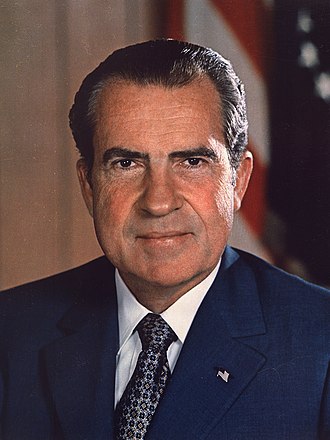
Richard M. Nixon served as the 37th President of the United States from January 1969 until his resignation in August 1974. In February 1971, he ordered the installation of a secret voice-activated taping system in the White House to preserve a historical record of his administration. Until the system's existence was revealed and dismantled in July 1973, the tapes captured Nixon directing major foreign policy initiatives, such as the opening to China, as well as his central role in the Watergate cover-up.
What Nixon talks about on the tapes
White House operations 4,718Presidential scheduling 2,225Public relations 1,784Presidential schedule 1,782Vietnam War 1,693Logistics 1,650Manolo Sanchez 1,626White House communications 1,400White House administration 1,399Presidential communication 1,243Henry Kissinger 1,191Foreign Policy 1,183
Conversations (21,010)
— Page 30 of 211President Nixon met with Charles Colson and labor leader Peter Brennan to discuss strengthening political support from construction unions, specifically regarding the administration's foreign policy and the Vietnam War. They addressed the controversy surrounding the recent publication of the Pentagon Papers and the perceived bias of mainstream media outlets. Additionally, the group reviewed domestic challenges including union frustrations with minority hiring initiatives, the management of urban issues in New York City, and the economic impact of environmental regulations on major construction projects.
President Nixon hosted photographer Oliver F. Atkins along with the Peterson family for a brief social meeting in the Oval Office. The participants engaged in informal conversation regarding the logistics of a group photograph and the presentation of presidential gifts. During the session, the President presented the family with cufflinks featuring the presidential seal and an Apollo viewer to commemorate the era's space exploration.
President Nixon met with NSC staffer Robert G. Houdek, his wife, Alexander Haig, and Ronald Ziegler to facilitate a brief farewell and photo opportunity. During the meeting, the President discussed Houdek’s transition to Princeton University for his undergraduate studies. The encounter concluded with the President presenting a gift featuring the presidential seal to Houdek's wife.
President Nixon consulted with an unknown female staff member regarding the logistical arrangements for his upcoming presidential photo opportunities. The discussion centered on changing the format of these sessions to a standing position rather than a seated one. The meeting concluded with a mutual agreement on the effectiveness of implementing this new approach for future press engagements.
President Nixon met with Lane and Elizabeth Dwinell to express his personal appreciation for Lane Dwinell's service to the administration. The brief encounter included a discussion regarding a scheduled luncheon for Mrs. Juan Velasco, to which the Dwinells were invited as part of broader diplomatic engagement. The meeting concluded with the exchange of presidential gifts and a photograph, marking the formal end of Dwinell's tenure.
President Nixon met with Master Chief Eleuterio Mendoza, his family, and Brig. Gen. James D. Hughes to recognize and commend the Chief's dedicated service at the White House. The brief social encounter included a photo opportunity, the presentation of presidential gifts, and informal conversation about the Mendoza children. The meeting served as a formal farewell and expression of appreciation for the Chief's contributions.
President Nixon hosted a brief meeting in the Oval Office with Robert J. Newbrand and his family, accompanied by Alexander P. Butterfield. The visit served as a formal gesture of appreciation for Newbrand's service dating back to 1968, as he prepared to relocate to Florida. The encounter included a commemorative photo session and the presentation of official presidential gifts to the family.
President Nixon and Stephen B. Bull met to finalize the logistics for an upcoming Congressional event scheduled in the Oval Office. They reviewed the sequence of attendees for a meet-and-greet session and coordinated the necessary protocol for the presentation of presidential gifts. The discussion served to refine the operational flow of the meeting to ensure a smooth interaction with stakeholders.
President Nixon met with Congressman Wilmer D. Mizell and the Arizona State University baseball team, coached by Bobby Winkles, to discuss their upcoming participation in the Pan American Games in Cali, Colombia. The group outlined plans to conduct baseball clinics for local youth in Colombia as a form of cultural diplomacy, a program the President agreed to support through coordination with the Department of State. During the visit, Nixon offered encouragement to the athletes and distributed presidential mementos, including cufflinks and golf balls.
President Nixon met with Congressman Roman C. Pucinski, Orlando Rivera, and Father Arthur Fagan to discuss federal education funding and the administration's policy regarding school busing. During the meeting, Nixon presented gifts to the visitors and engaged in a brief discussion about the effectiveness of current Department of Health, Education and Welfare (HEW) spending. Nixon concluded by directing his staff member Edward L. Morgan to meet with Pucinski to review the budget and address concerns about the allocation of funds toward busing initiatives.
President Nixon met with his aide Stephen B. Bull in the Oval Office to coordinate his official schedule. The discussion focused on upcoming appointments, specifically regarding a meeting with Congressman William J. Keating. Following the brief briefing, Bull concluded the meeting by departing the office.
President Nixon met with Representative William J. Keating, Herbert W. Wengler, and Richard A. Fossier to discuss the manufacturing and potential future production of commemorative medallions, including those featuring former President Lyndon B. Johnson. The participants also touched upon the administration’s progress regarding the Vietnam War and domestic unemployment rates. Nixon directed the group to coordinate further details concerning the production and presidential seal requirements with H.R. Haldeman and John Ehrlichman.
President Nixon met with Congressman Chalmers P. Wylie to discuss domestic economic policy, welfare reform, and foreign policy matters, specifically regarding the withdrawal of troops from Vietnam. The President explained his rationale for vetoing a public works bill, emphasizing the need to control federal spending and inflation while prioritizing targeted emergency employment measures. Additionally, the pair discussed economic conditions in Ohio and coordinated a potential future visit by the President to the state.
President Nixon met with Stephen B. Bull to coordinate his upcoming schedule and manage administrative logistics for an assembly of presidential appointees. The discussion specifically focused on arrangements for Frederic V. Malek and the coordination of a group photograph session. This meeting served to finalize protocols for official staff interactions and documentation within the White House.
President Nixon met with a group of administration officials and appointees, including Frederic Malek and several representatives from the Department of the Interior, for a brief introductory session. The President utilized the opportunity to express appreciation for the sacrifices made by individuals serving in government and to acknowledge the bureaucratic challenges inherent in Washington work. The meeting concluded with the exchange of presidential gifts for the attendees and their spouses.
President Nixon and Stephen B. Bull discussed the design and production of permanent commemorative plaques featuring the presidential seal for use in hotels and meeting rooms visited by the President. They deliberated on materials, such as metal on wood, and the appropriate language to designate specific "presidential suites." The President instructed Bull to formalize these installations as a standardized practice for commemorative purposes.
President Nixon and Alexander P. Butterfield met briefly in the Oval Office to coordinate administrative logistics regarding the President's schedule. The discussion focused on H.R. Haldeman’s recent interview, the potential recording of that session, and an upcoming engagement involving Harry S. Dent. The meeting served to ensure synchronization between the President and his staff regarding pending appointments and personnel matters.
President Nixon met with Alexander P. Butterfield to coordinate administrative details regarding the President’s upcoming schedule. The brief discussion centered on managing appointments and logistical arrangements for the following day. No substantive policy decisions were reached during this short logistical exchange.
President Nixon met with Rose Mary Woods, H. R. Haldeman, and Alexander Butterfield to manage presidential logistics, including scheduling, correspondence, and photography, while discussing high-level foreign policy and security concerns. The participants addressed the handling of autograph and photo requests to improve efficiency, and Nixon expressed frustration over the perceived disloyalty of NSC staff members like William Lake and Morton Halperin. Furthermore, Nixon and Haldeman coordinated strategy regarding Secretary of State William Rogers' potential Mideast diplomatic mission and the ongoing secret negotiations with China, ultimately transitioning into a discussion on the messaging and tone of the President's upcoming July 3rd Bicentennial speech.
President Nixon met with Stephen B. Bull and Alexander P. Butterfield to coordinate scheduling details regarding a forthcoming luncheon for Mrs. Juan Velasco. The discussion centered on logistics involving the First Lady and considerations related to the weather. The participants finalized the arrangements before departing together.
President Nixon met briefly with his personal valet, Manolo Sanchez, and an unidentified individual to discuss his movement between locations. The exchange was strictly logistical, primarily serving to coordinate the President's transition to a different area of the White House complex. No policy matters or significant administrative decisions were recorded during this brief transition period.
President Nixon met with his staff and advisors to coordinate logistical arrangements for his upcoming National Archives speech, focusing on timing, camera blocking, and the inclusion of the national anthem. The group also discussed planning a signing ceremony for the Twenty-sixth Amendment featuring a student group, and reviewed current media strategies regarding unemployment statistics and the ongoing Pentagon Papers controversy. Nixon emphasized maintaining a strong, authoritative public image while managing press narratives and reinforcing government discipline regarding classified information.
President Nixon held a brief, private meeting with an unidentified individual in his Old Executive Office Building workspace. The majority of this short encounter remains restricted due to the withdrawal of personal returnable material. Consequently, no substantive policy discussions, decisions, or records of the interaction are available for historical analysis.
President Nixon held a brief, unscheduled communication with the White House operator from his office in the Old Executive Office Building. While the specific substance of the exchange remains unrecorded, the interaction reflects the President's routine engagement with his administrative staff to facilitate external connectivity. No substantive policy decisions or administrative directives resulted from this brief operational interaction.
President Nixon initiates a brief telephone call to speak with the First Lady, Pat Nixon. The primary objective of the interaction is to facilitate a personal connection between the President and his wife. The conversation concludes as the operator successfully connects the President to Mrs. Nixon.
President Nixon and John K. Andrews, Jr. reviewed a draft of a forthcoming presidential speech, focusing on refining its thematic content and tone. The discussion involved editing specific phrasing, removing confusing references to a constitutional amendment, and evaluating the inclusion of a high school valedictory address anecdote. Nixon ultimately instructed Andrews to shorten sections of the text and reconsider the use of a literary reference to "John Brown’s Body" to ensure the message remained clear and impactful.
President Nixon and First Lady Pat Nixon, with input from H. R. Haldeman, discuss the success of recent White House social events, including a luncheon for Consuelo Juan Velasco and the positive reception of the President's toast. They reflect on the importance of hosting long-serving Congressional members like Representative Thomas G. Abernethy and note the aesthetic appeal of daytime gatherings in the Red Room. The conversation concludes with a discussion regarding the First Lady's potential attendance at a televised event at the National Archives, with the suggestion that Tricia Nixon Cox and Edward Cox join her.
President Richard Nixon and First Lady Pat Nixon held a brief, informal meeting in the Old Executive Office Building. The conversation primarily consisted of social pleasantries and a discussion regarding the First Lady's potential attendance at an upcoming event. No significant policy decisions were reached during this short interaction.
President Nixon consulted with an unidentified individual regarding an upcoming National Archives event involving First Lady Pat Nixon, Tricia Nixon, and Edward R.F. Cox. The discussion focused on the potential impact of the First Lady’s participation and the strategic importance of her addressing the attendees. Despite the significance placed on the event, the participants expressed doubt that the First Lady would ultimately deliver the suggested remarks.
President Nixon consulted with a White House operator to facilitate a telephonic connection. This interaction served purely administrative purposes, as the President utilized the operator to initiate communication with an unnamed third party. No substantive policy discussions or decisions were recorded during this brief logistical exchange.
President Nixon initiates a brief telephone call through the White House operator to connect with his special counsel, Charles W. Colson. The interaction serves solely as a logistical bridge to facilitate an upcoming discussion between the President and Colson. No substantive policy or political matters are addressed during this brief exchange.
President Nixon and Charles Colson discussed managing media narratives regarding positive economic and military indicators, specifically focusing on falling unemployment statistics and reduced Vietnam War casualties. The President expressed frustration with Bureau of Labor Statistics staff who characterized the positive unemployment data as a "statistical fluke" and ordered an immediate investigation to identify and potentially terminate the responsible party. Additionally, the pair strategized on securing labor support, specifically through Peter J. Brennan and organized labor groups, by prioritizing the replacement of Arthur A. Fletcher and emphasizing national security alignment.
President Nixon and Charles Colson discuss the coordination of administrative strategies and the implementation of specific reporting initiatives, potentially involving Dr. Scali. They deliberate on messaging tactics, including the necessity of planning inquiries to influence public or legislative opinion effectively. The conversation concludes with an emphasis on utilizing these refined methods to ensure the success of their objectives.
President Nixon initiates a brief request for the White House operator to place a telephone call to Charles W. Colson. The interaction serves solely as a logistical bridge to connect the President with his Special Counsel. No further substantive policy matters or tactical decisions were discussed during this short exchange.
President Nixon directed Charles Colson to relay praise from Secretary of State William Rogers to John Scali regarding their collaboration on a joint press statement. Nixon further specified that Scali should be positioned as the primary advisor for future presidential trips to boost his morale and improve press coordination. Finally, the two discussed managing media coverage of recent unemployment data, with Nixon instructing Colson to minimize the narrative of a "statistical fluke" in upcoming NBC news reports.
President Nixon held a brief administrative interaction with the White House operator while located in his Old Executive Office Building workspace. The discussion served as a logistical bridge to facilitate an additional communication, as indicated by the subsequent reference to a related conversation. No substantive policy matters were recorded during this brief operational exchange.
President Nixon and Charles Colson held a brief consultation concerning the performance and work of an individual identified as John Skelly. The discussion touched upon professional evaluations and potential future assignments or projects. The exchange concluded with an agreement to proceed with established plans despite the brief nature of the deliberation.
President Nixon spoke with the White House operator during a brief administrative interaction in his Old Executive Office Building workspace. The conversation functioned as a request for telephonic assistance, likely to facilitate an outgoing call or manage his communications. No policy decisions or substantive political discussions were recorded during this brief exchange.
President Nixon requested that the White House operator connect him to First Lady Pat Nixon. The brief interaction served as a formal bridge to facilitate a private communication between the President and his wife. No substantive policy discussions or administrative actions occurred during this connection process.
President Nixon and First Lady Pat Nixon discussed appropriate diplomatic gift exchanges for Consuelo Juan Velasco following an unexpected gift they received from her. The couple debated sending a Boehm bird and cufflinks, ultimately deciding to coordinate with Stephen B. Bull to have these items delivered via the Peruvian ambassador. They prioritized this gesture despite the State Department's classification of the interaction as a non-state visit.
President Nixon and First Lady Pat Nixon held a brief, informal meeting in the President's office to discuss personal administrative matters, specifically involving a check and a missing link or document. The conversation, which largely features unintelligible or non-English dialogue, centers on the couple attempting to clarify a personal financial or logistical task. No substantive policy decisions or political actions resulted from this brief interaction.
President Nixon initiates a brief telephone call through the White House operator to contact his personal secretary, Rose Mary Woods. The conversation serves as a routine administrative request to facilitate communication with a key staff member. No policy matters or significant executive decisions are discussed during this brief exchange.
President Nixon met in the Old Executive Office Building to dictate the formal remarks for a ceremony marking the opening of the American Revolution Bicentennial Era. This speech was prepared for delivery the following day in conjunction with Chief Justice Warren E. Burger and Speaker of the House Carl Albert. The session served to finalize the rhetoric and thematic framing for this national commemorative event.
President Nixon consulted with the White House operator to facilitate an outgoing call. This interaction served a logistical purpose, enabling the President to connect with another party to conduct official business. No substantive policy discussions or significant executive decisions were recorded during this brief exchange.
President Nixon and H.R. Haldeman discuss the preparation of a forthcoming speech draft. The brief meeting serves as a prelude to a more extensive session involving John D. Ehrlichman. The primary objective is to align strategy and refine the content for the President’s upcoming public address.
President Nixon instructed his personal secretary, Rose Mary Woods, to duplicate a rough draft of upcoming remarks intended for the following evening. He directed Woods to incorporate a specific anecdote about John Brown—previously used in a speech to the J.C.'s—to serve as the speech's conclusion. Once processed, the draft was to be forwarded to John K. Andrews, Jr. for further development.
President Richard M. Nixon met briefly with his personal secretary, Rose Mary Woods, in the Old Executive Office Building. The extremely short duration of this interaction suggests it served as a perfunctory exchange or a transition between formal appointments. No substantive policy discussions or specific administrative actions were recorded during this brief encounter.
President Nixon contacted the White House operator to request a telephone connection with John K. Andrews, Jr. The operator facilitated the request by identifying Andrews as being located within the office of speechwriter Raymond K. Price. This brief exchange served solely as an administrative bridge to initiate a subsequent conversation between the President and his staff.
President Nixon met with his personal valet, Manolo Sanchez, in the Old Executive Office Building. While the official record provides no transcript, the primary objective of this brief interaction was to record a dictation intended for the President's personal secretary, Rose Mary Woods. The meeting concluded immediately following the recording of this message.
President Nixon consulted with the White House operator regarding the presence of John Andrews in the office. The brief exchange focused on verifying Andrews's identity and location within the executive complex. No further policy decisions or significant administrative actions were recorded during this communication.
President Nixon consulted with John K. Andrews, Jr. to coordinate the final drafting and polishing of a televised speech scheduled for July 3. The President emphasized his desire to incorporate specific themes, including the declaration of the Bicentennial era and the importance of American spirit, while directing Andrews to recycle impactful phrases from previous addresses rather than seeking new material. Nixon instructed Andrews to refine a rough dictation into a 1,500-word text that maintained his personal oratorical tempo, setting a deadline for the revised draft to be ready by 9:00 p.m. that evening.
President Nixon met with staff member John K. Andrews, Jr. for a brief discussion regarding ongoing work assignments and administrative tasks. The conversation touched upon the management of various projects, the handling of written materials, and the President's personal reflections on his work. No major policy decisions were reached, as the dialogue focused primarily on procedural matters and the status of current internal projects.
President Nixon contacted the White House operator to facilitate a telephone call to First Lady Thelma C. ("Pat") Nixon. The interaction served solely as a procedural request to connect the President with his wife. No substantive political or policy discussions took place during this brief exchange.
President Nixon consulted with the White House operator to facilitate a telephone connection. The interaction served as a logistical administrative bridge to reach an external party. No substantive policy discussions or executive decisions occurred during this brief telephonic coordination.
President Nixon consulted with Pat Nixon and Tricia Nixon Cox regarding his schedule and the timing of upcoming speech drafts. The President indicated that he would be available around 9:00 p.m. once his staff completed the necessary work. The discussion also touched upon personal logistics, including Tricia's upcoming travel to New York City and a boat ride on the Sequoia.
President Nixon met with his senior advisors, John Ehrlichman and H. R. Haldeman, to discuss the ongoing political and legal fallout from the publication of the Pentagon Papers. The conversation focused on managing the administration's response, specifically coordinating congressional investigations into the leak and establishing an internal White House operation to manage security and document declassification. Beyond these legal strategies, the President reviewed administrative priorities including school desegregation funding, labor union relations, and preparations for his upcoming speech at the National Archives.
President Nixon instructed the White House operator to connect him with Congressman Gerald R. Ford for a telephone consultation. The brief exchange focused exclusively on initiating this communication, reflecting the President's effort to confer with key legislative leadership. No further substantive details regarding the purpose of the call were captured in this segment of the recording.
President Nixon instructed the White House operator to locate Congressman Gerald R. Ford, who was golfing at Burning Creek. Rather than speaking with him directly, Nixon directed the operator to inform Ford that H.R. Haldeman would contact him later to deliver a message on the President's behalf. This brief exchange served as a coordination step to facilitate communication between the White House and Ford through the President's Chief of Staff.
President Nixon instructed the White House operator to place a telephone call to William E. Timmons, then serving as the Assistant to the President for Congressional Relations. The brief exchange served as a logistical coordination to facilitate direct communication between the President and Timmons. No further policy discussions or substantive developments occurred during this connection attempt.
President Nixon consulted with William E. Timmons to assess the viability of using Representative Richard H. Ichord’s House Internal Security Committee to conduct an investigation into the Pentagon Papers. Nixon envisioned the committee using its investigative powers—including the authority to subpoena individuals like Morton Halperin and Leslie Gelb for questioning—to counter the administration's political opposition. The President instructed Timmons to gauge the interest of Ichord and Minority Leader Gerald Ford in this strategy, suggesting that such a probe would provide political benefits for ambitious committee members.
President Nixon contacted the White House operator to place an outgoing call to John K. Andrews, Jr. The President requested that the operator connect him to Andrews, who was located in Raymond K. Price, Jr.'s office. The conversation was limited to these logistical arrangements for facilitating the call.
President Nixon held a brief, two-minute meeting with a White House operator to facilitate an outgoing call. The interaction functioned primarily as a logistical exchange to connect the President with an outside party. No substantive policy discussions or major administrative decisions occurred during this brief window of communication.
President Richard Nixon met briefly with his daughter, Tricia Nixon Cox, in the Old Executive Office Building. Given the extremely short duration of the recorded interaction, no substantive policy matters or official developments were addressed. The exchange served as a personal check-in between the President and his daughter.
President Nixon consulted with the White House operator to facilitate an outgoing telephone communication. This brief interaction served administrative purposes to connect the President with an external party. No substantive policy discussions or decisions were documented during this short exchange.
President Nixon met with Alexander P. Butterfield, Rose Mary Woods, and briefly with John K. Andrews, Jr. in his Old Executive Office Building office to address internal administrative or scheduling matters. The discussion largely remained unintelligible, consisting of brief consultations with his staff before they departed. No substantive policy decisions or historical milestones were recorded during this brief administrative meeting.
President Nixon and John K. Andrews, Jr. coordinated the finalization of a rough draft for a forthcoming presidential address. The conversation focused on incorporating an anecdote about John Brown, which Rose Mary Woods was currently delivering, and refining the text's length and organization. Andrews committed to completing these revisions and presenting the updated draft to the President by 8:30 p.m.
President Nixon instructed the White House operator to place a call to Special Counsel Charles W. Colson. This communication served as a brief administrative coordination to facilitate direct contact between the President and one of his key political advisors. No further substantive discussion was recorded during this brief exchange.
President Nixon and Charles Colson discuss their extreme dissatisfaction with the handling of recent unemployment figures and the subsequent negative media coverage. Nixon demands accountability for the problematic press releases, specifically ordering that officials Geoffrey H. Moore and Harold Goldstein be subjected to polygraph tests. He makes it clear that if these individuals are found responsible for the unfavorable framing of the economic data, they must be terminated immediately.
President Nixon instructed the White House operator to place an outgoing call to Charles W. Colson. This brief administrative exchange served as the necessary bridge to facilitate a direct consultation between the President and his Special Counsel. The conversation concluded once the connection process was initiated.
President Nixon directs Charles Colson to initiate polygraph examinations for Department of Labor officials, specifically targeting Harold Goldstein, regarding unauthorized comments labeling recent unemployment figures a "statistical fluke." Nixon expresses extreme frustration with the perceived lack of resolve from George Shultz and James Hodgson in addressing internal leaks, viewing the incident as a test of his administration's authority. He mandates that any employee refusing the test or failing to pass it must be terminated immediately to ensure control over the bureaucracy.
President Richard Nixon met with his personal secretary, Rose Mary Woods, in the Old Executive Office Building to review and manage his personal schedule. The discussion focused on coordinating upcoming appointments and administrative logistics essential to the President's workflow. This brief meeting served to facilitate executive time management and prioritize the President's immediate agenda.
President Nixon met with John K. Andrews, Jr. to coordinate preparations for an upcoming presidential address at the National Archives. The discussion focused on refining the speech's length, evaluating various draft versions, and perfecting the specific language to be used. The two men worked to ensure the content met the President’s standards before the event concluded.
President Nixon initiates a call through the White House operator to contact special counsel Charles W. Colson. This brief interaction serves as the administrative bridge to connect the President with his aide for a subsequent conversation. No substantive policy discussions occur during this exchange as the operator facilitates the requested connection.
President Nixon held a brief morning meeting with an unidentified individual in the Oval Office. The participants engaged in an inconclusive exchange regarding the presence of security or safety personnel at the location. No significant policy decisions or further actions were recorded during this brief interaction.
President Nixon speaks with the White House operator to coordinate the arrival of Charles W. Colson and George P. Shultz at the Oval Office. The brief exchange confirms the President's awareness of their upcoming visit and authorizes their entry. This short logistical communication facilitates an immediate staff meeting with two key administration officials.
President Nixon directed the White House operator to place a call to Congressman Harold D. Donohue. The President specified that Donohue was currently a patient at Massachusetts General Hospital in Boston. This brief exchange served to facilitate direct communication between the President and the Congressman.
President Nixon directs the White House operator to place three outgoing telephone calls. The requested recipients are Wellington T. Mara of the New York Giants, Frank C. Carlucci of the Office of Economic Opportunity, and John W. Mulcahy, Jr. Nixon provides specific instructions to ensure the operator contacts the younger Mulcahy rather than his father.
President Nixon initiated a brief communication with the White House operator to facilitate an outgoing call. This interaction served as a logistical step to connect the President with another party, though the specific recipient of the call remains unrecorded. No substantive policy discussions or major decisions occurred during this brief exchange.
President Nixon consulted with the White House operator to facilitate an outgoing call. This brief interaction served as a standard administrative precursor to the President's telephonic communications. No policy matters or significant political developments were addressed during this exchange.
President Nixon met with Charles Colson, George Shultz, and James Hodgson to discuss concerns over recent unemployment statistics released by the Bureau of Labor Statistics (BLS). Nixon expressed frustration with the BLS leadership, specifically targeting Assistant Commissioner Harold Goldstein and Commissioner Geoffrey Moore for their perceived lack of loyalty to the administration and their mishandling of reports. The group discussed plans to force a reorganization of the BLS to gain greater control over the reporting process, as well as the eventual replacement of Moore with a more reliable figure.
President Nixon contacted the intensive care unit at Massachusetts General Hospital to relay get-well wishes to Congressman Harold D. Donohue. During the brief call with the nurse in charge, Nixon reflected on his long-standing personal history with Donohue, noting their shared service in the U.S. Navy during World War II and their subsequent tenure together in Congress. The call served as a personal gesture of concern for a political colleague and old friend undergoing medical treatment.
President Nixon instructed the White House operator to facilitate a telephone connection with Carroll Donahue, who was located at Massachusetts General Hospital in Boston. The brief exchange was conducted solely to establish this specific communication link. No further substantive policy matters or political discussions were recorded during this interaction.
President Nixon instructed the White House operator to place several outgoing calls to specific individuals, including New York Giants president Wellington Mara, Frank Carlucci, and John W. Mulcahy. The primary purpose of this interaction was to facilitate communication with these figures by verifying contact information. No further policy or administrative decisions were reached during this brief exchange.
President Nixon contacted the nurse in charge of the Intensive Care Unit at Massachusetts General Hospital to inquire about the medical status of an old friend and former congressional colleague. The President reminisced briefly about their shared history serving in the Navy during World War II and their time in Congress together. He concluded the brief call by requesting that the nurse pass along his best wishes for the patient's recovery.
President Nixon instructed his personal secretary, Rose Mary Woods, to arrange a meeting with H.R. Haldeman and Charles Colson once they arrived at the White House. The President clarified that he had been occupied with other matters and emphasized that there was no urgency for them to be contacted at home. The call served to coordinate the President's schedule and manage the expectations of his key advisors.
President Nixon and his personal secretary, Rose Mary Woods, briefly coordinated the administrative handling and routing of incoming materials or personnel. The discussion centered on ensuring that specific arrivals were properly directed to the Coastal office for processing. This short exchange served to align their schedules and communication regarding ongoing logistical matters.
President Nixon consulted with the White House operator to facilitate a call to Frank C. Carlucci, who was currently located in California. After discussing the three-hour time difference between the coasts, the President decided to postpone the communication until a more appropriate time. No substantive policy matters were addressed during this brief logistical coordination.
President Nixon held a brief, informal session with an unidentified individual to coordinate future communication arrangements. The conversation focused on the logistics of placing a personal telephone call at a later time. No significant policy developments or substantive political matters were addressed during this brief exchange.
President Nixon and Charles Colson discuss methods to exert tighter control over executive branch messaging, specifically regarding unemployment figures from the Bureau of Labor Statistics and the public narrative surrounding the Pentagon Papers. The President emphasizes his constitutional obligation to enforce the law and protect national security, proposing a forceful public statement that prioritizes the lives of American servicemen and POWs over the sensationalism of the press. Additionally, they evaluate the political landscape for the 1972 election, focusing on building a coalition of labor union support and successfully managing negative press portrayals.
President Nixon called John W. Mulcahy, Jr. to personally extend his best wishes on the occasion of Mulcahy’s wedding to Elizabeth Shea. The conversation served as a gesture of personal goodwill, with the President drawing parallels to his daughter Tricia’s recent wedding and reflecting on his close relationship with the Mulcahy family. Nixon also took a moment to commend Mulcahy's professional service and offered his well wishes for the couple's upcoming honeymoon.
President Nixon held a brief, one-minute meeting with an unidentified individual, during which they discussed the scheduling of Charles W. Colson. Due to the extremely short duration and the lack of a substantial transcript, no further policy developments or complex topics were recorded. The conversation concluded with the departure of the visitor before the minute ended.
President Nixon initiated a brief, informal telephone call to the residence of Wellington T. Mara to offer personal congratulations on the birth of his tenth child. After being informed by the White House operator that Mara was unavailable, the President spoke with Mara's daughter, Susan, to convey his well-wishes to the family. The conversation concluded with lighthearted commentary regarding the family's gender balance and a brief exchange concerning the President's support for both the New York Giants and the Washington Redskins.
President Nixon placed a brief congratulatory call to Susan Mara regarding the recent birth of her family's tenth child. During the conversation, the President inquired about the gender balance of the children and jokingly encouraged the parents to have an eleventh child to complete a full football team. The exchange concluded with lighthearted banter regarding the President's preference for the Washington Redskins over the New York Giants.
President Nixon met with his aide Stephen B. Bull to coordinate upcoming appointments and manage the executive schedule. The discussion focused on finalizing the briefing sequence for General Alexander M. Haig, Jr. prior to the President’s scheduled speech. The meeting concluded quickly, ensuring the President remained on schedule for his high-level diplomatic and administrative obligations.
President Nixon met with General Alexander Haig to discuss the status of diplomatic initiatives, including the upcoming Middle East policy and potential summit meetings with Soviet and Chinese leaders. They addressed the necessity of coordinating foreign policy messages to manage congressional and public perceptions while avoiding premature escalations in the Middle East. Following Haig's departure, Nixon worked with John K. Andrews, Jr. to revise an upcoming speech for the National Archives, focusing on refining themes of American national identity, the value of patriotism, and the importance of emphasizing the country's virtues.
President Nixon and H. R. Haldeman convened in the Oval Office to coordinate the President's upcoming schedule. The discussion focused on managing the President's availability for requested meetings. No specific substantive policy decisions were reached during this brief administrative exchange.
President Nixon and H.R. Haldeman met to discuss various personnel matters, the President's upcoming National Archives speech, and the ongoing controversy surrounding the Pentagon Papers. During their conversation, Nixon expressed strong bias regarding the loyalty of Jewish employees in the federal bureaucracy and questioned their placement in sensitive roles. The President and Haldeman further analyzed the political risks of the Pentagon Papers case, considering whether to make a public statement or allow the situation to cool, while debating the efficacy of conducting public opinion polling over the holiday weekend.
President Nixon and H. R. Haldeman coordinate the staging and visual presentation of an upcoming public event, specifically focusing on the President’s demeanor during the playing of the national anthem. They determine that the President and others should stand at attention and salute without singing to maintain appropriate decorum. Additionally, Nixon briefly tasks Haldeman with drafting a letter to address a personal administrative matter.
President Nixon and his advisors, including H. R. Haldeman and Alexander Haig, met to refine the President's upcoming speech for the Bicentennial celebrations. They focused on trimming the text to fit a 12-minute delivery, adjusting the tone to emphasize American idealism, and finalizing strategies for the presentation, including the decision to withhold the written text from the press. Additionally, the group discussed potential public relations benefits from the speech, such as the future renaming of Air Force One to the "Spirit of '76."
President Nixon and H. R. Haldeman briefly conferred regarding the editing of a specific document or transcript. They confirmed that a reduction of 105 words had been successfully implemented. This exchange served to finalize the word count adjustment for the material in question.