Nixon, Richard M. (President)
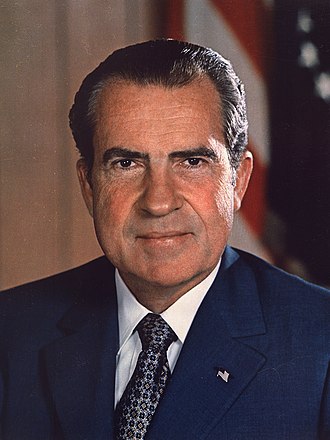
Richard M. Nixon served as the 37th President of the United States from January 1969 until his resignation in August 1974. In February 1971, he ordered the installation of a secret voice-activated taping system in the White House to preserve a historical record of his administration. Until the system's existence was revealed and dismantled in July 1973, the tapes captured Nixon directing major foreign policy initiatives, such as the opening to China, as well as his central role in the Watergate cover-up.
What Nixon talks about on the tapes
White House operations 4,718Presidential scheduling 2,225Public relations 1,784Presidential schedule 1,782Vietnam War 1,693Logistics 1,650Manolo Sanchez 1,626White House communications 1,400White House administration 1,399Presidential communication 1,243Henry Kissinger 1,191Foreign Policy 1,183
Conversations (21,010)
— Page 53 of 211President Nixon and John Ehrlichman discussed political strategies regarding the issue of school busing, evaluating the potential for a constitutional amendment to leverage political advantage against rivals like Edward Kennedy, Edmund Muskie, and Henry Jackson. Nixon emphasized the importance of aligning with the powerful education lobby and explored linking busing to broader education policies, including aid to parochial schools. The pair aimed to capitalize on the busing controversy as a significant electoral issue by appealing to specific interest groups.
President Nixon and H. R. Haldeman met to coordinate upcoming scheduling logistics for the President’s agenda. The discussion focused on finalizing the timeline for meetings on October 21, specifically addressing the arrangement of a session involving Nobusuke Kishi and Henry Kearns. The pair prioritized determining the preferred location and duration for these appointments to ensure the President's calendar was efficiently organized.
President Nixon met with Alexander Butterfield and H.R. Haldeman to handle administrative tasks, including the signing of a photograph for John R. Brown, III. The group primarily focused on planning a forthcoming White House dinner for Nobusuke Kishi, specifically debating guest list capacity in the family dining room. Nixon ultimately directed that the guest list be reduced to ensure a more intimate setting and instructed his staff to finalize the invitees for the Japanese delegation.
President Nixon and his valet, Manolo Sanchez, discuss the behavior of King Timahoe, the President's Irish Setter. Nixon reports that the dog has been barking at him near the Executive Office Building. The brief interaction concludes with the President instructing Sanchez to bring the dog over to him.
President Nixon and Attorney General John Mitchell discuss political strategies and upcoming Supreme Court nominations. They express frustration with Senator Edward M. Kennedy's criticism of the administration, agreeing that his rhetoric has been damaging to his own political standing. The conversation focuses on securing candidates for the Supreme Court, with Nixon pushing for a swift resolution from Howard Baker while evaluating the political optics of potential nominees William French Smith and William H. Mulligan.
President Nixon and Attorney General John Mitchell discuss potential candidates for upcoming Supreme Court vacancies, weighing the political implications and qualifications of various prospects. The conversation centers on navigating the vetting process for nominees like Powell, Rehnquist, and others, while specifically debating the optics of appointing corporate lawyers versus academic figures. Nixon emphasizes the importance of strategic appointments to balance legal expertise with political viability.
President Nixon initiates a brief telephone request for the White House operator to connect him with Richard A. Moore. This interaction serves as a functional administrative step to facilitate a subsequent conversation with Moore. No substantive policy discussions or decisions occurred during this brief exchange.
President Nixon consulted with the White House operator to facilitate a telephone connection with Richard A. Moore. The brief interaction focused solely on identifying the correct contact information for Moore, referred to as Dick or Billy Richard Moore. The exchange served as a logistical step to initiate this specific communication.
President Nixon initiates a brief telephone call to Richard A. Moore to coordinate a meeting. The President requests that Moore immediately relocate from the Executive Office Building to the Oval Office for an in-person discussion. No policy matters or substantive political issues are addressed during this brief logistical exchange.
President Nixon and Richard A. Moore held a brief, informal exchange to coordinate a subsequent meeting. Nixon requested that Moore come to his office in the Old Executive Office Building for further discussion. This interaction served primarily as a logistical arrangement to facilitate a more substantive conversation.
President Nixon initiates a brief telephone request to the White House operator to be connected with Attorney General John N. Mitchell. The call serves as an administrative bridge to facilitate direct communication between the President and the head of the Department of Justice. No further dialogue or policy discussion is captured in this brief exchange.
President Nixon met with his valet, Manolo Sanchez, to discuss the whereabouts and management of the President's Irish Setter, King Timahoe. During the brief interaction, Nixon provided specific instructions for Sanchez to keep a door open to allow the dog to remain nearby. The exchange reflects the informal nature of their personal interactions regarding the President's pet.
President Nixon met with Richard Moore, John Mitchell, and Alexander Butterfield to discuss the selection process for upcoming Supreme Court vacancies. Nixon expressed frustration with the American Bar Association's influence and affirmed his intention to bypass them to avoid leaks and public criticism of his nominees' ideologies. The group evaluated several candidates, including Lewis Powell, Howard Baker, William Rehnquist, and William French Smith, ultimately favoring a strategy to nominate highly qualified conservatives to preempt opposition. Additionally, the President discussed concerns regarding negative press coverage of his personal finances involving Charles Rebozo and strategized on managing political messaging regarding the Vietnam War and POW issues.
President Nixon and John Mitchell discuss potential Supreme Court nominees, confirming Lewis F. Powell, Jr.'s acceptance and weighing the qualifications and political implications of appointing William H. Rehnquist and Howard H. Baker, Jr. The two men deliberate on the strategic timing of public announcements and the management of the American Bar Association committee's review process. Throughout the discussion, they evaluate the professional reputation and perceived political benefits of their candidates, while briefly joking about Rehnquist’s religious background.
President Nixon and Attorney General John N. Mitchell discuss the selection process for upcoming Supreme Court appointments. The conversation centers on evaluating potential candidates, including Lewis F. Powell, Jr., William H. Rehnquist, and Howard H. Baker, Jr., while addressing concerns regarding American Bar Association (ABA) feedback. They also coordinate the timing and strategy for public announcements and potential press statements regarding these judicial nominations.
President Nixon and Press Secretary Ronald Ziegler strategized on how to manage media speculation regarding the upcoming nomination of two Supreme Court candidates, Herschel H. Friday and Mildred L. Lillie. Nixon instructed Ziegler to maintain a vague public posture to keep the press guessing about the timing of the announcement while protecting his own credibility. They agreed that Ziegler would deflect inquiries by stating that the President had not yet made a final decision, citing the pending American Bar Association report as the primary reason for the delay.
President Nixon met with his personal valet, Manolo Sanchez, in the Old Executive Office Building. The brief interaction, lasting less than ten minutes, primarily involved personal matters rather than substantive policy discussions. The meeting concluded without any recorded administrative decisions or significant political developments.
President Nixon and an unknown associate met to discuss strategy regarding pending Supreme Court nominations. The conversation focused on the timing for announcing these judicial appointments and addressed the American Bar Association's evaluation of Mildred L. Lillie. No definitive consensus or final action plan was established during the brief exchange.
President Nixon and John Mitchell coordinate the final strategy for upcoming Supreme Court nominations, specifically discussing candidates Lewis F. Powell, Jr., Howard H. Baker, Jr., and William H. Rehnquist. Mitchell briefs the President on the American Bar Association’s negative evaluations of other potential nominees, prompting Nixon to decide to publicly challenge the ABA's influence. Nixon directs Mitchell to finalize the selection of either Baker or Rehnquist to pair with Powell, and concludes that he will make a primetime televised announcement the following evening to control the narrative.
President Nixon and John Mitchell discussed the final selection process for upcoming Supreme Court nominations, specifically weighing the qualifications of potential candidates Howard Baker, Lewis Powell, and William Rehnquist. Nixon expressed frustration with the deliberative pace and instructed Mitchell to prepare strong, positive statements for the chosen nominees. The President decided to finalize and announce his selections the following evening to preempt leaks and control the narrative surrounding the appointments.
President Nixon initiated a series of telephone calls through the White House operator, primarily attempting to reach Attorney General John N. Mitchell. The brief sequence of exchanges also included administrative interactions with Ronald L. Ziegler and unidentified personnel. These communications reflect the President's ongoing coordination with high-level cabinet members and staff during this period.
President Nixon and H. R. Haldeman coordinate the final logistics for announcing two pending Supreme Court nominations. The President decides to bypass a full prime-time television address, opting instead for a 7:00 p.m. announcement the following evening. This decision finalized the timing for a sensitive political maneuver intended to manage the public reveal of his judicial selections.
President Nixon consulted with Press Secretary Ronald Ziegler and Attorney General John Mitchell to strategically manage the media coverage and timing of his upcoming Supreme Court nominations. Nixon decided to delay his public announcement until the following evening to create media confusion and effectively control the narrative. The participants also discussed the necessity of withholding information from the American Bar Association and coordinated messaging regarding the President's upcoming schedule, including a Veterans Day speech and price control initiatives.
President Nixon consulted with Attorney General John Mitchell regarding the strategic timing of an upcoming Supreme Court appointment announcement. Nixon instructed Mitchell to coordinate the release to coincide with prime-time network coverage, while issuing an ultimatum to a candidate who had not yet arrived in Washington. Additionally, Nixon directed Mitchell to compile favorable background dossiers emphasizing the academic credentials of potential nominees to ensure a strong public presentation.
President Nixon initiates a call to his aide, Richard A. Moore, through the White House operator. The primary purpose of this brief communication is to facilitate a direct line of contact with Moore. No further policy or strategic discussion occurs during this short exchange.
President Nixon consulted with the White House operator to facilitate a telephone connection with Richard A. Moore. The interaction served as a logistical step to initiate communication with Moore, a key legal aide and advisor to the administration. No further substantive policy discussions occurred during this brief request for assistance.
President Richard Nixon met briefly with his personal valet, Manolo Sanchez, to coordinate evening arrangements. The pair discussed the President's upcoming dinner schedule and confirmed a timing of 6:30 p.m. Additionally, Nixon requested that Sanchez prepare a scotch and soda.
President Nixon and Richard A. Moore discuss the political fallout from the American Bar Association (ABA) rating Mildred L. Lillie as unqualified for the Supreme Court, with plans to leak the ABA's contradictory acknowledgment that she was nonetheless the best-qualified woman available. The President also seeks confirmation of John Ehrlichman’s support for William H. Rehnquist as a potential fallback candidate should Howard H. Baker, Jr. decline the nomination. Nixon expresses a clear intention to bypass the ABA's approval process for the Rehnquist appointment.
President Nixon and Richard A. Moore discuss the status of potential judicial nominees for the Supreme Court, specifically weighing the qualifications of candidates like Mildred Lillie. Nixon expresses frustration over opposition to certain nominees and identifies Senator Howard Baker as a top contingency choice if his primary preferences do not move forward. The brief meeting concludes with Nixon instructing Moore to conduct further vetting on the suitability of specific candidates.
The White House operator facilitated a brief telephone call between President Nixon and H.R. Haldeman. The exchange served as a routine administrative connection to initiate a conversation between the two men. No substantive policy matters or specific decisions were discussed during this initial contact phase.
President Nixon directed H. R. Haldeman to reschedule a meeting with George H. W. Bush to accommodate preparation time for an upcoming public announcement. The President needed to finalize remarks regarding a pending Supreme Court nomination. Haldeman agreed to move the appointment to Friday to ensure the President had sufficient time for his statement.
President Nixon and H. R. Haldeman held a brief meeting to address a specific logistical or personal matter involving the landscaping of White House grounds. The discussion centered on instructions to replace a bush, reflecting the President's personal attention to the exterior aesthetics of the Executive Office Building. No broader policy or administrative developments were recorded during this exchange.
President Nixon contacted the White House operator to facilitate a telephone call to Raymond K. Price, Jr. This brief administrative interaction served as a logistical step to initiate a conversation with one of the President’s key speechwriters. No substantive policy matters were discussed during this brief exchange.
President Nixon and H. R. Haldeman met briefly to adjust the President's upcoming schedule, specifically focusing on rescheduling a meeting with George H. W. Bush. The pair also coordinated logistical arrangements for a forthcoming White House dinner. The brief discussion concluded with an agreement on the necessity for Bush to fulfill other professional obligations before meeting with the President.
President Nixon consulted with speechwriter Raymond K. Price, Jr. regarding a draft composed by Richard K. Cook. Nixon expressed approval of the speech's overall quality but directed Price to have the draft revised to remove references to the current conflict as potentially the "last war." The President worried that characterizing the era as the "last generation of veterans" created expectations of lasting peace that could be perceived as false hope, and he requested that the rhetoric be tempered to avoid such vulnerability.
President Nixon initiates a brief communication with the White House operator to request a telephone connection with his speechwriter, Raymond K. Price, Jr. The interaction serves as a functional bridge to facilitate a subsequent discussion with a key member of the President's staff. No further policy-related deliberation occurs during this brief administrative exchange.
President Nixon consults with speechwriter Raymond K. Price, Jr. regarding the tone and content of a draft document or speech. The discussion centers on tempering overly idealistic rhetoric concerning war and peace to avoid creating unrealistic public expectations. They reach a consensus to remove specific passages that the President deems too extreme for the current political climate.
President Nixon initiates a request to speak with Attorney General John N. Mitchell through the White House operator. This brief interaction serves as a routine administrative coordination to facilitate direct communication between the President and the Department of Justice. No further substantive policy matters were discussed during this specific connection.
President Nixon and H. R. Haldeman discussed the strategic communication and drafting process for the upcoming announcement of Supreme Court nominees. Nixon emphasized the necessity of employing a skilled writer, specifically mentioning William L. Safire, to ensure the speech is effectively crafted for public delivery. The conversation focused on the importance of selecting the right tone and reporter-like precision to articulate the appointments clearly.
President Nixon consulted with the White House operator to facilitate an urgent communication with Attorney General John N. Mitchell. The brief exchange focused primarily on establishing this telephone connection. No other substantive policy or political matters were addressed during this interaction.
President Nixon and John Mitchell discuss political messaging and strategic communications regarding upcoming remarks, specifically concerning the vetting or qualification of a female appointee. The conversation reflects concerns over potential information leaks and the potential political fallout from public statements. The two agree on the need for caution, ultimately deciding to hold off on addressing certain controversial topics until the following morning.
President Nixon and Attorney General John Mitchell discuss strategy for upcoming Supreme Court nominations, focusing on managing political fallout and public perception. They evaluate potential candidates like Lewis F. Powell, Jr. and address the ABA's negative reception toward Herschel Friday due to civil rights concerns. To ensure a controlled rollout, Nixon plans to utilize William Safire to draft his announcement remarks only hours before the official disclosure to prevent premature leaks.
President Nixon and Attorney General John Mitchell discuss the ongoing process of selecting Supreme Court nominees, focusing specifically on the potential candidacy of Howard H. Baker, Jr. The two men deliberate over Baker's willingness to accept an appointment and the necessity of resolving his outstanding financial disclosures. They conclude by noting that if Baker declines the offer, they will pivot to William H. Rehnquist as a primary alternative.
President Nixon met with Patrick J. Buchanan to prepare for the announcement of his upcoming Supreme Court nominations. The discussion focused on the desired judicial philosophy of potential appointees, specifically emphasizing the balance between the rights of society and the rights of the accused. The pair also reviewed a broader news summary covering international affairs and economic indicators, including the Nobel Peace Prize and stock market trends.
President Nixon met with his personal aide, Manolo Sanchez, in the Old Executive Office Building to conduct private business. The nature of their discussion remains classified as a withdrawn item due to its personal nature. Consequently, no specific policy decisions or administrative actions are recorded for this brief interaction.
President Nixon held a brief, informal discussion with an unidentified individual regarding administrative or procedural concerns. The dialogue focused on the timing and status of specific notifications or scheduled updates. The conversation concluded without any clear policy decisions or significant developments documented in the transcript.
President Nixon and H. R. Haldeman coordinated the logistics and communications strategy for the President's upcoming public announcement regarding his Supreme Court nominees. They discussed the involvement of various staff members, including Richard A. Moore and John Mitchell, and weighed concerns regarding public perception, the American Bar Association, and the impact of the announcement on the stock market. Additionally, the pair touched upon social matters involving the Kennedy family and potential press coverage of White House events, as well as the President’s upcoming schedule.
President Nixon utilized time in his Executive Office Building suite to refine and rehearse a forthcoming address. He recorded his practice remarks, reviewing the delivery and content to ensure the speech was prepared for final broadcast. This session focused on polishing the rhetoric intended for a national audience regarding significant policy decisions.
President Nixon and H. R. Haldeman discussed strategy regarding upcoming Supreme Court nominations, specifically focusing on managing the vetting process and the influence of the American Bar Association (ABA). The President emphasized the need for strict confidentiality, instructing staff to avoid leaks and to withhold information from the press, including directives for Ronald Ziegler to remain noncommittal regarding potential nominees. They also addressed the necessity of compiling detailed biographical data on candidates while asserting the administration's intention to proceed with appointments regardless of ABA approval.
President Nixon received a brief notification from the White House operator regarding an incoming telephone call from Attorney General John N. Mitchell. The exchange served as a logistical connection to facilitate immediate communication between the President and the Attorney General. No substantive policy discussions occurred during this initial contact.
President Nixon and John Mitchell discuss the strategy for upcoming Supreme Court appointments, specifically weighing the candidacy of Senator Howard H. Baker, Jr. against William H. Rehnquist. Nixon expresses significant concern regarding Baker’s academic credentials and insists on verifying his law school record before making a final commitment. Ultimately, they decide to decline Baker for the current vacancy based on political considerations and the strength of Rehnquist’s superior academic record, while leaving the door open for Baker’s future appointment.
President Richard M. Nixon and Attorney General John N. Mitchell engaged in a brief meeting to discuss the status and management of specific White House recordings. The conversation primarily concerns the importance of securing and reviewing these records to determine their potential implications or utility. No definitive administrative action was finalized during this brief exchange.
President Richard Nixon met in his Old Executive Office Building office to rehearse a forthcoming speech. The session focused on the President's delivery and the refinement of his public address. The final version of these remarks was subsequently published in the 1971 Public Papers of the Presidents.
President Nixon consulted with John N. Mitchell regarding the selection and public announcement of new Supreme Court nominees. The discussion focused on coordinating the nomination of William H. Rehnquist and Lewis F. Powell, Jr. while managing potential political fallout and vetting concerns from the American Bar Association. Mitchell was tasked with leveraging key congressional contacts to facilitate the process and handle media inquiries surrounding the candidates.
President Nixon and John Mitchell discuss the finalization and strategic rollout of two forthcoming Supreme Court appointments. Nixon emphasizes maintaining strict confidentiality—excluding even top staff—until a coordinated notification process begins to inform key Congressional leaders. They finalize communication plans, including how to address potential opposition from the American Bar Association and how to manage the media narrative surrounding the nominees, William Rehnquist and Lewis F. Powell, Jr.
President Nixon and John Mitchell conferred to coordinate strategy regarding upcoming personnel appointments and communications with key political figures, including Robert Byrd and John Connally. The discussion focused on managing the public rollout of these nominations and ensuring staff discretion to avoid premature leaks. Nixon emphasized the necessity of finalizing these details promptly to maintain control over the political narrative.
President Nixon initiates a brief telephone exchange with the White House operator to request a connection to his personal secretary, Rose Mary Woods. The conversation serves strictly as a logistical request for administrative assistance. No further policy or substantive matters are addressed during this interaction.
President Nixon contacted the White House operator to place an outgoing call to his personal secretary, Rose Mary Woods. The conversation served as a routine administrative request to facilitate communication with a key staff member. No further policy or substantive matters were addressed during this brief exchange.
President Nixon met to rehearse a public speech, focusing on the role of government, constitutional responsibilities, and public service. During the session, he reflected on the philosophical foundations of governance and the importance of leadership integrity. The session served as a final preparation for a televised address regarding the administration's policy objectives.
President Nixon and H. R. Haldeman met to coordinate White House administrative matters and media strategy. The discussion touched upon the scheduling of the President, interactions with the Attorney General, and potential outreach involving the American Bar Association. The two assessed the status of ongoing preparations to ensure that current executive initiatives remained on track.
President Nixon utilized time in his Executive Office Building office to conduct a private rehearsal of an upcoming public address. The session focused on refining the rhetoric and delivery of the speech to ensure clarity and effective messaging for the intended national audience. This preparation was finalized for the official broadcast subsequently recorded in the Public Papers of the Presidents.
President Nixon and Patrick J. Buchanan conferred briefly regarding the search for a specific quotation attributed to journalist Walter Lippmann. The discussion touched upon material appearing in Newsweek and the potential for a direct telephone inquiry to Lippmann to clarify the statement. The meeting concluded with an agreement to proceed with efforts to verify the citation.
President Nixon met with H. R. Haldeman and Ronald Ziegler to coordinate the public relations strategy and press messaging regarding his forthcoming Supreme Court nominations. The discussion focused on managing the American Bar Association’s (ABA) role and its reported leaks regarding potential candidates like Mildred L. Lillie and Herschel H. Friday. Nixon explicitly instructed Ziegler to maintain a position of ignorance regarding the specific nominees during press briefings and emphasized that Richard A. Moore should handle the primary communication strategy for the announcement.
President Nixon met with his valet, Manolo Sanchez, in the Old Executive Office Building for a brief, private encounter. Given the absence of a transcript and the immediate withdrawal of the recording content for personal reasons, the discussion remains historically inaccessible. No substantive policy matters or administrative decisions were documented as a result of this brief engagement.
President Nixon utilized this session to dictate notes intended for a formal speech regarding his upcoming nominations for the Supreme Court. The President specifically focused on incorporating perspectives or commentary from journalist Walter Lippmann into the draft. This process served as a preparatory step in shaping the administration's public messaging strategy for the judicial appointments.
President Nixon and H. R. Haldeman met to coordinate specific research data for an upcoming presidential address. The discussion centered on compiling statistics regarding the years of active law practice for various Supreme Court Justices. Haldeman received instructions to formalize this data to support the content of the President’s speech.
President Nixon met with his personal valet, Manolo Sanchez, to dictate notes regarding potential Supreme Court nominees. The discussion also involved coordination with Rose Mary Woods concerning these materials. The primary purpose of the meeting was to manage administrative tasks related to the judicial selection process.
President Nixon met with Stephen B. Bull in the Old Executive Office Building to discuss administrative or logistical matters. The discussion remained brief and primarily centered on the handling of internal communications or documentation. No major policy decisions were reached during this short interaction before Bull departed.
President Nixon held this meeting to deliberate on and rehearse the rhetoric for an upcoming public speech regarding judicial appointments. The discussion centers on the selection of conservative candidates for the Supreme Court, specifically mentioning Lewis Powell, and the necessity of balancing societal rights with constitutional frameworks. Nixon focuses on ensuring his nominees possess the judicial philosophy and character required to uphold the integrity of the government.
President Nixon initiates a brief communication through the White House operator to facilitate an external telephone connection. This interaction serves as a routine administrative request to reach a specific, unnamed party. The conversation concludes with the operator proceeding to connect the President to the desired individual.
President Nixon met with an unknown individual in the Old Executive Office Building to review logistical arrangements concerning Manolo Sanchez. The discussion centered specifically on the scheduling and operational planning for Sanchez, who served as a personal aide to the President. No further policy decisions were recorded during this brief encounter.
President Nixon communicated with a White House operator to facilitate an outgoing call. The interaction primarily served to manage telecommunications logistics for the President's official business. No substantive policy matters or administrative decisions were documented during this brief exchange.
President Nixon contacted his personal secretary, Rose Mary Woods, to address a technical issue with a malfunctioning buzzer in her Old Executive Office Building (OEOB) workspace. Beyond the maintenance request, Nixon directed Woods to transcribe a rough draft of a speech he recorded on tape. He explicitly commanded that the material remain strictly confidential and prohibited Woods from sharing or showing the tape to anyone without his express authorization, citing concerns about unauthorized access by staff members.
President Nixon and his personal secretary, Rose Mary Woods, engaged in a brief, non-substantive exchange regarding unresolved technical or administrative issues. The dialogue reflects frustration over a lingering operational failure that had persisted for two days. No specific policy decisions were reached, as the conversation focused on the inability to effectively address or troubleshoot the ongoing matter.
President Nixon initiates a call to Secretary of the Treasury John B. Connally through the White House operator. The conversation serves as a brief administrative bridge intended to facilitate direct communication between the President and his Treasury Secretary. No substantive policy discussions occur during this specific interaction as it functions primarily as a connection request.
President Nixon attempted to initiate a telephone conversation with Secretary of the Treasury John B. Connally. Upon learning that Connally was unavailable, the President coordinated with the White House operator to manage the timing of the call. Ultimately, Nixon decided to delay the conversation for approximately one hour due to his own impending schedule, explicitly instructing the operator not to rush the Secretary.
President Nixon met with an unidentified individual in the Old Executive Office Building for a brief exchange. The recording contains segments in Welsh, including repeated phrases regarding a lack of work, which do not correspond to standard administrative proceedings or substantive policy discussions. Due to the presence of withdrawn material and the cryptic nature of the transcript, no official business or policy decisions can be verified from this interaction.
President Nixon consulted with the White House operator to facilitate a telephone connection. The primary purpose of the brief interaction was to place a call to Secretary of the Treasury John B. Connally. No other substantive policy discussions were recorded during this exchange.
President Nixon met with H.R. Haldeman, John B. Connally, and Ronald L. Ziegler to coordinate administrative messaging and manage political strategy. The discussion focused on the selection process for Pay Board appointments, the public relations strategy regarding Supreme Court nominations, and the management of media coverage and polling data. The President emphasized his desire to control the narrative regarding his administration's accomplishments and addressed internal concerns regarding the performance of his cabinet members and staff.
President Nixon and Secretary of the Treasury John Connally discussed ongoing economic developments, including the stock market and upcoming testimony before Congress. They coordinated their strategy for dealing with Japanese officials regarding trade policy and surcharges, with Nixon designating Connally as his primary representative for these discussions. Finally, they expressed frustration with the American Bar Association’s rejection of judicial nominees, with Nixon planning to challenge the ABA's influence and proceed with his own appointments.
President Nixon initiates a brief request for the White House operator to connect him with his personal secretary, Rose Mary Woods. This administrative exchange serves the primary purpose of facilitating internal presidential communication. No substantive policy discussions or decisions are recorded during this short connection.
President Nixon and H. R. Haldeman discussed the efficiency and logistics of scheduling diplomatic credential presentations. Nixon expressed frustration regarding the excessive time currently allocated to these meetings, which included extended conversations with the diplomats. He instructed Haldeman to streamline future sessions by limiting them strictly to photo opportunities to conserve his official schedule.
President Nixon met with his aide, Stephen B. Bull, for a brief administrative discussion regarding the President's daily schedule. The primary focus of the meeting was the coordination and management of photographic opportunities. No substantive policy matters were addressed during this short session.
President Nixon met with Ruth Voss and representatives Edwin Etherington, James McLane, and Stanley Scott to discuss her volunteer initiatives in Cincinnati, particularly programs supporting local youth and community development. The conversation centered on the logistical and financial challenges of securing federal support through government agencies like ACTION. Nixon expressed interest in these volunteer efforts and provided directives to his staff to coordinate with administrative officials to address the project's funding needs.
President Nixon met with Alexander P. Butterfield to finalize logistical arrangements for upcoming White House state dinners. The discussion focused on coordinating event details for visiting dignitaries, including Nobusuke Kishi and Josip Broz Tito, as well as planning associated entertainment. The President specifically requested that the White House Communications Agency record the dinner honoring Kishi.
President Nixon initiates a brief request through the White House operator to speak with his personal secretary, Rose Mary Woods. The interaction serves as a functional bridge to facilitate further discussion between the President and Woods regarding administrative or personal scheduling. No substantive policy matters are addressed in this short exchange.
President Nixon and his personal secretary, Rose Mary Woods, coordinate the delivery of a speech draft that Woods has completed. Woods confirms the document is ready, and they arrange for Manolo Sanchez to retrieve it from her. The discussion ensures the secure and prompt transfer of the material to the President.
President Nixon met briefly with his personal secretary, Rose Mary Woods, to address immediate administrative or personal business in the Executive Office Building. Due to the extremely short duration of the meeting and the lack of a transcript, the specific nature of their discussion remains undocumented. This interaction serves as an example of the routine, private logistical coordination between the President and his long-time aide.
President Nixon consulted with Richard A. Moore regarding the drafting of a presidential address intended to announce his selections for the Supreme Court. The discussion focused on establishing a firm deadline for the completion of the speech. No significant policy decisions were reached, as the conversation served primarily to coordinate administrative preparations for the forthcoming announcement.
President Nixon met with his valet, Manolo Sanchez, in the Old Executive Office Building to discuss administrative tasks. The conversation centered on the logistical arrangements for the delivery of a speech, involving staff member Rose Mary Woods. The brief exchange focused on procedural coordination rather than substantive policy matters.
President Nixon met with his personal valet, Manolo Sanchez, in the Old Executive Office Building for a brief administrative interaction. The discussion primarily involved routine personal tasks or logistical arrangements, as indicated by the limited and fragmentary dialogue. No major policy developments or significant political decisions occurred during this brief exchange.
President Nixon met with an unknown individual in the Old Executive Office Building to review the President’s daily schedule. The discussion specifically focused on the activities and agenda involving Richard A. Moore. The session concluded when the visitor departed shortly after the meeting began.
President Nixon, H. R. Haldeman, and Richard A. Moore met to prepare for a public address regarding the President’s nominations of William H. Rehnquist and Lewis F. Powell, Jr. to the Supreme Court. The discussion focused on refining the speech text, emphasizing the nominees' judicial philosophies, and gathering background data on their professional qualifications and legal backgrounds. The participants also considered how to frame these appointments to the press and the public to ensure a favorable reception of the nominees' credentials and legal experience.
President Nixon and H. R. Haldeman met to coordinate the logistics and timing of a forthcoming presidential speech. The discussion focused on establishing the necessary lead time for the address, with specific reference to notifying Senator Jacob K. Javits. The brief exchange served to finalize the scheduling parameters for the President's public communications strategy.
President Nixon initiates a brief administrative interaction with the White House operator to facilitate an outgoing call. The conversation serves primarily as a logistical step to connect the President with another party. No substantive policy matters or strategic discussions occur during this brief exchange.
President Nixon met with his personal valet Manolo Sanchez and secretary Rose Mary Woods to discuss administrative adjustments to records and schedules. The dialogue focuses on managing specific documentation and limiting the duration of recorded materials or logs. The participants reach an understanding regarding the need to restrict the volume of these records while ensuring designated personnel follow the prescribed instructions.
President Nixon contacted the White House operator to request a telephone connection with his personal secretary, Rose Mary Woods. This brief communication served as an administrative bridge to facilitate a subsequent conversation between the President and Woods. No substantive policy discussions occurred during this exchange.
President Nixon calls his personal secretary, Rose Mary Woods, to request her presence in the Oval Office. He notes that her office bell is malfunctioning, necessitating a direct telephone summons. The brief exchange serves as a logistical coordination to facilitate an immediate in-person meeting between the two.
President Nixon initiates a request through the White House operator to be connected with Richard A. Moore. The brief interaction serves as a logistics bridge to facilitate communication with his advisor. No substantive policy matters are addressed in this short exchange.
President Nixon met with Rose Mary Woods and H. R. Haldeman to discuss ongoing judicial vacancies and the broader implications of his Supreme Court selections. The group reviewed candidate credentials—specifically those of Herschel H. Friday and William H. Rehnquist—while evaluating the judicial philosophies of current and prospective Justices. Additionally, Nixon provided Woods with instructions regarding specific revisions for upcoming speech materials.