Nixon, Richard M. (President)
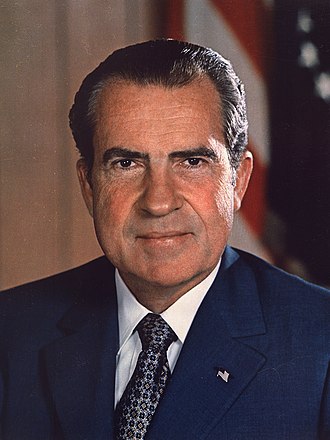
Richard M. Nixon served as the 37th President of the United States from January 1969 until his resignation in August 1974. In February 1971, he ordered the installation of a secret voice-activated taping system in the White House to preserve a historical record of his administration. Until the system's existence was revealed and dismantled in July 1973, the tapes captured Nixon directing major foreign policy initiatives, such as the opening to China, as well as his central role in the Watergate cover-up.
What Nixon talks about on the tapes
White House operations 4,718Presidential scheduling 2,225Public relations 1,784Presidential schedule 1,782Vietnam War 1,693Logistics 1,650Manolo Sanchez 1,626White House communications 1,400White House administration 1,399Presidential communication 1,243Henry Kissinger 1,191Foreign Policy 1,183
Conversations (21,010)
— Page 52 of 211President Richard Nixon and Attorney General John Mitchell discuss the recent volatility in the stock market and the public perception of the administration's economic policies, specifically regarding monetary tightening and inflation. The two men dismiss concerns over market fluctuations, noting that housing starts remain strong and that the current economic indicators should eventually lead to a market recovery. Additionally, they discuss personnel matters and potential political appointments, briefly touching upon the qualifications of candidates for judicial or administrative positions.
President Nixon initiated a request through the White House operator to place a telephone call to Donald H. Rumsfeld. This brief administrative interaction served as a logistical step to facilitate direct communication between the President and Rumsfeld. No substantive policy matters were discussed during this connection.
President Nixon and H.R. Haldeman discuss the potential judicial appointment of an individual referred to as 'Buster.' The dialogue centers on the strategic handling of Chief Justice Warren Burger regarding the candidate's professional qualifications and his standing with the American Bar Association. The participants evaluate whether Burger would approve the nomination if confronted directly about the candidate's credentials.
President Nixon consulted with the White House operator regarding the potential public perception of Senator Howard Baker. The President engaged in an informal assessment of Baker’s character and reputation, specifically questioning whether he would be viewed as a distinguished figure. No formal policy decisions or specific action items were recorded during this brief evaluative exchange.
Donald Rumsfeld briefs President Nixon on a private discussion with pollster George Gallup, who indicated that Nixon’s approval ratings are expected to see a significant rise. The two also discuss economic strategy, specifically addressing volatility in the stock market and public uncertainty regarding the upcoming Phase II wage and price controls. Nixon emphasizes the necessity of uncertainty in the transition toward free-market controls while tasking Rumsfeld with finalizing appointments to the pay and price commissions, including the potential addition of Robert Ellsworth.
President Nixon and Donald Rumsfeld discuss public perception and political strategy, specifically focusing on the reliability of Gallup polling data compared to Harris polls. The conversation also addresses economic concerns regarding the stock market and the inherent uncertainty surrounding the administration's Phase Two wage and price control policies. Nixon emphasizes the trade-off between economic control and bureaucratic growth, defending the necessity of flexibility in their approach to managing the national economy.
President Nixon consulted with the White House operator to facilitate a telephone connection with Lewis F. Powell, Jr. The discussion centered on identifying Powell's current whereabouts and confirming his availability at the Waldorf in New York. This administrative outreach was a preparatory step for the President to initiate direct communication with the future Supreme Court nominee.
President Nixon consulted with the White House operator to locate Lewis F. Powell, Jr. following reports that he had checked out of his current location. Upon learning that Powell could not be reached, the President directed the operator to connect him with Attorney General John N. Mitchell. The brief exchange reflects ongoing efforts to manage the scheduling and communication surrounding the potential Supreme Court nominee.
President Richard Nixon met with his valet, Manolo Sanchez, in the Old Executive Office Building to conduct personal business. The brief interaction consisted primarily of a private, withdrawn segment classified as personal and returnable. No substantive policy discussions or administrative actions were recorded during this engagement.
President Nixon held a brief meeting with his personal valet, Manolo Sanchez, in the Old Executive Office Building. The conversation primarily involved personal matters, as indicated by the withdrawal of the recorded segment for personal reasons. No substantive policy discussions or administrative actions were recorded during this interaction.
President Nixon met with his personal aide, Manolo Sanchez, to discuss the nomination of Lewis F. Powell Jr. to the Supreme Court. The conversation centers on the President's efforts to finalize and vet candidates for the judicial vacancy. No formal policy decisions were recorded during this brief administrative check-in regarding the ongoing nomination process.
President Nixon instructed the White House operator to place an outgoing call to Lewis F. Powell, Jr. The purpose of this communication was to facilitate a direct conversation between the President and the future Supreme Court nominee. This interaction served as a logistical step in the administration's judicial appointment process.
President Nixon and H.R. Haldeman met to coordinate scheduling and discuss logistical arrangements for an upcoming budget meeting. Their conversation addressed administrative priorities and included a brief exchange regarding Secretary of State William P. Rogers. The President concluded the meeting by requesting to speak with the Attorney General.
President Nixon consulted with the White House operator to facilitate a telephone connection with Attorney General John N. Mitchell. The primary objective of the interaction was to initiate this specific high-level communication. No further business was conducted beyond the request to reach the Attorney General.
President Nixon met with Stephen B. Bull to discuss the President's upcoming schedule and appointments. The conversation addressed the absence of specific figures that had been requested from an associate named Don. Bull subsequently departed the office to assist with the administration of these scheduling matters.
President Nixon and H. R. Haldeman analyze recent presidential approval polling data from Louis Harris, George Gallup, and Albert Sindlinger to assess the political climate. They focus on the timing of survey methodologies, specifically noting that current Gallup figures were collected prior to the announcement of the upcoming Soviet Union summit. The discussion reflects a desire to understand the lag in public opinion trends and the influence of media coverage on presidential support ratings.
President Nixon and Attorney General John Mitchell discuss strategy for filling Supreme Court vacancies, specifically focusing on persuading Lewis F. Powell, Jr. to accept an appointment. The two also evaluate the candidacy of Senator Howard H. Baker, Jr. and debate the merits of considering William H. Mulligan, noting that an appointment from a school like Fordham would challenge elitist preferences for top-tier institutions. Mitchell is instructed to consult with John Ehrlichman and Richard Moore regarding Mulligan's suitability while leveraging the endorsement of Warren E. Burger.
President Nixon and John Mitchell discuss strategies for recruiting a high-level candidate for a prestigious appointment, emphasizing the need to appeal to the individual's sense of duty to the country. They evaluate potential candidates, specifically dismissing Howard Baker due to concerns over his legal practice and political vulnerability in the Senate. Ultimately, Nixon instructs Mitchell to handle the outreach independently to maintain distance from the White House staff and ensure the recruitment process remains confidential.
President Nixon met with his aide, Stephen B. Bull, in the Old Executive Office Building to review and coordinate the President's upcoming daily schedule. The brief discussion focused on managing the logistics of executive appointments and administrative planning. No further administrative or policy developments were recorded during this session.
President Nixon met with his senior advisors to strategize on federal budget planning for fiscal years 1972 and 1973, focusing on controlling expenditures, managing the national economy, and navigating pending legislation such as revenue sharing and welfare reform. A primary objective was to reconcile budgetary constraints with political priorities, including the potential for a veto strategy against unfavorable congressional initiatives. The participants also discussed the necessity of maintaining a strong defense posture, the implications of defense spending on the economy, and the administration's ongoing efforts to resolve the Vietnam War and secure the release of prisoners of war.
President Nixon instructed the White House operator to place a follow-up telephone call to Lewis F. Powell, Jr. at his residence in Richmond, Virginia. This outreach was part of the administration's efforts to coordinate with the future Supreme Court nominee. No further substantive policy discussions occurred during this brief administrative exchange.
President Nixon initiates a brief telephone exchange with the White House operator to facilitate a connection with Charles W. Colson. This communication serves as a routine administrative request to reach a key staff member. No further substantive policy matters are addressed in this short segment.
President Nixon instructed the White House operator to place a call to Lewis F. Powell, Jr. during a brief administrative interaction. Following the request, Nixon engaged in a spontaneous critique of political opposition, specifically disparaging the Kennedy family's influence on the Vietnam War and their perceived efforts to rehabilitate the legacy of John F. Kennedy in the media. No further official actions were taken during this exchange.
President Nixon and H. R. Haldeman met to discuss scheduling concerns involving Treasury Secretary John Connally, specifically regarding his health and a potential visit to Camp Hoover. The conversation also touched on historical reflections regarding international summits and the Bay of Pigs operation. Additionally, Nixon considered strategies to manipulate media coverage by planting information with the New York Times or other outlets to gauge public and press reactions.
President Nixon consulted with the White House operator to facilitate a phone call to Charles W. Colson. During the brief exchange, the President inquired about the whereabouts of Lewis Powell, who was believed to be in Richmond, Virginia. This interaction functioned as an administrative effort to manage the President's immediate communication needs regarding ongoing personnel or political matters.
President Nixon and Charles Colson discuss the administration's recent legislative victory in the House regarding Mansfield amendments and the broader congressional agenda. The two review positive polling trends, including favorable data from Gallup and Sindlinger, and analyze the political implications of recent events such as the North Carolina reception and textile agreements. Additionally, they touch upon economic performance and the importance of maintaining positive public perception through the conclusion of the legislative session.
President Nixon and Charles Colson discuss recent legislative successes in the House of Representatives, specifically regarding efforts to reject Senate amendments. The conversation shifts to economic outlooks, where Nixon expresses frustration with cautious economic analysts and optimism for a strong consumer-driven Christmas season. They further address the need for disciplined control over inflation and economic messaging to foster positive public perception.
President Nixon contacted the White House operator to place a direct phone call to Attorney General John N. Mitchell. The brief exchange served as a logistical request to initiate this high-level communication. No substantive policy matters were discussed during this connection beyond the request to facilitate the conversation.
President Nixon met with his valet, Manolo Sanchez, to discuss recent political frustrations regarding administrative decisions and external perceptions. The conversation touches on dissatisfaction with how specific individuals, referred to as 'Eddie,' handled various responsibilities, as well as the President’s desire for a more assertive posture in international or diplomatic affairs. Nixon expresses a clear intolerance for continued setbacks and suggests a need for a more robust approach moving forward.
President Nixon instructed the White House operator to place a phone call to Attorney General John N. Mitchell. The recording consists primarily of fragmented, indistinct remarks that reflect the President's frustration regarding political opposition or hostile rhetoric. No significant policy decisions were finalized during this brief exchange beyond the logistical request for the connection.
President Nixon and Attorney General John Mitchell discussed the selection process for upcoming Supreme Court appointments, specifically noting difficulties in reaching preferred candidate Lewis F. Powell, Jr. Mitchell proposed William H. Rehnquist as a potential alternative, highlighting his legal background, conservative credentials, and performance as an Assistant Attorney General. The pair further evaluated the political optics and professional standing of various candidates, including William French Smith and William H. Mulligan, while affirming the need to finalize a decision with Howard Baker.
President Richard Nixon met with Attorney General John Mitchell in the Old Executive Office Building for a brief consultation. While the transcript remains unavailable, the discussion focused on high-level administrative or legal strategy during a period of intense activity for the Justice Department. No specific policy decisions were finalized during this five-minute encounter.
President Nixon initiates a brief telephone call to the White House operator to be connected with First Lady Pat Nixon. The exchange serves exclusively as a logistical request to facilitate a private conversation between the President and his wife. No substantive political or administrative policy matters are addressed during this brief connection.
President Nixon communicated with the White House operator to facilitate an outgoing call. The interaction was limited to administrative telephone logistics, as the majority of the brief exchange consists of a withdrawn segment classified as personal and returnable. No substantive policy discussions or significant political developments occurred during this connection.
President Nixon interacted with the White House operator to facilitate a personal phone call to the First Lady, Thelma C. “Pat” Nixon. This brief communication served as a logistical request to connect the President to his wife. No policy matters or significant administrative decisions were addressed during this interaction.
President Nixon consults with the White House operator regarding the professional background and qualifications of a potential judicial or administrative appointee. The discussion centers on the candidate’s legal experience, age, and professional standing in comparison to another individual named Smith. Nixon expresses concern over the candidate's stature, ultimately deciding on a strategy to handle the individual if he initiates further contact.
President Nixon held a brief, six-minute meeting with an unidentified individual in the Old Executive Office Building. While no transcript exists to detail the specifics of the exchange, the President utilized the time to convey a direct message to his guest. The meeting concluded abruptly, leaving no documented record of further actions or policy developments resulting from the encounter.
President Nixon and First Lady Pat Nixon discussed a recent diplomatic visit by the Prime Minister of Ceylon, Sirimavo Bandaranaike. The First Lady recounted the extended duration of the tea meeting, noting the difficulty of managing the Prime Minister's schedule. The pair briefly reflected on the success of the interaction and the Prime Minister’s positive reception.
President Nixon and First Lady Pat Nixon held a brief, informal meeting in the President's office. The conversation primarily served as a personal check-in between the couple, though the transcript remains largely obscured due to withdrawn items. No significant policy decisions or official White House actions were recorded during this one-minute interaction.
President Nixon instructed the White House operator to place a telephone call to Reverend Billy Graham. This brief administrative interaction served as the initiation for a direct communication line between the President and his longtime religious advisor. No substantive policy discussions occurred during this exchange as it was purely a request to connect with Graham.
President Richard Nixon met with his personal valet, Manolo Sanchez, in his Executive Office Building workspace. The brief interaction consisted primarily of personal matters rather than substantive policy discussions, as indicated by the withdrawal of the recorded segment. No significant administrative decisions or developments were documented during this short exchange.
President Nixon and John D. Ehrlichman discussed the development of the 1973 federal budget, specifically focusing on potential new initiatives and tax policy. The participants reviewed the perspectives of Caspar Weinberger regarding fiscal strategy and coordinated their respective schedules with John B. Connally. This meeting served as a planning session to align administrative priorities and scheduling for upcoming budgetary negotiations.
President Nixon instructed the White House operator to place an outgoing call to evangelist Billy Graham. This brief administrative interaction served as a logistical step to facilitate direct communication between the President and Graham. No further substance or policy decisions were captured in this exchange.
President Nixon and Reverend Billy Graham discuss the positive public and media reception of the President's recent appearance in North Carolina. Graham reports on the widespread enthusiasm for the event among his supporters and notes the favorable coverage in various regional newspapers and on CBS. Additionally, the pair discusses the installation of portraits of the Nixon family in Holiday Inn lobbies, an initiative facilitated by Dwight Chapin, and touches upon Graham's upcoming travel schedule.
President Nixon and evangelist Billy Graham engaged in a brief, informal discussion that transitioned from personal pleasantries into a deliberation regarding political strategy and economic messaging. The President solicited Graham’s counsel on a new initiative, emphasizing the need for a private follow-up meeting to refine their approach. Furthermore, Nixon touched upon the political sensitivities of tax restructuring, suggesting that any proposed tax increases must be carefully framed within the broader context of tax reform to maintain public support.
President Nixon initiates a request to the White House operator to be connected with his close friend and confidant, Charles G. "Bebe" Rebozo. The brief exchange serves as an administrative bridge to facilitate a private communication between the President and Rebozo. No substantive policy matters or further actions were discussed during this initial operator-assisted connection.
President Nixon contacted the White House operator to facilitate a personal phone call to his close friend and confidant, Charles G. “Bebe” Rebozo. The brief interaction served solely to initiate this communication connection. No further policy or administrative matters were discussed during this request.
President Nixon and Bebe Rebozo discuss logistics for upcoming travel, schedule coordination regarding budget meetings with George Shultz, and potential trip planning to Camp Hoover with Robert Abplanalp. The conversation also touches upon political concerns, specifically the President’s assessment of public opinion polls conducted by Gallup and Harris. Additionally, they discuss media relations, including concerns regarding press coverage in the New York Times and Washington Post and potential libel issues involving John Ehrlichman.
President Nixon and confidant Charles G. “Bebe” Rebozo reviewed the positive media coverage and public reception of a recent televised address. The President expressed satisfaction that major outlets like The New York Times and The Washington Post provided prominent coverage, noting that even historically critical networks like CBS offered professional treatment. The discussion centered on gauging the effectiveness of the President's messaging among his political base and personal acquaintances.
President Nixon initiates a request through the White House operator to place a telephone call to Paul W. Keyes. The brief exchange serves as a logistical coordination to establish a direct line of communication with Keyes. No further substantive policy matters or decisions were discussed during this brief request.
President Nixon held a brief, informal meeting with his personal valet, Manolo Sanchez, in the Old Executive Office Building. The conversation lasted less than ten minutes and did not yield any recorded policy discussions or substantive administrative developments. Due to the limited duration and the personal nature of the interaction, the exchange remains brief and primarily social in character.
President Richard Nixon met briefly with his personal valet, Manolo Sanchez, in the Old Executive Office Building. The recording of this encounter consists entirely of a withdrawn segment categorized as personal material. No substantive policy discussions or administrative actions were documented for this interaction.
President Nixon met with Alexander P. Butterfield in the Old Executive Office Building for a brief four-minute administrative consultation. While the specific substance of the discussion remains undocumented due to the lack of a transcript, the meeting served as a direct exchange between the President and his Deputy Assistant regarding ongoing White House operational matters. This interaction underscores the frequent, short-duration communication required to manage executive office logistics during this period.
President Nixon met with his personal valet, Manolo Sanchez, in the Old Executive Office Building. The brief interaction consisted primarily of personal matters rather than substantive policy discussions or administrative business. Due to the withdrawal of the majority of the recording for privacy reasons, no significant political developments or official action items were documented.
President Nixon held an brief, informal meeting with his personal valet, Manolo Sanchez, in the Old Executive Office Building. The conversation primarily concerned routine administrative tasks and the disposal of documents or materials. No major policy developments or significant political decisions emerged from this brief exchange.
President Nixon met with his personal valet, Manolo Sanchez, in the Old Executive Office Building for a brief private discussion. The exchange primarily concerned personal matters, as evidenced by the withdrawal of the segment for personal reasons. No policy decisions or administrative actions were recorded during this brief encounter.
President Nixon consulted with the White House operator to facilitate a telephone connection with Paul W. Keyes. This brief interaction served solely as a logistical request to initiate communication with the intended party. No further substantive policy matters or strategic developments were addressed during the exchange.
President Nixon held a brief, informal meeting in the Old Executive Office Building with his personal aide, Manolo Sanchez, and television writer Paul W. Keyes. The discussion, largely obscured by withdrawn material and limited transcript evidence, involved routine personal staff interactions and a brief exchange regarding keys. No major policy decisions or significant administrative actions were recorded during this short encounter.
President Nixon held a brief, informal check-in with television producer Paul W. Keyes to discuss the progress and ratings of his variety program. The two exchanged personal pleasantries and briefly recalled past shared experiences on the yacht 'Mojo.' Nixon expressed interest in future episodes, specifically requesting updates on an upcoming show featuring Liza Minnelli and a special 100th-episode milestone appearance by John 'Duke' Wayne, for which the President promised to send a congratulatory telegram.
President Nixon held a casual, friendly conversation with his longtime valet, Manolo Sanchez, during a brief meeting in the Old Executive Office Building. While the transcript includes dialogue regarding a television program hosted by an individual named Paul, the substantive portions of the meeting remain largely obscured or withdrawn. No formal policy decisions or major administrative actions were recorded during this brief exchange.
President Nixon calls Lewis F. Powell, Jr. to personally urge him to accept a nomination to the Supreme Court. Nixon emphasizes that Powell’s professional stature and reputation for excellence would serve as a crucial defense against critics who have previously alleged that administration nominees were mediocre. Powell expresses reservations about his health and age but agrees to consult with his wife and law partners before providing a final decision to Attorney General John Mitchell by the following morning.
President Nixon initiates a brief telephone call to the White House operator to be connected with Attorney General John N. Mitchell. The conversation serves solely as a logistical request to establish communication with the Attorney General. No further substantive matters were discussed during this interaction.
President Nixon and John Mitchell discuss efforts to secure Lewis F. Powell, Jr. as a Supreme Court nominee, with the President instructing Mitchell to press Powell aggressively to accept. They also coordinate their strategy regarding the American Bar Association and potential opposition to other candidates like Mildred L. Lillie. Additionally, Mitchell reports difficulty in contacting Howard H. Baker, Jr. and outlines efforts to manage the political fallout and appointment timeline.
President Nixon consulted with H. R. Haldeman, Frederic Malek, and Alexander Butterfield to discuss the selection process for upcoming Supreme Court nominations. The group deliberated on potential candidates, specifically focusing on the inclusion of qualified women for the vacancies. Nixon directed his staff to vet additional candidates from existing lists before coordinating further with Attorney General John Mitchell.
President Nixon and H.R. Haldeman discuss the vetting of personnel and potential political appointees within the administration. The conversation focuses on identifying specific individuals involved in recent internal conflicts, specifically mentioning legal professionals and figures like James Mann. They aim to assess the loyalty and backgrounds of these individuals to manage ongoing administrative challenges.
President Nixon met with H. R. Haldeman and Frederic V. Malek to discuss the recruitment and appointment of women to high-level legal and judicial positions. Following this, Nixon consulted with Attorney General John N. Mitchell regarding specific candidate vetting, the political necessity of increasing female representation in the federal judiciary, and strategies for managing potential appointments. The participants aimed to identify qualified female prospects to address public pressure and project a commitment to gender diversity in government.
President Nixon and Attorney General John Mitchell discuss ongoing efforts to appoint conservative judges to the Supreme Court, specifically focusing on the status of Senator Howard Baker and Lewis Powell. They discuss plans to bypass the American Bar Association (ABA) review process for these candidates to avoid political obstacles and public scrutiny. Additionally, the two explore strategies to improve the administration's image regarding female judicial appointments by identifying potential candidates like Sylvia Bacon for future openings in the federal district or appellate courts.
President Nixon initiates a request to the White House operator to place a telephone call to Bryce N. Harlow. The brief exchange serves as an administrative effort to connect the President with one of his key advisors. No further substantive discussion occurs during this communication.
President Nixon met with H.R. Haldeman and other staff members to review a wide range of political, administrative, and foreign policy matters. The conversation covered the potential appointment of a new Secretary of Agriculture, upcoming Supreme Court nomination strategies, and the President's schedule, including his desire to minimize press interviews and public appearances. Additionally, the participants discussed U.S. foreign policy toward the Soviet Union, Latin America, and NATO, with Nixon emphasizing his intent to exert greater control over these diplomatic initiatives while managing the roles of Secretary of State William Rogers and Henry Kissinger.
President Nixon and Bryce Harlow consulted on the selection of a new Secretary of Agriculture, weighing the political risks and administrative capabilities of potential candidates Henry Bellmon and Earl Butz. Nixon expressed significant concern that the agricultural portfolio, specifically corn and hog prices, could become an "Achilles heel" for his 1972 re-election effort, necessitating a loyal and effective spokesperson. The discussion highlighted the potential downside of associating a candidate with former Secretary Ezra Taft Benson, while simultaneously addressing the President's frustration with political opponents who he believed were sabotaging his efforts to conclude the Vietnam War.
President Nixon instructed the White House operator to manage an incoming call from the Attorney General due to his busy schedule. He specified that he would be unavailable until 1:00 p.m. and directed the operator to hold the communication until that time. This brief exchange served to coordinate the President's availability for a pending high-level discussion.
President Nixon was involved in an attempted telephone call facilitated by a White House operator. The connection failed to reach the intended party, resulting in no substantive dialogue or action items. Consequently, the brief interaction remains unrecorded in terms of policy or political developments.
President Nixon initiates a request to the White House operator to place a telephone call to his special counsel, Charles W. Colson. The exchange serves solely as a brief administrative interaction to facilitate this direct communication. No substantive policy discussions or decisions are recorded during this brief technical request.
President Nixon and an unknown associate discuss administrative budget reductions and the logistics of upcoming diplomatic outreach. The President emphasizes the necessity of scheduling private, interpreter-only meetings with Chairman Mao Zedong, separate from the broader, formal agenda managed by Henry Kissinger. The conversation concludes with instructions to ensure this requirement for direct, high-level diplomatic contact is communicated to Kissinger immediately.
President Nixon met with an unidentified individual in the Old Executive Office Building to facilitate the delivery of unspecified materials. The brief exchange confirms the successful transfer of the items before the visitor departed the office. Due to the limited nature of the recording, no further policy decisions or substantive discussions were documented.
President Nixon contacted the White House operator to facilitate a telephone call to the Attorney General, John Mitchell. The brief exchange served as a routine administrative request to establish a line of communication with the head of the Justice Department. No policy discussions occurred during this interaction.
President Richard M. Nixon met with his valet, Manolo Sanchez, in the Old Executive Office Building. While the bulk of the recording consists of a withdrawn personal segment, the interaction serves as a brief private exchange between the President and his personal staff member. No official policy discussions or major administrative decisions were recorded during this brief encounter.
President Nixon met with his personal valet, Manolo Sanchez, in the Old Executive Office Building for a brief, informal interaction. The discussion centered on the location and well-being of King Timahoe, the President’s Irish Setter. No significant policy decisions were recorded during this brief exchange.
President Nixon and H.R. Haldeman reviewed logistical arrangements for upcoming White House events, including a dinner for a Japanese delegation featuring Henry Kearns and Nobusuke Kishi. The discussion touched upon the scheduling of an October 25 meeting and broader concerns regarding press relations, specifically the administration’s strategy for dealing with the Los Angeles Times. The conversation also briefly veered into personal observations regarding the temperament and perceived attitudes of various individuals and groups within the administration's political sphere.
President Nixon met with an unidentified individual in the Old Executive Office Building to discuss his daily schedule. Given the sparse nature of the available records and the lack of a substantive transcript, no significant policy decisions or specific action items can be confirmed from this brief interaction.
President Nixon instructed the White House operator to initiate a telephone call to Charles W. Colson. This brief communication was limited to the President requesting assistance in contacting his special counsel. No further substantive matters or policy discussions were recorded during this exchange.
President Nixon and Charles Colson discuss strategies to counter aggressive political attacks from Senator Edward M. Kennedy, particularly regarding recent Supreme Court nominations and Kennedy’s attempt to associate the administration with the John Birch Society. They assess polling data from Connecticut that shows Nixon gaining significant ground against Kennedy and Muskie, and they explore ways to leverage the President’s support among Catholic voters regarding parochial school aid. To push back against negative media coverage and opposition rhetoric, Nixon directs Colson to have cabinet members and Republican leadership more forcefully challenge Kennedy’s "gutter politics" and promote the administration's recent successes.
President Nixon and Charles Colson discuss strategies for shaping public opinion and defending the administration against political opponents, particularly regarding the need for more aggressive advocacy from White House officials. They analyze recent polling data for Connecticut and national sentiment toward political rivals like Senator Edward Kennedy. The conversation concludes with a directive for Colson to coordinate with Pat Buchanan to draft a strong public statement condemning their opponents' tactics as "dirty gutter politics."
President Nixon contacted the White House operator to facilitate a telephone call to Secretary of State William P. Rogers. The brief exchange served as a routine administrative request to establish communication with the Secretary. No further policy discussions or significant developments occurred during this brief interaction.
President Nixon and Secretary of State William Rogers discussed strategies for managing U.S.-Latin American relations, specifically focusing on the potential removal of import surcharges to provide a concrete economic gesture. They also coordinated plans for First Lady Pat Nixon's upcoming trip to Liberia and other countries, aiming to reframe it as a business-oriented, women-led diplomatic mission. Additionally, the two reviewed a recent meeting with legislative leaders regarding the Vietnam War, with Nixon expressing frustration over continued political pressure despite low casualty rates.
President Nixon and Secretary of State William P. Rogers discuss plans for a diplomatic initiative toward Latin America, emphasizing the need for a high-profile tour to demonstrate commitment. They deliberate on potential policy gestures, such as addressing import surcharges and preferential trade treatment, to provide substance to the visit. Additionally, the conversation touches upon personnel choices for the delegation and assesses the decreasing intensity of the Vietnam War in terms of U.S. casualty rates.
President Nixon initiates a request to the White House operator to place a telephone call to Donald H. Rumsfeld. The brief exchange serves as a procedural step for the President to establish communication with his advisor. No further substantive policy matters were discussed during this brief request.
President Nixon initiates a brief request for the White House operator to place a telephone call to Donald H. Rumsfeld. This interaction serves as a functional step to facilitate communication between the President and his advisor. No further substantive policy matters are addressed in this short exchange.
President Nixon and Donald Rumsfeld discussed the appointment of members to the newly formed Price Board and Pay Board, key components of the administration's economic stabilization program. Nixon suggested Hoyt Ammidon for a board position and emphasized the need for a strong, decisive chairman for the Pay Board to counter union leaders like George Meany. They also coordinated plans to finalize the announcements by Friday to ensure maximum media coverage in the Sunday papers.
President Nixon and Donald Rumsfeld discuss potential appointments for the administration, specifically focusing on candidates for the chairmanship of the Price Board. Nixon emphasizes the need for a strong, vigorous leader who can effectively manage business community concerns regarding economic policy. The two also coordinate the scheduling of a media announcement to ensure maximum impact in upcoming Sunday papers and news cycles.
President Nixon consults with Alexander M. Haig, Jr. regarding the status of a potential meeting following a prior telephone discussion with Secretary of State William P. Rogers. The President instructs Haig to coordinate the logistics for this follow-up engagement. This brief interaction serves to facilitate administrative scheduling and direct communication between the President and his senior staff.
President Nixon met with Alexander Haig to discuss a wide range of administrative and foreign policy issues, including strategic planning for upcoming diplomatic summits with the Soviet Union and China, and the need for the President to engage in direct, private discussions with world leaders. They reviewed the status of the war in Vietnam, noting positive casualty trends and the importance of publicizing successes in Cambodia to maintain domestic and congressional support. Additionally, the President and his staff coordinated the logistics and messaging for First Lady Pat Nixon’s upcoming foreign travel, while also addressing trade negotiations with Japan and potential economic outreach initiatives for Latin American allies.
President Nixon and H. R. Haldeman coordinate the administration's legislative calendar, focusing on how congressional adjournment timelines affect the scheduling of the upcoming State of the Union address. The discussion weighs potential return dates for Congress in early 1972 to ensure the address does not conflict with First Lady Pat Nixon's travel publicity. They conclude that the State of the Union can be deferred until January 10th or later to accommodate these scheduling uncertainties.
President Nixon initiates a brief telephone request for the White House operator to connect him with First Lady Pat Nixon. The call serves as a routine administrative task to establish communication with his wife. No substantive political or policy matters were discussed during this brief exchange.
President Nixon suggests that First Lady Pat Nixon include several high-ranking women from the administration, such as Elizabeth Koontz, on a forthcoming diplomatic trip to increase the mission's substantive impact. Mrs. Nixon expresses hesitation, citing her previous negative experience with managing a group of cabinet wives during a trip to Mexico. To address these logistical concerns, the President proposes that the delegates follow separate, individual schedules and only join the First Lady for social events in the evening.
President Nixon initiated a brief telephone call to Attorney General John N. Mitchell through the White House operator. The primary purpose of the communication was to establish contact with the Attorney General for an unspecified discussion. This interaction served as a logistical administrative step to facilitate a direct conversation between the President and the head of the Department of Justice.
President Nixon utilizes the White House operator to place an outgoing call to Attorney General John Mitchell. This brief interaction serves as a logistical bridge to facilitate direct communication between the President and his chief legal officer. No substantive policy discussions occur, as the exchange is limited to the functional request for a telephone connection.
President Nixon consulted with the White House operator to facilitate contact with Attorney General John N. Mitchell regarding a scheduling matter. Upon learning that Mitchell was currently in transit, the President opted to wait until Mitchell returned to his office rather than contacting him via his vehicle. Nixon instructed the operator to leave a message at the Attorney General's office to coordinate the subsequent conversation.
President Nixon consulted with the White House operator to facilitate a communications request. The brief exchange centered on managing the President's incoming and outgoing calls, specifically regarding a follow-up conversation with an unidentified individual upon their return. Nixon directed the operator to hold the request until the party became available.
President Nixon met with an unknown individual in his Old Executive Office Building office to briefly discuss administrative logistics. The conversation focused on the coordination of the President's schedule and the immediate retrieval of unspecified materials. The exchange concluded with the departure of the unidentified party, confirming that no further action items remained for the duration of the meeting.