Nixon, Richard M. (President)
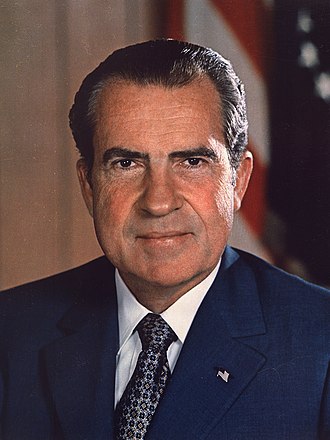
Richard M. Nixon served as the 37th President of the United States from January 1969 until his resignation in August 1974. In February 1971, he ordered the installation of a secret voice-activated taping system in the White House to preserve a historical record of his administration. Until the system's existence was revealed and dismantled in July 1973, the tapes captured Nixon directing major foreign policy initiatives, such as the opening to China, as well as his central role in the Watergate cover-up.
What Nixon talks about on the tapes
White House operations 4,718Presidential scheduling 2,225Public relations 1,784Presidential schedule 1,782Vietnam War 1,693Logistics 1,650Manolo Sanchez 1,626White House communications 1,400White House administration 1,399Presidential communication 1,243Henry Kissinger 1,191Foreign Policy 1,183
Conversations (21,010)
— Page 54 of 211President Nixon met with his personal valet, Manolo Sanchez, in the Old Executive Office Building for a brief discussion. The conversation consisted of the repeated recitation of a phrase in Welsh, "Mae'n rhaid i ni ddweud y gwirioneddau," which translates to "We must tell the truths." No substantive policy decisions or administrative actions were recorded during this brief encounter.
President Nixon and H. R. Haldeman met to coordinate the internal management and public messaging regarding upcoming judicial and administrative appointments. The discussion centered on finalizing the selection processes involving key figures such as John Mitchell, Lawrence Walsh, and Warren Burger, while also addressing concerns regarding sensitive leaks. They further reviewed statistical data intended to support the President’s scheduled speech concerning his recent appointments.
President Nixon met with Alexander P. Butterfield in the Old Executive Office Building to discuss a specific item requiring the President's attention. The brief three-minute encounter focused on the presentation of this administrative or policy-related matter. No further developments were recorded following the delivery of the item before Butterfield departed.
President Nixon met with his personal valet, Manolo Sanchez, during which he discussed sensitive administrative and personnel-related concerns. The conversation touched upon the involvement of Attorney General John Mitchell and his interactions with an individual named Walsh, as well as instructions regarding Anthony Lake/Berger. Nixon emphasized the necessity of maintaining discretion regarding specific undisclosed decisions, insisting that this information not be shared with others, including Carmen.
President Nixon met with his personal aide, Manolo Sanchez, in the Old Executive Office Building to discuss administrative or logistical details regarding a specific count of 3,000 items. The brief exchange focused on confirming this figure and the related documentation process. No major policy decisions were reached, as the conversation served primarily as a functional interaction between the President and his staff.
President Nixon consulted with a White House operator to facilitate a specific telephone connection. The brief exchange focused on administrative communication logistics rather than policy matters. No major developments or substantive decisions were recorded during this interaction.
President Nixon consulted Richard A. Moore to confirm the age of William H. Rehnquist during the lead-up to his Supreme Court nomination. Moore verified that Rehnquist was 47 years old, born in 1924, and discussed his military service background. The President concluded the brief call by inviting Moore to the Oval Office to review a pending document.
President Nixon met with Richard A. Moore for a brief discussion regarding ongoing administrative or political matters. Although the recording is extremely short and lacks a formal transcript, the meeting serves as a point of contact between the President and his aide during a period of intense White House activity. No specific policy shifts or major directives were recorded during this one-minute interaction.
President Nixon instructed the White House operator to contact his personal secretary, Rose Mary Woods, and direct her to report to his office in the Executive Office Building. This brief administrative communication served to coordinate Nixon's schedule and ensure Woods' immediate presence for assistance. No other policy or political matters were discussed during this short exchange.
President Nixon contacted the White House operator to facilitate a telephone connection with his personal secretary, Rose Mary Woods. This brief administrative interaction served as a logistical step to reach a key member of his staff. No further substantive policy matters were discussed during this brief communication.
President Nixon held a brief, one-minute meeting with his personal valet, Manolo Sanchez, in the Old Executive Office Building. Due to the lack of a transcript and the immediate withdrawal of the recording content, no substantive policy or political discussions can be verified. The encounter serves primarily as a record of a routine interaction between the President and his long-time domestic staffer.
President Nixon met with Richard A. Moore and Rose Mary Woods to rehearse and refine a televised speech regarding his nominations for the Supreme Court. The discussion focused on articulating the President’s judicial philosophy, specifically his preference for judicial conservatism, while incorporating a quote from commentator Walter Lippmann to support his stance. The participants also addressed the logistics of notifying key stakeholders and the drafting process for the broadcast, which aimed to clarify the administration's approach to judicial appointments.
President Nixon directs his personal secretary, Rose Mary Woods, to bring a copy of his upcoming speech to the White House. This brief administrative exchange serves to coordinate the distribution of presidential materials in preparation for a scheduled appearance. No further policy matters or decisions were addressed during the interaction.
Rose Mary Woods and Marjorie P. Acker discuss specific revisions and formatting requirements for a document currently being typed. The conversation focuses on clarifying discrepancies in the text, specifically concerning a philosophy-related section that had been modified but was missing from the carbon copy. The participants resolve these administrative details to ensure the final typed set is accurate.
President Nixon, Rose Mary Woods, and Marjorie P. Acker collaborated on the final editing and structural revisions of a speech concerning upcoming Supreme Court nominations. The President consulted with H. R. Haldeman throughout the process to refine specific content, including references to Chief Justice John Marshall. The session concluded with final instructions regarding the document's pagination and formatting to ensure the speech was prepared for delivery.
President Nixon and H. R. Haldeman briefly conferred to verify biographical details regarding the early career of former Chief Justice John Marshall. The President specifically sought confirmation that Marshall served in the Virginia legislature prior to his judicial tenure. The inquiry was successfully resolved with Haldeman confirming Nixon's recollection.
President Nixon and Ronald Ziegler met to strategize on the messaging for forthcoming Supreme Court nominations, specifically focusing on the selection of Lewis F. Powell, Jr. and the role of John N. Mitchell in the vetting process. They discussed the importance of managing public perception regarding the American Bar Association’s influence and the administration’s internal decision-making criteria. Additionally, the President provided specific instructions to Ziegler on how to frame the vetting process and the consideration of diverse candidates during upcoming media briefings.
President Nixon met with his personal valet, Manolo Sanchez, to discuss administrative matters and potential assignments. The brief discussion primarily focused on tasks involving Rose Mary Woods and logistics related to the management of library materials. No major policy developments were recorded during this brief administrative interaction.
President Nixon contacted the White House operator to be connected with his personal secretary, Rose Mary Woods. Following the connection, Nixon discussed a typographical error in an upcoming speech. The conversation also touched upon the career of William H. Rehnquist, then serving as Assistant Attorney General, and included a brief mention of Press Secretary Ronald L. Ziegler.
President Nixon and his personal secretary, Rose Mary Woods, coordinate the correction of a typographical error in the draft of an upcoming presidential speech regarding the career of William H. Rehnquist. The discussion focuses on whether the document, which incorrectly lists Rehnquist’s title as 'Assistant Attorney' rather than 'Assistant Attorney General,' requires a full retyping before it is released to Press Secretary Ronald Ziegler. They ultimately decide to have the page corrected to ensure accuracy for the post-speech press distribution.
President Nixon held a brief session with the White House operator to facilitate a telephonic communication. This interaction served an administrative purpose, likely connecting the President to an external party or official. No further record of the specific discussion content exists, as the call served primarily as an operational bridge for executive scheduling or correspondence.
President Nixon met briefly with his personal secretary, Rose Mary Woods, in the Old Executive Office Building. Given the brevity of the one-minute interaction and the absence of a transcript, the discussion likely concerned immediate administrative or scheduling matters. No specific policy decisions or significant developments were recorded during this session.
President Nixon utilized this session in his Old Executive Office Building suite to conduct a rehearsal for an upcoming public address. The meeting served as a final practice run, allowing the President to refine his delivery and pacing for the broadcast. This preparation ensured the President was adequately ready for his scheduled national communication later in October 1971.
President Nixon and H. R. Haldeman met to discuss the timing of impending Supreme Court vacancies. The primary focus of the brief consultation was to manage the political strategy surrounding potential judicial appointments. No final decisions were recorded, but the discussion highlights the administration's active planning regarding the composition of the high court.
President Nixon reviewed a draft of an upcoming speech, focusing on technical accuracy and clarity. During the rehearsal, he identified a specific error in the title of an assistant attorney general within the Office of Legal Counsel. Nixon ultimately decided against requesting a revision, concluding that the minor typographical error was not significant enough to necessitate reprinting the document.
President Nixon met with Rose Mary Woods and H. R. Haldeman to evaluate his pending Supreme Court nominations, specifically focusing on the qualifications and backgrounds of William H. Rehnquist and Lewis F. Powell, Jr. The discussion included a review of the candidates' legal school rankings and ages, as well as coordination regarding the President's upcoming speech on the appointments. Additionally, the participants addressed the President's schedule and the status of various administrative tasks handled by his speechwriting team.
President Nixon and H.R. Haldeman spoke briefly to clarify the specific resignation dates of Supreme Court Justices Hugo L. Black and John M. Harlan. The President sought confirmation of the exact dates, establishing that Black resigned on September 17 and Harlan on September 23. This exchange served to finalize the timeline of the vacancies for administrative or political record-keeping.
President Nixon initiates a brief telephone exchange with the White House operator to request a connection to Charles W. Colson. This administrative interaction serves as a functional request to facilitate communication between the President and a key political aide. No substantive policy matters were discussed during this brief logistical coordination.
President Richard M. Nixon spent this time rehearsing a speech and finalizing his public justifications for the nominations of Lewis F. Powell, Jr. and William Rehnquist to the Supreme Court. Nixon emphasized his desire for appointees who would interpret the Constitution based on its original intent rather than through a political or social-engineering lens. He also issued strict instructions to his staff to prevent interruptions from individuals identified as Berger and Walsh during his final preparations.
President Nixon held a brief administrative interaction with a White House operator to facilitate a communication connection. The exchange appears to be a routine logistical arrangement for the President to initiate a telephone call. No significant policy decisions were recorded during this brief encounter.
President Nixon and Charles Colson discuss administration strategy, focusing on upcoming Supreme Court nominations, economic indicators, and public opinion. They celebrate the strategic release of nominees with high academic credentials to neutralize criticism regarding "excellence" and "judicial philosophy." Furthermore, they review the current economic climate, expressing concerns about Federal Reserve Chairman Arthur Burns's monetary policies, and analyze recent polling data that shows rising support for the President.
President Nixon and Charles Colson met to discuss the pending Supreme Court nominations of Lewis Powell and William Rehnquist. The President expressed his confidence in the nominees and emphasized the importance of their judicial appointments to the broader government agenda. The conversation also touched upon broader concerns regarding public trust in government and the challenges of managing political discourse.
President Nixon initiates a request for the White House operator to place a telephone call to his personal secretary, Rose Mary Woods. The conversation serves solely as an administrative coordination to facilitate direct communication with a key staff member. No further substantive policy matters were discussed during this brief exchange.
President Nixon utilized this time to rehearse a public speech outlining his philosophy for selecting judicial nominees. During the session, he discussed his criteria for appointments, specifically emphasizing the need for candidates who balance social order with individual rights. He also highlighted the credentials of Lewis F. Powell as an exemplary candidate for a position in the federal judiciary.
President Nixon consulted with the White House operator to discuss the professional background and legal qualifications of William Rehnquist. The conversation focused on evaluating Rehnquist's academic history, including his time at Stanford University, in relation to his nomination prospects. No formal decisions were reached, as the discussion functioned primarily as a review of biographical credentials.
President Nixon and his personal secretary, Rose Mary Woods, discuss the length of an upcoming speech. After realizing they had not yet tallied the total word count, the President instructs Woods to calculate the figures and report back to him. This brief exchange highlights the administrative focus on speech preparation and timing requirements.
President Nixon and his personal secretary, Rose Mary Woods, discuss the professional background and legal credentials of William Rehnquist. The brief interaction focuses on Rehnquist’s academic history, his previous clerkship for Justice Robert Jackson, and his subsequent legal career in Arizona prior to his federal service. The dialogue serves to review Rehnquist’s qualifications, likely in preparation for his upcoming nomination to the Supreme Court.
President Nixon utilized this time to rehearse a public address in his Old Executive Office Building suite. The practice session served as a final preparation for the speech, which was subsequently published in the 1971 Public Papers of the Presidents. The exercise allowed the President to refine his delivery prior to the formal broadcast.
President Nixon and his personal secretary, Rose Mary Woods, held a brief telephone conversation to confirm a specific monetary figure. Woods provided the President with the exact amount of $1,694, which Nixon acknowledged before ending the call. The exchange served as a routine administrative verification of financial data.
President Nixon held a brief, one-minute meeting with his personal secretary, Rose Mary Woods, in the Old Executive Office Building. The conversation primarily served as a logistical touchpoint between the President and his trusted assistant. No substantive policy decisions or historical developments were recorded during this session.
President Nixon contacted the White House operator to facilitate a telephone call to his personal secretary, Rose Mary Woods. The brief exchange served as a routine administrative request to connect the President with a member of his staff. No further substantive policy discussions occurred during this brief communication.
President Nixon practiced a public address in the Old Executive Office Building, focusing on the upcoming nominations of Lewis Powell and William Rehnquist to the Supreme Court. The President emphasized the need to build public trust in these appointees and their ability to uphold institutional integrity. The session served as a rehearsal for a broadcast intended to garner political support for his judicial selections.
President Nixon and H. R. Haldeman met to coordinate preparations for an upcoming presidential address. The discussion centered on lighting requirements and logistical arrangements necessary to optimize the broadcast quality of the event. No major policy decisions were reached, as the conversation focused exclusively on technical stagecraft for the speech.
President Richard M. Nixon utilized this time in his office to rehearse a public address. The session was dedicated to refining the delivery and content of an upcoming speech intended for national broadcast. No other participants were involved in the recording, which served primarily as a preparation tool for the President's public messaging.
President Nixon and his valet, Manolo Sanchez, met briefly to coordinate logistical details for the President's evening schedule. The discussion centered on arrangements at Alexander P. Butterfield's office, specifically regarding the logistics of make-up application. The meeting served as a short operational planning session for the President's upcoming activities.
President Nixon rehearsed a televised address announcing his intention to nominate Lewis F. Powell, Jr. to the United States Supreme Court. The remarks focused on the judicial philosophy of the Court and the necessity of balancing social rights with law enforcement needs. Nixon praised Powell’s distinguished career and legal expertise to justify his selection as a candidate capable of upholding constitutional principles.
President Nixon held a brief meeting with an unidentified individual in the Old Executive Office Building. Due to the lack of a transcript and the presence of a withdrawn personal segment, the specific substance of their discussion remains unavailable for analysis. The conversation concluded within eight minutes, leaving no record of any actionable policy decisions or significant developments.
President Nixon met with various aides and technicians to prepare for and broadcast a televised national address, followed by a meeting with a group of Senators and staff to discuss his recent Supreme Court nominations. During the session, the President focused on the qualifications of his nominees, Lewis F. Powell and William H. Rehnquist, emphasizing the importance of the Supreme Court's role in the government. The conversation concluded with the President greeting and presenting gifts to the television, lighting, and sound crews who assisted with his broadcast.
President Nixon and his personal secretary Rose Mary Woods discussed the positive reception of the President's televised speech regarding his nominations of Lewis F. Powell, Jr. and William H. Rehnquist to the Supreme Court. Woods relayed congratulatory feedback from key administration figures and allies, including John Connally, George Romney, and John Mitchell, who particularly praised the President's historical context regarding the Court. Although Woods relayed a request from Secretary James D. Hodgson for the President to call labor leader George Meany regarding Wage and Price Board issues, Nixon firmly declined to initiate the call.
President Nixon held a brief telephone conversation with his daughter, Tricia Nixon Cox, and his son-in-law, Edward R.F. Cox. The discussion primarily involved personal family matters and informal exchanges. No significant policy decisions or official government business were addressed during this call.
President Nixon held a brief, personal telephone conversation with his daughter, Julie Nixon Eisenhower. The discussion was entirely private in nature, as indicated by the withdrawal of the transcript content for personal reasons. No administrative or political developments were recorded during this interaction.
President Nixon held a telephone conversation with the White House operator to facilitate a call to Attorney General John N. Mitchell. The primary purpose of the communication was to coordinate with Mitchell regarding sensitive administrative and political matters. The dialogue underscores Nixon's ongoing efforts to manage internal White House communications and outreach to key cabinet members during his presidency.
President Nixon and John Mitchell discuss the positive reception and strategic impact of Nixon's recent Supreme Court nominations, specifically highlighting William H. Rehnquist and Lewis F. Powell, Jr. The two emphasize the effectiveness of blindsiding the press with these appointments and discuss the necessity of maintaining a firm stance during the upcoming Senate confirmation process. They also address the political complications surrounding potential female nominees, noting the rejection of Mildred L. Lillie by the American Bar Association.
President Nixon contacted the White House operator to place an outgoing call to his personal secretary, Rose Mary Woods. The brief exchange served as a procedural request to facilitate a direct line to his long-time aide. No substantive policy matters or further developments occurred during this brief administrative interaction.
President Nixon and Rose Mary Woods discuss the overwhelmingly positive public and political reception to the President’s recent televised speech announcing his Supreme Court nominations. The conversation highlights the effective delivery of the speech and the public's preference for the President's direct messaging over the influence of the Washington Post. They also address minor logistical concerns regarding property near Mount Vernon and coordinate a plan for the President to follow up with key officials, including John Mitchell and Chief Justice Warren E. Burger.
President Nixon initiates a call to Chief Justice Warren E. Burger through the White House operator. The conversation is brief and serves solely as a logistical request to establish a connection with the Chief Justice. No further substantive policy matters or decisions are discussed during this exchange.
President Nixon initiates a request to the White House operator to place a telephone call to Secretary of State William P. Rogers. The brief exchange serves as a logistical coordination for the President to establish direct communication with his Secretary of State.
President Nixon consulted with his personal secretary, Rose Mary Woods, to coordinate his evening telephone schedule and finalize his list of evening calls. During the brief exchange, they dismissed a potential call to Senator James O. Eastland and confirmed that Nixon would instead reach out to Secretary of State William P. Rogers. The conversation concluded with Woods preparing to depart for the evening after helping organize the President's remaining communications.
President Nixon and Chief Justice Warren E. Burger discuss the recent nominations of William H. Rehnquist and Lewis F. Powell, Jr. to the Supreme Court. Nixon expresses strong confidence in both men, characterizing Rehnquist as a tough, constitutionalist jurist and Powell as an eminent legal mind. Nixon specifically instructs Burger to reassure Powell that his vision issues should not preclude his service, urging him to focus on his deliberative role on the Court rather than administrative minutiae.
President Nixon consulted with Secretary of State William Rogers and AFL-CIO leader George Meany to gauge their reactions to his recent Supreme Court nominations of Lewis F. Powell, Jr. and William H. Rehnquist. The conversations emphasized the nominees' commitment to law and order and their lack of anti-labor bias, which helped secure Meany’s preliminary support. Nixon also reflected on the authorship of his October 21 speech and discussed the ongoing challenges of finding qualified female candidates for judicial appointments.
President Nixon received a call from the White House operator to facilitate a requested conversation with H.R. Haldeman and an individual identified as Mr. Post. The primary purpose of the call was to connect the President with his Chief of Staff and his associate for an immediate briefing or consultation. This brief interaction served as the logistical precursor to a subsequent high-level discussion involving the President's inner circle.
President Nixon and H. R. Haldeman discussed the overwhelmingly positive public and editorial reaction to the President's recent Supreme Court nominations of Lewis F. Powell, Jr. and William H. Rehnquist. The pair noted that the surprise announcement effectively silenced critics and left political opponents, such as Senators Bayh and Kennedy, caught off guard. While Powell enjoyed broad recognition, the two agreed on the necessity of conducting an outreach campaign to build support for Rehnquist, whose credentials were less well-known to the broader public and legal establishment.
President Nixon contacted the White House operator to facilitate an outgoing call to his special counsel, Charles W. Colson. This brief administrative interaction served as the necessary logistical step to connect the President with one of his key political advisors. No substantive policy discussions occurred during this brief exchange.
The President contacted the White House operator to secure the current location and availability of Charles W. Colson. The operator confirmed that Colson was in Rutholm and expected to arrive shortly. This brief administrative exchange served to coordinate the President's immediate communication needs regarding Colson's schedule.
President Nixon contacted the White House operator to place an outgoing call to Press Secretary Ronald L. Ziegler. This interaction serves as a brief administrative bridge to initiate further communication with his press office. No substantive policy discussions occurred during this specific exchange.
President Nixon instructed the White House operator not to connect him with Press Secretary Ronald L. Ziegler, who was currently attending an event at the British Embassy. The exchange served as a brief administrative update regarding the President's attempt to locate and communicate with his press secretary. No further action was taken regarding the call.
President Nixon consulted his personal secretary, Rose Mary Woods, to gather feedback on his recent speech regarding Supreme Court nominations. The discussion addressed the political climate surrounding his administration's efforts to appoint a female justice and the general public and media reception to the announcement. They further reviewed the domestic impact of these personnel decisions, including the treatment of First Lady Pat Nixon by the press and political opponents.
President Nixon and his personal secretary, Rose Mary Woods, discuss the administration's stance on appointing women and minorities to high-level positions, specifically regarding the Supreme Court. The two express skepticism toward selecting candidates based on identity politics, arguing that such appointments undermine meritocracy and the professional readiness of the individuals involved. This exchange highlights the President's internal deliberations concerning diversity initiatives and the pressure to fill influential government roles.
President Nixon and Charles Colson discuss strategies for securing the confirmation of Supreme Court nominees William H. Rehnquist and Lewis F. Powell, Jr. following the President's recent announcement. They weigh the political challenges posed by opposition from groups like the American Bar Association and individual Democrats, specifically Edward M. Kennedy. Nixon emphasizes the nominees' superior academic and professional credentials as a defense against criticism and stresses the importance of maintaining momentum for their confirmation.
President Nixon contacted the White House operator to place an outgoing call to John D. Lodge, who was serving as the United States Ambassador to Argentina. The primary objective of the communication was to facilitate a direct conversation between the President and the Ambassador. No further details regarding the substance of the discussion were recorded.
President Nixon directs the White House operator to immediately connect Secretary of State William P. Rogers with Ambassador Graham A. Martin in Rome. The call serves as an urgent administrative request to facilitate direct communication between the Secretary and the diplomat. No further substantive policy matters are discussed during this brief exchange.
President Nixon and Secretary of State William P. Rogers coordinate with U.S. Ambassador to Argentina John D. Lodge to secure a critical vote regarding the status of Taiwan at the United Nations. Nixon emphasizes the personal nature of the request, urging Lodge to meet immediately with Argentine President Alejandro Augustin Lanusse to pressure the country to support the U.S. position on the "important question" resolution. Both Nixon and Rogers stress that an Argentine vote in favor of this procedural motion is essential to prevent Taiwan's expulsion from the UN, dismissing counterarguments regarding the UN charter as irrelevant to the strategic priority.
President Nixon met with his personal valet, Manolo Sanchez, in the Oval Office to retrieve a briefcase. This brief interaction served as a logistical exchange to prepare the President for his subsequent official business. The conversation concluded promptly once the item was secured.
President Nixon met with his valet, Manolo Sanchez, in the Oval Office for a brief informal interaction. The participants engaged in light conversation regarding observations of objects or animals outside the office. No significant policy decisions or official White House business were conducted during this exchange.
President Nixon met with his personal aide, Stephen B. Bull, in the Oval Office to discuss administrative or scheduling matters. Due to the unintelligible nature of the audio recording, no specific policy decisions or substantive outcomes were captured. The interaction serves as a routine record of the President's daily engagement with his immediate staff.
President Nixon met with Alexander P. Butterfield to coordinate the President's upcoming daily schedule and manage interactions with high-profile visitors. The discussion focused on the logistics of meetings involving Imelda Marcos and Alexander M. Haig, Jr. Nixon specifically instructed Butterfield to involve the State Department, specifically Emil Mosbacher, regarding matters involving Marcos while expressing his desire to avoid direct personal involvement in certain sensitive logistical details.
President Nixon met with Alexander P. Butterfield to coordinate social planning for an upcoming White House event. The brief discussion focused on dinner arrangements involving Emil “Bus” Mosbacher, Jr. No major policy decisions were made during this logistical exchange.
President Nixon and personal secretary Rose Mary Woods met to discuss the President's upcoming schedule, including plans for a radio address and potential travel to Camp David. They reviewed logistical concerns regarding upcoming meetings, such as the visit of Josip Broz Tito, and touched upon various personal and staff-related matters, including the travel expenses and conduct of family members. The conversation concluded with Nixon deciding to postpone certain commitments due to health concerns and scheduling conflicts.
President Nixon and H. R. Haldeman met to review the President’s upcoming public schedule, including strategy for a potential radio address and administrative coordination for meetings with Imelda Marcos and the Price Commission. The pair discussed current Gallup polling trends, noting a recent increase in presidential approval ratings, and reviewed the economic landscape, specifically focusing on the Consumer Price Index and Arthur Burns's handling of the money supply. Additionally, they touched upon the confirmation preparation for Supreme Court nominees William Rehnquist and Lewis Powell, with Nixon emphasizing the need for thorough vetting to avoid potential Senate confirmation pitfalls.
President Nixon met with members of the newly formed Pay Board and Price Commission to discuss the administration's strategy for curbing inflation through the wage-price freeze. Nixon emphasized his preference for a system reliant on voluntary public support rather than the rigid, expansive government controls characteristic of the Office of Price Administration. He thanked the board members for their service and sacrifice, acknowledging that their mission to stabilize the economy without long-term government intervention presented a significant challenge. The President also contextualized these domestic economic efforts within his broader foreign policy agenda, highlighting the importance of managing relations with the Soviet Union and China to maintain global peace.
President Nixon held a brief, unscheduled meeting in the Oval Office with an unidentified individual. The encounter lasted less than a minute and the content of the discussion remains entirely unintelligible. No substantive policy developments or decisions are recorded as a result of this interaction.
President Nixon met with Rose Mary Woods and Stephen B. Bull to discuss his recent televised address, manage his daily schedule, and address personnel and political matters. The group coordinated the President's attendance at a meeting regarding the Pay Board and Price Commission, ensuring no photography occurred due to the absence of labor leaders. Additionally, they reviewed potential Supreme Court nominees, evaluated a letter from Senator Charles Percy, and considered guest list arrangements for an upcoming White House dinner.
President Nixon, H.R. Haldeman, and Ronald Ziegler discussed the positive public and political reception of Supreme Court nominees Lewis F. Powell, Jr. and William H. Rehnquist, focusing on the importance of their conservative credentials and intellectual capability. Nixon analyzed the ideological balance of the Court and strategized on managing media narratives regarding the nominees' ages and backgrounds. Additionally, the participants reviewed the administration's public relations approach to the Pay Board and the potential labor boycott, deciding to downplay the absence of labor members during upcoming announcements.
President Nixon met with Imelda Marcos, wife of Philippine President Ferdinand Marcos, along with Alexander Haig to discuss the political stability of the Philippines and regional security in Asia. Mrs. Marcos expressed concerns regarding communist insurgency and domestic criticism of her husband's administration, while requesting U.S. military assistance and support for sugar quotas. President Nixon reaffirmed his commitment to maintaining strong ties with allies despite his forthcoming opening to the People's Republic of China, and he pledged to look into providing additional military equipment to help stabilize the Philippine government.
President Nixon met with Representative Peter H. B. Frelinghuysen, Jr., Alexander M. Haig, Jr., and Clark MacGregor to receive a briefing on Frelinghuysen’s recent fact-finding travels to Pakistan and India. The discussion centered on the escalating humanitarian crisis, the potential for war between the two nations, and the complexities of U.S. foreign aid policy in the region. Nixon and his advisors also engaged in a broader philosophical debate regarding the viability of democratic processes in diverse cultures and the perceived hypocrisy of critics who apply double standards to right-wing versus left-wing regimes.
President Nixon met with his aide, Stephen B. Bull, to review and finalize scheduling logistics for upcoming appointments. The discussion focused on coordinating a meeting with George H.W. Bush and William P. Rogers, as well as an engagement with former Japanese Prime Minister Nobusuke Kishi. This brief administrative interaction served to confirm the timing of the President’s afternoon agenda.
President Nixon met with his personal secretary, Rose Mary Woods, and personal aide Manolo Sanchez in the Oval Office to address administrative matters and logistics regarding his personal schedule. The discussion centered on planning the President's upcoming activities, including arrangements for Imelda Marcos's book presentation and logistics for family travel to Camp David. The session concluded with the President coordinating his lunch and departure schedule with his staff.
President Nixon consulted with an unidentified individual regarding an expected incoming telephone call from his daughter, Julie Nixon Eisenhower. Rose Mary Woods, the President's personal secretary, facilitated the communication coordination. The interaction was brief and focused solely on logistical arrangements for the scheduled conversation.
President Nixon met with his senior advisors, including H. R. Haldeman, Secretary of State William Rogers, and UN Ambassador George H. W. Bush, to coordinate a final, high-pressure diplomatic push regarding the United Nations vote on Chinese representation. The participants strategized on how to secure decisive votes from key nations, including Italy, Mexico, Argentina, and Malta, while weighing the political risks of direct presidential intervention and the potential impact of Henry Kissinger's upcoming return from China. They concluded by establishing a list of targeted countries and specific action items, such as arranging presidential phone calls and leveraging foreign aid dependencies, to bolster support for the U.S.-backed position.
President Nixon instructed the White House operator to place an outgoing telephone call to Virginia Governor Linwood Holton. The exchange was strictly logistical, serving as a brief administrative step to initiate communication between the President and the Governor. No substantive policy discussions occurred during this brief request for the operator's assistance.
President Nixon called Virginia Governor Linwood Holton to discuss the impending announcement of his Supreme Court nominations of William H. Rehnquist and Lewis F. Powell, Jr. Nixon urged Holton to publicly endorse the selections during his press conference, emphasizing the high quality of the candidates and the bipartisan nature of the appointments. The conversation also touched on international affairs, including tensions in Pakistan and the Middle East, before concluding with plans for Holton to meet with White House staff regarding Virginia's school policies.
President Nixon instructed the White House operator to place a telephone call to Bryce N. Harlow. This administrative interaction was initiated to facilitate direct communication between the President and Harlow. The recording consists primarily of the request to connect the two parties.
President Nixon and Bryce N. Harlow discussed the selection process for a new Secretary of Agriculture and exchanged congratulations regarding the recent, successful nominations of Lewis F. Powell, Jr. to the Supreme Court. Harlow advised the President against considering certain senators due to constitutional eligibility constraints and provided an analysis of the leading departmental candidates, specifically Clarence D. Palmby, J. Phillip Campbell, and Earl L. Butz. Nixon directed Harlow to consult with Henry L. Bellmon to gauge his perspective on the candidates and instructed him to deliver a final recommendation by the following Tuesday.
President Richard Nixon called Italian Prime Minister Emilio Colombo to urge Italy to support the U.S. position during an upcoming United Nations vote regarding the representation of China. The core of the American argument was that expelling Taiwan from the UN by a simple majority would set a dangerous precedent, and Nixon requested that Italy support the "Important Question" (IQ) motion to require a two-thirds majority for such an action. While Colombo highlighted domestic political constraints and Italy's previous diplomatic recognition of Beijing, he committed to navigating the Council of Ministers to avoid an outright vote against the U.S. position.
President Nixon contacted the White House operator to place an urgent telephone call to Attorney General John N. Mitchell. The brief exchange served as a logistical step to facilitate direct communication between the President and his Attorney General. No further substantive policy matters were discussed during this brief request for a connection.
President Nixon consulted with the White House operator to determine the whereabouts and schedule of Attorney General John N. Mitchell. Upon learning that Mitchell was attending a dinner engagement and expected to return home late, the President decided against interrupting him. No further action was taken regarding the communication.
President Nixon contacted his personal secretary, Rose Mary Woods, to coordinate personal administrative matters and family arrangements. Their discussion encompassed scheduling updates regarding his daughters, Julie and Tricia Nixon Eisenhower, including planned trips to Camp David. The President also reviewed logistics for an upcoming dinner with Nobusuke Kishi and exchanged personal pleasantries concerning health and well-being.
President Nixon and his personal secretary, Rose Mary Woods, discuss the success of a recent dinner with former Japanese Prime Minister Nobusuke Kishi. Expressing gratitude for Kishi's long-standing support, Nixon considers appropriate reciprocal gift-giving to honor the relationship. They ultimately decide to frame and send a photograph of the two men to Kishi as a gesture of appreciation.
President Nixon contacted the White House operator to place a personal telephone call to television writer and producer Paul W. Keyes. The request was intended to facilitate a direct communication between the President and Keyes at his California residence. The conversation was limited to the administrative coordination of this outgoing call.
President Nixon contacted the White House operator to initiate a telephone call to Treasury Secretary John B. Connally. The brief exchange served solely as a logistical request to establish a line of communication with the Secretary. No further policy discussions or substantive developments took place during this brief administrative interaction.