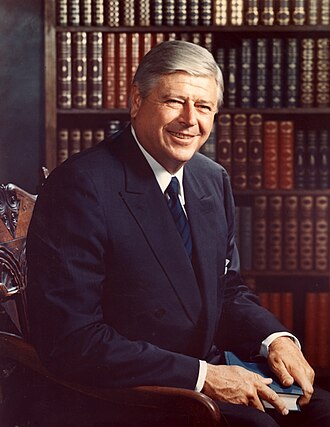
Morton, Rogers C. B.
Rogers C. B. Morton began the Nixon administration serving concurrently as a Republican U.S. Representative from Maryland and Chairman of the Republican National Committee from April 1969 to January 1971. In January 1971, just before the White House taping system was installed, Morton resigned from Congress to transition to the cabinet as Secretary of the Interior. He served as Interior Secretary throughout the entire taping period (February 1971 to July 1973) and remained in the position through the end of the Nixon administration in August 1974.
President Nixon and his Cabinet met to discuss the ongoing military operations in Indochina and the development of the administration's national health reform agenda. Regarding the war, officials reviewed the progress of South Vietnamese incursions into Laos and Cambodia, noting that the strategy was successfully disrupting enemy supply lines while shifting the burden of ground operations away from American forces. The conversation then transitioned to a detailed proposal from Secretary of Health, Education, and Welfare Elliot Richardson regarding healthcare reform, with the group debating the costs, tax implications, and administrative feasibility of implementing Health Maintenance Organizations (HMOs) and national health insurance standards.
President Nixon met with Interior Secretary Rogers C. B. Morton and advisor John D. Ehrlichman to address organizational restructuring and leadership appointments within the Department of the Interior. The discussion centered on identifying a strong Undersecretary with budget expertise, with Jim Schlesinger emerging as a primary candidate despite potential friction with other cabinet members. Additionally, the group reviewed the status of the Alaska pipeline project, acknowledging the complexities of native land claims, environmental concerns, and the national need for a cohesive energy policy.
President Nixon hosted a group of officials, family members, and congressional guests in the Oval Office for the ceremonial swearing-in of Thomas S. Kleppe as the new Administrator of the Small Business Administration (SBA). Following the oath of office, the group discussed the agency's primary objectives, specifically emphasizing the need for active engagement with the business community and the provision of low-interest loans for victims of the recent California earthquake. The meeting concluded with the President presenting gifts to the attendees and formal expressions of mutual support and cooperation.
President Nixon met with his Cabinet and key staff to discuss the status of the administration's revenue sharing legislative agenda and receive briefings on various international developments. Administration officials reported on their outreach efforts to build public and Congressional support for revenue sharing while addressing opposition from labor and minority groups. Additionally, Cabinet members provided updates on their recent foreign travels, emphasizing the geopolitical successes of the Nixon Doctrine in Southeast Asia and the strengthening of international cooperation on transportation and environmental safety.
President Nixon and his Cabinet met to discuss the ongoing challenge of inflation and rising construction costs, focusing on the administration's strategic options for economic stabilization. Dr. Paul McCracken reviewed current inflationary trends and labor market data, outlining a spectrum of potential responses ranging from maintaining current fiscal policies and targeted interventions to implementing more aggressive measures like wage and price controls. The meeting served as a forum to evaluate the efficacy of various regulatory mechanisms, such as the National Commission on Productivity and the suspension of the Davis-Bacon Act, while weighing the political and practical risks of further government intervention in the economy.
President Nixon met with Rogers C. B. Morton, Ted Stevens, and several staff members to discuss the status and legislative strategy for the Alaska Native Claims Settlement Act. The participants reviewed the challenges of moving the bill through the House and Senate, specifically noting the roles of key legislators like John P. Saylor and James A. Haley. During the meeting, which included a photo session, the President emphasized the historical significance of the legislation and encouraged the team to continue their efforts to secure its passage.
President Nixon met with his Cabinet and key staff to coordinate legislative strategies and manage domestic policy agendas. The discussion focused on securing passage for welfare reform and other administration priorities by engaging directly with congressional leadership and balancing competing interests within the labor market. Participants assessed the challenges of mobilizing support among both Democrats and Republicans and emphasized the necessity of persistent lobbying and effective communication with legislative committees.
President Nixon met with senior staff and Cabinet members to address various domestic policy challenges, including automobile safety regulations, school desegregation strategies, and environmental initiatives. A significant portion of the discussion focused on managing the administration's economic message and the internal friction regarding withholding federal funds from Congress. The President also emphasized the need for a unified voice on economic policy and directed staff to improve the administration's political coordination on projects like the Alaska pipeline and public parks.
President Nixon and his Cabinet met to receive a briefing on international affairs and domestic policy, with a focus on Secretary of State William P. Rogers' recent diplomatic travels to the Middle East and the feasibility of desalinization technology. Rogers reported on his efforts to stabilize the Middle East through ceasefire maintenance and discussed the geopolitical concerns of various regional leaders. Dr. Edward E. David Jr. and other experts presented a detailed plan to advance domestic water desalinization and nuclear power capabilities, with the President calling for a major, accelerated federal effort to ensure American technological leadership. The meeting concluded with a brief status report from Treasury Secretary David M. Kennedy regarding the current international monetary situation and the fluctuations of the dollar.
President Nixon, Vice President Agnew, and a large group of Cabinet members and senior staff met to establish a strategic framework for domestic policy, budget planning for the 1973 fiscal year, and the development of the 1972 Republican legislative and election platform. Participants reviewed polling data regarding national, community, and family concerns, noting that the economy, inflation, and unemployment are primary public priorities while other issues like pollution and consumerism are often driven by media visibility. The President and attendees emphasized the need for better communication to receive credit for administration accomplishments, focusing on a limited number of 'gut issues' rather than overextending on too many programs. Ultimately, the group discussed the necessity of coordinating policy initiatives and messaging to ensure visible progress on key economic and social concerns ahead of the 1972 election.
President Nixon met with his Cabinet to address the persistent problem of unauthorized leaks within the federal bureaucracy and to establish clear expectations for departmental discipline. He emphasized that decision-making must remain internal and closed to prevent political sabotage, specifically citing the negative impact of leaks on economic policy and administrative unity. Nixon announced that H.R. "Bob" Haldeman would oversee efforts to tighten internal controls, while Secretary John Connally was designated to handle the official announcement of upcoming economic policy decisions.
President Nixon met with his Cabinet members to discuss the delicate political landscape surrounding the administration's efforts to open communications with the People's Republic of China. The conversation centered on the necessity of maintaining strict discretion to avoid premature public speculation, which could jeopardize sensitive diplomatic negotiations and create political vulnerabilities. Nixon emphasized the importance of a unified front among Cabinet members to manage domestic and international expectations as the policy shift progressed.
President Nixon, Pat Nixon, and the Cabinet met with their spouses to discuss the implementation and public perception of the administration’s New Economic Policy. Secretary of the Treasury John Connally led a comprehensive briefing on the wage-price freeze, tax reforms, and international monetary adjustments aimed at curbing inflation. The discussion emphasized the necessity of these economic measures for restoring national growth, managing federal expenditures, and building public and congressional support for the administration's program.
President Nixon, Vice President Agnew, and members of his Cabinet met to coordinate a unified administration strategy ahead of critical International Monetary Fund (IMF) meetings and ongoing global trade negotiations. The discussion emphasized the necessity of maintaining the recently imposed 10% import surcharge and a firm bargaining stance to address the nation's economic balance of payments and reshape the international monetary system. Nixon and his advisors agreed that while foreign partners would likely criticize U.S. policy, maintaining domestic political support and correcting long-standing trade imbalances remained the administration's primary objective.
President Nixon met with his Cabinet and key staff members to review the administration’s domestic and foreign policy priorities, primarily focusing on the economic transition to 'Phase II' and the announcement of a 1972 Soviet summit. Officials discussed the successful implementation of the wage-price freeze and the strategy for securing organized labor's cooperation on the newly formed Pay Board and Price Commission to curb inflation. Additionally, the President addressed the importance of linking economic policy to job growth through his pending tax proposals, while Secretary of State Rogers and the President emphasized that international diplomatic overtures toward the Soviet Union and China were part of a cohesive, long-term strategy for global peace.
President Nixon met with his Cabinet Committee on Executive Reorganization to coordinate strategy for the administration's departmental restructuring proposals. The discussion focused on overcoming bureaucratic resistance, navigating complex Congressional committee jurisdictions, and addressing concerns regarding constituency-based programs like the Rural Electrification Administration. To advance these reforms, Nixon directed his Cabinet members to personally engage with key Congressional leaders and exert stricter control over their respective bureaucracies to ensure support for the legislative agenda.
President Nixon met with Interior Secretary Rogers Morton to discuss the administration's policy priorities, including the development of Western water projects, management of Indian affairs, and the status of U.S. territories like Micronesia. Additionally, Massachusetts Governor Francis Sargent joined the meeting to address welfare reform legislation, state economic challenges, and potential political strategies for the upcoming 1972 campaign. The participants explored ways to enhance the President's environmental record and streamline the Administration's messaging to better appeal to young voters and the broader public.
President Nixon and Secretary of the Interior Rogers C. B. Morton engaged in a holiday check-in regarding Morton's travel schedule, health, and upcoming administrative duties. Nixon advised Morton to remain firm against political opposition regarding the recent release of Jimmy Hoffa, citing public sympathy for Hoffa's ailing wife and information from J. Edgar Hoover suggesting Hoffa had been railroaded. The President also discussed his own upcoming meetings with Willy Brandt and Eisaku Sato.
President Nixon and Secretary of the Interior Rogers C. B. Morton discussed planning a post-China trip environmental tour to showcase national parks and conservation efforts. Nixon also addressed a proposal from Theodore Roosevelt III regarding the donation of a historical letter from the Empress of China to President Theodore Roosevelt. The two agreed to have Rose Mary Woods facilitate the acquisition of the document for potential inclusion in the Presidential Library.
President Nixon and Secretary of the Interior Rogers C. B. Morton coordinate follow-up efforts involving John Irwin and Russ Crane regarding ongoing departmental interests. The discussion touches upon the scheduling of future administrative priorities in light of the President's current focus on drafting the State of the Union address and the federal budget. The two briefly deliberate on the placement of materials in the presidential library before concluding with a lighthearted exchange regarding Morton's professional conduct.
President Nixon met with his Cabinet and senior staff to debrief them on the results and implications of his recent diplomatic trip to the People's Republic of China. The President emphasized that the primary success of the visit was the establishment of a new communication channel between the two nations, which he argued was essential for managing long-term stability and reducing the potential for future conflict. Nixon shared his impressions of Chinese leadership, particularly his discussions with Chou En-lai, noting the stark ideological differences while highlighting common strategic interests, such as peace in the Pacific and balancing influence against the Soviet Union. The discussion concluded with a focus on how this opening could be leveraged to reshape international relations and manage regional tensions across Asia.
President Nixon held an Oval Office meeting with Peter G. Peterson, his family, and members of the Cabinet to commemorate Peterson's recent Senate confirmation. The event served primarily as a formal ceremony for the administration of the oath of office and a subsequent photograph session with White House photographer Ollie Atkins. The interaction concluded with informal social conversation regarding Camp David and scheduling logistics.
President Nixon met with his advisors to discuss the political and economic complexities of the proposed Trans-Alaska Pipeline, specifically the potential for an alternative pipeline route through Canada. While facing significant pressure from environmentalists and ongoing court battles, Nixon expressed a desire to maintain administrative control over the narrative and avoid being forced into a reactive position by the Canadian government. The participants decided to handle negotiations with Canadian energy officials through Secretary of the Interior Rogers Morton and other staff rather than directly involving the White House, while keeping options open to protect U.S. oil interests and investment.
President Nixon met with Vice President Agnew, Cabinet members, and senior staff to discuss the administration's recent escalation in Vietnam, specifically the blockade of North Vietnamese ports. The President articulated his rationale for the decision and sought unified support from his team to manage potential congressional and public opposition. He emphasized the necessity of leadership during difficult times and urged his Cabinet to present a cohesive front in defending the policy to the public.
President Nixon met with his Cabinet and key staff to discuss the upcoming departure of Secretary of the Treasury John B. Connally and to address broader administration matters. The discussion covered the timing of administrative changes, the transition of economic policy responsibilities to George Shultz, and the status of ongoing federal investigations following the recent shooting of George C. Wallace. Connally reflected on his tenure as Treasury Secretary and his future plans, while the President reaffirmed his commitment to his current economic program and leadership agenda.
President Nixon met with his Cabinet and senior staff to discuss strategies for achieving a balanced federal budget by 1975, emphasizing the necessity of immediate spending cuts and potential vetoes of congressional legislation to curb inflation. Budget Director George Shultz outlined the administration’s plan to issue "ceiling letters" to agency heads to enforce strict fiscal guidelines and reduce government deficits. The participants also reviewed recent positive economic indicators, including growth in the Gross National Product and declining unemployment, while noting that the public generally views government spending as a primary driver of inflation.
President Nixon met with John Ehrlichman and Nelson Rockefeller to coordinate legislative strategy, particularly regarding revenue sharing, federal government reorganization, and NASA space shuttle contracts. The discussion explored ways to build a legislative mandate for a second term, including potential energy and regulatory reforms and strategies to leverage support from key congressional leaders. Later, Pat Nixon and Secretary of the Interior Rogers C. B. Morton joined the session to discuss the administration's national parks agenda, specifically focusing on promoting the centennial of Yellowstone National Park and Mrs. Nixon's upcoming public appearances.
In this meeting, President Nixon met with his Vice President, Cabinet, and senior staff to provide a briefing on the impending Vietnam cease-fire agreement, scheduled for signing on January 27, 1973. National Security Advisor Henry Kissinger detailed the arduous negotiation process, emphasizing that the agreement achieved key U.S. objectives including the return of POWs, the withdrawal of American forces, and the right of South Vietnamese self-determination. Following the Vietnam discussion, the President transitioned to a briefing on the fiscal year 1974 budget, where Director Caspar Weinberger presented plans for spending cuts and program terminations designed to maintain a full-employment balance and avoid tax increases.
President Nixon met with his Vice President, Cabinet members, and senior staff to conduct a briefing on the upcoming federal budget. The discussion focused on the necessity of fiscal restraint, including the reduction and termination of certain government programs, to avoid tax increases and curb inflationary pressures while maintaining an expanding economy. Cabinet members analyzed projections for the 1974 and 1975 budgets, emphasizing the shift in spending priorities from defense toward human resources and the importance of presenting the budget to Congress and the public as a responsible alternative to higher taxation.
President Nixon and his Cabinet members strategized on how to promote the administration’s 1974 budget and defend proposed spending cuts against inevitable Congressional and lobbying opposition. The participants emphasized shifting from a constituency-based political strategy to a national message centered on fiscal responsibility, specifically using the themes of 'jobs' and 'taxes' to appeal to working-class voters. Nixon underscored the necessity of forcing Congress to accept accountability for spending, ultimately positioning the administration to blame Democrats if tax increases become required to fund legislative priorities.
President Nixon met with incoming Ambassador to India Daniel P. Moynihan to discuss the strategy and tone required for his diplomatic mission, emphasizing the need for a cool, pragmatic relationship that balances U.S. interests in India with those in Pakistan and the People's Republic of China. Nixon instructed Moynihan to circumvent standard bureaucracy by using private, secure channels for sensitive communication while maintaining a non-partisan stance as a Democrat to signal U.S. bipartisan support. They also addressed specific policy issues, including the restriction of military arms sales to South Asia, the management of surplus wheat, and the resolution of long-standing debt and foreign aid agreements.
President Nixon met with Secretary of the Interior Rogers C. B. Morton to discuss Morton’s upcoming medical leave for radiation treatment following a prostate health diagnosis. The two men coordinated plans for Morton to work remotely from Palo Alto while undergoing his five-week treatment regimen. Additionally, they briefly touched upon political strategy, specifically emphasizing the need for the administration to communicate its policy goals effectively to the American public and maintain support in Congress.
President Nixon met with his senior environmental and interior officials to coordinate a public relations strategy for the administration's environmental and energy policies. The discussion focused on framing the upcoming energy message and budget as a positive, proactive agenda rather than a series of cutbacks, while emphasizing the restoration of the environment as a central legacy of the 1970s. The group specifically discussed the need to promote land-use planning and to advocate for the repurposing of the Highway Trust Fund to support mass transit as a solution to urban congestion and smog.
President Nixon met with Vice President Agnew, Cabinet members, and key staff to discuss recent foreign policy developments and economic strategy. Vice President Agnew briefed the group on his recent tour of Southeast Asian nations, while Treasury officials and Cabinet members deliberated on international monetary policy, trade barriers, and the need for a more competitive U.S. industrial posture. The President emphasized the importance of maintaining international engagement, securing legislative tools for trade negotiations, and justifying reconstruction aid for Vietnam as a strategic security necessity rather than purely humanitarian relief.
In this meeting, President Nixon addressed his Cabinet and senior staff regarding the recent departures of top aides H.R. Haldeman and John Ehrlichman, framing the transition as a necessary move to restore stability amidst the escalating Watergate investigation. Nixon emphasized the importance of maintaining public trust, directed the staff to cooperate fully with investigators, and insisted that the White House avoid any appearance of a cover-up. Cabinet members and staff discussed the administration’s focus on governance, foreign policy, and economic management, reaffirming their collective commitment to the President's agenda despite the political crisis.
President Nixon met with Vice President Agnew and his Cabinet to discuss the ongoing impact of the Watergate scandal on the administration, personnel changes, and the need to maintain governmental stability. Key topics included the appointment of a special prosecutor, the selection of Elliot Richardson, and the importance of professional coordination between the White House and Cabinet departments to ensure the administration's 1972 election mandate remained the primary focus. Nixon emphasized the necessity of improving Congressional relations and maintaining morale within the bureaucracy despite the political distractions caused by the Ervin Committee hearings.
President Nixon met with his Vice President, Cabinet members, and senior staff to receive departmental updates and reinforce the administration's policy goals. The discussion spanned a wide array of topics, including minority recruitment, the status of the Watergate special prosecutor search, energy policy, and the administration's foreign policy record. Nixon emphasized the importance of maintaining a strong national defense and a unified front against political challenges while encouraging his team to continue their work with confidence.
President Nixon met with Republican congressional leadership to discuss administration strategy regarding pending agricultural legislation and the proposed Alaska pipeline. The President and his team emphasized the shift toward an export-driven agricultural policy and sought consensus on managing the Senate's version of the farm bill, noting the political risks of introducing a standalone administration proposal. Regarding the Alaska pipeline, the President and Secretary Morton argued for immediate legislative approval to address urgent domestic energy shortages, asserting that current supply crises were exacerbated by previous delays and that alternative Canadian routes were not currently viable. Finally, the President urged the leaders to maintain support for his foreign policy initiatives, highlighting recent successes in Vietnam, China, and the USSR while stressing the need for continued operational security to protect sensitive ongoing negotiations.
President Nixon and Vice President Agnew met with the Cabinet and senior staff to discuss major foreign and domestic policy priorities and internal administration management. The discussion centered on upcoming diplomatic summits with Leonid Brezhnev and Georges Pompidou, negotiations with North Vietnam regarding the ceasefire, and economic challenges including inflation and energy policy. Additionally, General Alexander Haig briefed the Cabinet on the administration's efforts to stabilize internal governance, improve relations with Congress, and manage the ongoing political fallout from the Watergate scandal.
President Nixon met with his Cabinet and key legislative leaders to discuss the restructuring of domestic policy operations, the appointment of Clarence M. Kelley as FBI Director, and strategies for improving congressional cooperation. Nixon emphasized a team-based approach to policy formulation, delegating significant oversight to Mel Laird, and urged Cabinet members to actively engage with Congress to pass the administration's legislative agenda. The discussion also addressed the administration's response to inflation, the importance of maintaining public morale amidst the Watergate crisis, and the necessity of presenting a unified, forward-looking policy front to the American people.
President Nixon met with his Vice President, Cabinet members, and senior staff to announce the implementation of a 60-day price freeze as part of a strategy to combat inflation. He explained that this measure, aimed at stabilizing food and gasoline prices, was a necessary pragmatic step to preempt more extreme, mandatory controls favored by Congress. Nixon emphasized his commitment to maintaining a free-market economy and tasked his Cabinet with actively promoting this policy to the public and opinion makers. He also highlighted the administration's broader accomplishments in foreign policy, including the end of the draft and the upcoming U.S.-Soviet summit.
President Nixon met with Vice President Agnew and his Cabinet to discuss the transition from the current wage and price freeze to a "Phase IV" economic policy. The President emphasized the need to balance controlling inflation with maintaining domestic production, while acknowledging the political difficulty of removing controls due to congressional and public pressure. Key developments included the administration's resolve to move toward a free-market economy as quickly as possible, coupled with a renewed commitment to fiscal austerity and a balanced federal budget to bolster economic confidence.