Nixon, Richard M. (President)
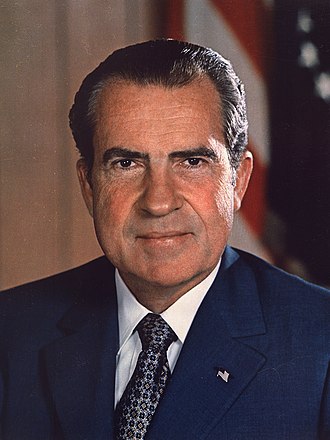
Richard M. Nixon served as the 37th President of the United States from January 1969 until his resignation in August 1974. In February 1971, he ordered the installation of a secret voice-activated taping system in the White House to preserve a historical record of his administration. Until the system's existence was revealed and dismantled in July 1973, the tapes captured Nixon directing major foreign policy initiatives, such as the opening to China, as well as his central role in the Watergate cover-up.
What Nixon talks about on the tapes
White House operations 4,718Presidential scheduling 2,225Public relations 1,784Presidential schedule 1,782Vietnam War 1,693Logistics 1,650Manolo Sanchez 1,626White House communications 1,400White House administration 1,399Presidential communication 1,243Henry Kissinger 1,191Foreign Policy 1,183
Conversations (21,010)
— Page 105 of 211President Nixon met with Beverly J. Kaye at Camp David to provide administrative instructions regarding the processing of his briefing materials. He requested that she review specific briefing books to transcribe paragraphs he had underlined and include any marginal notes he had added. The primary goal of this task was to create simplified, focused folders for the President's personal use, and Nixon encouraged Kaye to enjoy the amenities of the retreat during her stay.
President Nixon and H.R. Haldeman met to finalize logistical and rhetorical preparations for the upcoming Soviet Union summit, specifically focusing on speech guidelines and the efficient management of briefing materials. The discussion extended to 1972 election strategy, where Nixon emphasized the political necessity of adopting a strong stance on busing in key states based on George Wallace’s recent primary performance. Furthermore, they addressed ongoing frustrations with Senate opposition to Vietnam War policies and the need to maintain engagement with John Connally during his transition period.
President Nixon communicated briefly with the Camp David operator to facilitate an incoming telephone call. The exchange served as a logistical transition, allowing the President to connect with an unidentified party. No policy discussions or significant administrative decisions occurred during this brief request for line access.
President Nixon and Harry S. Dent discussed the political implications of the 1972 Democratic primary, specifically focusing on George Wallace’s unexpected success in Michigan and the potential for a GOP electoral victory. The two also addressed the logistics of a private presidential visit to Wallace following his recent injury, with Nixon expressing a desire to avoid press coverage. Finally, the President defended his recent decision to implement a naval blockade in Vietnam, asserting that it was a necessary and correct strategic move to bolster both South Vietnamese and American morale.
President Nixon contacted the Camp David operator to facilitate an urgent phone connection with National Security Advisor Henry A. Kissinger. This brief interaction served as a procedural request to initiate high-level communication. The conversation reflects the President's reliance on White House operators to manage secure and immediate access to his key foreign policy advisor.
President Nixon and Henry Kissinger met to refine the strategy and messaging for the President’s upcoming trip to the Soviet Union. Nixon provided specific revisions for his prepared speech, emphasizing the importance of anecdotal material and a focus on mutual respect rather than ideological rhetoric, while also reviewing plans for his itinerary and plenary sessions. Furthermore, Nixon expressed clear preferences regarding the structure of diplomatic meetings, insisting that cabinet members like Secretary of State William P. Rogers should not have separate, unscripted meetings with Soviet leadership to ensure a disciplined, protocol-driven approach.
President Nixon contacted the Camp David operator to facilitate a telephone connection with his Chief of Staff, H.R. Haldeman. This brief administrative exchange served as an essential operational step for the President to coordinate executive communications while stationed at the presidential retreat. No policy decisions or substantive matters were discussed during this brief request.
President Nixon dictated a memorandum regarding his previous interactions with Nikolai Podgorny of the USSR during the funeral of Charles de Gaulle. The discussion focused on clarifying the accuracy of US intelligence reports concerning Soviet interest in meeting with the President. Nixon emphasized the need for the CIA to provide more precise assessments of these high-level diplomatic encounters.
President Nixon contacted the Camp David operator to facilitate an outgoing call. This brief interaction served as a logistical step for the President to initiate further communication through the camp's switchboard. No significant policy decisions were reached during this exchange, which functioned primarily as a routine telecommunications task.
President Nixon and H.R. Haldeman discussed the logistics and potential political optics of a presidential visit to Governor George Wallace, who was recovering in the hospital following an assassination attempt. The two men also reviewed the ongoing 1972 election landscape, specifically examining George Wallace’s impact on third-party ballot access and the surprising momentum of George McGovern’s campaign through grassroots organizing. Nixon concluded the call by reflecting on the challenges of maintaining his own physical schedule and rest in anticipation of an upcoming trip to the Soviet Union.
President Nixon and H. R. Haldeman discussed the political implications of George Wallace's recovery following the recent assassination attempt on his life. They deliberated over the timing and optics of a potential presidential phone call to Wallace at Walter Reed hospital, ultimately deciding to postpone any contact to avoid media scrutiny and negative associations. Additionally, the pair analyzed the broader political landscape, including the growing momentum of George McGovern’s primary campaign and the impact of Wallace’s potential absence on the upcoming Democratic convention.
President Nixon contacted the Camp David operator to facilitate a telephone connection with his personal physician, Dr. Walter R. Tkach. The brief exchange served as a routine administrative request to place the call. No substantive policy discussions or complex developments occurred during this interaction.
President Nixon contacted the Camp David operator to facilitate a telephone connection. The primary purpose of the brief interaction was to request that the operator place a call to a Dr. Dukash. No other substantive policy discussions or significant political developments occurred during this exchange.
President Nixon consults with his personal physician, Dr. Walter R. Tkach, regarding the health and recovery schedule of White House valet Manolo Sanchez and the worsening medical condition of Governor George C. Wallace following his assassination attempt. The President coordinates a recovery plan for Sanchez to vacation in Florida and discusses the potential risks of moving Wallace to Walter Reed Hospital due to complications from his wounds. Nixon determines he will make a quiet, private visit to see Wallace, while continuing to send regular updates and well wishes to the governor.
President Nixon consulted with his physician, Dr. Walter R. Tkach, regarding the medical status and transfer plans for Manolo Sanchez. Nixon directed Tkach to arrange for Sanchez’s convalescence in Florida following his medical treatment, emphasizing strict secrecy to prevent premature expectations or media attention. The President also discussed maintaining a discreet level of support by regularly expressing his well-wishes through Tkach without directly intervening in the hospital situation.
President Nixon contacted the Camp David operator to facilitate a telephone connection with his Chief of Staff, H.R. Haldeman. This brief interaction served solely as an administrative request to bridge communication between the President and a key advisor. No substantive policy discussions or decisions occurred during the exchange.
President Nixon communicated briefly with the Camp David operator via the facility's hard wire system. The exchange concerned logistical operations regarding the President's telephone connectivity from the Aspen Lodge. No substantive policy matters or major administrative decisions resulted from this short technical interaction.
President Nixon and H.R. Haldeman discuss the medical status of George C. Wallace following an infection that delayed his transfer to Walter Reed Hospital. Nixon considers the logistics and political implications of visiting Wallace, tasking Haldeman with consulting Dr. Lukash and the Secret Service regarding a potential helicopter arrival at the hospital. The conversation concludes with administrative arrangements to have a courier transport documents and the President's dog, King Timahoe, to Camp David.
President Nixon and H.R. Haldeman discuss the scheduling of a personal visit to an associate named Kash, who is currently hospitalized with an infection. Nixon evaluates the logistics of visiting the hospital via helicopter and requests that Haldeman coordinate with trusted Secret Service agents to assess landing site feasibility. Additionally, Nixon asks for his dog to be transported to Camp David to accompany him on walks during his stay.
President Nixon contacted the Camp David operator to facilitate a telephone connection with his special counsel, Charles W. Colson. The brief exchange served purely administrative purposes to establish communication with a key member of the White House staff. No policy matters or substantive political issues were addressed during this short request.
President Nixon initiated a brief communication with the Camp David operator from the Aspen Lodge study. The interaction was primarily administrative in nature, serving to facilitate necessary telephonic connections for the President. No substantive policy discussions or significant political decisions occurred during this brief exchange.
President Nixon and Charles Colson discuss the political fallout of the assassination attempt on George C. Wallace and how to frame the incident to benefit the administration. Nixon directs Colson to have his staff research and plant historical parallels—specifically regarding Franklin D. Roosevelt and Harry Truman—in the press to counter liberal narratives about societal violence. Additionally, they strategize on exploiting Democratic divisions by attacking George McGovern and Hubert Humphrey on contentious issues like busing, amnesty, marijuana, and abortion to alienate key Democratic voting blocs.
President Nixon and Charles Colson discussed strategies to counter liberal media narratives by highlighting historical precedents of political violence under Democratic administrations. The two focused on shifting public discourse regarding political unrest and social issues like busing by utilizing targeted mailers to opinion leaders and editors. Nixon encouraged a more aggressive communication approach to challenge liberal rhetoric and influence the upcoming political climate.
President Nixon contacted the Camp David operator to facilitate a telephone connection with John N. Mitchell. The primary purpose of the brief exchange was to initiate a private conversation with his former Attorney General and campaign associate. No substantive policy matters were discussed during this request for assistance.
President Nixon initiates a brief request to the Camp David operator to be connected with John Mitchell. The conversation serves solely as a logistical bridge to facilitate direct communication with the former Attorney General. No substantive policy matters or further details were discussed during this short exchange.
President Nixon and John Mitchell discuss the 1972 Democratic primary developments, specifically George McGovern's momentum following the Michigan primary and the implications of the shooting of George Wallace. The conversation highlights busing as a potent symbolic issue and the strategic importance of the upcoming California primary. Additionally, Nixon and Mitchell review the success of the recent mining and bombing campaign in North Vietnam, expressing confidence that the blockade is effectively crippling enemy logistics despite military or intelligence skepticism.
President Nixon and John Mitchell discuss current political developments, including Democratic primary trends and the potential impact of busing as a campaign issue. The conversation shifts to the administration's military strategy in Vietnam, with Nixon justifying the blockade and bombing campaigns as necessary measures despite the risk of canceling the Moscow summit. Nixon expresses confidence that these actions have improved domestic and South Vietnamese morale, maintaining that securing a favorable outcome in Vietnam is his overriding priority.
President Nixon contacted the Camp David operator to facilitate an urgent communication with General Alexander M. Haig, Jr. The brief exchange served solely as a logistical request to establish a telephone connection between the President and his deputy assistant for national security affairs. No substantive policy matters were discussed during this request.
President Richard M. Nixon utilized the time at the Aspen Lodge at Camp David to dictate a personal diary entry. While a portion of the recording remains withdrawn for privacy considerations, the session functioned as a reflective record for the President. No further policy developments or participants were recorded in this brief dictated segment.
President Nixon communicated with the Camp David operator from the Aspen Lodge study to address logistical or telecommunications needs. As the transcript is unavailable, the specific content of the request remains unrecorded, though it reflects the President's routine interactions with support staff while residing at the retreat. This brief exchange serves as a functional record of administrative operations at Camp David.
President Nixon recorded a brief diary entry while at Camp David, which included a request for a status report from General Alexander Haig. The discussion focused on military developments in Vietnam, specifically questioning the intent behind troop movements and the intensity of airstrikes in the canton area. The exchange reflects the President’s close monitoring of tactical operations during a critical phase of the Vietnam War.
President Nixon and Alexander Haig reviewed the status of ongoing military operations in South Vietnam, specifically noting that North Vietnamese attacks at An Loc and Kontum appeared to be faltering. Expressing deep frustration with the lack of creativity from the CIA and State Department, Nixon ordered Haig to intensify psychological warfare efforts to exploit the enemy's morale. The President directed that the intelligence community develop new, aggressive propaganda initiatives, including false reports about additional B-52 deployments, to instill fear and hasten the enemy's collapse.
President Nixon and Alexander Haig discuss military operations and psychological warfare tactics concerning the conflict in Vietnam. Nixon expresses frustration with the lack of aggressive propaganda efforts and urges Haig to initiate a deception campaign aimed at demoralizing enemy forces through misinformation and exaggerated reports of increased B-52 bomber deployments. Additionally, Nixon suggests retaliatory air strikes in response to recent attacks on American equipment and personnel.
President Nixon instructed the Camp David operator to place a telephone call to political columnist Stewart Alsop in Washington, D.C. The primary purpose of this contact was to facilitate a direct conversation between the President and the journalist. This action highlights Nixon's ongoing efforts to engage with influential members of the press during his administration.
President Nixon instructed the Camp David operator to relay a directive to intelligence agencies—specifically mentioning Richard Helms’ organization—demanding immediate, creative propaganda strategies regarding the Vietnam War. Frustrated by a perceived lack of initiative, Nixon insisted that staff work through the night to develop non-routine ideas that could strike terror into the enemy. The conversation concluded with the President emphasizing the urgency of the situation and acknowledging the ongoing efforts of the support staff.
President Nixon met with Beverly J. Kaye and an unidentified individual in the Aspen Lodge study at Camp David. The majority of the recorded session consists of a withdrawn segment classified as personal and returnable. No substantive policy discussions or official administrative actions are documented for this exchange.
President Nixon initiated a telephone call through the Camp David operator to establish contact with his aide, Charles W. Colson. The brief exchange served as a logistical request to facilitate this communication. No further policy or strategic matters were discussed during this connection.
President Nixon communicated with the Camp David operator to facilitate urgent contact with Charles W. Colson. The operator confirmed that a message had been left at Colson's residence and that he was currently en route. No further actions or substantive policy discussions occurred during this brief administrative exchange.
President Nixon held a brief, informal exchange with a Camp David operator at the Aspen Lodge. The conversation consisted of lighthearted pleasantries rather than substantive policy discussion or strategic decision-making. No official business or actionable items were addressed during this short interaction.
President Nixon consulted with the Camp David operator to conduct a technical test of the communications equipment within the Aspen Lodge. The exchange served primarily as a functional check of the taping system and internal telephone lines. No substantive policy matters or political discussions were addressed during this brief procedural interaction.
President Nixon contacted the Camp David operator to facilitate an urgent communication with his Press Secretary, Ronald L. Ziegler. The brief exchange served solely as a logistical request to initiate a phone call. No further substantive policy matters or discussions were captured during this short administrative interaction.
President Nixon requested a quiet atmosphere while stationed at the Aspen Lodge in Camp David. He instructed the operator to minimize interruptions to ensure a period of solitude. No other substantive policy or political matters were addressed during this brief exchange.
President Nixon and Charles Colson discuss strategies for maintaining public support for the administration's decision to blockade and mine North Vietnamese harbors, including coordinating favorable press coverage and speeches from allies. They review the political fallout of the attempted assassination of George Wallace, concluding it will not significantly shift voting patterns, and strategize on using the event to highlight issues like gun control and civil unrest. The conversation also shifts to the 1972 election, where they analyze primary results in Michigan and Maryland and affirm the importance of appealing to the "silent majority" over elite establishment interests.
President Nixon and Charles Colson discuss strategies for managing public and political opposition following a recent administration announcement. The pair focuses on pressuring Democratic critics and media network owners, concluding that the administration must aggressively confront its political opponents. Nixon emphasizes the need for continued, combative engagement to ensure the opposition remains out of step with the public.
President Nixon instructed the Camp David operator to cancel an existing call with Press Secretary Ronald L. Ziegler. However, after confirming the frequency of Ziegler's outreach, Nixon reversed his decision and agreed to accept the communication. The operator confirmed the call would be reconnected within approximately five minutes.
President Nixon requested that the Camp David operator cancel a previously placed call to the signaler. The brief exchange focused exclusively on managing telecommunications logistics while the President was at Aspen Lodge. The interaction concluded with the operator confirming they would handle the request.
President Nixon and H.R. Haldeman discussed political optics, specifically regarding Vice Presidential speculation and the administration's strategy for managing unfavorable press coverage. They evaluated the public response to the upcoming Soviet summit and the potential for a campaign to expose media hypocrisy regarding the President's Vietnam policies. Additionally, they deliberated the logistical and political implications of a presidential visit to George Wallace following his assassination attempt, while also assessing the anticipated developments in the Vietnam conflict.
President Nixon contacted the Camp David operator to facilitate a telephone connection with his special counsel, Charles W. Colson. The call served purely as a logistical request to bridge the President to his aide. No substantive policy matters or further developments were addressed during this brief exchange.
President Nixon met with an unknown female individual at the Aspen Lodge study to discuss the logistics of securing a door latch. The brief exchange focuses on technical or maintenance-related concerns regarding the facility's hardware. No broader policy or administrative developments resulted from this minor interaction.
President Nixon initiates a brief communication via the Camp David operator to request a connection with Chuck Coulson. The exchange serves exclusively as an administrative bridge to facilitate a subsequent conversation with a key staff member. No substantive policy discussions or decisions are recorded during this brief operator-assisted call.
President Nixon and Charles Colson discuss the 1972 election landscape, specifically noting Nixon's strong polling performance in the Michigan and Maryland primaries and the political vulnerability of Democratic candidates. They evaluate the importance of the busing issue, the potential impact of George Wallace's candidacy, and the positive public reception to the President’s handling of recent domestic and foreign crises, including the assassination attempt on Wallace and the Vietnam War. Nixon and Colson decide to maintain a hard line on the Vietnam bombing campaign leading into the upcoming Soviet summit while planning a focused media strategy to highlight the administration's global achievements upon the President's return.
President Nixon and Charles Colson discuss the political fallout and public relations surrounding the recent assassination attempt on George Wallace. They evaluate the administration’s response to Wallace’s injury, the impact of busing as a political issue, and strategies for maintaining a strong stance on the ongoing bombing campaign in Indochina. Nixon emphasizes his intent to avoid appearing to back down in the face of international criticism, reinforcing a firm diplomatic line regarding the Soviet Union.
President Nixon contacted the Camp David operator to facilitate an urgent communication with his Chief of Staff, H.R. Haldeman. This brief administrative interaction served as the necessary logistical step to connect the President with his key advisor during his stay at the presidential retreat. No substantive policy discussions occurred during this exchange.
President Nixon contacted the Camp David operator to request a telephone connection to the Parliament. This brief interaction served as a logistical step to facilitate an external communication. No substantive policy discussions or complex administrative decisions occurred during this exchange.
President Nixon and H. R. Haldeman coordinated the logistics for a clandestine visit to George Wallace, who was recovering at Holy Cross Hospital, to discuss Wallace's potential political alignment with the administration. The two also reviewed scheduling for upcoming meetings with Soviet officials and congressional leaders regarding the approaching Moscow summit. Additionally, they deliberated on the optics of gift exchanges between heads of state, specifically deciding to frame the reciprocal gifting of a Cadillac and a hydrofoil as a formal government exchange to mitigate public relations concerns.
President Nixon and H. R. Haldeman met at Camp David to coordinate upcoming logistical arrangements, including travel security and media management for a planned public appearance. They discussed avoiding a large press caravan at Walter Reed by opting for an alternative landing site and streamlined their schedule for meetings with political leaders and the press. Additionally, the pair strategized on diplomatic gift-giving, specifically determining that the exchange of a hydrofoil with the Soviet government should be presented as an official state gesture rather than a personal transaction.
President Nixon contacted the Camp David operator to facilitate a telephone connection with his Chief of Staff, H.R. Haldeman. This brief administrative interaction served as a logistical step to coordinate executive communications while the President was at the presidential retreat. No substantive policy matters were discussed during this specific exchange.
President Nixon consulted with a staff member at Camp David to ensure that a gift jacket intended for Soviet Ambassador Anatoliy F. Dobrynin was the correct size. The discussion confirmed that a replacement jacket had been moved to the cabin to accommodate the Ambassador ahead of an upcoming luncheon. This logistical exchange served to finalize arrangements for the gift prior to the President's scheduled meeting with the Soviet official.
President Nixon held a brief administrative interaction with the Camp David operator to facilitate telecommunications from the Aspen Lodge. The conversation served as a functional check of the facility's hard wire connection system. No substantive policy matters or historical developments were recorded during this exchange.
President Nixon and H. R. Haldeman discuss the public relations risks associated with the President gifting a Cadillac to Soviet leader Leonid Brezhnev. They weigh the optics of this exchange against the precedent of receiving pandas from the People’s Republic of China, emphasizing that the gift is a reciprocal trade for a Soviet hydrofoil rather than an ostentatious gesture. To mitigate potential criticism regarding the expense, Nixon directs Haldeman to involve Richard A. Moore in crafting a narrative that frames the transaction as a balanced, material exchange between the two nations.
President Nixon and H. R. Haldeman discuss the potential public relations fallout regarding the exchange of high-value gifts between the United States and the Soviet Union. Nixon emphasizes the need to frame the situation by highlighting the reciprocal nature of the gift-giving—specifically the trade of a Soviet hydrofoil for an American car—to mitigate concerns about ostentatiousness. The President instructs Haldeman to consult with staff to craft a narrative that frames these exchanges as balanced and diplomatic rather than extravagant.
President Nixon contacted the Camp David operator to facilitate a follow-up communication. The brief interaction served as a logistical request to place a call to White House Chief of Staff H. R. Haldeman. No substantive policy discussions occurred during this exchange.
President Nixon contacted the Camp David operator from the Aspen Lodge study to facilitate an outgoing telephone call. This brief interaction served administrative purposes to connect the President with another party. No substantive policy discussions or decisions were recorded during this connection.
President Nixon and H.R. Haldeman discussed strategies to procure a Cadillac as a gift for Soviet leader Leonid Brezhnev without utilizing taxpayer funds. Nixon expressed concern over potential public relations optics and proposed that General Motors donate the vehicle directly to avoid government expenditure. The two agreed that a corporate donation would resolve potential controversy, and Haldeman committed to facilitating the arrangement with GM.
President Nixon and H. R. Haldeman discuss the logistics and potential public relations fallout of providing a Cadillac to Soviet officials. Nixon recalls past efforts to introduce American industrial goods to the Soviet Union and suggests that General Motors should donate or fund the vehicle to avoid the appearance of using taxpayer money. The President emphasizes the importance of avoiding government expenditures on the gift to mitigate potential criticism.
President Nixon and Treasury Secretary George P. Shultz discussed the management and staffing of the Treasury Department during the transition period. Shultz recommended retaining the existing, well-regarded staff for the remainder of the year while supplementing them with external advisors like Milton Friedman to foster more creative policy thinking on issues like tax reform. The President approved this approach and authorized Shultz to move forward with specific personnel nominations for Deputy and Undersecretary positions.
President Nixon advises George Shultz on the reorganization of his staff and the management of his new department, emphasizing the need for fresh perspectives and independent aides. Nixon encourages Shultz to recruit outside advisors, such as Milton Friedman, to foster new ideas and urges him to begin planning tax reform initiatives immediately rather than waiting for the next legislative session. The President grants Shultz broad autonomy to manage his team and administrative appointments as he sees fit.
President Nixon contacted the Camp David operator to facilitate a telephone connection with his personal secretary, Rose Mary Woods. This brief communication served solely as a logistical request to bridge the line for administrative coordination. No further policy or political matters were addressed during this exchange.
President Nixon contacted the Camp David operator from the Aspen Lodge study to facilitate an external telephone communication. This brief exchange served administrative purposes, functioning as a routine request for operator assistance to connect the President to another party. No substantive policy discussions or major decisions were recorded during this brief interaction.
President Nixon and Rose Mary Woods discuss logistical preparations for the upcoming U.S.-Soviet Union summit, including clothing requirements for the trip and weather expectations in Moscow. Woods raises a request from Herbert Klein regarding the inclusion of journalist Earl Mazo on the passenger list, despite previous concerns over financing. Nixon directs Woods to coordinate with H.R. Haldeman to verify if Mazo’s travel expenses are fully covered by the Woodrow Wilson International Center for Scholars before finalizing his addition to the trip.
President Nixon and his personal secretary, Rose Mary Woods, discuss logistical preparations and travel concerns ahead of an upcoming trip to Moscow. The conversation shifts to the difficulties of funding support staff and personnel for official travel, specifically noting that government funds cannot cover these expenses for certain individuals. Nixon directs Woods to coordinate with other staff to finalize these arrangements, emphasizing the need for external financing.
President Nixon contacted the Camp David operator to facilitate a telephone connection with his Chief of Staff, H.R. Haldeman. This brief administrative interaction served as a precursor to a higher-level discussion between the President and his top aide. No substantive policy matters were addressed during this exchange.
President Nixon contacted the Camp David operator to facilitate a telephone connection. This brief interaction served administrative purposes to enable communication while the President was stationed at Aspen Lodge. No substantive policy discussions occurred during this exchange.
President Nixon and H. R. Haldeman discussed concerns regarding journalist Earl Mazo’s attempts to secure financing for a trip to the Soviet Union. Nixon emphasized that the White House could not justify providing a discounted rate or government funding for the travel, insisting that Mazo must secure independent financing through channels like the Woodrow Wilson Center. Haldeman agreed to coordinate with Communications Director Herbert Klein and Press Secretary Ronald Ziegler to resolve the logistical and funding issues surrounding the trip.
President Nixon and H. R. Haldeman briefly discuss the logistics of Earl Mazo's travel arrangements and potential financial concerns. The two evaluate whether Mazo can be justified for a "cut rate" or subsidized travel, considering Herb Klein's interest in the matter. They ultimately resolve to address the ambiguity of the financing through further coordination with Xavier.
President Nixon contacted the Camp David switchboard operator to facilitate a personal phone call to First Lady Pat Nixon. The brief interaction served solely to request that the operator connect the President to his wife. No substantive political or administrative matters were discussed during this request.
President Nixon initiates a brief telephonic request through the Camp David operator to be connected with an individual identified as Mr. Jackson. This exchange serves strictly as an administrative call to facilitate communication with a specific party. No further policy discussions or significant decisions occur during this brief operator-assisted connection.
President Richard Nixon and First Lady Pat Nixon discussed logistical preparations for their upcoming international trip, specifically coordinating their wardrobe selections based on varying regional weather forecasts. They reviewed the climatic conditions for their scheduled stops, including Moscow, Iran, Austria, and Warsaw, to determine appropriate clothing needs. The First Lady also updated the President on positive public reception to the redecorated Blue Room and confirmed that their scheduled travel arrangements remained on track.
President Richard Nixon and First Lady Pat Nixon coordinate personal logistics and wardrobe preparations for an upcoming trip to Iran. The couple discusses the expected weather conditions to determine appropriate clothing requirements, specifically the need for both lightweight and heavier attire. Additionally, the President briefly mentions his daily routine at Camp David, including his swimming schedule and social engagements with staff members.
President Nixon and Henry Kissinger spoke via telephone to conduct a brief, routine check of the communication lines between the White House and Camp David. The conversation functioned as a technical verification to ensure secure connectivity for the President while at the retreat. No substantive policy matters were addressed during this call, as it was limited to establishing a clear signal between the participants.
President Nixon, Henry Kissinger, and H.R. Haldeman met at Camp David to coordinate strategy for the upcoming Moscow summit and address domestic concerns regarding Vietnam and institutional opposition. Kissinger detailed the successful navigation of complex negotiations with the Soviet Union, including the SALT agreement and various bilateral accords, emphasizing the necessity of Nixon's personal oversight in achieving these breakthroughs. The group also discussed the logistics of upcoming television addresses and public diplomacy, while Nixon expressed deep frustration with the Ivy League establishment and anti-war critics, vowing to shift federal funding away from resistant institutions.
President Nixon instructed H. R. Haldeman to direct OMB Director Caspar Weinberger to immediately terminate federal funding for the Massachusetts Institute of Technology (MIT). Nixon expressed frustration that John Ehrlichman had previously delayed this action due to influence from George Shultz. Haldeman confirmed he would relay the order to Weinberger to ensure the funding cutoff was executed as demanded.
President Nixon contacted the Camp David operator to facilitate an urgent connection to his Chief of Staff, H.R. Haldeman. This brief administrative exchange served as a logistical bridge to manage ongoing presidential business from the retreat. No substantive policy discussions occurred during this communication as it was strictly focused on establishing a secure line for further high-level deliberations.
President Nixon communicated with the Camp David operator from the Aspen Lodge study to handle routine telecommunications logistics. The brief interaction focused on facilitating necessary administrative connectivity for the President during his stay at the retreat. No substantive policy discussions or major strategic decisions occurred during this brief exchange.
President Nixon and H. R. Haldeman coordinated the logistics for adding Dr. William Chase to the official party for the upcoming Soviet Union summit. To avoid unwanted attention regarding a dentist's presence, they agreed to classify Chase as a staff member and emphasize his Russian heritage as his primary justification for joining the trip. Additionally, the pair finalized a covert plan for Nixon to visit Governor George Wallace at Holy Cross Hospital following a stop at Walter Reed, ensuring the Secret Service had sufficient notice to manage the move.
President Nixon and H. R. Haldeman coordinate a secret visit to Walter Reed Hospital, discussing the logistics of avoiding public attention during the stop. The President also reviews plans to include a long-time associate in his official party, citing the individual's counsel and political alignment. They finalize the travel sequence for the upcoming trip, ensuring Secret Service coordination for the unscheduled hospital visit.
President Nixon initiates a brief telephonic request with the Camp David operator to connect him with H. R. Haldeman. This administrative interaction serves as a logistical bridge to facilitate further communication between the President and his Chief of Staff. No policy discussions occur during this short exchange, as it is strictly a request for assistance in establishing a line of communication.
President Nixon met with Alexander Butterfield at Camp David to coordinate his immediate schedule and review administrative documentation. The discussion addressed the logistics of incoming briefing materials, including Kissinger’s reports and news wires, while also covering the strategic delay of the black lung bill involving John Mitchell. The two finalized the President’s upcoming departure arrangements and handled a confidential tape recording.
President Nixon met with Beverly J. Kaye at the Aspen Lodge study at Camp David to discuss logistical details regarding the President's schedule. The conversation focused on coordination concerning an unidentified male individual and his location. No further substantive actions or policy decisions were recorded during this brief exchange.
President Nixon communicated with a Camp David operator to address an issue regarding a missing or improperly positioned communication link. The discussion centered on the status of a specific wire or equipment connection that was not currently functional. No broader policy or administrative developments resulted from this brief exchange.
President Nixon and H.R. Haldeman briefly conferred regarding the administration's outreach strategy following a recent legislative vote. Nixon inquired about the status of replies to correspondence from VIP supporters and proposed sending personalized 'one-liner' acknowledgments to the 47 senators who voted in favor of the Byrd Amendment. Upon reflection, they collectively decided to abandon the direct outreach to the senators, opting instead to rely on the personal calls Nixon had already initiated.
President Nixon and H. R. Haldeman briefly discussed the administration's protocol for responding to incoming correspondence, including letters and telegrams from VIPs and other supporters. Nixon directed Haldeman to ensure that official replies were being processed for these communications. The President also briefly considered drafting a personal acknowledgment to an individual regarding their vote on the Bird Amendment, though he expressed some hesitation about the political optics of such a move.
President Nixon contacted the Camp David operator to facilitate an urgent connection with his Chief of Staff, H.R. Haldeman. This brief interaction served solely as a logistical bridge to initiate a direct line of communication between the President and his top aide. No substantive policy matters or strategic discussions occurred during this brief exchange.
President Nixon communicated with the Camp David telephone operator from the Aspen Lodge study to handle routine administrative or logistical matters. This brief interaction utilized the Camp David hard wire system, reflecting the President's standard communication procedures while working from the retreat. No substantive policy discussions or significant political decisions were recorded during this brief exchange.
President Nixon and H. R. Haldeman coordinated the public messaging strategy regarding the President’s upcoming trip to the Soviet Union. They discussed the inclusion of specific, favorable editorial themes in the publication 'Monday' to reassure the public of the administration's foreign policy positioning. Haldeman confirmed that these materials, featuring strong rhetoric, were already being finalized for print.
President Nixon and H. R. Haldeman briefly discussed the political strategy for managing public perception following recent foreign policy developments. Haldeman suggested capitalizing on positive editorial commentary and poll data, specifically highlighting themes of presidential strength and resolve. The conversation served to reinforce the use of favorable media framing to bolster the administration's image.
President Nixon met with H. R. Haldeman and Henry Kissinger at Camp David to dictate memoranda regarding administrative management and foreign policy strategy. The discussion focused on establishing editorial accountability during absences, coordinating leaks through Richard Helms to counter negative reporting on North Vietnam, and planning a high-profile diplomatic trip for John B. Connally to Latin America and the Pacific. Nixon directed his staff to finalize recommendations for the Connally mission and strategic communication efforts by the end of the week.
President Nixon directed John Ehrlichman to prepare for a pivot toward a constitutional amendment regarding busing legislation, expressing frustration over the lack of progress in Congress. Nixon argued that the administration's current, more moderate proposal was ineffective and that an amendment would provide a clear ideological battleground against the eventual Democratic presidential nominee. Ehrlichman was instructed to task staff with drafting the amendment for a potential rollout by September or shortly before the Republican National Convention.
President Nixon directed Charles Colson to reorganize administration lobbying efforts to better mirror the aggressive, direct-action tactics used by anti-war radicals. Nixon argued that congressional members were increasingly susceptible to pressure and instructed Colson to coordinate with Clark MacGregor to deploy proactive delegations to secure legislative commitments. The President emphasized that this shift from traditional mail and phone campaigns to face-to-face, intensive lobbying was essential to influence members of Congress effectively.
President Nixon directed H. R. Haldeman to assign a research staffer to compile a comprehensive dossier documenting the various 'smear' campaigns launched against the administration. This memorandum was intended to catalog vicious attacks found in books, films, pamphlets, and political statements by members of Congress. Nixon envisioned this research as a strategic resource to be utilized by administration surrogates if political criticism intensified later in the year.