Nixon, Richard M. (President)
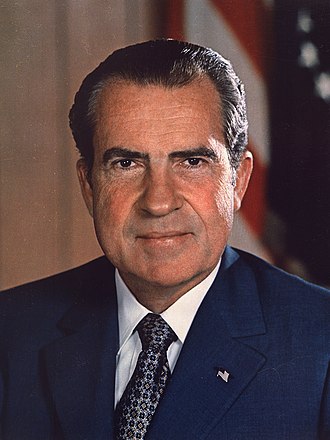
Richard M. Nixon served as the 37th President of the United States from January 1969 until his resignation in August 1974. In February 1971, he ordered the installation of a secret voice-activated taping system in the White House to preserve a historical record of his administration. Until the system's existence was revealed and dismantled in July 1973, the tapes captured Nixon directing major foreign policy initiatives, such as the opening to China, as well as his central role in the Watergate cover-up.
What Nixon talks about on the tapes
White House operations 4,718Presidential scheduling 2,225Public relations 1,784Presidential schedule 1,782Vietnam War 1,693Logistics 1,650Manolo Sanchez 1,626White House communications 1,400White House administration 1,399Presidential communication 1,243Henry Kissinger 1,191Foreign Policy 1,183
Conversations (21,010)
— Page 106 of 211President Nixon met with H. R. Haldeman, Vice President Spiro Agnew, Henry Kissinger, and Admiral Thomas Moorer to coordinate administration responses to the Vietnam War and manage the public narrative surrounding the conflict. The discussion focused on the effectiveness of recent bombing campaigns and the blockade of North Vietnam, as well as the need to address internal military resistance regarding bombing targets. Nixon also received a briefing from Agnew on his recent diplomatic trip to Japan, Thailand, and South Vietnam, and coordinated plans for the Vice President to visit the recently wounded George Wallace.
President Nixon and Henry Kissinger discuss the transition of duties to George Shultz in light of an upcoming ten-day window for Kissinger to finalize his outstanding responsibilities. They confirm that Shultz is prepared to assume his acting role, ensuring a seamless handover of tasks. The exchange serves to solidify the timeline for finalizing Kissinger's current portfolio before shifting focus to new priorities.
President Nixon consulted with the White House operator to facilitate a telephone connection with Admiral Thomas H. Moorer, Chairman of the Joint Chiefs of Staff. The brief administrative exchange touched upon scheduling logistics regarding George Shultz's transition into a new role and the associated timeline for completing relevant tasks. The conversation served primarily as a logistical step to coordinate high-level communication between the President and military leadership.
President Nixon and Admiral Thomas Moorer discuss the logistical timeline for a forthcoming international trip, specifically focusing on travel duration and comfort. They conclude that the transit will require approximately three weeks to complete. The brief exchange confirms that Moorer's scheduling conflicts, specifically his commitments involving George Shultz, will be resolved in time to accommodate this mission.
President Nixon met with aide Stephen Bull to discuss the effectiveness of strategic aerial bombing campaigns during the Vietnam War. Nixon expressed frustration over public misconceptions regarding military restrictions, asserting that he had provided the military with full operational freedom. The discussion emphasized the psychological impact of B-52 strikes versus the limitations of smaller fighter aircraft like the F-4.
President Nixon and Vice President Spiro Agnew met to coordinate logistics for an upcoming public event, specifically focusing on an escort to the press room. Stephen B. Bull and Ronald Ziegler participated in the discussion, which involved arrangements concerning Tricia Nixon Cox. The meeting served as a continuation of prior deliberations regarding administrative preparations for these individuals.
President Nixon and Alexander P. Butterfield met briefly to finalize details regarding the President's upcoming schedule. The primary focus of the discussion was a planned press reception, specifically addressing the participation and potential remarks of First Lady Pat Nixon. Ultimately, the President decided against receiving a specific group of attendees at the event.
President Nixon met with his senior staff, including H.R. Haldeman, Henry Kissinger, and John Ehrlichman, to coordinate messaging and strategy ahead of his upcoming Soviet Summit. The group discussed controlling the flow of information to the press—specifically managing William Rogers's public statements to ensure they did not conflict with the President's own summit briefings—and addressed Vietnam military policy, including the President's frustration with air strike performance. Additionally, the President and his staff reviewed domestic legislative priorities, such as the black lung bill veto, busing policy, and welfare reform, while also discussing the investigation into Arthur Bremer following the assassination attempt on George Wallace.
President Nixon met with George P. Shultz to discuss Shultz's transition into the role of Secretary of the Treasury and to outline administration priorities. The President urged Shultz to restructure the Treasury Department with a new, younger team while managing delicate congressional relationships, specifically with Wilbur Mills and Russell Long. They also discussed economic strategy, including tax reform, wage and price controls, and the recruitment of economist Milton Friedman to assist with policy development.
President Nixon met with Stephen B. Bull to discuss the coordination of international economic business, directing Bull to oversee Peter Flanagan in a manner similar to former Treasury Secretary John Connally. Nixon emphasized that Flanagan requires guidance in this field and stressed the need for strict adherence to the projected federal budget. Additionally, Nixon instructed that the administration must maintain a public stance favoring the removal of wage and price controls leading up to the election.
President Nixon and H. R. Haldeman discuss the scheduling of upcoming meetings, including sessions with Henry Kissinger and Senator Jacob Javits. The conversation primarily focuses on managing the administration's public messaging regarding the upcoming Soviet summit, specifically addressing a press conference held by William P. Rogers. Nixon and Haldeman analyze a news report by Marvin Kalb, suspecting that information provided at a private dinner party involving the Kalb brothers and Kissinger served as the underlying source.
President Nixon met with William J. Porter and Henry Kissinger to discuss the deteriorating state of the North Vietnamese offensive and the resulting strategic opportunities for the U.S. in Paris peace negotiations. Nixon expressed significant frustration with military leadership regarding air strike restrictions and ceiling limitations, demanding that bombing missions against North Vietnamese supply lines continue aggressively. The group ultimately agreed that the U.S. should maintain its current pressure and refuse a plenary session in Paris until private negotiations yield substantive progress.
President Nixon met with an unidentified individual to discuss international objectives, specifically regarding the capabilities and motivations of the Soviet Union. The dialogue touched upon the perceived inefficiencies caused by Soviet bureaucracy and the tendency of media networks to engage in speculative reporting. Nixon emphasized the necessity of avoiding bureaucratic entrapment as they navigated these complex foreign policy challenges.
President Nixon met with his aide Stephen B. Bull to review and adjust the presidential schedule for the day. The discussion primarily focused on coordinating the timing of a meeting with Henry Kissinger and arranging a barber's appointment. Nixon explicitly instructed Bull to prioritize his schedule, noting that Kissinger would be required to wait if the President's other commitments ran overtime.
President Nixon met with H. R. Haldeman and Henry Kissinger to refine talking points and press strategy for the upcoming Soviet summit, including plans for post-summit reports to the American public and the Senate. The discussion also addressed frustrations with bureaucratic resistance to the President's directives, specifically regarding psychological warfare and the procurement of equipment for South Vietnam. Nixon and Kissinger further evaluated military operations in Vietnam, expressing dissatisfaction with the military's target limitations and their perceived efforts to avoid responsibility for the ongoing conflict.
President Nixon contacted the White House operator to facilitate a telephone connection with Press Secretary Ronald L. Ziegler. This brief administrative exchange served solely to bridge the communication to a senior staff member for further discussion. No policy matters or substantive political topics were addressed during this initial operator interaction.
President Nixon held a meeting with an unidentified individual in his Old Executive Office Building office to discuss the retention of an unknown document or item. The conversation concluded with a brief, informal sign-off, leaving the specific nature of the materials and any resulting directives ambiguous. No further policy developments or definitive actions are discernible from the brief recorded exchange.
President Nixon held a meeting with an unidentified individual in his Old Executive Office Building workspace to discuss matters that remain undocumented due to the lack of an available transcript. The conversation occurred within a 82-minute window, though the specific agenda and any resulting administrative actions or decisions are currently unknown. Historical researchers are unable to verify the participants or the substance of the dialogue based on existing archival records.
President Nixon met with Henry Kissinger and Alexander Haig to express intense frustration regarding the bureaucracy's failure to execute his orders concerning the Vietnam War. He sharply criticized the CIA for a lack of imagination in psychological warfare and denounced the Pentagon for harboring "McNamara-era" personnel who he claimed were sabotaging his policies. To rectify these performance issues, Nixon mandated an increase in B-52 deliveries and announced he would bypass standard command structures by selecting a naval commander to oversee specific bombing operations in North Vietnam.
President Nixon expresses intense frustration regarding the U.S. Air Force's failure to execute critical military operations as ordered. He criticizes the leadership for failing to strike important targets despite having the necessary opportunities. Nixon signals his intent to intervene and expose these operational deficiencies to ensure future compliance with his military directives.
President Nixon expresses a firm demand for increased administrative discipline and control over the operations of the State Department, the Pentagon, and the CIA. He emphasizes the need for centralized authority in his dealings with these government agencies and military branches. This directive highlights the President's ongoing efforts to assert tighter executive oversight across his foreign policy and national security apparatus.
President Nixon dictates a sharp memorandum for Alexander Haig and Henry Kissinger expressing his deep dissatisfaction with military leadership, specifically naming General Creighton Abrams. He demands that underperforming officials either improve their performance or vacate their positions. The President concludes by arranging for the administrative handling and transcription of these instructions.
President Nixon held a brief, informal meeting with an unidentified individual, likely a staff member or guest, in the Old Executive Office Building. The exchange remained purely social, concluding with lighthearted remarks about leaving a person named Pat behind and maintaining the status quo at the office. No substantive policy discussions or official directives were recorded during this brief interaction.
President Nixon instructed the White House operator to facilitate a meeting by directing an unnamed individual to the Executive Office Building. This brief exchange served as a logistical coordination to ensure the individual's arrival upon being summoned. The conversation underscores the procedural reliance on operators to manage the President's immediate scheduling and visitor access.
President Nixon and Press Secretary Ronald Ziegler coordinate the logistics and talking points for an upcoming press reception regarding the President’s imminent trip to the Soviet Union. Nixon emphasizes that his remarks at the event must be on the record and decides to extend invitations to Secretary of State William P. Rogers, Henry Kissinger, and their staff as a professional courtesy. The two also review specific briefing schedules and travel accommodations, ultimately agreeing that Nixon will announce his planned televised address to the Russian people while maintaining flexibility regarding daily briefing commitments.
President Nixon and Press Secretary Ronald Ziegler discuss the logistics and media protocols for an upcoming debate. Nixon decides that the event must be on the record for the press and directs Ziegler to offer the attendees a transcript instead of allowing live media coverage. The President also reviews the guest list, ultimately opting to include Secretary of State William Rogers and Congressman Pete McCloskey to ensure a broader presence.
President Nixon directs the White House operator to place a telephone call to former Secretary of the Treasury John B. Connally. The interaction serves as a brief logistical request to initiate a direct line of communication between the President and Connally. No further substantive discussion occurs during this short administrative exchange.
President Nixon met with H.R. Haldeman and John B. Connally to coordinate strategy for the upcoming U.S.-Soviet summit and to organize a diplomatic trip for Connally to South America and potentially other regions. The participants discussed managing the President's public image, strategies to discredit the press, and the logistics of personnel attending the Moscow trip. Additionally, Nixon directed Connally to begin planning his international travel, emphasizing the strategic importance of his mission following the President's return from the Soviet Union.
President Nixon and John B. Connally discuss the logistics and itinerary for Connally's upcoming three-week overseas trip to South America, Australia, and New Zealand. The President instructs Connally to travel via a presidential aircraft with a small staff and emphasizes the importance of keeping planning restricted to a select few to avoid bureaucratic interference. Additionally, they discuss the transition of Treasury responsibilities to George P. Shultz, with Nixon confirming that Shultz will assume the same high-level portfolios and economic authorities previously held by Connally.
President Nixon met with Senator Robert C. Byrd, John Ehrlichman, and Clark MacGregor to discuss the pending black lung benefits bill. Acknowledging the fiscal concerns and potential budget implications, Nixon informed Byrd of his decision to sign the legislation, concluding that a veto would likely be overridden by Congress. They coordinated a public relations strategy for the announcement, agreeing that Byrd would signal his satisfaction with the meeting to the press while emphasizing the President's careful deliberation of the budgetary and humanitarian factors.
President Nixon met with bipartisan Congressional leaders to discuss the upcoming Soviet summit and the administration's strategic approach to international relations. The discussion focused on complex issues including trade, Most Favored Nation (MFN) status for the Soviet Union, and the potential for bilateral cooperation despite ideological differences. Nixon emphasized the importance of maintaining a unified stance to ensure the success of the negotiations while managing domestic political expectations.
President Nixon met with Alexander Butterfield, Ronald Ziegler, and Rose Mary Woods to manage administrative tasks and scheduling priorities. The participants focused on reviewing items requiring the President's signature and coordinating necessary deliveries. Key actions included facilitating a call between Henry Kissinger and Senator John C. Stennis as well as coordinating with Dr. William M. Lukash.
President Nixon and Henry Kissinger met to strategize the domestic political management of the upcoming Soviet summit and the pending Strategic Arms Limitation Talks (SALT) agreement. They discussed the necessity of lobbying skeptical lawmakers, such as Senator Henry "Scoop" Jackson, to ensure support for ABM and offensive weapons provisions. Additionally, they reviewed messaging for the President’s upcoming speeches and press briefings to ensure a cautious, balanced tone that would satisfy both congressional hawks and international concerns.
President Nixon and Alexander Butterfield coordinate the delivery of briefing materials prepared by Henry Kissinger. Butterfield confirms the logistical arrangements for getting these essential documents to the President. This brief exchange ensures Nixon has the necessary background information for his upcoming agenda.
President Nixon contacted the White House operator to facilitate an urgent connection to his Special Counsel, Charles W. Colson. The call served purely as a logistical request to bridge communication between the President and a key aide. No further substantive discussion took place during this brief administrative interaction.
President Nixon directed Charles Colson to maintain daily coordination with Alexander Haig to manage the public relations strategy surrounding the Vietnam War. The President emphasized the need to leak confidential reports regarding North Vietnamese morale to the press without revealing their origin to bolster support for South Vietnamese efforts. Additionally, the pair discussed upcoming publicity for the President's Soviet trip and plans for his visit with George Wallace.
President Nixon contacted the White House operator to facilitate a telephone call to Marjorie P. Acker. This brief administrative interaction served as a direct request for operator assistance to connect the President with a specific individual. No further policy or substantive matters were discussed during this brief exchange.
President Nixon instructs Marjorie P. Acker to organize and formalize a memorandum regarding key administration figures and advisors, including Barry Goldwater, Thomas Moorer, Kenneth Rush, Spiro Agnew, and Edward Teller. The President emphasizes highlighting the importance of these individuals' roles and their alignment with administration goals. Additionally, Nixon requests that efforts be made to bring physicist Edward Teller back for further consultation.
President Nixon contacted the White House operator to place an outgoing call to Chief of Staff H. R. Haldeman. He specifically requested that the operator attempt to reach all of Haldeman’s available locations to ensure the connection was made. The interaction served as a logistical administrative task to facilitate direct communication with his top advisor.
President Nixon and H. R. Haldeman discussed the political reception of the President's recent address to Congress following his historic trip to the Soviet Union. While both men expressed private reservations regarding the quality of the speechwriting, they reviewed positive feedback from various congressional members, newspaper editors, and public segments. The conversation concluded with discussions regarding the upcoming ratification process for the Strategic Arms Limitation Treaty (SALT) and the President's need for rest in Florida.
President Nixon and Charles Colson met to review the successful public relations outcomes of the President's recent trip to the Soviet Union and his handling of the Vietnam War. They discussed the positive media reception of the First Lady’s diplomatic appearances and the strategic effectiveness of the administration's recent military actions in Vietnam, including the mining of harbors and the use of precision-guided bombs. Additionally, the pair evaluated the decline in congressional support for anti-war legislation and received an update on the precarious health status of Governor George Wallace following his assassination attempt.
President Nixon met with his aide Stephen B. Bull to coordinate his morning schedule and manage upcoming appointments. The discussion focused on the timing of a bipartisan congressional leadership meeting and a subsequent session with John D. Ehrlichman. Nixon also issued a specific directive for Bull to arrange a meeting with Henry Kissinger prior to the start of the leadership conference.
President Nixon and Stephen B. Bull met to review and adjust the President's daily schedule regarding upcoming appointments with key advisors and Congressional leaders. Nixon specifically requested a meeting with Henry Kissinger prior to his scheduled session with legislative leadership. Bull coordinated these logistical arrangements to ensure the President's morning agenda remained manageable.
President Nixon met with his aide Stephen B. Bull in the Oval Office to discuss scheduling and logistics related to National Security Advisor Henry A. Kissinger. The brief interaction focused on coordinating Kissinger's activities or appointments. No further actions or developments were recorded beyond these administrative arrangements.
President Nixon, H.R. Haldeman, and Henry Kissinger met to refine the President’s strategy for an upcoming briefing with bipartisan Congressional leaders regarding the recent summit in the Soviet Union. The participants strategized on how to frame the success of the summit and the Strategic Arms Limitation Treaty (SALT) while minimizing the political impact of congressional critics like Henry “Scoop” Jackson. Additionally, they reviewed positive public and media reactions to the President’s recent address and discussed the ongoing conflict in Vietnam.
President Nixon met with key staff members and Henry Kissinger to coordinate domestic political strategy and foreign policy initiatives. The participants discussed managing the Congressional reaction to the recently negotiated SALT agreement, securing support for defense spending, and balancing the Administration's position on welfare reform legislation. Additionally, the President and Kissinger reviewed the recent Moscow summit, focusing on the sophisticated nature of Communist leadership and strategies for countering international criticism of U.S. actions in Vietnam.
President Nixon met with David C. Hoopes in the Executive Office Building for a brief one-minute session. The discussion primarily focused on the President providing specific instructions regarding the operation of the office buzzer system. No other policy or political matters were addressed during this brief encounter.
President Nixon contacted the White House operator to place an outgoing call to John Cardinal Krol in Philadelphia. This brief exchange served as a logistical request to facilitate communication between the President and the high-ranking Catholic official. No further policy discussions or significant substantive developments occurred during this administrative interaction.
President Nixon dictated a memorandum concerning the voting records of John Connally. He directed that the document be transmitted to Connally via a specific delivery sequence to ensure receipt at his second stop. This instruction aimed to prioritize the timely delivery of these voting details to the former Treasury Secretary.
President Nixon met with John B. Connally and Stephen B. Bull to provide instructions and background context for an upcoming international trip undertaken by Connally. The President dictated a memorandum outlining the mission's central theme, which focused on the shifting global balance of economic and political power among the U.S., Western Europe, the Soviet Union, China, and Japan. Nixon also shared personal reflections on his past travels to various nations to assist Connally in his engagements with foreign leaders.
President Nixon met with John N. Mitchell and an unidentified individual to dictate a memorandum regarding administrative matters and coordinate the delivery of specific books to Camp David. The discussion touched upon domestic policy and the handling of personal items or recordings, involving staff members like H.R. Haldeman, Charles Colson, and Alexander Butterfield. This brief administrative session focused primarily on logistical arrangements for the President's upcoming schedule.
President Nixon met with an unidentified female visitor to discuss recent travel experiences and social interactions. The conversation touched upon the President’s previous trip to Key Biscayne, noting his time spent with Charles “Bebe” Rebozo and the local weather conditions. The brief exchange focused primarily on casual social pleasantries and reflections on the President's recreational activities.
President Nixon and Henry Kissinger discuss perceived anti-administration bias and propaganda in media coverage of the Vietnam War and Cambodia. Nixon characterizes reports by journalists such as Anthony Lewis and Selig Harrison as aligned with Communist interests and aimed at influencing the 1972 election. Consequently, the President directs his staff, specifically Charles Colson and Kenneth Clawson, to initiate efforts to discredit these reporters and expose their backgrounds.
President Nixon met with an unknown woman to discuss scheduling matters related to Marjorie P. Acker and the President's upcoming trip to Florida. The conversation touched on logistical details such as weather concerns and the health of White House valet Manolo Sanchez. Additionally, the President facilitated a connection for his guest by offering to arrange a meeting with Cardinal John Krol of Philadelphia.
President Nixon consulted with the White House operator to facilitate an outgoing telephone communication. This routine interaction served as a logistical bridge to connect the President with an unidentified party. No policy decisions or substantive discussions were captured during this brief exchange.
President Nixon briefed Cardinal John Krol on his recent diplomatic trip to Poland, detailing his impressions of the country's leadership, specifically Edward Gierek, and the enthusiastic reception he received from the Polish people. Nixon emphasized the stark contrast between the atmosphere in Poland and the Soviet Union, noting the resilience of the Catholic Church and the Polish populace's latent anti-Soviet sentiment. The two discussed the importance of expanding economic and diplomatic relations with Poland, and Nixon committed to exploring the potential for a high-profile visit to the United States by Polish Cardinal Stefan Wyszynski.
President Nixon met with John Cardinal Krol to debrief him on his recent state visit to Poland, focusing on the country's political climate and the status of the Catholic Church under the communist regime. Nixon shared his impressions of Polish leadership, specifically regarding his interactions with Edward Gierek, and noted the palpable anti-Russian sentiment among the Polish populace. The two discussed the potential for improving U.S.-Poland relations and explored the possibility of facilitating a visit by a prominent religious leader, with Nixon committing to pursue follow-up actions through established diplomatic channels.
President Nixon and H. R. Haldeman met to discuss personnel availability and logistical coordination. The discussion focused on establishing the immediate schedule and accessibility of staff members within the Executive Office Building. No further substantive policy issues were recorded due to the fragmentary nature of the audio.
President Nixon directed Henry Kissinger to facilitate follow-up actions regarding diplomatic relations with Poland, specifically focusing on religious freedom and church-state interactions. The discussion centered on potential exchanges between high-ranking Catholic clergy, such as Cardinal Krol and Cardinal Wyszynski, to leverage the impression of openness conveyed by Polish leader Edward Gierek. Nixon emphasized bypassing the State Department to arrange these sensitive diplomatic channels, viewing the engagement as a significant opportunity for U.S. interests.
President Nixon met with H. R. Haldeman, John Ehrlichman, and Henry Kissinger to strategize his public relations posture ahead of the upcoming Democratic National Convention. The participants reached a consensus that the President should maintain a low-visibility, high-stature profile, focusing primarily on foreign policy successes—such as the recent trips to the Soviet Union and China—rather than engaging in domestic political spectacles. Additionally, they reviewed administrative appointments, including the confirmation of George Shultz and Richard Kleindienst, and discussed the President's upcoming travel and speaking schedule.
President Nixon contacted the White House operator to facilitate a telephone call to First Lady Pat Nixon. The brief interaction served as a logistical bridge to connect the President with his wife. No substantive political or policy matters were discussed during this request.
President Nixon met with Alexander P. Butterfield in the Old Executive Office Building to review the President's upcoming schedule. The discussion focused on the management and coordination of Nixon's official appointments and daily obligations. No specific policy decisions were finalized, as the meeting served primarily for logistical administrative planning.
President Nixon consulted with First Lady Pat Nixon regarding his upcoming schedule and travel arrangements. The discussion focused on coordinating a potential joint trip to Camp David and evaluating the feasibility of the President attending the Rotary Convention in Houston. No final decisions were recorded, though the conversation served to align their personal plans for the immediate future.
President Richard Nixon and First Lady Pat Nixon engaged in a brief, one-minute meeting in the President's Old Executive Office Building office. The recording does not contain a transcript, and no specific policy matters or significant administrative decisions were documented during this interaction. Due to the lack of available dialogue, the session remains categorized as an informal exchange between the President and the First Lady.
President Nixon held a brief, informal meeting with an unidentified individual to exchange pleasantries regarding their recent weekend activities. The conversation touched upon travel and weather conditions in Florida, ultimately concluding with a short tour of the office space. No substantive policy matters or official administrative decisions were addressed during this interaction.
President Nixon held an informal meeting with an unidentified individual, possibly a member of his domestic staff or security detail. The brief dialogue centered on the logistics of returning to a vehicle and the possession of a specific, unnamed item referred to as "dope." No significant policy or political decisions resulted from this exchange, which appears to concern routine personal or administrative tasks.
President Nixon met with an unidentified male visitor in the Old Executive Office Building to conduct business over refreshments. The specific agenda and substantive details of the meeting remain undocumented due to the lack of a transcript. This interaction concludes with the departure of the unknown participant prior to the cessation of the recording session.
President Nixon met with an unidentified individual to coordinate the logistics of a delivery at an unspecified location. The discussion focused on securing the site and ensuring the arrival of a single package or item. The President provided direct instructions to maintain perimeter control during the exchange.
President Nixon and Charles Colson strategize on how to undermine Democratic presidential candidate George S. McGovern by capitalizing on his perceived political vulnerabilities. They discuss efforts to influence key labor leaders, specifically George Meany, to withhold support from the Democratic ticket, while evaluating the potential for securing backing from New York labor unions. The conversation focuses on leveraging institutional relationships and media narratives to frame McGovern as an extreme candidate and solidify labor support for Nixon's re-election campaign.
President Nixon and Charles W. Colson met to discuss strategic administrative and legislative priorities, including the confirmation schedules for Richard Kleindienst and George P. Shultz. The conversation covered personnel matters involving key cabinet officials and the political implications of the President’s recent appearance at a joint session of Congress. They also touched upon national defense policy and administrative planning for upcoming presidential travel.
President Nixon initiated a brief exchange with the White House operator to clarify the source of a recent incoming call. The operator confirmed that H. R. Haldeman had been attempting to reach the President. This interaction functioned primarily as a procedural check to facilitate communication with his Chief of Staff.
President Nixon met with Alexander P. Butterfield to coordinate the President's immediate administrative schedule. The brief discussion centered on the logistical necessity of signing outstanding official documents. The meeting concluded quickly after logistical confirmation between the two parties.
President Nixon consulted with a White House operator to facilitate an outgoing call. This brief interaction served as a routine administrative request to connect the President to another party. No substantive policy discussions or significant political decisions occurred during this brief exchange.
President Nixon met with his personal secretary, Rose Mary Woods, to discuss logistical arrangements and his upcoming travel schedule. The brief conversation focused on his plans to visit Camp David, where he intended to meet with Henry Kissinger, as well as comments regarding poor weather conditions in Florida. The discussion remained administrative in nature, focusing on the President's immediate movements and personal itinerary.
President Nixon and Alexander Haig met to review positive military developments in Vietnam, including successful operations against North Vietnamese forces and the effectiveness of the ongoing bombing campaign. The conversation shifted to Nixon’s deep frustration with the Central Intelligence Agency, specifically criticizing its personnel for being overly cautious, unreliable, and obstructionist. Nixon and Haig discussed plans to aggressively purge the agency of the established 'Georgetown' and 'OSS' crowd, emphasizing the need to cut staff and forcibly reassign those deemed to be problematic.
President Nixon initiates a brief exchange with the White House operator to clarify if he had been signaled for a call. The conversation serves as a routine administrative check to address a potential missed connection or communication request. No substantive policy matters or further actions are recorded during this brief interaction.
President Nixon met with his personal secretary, Rose Mary Woods, and briefly with Chief of Staff H.R. Haldeman to review his daily schedule, administrative dictation, and upcoming travel arrangements. The discussion covered routine matters such as weather reports for Camp David, feedback regarding the President's recent speech to Congress, and planning for a state dinner. Additionally, Nixon and Woods engaged in a discussion expressing strong disapproval of the recent acquittal of Angela Davis and the conduct of her jury, which led to a broader conversation about political opponents and current public figures.
President Nixon, H.R. Haldeman, and Henry Kissinger met to coordinate the President's upcoming schedule, finalize foreign policy messaging regarding the recent Soviet Union summit, and discuss strategy for the Strategic Arms Limitation Treaty (SALT). The participants emphasized the need to control public relations and domestic messaging while avoiding overexposure of Kissinger to congressional testimony. Additionally, Nixon directed Kissinger to undertake personnel reforms within the CIA to ensure bureaucratic loyalty, while also evaluating potential diplomatic openings to resolve the Vietnam conflict before the upcoming Democratic National Convention.
President Nixon met with Rose Mary Woods to handle administrative tasks, including signing documents and discussing weather conditions at Camp David. Alexander P. Butterfield briefly joined the session to consult on the President's upcoming schedule, specifically regarding Barry M. Goldwater. The conversation also touched upon political messaging regarding nuclear defense capabilities and congressional resistance to military building programs.
President Nixon held a brief, four-minute meeting in the Oval Office with an unidentified individual. Due to the lack of an available transcript and limited documentation, the specific subject matter and any resulting decisions remain unknown. The interaction concluded when the President and the participant departed the office together.
President Nixon provided an informal tour of his Aspen Lodge study at Camp David to an unidentified female guest. The conversation focused on the President's personal work habits and the specific environment where he drafted his November 3, 1969, address on Vietnam. This interaction served as a casual social visit rather than a formal policy discussion.
President Nixon held a private meeting at Camp David to discuss his ongoing executive schedule and administrative agenda. Although the identity of the interlocutor remains unconfirmed, the discussion focused on high-level logistical planning and internal governance matters. This meeting served as a consultative session to facilitate the President's priorities during his time at the retreat.
President Nixon contacted the Camp David operator to initiate a telephone call to his special counsel, Charles W. Colson. The interaction served as a brief administrative bridge to connect the President with his advisor. No substantive policy discussions or decisions were recorded during this brief bridge segment.
President Nixon held an informal interaction with the Camp David operator while stationed at the Aspen Lodge. The conversation serves primarily as a logistical check-in, as no substantive policy discussions or major administrative decisions are recorded. This brief exchange reflects the routine coordination between the President and support staff during his time at the retreat.
President Nixon contacted the White House operator to place an outgoing call to his close friend and confidant, Charles G. “Bebe” Rebozo. The interaction served as a logistical bridge for the President to establish private communication with Rebozo late at night. No further substantive policy matters were discussed during this brief request.
President Nixon communicated with the White House operator to facilitate an urgent attempt to contact an individual named Sozo. The operator informed the President that Sozo was currently unavailable, but noted that a security guard could reach him via pager to request a return call. The President acknowledged these instructions, confirming the attempt to establish communication.
President Nixon and his close associate Charles G. "Bebe" Rebozo discussed the President's upcoming trip to Florida following his return from the Soviet Union. Rebozo expressed concern over the President's exhaustion after his 10-hour flight and immediate post-arrival speech. The two finalized travel logistics, confirming that the President would be joined by Pat Nixon, Tricia Nixon Cox, and Julie Nixon Eisenhower for a multi-day visit.
President Nixon and Charles Colson discuss ongoing 1972 Democratic primary election returns, focusing specifically on George McGovern's performance and the strategic benefits of his perceived weaknesses. They evaluate the impact of the primary race on the broader political landscape, including potential labor and Catholic voter shifts in favor of the President. The conversation also touches on internal party dynamics, polling data, and the importance of keeping the campaign focused on foreign policy achievements rather than domestic policy disputes.
President Nixon and Charles Colson convened at the Aspen Lodge at Camp David to discuss ongoing political initiatives and administrative tasks. The participants reviewed the status of various projects and addressed logistical concerns regarding their current agenda. Due to the fragmentary nature of the recording, no significant policy decisions or actionable directives are clearly articulated in this brief exchange.
President Nixon and Charles Colson reviewed the early returns of the 1972 California Democratic primary, observing George McGovern's strong showing against Hubert Humphrey. The two discussed campaign strategies to exacerbate internal Democratic divisions, specifically focusing on feeding negative narratives about McGovern—such as his stances on amnesty, abortion, and defense spending—to party dissidents. Nixon and Colson also analyzed potential vice-presidential candidates, dismissed Edward Kennedy’s electoral viability, and reaffirmed their plans to use indirect methods to undermine the Democratic ticket.
President Nixon and Charles Colson met at Camp David to discuss personal matters, specifically the physical modification or maintenance of wood materials within the lodge study. The brief exchange focused on structural adjustments rather than policy or political strategy. No significant administrative decisions were recorded during this late-night interaction.
President Nixon contacted the Camp David operator to facilitate an urgent telephone connection with his Special Counsel, Charles W. Colson. This brief administrative interaction served as the necessary logistical step to initiate a direct conversation between the President and his advisor. No policy matters were discussed during this request for telephonic assistance.
President Nixon hosted an unidentified individual at the Aspen Lodge in Camp David to discuss the layout and usage of the presidential retreat facilities. The conversation touched upon the distinction between the Aspen and Laurel lodges, noting that White House secretaries and staff typically tour the latter. The participants also briefly addressed a fire that occurred at the site the previous evening.
President Nixon contacted the Camp David operator from the Aspen Lodge to request assistance in placing an outgoing telephone call. The exchange serves as a brief administrative interaction to facilitate communication. No further substantive policy or political matters were discussed during this brief request.
President Nixon and Charles Colson discuss the results of the June 7, 1972, Democratic primary in California, concluding that George McGovern's victory margin was significantly smaller than polls had predicted, thereby damaging his momentum. They analyze the relative weakness of McGovern's popular support compared to Hubert Humphrey and discuss the political vulnerability of the Democratic field. Nixon and Colson also deliberate on messaging strategies to contrast the President's recent international achievements with the radical political leanings of his potential opponents.
President Nixon and Charles Colson met at Camp David to confer on administrative matters and political strategy. Given the lack of a transcript for this specific exchange, the substance of their discussion remains classified or documented only through restricted materials. The meeting highlights the ongoing high-level coordination between the President and his special counsel during the summer of 1972.
President Nixon contacted the Camp David operator to facilitate a telephone connection with Harry S. Dent at the White House. This brief administrative exchange served as a logistical request to initiate a conversation with his advisor. No substantive policy matters were discussed during this brief communication.
President Nixon and Harry S. Dent discussed the results of recent Democratic primary elections, focusing on the unexpected strength shown by George McGovern and the potential for a contentious Democratic convention. They analyzed campaign strategies, including the effectiveness of recent debates and the political implications of potential vice-presidential candidates like Wilbur Mills or Reubin Askew. The conversation also covered foreign policy successes, the President's public approval, and ongoing efforts to recruit Republican candidates in Southern states to capitalize on potential Democratic party fractures.
President Nixon consulted with a Camp David operator to facilitate a telephonic connection from the Aspen Lodge. The interaction served the logistical purpose of managing the President's internal communications while he was stationed at the retreat. No substantive policy matters or major political decisions were recorded during this brief administrative exchange.
President Nixon and Harry S. Dent discuss the positive political reception of Nixon's recent summit in Moscow and the administration's ongoing military strategy in Vietnam. The conversation emphasizes the public's approval of the President's firm negotiating stance regarding missile reductions and infrastructure requirements. They also evaluate the viability of a campaign schedule for a physically incapacitated political figure, concluding that a traditional campaign approach is likely untenable.