Nixon, Richard M. (President)
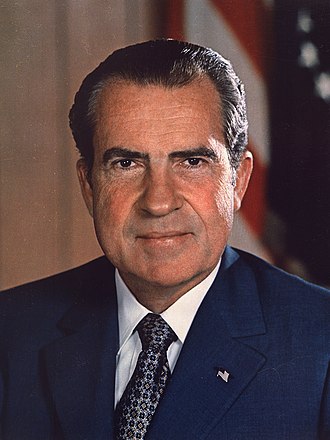
Richard M. Nixon served as the 37th President of the United States from January 1969 until his resignation in August 1974. In February 1971, he ordered the installation of a secret voice-activated taping system in the White House to preserve a historical record of his administration. Until the system's existence was revealed and dismantled in July 1973, the tapes captured Nixon directing major foreign policy initiatives, such as the opening to China, as well as his central role in the Watergate cover-up.
What Nixon talks about on the tapes
White House operations 4,718Presidential scheduling 2,225Public relations 1,784Presidential schedule 1,782Vietnam War 1,693Logistics 1,650Manolo Sanchez 1,626White House communications 1,400White House administration 1,399Presidential communication 1,243Henry Kissinger 1,191Foreign Policy 1,183
Conversations (21,010)
— Page 118 of 211President Richard M. Nixon and aide Patrick J. Buchanan held a brief telephone call that was immediately followed by a period of withdrawn, personal conversation. Due to the minimal duration and the withdrawal of the substantive portion of the call, no specific policy decisions or agenda items were recorded in the available transcript. The interaction primarily serves to document the direct lines of communication between the President and his advisor during this period.
President Richard M. Nixon met with White House aide Patrick J. Buchanan for a brief, one-minute consultation in the Oval Office. While no transcript exists for this session, the meeting reflects the ongoing administrative coordination between the President and his advisor during the 1972 campaign season. The interaction serves as a record of high-level access and informal communication patterns within the Nixon White House.
President Nixon met with his valet, Manolo Sanchez, to discuss administrative tasks and communication protocols. The brief exchange centered on a recent telephone call from Charles W. Colson and the logistics of handling a specific report that needed to be routed to the WTOB. Sanchez confirmed his understanding of these instructions before departing the Oval Office.
President Nixon utilized the Oval Office taping system to dictate a memorandum for his personal files. While the specific content of the recording remains restricted under a withdrawal category, the session functioned as an administrative record-keeping task. The dictation serves as an official internal documentation of presidential actions or observations.
President Nixon utilized the Oval Office taping system to dictate a memorandum for his personal records. The recording contains a significant segment of withdrawn material designated as personal and returnable. No other participants were present during this brief administrative session.
President Nixon utilized this session to dictate a personal memorandum for the historical record. The recording consists primarily of a private dictation regarding sensitive matters designated as personal and returnable. No other participants were present during this brief administrative task.
President Richard M. Nixon and H. R. Haldeman engaged in a brief telephone conversation that was subsequently classified and withheld from the public record. Due to the withdrawal of the transcript and audio content, the specific substance of their discussion remains unavailable for historical analysis. Consequently, no policy decisions or action items can be verified from this exchange.
President Richard Nixon met with H. R. Haldeman in the Oval Office to address administrative or political matters. While specific details of the discussion remain restricted, the meeting served as a brief late-night consultation between the President and his Chief of Staff. One item from this recorded exchange has been officially withdrawn from public record, limiting the available insight into the session's specific action items.
President Nixon utilized this session in the Oval Office to dictate a memorandum for his personal records. Due to the lack of available transcript material and the presence of a withdrawn segment, the specific subject matter remains classified or inaccessible. The recording serves primarily as a procedural documentation effort by the President.
President Nixon met with an unidentified individual in the Oval Office to discuss scheduling matters. During the brief interaction, the President addressed a pardon regarding an interruption to his agenda. The meeting concluded shortly after these logistical concerns were handled.
President Nixon dictated a memorandum for the file in the Oval Office. The purpose of this dictation, captured by the White House taping system, was to create an official record of his thoughts. No specific topics or decisions are available due to the lack of a transcript.
President Nixon utilized this session in the Oval Office to dictate a formal memorandum for his personal records. Although a segment of the recording was withdrawn for privacy reasons, the primary intent of the session was to document specific administrative or political assessments. The resulting record serves as an official presidential file entry reflecting Nixon's private reflections or policy determinations.
President Nixon dictated a memorandum for the file in the Oval Office. The specific purpose and content of this memorandum are not detailed due to the absence of a transcript, but it was recorded by the Oval Office taping system. The meeting involved only President Nixon.
President Nixon and H. R. Haldeman discussed strategies to exploit the political vulnerabilities of George McGovern following the controversy surrounding his running mate, Thomas Eagleton. They specifically strategized to attack McGovern’s judgment regarding the potential selection of Lawrence O'Brien, while opting to withhold a sensitive letter from Fort Wayne to avoid a public backlash similar to historical precedents. The President instructed Haldeman to aggressively pursue and catalog derogatory information on their political opponents to leverage as needed.
President Nixon and H. R. Haldeman discuss the strategic timing of releasing campaign materials, specifically weighing the risks posed by ongoing negative media coverage in Cleveland. The pair assesses whether current political conditions make the public release of these items premature or potentially damaging. They ultimately reach a consensus to delay action, opting to keep the sensitive documents in reserve.
President Nixon consulted with Patrick J. Buchanan to solicit his assessment of a briefing recently provided by H. R. Haldeman. Buchanan expressed his alignment with the strategy or information outlined in the rundown. The exchange functioned as a brief confirmation of internal consensus regarding the reported subject matter.
President Nixon and Patrick J. Buchanan engaged in a brief discussion regarding a specific, though currently redacted, strategic idea. The conversation centered on the potential implementation of this initiative, which was associated with the reference of Captain Holden. No further substantive details regarding the outcome or further actions are available due to the withdrawal of the specific item discussed.
President Nixon contacted the White House operator to facilitate a telephone connection with his special counsel, Charles W. Colson. This brief administrative interaction served as the necessary logistical step to initiate a formal discussion between the two men. No substantive policy matters were addressed during this initial call setup.
President Nixon contacted the White House operator to initiate a telephone call to his special counsel, Charles W. Colson. The brief exchange served as a directive for the operator to facilitate this specific communication. No further substantive matters were discussed during this brief administrative request.
President Nixon consulted with the White House operator to facilitate an outgoing call. The brief exchange focused on establishing a connection to an external party. No substantive policy or political matters were discussed during this administrative interaction.
President Nixon held a brief interaction with the White House operator to facilitate an outgoing call. The discussion was purely administrative, serving as the logistical bridge to connect the President with a third party. No policy matters or significant executive decisions were conducted during this short exchange.
President Nixon and Charles Colson spoke via telephone to discuss undisclosed matters, as the primary content of the conversation remains restricted under withdrawal guidelines. Due to the lack of available transcript details, the specific political objectives or decisions reached during this exchange cannot be confirmed. The interaction is cataloged as part of the White House internal communication records for that period.
President Nixon met with special counsel Charles Colson to discuss sensitive political strategy and potential damage control efforts regarding the ongoing investigation into the Watergate break-in. The pair explored tactics to manage public perception and insulate the administration from fallout during the 1972 election cycle. Their discussion focused on assessing the vulnerabilities of the White House position and coordinating countermeasures to limit political damage.
President Richard M. Nixon used this time in the Oval Office to dictate a memorandum for his personal files. The recording consists primarily of a dictated entry regarding official records or administrative reflections. Due to the personal nature of the content and subsequent withdrawals, no further details regarding the specific subjects or action items remain accessible.
President Nixon met with an unidentified woman in the Oval Office for a brief morning discussion. The conversation began with standard greetings, though the substance of the meeting remains entirely unintelligible due to a lack of available transcript data. No specific policy decisions or significant developments were recorded during this brief encounter.
President Richard M. Nixon met with Alexander P. Butterfield to coordinate the President's daily agenda and administrative requirements. The brief session focused on the review and execution of official documents scheduled for the morning. No substantive policy shifts occurred, as the meeting was primarily limited to managing presidential paperwork.
President Nixon initiates a request to the White House operator to be connected with John N. Mitchell. The conversation serves solely as an administrative bridge to facilitate direct communication with the former Attorney General. No substantive policy matters or tactical decisions are discussed during this brief exchange.
President Nixon consulted with the White House operator to facilitate an outgoing call. This brief exchange served as a logistical step to connect the President with another party. No substantive policy matters or major decisions were recorded during this brief administrative interaction.
President Nixon and John Mitchell discuss strategies to neutralize Republican opposition against influential Democratic senators John McClellan and James O. Eastland. Recognizing the strategic importance of these chairmen to the administration's legislative agenda, Nixon and Mitchell agree to pressure their Republican challengers to withdraw from their respective races. As an incentive, they consider offering qualified candidates alternative government positions to facilitate their exit from the campaigns.
President Nixon and John N. Mitchell discuss political strategy regarding Republican primary opposition and the potential role of Nelson Rockefeller. The conversation focuses on securing a clear path for the President's reelection campaign by neutralizing potential internal rivals and managing party financial support. Nixon emphasizes the importance of consolidating influence within the party to ensure his program remains unchallenged throughout the campaign cycle.
President Nixon met with Alexander P. Butterfield to address administrative matters, specifically reviewing documents requiring a signature and discussing the President's upcoming daily schedule. Following Butterfield’s departure, Stephen B. Bull joined the President to continue coordinating the schedule, which included a specific request for Charles W. Colson’s presence. These brief meetings served primarily to manage the logistical flow of the Oval Office and presidential priorities.
President Nixon, H. R. Haldeman, and Charles Colson met to discuss campaign strategy, press relations, and economic policy ahead of the 1972 election. They evaluated tactics for addressing inflation and debated how to effectively frame political messaging, including the potential to leverage questions about campaign finance and foreign funding against George McGovern. Additionally, the President expressed frustration with campaign official Clark MacGregor's public criticisms of the staff, leading the group to discuss the necessity of maintaining discipline and secretly recording interviews for future protection.
President Nixon met with Secretary Richardson and other officials to discuss the burgeoning US-Soviet health research agreement, emphasizing its importance for public opinion and comparing it to US-PRC exchanges. Key topics included the shift from confrontation to cooperation in scientific exchanges, potential meetings with Soviet and Polish health officials, and the sensitive issue of Soviet dissidents being confined to mental hospitals, which could impact the Soviet Health Minister's upcoming visit. The discussion also touched upon domestic health initiatives like triage and emergency care projects.
This brief Oval Office exchange between President Nixon and an unidentified individual, likely H.R. Haldeman, concerned the latter's upcoming schedule with the President. The conversation was very short and did not delve into substantive policy matters, focusing instead on logistical arrangements for future meetings.
President Richard M. Nixon met briefly with his personal valet, Manolo Sanchez, in the Oval Office. The conversation consisted of routine personal exchanges, as the majority of the recording was withdrawn due to its private nature. No significant policy discussions or administrative decisions were documented during this short encounter.
President Nixon met with his aide, Stephen B. Bull, to discuss the whereabouts of Press Secretary Ronald L. Ziegler. The President directed Bull to locate Ziegler and assess his current activities. This brief administrative interaction served as a logistical check-in regarding the location of key White House staff.
President Nixon met with H.R. Haldeman and other staff to review the status of the Watergate investigation, focusing on maintaining the secrecy of White House involvement and managing the legal exposure of committee officials. The participants discussed grand jury strategies, the handling of potential indictments for figures like Jeb Stuart Magruder, and efforts to discredit political opponents by tying them to Howard Hughes. They concluded that while the scandal was a "powder keg," they had successfully minimized the immediate damage and expected to avoid trial-related repercussions until after the upcoming election.
President Nixon communicated with a White House operator during the midday hours to address routine telecommunications needs. Due to the lack of a transcript and the unintelligible nature of the audio, the specific substance of the exchange remains unrecorded. Consequently, no significant policy decisions or administrative actions can be attributed to this brief interaction.
President Nixon communicated with a White House operator in a brief exchange regarding routine administrative or telephonic connectivity. Due to the unintelligible nature of the transcript, no substantive policy matters, decisions, or specific developments were recorded. The interaction serves primarily as evidence of the logistical operations of the White House switchboard.
President Nixon met with Jaycees representatives, including Samuel D. Winer, to discuss the organization's civic initiatives and potential collaboration on the upcoming Bicentennial celebration. The participants reviewed the Jaycees' efforts regarding disaster relief for Hurricane Agnes, voter participation programs, and social issues such as drug and alcohol abuse. Nixon encouraged the organization to work with the Bicentennial Committee and David J. Mahoney, Jr., while reminiscing about his own past involvement with the group and exchanging gifts.
President Nixon met with Stephen B. Bull to coordinate a brief visit and photo opportunity with musical duo Richard and Karen Carpenter. The discussion focused on logistical arrangements, including the involvement of their manager, Sherwin Bash, and the presentation of gifts. The President specifically requested that Karen Carpenter be brought in for the engagement.
President Nixon hosted a social meeting in the Oval Office with popular musicians Richard and Karen Carpenter, accompanied by their manager Sherwin Bash and several White House staff members. The discussion focused on shared California roots, including the musicians' background in Downey and Nixon's ties to Whittier, as well as casual conversation regarding golf and the logistics of the Carpenters' touring schedule. The President concluded the brief engagement by presenting the visitors with commemorative gifts bearing the presidential seal.
President Nixon met briefly with Stephen B. Bull and a White House photographer in the Oval Office. The primary purpose of this short interaction was to take a photograph of the President for the Retired Officers Association. Following the photo session, Nixon and Bull briefly discussed the President's upcoming barber appointment before departing.
President Richard Nixon and special counsel Charles Colson held a telephonic consultation to discuss ongoing administrative priorities and political strategy. Given the lack of a transcript for this specific exchange, the exact nature of their deliberations remains undocumented, though such interactions typically concerned reelection efforts or sensitive policy matters. No definitive outcomes or action items were recorded in the available archival descriptions.
President Nixon and Charles Colson discuss the political fallout following the removal of Thomas Eagleton from the Democratic ticket and its potential impact on the upcoming election. The conversation touches on the reactions of key political figures, including George Meany, Lawrence O'Brien, and Edward Kennedy, while evaluating how these developments might affect the electoral landscape. They further analyze news coverage and the shifting dynamics of the political climate in the suburbs.
President Nixon contacted the White House operator to facilitate a telephone connection. The primary purpose of the brief interaction was to place a call to William E. Timmons, who served as the Assistant to the President for Legislative Affairs. This action was a routine administrative step to reach a key member of the White House staff.
President Nixon held a brief, ten-minute meeting in the Old Executive Office Building to coordinate a return phone call with an unidentified individual. The discussion was primarily logistical, focusing on the participant's current availability and the scheduling of follow-up communication. No substantive policy matters were addressed during this exchange.
President Nixon met with his personal secretary, Rose Mary Woods, to coordinate his schedule and address administrative priorities. The brief discussion focused on reviewing specific items and potential meetings, including a request for an appointment with the President. The exchange served to organize the President’s immediate workflow and manage access to his office.
President Nixon met with Rose Mary Woods and Stephen B. Bull to coordinate administrative tasks and discuss sensitive political matters. The conversation covered logistical arrangements for providing the film *Sunrise at Campobello* to George C. Wallace and addressed Elmer Bobst’s urgent recommendation that the President seek legislation for capital punishment regarding hijackers and kidnappers. Additionally, the participants touched upon the health and behavior of Martha Mitchell and the associated stress placed on John Mitchell amid the ongoing ITT and Watergate controversies.
President Nixon met briefly with his personal valet, Manolo Sanchez, in the Old Executive Office Building. The recording consists of a very short interaction that concludes almost immediately. No substantive policy matters or official developments are captured in this brief exchange.
President Nixon consulted with legislative liaison William E. Timmons regarding ongoing congressional strategy and outreach. The conversation focused on managing key legislative priorities and coordinating executive influence on Capitol Hill. While the specific transcript is largely unintelligible, the discussion served to align White House goals with current developments in the legislative branch.
President Nixon initiated a brief, routine request for a telephone connection through the White House operator. The conversation served primarily as a functional administrative exchange to facilitate an outgoing call. No substantive policy discussions or significant political developments occurred during this short interaction.
President Nixon met with Alexander M. Haig, Jr. and John D. Ehrlichman to discuss military strategy in Vietnam and the administration's political agenda during the 1972 election year. Nixon expressed frustration with the lack of progress in peace negotiations and advocated for intensified bombing campaigns, including the potential targeting of North Vietnamese dikes to force a resolution. Additionally, the participants addressed the need to counter criticism from the United Nations and discussed strategies for promoting the administration's economic record to voters.
President Nixon and John D. Ehrlichman engaged in a brief telephone consultation regarding internal administration matters. The recording consists primarily of unintelligible segments, yielding no verifiable policy decisions or specific substantive developments. Consequently, the nature of their discussion remains undocumented due to the poor audio quality of the transcript.
President Nixon contacted the White House operator to place an outgoing call to John McCarroll, the president of United Auto Workers Local 544 in the Pittsburgh area. The President provided the operator with instructions to locate McCarroll's contact information and initiate the connection. This administrative interaction serves as a brief record of the President's efforts to facilitate communication with local union leadership.
President Nixon instructed the White House operator to place an outgoing call to Edward J. Kiernan. Kiernan, serving as the president of the International Conference of Police Associations in New York City, was the intended recipient of the communication. This brief exchange served solely as an administrative coordination to facilitate direct contact between the President and the police labor leader.
President Nixon consulted with the White House operator to coordinate a return phone call to John McCarroll. He established a strict deadline for the call, noting that he needed to complete it before 5:00 pm. The President clarified his availability constraints, specifically citing an upcoming photo session that required his attention.
President Nixon met with White House aides Robert J. Brown and Stanley S. Scott for a brief photo opportunity in the Oval Office. Following the departure of the photographer, the participants engaged in a private discussion lasting nearly four minutes. The specific substance of this dialogue was removed from the public record due to its personal nature.
President Nixon met with a large group of Republican Congressmen and candidates, along with White House staff, primarily to coordinate strategy regarding anti-busing legislation. The discussion focused on the current status of busing bills in the Rules and Education and Labor Committees, including the feasibility of a constitutional amendment versus a moratorium. Nixon and the legislators explored pushing an 'affirmative standards' bill through the House to pressure the Senate, while strategically maneuvering against liberal opposition to strengthen the Republican position on the issue.
President Nixon met with Stephen B. Bull to coordinate administrative details regarding his upcoming schedule. The discussion focused on arrangements for a planned reception honoring the Secret Service Presidential Protective Division. Additionally, the two men addressed the logistics of a potential meeting between the President and H.R. Haldeman.
President Nixon met with Stephen B. Bull and Alexander P. Butterfield to review his upcoming schedule and the activities of H.R. Haldeman. The discussion included planning for a reception honoring the Secret Service Presidential Protective Division and touched upon the schedule of Charles W. Colson. Additionally, the group addressed a telephone call from Edward J. Kiernan before concluding the brief meeting.
President Richard M. Nixon held a brief telephone conversation with Edward J. Kiernan, the president of the International Conference of Police Associations. The discussion served as a follow-up to a previous engagement between the two men. Due to the withdrawal of the primary content for privacy reasons, no specific policy decisions or action items are available for review.
President Richard Nixon met with Edward J. Kiernan, the president of the International Conference of Police Associations, for a brief introductory discussion. The meeting served as a formal engagement between the administration and the representative of national police interests. No significant policy decisions were recorded during this one-minute exchange, which functioned primarily as a courtesy visit.
President Nixon met with his aide Stephen B. Bull to discuss the scheduling of Charles W. Colson. The conversation specifically addressed arrangements involving John B. Connally. This brief exchange served to coordinate high-level political meetings within the President's calendar.
President Nixon and Alexander P. Butterfield met briefly to discuss the scheduling of a forthcoming telephone call to John McCarroll. The discussion focused on coordinating the availability of both parties to facilitate the communication. The meeting concluded after the exchange of necessary logistical information for the President's files.
President Nixon held a brief, informal telephone conversation with John McCarroll and several other employees during a meeting at a General Motors Fisher Body plant in Pittsburgh. The President used the call to offer greetings, express support for the workers, and discuss the importance of maintaining strong auto sales to ensure job security. The conversation served primarily as a morale-boosting gesture during the transition to the 1973 model production line.
President Nixon held a brief, informal discussion with John McCarroll, likely a representative or associate involved in the automotive industry. The conversation centered on the importance of maintaining strong car sales to ensure continued economic growth and the preservation of jobs. Nixon expressed his commitment to monitoring employment statistics and requested that McCarroll convey his best regards to those in attendance at the ongoing meeting.
President Nixon met with an unknown woman in the Oval Office to discuss a request for information from Life magazine. Specifically, the President was interested in a photograph of Thomas F. Eagleton's son, Terry Eagleton, with himself, which was taken by Oliver F. Atkins. The purpose of the meeting was to facilitate this information request.
President Nixon and H.R. Haldeman discussed the content and purpose of films being produced for the Republican National Convention. They reviewed various segments, including footage of the President's trip to the Soviet Union, his family, and his interactions with foreign leaders, debating the effectiveness and potential use of specific scenes, such as the Tanya Savicheva story. The conversation also touched upon campaign budget controls, the General Accounting Office investigation, and the Watergate affair, with Mitchell expressing concerns about Martha Mitchell's behavior and potential treatment options.
H. R. Haldeman consulted with President Nixon regarding administrative coordination and scheduling, including a planned trip to Walker's Cay. During this time, Haldeman also attempted to facilitate a telephone conversation with John N. Mitchell. The exchange concluded with the White House operator informing Haldeman that Mitchell was currently occupied with guests and would return the call shortly.
President Nixon briefly spoke with an unknown woman in the Oval Office. The conversation touched upon Nixon's upcoming meeting with Henry Kissinger. The woman departed before 10:34 am.
President Nixon and Stephen B. Bull met to coordinate the administrative follow-up regarding a meeting with Senator Thomas F. Eagleton and his son, Terry. They discussed the logistics of providing an enlarged photograph from that encounter and the drafting of a personalized letter from the President to Terry Eagleton. Nixon specifically directed Bull to prioritize the correspondence over other potential requests.
President Nixon and Henry Kissinger met to evaluate progress in Vietnam negotiations following a complex and lengthy session in Paris. Kissinger detailed a significant shift in the North Vietnamese position, including their newfound willingness to negotiate directly with the Saigon government and the abandonment of fixed withdrawal deadlines. While noting that the current proposal remains unacceptable, they discussed using these negotiations to create an appearance of imminent peace to benefit Nixon’s reelection campaign, while simultaneously planning to maintain pressure and avoid a perceived "sellout." The conversation also touched upon broader foreign policy, including potential Middle East diplomacy and trade agreements with the Soviet Union.
President Nixon met with his aide, Stephen B. Bull, in the Oval Office to address administrative matters and logistics. The brief discussion facilitated the coordination of upcoming presidential engagements, including a scheduled photograph session with Terry Eagleton. Following these logistical arrangements, the conversation concluded as Bull departed the office.
President Richard Nixon met with his personal valet, Manolo Sanchez, in the Oval Office. The conversation remains largely inaccessible due to a withdrawn segment and a lack of transcribed content. Consequently, there are no documented developments or specific policy matters resulting from this brief interaction.
President Nixon and his personal secretary, Rose Mary Woods, discussed various administrative and political matters, including the handling of a note for Hubert Humphrey and the vetting of potential guests for the Republican National Convention. Woods expressed concerns regarding the attendance of individuals linked to the unfolding Watergate scandal, specifically recommending the exclusion of Robert C. Odle, Jr. from the President’s box. The pair also addressed the logistics of a sensitive CIA report, domestic remodeling projects, and the handling of personal gifts.
President Nixon met with his aide Stephen B. Bull to review his upcoming schedule, which included meetings with John D. Ehrlichman and Harvey J. McFarland. During the brief discussion, Nixon expressed a desire for personal solitude away from his political responsibilities. The meeting concluded with coordination regarding a scheduled photograph session involving Rose Mary Woods.
President Nixon, Rose Mary Woods, and Harvey J. McFarland met in the Oval Office for a personal visit, during which McFarland presented the President with gifts, including cheese. The conversation centered on nostalgic anecdotes regarding Nixon's past travels and encounters as Vice President, particularly in Canada. The discussion briefly turned toward political topics, with McFarland expressing his views on the Vietnam War and criticizing the Bay of Pigs invasion during the Kennedy administration.
President Nixon, H.R. Haldeman, and Henry Kissinger discuss strategies for maintaining Senate support for the administration’s Vietnam policy, specifically regarding an amendment sponsored by Senator George D. Aiken. Nixon and Kissinger emphasize the sensitivity of ongoing Paris peace negotiations and the necessity of preventing congressional interference that might undercut their diplomatic leverage. The participants also coordinate the President’s upcoming schedule, including logistical details for a potential weekend trip to the McCabe residence and medical arrangements involving Dr. W. Kenneth Riland.
President Nixon instructed the White House operator to place an outgoing call to Senator George D. Aiken. This administrative interaction reflects the President's efforts to facilitate direct communication with key legislative figures during his administration. The conversation concluded with the operator confirming the request to connect the President to the Senator.
President Nixon and Henry Kissinger coordinated with Senator George D. Aiken regarding the tactical implications of his proposed congressional amendment amidst ongoing secret peace negotiations with North Vietnam. The participants discussed the risk that the amendment might inadvertently signal weakness or encourage North Vietnamese stalling tactics, specifically emphasizing the need for a unified front against competing legislative efforts like the Brooke substitute. Ultimately, the administration sought to balance Aiken's support for the President's policy with the necessity of maintaining diplomatic leverage and preventing premature funding cutoffs that could undermine the peace process.
President Nixon contacted the White House operator to facilitate a telephone connection with his Press Secretary, Ronald L. Ziegler. The brief exchange served as a routine administrative request to initiate official communication between the President and his primary spokesperson. No further substantive policy matters were discussed during this operator-assisted call.
President Richard Nixon met with his personal valet, Manolo Sanchez, in the Old Executive Office Building. The brief interaction, which included a segment restricted from public access as a personal returnable item, involved a private exchange between the President and his longtime staff member. No further substantive policy matters or administrative developments are documented in this recording.
President Nixon held a private meeting with an unidentified individual in the Old Executive Office Building. The recorded portion of the exchange consists exclusively of a brief, one-second segment categorized as a personal, returnable item. Due to the lack of a transcript and the extremely short duration of the available audio, no substantive topics, decisions, or developments are documented.
President Nixon met with his personal valet, Manolo Sanchez, in the Old Executive Office Building to handle private administrative tasks. During the interaction, the President provided specific instructions regarding items intended for his personal secretary, Rose Mary Woods. The meeting served as a brief coordination session between the President and his staff to manage internal office logistics.
President Nixon met with his personal valet, Manolo Sanchez, in the Old Executive Office Building. The recording is extremely brief and consists of an undefined exchange, with the majority of the encounter redacted as a personal, non-substantive matter. No policy discussions, official decisions, or significant administrative actions were recorded during this interaction.
President Nixon consulted with the White House operator to facilitate a telephone connection. The primary purpose of this brief interaction was to reach Press Secretary Ronald L. Ziegler. No further substantive policy matters were discussed during this request.
President Nixon and Press Secretary Ronald L. Ziegler discuss the management of media communications regarding the Watergate scandal. The conversation focuses on coordinating official statements and briefings, specifically those delivered by Deputy Press Secretary Gerald L. Warren. This exchange serves to reinforce the White House strategy of directing all relevant spokespersons to adhere to a unified messaging approach.
President Nixon and Press Secretary Ronald Ziegler briefly coordinate a unified public relations strategy regarding ongoing investigations. They emphasize the necessity of directing White House staff to cooperate with inquiries while managing the discomfort caused by emerging negative publicity. The discussion serves to align the administration's messaging to ensure consistency as the team navigates political pressure.
President Richard Nixon met with his personal secretary, Rose Mary Woods, in the Old Executive Office Building to handle private administrative matters. The brief encounter consisted primarily of a personal exchange, categorized as a withdrawn item, which precluded the recording of substantive policy discussions. No official actions or developments were documented as a result of this brief, private meeting.
President Nixon held an brief, undocumented discussion with an unidentified participant in the Old Executive Office Building. Because the recording consists only of a closing farewell, the specific subject matter and any potential policy implications remain unknown. This segment serves primarily to document a brief administrative or social interaction during the President’s afternoon schedule.
President Nixon met with his aide Stephen B. Bull to coordinate his upcoming daily schedule. The discussion focused on logistical arrangements for meetings with John B. Connally and H. R. Haldeman. This brief consultation served to confirm the availability and timing of these key personnel for the President's afternoon appointments.
President Nixon and H. R. Haldeman engaged in an extensive series of consultations regarding staffing and political strategy for the 1972 re-election campaign. Key discussions focused on absorbing George Wallace's political organization into the Nixon campaign, managing Cabinet-level appointments like those for the Secretary of the Army, and addressing specific policy issues including food price inflation, school busing, and environmental legislation. The President also reviewed strategies for leveraging administrative power to influence corporate contracts and pressured staff to develop immediate, high-visibility economic actions to address public concerns before the Republican National Convention.
President Nixon held a brief morning meeting in the Oval Office with an unidentified participant. The discussion primarily concerned the logistics of the President's daily schedule, with a potential meeting involving National Security Advisor Henry A. Kissinger under consideration. The brief exchange concluded after approximately two minutes.
President Nixon directed the White House operator to place a telephone call to John O. Marsh, Jr., a former Democratic congressman from Virginia. The President instructed the operator to obtain the necessary contact information from Charles W. Colson’s office if it was not already on file. This brief administrative exchange facilitated communication with a political figure outside of the immediate White House staff.
President Nixon received an update from the White House operator regarding the travel status of John O. Marsh, Jr. The operator confirmed that Marsh was en route and expected to reach his office within twenty to thirty minutes. This brief exchange served to facilitate a return call between the President and Marsh.
President Nixon instructed the White House operator to initiate two separate calls. He requested a connection to General John Marsh, a former Democratic Representative, and sought to obtain a specific offer from the office of Charles Colson. These calls reflect the President's ongoing management of political outreach and administrative tasks.
President Nixon met with his aide Stephen B. Bull in the Oval Office to conduct a review of the President's daily schedule. The discussion focused on administrative planning and logistical arrangements for the upcoming presidential agenda. No specific policy decisions were recorded during this brief administrative session.
President Nixon met with his personal valet, Manolo Sanchez, in the Oval Office for a brief, private discussion. The meeting consisted primarily of a withdrawn segment categorized as personal and returnable material. No official policy or administrative actions were recorded during this interaction.
President Nixon held a brief administrative interaction with the White House operator to facilitate internal telecommunications. The discussion functioned as a standard operational check-in to manage the President's outgoing calls. No substantive policy matters or strategic decisions were addressed during this short exchange.