Nixon, Richard M. (President)
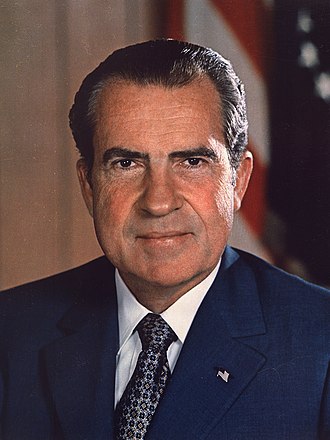
Richard M. Nixon served as the 37th President of the United States from January 1969 until his resignation in August 1974. In February 1971, he ordered the installation of a secret voice-activated taping system in the White House to preserve a historical record of his administration. Until the system's existence was revealed and dismantled in July 1973, the tapes captured Nixon directing major foreign policy initiatives, such as the opening to China, as well as his central role in the Watergate cover-up.
What Nixon talks about on the tapes
White House operations 4,718Presidential scheduling 2,225Public relations 1,784Presidential schedule 1,782Vietnam War 1,693Logistics 1,650Manolo Sanchez 1,626White House communications 1,400White House administration 1,399Presidential communication 1,243Henry Kissinger 1,191Foreign Policy 1,183
Conversations (21,010)
— Page 166 of 211President Nixon and Stephen B. Bull met to coordinate the President's upcoming schedule and administrative tasks. The discussion primarily centered on arranging a meeting with John D. Ehrlichman and finalizing the text of a scheduled radio address. Bull requested additional time to complete his work on the speech, which Nixon granted before concluding the brief exchange.
President Nixon met with H. R. Haldeman and John Ehrlichman to discuss a wide-ranging agenda, primarily focusing on managing the political fallout from international monetary policy, specifically dollar devaluation, and navigating complex economic and tax legislation with Congressional leadership. The group addressed the President's upcoming schedule, including a potential trip to California, while strategizing on how to handle the escalating Watergate investigations and the role of executive privilege. Throughout the discussion, Nixon emphasized the need for a more proactive and coordinated public relations strategy to counter Congressional opposition and maintain leverage on domestic spending initiatives.
President Nixon met with aide Stephen B. Bull to coordinate upcoming logistical and scheduling details for the White House. The discussion focused on managing staff departures, arranging meetings with families, and organizing the distribution of presidential gifts such as ash trays and tie clasps. Nixon specifically instructed Bull to prioritize the processing of official photographs for visitors and staff.
President Nixon met with Wallace B. Henley and his family in the Oval Office to express personal appreciation for Henley's service and the support received from the Birmingham News. The session included formal photographs and a brief discussion regarding the Henley family's background and their connection to the administration. Nixon concluded the meeting by presenting the family with presidential gifts before transitioning to discuss his upcoming schedule with Stephen B. Bull.
President Nixon met with J. Roy Goodearle and his family, accompanied by Stephen B. Bull, for a brief social visit and photo opportunity in the Oval Office. The President expressed appreciation for the family's past support during his 1960 and 1962 campaigns and presented them with commemorative presidential ashtrays. The meeting concluded with light conversation regarding their future endeavors and the President's upcoming schedule.
President Nixon met with his valet, Manolo Sanchez, in the Oval Office to discuss administrative logistics regarding the President's daily schedule. The brief conversation focused on the handling of materials, specifically involving a briefcase. No further policy or significant political developments were recorded during this interaction.
President Nixon met with E. Pendleton James and his family to bid them farewell as they prepared to return to California. During the brief meeting, the President expressed his appreciation for James's service within the administration and discussed the family's future in the Palos Verdes area. The encounter concluded with a formal photo session and the presentation of presidential mementos to the family.
President Nixon met with Patrick and Mrs. O'Donnell, accompanied by photographer W. Richard Howard, for a brief social meeting and photo opportunity in the Oval Office. The discussion centered on Patrick O'Donnell's recent legal work with Charles Colson's staff and his positive experience serving in the administration. Nixon expressed appreciation for O'Donnell's service and exchanged pleasantries regarding the couple's personal life and future plans.
President Nixon, Stephen B. Bull, and Manolo Sanchez discuss administrative logistics regarding meeting durations and scheduling protocols for congressional visitors. The President emphasizes managing meeting lengths—specifically for members of Congress who prioritize brief interactions—to ensure efficient use of his time. Nixon directs Bull to arrange a 3:00 p.m. meeting with John T. Dunlop at the Executive Office Building, tasking him with coordinating the setup for that session.
President Nixon initiates a request through the White House operator to summon Charles W. Colson to the Executive Office Building. The brief exchange serves as a logistical coordination to facilitate an immediate, in-person consultation between the President and his special counsel. No further substantive policy matters are addressed in this short communication.
President Nixon and H. R. Haldeman discuss how Secretary of State William P. Rogers should respond to harsh public criticisms of U.S. Vietnam policy made by Indian Prime Minister Indira Gandhi. While National Security Council staff advised a 'no comment' approach, Nixon explicitly overrules them and authorizes Rogers to publicly rebuke Gandhi's remarks. Nixon instructs Haldeman to have Rogers use the President's previous correspondence regarding peace efforts as the basis for his response.
President Richard Nixon met with his personal valet, Manolo Sanchez, in the Old Executive Office Building. The recording consists entirely of administrative dictation related to the President's personal notes and correspondence. No substantive policy discussions or major political developments occurred during this brief interaction.
President Nixon and Stephen B. Bull met briefly to review the logistics of the President’s afternoon schedule. Their discussion focused on coordinating a series of appointments, including meetings with John D. Ehrlichman and Wilbur D. Mills, the swearing-in of John T. Dunlop, and tea with Alice Roosevelt Longworth. The brief exchange concluded with a confirmation of the President's planned departure time.
President Nixon met with George Shultz, John Ehrlichman, and others to strategize the communication and rollout of pending economic policies, specifically currency devaluation and trade packages. Nixon and his advisors agreed to separate the announcements to ensure the trade initiatives remained a positive, standalone narrative, fearing that tying them to the complex and potentially controversial devaluation would dilute their impact. Furthermore, they discussed engaging with Congressional leaders like Wilbur Mills to advance legislative goals, including welfare reform, and debated the necessity of incorporating Henry Kissinger into future economic policy deliberations.
President Nixon met with John T. Dunlop and several senior administration officials to formalize Dunlop’s appointment as the new chair of the Cost of Living Council. The discussion centered on the challenges of implementing Phase III of the administration's economic policy, specifically emphasizing the necessity of fiscal restraint and cooperation from labor and management to combat inflation. Nixon expressed his confidence in Dunlop’s unique ability to bridge the gap between business and labor interests to stabilize food prices and the broader economy.
President Nixon met with George Shultz, John Ehrlichman, and Wilbur Mills to coordinate the administration's legislative strategy regarding tax reform, foreign trade, and energy policy. The discussion focused on establishing a bipartisan approach to these initiatives, with Nixon emphasizing the need for political cooperation to advance key priorities like energy independence and trade negotiations while avoiding overly contentious tax reform proposals. The participants agreed on the importance of consulting with congressional leadership to ensure bipartisan support for upcoming legislative packages and discussed leveraging presidential bargaining authority in international trade and monetary affairs.
President Nixon met briefly with his valet, Manolo Sanchez, in the Oval Office to facilitate his departure from the workspace. The primary focus of this short interaction was the President retrieving his coat. The meeting concluded immediately as the President prepared to leave the office.
President Nixon met with his aide Stephen B. Bull to coordinate a visit to Alice Roosevelt Longworth. The discussion centered on selecting an appropriate gift for the former first daughter. No significant policy decisions were reached during this brief logistical encounter.
President Nixon instructed the White House operator to place a call to John D. Ehrlichman after learning that H. R. Haldeman was unavailable. The conversation served as a brief administrative coordination to facilitate contact with a key advisor. No further policy or strategic matters were discussed during this short exchange.
President Nixon consulted with the White House operator to facilitate communication with his staff regarding scheduling logistics. After learning that John D. Ehrlichman would be unavailable until late in the evening, the President requested to be connected to Stephen B. Bull. This brief exchange served as a logistical coordination effort to reach key administrative personnel.
President Nixon consulted with the White House operator to facilitate communication with aide Stephen B. Bull. After being informed of Bull's current location, the President instructed the operator to have Bull return the call upon his arrival. The brief exchange served purely as a logistical coordination to arrange a follow-up discussion between the President and his staff member.
President Nixon consulted with his aide Stephen B. Bull regarding the logistics and guest list for an upcoming breakfast meeting in the State Dining Room. Concerned that the room's large size would make the gathering look sparse, Nixon directed Bull to increase the number of attending staff members. The President explicitly confirmed that key senior aides, including Kenneth Cole, John Ehrlichman, H.R. Haldeman, Peter Flanigan, Ronald Ziegler, and William Timmons, would be present and seated at the table.
President Nixon initiates a brief telephone communication through the White House operator to contact his aide, Stephen B. Bull. This administrative exchange serves the primary purpose of facilitating internal staff coordination. No further policy or strategic discussions occur during this short connection.
President Nixon directed Stephen Bull to expand the guest list for an upcoming breakfast meeting to include Charles Colson, Leonard Garment, Richard Moore, William Safire, and Raymond Price. The President emphasized that the primary goal was to increase attendance to fill the large room and facilitate better interaction between White House staff and Cabinet members. Specific seating arrangements were ordered, placing William Rogers and Peter Brennan beside the President to ensure they could address specific business.
President Nixon contacted the White House operator to facilitate a telephone connection with Stephen B. Bull. This brief administrative interaction served as a logistical step to reach the President's personal aide. No further substantive policy matters were discussed during this brief exchange.
President Nixon directs his aide, Stephen B. Bull, to ensure that Stanley S. Scott, a Black staff member, is included in an upcoming breakfast meeting. This brief administrative exchange serves to confirm the guest list for the scheduled event. No further policy issues or substantive matters were addressed during this short call.
President Nixon contacted the White House operator to request an immediate call to his aide, Stephen B. Bull. This brief exchange served as a logistical bridge to facilitate direct communication with a member of his staff. No further substantive policy matters were discussed during this brief administrative request.
President Nixon consulted with Stephen B. Bull to finalize the seating arrangements for an upcoming breakfast meeting. To avoid potential social misunderstandings, the President directed that Anne L. Armstrong be seated to his left. Peter J. Brennan was subsequently assigned to the second position on the left to complete the protocol for the event.
President Nixon directs the White House operator to place an urgent follow-up call to Stephen B. Bull. This brief exchange serves solely as a logistical instruction to facilitate direct communication with a key aide. No further substantive policy matters were discussed during this brief request.
President Nixon directs his aide, Stephen B. Bull, to ensure that personal secretary Rose Mary Woods is invited to an upcoming breakfast meeting. Despite potential uncertainty regarding her availability, Nixon insists that she be included in the invitation list. Bull acknowledges the instruction and prepares to coordinate the arrangements.
President Nixon contacted the White House operator to place an outgoing call to Lyndon K. "Mort" Allin. The conversation was strictly administrative, consisting only of the President providing the request and the operator acknowledging the task. No further substantive policy or political discussions occurred during this brief exchange.
President Nixon instructed the White House operator to place an outgoing telephone call to Lyndon K. "Mort" Allin. This interaction served to facilitate direct communication between the President and Allin. No further details regarding the substance of the intended conversation were captured on the recording.
President Nixon met with his aide Stephen B. Bull to coordinate the delivery of specific reading materials to Alice Roosevelt Longworth. The President requested that Charles W. Colson facilitate sending a copy of Henry Fairlie's book, *Great Expectations*, along with a Vermont Royster column regarding the Vietnam settlement. This administrative task aimed to ensure that Longworth received the correct press commentary as part of the President's ongoing media outreach efforts.
President Nixon met with Lyndon K. Allin to offer birthday congratulations on Allin's 64th birthday. The brief discussion touched upon the administration's relationship with the media and the necessity of maintaining a strategic perspective on public perception. Nixon concluded the meeting by encouraging Allin to take the rest of the day off to celebrate.
President Nixon and Stephen B. Bull met to coordinate logistical details for upcoming presidential travel and high-level diplomatic hosting. Their discussion primarily focused on scheduling for an impending trip to California and arranging entertainment for the official visit of Israeli Prime Minister Golda Meir. Notable guests considered for the entertainment program included renowned musicians such as Van Cliburn, Benny Goodman, and Lionel Hampton, with input from First Lady Pat Nixon.
President Richard M. Nixon met with his personal aide, Manolo Sanchez, in the Oval Office to receive refreshments. The interaction was limited to the provision of coffee during the President's morning schedule. No substantive policy matters or administrative decisions were documented during this brief encounter.
President Nixon met with his aide Stephen B. Bull to coordinate upcoming discussions with Treasury Secretary George Shultz and Senator Russell B. Long regarding legislative priorities. Nixon directed Bull to arrange the schedule so that welfare reform is addressed as the primary topic before pivoting to tax and trade issues. The President emphasized a need for 25 minutes of dedicated time for welfare reform before allowing Shultz and Long to join the conversation.
President Nixon met with his personal valet, Manolo Sanchez, to discuss logistical preparations for an upcoming trip. The conversation focused on procuring essential supplies, specifically batteries and additional recording tapes for the President's use. The two also briefly touched upon arrangements for refreshments.
President Nixon dictates his reflections on the Vietnam settlement, emphasizing the need for caution in dealings with Congress and the press. He discusses the emotional impact of meeting with families of missing soldiers, such as the Nolde family, while warning against allowing personal grievances or political agendas to undermine loyalty. Additionally, Nixon evaluates Henry Kissinger's 'Peace is at Hand' statement, characterizing the resulting media interpretation as a misunderstanding of Kissinger's original intentions.
President Nixon met with Stephen B. Bull to coordinate his daily schedule and manage incoming appointments with key officials. The discussion focused on logistics regarding meetings with Senator Russell B. Long and Treasury Secretary George P. Shultz, including instructions for a scheduled telephone call. Additionally, Nixon utilized the time to record private notes and finalize the arrival arrangements for his upcoming visitors.
President Nixon met with Senator Russell Long, John Ehrlichman, and George Shultz to coordinate administration strategy regarding welfare reform, tax policy, and trade legislation. The discussion focused on securing Congressional support for the administration's agenda while maneuvering around bureaucratic interference and the influence of partisan groups like Common Cause. Nixon emphasized the need for a collaborative approach with Congressional leadership, particularly regarding trade negotiations and energy policy, while also reflecting on the importance of maintaining strength and respect in foreign policy.
President Nixon and Stephen B. Bull discussed the President's upcoming schedule and the coordination of meetings with Secretary of the Treasury George P. Shultz. Nixon specifically instructed Bull to ensure that E. D. Kenna and W. Richard Howard were excluded from the follow-up meeting with Shultz. The conversation serves to manage access to the President and refine the roster of attendees for high-level administration deliberations.
President Nixon met with representatives from the National Association of Manufacturers (NAM) and later George Shultz to discuss strategies for promoting administration policies, specifically regarding federal spending, trade, and energy. The President emphasized the need for NAM to mobilize its grassroots membership to pressure Congress on fiscal responsibility and trade policy, while Shultz provided an update on the chaotic international monetary situation and the administration's defensive stance. Additionally, the President and Shultz consulted on personnel management, focusing on the need for Labor Secretary Peter Brennan to appoint loyal and competent managers and evaluating potential candidates like Patricia Hitt for administration roles.
President Richard M. Nixon met with his aide Stephen B. Bull in the Oval Office to discuss the handling of a specific package. The interaction was brief, concluding shortly after the exchange began. No further policy or administrative decisions were documented during this limited segment of the recording.
The meeting began as a farewell session for John L. Campbell, who was departing his administrative role, followed by a transition to a policy briefing. President Nixon then met with Charles J. DiBona, George P. Shultz, John D. Ehrlichman, and Brent G. Scowcroft to discuss DiBona's new role as a special consultant on energy. The group analyzed complex domestic and foreign policy issues regarding energy security, including Middle Eastern oil dependence, the political influence of environmental advocacy groups, and the need for a coordinated interagency strategy.
President Richard Nixon met with Zosimo Monson in the Old Executive Office Building for a brief, informal engagement. The discussion primarily involved administrative or logistical requests, specifically an exchange regarding a phone call or incoming communication. No significant policy decisions or major historical actions resulted from this brief encounter.
President Nixon held an undocumented meeting with an unidentified individual in his Old Executive Office Building suite to discuss matters of state or personal administration. Although the specific substance of the dialogue remains unrecorded due to the lack of a transcript, the interaction concluded abruptly when the visitor departed less than twenty-one minutes into the session. This encounter highlights the presence of private, unindexed consultations occurring within the Executive Office Building during the administration.
President Nixon instructed the White House operator to contact Charles W. Colson and request his presence at the Old Executive Office Building. The President specifically requested that Colson not be disturbed during his lunch hour. This brief exchange served to coordinate a subsequent meeting between the two men.
President Nixon instructed the White House operator to close the door to his office, signaling a need for privacy regarding a series of upcoming sensitive discussions. He expressed his intention to consult with numerous individuals on an unspecified but significant matter. This brief exchange served as a preparatory step for the President to conduct private deliberations away from staff interruption.
President Nixon met with Charles W. Colson to review Colson’s recent media appearances regarding the Watergate scandal and his defense of administration policy, particularly concerning the Vietnam War and draft amnesty. The two men also discussed administrative staffing challenges for the second term, specifically focusing on appointments within the Treasury and Labor Departments and the importance of maintaining loyalty and control over agency leadership. Additionally, the President touched upon the ongoing Senate Watergate investigation and considered political strategies regarding potential high-profile party shifts involving figures like John Connally.
President Nixon and Stephen B. Bull briefly conferred regarding the status of Daniel P. Moynihan's confirmation, noting that a unanimous voice vote had been secured. The discussion also addressed the President’s upcoming schedule, specifically coordinating a meeting with Secretary of the Interior Rogers C. B. Morton. The exchange concluded with the participants acknowledging the necessity of finalizing the pending votes.
President Nixon met with incoming Ambassador to India Daniel P. Moynihan to discuss the strategy and tone required for his diplomatic mission, emphasizing the need for a cool, pragmatic relationship that balances U.S. interests in India with those in Pakistan and the People's Republic of China. Nixon instructed Moynihan to circumvent standard bureaucracy by using private, secure channels for sensitive communication while maintaining a non-partisan stance as a Democrat to signal U.S. bipartisan support. They also addressed specific policy issues, including the restriction of military arms sales to South Asia, the management of surplus wheat, and the resolution of long-standing debt and foreign aid agreements.
President Nixon met with Secretary of the Interior Rogers C. B. Morton to discuss Morton’s upcoming medical leave for radiation treatment following a prostate health diagnosis. The two men coordinated plans for Morton to work remotely from Palo Alto while undergoing his five-week treatment regimen. Additionally, they briefly touched upon political strategy, specifically emphasizing the need for the administration to communicate its policy goals effectively to the American public and maintain support in Congress.
President Richard Nixon met with his personal valet, Manolo Sanchez, in the Oval Office to discuss routine logistical matters. The brief interaction focused on the President's upcoming departure and current weather conditions. The conversation concluded with the two men exiting the office together.
President Nixon telephoned Lyndon K. “Mort” Allin to offer birthday greetings and express appreciation for his strenuous work in managing media relations. The pair discussed the administration's adversarial relationship with outlets like Time and Newsweek, with Nixon emphasizing that the media bears a responsibility to understand the administration's perspective. The conversation concluded with a brief exchange regarding Allin's recent attendance at a Debbie Reynolds performance.
President Nixon consulted with the White House operator to facilitate a phone call to Colonel Reisner, a resident of Oklahoma City. The brief exchange focused on confirming the spelling of the name and clarifying the status of the Colonel's spouse. The primary objective was to successfully initiate a connection with the intended party.
President Nixon met with his personal aide, Stephen B. Bull, to conduct brief administrative business. The discussion focused on logistical matters regarding John D. Ehrlichman's office space. No major policy developments occurred during the short exchange.
President Nixon instructed the White House operator to place calls to the wives of two recently released American prisoners of war. He identified the individuals as Mrs. Jeremiah A. Denton, Jr., located in Virginia Beach, and Mrs. Robinson Risner, located in Oklahoma City. Nixon directed the operator to coordinate with the military aide's office to facilitate contact with these family members.
President Nixon called Mrs. Robinson Risner to express his personal admiration for her husband, Colonel Robinson Risner, following his return as a prisoner of war. The President lauded the resilience of POW families and emphasized the importance of their support in achieving peace with honor. Nixon advised the family to prioritize the Colonel’s rest and recovery during his homecoming, specifically suggesting that they help him regain his strength with his favorite foods.
President Nixon telephoned Mrs. Robinson Risner to express his profound gratitude and pride regarding the return of her husband, Colonel Robinson Risner, a recently released prisoner of war. Nixon praised the Colonel's heroism and acknowledged the critical role that the families of POWs played in maintaining national resolve during the conflict. The President urged the family to prioritize the Colonel’s rest and recovery before any formal recognition ceremonies, even offering lighthearted advice on his post-captivity diet.
President Nixon called Mrs. Jeremiah A. Denton, Jr. to express his gratitude and admiration for her husband following his recent release from captivity as a prisoner of war in North Vietnam. The President acknowledged the sacrifices made by the families of POWs and credited their resilience with helping the administration achieve an honorable end to the war. During the exchange, Nixon shared personal anecdotes from his own military service to emphasize the significance of the simple comforts the returning men would soon enjoy.
President Nixon met with Mrs. Jeremiah A. Denton, Jr. to offer his gratitude and support following the imminent return of her husband, a Vietnam prisoner of war. The President praised the resilience of POW families in helping secure an honorable end to the conflict and assured Mrs. Denton that returning servicemen would be reunited with their families as quickly as medical evaluations permitted. Nixon emphasized the importance of the men readjusting to civilian life after their long captivity.
President Nixon directed the White House operator to place a telephone call to former First Lady Claudia “Lady Bird” Johnson. This brief exchange served as a logistical request to facilitate communication between the President and Mrs. Johnson. No further substantive policy matters were discussed during this brief request.
President Nixon initiates a brief request to the White House operator to place a telephone call to Mrs. Leonard Johnson. This interaction serves as a routine administrative step for the President to facilitate personal or official communication. No further substantive policy matters or decisions are recorded during this brief exchange.
President Nixon called Lady Bird Johnson to propose raising the American flag, which was currently at half-mast following Lyndon B. Johnson's death, to commemorate the return of American POWs from North Vietnam. Nixon sought Mrs. Johnson's approval to frame the announcement as a gesture that her late husband would have supported, viewing it as a morale boost and a symbolic rebuttal to anti-war critics. Mrs. Johnson expressed her support for the idea, and the President agreed to verify the legal feasibility of ending the mourning proclamation early before making a final public decision.
President Nixon and former First Lady Claudia "Lady Bird" Johnson discuss the return of American prisoners of war and the appropriate way to honor the occasion. Nixon proposes raising the American flag to full-mast from its current half-mast position to signify the joy of the soldiers' homecoming, reflecting the sentiment that the late President Lyndon B. Johnson would have desired such a tribute. Nixon commits to consulting legal counsel regarding the protocol for flying the flag before proceeding with an official announcement.
President Nixon instructed the White House operator to connect him with Mrs. James Mulligan, the wife of a recently returned Navy captain. Nixon requested that the operator obtain the necessary contact information for Mrs. Mulligan through the National Security Agency. This call was initiated as part of the President's outreach efforts regarding returning prisoners of war.
President Nixon met with Stephen B. Bull to coordinate the scheduling of upcoming meetings with H.R. Haldeman and Ronald Ziegler. The conversation focused on the logistics of an arriving group, specifically noting that a second bus would reach the White House within fifteen minutes. This brief exchange served to facilitate the immediate management of the President's morning appointments and personnel arrivals.
President Nixon and Press Secretary Ronald Ziegler reviewed news coverage, specifically discussing journalistic criticism directed toward the administration. The conversation pivoted to the logistics of ending the official mourning period for the late President Lyndon B. Johnson, incorporating feedback from Lady Bird Johnson regarding flag protocols. They ultimately decided to issue a formal public statement that would simultaneously serve as a tribute to the former president and acknowledge the return of prisoners of war.
President Nixon held a brief meeting in the Oval Office with an unidentified individual. The discussion primarily consisted of the President expressing his thanks to the participant. No other policy matters or substantive actions were documented during this short exchange.
President Nixon met with Stephen B. Bull to discuss logistical preparations regarding the reception of returning prisoners of war. The conversation focused on the identification of specific POW leaders, including Captain Jeremiah A. Denton, Jr., and the coordination of transport aircraft for their return. No final policy decisions were finalized, but the exchange highlighted the logistical focus on managing the high-profile return of these individuals.
President Nixon and Stephen B. Bull discussed the status of recently released prisoners of war, specifically focusing on Captain James A. Mulligan, Jr. and another returnee named Strunk. The President reviewed details regarding statements made by the repatriated individuals upon their arrival from South Vietnam. Bull provided updates on communication efforts with the families and the involvement of General Brent Scowcroft in managing the information flow.
President Nixon consulted with an unidentified associate regarding the well-being and status of spouses of American prisoners of war (POWs). The discussion focused on confirming the current condition of specific women, including Mrs. Robinson Risner, Mrs. Jeremiah A. Denton, Jr., and Mrs. James A. Mulligan, Jr. The participants briefly exchanged updates to ensure these individuals were being properly managed or accounted for during the sensitive period of the POW repatriation process.
President Nixon directs the White House operator to place a phone call to Mrs. James Mulligan, the wife of a recently returned Navy captain. The purpose of the request is to facilitate a conversation with the spouse of a returning service member. This interaction highlights the President's personal involvement in outreach efforts regarding military personnel returning from duty.
President Nixon called Mrs. James Mulligan to express his appreciation for her husband’s eloquent public statement following his recent release as a prisoner of war in North Vietnam. The two discussed the importance of the unwavering faith shown by POW families, the transition of veterans returning to civilian life, and the President's commitment to ensuring the ongoing release of remaining prisoners. Nixon also shared his vision for a post-war Southeast Asia, emphasizing his goal of securing peace without communism and acknowledging the role of his diplomatic policies, including the contributions of Henry Kissinger, in achieving these objectives.
President Nixon met with Mrs. James A. Mulligan, Jr. to express his gratitude for the support and faith provided by the families of prisoners of war during the Vietnam conflict. The President praised the recent public statements made by returning servicemen, including Mrs. Mulligan's husband, and emphasized that their sacrifices were instrumental in achieving peace in the region. Nixon reaffirmed his commitment to the ongoing prisoner release schedule and expressed optimism regarding the future stability of South Vietnam, Cambodia, and Laos.
President Nixon and Stephen B. Bull reviewed the President’s upcoming schedule and administrative preparations. Their discussion centered on coordinating a meeting involving Charles Colson and H.R. Haldeman, as well as timing for a legislative message and a related radio announcement. They ultimately decided to schedule a briefing or announcement for 12:00 p.m.
President Nixon met with an unknown individual in the Oval Office for a brief interaction. The brief, seven-minute exchange consisted of standard greetings and the delivery of unspecified materials or information. No substantive policy discussions or significant presidential directives were recorded during this encounter.
President Nixon held a brief, undocumented meeting with an unidentified individual in the Oval Office. Due to the lack of an available transcript, the specific subject matter and any resulting decisions or actions remain unknown to historical researchers. The interaction lasted no more than seven minutes, concluding before 9:48 am.
President Nixon met with Charles W. Colson to discuss Colson’s upcoming diplomatic travel to the Soviet Union and Romania, as well as broader issues of administration strategy. The conversation covered political public relations, specifically the need to project strength regarding the recent return of Vietnam POWs and a firm stance against amnesty for draft dodgers and deserters. Additionally, they reviewed personnel appointments for the Department of Labor and Commerce, emphasizing the necessity of hiring staff with political loyalty over neutral systems analysts, while also strategizing on how to manage potential congressional investigations into the Watergate scandal.
President Nixon and Press Secretary Ronald Ziegler coordinated a public relations strategy surrounding the return of American prisoners of war (POWs). They discussed issuing a presidential proclamation to raise flags to full staff upon the arrival of the POWs on U.S. soil, a gesture intended to serve as a positive national event. Additionally, they consulted with Lady Bird Johnson regarding the announcement and reviewed talking points prepared by staff, including David Gergen, while noting concerns about potential controversies regarding the conduct of some POWs during their imprisonment.
President Nixon met with John Ehrlichman, George Shultz, and other staff to discuss economic policy, personnel appointments, and administration public relations strategy. The discussion centered on managing the ongoing international monetary crisis, the devaluation of the dollar, and the necessity of passing new trade legislation to address economic imbalances. Nixon emphasized a need for calm, steady leadership to combat public and corporate uncertainty, while also navigating labor relations with figures like Frank Fitzsimmons to build support for the administration's trade agenda.
President Nixon initiates a brief telephone call through the White House operator to speak with his daughter, Julie Nixon Eisenhower. The primary purpose of the communication is to facilitate a personal connection between the President and his daughter. No substantive policy matters or official developments are discussed during this brief request.
President Nixon and his daughter, Julie Nixon Eisenhower, coordinate family plans for an upcoming Valentine's Day dinner. They discuss the potential of dining at Trader Vic's or watching a movie at the White House with Pat Nixon and Tricia Nixon Cox. The President asks Julie to consult with her mother and confirms that the outing would serve as a celebratory meal for the holiday.
President Nixon and Stephen B. Bull met briefly to coordinate logistics for a scheduled photo session with Ambassador John A. Scali. They discussed moving the shoot to the Rose Garden to take advantage of the pleasant weather. The President directed Bull to inform relevant staff of the change in venue before the participants proceeded with the walk and subsequent meeting.
President Nixon met with incoming UN Ambassador John A. Scali and General Brent Scowcroft to discuss strategies for representing U.S. interests within the United Nations. Nixon emphasized that Scali should adopt a pragmatic approach, defend U.S. foreign policy, and actively challenge the 'double standard' often applied to the United States by smaller nations. The discussion also covered logistical improvements for the UN mission staff, the status of Vietnam POWs, and the administration's firm stance against international subversion, particularly regarding Cuba.
President Nixon instructed the White House operator to place an outgoing telephone call to Secretary of State William P. Rogers. This brief administrative interaction served as the necessary procedural step to facilitate direct communication between the President and his Secretary of State. No substantive policy discussions occurred during this exchange.
President Nixon met briefly with Stephen B. Bull to coordinate his daily schedule and manage administrative logistics. The discussion centered on arrangements for a telephone call with Julie Nixon Eisenhower and the handling of incoming messages regarding corsages. The brief exchange concluded with the President and Bull addressing minor clerical items before Bull departed the Oval Office.
President Nixon and his daughter, Julie Nixon Eisenhower, coordinate plans for a Valentine’s Day celebration for First Lady Pat Nixon. The President seeks Julie's advice on whether to host a dinner out or stay in, ultimately deciding to frame an outing as a Valentine’s surprise. The conversation focuses on scheduling and logistics to ensure the First Lady has a pleasant evening.
President Nixon met with Stephen B. Bull to coordinate a logistical plan for sending floral arrangements and personalized messages to the wives and mothers of returning prisoners of war. The discussion also addressed adjustments to the President's upcoming schedule, specifically prioritizing meetings with Donald Rumsfeld regarding his NATO assignment and Richard Helms prior to his departure. Nixon finalized these scheduling priorities, emphasizing the need for photographic records of these personnel transitions.
President Nixon and Stephen B. Bull coordinate a brief meeting or phone call with Donald Rumsfeld before his departure for Brussels. Nixon expresses a desire to bid Rumsfeld farewell, tasking Bull with determining whether a personal meeting at the National Airport or a telephone call would be more convenient given Rumsfeld’s travel schedule. The discussion serves as a logistical arrangement to facilitate this brief high-level interaction.
President Nixon met with General Brent Scowcroft and Stephen B. Bull to review the status of Henry Kissinger’s ongoing negotiations with North Vietnam and discuss the political implications of a proposed anti-hijacking agreement with Cuba. The President expressed concerns regarding how the timing of the Cuban agreement might affect U.S. relations with the People's Republic of China, leading him to request a meeting with Secretary of State William P. Rogers to coordinate the public rollout. Additionally, Nixon addressed the sensitive issue of returning prisoners of war, directing that no information regarding potential collaborators be released to avoid jeopardizing the positive public narrative surrounding their return.
President Nixon met with Marjorie P. Acker to discuss the status and handling of two specific Japanese audio recordings. The President requested that Acker retrieve the tapes and assess their audio quality to determine if they could be successfully transcribed. This brief interaction focused on the technical verification and preparation of these materials for further review.
President Nixon and Stephen B. Bull met briefly to review and finalize the President’s upcoming schedule. They discussed the attendance and logistics of various appointments, including meetings with Donald H. Rumsfeld, Alexander M. Haig, Jr., and William P. Rogers. The conversation also touched upon a seminar being held at Camp David involving William E. Timmons and the presence of Senator Joe Biden.
President Nixon met with his aide Stephen B. Bull to coordinate an upcoming administrative briefing. The primary purpose of the brief interaction was to arrange for Press Secretary Ronald L. Ziegler to provide a status update. No substantive policy matters were recorded, as the meeting functioned primarily as a logistical check-in.
President Nixon met with his aide, Stephen B. Bull, to review and finalize administrative arrangements for his daily schedule. The discussion focused on coordinating upcoming meetings with Press Secretary Ronald L. Ziegler and counselor Donald H. Rumsfeld. The session served primarily as a logistical check-in to confirm the arrival times and sequence for these key personnel.
President Nixon met with his personal valet, Manolo Sanchez, in the Oval Office to address a brief personal matter. The conversation focused on locating the President's eyeglasses. The brief exchange concluded shortly thereafter when Sanchez departed the room.
President Nixon met with Stephen B. Bull to review and coordinate the President's daily schedule and upcoming appointments. The discussion focused on the logistics regarding Donald Rumsfeld’s arrival and departure, as well as preparations for a telephone call with Secretary of State William P. Rogers concerning trade legislation and George P. Shultz. The conversation served primarily as an administrative briefing to manage the timing and sequence of these high-level meetings.
President Nixon and Secretary of State William Rogers discussed the finalization of a memorandum of understanding with Cuba to combat aircraft hijacking, emphasizing that the agreement would merely codify existing legal obligations without signaling a shift toward diplomatic normalization. The conversation transitioned to the domestic reception of returning American POWs, with Nixon commending the bravery of the servicemen and their families. Finally, the two men addressed their public relations strategy regarding the media and Congress, with Nixon encouraging Rogers to remain firm and avoid capitulating to critical press coverage or historical revisionism concerning the Vietnam War.
President Nixon and Secretary of State William P. Rogers discuss sensitive public relations and foreign policy matters, specifically cautioning against any premature move toward normalizing relations that might alienate the American Jewish community. The President also expresses deep admiration for recently released prisoners of war, contrasting their resilience with the critical stance of the news media. Nixon urges Rogers to maintain a firm position regarding the administration's Vietnam policy, advising him not to be rattled by hostile press coverage or political critics.