Nixon, Richard M. (President)
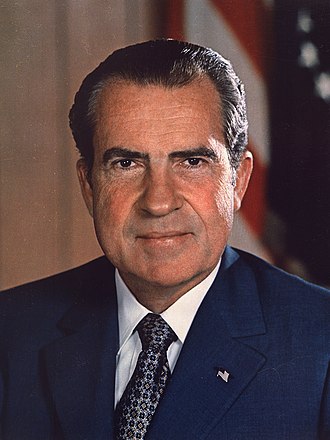
Richard M. Nixon served as the 37th President of the United States from January 1969 until his resignation in August 1974. In February 1971, he ordered the installation of a secret voice-activated taping system in the White House to preserve a historical record of his administration. Until the system's existence was revealed and dismantled in July 1973, the tapes captured Nixon directing major foreign policy initiatives, such as the opening to China, as well as his central role in the Watergate cover-up.
What Nixon talks about on the tapes
White House operations 4,718Presidential scheduling 2,225Public relations 1,784Presidential schedule 1,782Vietnam War 1,693Logistics 1,650Manolo Sanchez 1,626White House communications 1,400White House administration 1,399Presidential communication 1,243Henry Kissinger 1,191Foreign Policy 1,183
Conversations (21,010)
— Page 194 of 211President Richard Nixon met briefly with his personal valet, Manolo Sanchez, in the Old Executive Office Building. The conversation primarily served as an administrative arrangement, with the President instructing Sanchez to wait for an unspecified individual's return. No major policy developments occurred during this brief interaction.
President Nixon instructed the White House operator to place a telephone call to H. R. Haldeman. He specifically requested that the operator avoid interrupting Haldeman if he was currently in a meeting. The President directed the operator to notify him only once Haldeman became available.
President Nixon instructed the White House operator to facilitate travel arrangements for an individual named Huckerton. The President emphasized the urgency of the situation, expressing a desire to expedite Huckerton’s departure to Holland. This brief exchange served to initiate immediate logistical support for this specific international assignment.
President Richard Nixon met with his valet, Manolo Sanchez, in the Old Executive Office Building for a brief administrative interaction. While the limited audio recording does not reveal substantive political dialogue, the meeting served to coordinate personal scheduling matters involving Julie Nixon Eisenhower. The conversation concluded quickly with Sanchez departing the office shortly thereafter.
President Nixon consulted with an unidentified staff member regarding the preparation of a forthcoming Sunday night television address. The discussion focused on the necessary length of the speech, with the President specifying a fifteen-minute duration to ensure effective delivery. Nixon emphasized the importance of coordinating the message with advisors Leonard Garment and William P. Rogers while considering the political implications for Congress.
President Nixon and Stephen B. Bull met to coordinate scheduling logistics for the President and his daughter, Julie Nixon Eisenhower. The discussion centered on upcoming travel arrangements for Julie and potential changes to the President's own calendar. No major policy decisions were made, as the conversation focused exclusively on managing personal family commitments and logistical planning.
President Nixon and H. R. Haldeman discuss the recent New York grand jury indictments of John Mitchell and Maurice Stans in the Robert Vesco case. The conversation turns to legal strategy and internal frustrations regarding the accuracy of reports being relayed to Alexander Haig about meetings with Haldeman's legal counsel. Haldeman specifically corrects the record concerning the attendance of J. Fred Buzhardt, Leonard Garment, and Horace Chapman Rose at a recent meeting, highlighting ongoing friction within the administration’s legal coordination.
H. R. Haldeman and President Nixon engage in a brief, disjointed exchange that appears to involve personal matters and logistics regarding guest invitations or social arrangements. The participants touch upon a recent meeting involving individuals referred to as Jackie and another unnamed party, though the discussion remains vague. No formal policy decisions or substantive administrative actions are reached during this brief interaction.
President Nixon initiates a request through the White House operator to place a telephone call to William E. Timmons, the Assistant to the President for Legislative Affairs. The brief exchange serves as an administrative bridge to facilitate direct communication between the President and his top congressional liaison. No further substantive policy matters were discussed during this connection.
President Nixon and Alexander Haig discuss a potential inaccuracy regarding the reported attendance of Horace “Chappie” Rose at a previous meeting involving Leonard Garment and J. Fred Buzhardt, Jr. Nixon expresses concern that misinformation about meeting participants is circulating and causing confusion. The two men agree to clarify whether Rose was indeed absent, highlighting the President’s focus on controlling the narrative and accuracy of internal reporting during this period.
President Nixon initiates a brief interaction with the White House operator to facilitate an outgoing call. The conversation is strictly functional, serving to connect the President to another party for further discussion. No substantive policy matters or major decisions were recorded during this short exchange.
President Nixon and legislative aide William E. Timmons discuss the whip count for a critical upcoming House of Representatives vote concerning Vietnam policy. Timmons outlines a narrow path to victory, noting that the administration is actively lobbying undecided Republican freshmen following interventions by Gerald Ford and Leslie Arends. Nixon emphasizes the vital importance of the outcome, urging Timmons to exert every effort to flip votes and secure a legislative win.
President Nixon and William E. Timmons discuss the administration's political strategy regarding a vote in the House of Representatives. Expressing confidence, the two men affirm their intent to aggressively leverage political strength and resources to secure a victory. The conversation concludes with a resolute commitment from both parties to fight for the desired outcome.
Alexander M. Haig, Jr. updates President Nixon on his discussions with J. Fred Buzhardt, Jr. regarding recent legal meetings involving H.R. Haldeman’s counsel and Horace "Chappie" Rose. The conversation centers on clarifying Rose’s level of involvement in these meetings and addressing internal anxieties regarding potential misinformation conveyed by Leonard Garment. Nixon and Haig conclude by reaffirming their trust in Rose’s integrity while seeking to minimize staff tensions regarding the handling of sensitive information.
President Nixon and Alexander Haig held a brief, informal meeting to clarify the attendance of specific individuals, identified as “Chappie” and Garland, at a prior gathering. The discussion focused on rectifying the President’s uncertainty regarding who was present during that meeting. No major policy decisions were made, as the exchange served primarily to resolve a minor factual discrepancy regarding personnel.
President Nixon initiates a brief telephone call with the White House operator to request a connection with Press Secretary Ronald L. Ziegler. The conversation serves solely as a logistical bridge to facilitate communication with his staff. No further substantive policy matters or tactical discussions are addressed during this brief exchange.
President Nixon initiates a brief telephonic request through the White House operator to be connected with H. R. Haldeman. This exchange serves as a standard administrative action to facilitate communication between the President and his Chief of Staff. No further substantive policy matters or tactical discussions are addressed during this specific connection process.
President Nixon and Press Secretary Ronald Ziegler discuss the political fallout and public relations strategy following the federal indictments of John N. Mitchell, Maurice H. Stans, and Robert L. Vesco on perjury charges. They coordinate a "no comment" strategy regarding the indictments to emphasize the integrity of the judicial process while aiming to shift media attention toward positive administration announcements, including Cabinet appointments and the upcoming U.S.-Soviet summit. The conversation also touches on the President's desire to counterattack through the formation of a "Blue Ribbon Committee" and his perception that figures like John W. Dean III are overextending their political positions.
President Nixon initiates a brief telephone communication through the White House operator to request a call with his personal secretary, Rose Mary Woods. The conversation is strictly logistical, serving as an administrative bridge to facilitate direct contact between the President and his long-time aide. No substantive policy discussions or major decisions occur during this brief exchange.
President Nixon instructed his personal secretary, Rose Mary Woods, to relay a message of support to Maurice Stans and John Mitchell to avoid direct presidential contact that might create political exposure. He tasked Woods with assuring them of his confidence in their eventual vindication while specifically requesting that she also attempt to reach John and Martha Mitchell. This conversation highlights the President's efforts to maintain back-channel morale among key associates embroiled in the Watergate investigation without creating a traceable record of his involvement.
President Nixon initiates a brief telephone call through the White House operator to connect with Alexander M. Haig, Jr. The primary purpose of the communication is to facilitate a direct conversation between the President and his Chief of Staff. No further substantive policy matters or tactical discussions are addressed in this short transcript beyond the initial request to reach Haig.
President Nixon and Alexander Haig discuss the public relations fallout surrounding the indictments of John Mitchell and Maurice Stans, with Nixon expressing frustration over the underlying circumstances. The conversation shifts to scheduling meetings with Henry Kissinger and William Rogers to manage media coverage, as well as vetting William C. Sullivan for the FBI directorship based on strong recommendations from Senator Henry Jackson. Additionally, they review potential candidates for other high-level appointments, including James Schlesinger and replacements for the commission roles previously discussed with Earl Warren.
President Nixon initiates a request to the White House operator to be connected with Secretary of State William P. Rogers. This brief communication serves as a standard administrative task to facilitate a direct telephone conversation between the President and his top diplomat. No further substantive discussion occurs during this short exchange.
President Nixon and Secretary of State William P. Rogers discuss the possibility of appointing Earl Warren or Tom Clark to head a commission regarding the Watergate scandal, weighing the political sensitivities against the necessity for institutional legitimacy. Nixon expresses deep frustration over the recent indictments of John Mitchell and Maurice Stans in the Vesco case, comparing their conduct unfavorably to the Sherman Adams scandal. Additionally, the two coordinate their upcoming schedules to meet with Henry Kissinger and manage public communications regarding an impending U.S.–Soviet Union summit.
President Nixon contacted the White House operator to place a telephone call to H. R. "Bob" Haldeman. The brief exchange served as a routine administrative request to facilitate communication between the President and his former Chief of Staff. No further policy or strategic discussions occurred during this connection.
President Nixon and a White House operator discussed the scheduling of a return phone call from H. R. Haldeman. Upon being informed that Haldeman would be unavailable for approximately thirty minutes, the President consented to the delay. This brief administrative exchange served solely to manage the President's communications regarding his former Chief of Staff.
President Nixon initiates a brief request for the White House operator to connect him with his personal secretary, Rose Mary Woods. The conversation serves solely as a logistical bridge to facilitate direct communication with his staff. No further substantive policy matters or administrative decisions are addressed during this brief exchange.
President Nixon and his personal secretary, Rose Mary Woods, discuss the enthusiastic reception Nixon received at a recent Republican fundraising dinner. The conversation shifts to the ongoing Watergate scandal, specifically focusing on the legal troubles and reputations of Maurice Stans and John Mitchell. Nixon expresses personal sympathy for both men, while Woods provides updates on her efforts to maintain contact and support them during their testimony and legal challenges.
President Nixon contacted the White House operator to place an outgoing telephone call to his daughter, Tricia Nixon Cox, in New York. The conversation was purely logistical, serving only to facilitate this personal connection. No policy matters or substantive political business were discussed.
President Nixon and his daughter, Tricia Nixon Cox, discussed the political climate surrounding the Watergate scandal, specifically referencing the recent indictments of John Mitchell and Maurice Stans. The President sought reassurance regarding public sentiment and expressed optimism that the scandal would fade from public consciousness within several months. They also touched upon the positive reception Nixon received at a recent Republican dinner, which served as a focal point for their mutual confidence in the remainder of his second term.
President Nixon instructed the White House operator to connect him to William E. Timmons, who was attending a meeting at the Capitol. Timmons was currently conferring with Senator Hugh Scott and General Alexander M. Haig, Jr. at the time of the request. Nixon ultimately decided to speak with Timmons directly at that location to address the ongoing discussions.
President Nixon and H.R. Haldeman discuss the legal implications of recent Watergate-related indictments, specifically those targeting John Mitchell and Maurice Stans. The conversation focuses on coordinating their defense regarding past interactions with John Dean, particularly an effort to have the IRS investigate Lawrence O'Brien. Nixon and Haldeman emphasize the propriety of their past actions and discuss strategies to counter potential damaging testimony from Dean.
President Nixon contacted the White House operator to place an outgoing call to William E. Timmons, his Assistant for Legislative Affairs. The brief interaction served as a logistical step to initiate this communication. No further policy or substantive matters were discussed during the exchange.
President Nixon and William Timmons discussed the recent House defeat of a Defense Department transfer authority provision, which had been linked to Cambodian funding. Timmons provided an update on the administration's efforts to regroup and salvage portions of the authority related to non-Southeast Asian operations through a potential amendment by Samuel Stratton. Nixon emphasized minimizing the political fallout in the press and instructed Timmons to coordinate with Alexander Haig and Gerald Ford to issue statements clarifying that the vote did not signal the end of U.S. policy in the region.
President Nixon contacted the White House operator to request an urgent telephone call with Alexander M. Haig, Jr. He instructed the operator to reach Haig as soon as he concluded his current meeting. This brief administrative exchange served to facilitate direct communication between the President and his Chief of Staff.
President Nixon and Alexander Haig discuss the political fallout from a recent legislative setback in the House of Representatives, attributing the loss to poor coordination within the Departments of State and Defense and a lack of support from Republican members. To address these deficiencies, they plan to bolster William E. Timmons's congressional relations team and refine their legislative strategy. Additionally, they discuss managing Henry Kissinger’s concerns regarding John B. Connally’s role, while noting positive press reactions following recent Cabinet changes.
President Nixon met with an unknown individual to engage in an informal, brief interaction. The primary focus of the brief exchange involved a practical demonstration regarding a watch battery. No significant policy decisions or official administrative actions were recorded during this encounter.
President Nixon met with his aide Stephen B. Bull to review his daily schedule. The primary focus of the discussion was arranging a potential telephone call with Canadian Prime Minister Pierre E. Trudeau. Bull left the meeting shortly thereafter to finalize these administrative details.
President Nixon consulted with the White House operator to facilitate a phone connection to a Senator. This brief interaction served as a logistical step for the President to initiate official legislative outreach. No further substantive policy discussions were recorded during this segment of the call.
President Nixon held a brief morning meeting in the Oval Office with an unidentified individual to discuss his daily schedule. The primary focus of the exchange was the coordination of appointments, specifically involving William E. Timmons. The conversation concluded shortly before 8:27 am after the administrative matter was addressed.
President Nixon met with Nellie L. Yates in the Oval Office to coordinate his daily schedule. The discussion focused on administrative arrangements for upcoming meetings with staff members William E. Timmons and Ronald L. Ziegler. The brief encounter served to finalize the President's morning agenda.
President Nixon met with his aide, Stephen B. Bull, to review the President’s daily schedule. The brief discussion focused on coordinating upcoming meetings with key advisors, specifically Henry A. Kissinger and Alexander M. Haig, Jr. The exchange served as a routine administrative session to facilitate presidential staff accessibility and time management.
President Nixon held a brief, undocumented meeting in the Oval Office to request the presence of his personal secretary, Rose Mary Woods. The primary purpose of this interaction was to secure her immediate assistance or consultation. No further details regarding the substantive nature of the discussion are preserved in the historical record.
President Nixon initiated a brief telephone request through the White House operator to be connected with Senator Henry Bellmon. This administrative interaction was strictly logistical, aimed at facilitating a direct conversation between the President and the Senator. No further discussion occurred during this call beyond the request for the connection.
President Nixon initiated a call through the White House operator to place an outgoing connection. The conversation remained incomplete as the President aborted the request before the intended party could be reached. No substantive topics or policy decisions were discussed during this brief administrative interaction.
President Nixon met with Ronald Ziegler to strategize the White House response to the escalating Watergate scandal, specifically addressing negative press coverage and the potential for a formal election reform initiative. The discussion focused on shifting public attention away from the scandal by emphasizing the administration's foreign policy achievements and the need to professionalize government communications through the Republican National Committee. Nixon directed Ziegler to pursue a strategy of full disclosure regarding the administration’s actions while framing Watergate within the context of previous political wiretapping practices and media manipulation.
A White House operator informs President Nixon that Senator Henry Bellmon has checked out of his hotel in Oklahoma and is currently being tracked. The President acknowledges this update and indicates he is available to speak with the Senator at any time. This brief exchange serves as an administrative effort to facilitate direct contact between the President and Senator Bellmon.
President Nixon calls Senator Henry Bellmon to express strong support for his upcoming Senate candidacy announcement. The two discuss the political landscape in Oklahoma, with Nixon dismissing the potential negative impact of the Watergate scandal on Bellmon's campaign. Nixon concludes the call by offering to campaign on Bellmon's behalf and authorizing him to publicly share the President's endorsement with the press.
President Nixon and Alexander Haig discuss the potential resignation of Henry Kissinger and his future role as Secretary of State. The President considers the strategic timing of offering Kissinger the position to ensure political stability. The conversation focuses on navigating this sensitive cabinet transition and determining the best approach for delivering the offer.
President Nixon met briefly with his personal aide, Stephen B. Bull, to conduct administrative business in the Oval Office. The primary purpose of the meeting was for the President to sign the official Mother's Day Proclamation. The encounter was short, concluding immediately after the document was executed.
President Nixon and Alexander Haig discussed strategies to manage the fallout from the Watergate scandal, specifically focusing on the upcoming Congressional hearings and potential revelations regarding unauthorized wiretaps. They strategized on how to frame past FBI wiretapping activities as standard national security protocols inherited from previous administrations rather than partisan misconduct. Additionally, they evaluated the political implications of replacing Secretary of State William Rogers with Henry Kissinger or John Connally, ultimately weighing Kissinger's professional indispensability against the political utility of a cabinet change.
President Nixon met with an unidentified individual in the Oval Office to briefly discuss the scheduling arrangements of National Security Advisor Henry Kissinger. The short exchange provided no further details regarding specific foreign policy objectives or strategic decisions. The meeting concluded abruptly after the brief administrative consultation.
President Nixon held a brief meeting in the Oval Office with an unidentified individual, during which National Security Advisor Henry Kissinger was also present. The discussion centered on matters involving Kissinger's location and schedule, though the limited recording provides minimal detail on broader policy objectives. The meeting concluded quickly, leaving no specific record of substantive decisions or follow-up actions.
In this meeting, President Nixon, Henry Kissinger, and Secretary of State William Rogers discussed the administration's foreign policy strategy amidst the growing pressure of the Watergate scandal. The participants focused on preparing for an upcoming Soviet summit, managing ongoing negotiations regarding the Paris Peace talks and Cambodia, and evaluating personnel changes within the State Department. Despite concerns about domestic distractions and Congressional opposition, they emphasized the necessity of maintaining a firm stance in international negotiations, particularly regarding nuclear arms control and Southeast Asian stability.
President Nixon initiates a telephone call to Canadian Prime Minister Pierre E. Trudeau through the White House operator. The conversation is strictly logistical, with the President directing the operator to connect him with the Prime Minister. No policy discussions occur during this brief interaction, as it serves solely to facilitate the international communication.
President Nixon consulted with the White House operator to facilitate an outgoing call. This routine interaction served to connect the President with an unnamed party. No substantive policy discussions or significant political decisions occurred during this brief communication.
President Nixon and Alexander Haig discuss legal and public relations strategies regarding Watergate, specifically focusing on the potential impact of CIA memoranda (memcons) and wiretap evidence. The conversation centers on coordinating testimony from Lt. Gen. Vernon Walters to ensure it aligns with the administration's position that Nixon had no direct involvement in attempting to use the CIA to cover up the scandal. They determine that these documents must be withheld under executive privilege to prevent political damage and plan to instruct H.R. Haldeman and John Ehrlichman on how to frame their upcoming interactions with investigators.
Prime Minister Pierre Trudeau called President Nixon to express personal support and sympathy regarding the political fallout from the Watergate scandal. The two leaders discussed the pressures of political life, with Nixon characterizing the scandal as the result of misguided actions by subordinates. Nixon also updated Trudeau on Henry Kissinger’s upcoming trip to Paris to meet with Le Duc Tho, promising to provide the Prime Minister with a follow-up report on the negotiations.
President Nixon met with John C. Slemp and Stephen B. Bull to host a brief social visit and photo session. The conversation centered on Slemp’s extensive background in religious journalism, his global travels, and his literary work. The President concluded the meeting by presenting Slemp with personal gifts, including an autographed pen and cufflinks.
President Nixon met with Stephen B. Bull to coordinate an upcoming meeting with H. R. Haldeman. The discussion focused on locating Haldeman, who was reportedly conferring with Lawrence M. Higby at the time. Bull facilitated the scheduling, confirming that Haldeman was nearby and ready to meet with the President.
President Nixon met with H. R. Haldeman and Alexander Haig to strategize their defense regarding the Watergate investigation and the potential release of sensitive documents. The discussion centered on managing the implications of memoranda created by CIA Deputy Director Vernon Walters, which documented past interactions involving the President, Haldeman, John Ehrlichman, and John Dean. The group focused on shielding the administration from allegations of a cover-up by emphasizing national security concerns and framing the CIA’s involvement as a peripheral issue, while also ensuring that Haldeman and Ehrlichman’s forthcoming testimony remained consistent with their narrative.
President Nixon and Alexander Haig coordinate the logistics for the arrival of an unidentified individual, likely Lieutenant General Vernon A. Walters, to the Executive Office Building. They confirm the guest's travel progress to ensure a timely meeting. The discussion serves as a brief operational update to facilitate the visitor's imminent arrival.
President Nixon and Stephen B. Bull met briefly to finalize logistical details regarding a private signing ceremony for the Rural Electrification and Telephone Program. They discussed the specific timing of the event and the anticipated participation of Secretary of Agriculture Earl L. Butz. The meeting concluded after confirming the departure schedule for these proceedings.
President Nixon initiates a brief request for the White House operator to place a telephone call to Stephen B. Bull. This exchange serves as an administrative bridge to facilitate direct communication with a key staff member. No further policy or substantive discussion occurs during this short connection.
President Nixon instructed Stephen B. Bull to coordinate with Alexander Haig's office regarding the schedule of Lieutenant General Vernon A. Walters. Upon learning that Walters was already present at the White House, Nixon directed Bull to escort the General to his office for a meeting. This interaction facilitated an immediate private consultation between the President and Walters.
President Nixon met with his personal valet, Manolo Sanchez, in the Old Executive Office Building to discuss administrative adjustments regarding the President's upcoming schedule. The conversation focused on coordinating logistics for an impending meeting with a visitor. The brief exchange concluded with instructions to facilitate the entry of the expected guest.
President Nixon requested that the White House operator disconnect or stop recording the active line. This brief interaction served as a procedural administrative instruction regarding the management of the President's telecommunications. No other substantive political or policy matters were discussed during this exchange.
President Nixon and Stephen B. Bull briefly discussed administrative logistics regarding the scheduling of John Walters. Nixon instructed Bull to coordinate with Dave’s office to determine Walters's arrival time and requested that Walters meet with him directly upon arrival. This short exchange reflects the President's ongoing management of staff appointments during a period of high political sensitivity.
Alexander M. Haig, Jr. advised President Nixon against meeting with Lieutenant General Vernon A. Walters to avoid attracting undue attention from investigators or the press. Nixon promptly accepted this counsel, acknowledging the potential liability such a meeting would create. Consequently, the two agreed to meet privately instead to discuss the matter further.
President Nixon and Alexander Haig held a brief administrative exchange to coordinate their schedules. The President invited Haig to his office in the Old Executive Office Building for a follow-up discussion. This brief interaction served as a logistical arrangement to facilitate a more substantive meeting between the two officials.
President Nixon met with Stephen B. Bull in the Old Executive Office Building to coordinate his upcoming daily schedule. The discussion primarily focused on logistics regarding an upcoming meeting with Alexander M. Haig, Jr., specifically concerning the participation of Vernon A. Walters. Additionally, they addressed scheduling matters related to Charles G. "Bebe" Rebozo.
President Nixon and Alexander Haig met to discuss managing the ongoing Watergate investigation and coordinating the testimony of CIA Deputy Director Vernon Walters. Nixon emphasized that he wanted Walters to reassure officials like Elliot Richardson, William Colby, and James Schlesinger of the President’s innocence and his desire for a full investigation. The conversation centered on the potential legal exposure of H.R. Haldeman and John Ehrlichman, the status of sensitive memoranda of conversation, and ensuring the loyalty of key administration appointees amidst the political fallout.
President Nixon, Rose Mary Woods, and Alexander Haig confer to locate missing files once belonging to J. Edgar Hoover that were reportedly sent to the White House following the departures of H. R. Haldeman and John Ehrlichman. Woods clarifies that the sensitive materials were never delivered to her office or placed in her custody. Consequently, Haig agrees to investigate the matter further to determine the actual location of the files.
President Nixon initiated a call through the White House operator to contact Alexander M. Haig, Jr. The brief exchange served as a logistical bridge to facilitate direct communication with his Chief of Staff. No substantive policy matters were discussed, as the interaction focused solely on placing the outgoing connection.
President Nixon met with his valet, Manolo Sanchez, to discuss personal scheduling and logistics regarding an upcoming dinner. The brief exchange primarily concerned the availability of a venue and the President's need for a rest period. No significant policy decisions were made during this informal interaction.
President Nixon consulted with a White House operator to facilitate an outgoing call. The brief exchange focused on establishing a connection with another party. No substantive policy matters or major developments occurred during this administrative interaction.
President Nixon instructed Alexander Haig to direct J. Fred Buzhardt to adopt a more supportive and optimistic tone when communicating with H.R. Haldeman and John Ehrlichman regarding their legal strategy. Nixon emphasized that Buzhardt must project confidence that the Watergate situation is manageable to counter the anxiety caused by Leonard Garment’s more alarming counsel. Additionally, the two discussed John Connally’s potential leave of absence from his law firm, with Nixon approving the move to address concerns regarding professional conflicts of interest.
President Nixon instructed Alexander Haig to manage the morale of staff members—specifically referencing Bob [Haldeman] and John [Ehrlichman]—by discouraging apocalyptic rhetoric regarding impeachment or legal jeopardy. Nixon directed Haig to reassure these individuals that the administration remains supportive and committed to their defense to prevent them from losing confidence. The primary objective was to ensure that distressed associates felt the White House was actively fighting on their behalf rather than conceding to the growing pressures of the Watergate scandal.
President Nixon contacted the White House operator to facilitate a telephone connection to his former Chief of Staff, H. R. Haldeman. This brief administrative interaction served as the necessary logistical step to initiate a private conversation with Haldeman following his resignation. No substantive policy matters were discussed during this request for an operator-assisted call.
President Nixon consulted with a White House operator to facilitate an outgoing telephone connection. This brief interaction served solely as an administrative bridge to initiate further communication with another party. No substantive policy matters or political issues were discussed during this brief exchange.
President Nixon met with his personal aide, Manolo Sanchez, to discuss the transportation logistics for his dog. The brief conversation focused on ensuring the animal was prepared for travel. No broader policy or administrative developments resulted from this exchange.
President Nixon directs H. R. Haldeman to proceed with the establishment of the Nixon Foundation, emphasizing the project's critical role in securing the President's legacy and managing his archives. They discuss utilizing the foundation to facilitate the writing of the administration's history, potentially by Henry Kissinger, while providing the President access to his records, including the White House tapes, without direct personal involvement. The conversation concludes with Nixon instructing Haldeman to continue his scheduled engagement with the FBI.
President Nixon and H. R. Haldeman briefly discuss the establishment of a foundation intended to preserve the administration's legacy. Nixon expresses enthusiasm for the project and indicates his personal intention to author a history of his first term. The two agree that the comprehensive collection of White House tape recordings will serve as the primary resource for this historical account.
President Nixon initiates a request through the White House operator to place an outgoing telephone call to his aide, Stephen B. Bull. This brief administrative interaction serves solely to facilitate direct communication between the President and a member of his staff. No substantive policy discussions or decisions are recorded during this brief connectivity exchange.
President Nixon held a brief, routine communication with the White House operator to facilitate an outgoing call. No substantial policy discussions or administrative decisions occurred during this interaction. The exchange served primarily as a functional administrative request to connect the President to another party.
President Nixon directed Stephen B. Bull to move the signing ceremony for the Rural Electrification and Telephone Program to 3:30 p.m. in the Executive Office Building to accommodate his departure for Camp David. Emphasizing privacy, Nixon strictly forbade any press coverage or on-the-record status for his travel to Camp David, citing his frustration with being followed by press vehicles. He explicitly ordered Bull to ensure that all future presidential drives remain off the record.
President Nixon and aide Stephen B. Bull coordinate the scheduling and logistics for a private document signing session. Nixon emphasizes his desire to avoid media presence, explicitly instructing Bull that future signings and events should not be open to the press. The conversation serves as a directive to restrict public and photographic access to presidential activities moving forward.
President Nixon utilized the White House operator to initiate a telephone call to Alexander M. Haig, Jr. The primary purpose of this brief exchange was to facilitate communication between the President and his Chief of Staff. No substantial policy or strategic discussions took place during this administrative connection.
President Nixon met with his personal valet, Manolo Sanchez, in the Old Executive Office Building to discuss the President's immediate schedule. The brief interaction focused on logistics regarding the time of day and upcoming appointments. The meeting concluded quickly without any significant policy developments or major strategic decisions.
President Nixon consulted with a White House operator to facilitate an outgoing telephone connection. This brief interaction served administrative purposes to establish communication with an external party. No substantive policy discussions or significant political developments occurred during this exchange.
President Nixon and Alexander Haig discuss the urgent search for specific FBI files and a sensitive memorandum previously handled by John Ehrlichman. Nixon expresses concern over the potential inclusion of damaging material regarding Henry Kissinger within these documents, insisting that the damaging memo be retrieved to facilitate a proactive political offensive. Additionally, Haig confirms he will provide Fred Buzhardt with instructions for upcoming interviews with H.R. Haldeman, Ehrlichman, and Charles Colson.
President Nixon and Alexander Haig held a brief, cryptic discussion regarding the urgent location and secure handling of sensitive documents that Nixon wanted kept hidden from certain individuals. Nixon expressed frustration over the inability of staff to retrieve these materials from a safe within the building. The President directed Haig to locate the files immediately and ensure their contents remained shielded from unauthorized access.
President Nixon instructed the White House operator to place a telephone call to Alexander M. Haig, Jr. This brief interaction served as a logistical step to facilitate direct communication between the President and his Chief of Staff. No further substantive policy discussions occurred during this specific exchange.
President Nixon spoke briefly with the White House operator to facilitate a telephonic connection. This interaction served an administrative purpose to initiate communication with another party. No substantive policy discussions or significant political decisions were recorded during this brief exchange.
President Nixon directs Alexander Haig to prioritize the urgent location of a specific document, insisting that his staff conduct a comprehensive search of the White House. Emphasizing a shift toward a public relations strategy, Nixon instructs Haig to leak the document to the press before it is submitted to the judge handling the case. This exchange highlights the administration’s focus on controlling the public narrative regarding Watergate-related materials.
President Nixon and Alexander Haig coordinate the preemptive release of a sensitive document to control the narrative amid concerns over unauthorized leaks. Nixon emphasizes that the current climate has become a public relations struggle and directs Haig to locate the material before it can be leaked by political opponents. The discussion reflects the administration's defensive strategy to manage information flow and prevent unfavorable press coverage.
President Nixon and Stephen B. Bull reviewed the President’s upcoming schedule for the following Monday, focusing on a variety of diplomatic and domestic appointments. Key agenda items included a state visit by Haile Selassie, a meeting with Nelson Rockefeller regarding the Study Commission on Third Century America, and a ceremony to honor Mrs. Roberto Clemente. The two also coordinated logistics for Nixon’s travel plans to Camp David, specifically discussing the timing of a helicopter departure.
President Nixon met with Secretary of Agriculture Earl L. Butz and several Department of Agriculture staff members to preside over a bill signing ceremony. The participants, including Dana G. Mead and William W. Erwin, gathered for a photo opportunity with the President to commemorate the new legislation. Brief discussions during the event touched upon the cattle industry in Colorado and concerns regarding consumer food prices.
Alexander M. Haig, Jr. informs President Nixon that he has located a large volume of sensitive FBI files related to Watergate, estimated at three feet of material, stored in a vault. Haig expresses the need to personally screen these documents to ensure security and prevent unauthorized access. The two agree to meet briefly at the White House before the President departs for Camp David to discuss the matter further.
President Nixon and Alexander Haig coordinate a meeting to discuss consolidating documents before the President’s departure for Camp David. The brief exchange focuses on logistical arrangements for the review of materials. Haig confirms his availability to meet with the President prior to his travel.