Nixon, Richard M. (President)
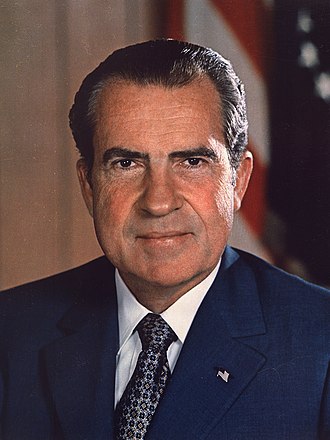
Richard M. Nixon served as the 37th President of the United States from January 1969 until his resignation in August 1974. In February 1971, he ordered the installation of a secret voice-activated taping system in the White House to preserve a historical record of his administration. Until the system's existence was revealed and dismantled in July 1973, the tapes captured Nixon directing major foreign policy initiatives, such as the opening to China, as well as his central role in the Watergate cover-up.
What Nixon talks about on the tapes
White House operations 4,718Presidential scheduling 2,225Public relations 1,784Presidential schedule 1,782Vietnam War 1,693Logistics 1,650Manolo Sanchez 1,626White House communications 1,400White House administration 1,399Presidential communication 1,243Henry Kissinger 1,191Foreign Policy 1,183
Conversations (21,010)
— Page 21 of 211President Nixon and H.R. Haldeman reviewed the success of Nixon’s June 1, 1971, press conference, focusing on the positive public reception of his firm stance on the recent May Day demonstrations. They discussed the effectiveness of framing the protesters as vandals and lawbreakers to bolster his 'law and order' platform, while noting the media's disproportionate fixation on Vietnam and the neglect of domestic policy issues. Nixon also addressed logistical concerns regarding television camera angles and concluded that in future briefings, he should speak directly to the camera rather than the reporters to improve his communication with the public.
President Nixon instructed the White House operator to place a telephone call to National Security Advisor Henry A. Kissinger. This brief administrative interaction served as the initiation of a high-level diplomatic or security-related communication. No further substantive details regarding the purpose of the call were captured in this recording.
President Nixon and Henry Kissinger debriefed regarding the President's June 1, 1971, press conference, expressing mutual satisfaction with his performance and the public's likely reception. They analyzed the President's firm stance on the recent May Day demonstrations and reviewed his handling of complex foreign policy questions concerning the USSR, the Middle East, and relations with the People's Republic of China. Both agreed that the television format remained an essential tool for the President to communicate directly with the public, and they committed to holding such press conferences on a regular, recurring basis.
President Nixon contacted the White House operator to request a telephone connection with Chief of Staff H.R. Haldeman. This brief administrative interaction served as a logistical bridge to facilitate a direct conversation between the President and his top aide. No substantive policy discussions occurred during this exchange, as it was strictly for the purpose of placing a call.
President Nixon and H.R. Haldeman reviewed the feedback and public reception following the President’s recent televised press conference. They discussed the administration's performance on key issues such as drug policy, the May Day protests, and diplomatic efforts regarding China and Vietnam. The two also assessed the effectiveness of Nixon's presentation style, specifically debating the merits of looking directly into the camera versus engaging with the press, while planning adjustments for future appearances.
President Nixon initiates a brief telephone request to the White House operator to be connected with Secretary of the Treasury John B. Connally. The interaction serves solely as a logistical bridge to facilitate an urgent communication between the President and his Treasury Secretary. No further policy discussions or administrative decisions occur during this short exchange.
President Nixon and Treasury Secretary John B. Connally reviewed the President’s recent press conference, agreeing that the press corps’ aggressive questioning highlighted media bias to the American public. They expressed frustration that the media ignored key domestic issues such as the economy and revenue sharing, despite Nixon being fully prepared to address them. The conversation concluded with Nixon providing strategic advice to Connally regarding his upcoming appearance before Representative Wilbur D. Mills to advocate for revenue sharing legislation.
President Nixon initiates a brief telephone request to the White House operator to be connected with his personal secretary, Rose Mary Woods. This administrative exchange facilitates direct communication with a key staff member during late-night hours. No further policy or substantive matters are discussed during the brief interaction.
President Nixon and his personal secretary, Rose Mary Woods, discuss the President's recent press conference performance and public reception. Woods commends Nixon for his calm demeanor while addressing aggressive questioning regarding the administration's handling of May Day demonstrators. The conversation highlights the administration’s strategy of framing these protests as law and order issues, noting that Attorney General John Mitchell expressed strong approval of the President's steady approach.
President Nixon contacted the White House operator to place an urgent call to FBI Director J. Edgar Hoover. The brief exchange served as a routine administrative request to facilitate direct communication between the President and the Bureau's leadership. No further substantive details regarding the purpose of the call were captured.
President Nixon instructed the White House operator to place an urgent call to Attorney General John N. Mitchell. He subsequently requested that the operator connect him directly to FBI Director J. Edgar Hoover. This brief exchange served as a logistical coordination to facilitate immediate communication with his top law enforcement and legal officials.
President Nixon and FBI Director J. Edgar Hoover discussed the President's recent press conference, specifically his defense of law enforcement tactics used against May Day demonstrators and his firm stance against the legalization of marijuana. The two men criticized the D.C. court system, particularly Judge David L. Bazelon, while coordinating the agenda for an upcoming meeting involving police officials. Additionally, Hoover updated the President on an ongoing FBI investigation into a recent criminal incident involving Black suspects in New York.
President Nixon and Attorney General John Mitchell discuss the political fallout from recent anti-war protests and the media's coverage of law and order issues. The conversation emphasizes the administration's commitment to combatting domestic drug abuse, specifically rejecting the legalization of marijuana and framing the issue as a national crisis rather than one isolated to Vietnam. The two conclude by coordinating plans for a follow-up meeting scheduled for June 3 to address these policy initiatives.
President Nixon contacted the White House operator to facilitate a personal communication. The primary purpose of the brief call was to request that the operator place a connection to his daughter, Julie Nixon Eisenhower. No further policy or administrative matters were discussed during this exchange.
President Nixon dictates a letter reflecting on his past interactions with the press while preparing for an upcoming press conference. He specifically discusses the performance of Ronald L. Ziegler and John A. Scali, evaluating their roles in managing media relations. The President further analyzes his own strategic approach to public appearances, emphasizing the necessity of maintaining a cooperative persona when addressing the White House press corps.
President Nixon dictates a letter to an unidentified professional shortstop struggling with an extended hitting slump. Drawing a parallel to his own political career, the President offers encouragement regarding the necessity of perseverance during periods of professional failure. Nixon frames the letter as a gesture of support, urging the athlete to maintain confidence despite his current lack of performance.
President Nixon directed John D. Ehrlichman to prepare a detailed cost analysis of the legislative agenda proposed by the Congressional Black Caucus. Nixon emphasized the urgency of the request, demanding a comprehensive evaluation of the total projected costs within a 24-hour window. This initiative aimed to quantify the fiscal impact of all sixty recommendations to better inform the administration's political response.
President Nixon dictated a memorandum to Egil “Bud” Krogh, Jr., tasking him with gathering reliable data on the correlation between marijuana use and subsequent heroin addiction. He directed Krogh to leverage research held by federal agencies, specifically identifying the National Institute of Mental Health and its director, Dr. Bertram S. Brown, as key sources. The President’s objective was to acquire concrete statistics to bolster his administration’s drug policy messaging.
President Nixon dictates a memorandum to John Ehrlichman instructing him to investigate the role of physician over-prescription in the nation's drug abuse crisis. The President directs Ehrlichman to consult with the Department of Health, Education, and Welfare and the Secretary of Health regarding the misuse of amphetamines and other controlled substances. The primary objective is to obtain a formal study and actionable recommendations on how to restrict the ability of medical professionals to facilitate drug abuse through excessive prescribing practices.
President Nixon dictated a memorandum to John D. Ehrlichman and Egil Krogh, Jr. tasking them with developing recommendations to increase criminal penalties for drug suppliers and pushers. Nixon specifically expressed a willingness to consider extreme measures, including the death penalty, for major narcotics traffickers despite potential judicial resistance regarding stiff sentencing. He requested an urgent review of federal statutes to determine how they might be utilized to address the trafficking of hard drugs like heroin.
President Nixon dictates a memorandum for John D. Ehrlichman regarding the urgent need to address rising urban unemployment. Concerned that unemployment rates exceeding 6% would create severe political repercussions and irreparable economic damage, Nixon directs Ehrlichman to coordinate with George P. Shultz to develop a strategy for the summer months. The discussion focuses on evaluating Pierre Rinfret’s economic forecasts and formulating proactive policy measures to mitigate potential civil and political instability.
President Nixon dictates a memorandum to General Alexander M. Haig, Jr. regarding the creation of a memorial at West Point honoring both Robert E. Lee and Ulysses S. Grant. He suggests that commemorating prominent generals from both sides of the Civil War could help heal lingering regional divisions and address sensitivities in the American South. The President directs Haig to explore the feasibility of such a tribute to foster national reconciliation.
President Nixon discusses a personnel matter regarding a formal letter of recommendation for an individual, identified as 'Mel.' He expresses high praise for the individual's performance over the previous two and a half years and explicitly requests a positive addition to their official employment record. The discussion reflects the President's personal interest in ensuring this associate receives formal recognition and long-term professional credit.
President Nixon met with his aide Stephen B. Bull to discuss administrative logistics regarding the President’s daily schedule and the management of White House tape recordings. The primary focus involved coordinating tasks with Alexander P. Butterfield to ensure the proper handling and documentation of presidential activities. This meeting served as a procedural session to maintain the integrity of the White House internal record-keeping systems.
President Nixon consulted with Alexander P. Butterfield and Rose Mary Woods to address equipment malfunctions regarding his dictation process. The group also coordinated logistical details for upcoming events, specifically planning protocol for a meeting with Anastasio Somoza Debayle and organizing gifts and arrangements for the 80th Congressional Club reception. Additionally, Nixon prepared for an upcoming congressional briefing on international economic policy involving Peter G. Peterson.
President Nixon held an Oval Office meeting with an unidentified individual to discuss matters pertaining to the President's official schedule. While the specific identity of the participant and the details of their conversation remain unrecorded, the discussion focused on logistical or planning requirements for the executive office. The interaction concluded when the individual departed the office shortly before 9:20 am.
President Nixon met with Alexander P. Butterfield and Rose Mary Woods to address logistical arrangements for upcoming events and resolve technical issues with his dictation equipment. The discussion covered protocols for a meeting with Anastasio Somoza Debayle, ensuring the encounter remained informal and strictly limited in scope. Additionally, they coordinated the physical arrangements and gift selection for the 80th Congressional Club reception and finalized the scheduling and venue logistics for a bipartisan congressional briefing on international economic policy.
In this extensive meeting, President Nixon and H. R. Haldeman, later joined by Henry Kissinger and other staff, discussed a broad range of administrative, political, and foreign policy matters. The conversation focused heavily on the President's recent press conference, strategies for managing the press and domestic public opinion, and the imperative to achieve foreign policy breakthroughs in Vietnam, relations with the USSR, and potential overtures to the People's Republic of China. Significant developments included internal planning for clandestine diplomatic channels and a firm resolve to maintain a "law and order" stance against anti-war demonstrators and critics of the administration.
President Nixon, Pat Nixon, and Stephen Bull met with William J. Hopkins and his guests to coordinate a Medal of Freedom ceremony. The participants discussed the logistics and sequence of events for the presentation, including the role of Commander Craig Campbell. Following brief social conversation regarding their shared experiences growing up in small towns, the group departed the Oval Office to proceed to the formal ceremony.
President Nixon met with his aide Stephen B. Bull to review and adjust his daily schedule regarding upcoming appointments with Robert H. Finch and H. R. Haldeman. Nixon specifically sought to avoid a lunch meeting with Finch, preferring to shift the appointment to a different time slot. The brief discussion concluded with a decision to finalize the logistics of these encounters.
President Nixon met with his aide Stephen B. Bull to coordinate and review the upcoming schedule of Robert H. Finch. The brief session focused on logistical planning regarding Finch's official engagements. No further administrative actions were recorded beyond this scheduling discussion.
President Nixon met briefly with Alexander P. Butterfield to coordinate the President's daily calendar and administrative logistics. The discussion focused specifically on the scheduling of a meeting with Robert H. Finch. This interaction served to finalize administrative arrangements for the President's upcoming appointments.
President Nixon met with his aide Stephen B. Bull in the Oval Office to conduct a brief review of his daily schedule. The primary focus of the discussion concerned the timing and arrangements for upcoming meetings with Robert H. Finch and H.R. Haldeman. Following this administrative coordination, Bull concluded the meeting and departed.
President Nixon met with H. R. Haldeman, Robert Finch, Ronald Ziegler, and Alexander Butterfield to coordinate 1972 re-election strategy, focusing specifically on California politics and the management of Republican primaries. The group discussed the potential for Caspar Weinberger to run for mayor of San Francisco to boost the President's standing in the state, while also strategizing on how to handle potential stand-in candidates and primary challenges. Nixon emphasized a desire to minimize his direct campaign travel during the primaries, delegating tactical operations to a small, loyal team including Haldeman, Finch, and Bryce Harlow, while expressing distrust toward Charles Colson’s political judgment.
President Nixon met with an aide to discuss the management of public perception regarding a high-level briefing on the heroin problem, specifically ensuring it was framed as a broad, non-military domestic issue. The discussion covered plans for legislative reform, including the creation of a special federal narcotics office and the implementation of mandatory treatment for military personnel. Additionally, the President and his advisor evaluated recent media appearances and political communication strategies, debating whether Nixon should adopt a more combative stance toward the press and critics to project strength and clarity on key issues.
President Nixon met with his aide, Stephen B. Bull, for a brief one-minute session in the Oval Office. The discussion focused on administrative matters regarding the President's upcoming schedule. No further details were recorded as the meeting concluded immediately after the brief exchange.
President Nixon and John Ehrlichman met to discuss the administration's aggressive new strategy for addressing drug abuse, including the formation of a centralized office led by Dr. Jerome H. Jaffe and the implementation of mandatory drug testing and rehabilitation for military personnel. They further explored political tactics for the President, debating whether he should adopt a more combative public persona to better challenge opponents and define his presidency. Finally, they touched upon federal personnel management and potential legislative strategies regarding economic issues, such as revenue sharing and public service employment.
President Nixon met with an advisory committee of the Boy Scouts of America's Explorer division to discuss their organization, the integration of female members, and the age demographic of the program. The President engaged in brief conversation regarding his personal history with the Boy Scouts and his upcoming travel plans to Rochester, New York. The group also reviewed the logistics and schedule for an outdoor ceremony where Nixon would provide remarks and present gifts to the attendees.
President Nixon met with John Connally and other staff members to discuss administration strategy regarding the drug crisis, the national economy, and political messaging. They addressed the success of recent heroin seizures and evaluated potential international and domestic economic policies, including the possibility of a wage-price freeze and strategies to combat inflation. Additionally, Nixon emphasized the need to project strength and confidence in press conferences while coordinating his cabinet to effectively articulate administration goals ahead of the 1972 election.
President Nixon held a brief, private meeting in the Oval Office with an unidentified individual. The recording contains limited audible content, as the majority of the encounter is obscured by a withdrawn personal-returnable segment. No substantive policy discussions or administrative actions can be verified from the available documentation.
President Nixon and H. R. Haldeman discuss public relations strategy, focusing on how the President should project strength and manage his emotions during media appearances. They analyze the political effectiveness of Nixon's recent press conferences, debating whether he should adopt a more combative, 'righteous' tone rather than maintaining a perpetually cool demeanor. Additionally, they discuss the logistical coordination of upcoming social events, including a dinner with Nicaraguan President Somoza, and the continued use of polling to gauge public opinion on specific issues like drug policy.
President Nixon met with Alexander P. Butterfield and Stephen B. Bull to coordinate logistical details regarding an upcoming evening meeting with FBI Director J. Edgar Hoover and Attorney General John N. Mitchell. The participants confirmed the 10:00 p.m. scheduling for the session and established the protocol for the officials' arrival. Nixon directed that Hoover and Mitchell enter together so he could join them at the start of the discussion.
President Nixon met with a large group of law enforcement officials, including J. Edgar Hoover and Attorney General John Mitchell, to discuss the increasing dangers facing police officers and to bolster morale through strong federal support. The conversation covered the need for legislative action, such as federal death benefits for families of slain officers, as well as strategies for better inter-agency cooperation against civil unrest and drug-related crime. Nixon emphasized the importance of public respect for law and order, highlighting recent May Day demonstrations as a point of discussion regarding the administration's firm stance on maintaining public security.
President Nixon and H. R. Haldeman met to review the President's upcoming schedule, including various appointments and the preparation for a press conference. The discussion focused heavily on the political risks posed by unfavorable economic indicators, specifically rising unemployment figures and the wholesale price index. They strategized on how to manage media narratives surrounding these economic reports and potential legislative vetoes to minimize negative press coverage.
President Nixon met with J. Edgar Hoover, John Mitchell, Egil Krogh, and John Ehrlichman to coordinate an upcoming meeting with law enforcement leaders. The participants discussed the administration's proposed legislation for providing financial compensation to the families of crime victims and strategies for presenting these initiatives to police officials. Nixon specifically instructed Hoover to emphasize the FBI's commitment to providing assistance to local police departments as part of the broader legislative agenda.
President Nixon and H. R. Haldeman discuss strategies for upcoming press conferences, focusing on how the President should handle political questions and maintain his control over the news cycle. Nixon expresses a desire to avoid being drawn into partisan debates or candidate-specific topics, instead preferring to project a presidential image that resonates with the public. They also review the political utility of recent law-and-order rhetoric, particularly regarding police support and the administration's firm stance against drug legalization, and deliberate on the timing and location of future press engagements to maximize reach and impact.
President Nixon met with actress Corinne Griffith and Roger E. Johnson in the Oval Office, accompanied by a photographer to document the occasion. The conversation was largely social, touching upon Washington Redskins games, Griffith’s residence in Los Angeles, and the President's recent interactions with J. Edgar Hoover. Nixon concluded the meeting by presenting Griffith with a presidential gift, a compact featuring the presidential seal, while acknowledging her continued support.
President Nixon and Stephen B. Bull reviewed the logistics for an upcoming appearance by a Polish boys' choir at the White House. They discussed the involvement of Senator Robert P. Griffin and Congressman Lucien N. Nedzi in coordinating the visit for the Polish-American community. The brief meeting also included a specific clarification regarding the correct pronunciation of the Polish city, Poznan.
President Nixon, H. R. Haldeman, and Ronald Ziegler met to coordinate logistics for upcoming presidential travel, review scheduling for meetings with political allies and foreign officials, and discuss the administration's media strategy regarding recent May Day protests. The group reviewed gift-giving protocols for members of Congress and evaluated the political risks associated with various appearances, including a rejected proposal for a concert in the Rose Garden. Nixon and his staff also discussed managing press relations, specifically reinforcing the President's policy of declining to answer partisan political questions during televised press conferences.
President Nixon held a meeting with an unidentified individual in the Oval Office to conduct internal administration business. The recording captures only a brief, fragmented exclamation from the visitor, providing no substantial information regarding policy discussions or administrative actions. Consequently, the specific nature and outcome of this interaction remain historical unknowns due to the lack of audible dialogue.
President Nixon and Henry Kissinger met in the Oval Office to discuss scheduling and the management of Kissinger's calendar. The conversation primarily focused on coordinating upcoming engagements and strategic planning regarding the National Security Advisor's availability. No major policy decisions were reached, as the discussion remained centered on administrative logistics.
President Nixon met with his personal valet, Manolo Sanchez, in the Oval Office to address routine logistical matters. The brief discussion primarily concerned the physical arrangement of equipment within the room. No significant policy decisions or political developments were recorded during this exchange.
President Nixon consulted with the White House operator to facilitate an outgoing call. This interaction served a logistical purpose, as the President required assistance in connecting with a specific party via the White House switchboard. No substantive policy matters or political discussions were recorded during this brief administrative exchange.
President Nixon and his daughter, Julie Nixon Eisenhower, discussed upcoming scheduling logistics and personal plans. Their conversation focused primarily on the President’s attendance at an 80th Congressional club reception and potential plans for utilizing the presidential yacht, the Sequoia. They also briefly touched upon weather conditions as they evaluated the feasibility of using the vessel the following day.
President Nixon and Henry Kissinger met to coordinate strategy regarding ongoing diplomatic negotiations, specifically concerning Vietnam and the President's upcoming trip to the People's Republic of China. They discussed the importance of maintaining secrecy and timing for these sensitive foreign policy initiatives while addressing the domestic political fallout from the recent May Day demonstrations and military controversies. Additionally, the pair evaluated the geopolitical complexities surrounding the India-Pakistan conflict and expressed a desire to keep U.S. involvement limited to protect broader strategic interests.
President Nixon and John Ehrlichman spoke briefly to coordinate before a scheduled meeting while Ehrlichman was at the office of Maurice Stans. The two men discussed the heavy law enforcement presence regarding recent May Day demonstrations, expressing satisfaction that the security measures had successfully frustrated the Washington press corps. No further policy decisions were made, as the conversation served primarily as a brief situational update.
President Nixon and John Ehrlichman briefly coordinate the timing of a meeting scheduled for later that afternoon. During the exchange, they discuss the visible presence of law enforcement around the White House grounds, which Nixon notes has successfully unsettled the press corps. No major policy decisions are reached, as the conversation serves primarily as a logistical check-in.
President Nixon held an informal discussion with an unidentified individual regarding the composition and political influence of the 80th Congressional Club. The dialogue focused on the difficulties of governance during that legislative period and the historical dynamics between the executive branch and congressional leadership. No specific policy decisions were recorded during this brief administrative exchange.
President Nixon met briefly with an unidentified woman in the Oval Office to facilitate an exchange of documents or items related to Rose Mary Woods’ schedule. The meeting was administrative in nature and concluded shortly thereafter, with the guest departing the office within ten minutes. No substantive policy discussions were recorded during this brief encounter.
President Nixon and Rose Mary Woods met to discuss various administrative and personal matters, including the Blair House Fine Arts Committee's proposal to create a new reception hall in honor of the President and First Lady. They also addressed concerns regarding ongoing anti-war demonstrations, with the President expressing frustration over the behavior of the protestors. Additionally, the conversation touched upon the logistics of David Eisenhower's stay at the U.S. Embassy in Athens and administrative notes regarding gifts and correspondence.
President Nixon met with H. R. Haldeman, Robert Dole, and John Mitchell to discuss the administration's political strategy, including the management of the 1972 Republican National Convention site selection and efforts to increase youth voter registration. The group evaluated the political risks of pending legislation, specifically gun control, health care, and public works bills, while coordinating messaging to contrast Nixon's policies with Democratic alternatives. Additionally, the President and his advisors reviewed strategies for handling press relations—including a potential public moratorium for Vice President Agnew—and addressed concerns regarding the Vietnam War, POW repatriation, and the impact of economic issues on his reelection prospects.
President Nixon contacted the White House operator to facilitate an urgent communication with his Chief of Staff, H.R. Haldeman. This brief administrative interaction served as a logistical step to initiate a direct line of contact with a key advisor. No substantive policy discussions occurred during this exchange.
President Nixon and H.R. Haldeman discussed the need to implement a "one-man responsibility" program within the administration to increase accountability on key policy initiatives, drawing a parallel to Egil Krogh’s leadership on drug policy. The President reflected on the positive reception he received at a recent event for members of Congress, suggesting that he should host more informal, social gatherings to foster personal loyalty and capitalize on the power of the White House. Additionally, they reviewed strategies for handling economic messaging regarding unemployment, explored the benefits of utilizing Q&A formats in public appearances, and confirmed the cancellation or relocation of certain social events to accommodate renovations at the White House.
President Nixon and his daughter, Tricia Nixon Cox, discussed the logistics and scheduling for an upcoming diplomatic reception. They reviewed plans for gift presentations, the formation of the receiving line involving the First Family and the Cox family, and the potential for a public statement. Additionally, they coordinated arrangements for an official photograph of the First Family intended for use by Time and Life magazines.
President Nixon contacted the White House operator to initiate a telephone call to Senator John O. Pastore. This brief interaction served as a logistical step to connect the President with the Senator for further discussion. No substantive policy matters were addressed during this initial exchange.
President Nixon held a brief, informal meeting with an unidentified individual in the Oval Office. The exchange consisted of casual pleasantries and a directive for the individual not to interfere with ongoing operations. No substantive policy decisions or specific administrative actions were recorded during this three-minute interval.
President Nixon met with Alexander P. Butterfield for a brief administrative consultation regarding the scheduling and agenda of Chief of Staff H. R. Haldeman. The discussion focused on coordinating the President's upcoming internal engagements and managing Haldeman’s daily commitments. The meeting concluded quickly after Butterfield confirmed the necessary arrangements for the morning's proceedings.
President Nixon met with his aide Stephen B. Bull in the Oval Office to coordinate administrative logistics regarding H. R. Haldeman’s daily schedule. The brief discussion centered on managing the President's upcoming time commitments and ensuring staff availability. Bull confirmed the timing for the President's departure from the office, facilitating the transition for the morning's subsequent activities.
President Nixon held a brief meeting in the Oval Office with an unidentified individual regarding an unspecified delivery. Due to the lack of transcript data and the brevity of the encounter, the specific nature of the materials exchanged remains unknown. The meeting concluded when the participant departed the office shortly before 9:42 am.
President Nixon held a brief, informal meeting in the Oval Office with an unidentified individual to discuss his daily schedule. The transcript contains no substantive policy deliberations or recorded dialogue beyond general commentary. No specific decisions or action items were documented during this brief encounter.
President Nixon, Henry Kissinger, and H.R. Haldeman met to discuss a wide-ranging agenda involving U.S. foreign policy, specifically relations with India, Pakistan, China, and the Soviet Union, as well as the ongoing conflict in Vietnam. They strategized on managing domestic political pressures, including the potential for trade with China and the Soviet Union and how to mitigate public criticism regarding the war. The President emphasized the need to maintain a firm stance with international allies and adversaries, particularly regarding force reductions and prisoner of war issues, while seeking ways to keep the administration's diplomatic initiatives in a positive light.
President Nixon met with H. R. Haldeman and briefly with Ronald Ziegler to refine his political outreach and public messaging strategy. The discussion focused on managing the President's schedule to maximize positive media impact, specifically regarding energy policy announcements, radio addresses, and strategic use of White House events for political supporters. Nixon also directed staff to initiate a national program for presidential commendations of law enforcement and student leaders to bolster support among core constituencies.
President Nixon met with Alexander P. Butterfield in the Oval Office to address administrative matters related to the President's daily schedule. The brief one-minute exchange served to finalize arrangements or provide instructions regarding upcoming commitments. No substantive policy discussions occurred during this brief interaction.
President Nixon directs the White House operator to place a telephone call to Senator Castore. This brief administrative interaction serves as a functional request to initiate communication with a legislator. No substantive policy discussions or decisions are recorded during this exchange.
President Nixon instructed the White House operator to coordinate communication with two key legislators. He sought a return call from Senator John O. Pastore once he arrived at his office from the airport, while also initiating a call to Congressman Craig Hosmer. These exchanges were intended to facilitate high-level legislative outreach by the President.
President Nixon consulted with a White House operator to arrange for transportation from Hawthorne. The brief interaction served as a logistical coordination for the President's travel needs. No substantive policy matters or political developments were addressed during this call.
President Nixon and John D. Ehrlichman met in the Oval Office to coordinate administrative scheduling and personnel management. The discussion centered on managing Ehrlichman's upcoming commitments and internal White House operations. No formal policy decisions were recorded during this brief administrative briefing.
President Nixon and Press Secretary Ronald Ziegler met to coordinate the press strategy for the President’s upcoming energy message. Nixon emphasized the importance of framing the initiative as a bipartisan effort and instructed Ziegler to acknowledge the specific support of key congressional figures, including Chet Holifield, John O. Pastore, and Craig Hosmer. The discussion focused on maximizing favorable media coverage by highlighting this legislative cooperation.
President Nixon consulted with Congressman Craig Hosmer regarding a new bipartisan initiative on breeder reactors and energy policy. Nixon emphasized his commitment to directing energy and saline water projects to Southern California to support local employment and requested that Hosmer advocate for this regional focus. The two also discussed the recent release of $16 million in federal funding for an enriching complex, which Hosmer noted would help resolve ongoing political tensions.
President Nixon met with Congressman Craig Hosmer to coordinate efforts regarding the placement of federal energy projects in Southern California. Seeking to address regional unemployment and support the local aircraft industry, Nixon confirmed his intent to prioritize the state for new water and energy plant developments. He encouraged Hosmer to advocate for these California-based initiatives within bipartisan committees to ensure the projects receive necessary administrative support.
President Nixon and John Ehrlichman met to discuss a variety of domestic policy issues, including strategies for handling energy policy, narcotics enforcement, and the national economy. They reviewed recent polling data that identified crime and the economy as primary public concerns and discussed the potential political implications of an upcoming public service jobs bill. The President decided to pursue a more aggressive "hard-line" approach to drug enforcement and requested a strategic evaluation of the administration's economic messaging to bolster public confidence.
President Nixon called Senator John O. Pastore to inform him that his energy message had been submitted to Congress and to ensure the administration's public messaging highlighted the bipartisan nature of the effort. Nixon specifically credited Pastore, Chet Holifield, and Craig Hosmer for their crucial contributions to the policy's development. In response, Pastore pledged to deliver supportive remarks on the Senate floor to underscore this cooperative legislative approach.
President Nixon instructed the White House operator to place an outgoing telephone call to Attorney General John N. Mitchell. This brief administrative interaction served as a precursor to a substantive discussion between the President and the Attorney General. No policy decisions or detailed exchanges occurred during this initial request for a connection.
President Nixon met with Herbert G. Klein, Henry Kearns, and Rosemary Mazon for a brief Oval Office photo session and informal discussion. The conversation centered on Kearns’ career history and the status of pending legislation, with participants expressing cautious optimism regarding its progress. The meeting concluded after the exchange of gifts and brief personal anecdotes.
President Nixon met with his aide Stephen B. Bull to review logistical details regarding his immediate schedule and the professional activities of his staff. The discussion focused on coordinating the whereabouts of Attorney General John N. Mitchell and preparing for an upcoming meeting involving Arlen Specter. The brief exchange served to finalize administrative arrangements for the President's subsequent appointments.
President Nixon and H. R. Haldeman met to streamline the structure and membership of his economic policy group to prioritize strategic decision-making over administrative bureaucracy. The President expressed a desire to limit participants to a core group—including John Connally, John Ehrlichman, and Peter Peterson—to foster effective policy planning and avoid the stagnation caused by larger, disparate committees. The discussion centered on balancing economic management, such as the jobs bill, with the broader necessity of instilling public confidence and optimism in the administration's leadership.
President Nixon met with Philadelphia District Attorney Arlen Specter and Attorney General John Mitchell to discuss strategies for the Philadelphia mayoral race, the promotion of law enforcement policies, and broader national concerns regarding drug abuse and judicial reform. Nixon emphasized the importance of securing Philadelphia for future elections and advised Specter to maintain a firm stance on law enforcement without alienating minority voters. The participants also explored the effectiveness of pre-indictment probation programs for addicts and the need to reduce court backlogs to restore public confidence in the judicial system.
President Nixon met with his personal valet, Manolo Sanchez, to discuss logistical arrangements regarding the President’s daily schedule. The conversation focused on coordination for a planned departure or transition to the Executive Office Building. Sanchez subsequently left the Oval Office to facilitate these administrative tasks.
President Nixon and H. R. Haldeman met to discuss various political and policy matters, including potential personnel appointments like Arlen Specter and strategies for managing the national economy. They evaluated the political impact of upcoming public opinion polls and assessed the strategic implications of the administration's Vietnam policy, specifically regarding the McGovern-Hatfield resolution. Additionally, the pair coordinated on the delicate planning and potential domestic impact of the President’s prospective visit to the People’s Republic of China, emphasizing the secrecy required for Henry Kissinger's diplomatic efforts.
President Nixon met with his valet, Manolo Sanchez, at the Old Executive Office Building to attend to personal staff matters. During this brief interaction, the President requested a beverage. The exchange concluded quickly and did not involve substantive policy or administrative discussions.
President Nixon and Attorney General John Mitchell discuss the political fallout from a recent meeting with police chiefs, specifically regarding the exclusion of New York City Police Commissioner Patrick Murphy. The conversation shifts to the ongoing tensions between New York Governor Nelson Rockefeller and Mayor John Lindsay, with both men criticizing Lindsay’s administrative abilities and his reliance on liberal staff. Finally, they touch upon the political future of Lindsay, speculating on his upcoming speaking engagements in New Hampshire and the viability of his potential political ambitions.
President Nixon initiated a brief interaction with the White House operator to facilitate an outgoing call. The conversation consists entirely of the President prompting the operator to complete the connection to his intended recipient. No substantive policy discussions or administrative decisions occurred during this brief exchange.
President Nixon and Attorney General John Mitchell discuss political maneuvering and administrative challenges, specifically focusing on the performance and future prospects of political figures like Murphy and Arlen Specter. The conversation touches on the volatile nature of urban conflicts and leadership struggles. Nixon emphasizes the importance of monitoring Specter's career trajectory, characterizing him as a promising figure for the future.
President Nixon initiates a brief telephone call through the White House operator to connect with Charles W. Colson. The primary purpose of the communication is to facilitate a direct conversation between the President and his special counsel. No substantive policy discussions or decisions were recorded during this brief administrative request.
President Nixon briefly interacts with the White House operator to facilitate a telephonic connection. This interaction serves as a routine administrative step required to initiate a subsequent official conversation. No substantive policy matters or major developments occurred during this brief exchange.
President Nixon and Charles Colson discussed strategies for bolstering administration support through public engagement, specifically highlighting a group of pro-administration Vietnam veterans and the national meetings held with police chiefs. They analyzed the current political landscape, including the 1972 election outlook and the impact of presidential polling data. Additionally, the pair strategized on managing relations with television networks, including potential quid pro quo arrangements to influence favorable media coverage.
President Nixon and Charles Colson discuss strategies for managing public relations and media narratives surrounding the administration's policy initiatives, particularly regarding law enforcement and Vietnam veterans. They review the political impact of recent meetings between the President and national police chiefs and sheriffs, viewing these engagements as successful tools for garnering support. The conversation reflects on the importance of sustaining media interest in key issues to maintain political momentum through the upcoming election cycle.
President Nixon met with an unknown associate to discuss an upcoming 3:30 meeting, labor relations involving George Meany, and a sensitive, limited-scope project possibly involving grain exports. The participants deliberated on strategic diplomatic maneuvering with Soviet Ambassador Anatoliy Dobrynin, specifically emphasizing that any potential agreement must remain temporary and strictly excluded from broader technological exchanges. Nixon underscored the necessity of compartmentalizing these negotiations to ensure they do not expand beyond the immediate, narrow objective.
President Nixon met with unidentified participants to review his upcoming schedule, specifically focusing on a meeting with the Foreign Intelligence Advisory Board. The discussion centered on coordinating the President's calendar and addressing matters pertaining to intelligence oversight. No further specific actions or policy decisions were recorded during this brief administrative session.
President Nixon instructed the White House operator to place an urgent telephone call to Press Secretary Ronald L. Ziegler. The brief administrative exchange served to initiate communication between the President and his press office regarding a scheduled trip. No further substantive policy discussions occurred during this brief request for a connection.