Nixon, Richard M. (President)
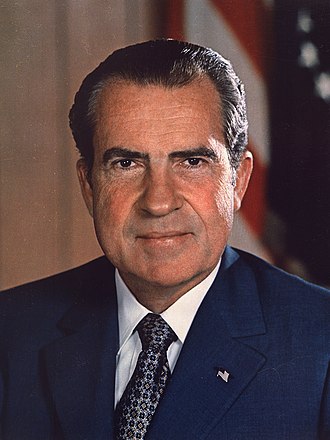
Richard M. Nixon served as the 37th President of the United States from January 1969 until his resignation in August 1974. In February 1971, he ordered the installation of a secret voice-activated taping system in the White House to preserve a historical record of his administration. Until the system's existence was revealed and dismantled in July 1973, the tapes captured Nixon directing major foreign policy initiatives, such as the opening to China, as well as his central role in the Watergate cover-up.
What Nixon talks about on the tapes
White House operations 4,718Presidential scheduling 2,225Public relations 1,784Presidential schedule 1,782Vietnam War 1,693Logistics 1,650Manolo Sanchez 1,626White House communications 1,400White House administration 1,399Presidential communication 1,243Henry Kissinger 1,191Foreign Policy 1,183
Conversations (21,010)
— Page 34 of 211President Nixon held a meeting in his Old Executive Office Building suite with an unidentified participant, with H.R. Haldeman also present. The discussion remains largely obscured due to the lack of a decipherable transcript beyond a brief introductory remark. No specific policy decisions or significant developments can be determined from the available record of this interaction.
President Nixon met with H.R. Haldeman to finalize logistical arrangements and press strategy for his upcoming trip to Bohemian Grove, emphasizing the importance of ensuring off-the-record coverage and maintaining specific prohibitions on recording his speeches. The pair also extensively discussed personnel and management issues, including the performance and role of Vice President Spiro Agnew, the influence of Murray Chotiner, and the internal dynamics among senior staff members like John Ehrlichman and John Mitchell. Additionally, the President reviewed various upcoming scheduling items, including meetings with political allies, photo sessions, and administrative tasks related to his executive schedule.
President Nixon and First Lady Pat Nixon engaged in a brief, informal telephone conversation regarding the President's personal schedule. The exchange centered on coordinating their movements and expectations for the President's arrival at their residence. No substantive policy decisions were made during this brief domestic check-in.
President Nixon and George Shultz discussed strategies for mediating ongoing rail and steel industry labor disputes to mitigate their impact on the national economy. Shultz proposed a meeting with rail leaders in the Roosevelt Room to dramatize the strike's consequences, with participation from key administration officials including John Volpe and Paul McCracken. Nixon approved the plan, noting the importance of publicizing the administration's involvement while keeping his own potential appearance as an flexible option.
President Nixon contacted the White House operator to place an outgoing call to special counsel Charles W. Colson. The interaction served as a logistical bridge to facilitate a direct conversation between the President and his aide. No substantive policy matters were discussed during this brief administrative exchange.
President Nixon consulted with the White House operator to determine the whereabouts of special counsel Charles W. Colson. The call served as an administrative check to locate a key staff member for communication. No further substantive policy matters or major developments were recorded during this brief inquiry.
President Nixon contacted the White House operator to facilitate a telephone connection to his personal secretary, Rose Mary Woods. This administrative exchange served as the primary purpose of the brief communication. No further substantive policy or political discussions took place during this specific recording.
President Nixon and Charles Colson discussed political strategies regarding the administration's China initiative, the economic situation, and media relations. Colson reported positive reactions from senators and public figures concerning the China policy, while they analyzed negative press coverage of Vice President Spiro Agnew’s recent trip. The President emphasized the importance of maintaining strong, positive communication regarding economic policies and instructed Colson to convey his appreciation to Treasury Secretary John B. Connally for his effective work with business leaders.
President Nixon and Henry Kissinger coordinate a logistics plan for an immediate, unscheduled meeting at the Executive Office Building. The brief exchange serves solely to confirm their respective locations and establish a rendezvous point. Kissinger acknowledges the directive and prepares to depart his current office to join the President.
President Nixon contacted the White House operator to facilitate a direct communication with his Chief of Staff, H.R. Haldeman. This brief interaction served solely as a logistical request to initiate a phone call with a key advisor. No further substantive policy matters were discussed during this brief exchange.
President Nixon and H. R. Haldeman discussed logistics and political optics regarding an upcoming trip to the Bohemian Grove. Nixon proposed inviting Attorney General John Mitchell and Treasury Secretary John Connally to accompany them, specifically emphasizing the symbolic importance of Mitchell's attendance at the event. They agreed that while the officials should attend the festivities at the Grove, they would remain there while the President departed.
President Nixon and Alexander P. Butterfield met to coordinate the President's upcoming schedule and manage communications with George P. Shultz. The discussion focused on logistical arrangements for Shultz's meeting with railroad officials and the potential need for a follow-up telephone briefing. Nixon deliberated on whether a direct meeting with Shultz was necessary or if a telephonic update would suffice, ultimately questioning the utility of a formal sit-down.
President Nixon met briefly with an unidentified male visitor in the Old Executive Office Building. Given the limited duration of the recording—lasting no more than three minutes—no substantive dialogue or policy decisions were captured. The encounter concludes without record of the participants' identities or the nature of their brief discussion.
President Nixon and George Shultz coordinated a brief appearance by the President at a meeting between United Transportation Union head Charles Luna and railroad industry representatives. The goal was to exert pressure on both labor and management to resolve a damaging strike through private collective bargaining without explicitly threatening government intervention. Shultz recommended that Nixon deliver a statement emphasizing the administration's concern regarding the strike's economic impact, with White House photographer Ollie Atkins documenting the session to convey presidential involvement.
President Nixon and George P. Shultz briefly coordinate their attendance for an upcoming meeting or appearance. The participants focus on timing, with Nixon deciding to arrive at the last possible moment to maintain tactical positioning. Their exchange suggests a desire to execute a strategy that contrasts with the actions of their unidentified counterparts.
President Nixon contacted the White House operator to facilitate a telephone connection to pollster Louis Harris. This interaction served as an administrative request to reach an external consultant for a private discussion. No further details regarding the substance of the intended conversation were captured.
President Nixon met briefly with an unidentified woman in his Old Executive Office Building office to discuss personal or administrative scheduling matters. The exchange was limited to brief greetings, and the participants departed the office together shortly after the meeting began. No substantive policy discussions or significant political decisions were recorded during this brief encounter.
President Nixon met with United Transportation Union leaders and railroad management representatives to address the economic crisis caused by an ongoing railroad strike. Nixon emphasized his administration's preference for private-sector collective bargaining over government intervention, warning that continued labor stoppages could provoke negative public and Congressional reactions that would ultimately damage the industry. The discussion centered on the need for both parties to reach an equitable settlement quickly to protect the economy, with the President urging management to streamline their decision-making process to facilitate a resolution.
President Richard M. Nixon met with his personal valet, Manolo Sanchez, in the Oval Office. Given the lack of a transcript or record of substantive policy deliberations, the interaction likely concerned routine personal assistance or staff coordination. No specific administrative decisions or political developments are documented as resulting from this brief encounter.
President Nixon initiates a brief administrative interaction with the White House operator to facilitate a telephonic connection. The conversation serves as a routine procedural step to bridge a call to another party. No substantive policy matters or major political decisions were addressed during this exchange.
President Nixon met with H.R. Haldeman and Henry Kissinger to discuss his upcoming schedule, specifically deciding to cancel his planned visit to the Bohemian Grove due to concerns regarding press intrusion and the potential breach of the club's traditional off-the-record atmosphere. The participants also reviewed foreign policy developments, including the China initiative and ongoing Vietnam peace negotiations, while addressing the need to manage conservative discontent within the party. Finally, they evaluated the political implications of recent labor disputes and strategized on the handling of upcoming presidential trips and public relations.
President Nixon consults with pollster Louis Harris regarding a proposed study on public sentiment toward domestic issues, particularly the economy. The two discuss the potential benefits of integrating foreign policy topics, such as the China initiative and Vietnam, to better understand their influence on the public's overall economic optimism. Harris agrees to coordinate with staff members Chuck Colson and Edwin Harper to develop a comprehensive survey that probes beyond surface-level polling data.
President Nixon contacted the White House operator to facilitate a telephone connection with First Lady Pat Nixon. The brief interaction served as a routine administrative request to reach the First Lady directly. No further substantive policy or political matters were discussed during this exchange.
President Richard Nixon and First Lady Pat Nixon held a brief telephone conversation to coordinate logistical arrangements for their family. The discussion focused on scheduling details regarding Julie Nixon Eisenhower’s upcoming visit to Camp David and travel arrangements involving Air Force One. Additionally, they touched upon dinner plans involving Rose Mary Woods and the President’s travel itinerary for Bohemian Grove.
President Nixon met with Rose Mary Woods and Manolo Sanchez to discuss travel arrangements for his upcoming vacations to California and New York. The conversation focused on the President's desire for genuine rest, the logistical necessity of limiting visitors to ensure privacy, and managing the expectations of friends like Jack Drown and Bebe Rebozo. The President emphasized his need for a working retreat, free from political staff, to recover from the stresses of his office while maintaining a controlled schedule for his family and guests.
President Nixon and H.R. Haldeman discuss the cancellation of the President's planned visit to Bohemian Grove to avoid unwanted media scrutiny and potential tax implications for the club. They also address a communications breakdown regarding the unauthorized release of a presidential letter to a Soviet cosmonaut’s daughter, which had gained significant media attention. Finally, they touch upon Vice President Spiro Agnew’s scheduling habits and plan a follow-up presidential call to NASA officials following the lunar landing of Apollo XV.
President Nixon and H.R. Haldeman met in the Old Executive Office Building to coordinate the President's upcoming schedule. The discussion focused on logistical planning and the prioritization of forthcoming meetings. No specific policy decisions were finalized, as the dialogue served primarily as an administrative briefing to organize the executive calendar.
President Nixon consults with his personal secretary, Rose Mary Woods, regarding the preparation of a speech draft for an upcoming trip to Iowa. He instructs Woods to oversee the final typing and formatting, specifically requesting that she emphasize certain underlined words during delivery. The discussion focuses on logistical coordination to ensure the document is prepared for his review and subsequent use.
President Nixon met with an unknown individual to coordinate administrative tasks and official photography. The President specifically requested that a group photograph be taken of the team and asked for a secretary to be brought into the office. This brief interaction focused on facilitating routine staff documentation.
President Nixon met with an unknown female staff member to provide specific editing instructions for a speech draft intended for his personal secretary, Rose Mary Woods. He directed her to ensure particular sentences were underlined to emphasize key points within the text. This brief exchange focused on administrative preparation for upcoming presidential communications.
President Nixon and H. R. Haldeman met to discuss strategies for addressing negative press coverage regarding Vice President Spiro Agnew and to coordinate a forceful response to unfair media portrayals. The discussion included plans to isolate critical press outlets by cutting off White House cooperation until retractions are issued, specifically targeting Newsweek's inaccurate reporting on the Vice President. Additionally, the President reviewed a speech by Thomas R. Shepard that criticized the 'disaster lobby' and environmental activists, leading Nixon to decide that this narrative should be adopted to reframe public discourse on environmental and consumer issues.
President Nixon utilized the White House operator to facilitate a personal phone call to First Lady Pat Nixon. The brief interaction served as a logistical bridge to connect the President with his wife. No substantive policy discussions or political developments occurred during this exchange.
President Richard Nixon and First Lady Pat Nixon discussed logistical plans for their upcoming trip to Camp David and travel arrangements for their daughters. The President expressed concerns regarding persistent noise and mechanical issues with the air conditioning system at the retreat. They coordinated family schedules, noting that Julie Nixon Eisenhower would not be joining them and confirming the dates for a visit to Tricia Nixon Cox.
President Nixon and H. R. Haldeman discussed their dissatisfaction with current White House domestic policy messaging, specifically regarding welfare, the environment, and consumer issues. Nixon expressed frustration that domestic speechwriting staff were producing content he felt was too liberal and lacking in ideological conviction. He directed Haldeman to shift toward a more aggressive, sharper rhetorical style to better align the administration's public persona with his personal political positions as the 1972 campaign approached.
President Nixon met with Marjorie P. Acker to discuss logistical preparations for his upcoming travel. The brief interaction focused on the organization of items to be included in his luggage for the trip. No major policy decisions were made during this administrative consultation.
President Nixon and an unidentified staff member coordinate the scheduling of a forthcoming meeting. The discussion centers on determining the duration of a commitment and confirming staff availability through the late afternoon. No substantive policy matters are addressed, as the exchange focuses strictly on logistics and personnel presence in the office.
President Nixon directed the White House operator to place a telephone call to George P. Shultz, then the Director of the Office of Management and Budget. This brief administrative interaction served as the necessary logistical step to initiate a discussion between the President and Shultz. No substantive policy matters were addressed during this connection request.
President Nixon consults with the White House operator regarding the schedule of George P. Shultz. During the brief exchange, the President instructs the operator to maintain secrecy concerning the scheduling details. No further policy decisions are addressed in this short administrative interaction.
President Nixon initiated a phone call to connect with Secretary of Labor James D. Hodgson. After requesting the operator place the call, the President waited briefly for the connection to be established. No further substantive discussion occurred during this brief administrative interaction.
President Nixon and Secretary of Labor James D. Hodgson discussed strategies to force immediate settlements in ongoing steel and railroad labor negotiations. Concerned by the inflationary impact and the public's exhaustion with labor disputes, Nixon authorized Hodgson to convey a stern ultimatum to both industries, signaling that the administration was prepared to take aggressive action if negotiations failed. Nixon further expressed his willingness to personally intervene in the steel talks if a breakthrough appeared imminent, emphasizing the necessity of resolving productivity and work rule issues.
President Nixon instructed the White House operator to place a telephone call to his special counsel, Charles W. Colson. This brief interaction served solely as a logistical request to initiate contact with a senior staff member. No substantive policy matters or further developments were discussed during this short exchange.
President Nixon and H. R. Haldeman met to coordinate the President's upcoming schedule. They focused on evaluating specific meeting requests to manage the executive calendar effectively. This discussion served to prioritize incoming appointments and streamline the administration's daily operations.
President Nixon met with his staff and advisors, including H.R. Haldeman and Henry Kissinger, to discuss political messaging, criticism of the Domestic Council, and strategies for upcoming foreign policy initiatives. Nixon expressed frustration with the liberal bias of the media and the academic community, particularly regarding environmental and social issues, and directed his team to sharpen his administration's messaging. Additionally, the participants discussed the logistics and strategic timing of a potential presidential trip to China, weighing the domestic political implications against international relations.
President Nixon met with his personal valet, Manolo Sanchez, in the Oval Office to address a routine administrative matter. The primary purpose of the brief interaction was for the President to request coffee. No other substantive policy or political discussions were recorded during this segment.
President Nixon held a brief, informal session in the Oval Office with an unidentified individual. The interaction consisted primarily of the President issuing a direct request for a specific person to report to his office. No substantive policy discussions or further developments were captured in this brief exchange.
President Nixon contacted the White House operator to facilitate a telephone connection with George P. Shultz. This brief administrative interaction served as the necessary logistical step to initiate a direct conversation between the President and his Director of the Office of Management and Budget. No policy discussions occurred during this exchange, as its sole purpose was to establish the call.
President Nixon and Henry Kissinger discussed the delicate management of the forthcoming public announcement regarding the People's Republic of China (PRC) and its potential impact on U.S. relations with Taiwan. They emphasized the importance of maintaining a tough negotiating stance for the President's upcoming trip to Beijing to ensure no conditions are forced upon the U.S. Additionally, they reviewed regional crises, specifically the distribution of food aid in Pakistan and the destabilizing role of India, while coordinating strategies to manage conservative domestic critics and press narratives.
President Nixon and George Shultz discuss the administration's public relations strategy regarding recent steel and rail labor settlements ahead of an 11:00 a.m. statement. They agree to avoid denouncing the large wage increases in the new contracts, opting instead to emphasize that strikes were successfully averted and that the agreements include provisions for improved productivity. Nixon instructs Shultz to coordinate with Treasury Secretary John Connally to ensure the administration presents a unified front on the matter.
President Nixon contacted the White House operator to place a telephone call to Senator Carl T. Curtis of Nebraska. After initially referring to Curtis as a Congressman, the President promptly corrected himself to specify his proper title as Senator. This brief exchange served as a logistical step to facilitate direct communication between the President and the Senator.
President Nixon consulted with the White House operator to facilitate an urgent communication with Senator Carl T. Curtis. After learning that the Senator was currently occupied in a finance committee meeting, the President instructed the operator to ensure a return call was placed within five minutes. This interaction reflects the administrative process used by the President to manage high-priority legislative outreach.
President Nixon met with his aide, Stephen B. Bull, to coordinate logistics regarding the President's upcoming schedule and appointments. The discussion centered on arrangements for meetings with key officials, including John B. Connally, George P. Shultz, and Gerald L. Warren. Bull provided updates on the availability and status of these individuals to ensure the President's morning agenda remained organized.
President Nixon and Gerald L. Warren coordinated the administration’s messaging regarding the ongoing Apollo 15 mission and the sensitivity of the pending steel strike. They finalized logistics for the President to view the Apollo lift-off from the Executive Office Building and discussed the need for further briefings from George Shultz and John Connally. The discussion emphasized the delicate nature of the labor negotiations and the need for careful public positioning on the economy.
President Nixon and George Shultz met with John Connally to discuss the resolution of the steel and rail strikes, emphasizing the need for an administration-led push for Congressional action on labor legislation. The participants explored a sweeping economic program that could include an import tax, investment tax credit, federal spending cuts, and a temporary wage-price freeze to combat inflation and balance-of-payments issues. They also coordinated strategy regarding an upcoming Senate vote on the Lockheed loan guarantee bill and discussed public relations for the administration's economic and social initiatives.
President Nixon and John Ehrlichman discussed political strategies regarding school busing, specifically focusing on how to manage Southern congressional chairmen. Ehrlichman planned to coordinate with Harry Dent to ensure these chairmen were briefed on the administration's intention to pursue a constitutional amendment to limit busing. The discussion aimed to leverage these legislative maneuvers for partisan advantage while maintaining control over the administration's public stance on the issue.
President Nixon initiated this call to Senator Carl T. Curtis to lobby for support on the proposed Lockheed loan guarantee amendment, emphasizing the severe political and economic risks to the 1972 election in California. Drawing on conversations with Governor Ronald Reagan, Nixon highlighted how further distress in the aerospace and defense sectors would exacerbate regional unemployment. Beyond the immediate legislative push, Nixon requested a private future meeting with Curtis to discuss the administration's welfare reform bill, H.R. 1, seeking to align Republican support while minimizing public friction within the party.
President Nixon and Senator Barry Goldwater discuss the political stakes of an upcoming Lockheed loan guarantee amendment, with Nixon highlighting the potential economic fallout for Southern California's unemployment rate. Despite acknowledging Goldwater's principled opposition to the government intervention, Nixon emphasizes the necessity of the legislation to avoid further economic and political distress. The conversation concludes with a discussion regarding U.S. diplomatic relations with the People's Republic of China, with Goldwater expressing support for the administration's strategy to maintain Taiwan's status in the United Nations.
President Nixon initiates a request for the White House operator to connect him with George P. Shultz. The brief exchange serves as a logistical bridge to facilitate direct communication between the President and the Director of the Office of Management and Budget. No policy discussions occur during this short administrative interaction.
President Nixon and George P. Shultz discussed the administration's public response to a surprise 8% price increase announced by U.S. Steel. They coordinated a statement emphasizing that the White House had no prior knowledge of the hike and warning that such increases undermine the domestic industry’s competitive position and job security. Nixon directed Shultz to strengthen the statement by mandating that labor and management prioritize productivity improvements to address these systemic issues.
President Nixon instructed the White House operator to place an outgoing telephone call to Senator George Aiken. This brief administrative interaction served as a logistical step to facilitate direct communication between the President and the Senator. No further substantive discussion occurred during this recording.
President Nixon consulted Senator George D. Aiken regarding the Lockheed loan guarantee, emphasizing the urgent need to support the Southern California aerospace industry following the cancellation of the SST program. Aiken expressed reservations about the selective nature of the proposal but agreed to remain neutral during the upcoming debate, acknowledging the economic hardships facing the region. The two also discussed current foreign policy, specifically affirming their mutual support for the administration's stance on maintaining Taiwan's position in the United Nations amid the evolving relationship with the People's Republic of China.
President Nixon instructed the White House operator to place an outgoing call to Senator J. Caleb Boggs of Delaware. This brief administrative interaction served as a logistical step to initiate direct communication between the President and the Senator. No further policy discussions or substantive developments occurred during this brief exchange.
President Nixon attempted to reach Senator J. Caleb Boggs via the White House operator. The operator informed the President that Boggs was temporarily unavailable and suggested a return call shortly. Nixon acknowledged the delay, concluding the brief exchange.
President Nixon lobbied Senator J. Caleb Boggs to support a government loan guarantee for the Lockheed Corporation, citing concerns raised by California Governor Ronald Reagan regarding the potential for increased unemployment in Southern California. Boggs explained that he faced significant political pressure in Delaware, noting that his colleague in the House and local news journals were staunchly opposed to the measure. While Boggs remained noncommittal due to his local political climate, he agreed to keep his vote open, prompting Nixon to suggest the administration would exert influence on Boggs's colleague.
President Nixon initiates a request through the White House operator to place a telephone call to Treasury Secretary John B. Connally. The brief exchange focuses on coordinating the Secretary's location and securing a direct line of communication. No further policy discussions occur during this administrative interaction.
President Nixon consulted with the White House operator to determine the whereabouts of Treasury Secretary John B. Connally. The President required this information in order to facilitate a connection with Henry Kissinger. No further substantive policy discussions occurred during this brief administrative exchange.
President Nixon met briefly with an unidentified individual in the Old Executive Office Building. The interaction was limited to a brief exchange regarding a request for refreshments. No substantive policy discussions or administrative actions were recorded during this brief encounter.
President Nixon held an brief, informal meeting with an unidentified individual in the Executive Office Building. The conversation primarily consisted of casual pleasantries and a request for iced tea. No substantive policy discussions or significant political decisions were recorded during this brief encounter.
President Nixon met with an unidentified individual in his Old Executive Office Building suite to facilitate a brief, unscheduled entry into his workspace. The interaction was limited to the procedural access of this guest rather than a substantive discussion of administration policy. The meeting concluded quickly, with the visitor departing the office shortly after arrival.
President Nixon and Alexander P. Butterfield met to coordinate the President's upcoming schedule and administrative personnel matters. The discussion focused on the logistics of engaging Ronald Reagan as a personal representative, alongside briefings regarding the Republic of China and various California-based meetings. They further addressed the procedural requirements for formal documentation and the transparency needed for high-level appointments.
President Nixon met with H.R. Haldeman and John Mitchell to discuss a wide-ranging agenda encompassing the 1972 campaign strategy, potential Cabinet-level personnel shifts, and upcoming major economic policy decisions. The group evaluated the political ramifications of the President's recent overtures to China, the ongoing busing controversy, and the necessity of managing conservative Republican factions. A significant portion of the discussion focused on a proposed package of economic interventions, including a possible wage and price freeze, to address domestic inflation and international monetary concerns. These deliberations underscored a transition toward more direct administrative control over economic policy as the 1972 election cycle approached.
President Nixon met with George Shultz and John Connally to strategize on impending domestic and international economic policy, specifically debating the necessity and political timing of a wage and price freeze. The participants weighed the risks of global monetary instability and potential devaluation of the dollar against the need to restore domestic confidence and curb inflation. Nixon and his advisors explored various options, including closing the gold window and implementing tax adjustments, while emphasizing the importance of secrecy and keeping tight control over the rollout of any major economic reforms.
President Nixon met with his valet, Manolo Sanchez, to facilitate a specific request for information regarding a telephone call involving Harry S. Dent. This brief interaction served as a coordination effort to bridge communication between the President and Dent. No further substantive details regarding the nature of the inquiry were recorded.
President Nixon and Harry S. Dent consulted on the political implications of a sensitive issue, likely related to the ongoing controversy over school busing. The discussion centered on a recent outreach effort to Senator Barry M. Goldwater to gauge his position and secure support. The exchange reflects the administration's efforts to manage internal political messaging and consolidate influence regarding volatile domestic policy challenges.
President Nixon requested that the White House operator connect him with John D. Ehrlichman. The brief exchange served as a logistical step to initiate a direct conversation between the President and his Assistant for Domestic Affairs. No further policy discussions or substantive developments occurred during this administrative bridge.
President Nixon and John Ehrlichman met to discuss the growing political pressure surrounding school busing, specifically concerns relayed by Harry Dent regarding the dissatisfaction of various state party chairmen. They debated potential legal and administrative strategies, weighing the partisan implications of the administration's stance. The President instructed Ehrlichman to contact Dent to address these concerns and coordinate a response to the ongoing controversy.
President Nixon utilized the White House operator to place an outgoing telephone call to National Security Advisor Henry A. Kissinger. The interaction served as a logistical bridge to facilitate a direct line of communication between the President and his advisor during a late-evening window. No further substantive policy discussions were recorded during this brief administrative exchange.
President Nixon utilized the White House operator to facilitate an outgoing call to domestic policy advisor John D. Ehrlichman. The brief exchange served as a logistical bridge to connect the President with a key staff member during late-night deliberations. No substantive policy discussions were recorded during this brief administrative interaction.
President Nixon held a brief meeting with his personal valet, Manolo Sanchez, in the Old Executive Office Building. As the majority of the recording is withdrawn for personal reasons, no substantive policy matters or administrative decisions are reflected in the available documentation. The interaction appears to have been limited to routine personal or household affairs.
President Nixon coordinated with H. R. Haldeman to arrange a meeting with Treasury Secretary John B. Connally. The President directed that the appointment be scheduled between 10:30 a.m. and 12:30 p.m. at the Executive Office Building, specifically requesting that Connally maintain the existing plans.
President Nixon instructed the White House operator to place urgent telephone calls to J. Curtis Counts of the Federal Mediation and Conciliation Service and W.J. Usery, Jr. of the Department of Labor. The brief interaction focused on coordinating communications with these key labor relations officials. The President's request suggests an immediate, albeit unidentified, administrative or labor-related priority requiring federal mediation expertise.
President Nixon met with Assistant Secretary of Labor Willie J. Usery, Jr. to formally acknowledge and express gratitude for his pivotal role in negotiating the recent steel industry labor settlement. The discussion centered on the successful conclusion of these negotiations and the strategy for managing the immediate aftermath of the agreement. No specific follow-up actions were recorded, as the meeting served primarily as a debriefing and recognition of Usery’s diplomatic efforts.
President Nixon met with Secretary of Labor James D. Hodgson to commend him and his team for their successful mediation of the recent steel industry labor negotiations. The President expressed his satisfaction with the settlement and the handling of subsequent price increases, acknowledging the dedicated efforts of Hodgson, Willie J. Usery, Jr., and J. Curtis Counts. Nixon instructed Hodgson to ensure that all involved parties received formal recognition for their contributions before Hodgson took personal leave.
President Nixon met with Federal Mediation and Conciliation Service Director J. Curtis Counts to express his appreciation for Counts' successful efforts in mediating a recent steel labor settlement. The conversation addressed the necessity of the resulting price increases while affirming that avoiding a strike remained the administration's primary objective. Nixon also commended Counts' personal dedication throughout the grueling negotiation process and encouraged him to take time off to recuperate.
President Nixon and John Ehrlichman discuss methods to obstruct court-ordered school busing in Texas, specifically focusing on pursuing legal appeals and alternative compliance strategies. Frustrated by a regional Department of Health, Education, and Welfare (HEW) office that issued a non-compliant directive, Nixon orders Ehrlichman to instruct George Shultz to publicly reprimand the office and initiate disciplinary action. The conversation also briefly touches on managing Senator Lowell Weicker regarding his public criticism of the administration's economic policies.
President Nixon met with an unidentified individual to discuss a matter involving local law enforcement. Due to the unintelligible nature of the audio, the specific motive for contacting the police remains unclear. The conversation concluded abruptly when the visitor departed the office shortly thereafter.
President Nixon requested that the White House operator place a call to his Special Counsel, Charles W. Colson. This brief administrative interaction facilitated direct communication between the President and a key advisor regarding ongoing executive business. No further substantive dialogue was recorded during this brief exchange.
President Nixon and Charles Colson met to discuss the national economy, focusing on rising steel prices, unemployment figures, and the administration's messaging strategy. They addressed the need to manage public perception through economic talking points and discussed strategies to counter political criticism from Senator Lowell P. Weicker, Jr. and other Republicans. Nixon directed Colson to organize a coordinated effort to influence GOP legislators and prepare effective materials for upcoming electoral messaging.
President Nixon and Henry Kissinger discuss strategies for managing political optics and countering unfavorable media coverage regarding the national economy. Nixon emphasizes the need to mobilize Republican allies, specifically mentioning Senator Lowell Weicker, to build support and shape public perception. The conversation reflects the President's frustration with media commentary and his determination to shift the prevailing narrative through organized political outreach.
President Nixon instructed the White House operator to initiate a telephone call to Benjamin F. Biaggini, the head of the Southern Pacific Transportation Company. The brief exchange served as a logistical step to facilitate direct communication between the President and the railroad executive. No further policy discussions or substantive developments occurred during this short administrative interaction.
President Nixon met with his senior advisors and John Connally to address two primary issues: the implementation of a firm administration stance against school busing and the development of a comprehensive new economic policy. Nixon explicitly ordered the discipline of HEW regional staff for their role in busing mandates and directed his team to prepare a strategy for a wage-price freeze and potential tax reforms. The President decided to delay these major economic announcements until September to ensure thorough preparation, avoid Congressional interference during the summer recess, and build a cohesive narrative of national renewal for his upcoming State of the Union address.
President Nixon and Henry Kissinger met to discuss strategies regarding business-side tax reform initiatives. The President directed Kissinger to formalize his input on the matter through a written letter to help influence administration thinking. They also briefly exchanged pleasantries regarding a personal contact, Mrs. Crosby, before concluding the brief discussion.
President Nixon and H. R. Haldeman coordinate the scheduling of an upcoming meeting, potentially involving Henry Kissinger. The President grants Haldeman flexibility in his timing, indicating a brief window of availability to discuss outstanding matters. No substantive policy decisions were reached, as the dialogue served primarily as a logistical exchange to facilitate further private consultations.
President Nixon consulted with the White House operator to facilitate an urgent telephonic connection with I.W. Abel, the president of the United Steelworkers of America. This outreach was part of an effort to communicate directly with labor leadership regarding ongoing industrial relations or economic policy. No further details were recorded regarding the content of the subsequent call.
President Nixon met with several senior advisors and staff members, including H. R. Haldeman, John Ehrlichman, Henry Kissinger, and Clark MacGregor, to manage a range of domestic and foreign policy issues. The discussions focused on navigating the fallout of the steel industry settlement, celebrating the recent legislative victory regarding the Lockheed loan guarantee, and refining the administration's stance on busing in Texas schools. Furthermore, the participants coordinated the logistics and messaging for the President’s upcoming press conference, his travel schedule, and his approach to ongoing concerns such as the Vietnam War and the Pentagon Papers.
President Nixon and Alexander Butterfield met to coordinate the administrative agenda for an upcoming Cabinet meeting and manage various logistical scheduling matters. They deliberated on the inclusion of topics such as veteran employment and departmental reports from figures like the Vice President, while also discussing the strategic optics of a potentially divisive policy issue. The President ultimately declined a request to meet with Jack J. Dreyfuss, Jr. due to scheduling constraints.
President Nixon and H. R. Haldeman consulted on strategic planning for an upcoming presidential press conference. They discussed utilizing a photo opportunity in the Oval Office with key advisors, including William Rogers, Henry Kissinger, and John Connally, as a tactical distraction to divert the press from the true focus of the event. The pair evaluated the timing and logistical implementation of this media management plan.
President Nixon and H. R. Haldeman met to coordinate the President's upcoming schedule and review staff memoranda. The discussion centered on delegating assignments to advisors, including Patrick J. Buchanan, William L. Safire, Richard A. Moore, and John A. Scali, specifically regarding economic policy. They evaluated the effectiveness of recent communications and addressed potential logistical adjustments for future meetings.
President Nixon and his valet, Manolo Sanchez, discuss logistical arrangements for a private movie screening, focusing on scheduling and the invitation list. The conversation centers on coordinating the timing for the film and excluding specific individuals from the viewing. The meeting concludes with brief instructions regarding the operational details of the event.
President Nixon met with an unidentified individual to discuss the summary and categorization of certain materials or information. The participants deliberated on the appropriate scope and detail level required for these documents. The discussion concluded with an agreement to refine the presentation of the subject matter into a concise format.
President Nixon met with his personal valet, Manolo Sanchez, in the Old Executive Office Building to review the President's upcoming schedule. The discussion remained brief and primarily centered on logistical coordination regarding Nixon's daily itinerary. No significant policy decisions or major developments were recorded during this brief administrative exchange.