Nixon, Richard M. (President)
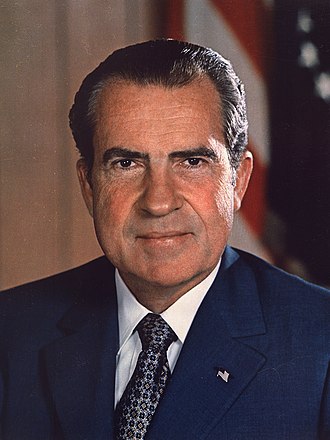
Richard M. Nixon served as the 37th President of the United States from January 1969 until his resignation in August 1974. In February 1971, he ordered the installation of a secret voice-activated taping system in the White House to preserve a historical record of his administration. Until the system's existence was revealed and dismantled in July 1973, the tapes captured Nixon directing major foreign policy initiatives, such as the opening to China, as well as his central role in the Watergate cover-up.
What Nixon talks about on the tapes
White House operations 4,718Presidential scheduling 2,225Public relations 1,784Presidential schedule 1,782Vietnam War 1,693Logistics 1,650Manolo Sanchez 1,626White House communications 1,400White House administration 1,399Presidential communication 1,243Henry Kissinger 1,191Foreign Policy 1,183
Conversations (21,010)
— Page 33 of 211President Nixon met with his aide, Stephen B. Bull, to review a copy of an article authored by economist Milton Friedman. The discussion focused on the materials presented in the article and the President's reaction to its contents. No formal policy decisions were recorded during this brief administrative exchange.
President Nixon and H.R. Haldeman discussed strategies to bolster presidential approval ratings by emphasizing decisive leadership, particularly in the context of the recent China initiative. They also evaluated domestic policy and budget priorities, reaching a consensus on the need to aggressively cut government personnel, independent agencies, and non-essential social programs to address fiscal deficits. Finally, they reviewed personnel changes, including the potential transition of Donald Rumsfeld from a White House role to a position leading the President's re-election campaign.
President Nixon met with his personal valet, Manolo Sanchez, to discuss the status and location of specific personal items or materials within the Oval Office. The brief exchange focused on confirming the delivery or placement of these items. No major policy or political decisions were made during this logistical interaction.
President Nixon consulted with the White House operator to facilitate an outgoing call. This brief interaction served as a logistical step to connect the President with another party for official communications. No substantive policy discussions or major decisions occurred during this brief exchange.
President Nixon, H.R. Haldeman, and Stephen Bull discuss polling data and political strategy, focusing on public dissatisfaction and the necessity of crafting a compelling, forward-looking administration narrative. Nixon emphasizes that the administration must move beyond the status quo by projecting strength and leadership, specifically citing the upcoming China visit as a means to reassert presidential authority. The group agrees on the need for a more aggressive, unified communication strategy to combat negative media coverage and improve the President's public approval ratings.
President Nixon and Charles Colson discuss recent favorable media coverage regarding Vietnam casualty figures and the success of Colson’s efforts to pressure CBS executive Frank Stanton into providing more balanced reporting. The two also analyze recent polling data, expressing skepticism toward George Gallup while planning to utilize Donald Rumsfeld to influence poll results regarding the President's upcoming initiative with the People's Republic of China. Ultimately, they agree that shifting media narratives is crucial to overcoming negative public sentiment surrounding the national economy.
President Nixon met with his senior staff and economic advisors to review a comprehensive set of domestic policy issues and political strategies ahead of the 1972 election. The participants analyzed regional economic and unemployment data, explored ways to address high inflation and juvenile delinquency, and developed messaging strategies regarding veterans, environmental concerns, and the role of the "liberal establishment." The President emphasized the need for a focused, repetitive, and regionalized public relations approach to regain public confidence and successfully manage the transition from wartime to a peacetime economy.
President Nixon met with his economic advisors, including John Connally and George Shultz, to evaluate a broad range of tax reform initiatives, including a potential Value Added Tax (VAT), property tax relief, and tax simplification. The discussion focused on finding a "bold" and politically viable strategy to replace or augment the existing tax system while addressing revenue needs and economic stimulation. Nixon expressed significant skepticism toward piecemeal social programs like child care deductions, favoring instead a comprehensive structural shift that could appeal to voters and simplify the tax code.
President Nixon met with H.R. Haldeman, Henry Kissinger, John Ehrlichman, and Alexander Butterfield to coordinate the administration's response to ongoing leaks of classified national security information. The President directed that all staff with access to sensitive documents be subjected to polygraph tests to identify the sources, expressing deep frustration with the Department of State and the Department of Defense. Additionally, the participants reviewed the status of Vietnam peace negotiations and planning for the President's forthcoming diplomatic initiative with the People's Republic of China.
President Nixon met with H.R. Haldeman, John Ehrlichman, and Egil Krogh to discuss strategies for curbing unauthorized leaks of government information and managing economic policy. The President directed that high-level officials and staff with top-secret access undergo polygraph examinations to identify leakers, specifically targeting a suspected individual within the Department of Defense. Additionally, the participants discussed the administration's strained relationship with Federal Reserve Chairman Arthur Burns, ultimately deciding to adopt a 'cool treatment' strategy to pressure him, while also considering efforts to influence the Federal Reserve's composition and independence.
President Nixon communicated with a White House operator to facilitate an outgoing call. The interaction was purely procedural, serving to connect the President with an unnamed third party. No substantive policy discussions or administrative decisions occurred during this brief exchange.
President Nixon and H. R. Haldeman met to coordinate upcoming appointments and resolve personal logistics for Charles G. “Bebe” Rebozo. The discussion included scheduling meetings with John Mitchell and Peter G. Peterson, as well as managing the details of Rebozo's hotel accommodations through discreet channels. The participants also touched upon the Pentagon Papers case and the expected return of Henry Kissinger.
President Nixon and Peter G. Peterson met to discuss the deteriorating U.S. balance of payments and the potential for a bold, secret economic initiative to address rising unemployment and trade deficits. Peterson argued that traditional economic measures were insufficient and politically risky, instead proposing a temporary import surcharge and export rebate system to stimulate the economy. The President authorized Peterson to coordinate with John Connally, George Shultz, and Paul McCracken to develop a confidential plan, while emphasizing the need for absolute secrecy to prevent market instability.
President Nixon met with H.R. Haldeman, Clark MacGregor, and John Ehrlichman to coordinate the administration's legislative strategy, focusing on the draft extension bill, busing, and the People's Republic of China initiative. The participants discussed managing the political fallout from school desegregation and housing issues, as well as the potential impact of Eugene McCarthy's 1972 candidacy on the political left. Additionally, the President and his advisors reviewed economic policy, the handling of government leaks like the Pentagon Papers, and the personal conduct of the President's brother, Donald Nixon.
President Richard Nixon and Alexander Haig coordinate the scheduling and logistical arrangements for Henry Kissinger’s upcoming return and debriefing. The discussion touches upon potential meeting venues, including the Pentagon, and addresses concerns regarding the political alignment and reliability of certain individuals associated with the Rand Corporation and the broader foreign policy establishment. Nixon also voices personal frustration regarding the perceived vindictiveness of Secretary of State William P. Rogers as they finalize the necessary reporting protocols.
President Nixon contacted the White House operator to facilitate a direct communication line to special counsel Charles W. Colson. The brief exchange served as an administrative request to initiate an urgent discussion between the President and his aide. No substantive policy matters were addressed during this interaction, as it was strictly focused on connecting the two parties.
President Nixon and Charles Colson discussed political strategy, focusing on public relations initiatives and legislative briefings. Key topics included coordinating Congressional briefings for George Shultz and John Connally, monitoring domestic reaction to foreign policy developments regarding China, and planning a symbolic Labor Day gesture involving a golf outing with union leader George Meany. Additionally, they reviewed positive economic indicators, specifically retail and automobile sales figures, to assess the administration's messaging effectiveness.
President Nixon instructed the White House operator to place a telephone call to New York Governor Nelson A. Rockefeller. This brief administrative interaction served as the initiation for the President to consult with the Governor. No further policy discussions or substantive developments occurred during this brief exchange.
President Nixon and Alexander P. Butterfield held a brief morning meeting to coordinate the President's daily schedule. The discussion focused on upcoming appointments involving General James D. Hughes and H.R. Haldeman. No substantive policy matters were addressed during this brief logistical check-in.
President Nixon and H.R. Haldeman discussed a wide range of administrative, political, and personnel matters, including the handling of Vice President Spiro Agnew’s return from an African tour and the potential nomination of Robert S. McNamara to the World Bank. The conversation also covered strategic planning for upcoming presidential radio addresses, the management of economic policy advisors like Paul McCracken, and the implementation of tighter control over presidential media coverage, specifically regarding Nixon's planned trip to the Bohemian Grove. Finally, the President directed staff to gather sensitive historical documents from the Kennedy and Johnson administrations, emphasizing the need for organized access to records concerning the Bay of Pigs, the Cuban Missile Crisis, and other Cold War-era crises.
President Nixon and Stephen B. Bull discussed the selection and scheduling of individuals for an upcoming press photography session. The President prioritized specific representation for the photos, noting recommendations provided by Ronald L. Ziegler and Charles W. Colson. It was decided that these selected individuals would be brought in specifically for the press event.
President Nixon met with American Legion officials, including National Commander Alfred P. Chamie and Charles W. Colson, to discuss international affairs and domestic relations. The conversation covered the Vietnam War, the American Legion's support for U.S. foreign policy—including the opening of relations with the People's Republic of China—and potential challenges regarding South Vietnamese elections. Additionally, the participants addressed the Legion's request for the President's attendance at their upcoming convention, which Nixon struggled to accommodate due to a prior commitment to the Veterans of Foreign Wars.
President Nixon met with Indonesian Ambassador Soedjatmoko and Henry Kissinger to discuss the geopolitical implications of the administration's recent initiative to open diplomatic relations with the People's Republic of China. The participants addressed concerns from Asian allies regarding potential U.S. withdrawal from the region, with Nixon emphasizing that the U.S. remains committed to an active security and economic presence in Asia despite the normalization efforts. Additionally, Nixon and Kissinger reviewed the status of secret Vietnam peace negotiations and planned a series of diplomatic communications to reassure global leaders of the strategic intent behind the China policy.
President Nixon met with Mamie Eisenhower, Treasury Secretary John Connally, and Mint Director Mary Brooks to discuss the production and distribution of commemorative Dwight D. Eisenhower silver dollars. The group explored logistics for presenting these coins as official White House gifts to foreign dignitaries and members of Congress. Additionally, the participants coordinated on the selection and inventory of various other presidential gift items intended for official use.
President Nixon met with John Connally and Peter Peterson to strategize a bold, coordinated plan to address U.S. economic instability, specifically the trade deficit and the defense of the dollar. The participants discussed potential measures such as the cessation of gold convertibility, the floating of exchange rates, and the implementation of wage and price controls. They emphasized the need for strict confidentiality, the importance of maintaining Arthur Burns’ cooperation, and the political necessity of framing these actions as a display of strong, decisive leadership.
President Nixon and H.R. Haldeman met to coordinate upcoming administrative travel, public relations strategies, and media management for various high-level officials. Key discussions included planning a national speaking tour for John B. Connally, managing the President's low-key appearance at Bohemian Grove to minimize press coverage, and organizing logistical details for youth outreach programs like Boys and Girls Nation. They also addressed administrative matters, such as the handling of official correspondence regarding the People's Republic of China and the distribution of Eisenhower silver dollars.
President Nixon contacted the White House operator to facilitate a telephone call to Senator Marlow W. Cook. This brief administrative interaction served as the necessary logistical step to connect the President with the Senator for a subsequent discussion. No substantive political or policy matters were addressed during this specific connection process.
President Nixon consulted with the White House operator to coordinate a call with Senator Marlow W. Cook. After confirming the Senator's availability following his lunch, Nixon instructed the operator to have Cook reach out to him later that afternoon. This brief administrative exchange served to facilitate direct communication between the President and the Senator.
President Nixon and Alexander P. Butterfield met to finalize logistical arrangements for an upcoming meeting involving Vice President Spiro T. Agnew and Secretary of State William P. Rogers. The primary discussion focused on the seating arrangement for National Security Advisor Henry Kissinger to ensure his presence during the sensitive policy consultation. No major policy decisions were made, as the exchange was strictly limited to administrative planning and protocol for the group session.
President Nixon held a brief, unscheduled meeting in the Oval Office with Henry A. Kissinger. While the specific nature of their discussion remains undocumented due to the absence of a transcript, the encounter took place during a critical period of foreign policy activity. This meeting highlights the frequent, informal consultations between the President and his National Security Advisor regarding ongoing administrative priorities.
President Nixon and Henry Kissinger met to coordinate strategy for an upcoming press conference, focusing on managing public and political expectations regarding the administration's foreign policy initiatives. They discussed the timing of Nixon's summit in the People's Republic of China, emphasizing the need for favorable weather and political leverage, as well as the progress of Vietnam peace negotiations. Additionally, they reviewed domestic political concerns, including the 1972 election landscape, the impact of the Pentagon Papers, and the necessity of maintaining a firm stance against leaks and political opponents.
President Nixon initiated this call to Senator Marlow W. Cook to offer birthday wishes and discuss Cook's recent attendance at a space launch. The conversation quickly shifted to legislative concerns, specifically the precarious status of the Lockheed loan guarantee bill in the Senate. Nixon emphasized the importance of the legislation, and they strategized on avoiding the prolonged, unsuccessful floor tactics that previously doomed the Supersonic Transport (SST) project. Nixon directed the Senator to coordinate further efforts with Clark MacGregor.
President Nixon contacted the White House operator to provide instructions regarding his previous communication request. He ultimately decided that no action was necessary at that time. The brief exchange served only to cancel an earlier task.
President Nixon contacted the White House operator to facilitate a personal telephone call to his daughter, Tricia Nixon Cox. The conversation was strictly administrative, serving only to initiate the connection. No substantive policy discussions or political decisions were conducted during this brief exchange.
President Nixon instructed the White House operator to place an outgoing call to special counsel Charles W. Colson. This brief interaction served as a logistical bridge to facilitate a direct conversation between the President and his advisor. No further substantive policy matters were discussed during this brief request for communication.
President Nixon met with Congressman Edward B. Biester, Jr. and a delegation from Bucks County, Pennsylvania, to accept a local tourist guide. The brief encounter focused on pleasantries, the presentation of regional materials, and a reciprocal exchange of presidential gifts. The session concluded with light conversation regarding travel in the region and mutual well-wishes.
President Nixon met briefly with an unidentified individual in the Oval Office to exchange a presidential gift. Following the brief interaction, the guest departed immediately. No substantive policy matters or official developments were recorded during this exchange.
President Nixon met with Congressman Durward G. "Doc" Hall, his wife, and Melanie Ellison for a brief social call centered on Missouri's 150th anniversary. During the meeting, Hall presented the President with a commemorative plaque and discussed various mementos, including Eisenhower silver dollars. The group also touched upon Missouri state politics, specifically concerning the gubernatorial race and the support for candidate Marion G. Bennett.
President Nixon met with Representative William J. "Jack" Edwards to review commemorative materials from a recent trip to Mobile, Alabama, including photographs and a medal. The discussion transitioned into domestic political matters, specifically revenue sharing and the activities of various governors, including Jimmy Carter and George Wallace. Additionally, the participants touched upon the broader context of U.S. foreign policy and the significance of the President’s geopolitical strategy.
President Nixon met with Senator Lowell P. Weicker, Jr. and Paul Calley in the Oval Office for a brief, informal courtesy visit. The discussion centered on a NASA commemorative stamp featuring the Apollo moon landing, with the group sharing anecdotes about the mission and the lunar rover. Additionally, Weicker commended the President’s recent foreign policy initiatives, specifically praising the administration's strategic outlook regarding China. The meeting concluded with brief personal exchanges before Nixon transitioned to administrative scheduling with Stephen B. Bull.
President Nixon met with Representative Otto E. Passman and William E. Timmons to discuss political support, upcoming drug abuse conferences, and foreign aid legislation. Passman pledged his loyalty and legislative assistance to the President while expressing his intent to significantly reduce foreign assistance funding, particularly regarding international organizations and the Overseas Private Investment Corporation. The participants also touched upon the President's diplomatic outreach to the People's Republic of China and the ongoing status of the Vietnam War and prisoner of war issues.
President Nixon met with John Ehrlichman and William Magruder to discuss the deteriorating competitiveness of the U.S. aviation and high-technology industries. The participants examined why the U.S. lost its lead in the Supersonic Transport (SST) market and how international competitors, particularly in Europe and Japan, use state-backed subsidies and strategic planning to capture global market share. Nixon expressed deep frustration over the decline of American manufacturing and the potential for a long-term “brain drain,” eventually tasking Magruder and his staff to develop a comprehensive national strategy for technology, tax incentives, and export subsidies to reverse these trends.
President Nixon and Charles Colson discuss the political fallout of recent administrative events, including the public reaction to the upcoming trip to the People's Republic of China and preparations for the 1972 presidential campaign. The conversation covers political intelligence regarding potential Democratic challengers such as Edmund Muskie and Ted Kennedy, alongside a briefing on economic indicators. Nixon emphasizes the need for an upbeat message regarding the economy while coordinating with George Shultz and John Connally to manage administrative messaging.
President Nixon consulted with the White House operator to facilitate an urgent contact with New York Governor Nelson Rockefeller. Upon learning that the Governor was dining at the Knickerbocker Hotel, the President instructed the operator to attempt to place the call immediately. This brief exchange reflects the administrative process involved in the President's efforts to reach high-level political associates.
President Richard Nixon spoke with his daughter, Tricia Nixon Cox, to coordinate upcoming family social engagements. The discussion centered on arrangements for a dinner visit with Tricia and her husband, Edward R. F. Cox, including plans to dine on the White House balcony. Additionally, the participants briefly touched upon the travel schedule of David and Julie Nixon Eisenhower.
President Richard Nixon met with his personal valet, Manolo Sanchez, in the Old Executive Office Building. The recording is notably brief and contains withdrawn segments, suggesting the discussion involved private personal matters rather than substantive policy deliberations. No significant administrative developments or public actions resulted from this encounter.
President Nixon held a brief, informal meeting with his personal valet, Manolo Sanchez, in the Old Executive Office Building. While no transcript exists and the specific substance remains unavailable, the encounter reflects the routine personal interactions between the President and his long-serving staff member. No policy decisions or significant administrative actions were recorded during this brief exchange.
President Richard Nixon met with his valet, Manolo Sanchez, in the Old Executive Office Building. While the specific substance of the exchange remains largely obscured by a withdrawn personal segment, the interaction reflects the routine private associations between the President and his personal staff. No significant policy decisions or administrative actions were recorded during this brief encounter.
President Nixon and his personal secretary Rose Mary Woods coordinate logistical details regarding upcoming social engagements and family schedules. The discussion focuses on plans for a July 28 dinner involving First Lady Pat Nixon, as well as the President’s anticipated visit with Tricia Nixon Cox on August 4. The call concludes with updates on communications between Woods and various associates, including Bebe Rebozo and J. Willard Marriott.
President Nixon held a brief, two-minute meeting with an unidentified individual in the Oval Office. Due to the lack of a transcript or recording content, the specific purpose and subject matter of the discussion remain unknown to historical researchers. No policy decisions, developments, or action items can be verified from this interaction.
President Nixon instructed the White House operator to place an outgoing call to First Lady Pat Nixon. The brief exchange served as a routine administrative request to facilitate communication with his wife. No substantive political or policy matters were discussed during this short interaction.
President Nixon and First Lady Pat Nixon discussed scheduling logistics regarding upcoming appearances before the Veterans of Foreign Wars (VFW) and the American Legion. The First Lady clarified that she was slated to attend the VFW event while the President postponed his involvement with these organizations until the following year. This brief exchange served to coordinate their respective public engagement calendars for these veteran groups.
President Nixon and First Lady Pat Nixon held a brief exchange regarding logistical arrangements for police presence at an upcoming event. The dialogue focused on ensuring security coordination at a specific location referred to as 'W.' No major policy decisions were made, as the conversation served primarily as a functional briefing on security deployment.
President Nixon contacted the White House operator to initiate a telephone call to Treasury Secretary John B. Connally. This administrative interaction served as the necessary precursor to a subsequent high-level discussion regarding the Federal Reserve Board and the President's upcoming scheduling requirements. The coordination facilitated an urgent consultation between Nixon and Connally involving economic policy, internal politics, and legislative meetings.
President Nixon and H.R. Haldeman discussed media management, scheduling, and the political optics surrounding Vice President Spiro Agnew’s recent trip. They focused on refining the President's public image, specifically regarding press access at events and the potential political fallout from his relationship with Agnew. The pair also addressed the President's upcoming schedule, staff appointments for the First Lady, and the development of economic messaging to be managed by the administration’s key fiscal advisors.
President Nixon, H. R. Haldeman, and Henry Kissinger discussed strategies for managing public and congressional expectations regarding the upcoming diplomatic initiative with the People's Republic of China. The conversation centered on neutralizing political opposition, balancing relations with Japan, and ensuring the PRC summit serves as a strategic maneuver against the Soviet Union. Nixon emphasized the necessity of a cold-blooded approach, maintaining that foreign policy successes should be used to strengthen his domestic political position and re-election prospects.
President Nixon and his personal secretary, Rose Mary Woods, discussed administrative details regarding White House social scheduling and guest list management. The conversation focused on inviting Lowell Watham, acknowledging Frank McCarthy, and organizing an upcoming dinner featuring Pat Nixon, Patrick and Shelley Buchanan, Raymond Price, and William Safire. Nixon instructed Woods to consult with the First Lady regarding these specific guest invitations and seating arrangements.
President Nixon met with Alexander P. Butterfield in the Oval Office to address administrative duties regarding pending paperwork. The discussion focused primarily on the review and signature of official documents, including a judicial appointment. The meeting concluded after these items were processed and Butterfield departed.
President Nixon consulted with a member of John D. Ehrlichman's staff to coordinate scheduling and determine the staffer's current location. The discussion focused on establishing a protocol for the staffer to provide a status update via telephone upon their arrival. This brief exchange served to facilitate administrative communication within the White House during a period of shifting availability.
President Nixon met with his aide Stephen B. Bull to coordinate an upcoming meeting with John D. Ehrlichman. The discussion focused on securing Ehrlichman's presence in the Oval Office for a private briefing. Bull was instructed to locate Ehrlichman, who was situated in the Presidential Library room, and escort him to the President.
President Nixon and John Ehrlichman met in the Oval Office to coordinate administration strategy across several fronts, including legal actions related to the Pentagon Papers and the Daniel Ellsberg case. They discussed personnel shifts to strengthen economic policy management, the implementation of a new children's park project on the National Mall, and intelligence-gathering efforts concerning political opponents and internal leaks. Nixon also provided directives on foreign economic policy, emphasizing a shift toward bilateral negotiations to prioritize domestic interests over foreign aid commitments.
President Nixon, H.R. Haldeman, and Alexander Butterfield met to coordinate administration strategy regarding economic messaging, legislative priorities, and personnel assignments. They discussed the tactical use of senior officials like John Connally and the management of staff roles, including potential diplomatic or special ambassador assignments for Charles Rhyne and others. A significant portion of the discussion focused on managing conservative opposition to the administration's foreign policy initiatives, specifically the opening to China and arms control, with Nixon directing that Henry Kissinger engage with key conservative figures like Ronald Reagan to maintain their support.
President Nixon held a brief, recorded session in the Oval Office with one or more unidentified individuals. While the specific transcript is unavailable, the meeting served as an official consultation within the executive office. No substantive policy developments or decisions can be confirmed due to the lack of available documentation regarding the dialogue.
President Nixon met briefly with his personal aide, Stephen B. Bull, to discuss administrative matters regarding the President's daily schedule. The exchange was exceedingly short, lasting only one minute, and focused on managing the President's immediate agenda. No major policy decisions or significant developments were recorded during this brief logistical consultation.
President Nixon and H.R. Haldeman briefly discussed political management strategies concerning conservative figures, specifically mentioning J. Daniel Mahoney, William F. Buckley, Jr., and Senator Charles Percy. The President expressed a desire to limit Percy's influence within the organizational structure while advocating for a strategy of leveraging John Mitchell and other loyalists to counterbalance dissenting conservative factions. The discussion concluded with a focus on utilizing executive power to navigate and neutralize potential political opposition.
President Nixon and Press Secretary Ronald Ziegler discuss managing conservative opposition regarding the administration's burgeoning initiative with the People's Republic of China. Ziegler assesses the potential for backlash from right-wing figures and publications like the National Review, noting that while vocal critics exist, they represent a relatively small segment of the political spectrum. Nixon concludes that the administration should avoid proactively addressing these critics, opting instead to maintain a firm stance against the anticipated political fallout.
President Nixon and his personal secretary, Rose Mary Woods, engage in a brief, informal exchange concerning Manolo Sanchez. The dialogue centers on a lighthearted or anecdotal observation regarding a dark road and limited visibility. No policy decisions or significant administrative actions are documented during this short interaction.
President Nixon and Stephen B. Bull met to coordinate the logistics for the arrival of Vice President Spiro T. Agnew. Bull confirmed he would personally notify the President the moment the Vice President’s vehicle entered the White House grounds. The discussion ensured that the President would be present to greet Agnew upon his arrival.
President Nixon held a brief, informal meeting in the Oval Office with an unidentified individual. The interaction was primarily social or logistical in nature, involving requests for refreshments such as coffee and tea. No substantive policy discussions or significant political developments occurred during this brief encounter.
President Nixon and Stephen B. Bull met to coordinate the logistical arrangements for Vice President Spiro T. Agnew’s upcoming arrival at the White House. The discussion focused on establishing the specific protocols and entry procedures required to ensure the smooth reception of the Vice President. The meeting concluded with the two men departing to facilitate the implementation of these arrival plans.
President Nixon, Vice President Agnew, and Secretary of State Rogers met to debrief on Agnew's recent diplomatic tour of Africa and the Middle East, while also discussing the administration's ongoing initiative to open relations with the People's Republic of China. The participants expressed frustration with press coverage—specifically in Newsweek—regarding the Vice President's trip and the China policy, and they strategized on how to manage the ensuing public and congressional reactions. Additionally, the President and his staff discussed personnel changes, including the potential replacement of Ambassador Joseph Farland in Pakistan, and reviewed the broader geopolitical implications of the unfolding China initiative.
President Nixon met with his personal valet, Manolo Sanchez, in the Oval Office to discuss minor domestic arrangements. During this brief interaction, the President requested a serving of consommé and additional eggs. No major policy discussions or administrative decisions were addressed during this exchange.
President Nixon and H. R. Haldeman met to discuss various personnel assignments, including potential roles for Robert Finch and Donald Rumsfeld, and to coordinate the President's upcoming schedule, specifically events surrounding the Pro Football Hall of Fame induction. They reviewed the political implications of Arthur Burns's public comments on the economy and discussed managing relations with conservative figures such as William F. Buckley Jr. and J. Daniel Mahoney. The conversation also touched upon intelligence gathering and the administration's strategic handling of various political outreach initiatives.
President Nixon and H.R. Haldeman briefly conferred regarding the removal of John S. Davies from a specific assignment or post. The discussion centered on confirming that Davies had been successfully removed and ensuring that he would not be permitted to carry weapons. This interaction serves as a follow-up to personnel decisions aimed at restricting Davies's official duties and access.
President Nixon and his advisors discussed the scheduling of various domestic and international political meetings, including an upcoming engagement with Ronald Reagan. Much of the conversation focused on managing the public relations challenges surrounding Vice President Spiro Agnew’s recent foreign travel, with the participants expressing frustration over his negative relationship with the press and his preference for recreational activities over substantive engagement. The group also touched upon economic strategy, the upcoming federal budget, and ongoing labor concerns in the steel and shipping industries.
President Nixon and Secretary of the Treasury John Connally discussed a strategy to exert political pressure on Federal Reserve Chairman Arthur Burns regarding monetary policy. Connally reported that their coordinated 'tactic' of feigning ignorance had successfully gotten Burns' attention and prompted a shift in his outlook. They agreed to maintain pressure while maintaining a posture of plausible deniability, with Connally planning to press Burns for more positive public statements during a future meeting.
President Nixon consulted with Secretary of State William P. Rogers to discuss critical public relations challenges regarding Vice President Spiro T. Agnew. The dialogue focused on the negative press coverage of Agnew’s recent travels, specifically scrutinizing the frequency of his golf outings and scheduling compared to past vice presidential visits, including those of Nixon himself. The two also addressed the administrative support provided to Agnew's staff and briefly touched upon broader foreign policy implications, including upcoming diplomatic relations with the People's Republic of China.
President Nixon, Secretary of State William P. Rogers, and H.R. Haldeman discuss the poor press coverage and negative public perception of Vice President Spiro Agnew’s recent 30-day foreign trip. The participants attribute the backlash to Agnew’s excessive time spent golfing, his refusal to engage with the press or follow scheduling advice, and his lack of substantive appearances. Ultimately, the group expresses frustration that Agnew ignored his staff's guidance and exacerbated his own difficulties, though they agree on the need to boost his morale upon his return.
President Nixon initiated a brief telephone contact with the White House operator to facilitate a direct communication line with George P. Shultz. This administrative request served as the immediate precursor to a substantive discussion regarding the administration's economic policy, labor relations, and pending legislative briefings. The call functioned as an essential logistical step in coordinating the President's engagement with his key economic advisors.
President Nixon and George Shultz discuss the current state of the U.S. economy, focusing on labor negotiations, potential strikes, and preparations for upcoming administrative briefings. Shultz reports on a recent meeting with Senators regarding wage-price policies and economic performance, while the two coordinate on avoiding a steel industry strike to prevent economic disruption. Nixon emphasizes the need for aggressive action to ensure a labor settlement and requests that Shultz leverage positive economic indicators, such as retail and automobile sales, to improve public sentiment.
President Nixon contacted the White House operator to facilitate a telephone connection with Special Counsel Charles W. Colson. The brief exchange served purely administrative purposes to initiate communication with a key member of the White House staff. No further substantive policy discussions occurred during this brief request.
President Nixon and Charles Colson discuss their recent, contentious interaction with Federal Reserve Chairman Arthur Burns, focusing on the need to manage his influence and public messaging. The conversation shifts to evaluating positive indicators in the economy, such as strong retail sales data, which Colson reports from recent industry meetings. Nixon instructs Colson to distill these economic findings into concise flash bulletins rather than lengthy reports to better communicate the administration's economic narrative.
President Nixon held a series of meetings involving staff and administration officials to coordinate on several pressing domestic and economic policy matters. The participants discussed legislative strategy regarding the Lockheed Corporation, the political risks associated with school busing and desegregation litigation in Texas, and the appointment of William D. Eberle as the new Special Trade Representative. Nixon emphasized a transition toward prioritizing domestic interests in international trade negotiations and sought to align his team on messaging regarding the administration's stance on school integration compliance.
President Nixon met with Murray Chotiner to discuss the growing instability and grievances of Vice President Spiro Agnew. Chotiner reported that Agnew felt marginalized by White House staff, particularly regarding his exclusion from domestic policy discussions and his desire to visit both Peking and Taiwan. Nixon and Chotiner acknowledged the need to manage Agnew’s volatile state of mind to prevent public embarrassment or a potential rift, with Nixon emphasizing the necessity of maintaining strict secrecy regarding his initiatives in China.
President Nixon met with administration officials, including George Shultz and Donald Johnson, along with Congressmen Charles and Olin Teague to discuss the status and long-term needs of the veterans' healthcare system. The discussion focused on balancing budget constraints with the necessity of upgrading aging VA hospital facilities and addressing the specific health and reintegration challenges faced by Vietnam-era veterans. Nixon emphasized his commitment to providing veterans with an 'edge' in public life and directed the participants to coordinate efforts between the VA and other agencies to develop a comprehensive, long-term health strategy, particularly regarding drug abuse treatment and facility utilization.
President Nixon met with his aide Stephen B. Bull to review and manage his upcoming daily schedule. The discussion focused on coordinating appointments for Ambassador Agha Hilaly and Martin Anderson, with particular emphasis on navigating scheduling conflicts regarding Anderson’s availability. Bull was tasked with managing these logistics and determining if Anderson could be successfully relocated to the Oval Office despite his ongoing crisis.
President Nixon and Henry Kissinger met with Pakistani Ambassador Agha Hilaly to express gratitude for Pakistan's pivotal, secret role in facilitating the administration's opening to the People's Republic of China. The discussion addressed the diplomatic handling of the PRC's upcoming UN membership, the search for a new UN Secretary General, and the ongoing regional tensions between India and Pakistan. Nixon encouraged the Pakistani government to improve its public relations efforts regarding the humanitarian situation in East Pakistan to better counter critical Western press coverage while pledging continued, though constrained, U.S. economic support.
President Nixon met with Stephen B. Bull to review logistical arrangements for upcoming meetings with George P. Shultz, Martin Anderson, and a group of officers from the Distributive Education Clubs of America. They discussed the protocol for the student group's visit, focusing specifically on the details of a planned photo opportunity and the management of presidential gifts. The brief exchange ensured that the presentation and schedule were prepared to the President's satisfaction.
President Nixon met with representatives from the Distributive Education Clubs of America (DECA), accompanied by Henry C. Cashen II, to discuss the organization's work and receive commemorative gifts including a plaque and a blazer. During the exchange, the President presented the group with official presidential gifts and pens while briefly commenting on the challenges of national service and global leadership. The meeting concluded with an invitation for the President to attend an upcoming DECA conference in Salt Lake City.
President Nixon met with his aide Stephen B. Bull to review and refine the President's daily schedule. The discussion focused on coordinating upcoming appointments with key staff members, including John D. Ehrlichman, George P. Shultz, and Martin Anderson. The interaction served as a logistical planning session to finalize the attendance and sequencing of these internal briefings.
President Nixon met with John Ehrlichman and Martin Anderson to discuss staffing needs and the strategic direction of domestic policy, specifically emphasizing the need for conservative viewpoints to balance his administration's economic and social programs. The discussion focused on reforming or dismantling Great Society-era initiatives, such as the Office of Economic Opportunity (OEO) and various model city programs, while addressing challenges in housing integration and international trade. Nixon encouraged Anderson to rejoin the White House staff to provide essential input on the 1973 federal budget and to ensure that his administration's policy development reflects a more distinct ideological alternative to existing bureaucratic approaches.
President Nixon and George Shultz met to conduct an extensive review of the U.S. economy, focusing on current inflation, potential labor unrest in the steel and railroad industries, and upcoming international monetary policy decisions. Shultz updated the President on negotiations to prevent strikes, while Nixon urged caution regarding drastic administrative actions like wage-price freezes or ending gold convertibility. They also discussed federal budget strategy, specifically targeting defense spending, personnel salary grade inflation, and shifting the political blame for excessive government spending onto Congress.
President Nixon contacted the White House operator to facilitate a telephone call to First Lady Pat Nixon. The brief exchange served as a routine request to establish a private line of communication with his spouse. No further official business or substantive policy discussions were recorded during this interaction.
President Richard Nixon met with his personal valet, Manolo Sanchez, in the Old Executive Office Building for a brief private discussion. The recording consists primarily of garbled or unintelligible audio that does not reflect substantive administrative or political business. Consequently, no specific policy decisions or significant developments can be discerned from the transcript.
President Richard Nixon met with an unidentified individual in the Old Executive Office Building to discuss matters that remain undocumented in the available transcript. Due to the lack of audio content or textual record for this specific recording, the meeting's substance, primary topics, and any resulting action items cannot be determined. Consequently, this session provides no substantive insight into White House policy or executive decision-making.
President Richard Nixon met with his valet, Manolo Sanchez, in the Old Executive Office Building for a brief discussion. The conversation included references to international relations, specifically mentioning Taiwan and governmental affairs. The exchange concluded with the President expressing dissatisfaction regarding the status of these matters.
President Richard Nixon met with his personal aide, Manolo Sanchez, in the Old Executive Office Building for a brief, informal discussion. The conversation consists of a repetitive exchange in Welsh regarding the completion of a specific task or objective. No substantive policy matters or administrative decisions were recorded during this interaction.
President Richard M. Nixon met with his personal valet, Manolo Sanchez, in the Old Executive Office Building. The recording of this interaction consists of withdrawn personal material and unintelligible audio, precluding any substantive historical analysis of policy discussions or decision-making. Consequently, the meeting resulted in no documented developments or formal action items.
President Nixon met with his personal valet, Manolo Sanchez, in the Old Executive Office Building. While the specific details of their discussion remain undocumented, the meeting functioned as a private, informal interaction between the President and a trusted member of his domestic staff. No formal policy decisions or administrative actions were recorded as a result of this brief engagement.
President Nixon met with an unidentified individual to discuss scheduling arrangements. The conversation focused on coordination regarding the participant's upcoming itinerary. No specific policy decisions were recorded during this brief administrative exchange.