Nixon, Richard M. (President)
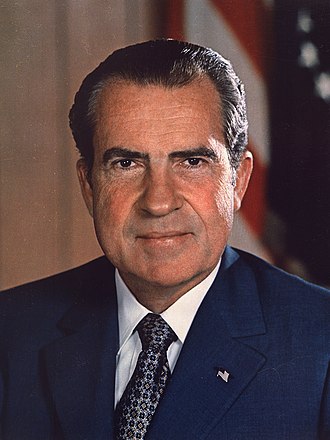
Richard M. Nixon served as the 37th President of the United States from January 1969 until his resignation in August 1974. In February 1971, he ordered the installation of a secret voice-activated taping system in the White House to preserve a historical record of his administration. Until the system's existence was revealed and dismantled in July 1973, the tapes captured Nixon directing major foreign policy initiatives, such as the opening to China, as well as his central role in the Watergate cover-up.
What Nixon talks about on the tapes
White House operations 4,718Presidential scheduling 2,225Public relations 1,784Presidential schedule 1,782Vietnam War 1,693Logistics 1,650Manolo Sanchez 1,626White House communications 1,400White House administration 1,399Presidential communication 1,243Henry Kissinger 1,191Foreign Policy 1,183
Conversations (21,010)
— Page 44 of 211President Nixon met with H.R. Haldeman and other staff to review administrative and political matters, including the handling of the Pentagon Papers and the reorganization of the Council on International Economic Policy (CIEP). The President emphasized the need to move beyond current staffing limitations by centering economic policy work around George Shultz and John Connally, rather than Peter Peterson. Additionally, the group discussed potential candidates for Secretary of Agriculture, the legislative strategy for a Supreme Court appointment, and the necessity of managing Vice President Agnew's role leading into the upcoming campaign.
President Nixon met with his aide Stephen B. Bull to discuss administrative concerns and handle specific directives regarding Virginia H. Knauer. The discussion focused on the President's personal notes concerning Knauer, indicating an interest in her professional activities or future status. The meeting concluded with Bull tasked with administrative follow-up based on these presidential instructions.
President Nixon and Ronald Ziegler discussed media strategy regarding the upcoming Detroit Economic Club Q&A session. Ziegler advocated for allowing electronic media coverage, arguing that the cumulative impact of news segments—especially when preempting negative focus on picket lines—would be more effective than a live broadcast. Nixon considered the logistics of press positioning, ultimately agreeing that if television cameras were permitted, they must be kept in the back to minimize intrusion and maintain the focus on his interaction with the audience.
President Nixon and H. R. Haldeman coordinated travel logistics and messaging strategies for upcoming presidential trips to Anchorage, Montana, and Oregon. They discussed the involvement of Secretary of State William P. Rogers, specifically debating whether he should join the President to deliver foreign policy briefings to regional editors. The discussion also addressed the assignment of domestic policy representatives, including John D. Ehrlichman and George P. Shultz, to balance the administration's public outreach agenda.
President Nixon, H. R. Haldeman, and Henry Kissinger met to coordinate the President's upcoming schedule, focusing on balancing his public appearances at various receptions with the need to protect his time. They discussed logistics for the President's Alaska trip, including interactions with newspaper publishers and potential appearances alongside Bill Rogers. Kissinger subsequently joined the meeting to brief the President on mounting evidence of domestic instability within the People's Republic of China, specifically citing the unexplained cancellation of civil aviation flights and the potential death or removal of Mao Zedong, which threatened the status of upcoming diplomatic initiatives.
President Nixon met with Prince Fahd of Saudi Arabia to discuss the ongoing Arab-Israeli conflict and the strategic importance of stability in the Middle East. Prince Fahd conveyed a message from King Faisal regarding the desire of Egyptian leadership to move away from Soviet influence and toward a more constructive relationship with the United States. Nixon expressed his commitment to regional peace and emphasized the value of maintaining close bilateral ties with Saudi Arabia to counter the spread of radicalism and communism in the region.
President Nixon and Henry Kissinger discussed the ongoing diplomatic efforts regarding the People's Republic of China, specifically focusing on the uncertainty surrounding Mao Zedong's health and internal political instability. Kissinger updated the President on recent communications with Chinese officials and the logistical challenges of finalizing dates for a presidential visit. The pair concluded that regardless of internal Chinese turmoil, the administration's strategic position remained advantageous for upcoming diplomatic negotiations, including potential summits with the Soviet Union.
President Nixon contacted the White House operator to place a follow-up telephone call to his special counsel, Charles W. Colson. The exchange served primarily as an administrative request to facilitate communication with a key staff member. No further substantive policy matters were discussed during this brief connection.
President Nixon communicated with a White House operator regarding the availability and location of special counsel Charles W. Colson. The operator informed the President that Colson was commuting home and had made a personal stop, rendering him currently unavailable for telephone consultation. No substantive policy matters were addressed, as the interaction served solely to coordinate a return call.
President Nixon initiates a brief telephone request to the White House operator to be connected with Attorney General John N. Mitchell. The conversation serves solely as a logistical bridge to facilitate direct communication with Mitchell. No policy matters or further substantive discussions occur during this brief interaction.
President Nixon communicated with the White House operator to confirm the current whereabouts of Attorney General John N. Mitchell. The inquiry was prompted by Mitchell's scheduled appearance at the University of Maryland that evening. No further policy discussions or significant political actions occurred during this brief administrative exchange.
President Nixon and Charles Colson confer regarding the administration’s economic strategy and public relations efforts, specifically focusing on the Consumer Price Index and its implications for October 1971. The discussion touches upon political strategy related to the draft and administrative management, including George Shultz’s role and communications with George Romney. Additionally, the pair evaluates the political fallout surrounding the Pentagon Papers and internal Cabinet dynamics involving James D. Hodgson.
President Nixon contacted the White House operator to facilitate a direct connection to his personal secretary, Rose Mary Woods. The brief exchange served as a routine administrative request to initiate communication with a key staff member. No further policy matters or significant developments were addressed during this call.
President Nixon and his personal secretary, Rose Mary Woods, held a brief informal check-in to discuss her current health status and medical treatments. The conversation also touched upon routine administrative matters, including the upcoming schedules for Julie Nixon Eisenhower and Tricia Nixon Cox. Additionally, they reviewed details regarding the President’s itinerary, specifically focusing on a planned visit from Tricia Nixon Cox and a scheduled appearance by Miss America.
President Nixon met with Alexander P. Butterfield to handle routine administrative tasks, including the signing of presidential documents and the review of a briefing book. The two discussed the security clearance and political background of Irving Brown, comparing his ideological history to Jay Lovestone. Nixon provided brief instructions regarding the handling of specific memoranda and materials located on his desk in the Oval Office.
President Nixon and Henry Kissinger met to evaluate the stability of the People's Republic of China, specifically discussing recent reports on Mao Zedong's health and potential political purges by Chou En-lai. The conversation shifted to managing foreign policy optics, with Nixon rejecting the need for public press engagements and emphasizing the importance of maintaining direct, exclusive control over high-stakes diplomatic summits with the USSR and China. They also coordinated their strategy to marginalize the State Department and other cabinet members from key negotiations to ensure that the administration retains full credit for its foreign policy successes.
President Nixon instructed the White House operator to place a telephone call to Patrick J. Buchanan. This brief exchange served solely as a logistical request to facilitate communication between the President and his advisor. No substantive policy discussions or decisions were addressed during this interaction.
President Nixon and Press Secretary Ronald Ziegler met to coordinate logistics for an upcoming televised Q&A session at the Detroit Economic Club, emphasizing the need to minimize distracting camera equipment and balance audience seating. The two also discussed strategies for framing economic and legislative topics, including tax reform and the Consumer Price Index, while reviewing the current state of White House press corps relations. Additionally, they touched upon planning a retirement reception for longtime wire service reporter Douglas B. Cornell and addressed potential responses to military developments in Vietnam.
President Nixon interacts with a White House operator to initiate a telephone call to an unspecified party. The brief exchange serves as a functional request to connect the President to an outside line. No substantive policy matters or major decisions are addressed in this short operational recording.
President Richard M. Nixon met with his personal aide, Manolo Sanchez, in his Old Executive Office Building suite for a brief, private engagement. Due to the lack of a transcript and the extremely short duration of the recording, the specific subjects of their discussion remain unknown. No policy decisions or administrative actions were documented during this encounter.
President Nixon and Patrick Buchanan coordinated messaging strategy ahead of a speaking engagement in Detroit, focusing on economic policy, busing, and a potential Supreme Court nomination. Nixon directed Buchanan to work with Herbert Stein on clarifying Phase II economic plans and suggested leveraging the contrast between his position on busing and that of Edmund Muskie to create political friction. Additionally, they discussed the strategy for securing the nomination of Richard H. Poff to the Supreme Court, specifically emphasizing how Poff’s background might appeal to Southern conservatives and provoke divisions within the Democratic Party.
President Nixon and Patrick Buchanan coordinated messaging strategy regarding upcoming public appearances and economic policy, specifically the impact of recent import surcharges and Phase II of the administration's economic control plan. Nixon directed Buchanan to consult with Herbert Stein to refine talking points on economic trends and policy justifications. Additionally, the pair discussed messaging on controversial social issues, including court-ordered busing, ensuring that the President’s stance was framed within the requirements of legal compliance while maintaining a clear ideological position.
President Nixon contacted the White House operator to facilitate a telephone connection with his special assistant and speechwriter, Patrick J. Buchanan. This brief administrative interaction served as the necessary bridge to initiate a direct consultation between the President and Buchanan. No substantive policy discussions occurred during this exchange beyond the successful placement of the requested call.
President Nixon met with his valet, Manolo Sanchez, to coordinate his personal schedule and logistical arrangements while working in the Executive Office Building. Nixon finalized plans for a 6:00 p.m. meeting with his physician, Dr. W. Kenneth Riland, and a 5:30 p.m. haircut with Stephen Bull. Additionally, the President requested tea and instructed Sanchez to inform Julie Nixon Eisenhower that he would be working late on a speech.
President Nixon consulted with a White House operator to facilitate an outgoing call. This brief interaction served as a logistical step to connect the President with another party. No substantive policy discussions or major decisions occurred during this exchange.
President Nixon instructed Patrick J. Buchanan to prepare a concise, half-page summary of the administration's anti-drug initiatives for public dissemination. The President emphasized the need to frame these efforts as a coordinated, three-front "worldwide offensive" while highlighting the role of the administration's drug policy advisor. This directive aimed to simplify the messaging regarding government drug policy to effectively garner public support and emphasize the administration's active oversight.
President Nixon and Patrick J. Buchanan discussed the need for a concise summary of the administration's anti-drug initiatives to be prepared for public communication. Nixon emphasized the importance of framing the federal response as a urgent, comprehensive effort involving international cooperation and specialized medical support. Buchanan was tasked with distilling these complex policy actions into a brief, high-impact document.
President Nixon contacted the White House operator to facilitate a telephone connection with his special assistant and speechwriter, Patrick J. Buchanan. This brief exchange served as a routine administrative request to initiate a direct line of communication with a key staff member. No policy matters or substantive discussions were addressed during this brief procedural interaction.
President Nixon consulted with the White House operator to facilitate an outgoing call. The brief exchange focused on establishing a telephonic connection to an unnamed party. This interaction served a purely administrative function regarding the President's communications logistics.
President Nixon directs Patrick J. Buchanan to secure a formal response from Henry Kissinger regarding the administration's stance on East-West trade. The conversation focuses specifically on the Kama River project, with the President emphasizing the need for a positive public relations strategy to highlight existing progress. Buchanan confirms the request and notes that Kissinger has already prepared relevant talking points regarding current trade developments.
President Nixon and Patrick J. Buchanan briefly discussed securing a positive response from Henry Kissinger regarding East-West trade initiatives and the Comer River project. The President directed Buchanan to ensure that Kissinger’s forthcoming paper highlights the administration’s previous accomplishments in these areas. This exchange functioned as a follow-up to coordinate communication strategy on foreign policy developments.
President Nixon met with his personal valet, Manolo Sanchez, in the Old Executive Office Building to discuss personal refreshments. During the brief interaction, the President requested a martini. The exchange concludes with Sanchez acknowledging the request and departing to fulfill it.
President Nixon and H. R. Haldeman met in the Old Executive Office Building to review and coordinate the President's upcoming schedule. The discussion centered on evaluating various meeting requests submitted to the White House. The two men assessed the strategic importance of these appointments to ensure the President's time was allocated according to current administrative priorities.
President Nixon and H. R. Haldeman met to coordinate logistics for an upcoming appearance at the Detroit Economic Club and to review a wide range of political and personnel matters. They discussed the administration's public relations strategy, the potential political future of Robert Finch, and campaign planning for the 1972 election, including concerns regarding the California delegation and Ronald Reagan's supporters. Additionally, the President reviewed cabinet-level staffing, including the transition of Maurice Stans and the appointment of Romana Acosta Banuelos, while evaluating the political impact of recent Vietnam bombing reactions and upcoming diplomatic initiatives involving China and the USSR.
President Nixon initiates a request for the White House operator to place a telephone call to his daughter, Julie Nixon Eisenhower. This brief interaction serves as a routine administrative coordination to establish communication with a family member. No policy matters or significant executive actions are discussed during the exchange.
President Nixon met with his valet, Manolo Sanchez, to briefly discuss the status of a dog. The conversation centered on the death of a pet associated with Julie Nixon Eisenhower. No major policy decisions were reached during this short, personal exchange.
President Nixon met with an unidentified individual in the Old Executive Office Building to coordinate his professional schedule. The brief discussion focused specifically on confirming the timing for a 2:45 appointment. No other substantive policy matters or decisions were recorded during this segment.
President Nixon initiates a brief request for the White House operator to place an outgoing call. The conversation is administrative in nature, focusing solely on connecting the President to an external party. No substantive policy discussions or significant political developments occur during this brief interaction.
President Richard Nixon and his daughter, Julie Nixon Eisenhower, held a brief personal conversation regarding their respective daily schedules and family matters. They discussed the logistics of caring for the family dogs, King Timahoe and Manolo Sanchez, as well as the President’s upcoming commitments in Detroit. Additionally, the pair exchanged commentary on baseball, specifically regarding the Washington Senators and David Eisenhower’s interests, before concluding with a brief note on the President's scheduled briefing with Henry Kissinger.
President Nixon and his daughter, Julie Nixon Eisenhower, engaged in a brief, informal discussion regarding family plans, pets, and scheduling for upcoming meetings. The conversation included commentary on the Washington Senators baseball team's recent performance and potential relocation. No significant policy decisions were made, as the exchange focused primarily on domestic coordination and casual social observations.
President Nixon initiates a request through the White House operator to place a telephone call to Patrick J. Buchanan. Following a brief clarification regarding the intended recipient, the President corrects the instruction and asks to be connected to Mr. Cannon. This exchange serves as a routine administrative coordination of the President's outgoing communications.
President Nixon and his valet, Manolo Sanchez, engage in a brief, informal interaction centered on the President's Irish Setter, King Timahoe. The President checks on the dog's behavior and well-being while in the office, praising his temperament and obedience. No official business is conducted, as the dialogue is entirely focused on the pet's presence and activity level during the workday.
President Nixon and H. R. Haldeman consulted on preparations for an upcoming appearance at the Detroit Economic Club. The discussion centered on ensuring that Paul W. McCracken would be in attendance to bolster the economic messaging of the event. The President emphasized the importance of this specific guest's presence as part of his strategy for the trip.
President Nixon and H. R. Haldeman consulted on the President's upcoming address to the Detroit Economic Club scheduled for the following day. They discussed the logistics of the trip and deliberated on the inclusion of specific staff members, particularly regarding the roles of George Grassmuck and Robert Finch. The exchange focused on finalizing the details and personnel involved in this significant economic policy engagement.
President Nixon held a discussion with an unidentified individual that serves as a continuation of a prior exchange. The dialogue reflects a direct disagreement or the correction of misinformation, marked by the participant’s repetitive denial of a specific point. Due to the fragmented nature of the transcript, no substantive policy decisions or actionable directives can be discerned beyond the internal tension of the communication.
President Nixon consulted with a White House operator regarding a sensitive personal matter involving an unidentified third party. The dialogue focuses on the apparent impossibility of reconciling a strained relationship. No policy decisions were made, as the exchange remained restricted to the President's informal interpersonal concerns.
President Nixon and Patrick Buchanan discuss the public relations strategy for the announcement of a new Environmental Protection Agency (EPA) engine initiative. Nixon advises against a formal White House rollout, suggesting instead that the information be released casually in response to a press inquiry. Buchanan is tasked with consulting William Ruckelshaus and John Whitaker to evaluate the viability and potential risks of this low-profile approach.
President Nixon and Patrick J. Buchanan briefly discussed a public relations matter involving the announcement of a property referred to as "Rocco's house." The President directed Buchanan to verify if there were any strategic concerns or potential issues that would prevent the administration from moving forward with the announcement. No definitive decision was reached, as the conversation concluded with instructions for further internal review.
President Nixon instructed the White House operator to place an outgoing call to George P. Shultz. The brief exchange served as a logistical coordination to facilitate direct communication between the President and the Director of the Office of Management and Budget. No policy discussions took place during this administrative request.
President Nixon met with his aide, Stephen B. Bull, to review and adjust his upcoming schedule regarding personal appointments. The conversation focused on the logistics of arranging a meeting with Dr. W. Kenneth Riland. Ultimately, the President decided to postpone the visit, shifting the potential appointment from the following day to Friday.
President Nixon met with his personal valet, Manolo Sanchez, in the Old Executive Office Building to provide instructions regarding a specific item. The President directed Sanchez to place an unknown object in the back of a book. This brief, personal exchange concludes with the requested task being delegated.
President Nixon held a brief, informal meeting in his Old Executive Office Building suite with an unidentified individual. The participants engaged in brief social pleasantries before the visitor departed shortly thereafter. No substantive policy matters or administrative decisions were documented during this brief encounter.
President Nixon held a brief, informal interaction with a White House operator. The exchange focused on social pleasantries rather than administrative or policy matters. No substantive government actions or policy decisions were initiated during this encounter.
President Nixon and George P. Shultz consulted on messaging for the President’s upcoming public remarks regarding the economy, specifically seeking an optimistic tone despite mixed economic indicators. The conversation addressed the status of Phase II planning, the ongoing West Coast dock strike, and the postponement of a military pay raise, with the President directing that the pay adjustment be handled by John Connally and the Cost of Living Council to distance the White House from the decision. Finally, the two scheduled a planning session to discuss Phase II strategy during the President’s upcoming trip to the Pacific Northwest.
President Nixon and George Shultz discuss messaging strategies for an upcoming speech regarding the national economy and the administration's policy goals. They express concerns over business sector confidence and agree to maintain a general, conciliatory public tone while deferring detailed policy questions to later Congressional testimony. The two agree to conduct further substantive discussions on economic planning during an upcoming flight to the West Coast.
President Nixon initiates a brief telephone call through the White House operator to contact speechwriter and political advisor Patrick J. Buchanan. The primary purpose of the communication is to facilitate a direct line of contact between the President and his aide for immediate consultation. No further substantive dialogue is recorded during this specific connection.
President Nixon consulted with a White House operator to facilitate an outgoing call. The brief interaction served as a logistical step to connect the President with a third party. No substantive policy discussions occurred during this exchange, which was primarily functional in nature.
President Nixon and Patrick J. Buchanan coordinate a media strategy to emphasize optimistic economic indicators to the public rather than focusing on complex policy details like Phase II or the Japanese yen. Nixon instructs Buchanan to collaborate with George Shultz and William Safire to generate a concise list of positive trends in retail, housing, and automobile sales. The primary goal is to bolster public confidence by highlighting tangible economic growth that resonates with ordinary citizens.
President Nixon and Patrick J. Buchanan discuss media strategy for promoting the administration's economic agenda to the public. Nixon directs Buchanan to emphasize optimistic economic indicators and domestic quality-of-life improvements rather than focusing on complex trade negotiations or bureaucratic personnel appointments. The objective is to craft a simplified, positive narrative that resonates with the general public rather than the press corps.
President Nixon initiates a request to the White House operator to place a telephone call to Charles W. Colson. The interaction serves as a brief administrative bridge to facilitate direct communication with his special counsel. No substantive policy matters or further developments occur during this short exchange.
President Nixon held a brief, three-minute meeting with an unidentified individual in his Old Executive Office Building suite. Due to the lack of a transcript or descriptive records, the specific subject matter and any potential outcomes of this interaction remain unknown to historical researchers. The meeting concluded when the visitor departed the office shortly before 5:41 pm.
President Nixon instructed the White House operator to place a telephone call to the police. This brief administrative interaction served to facilitate communication between the President and law enforcement authorities. No further details regarding the specific intent or the nature of the request were recorded.
President Nixon and Charles Colson discussed the administration's strategy for managing negative economic headlines, specifically focusing on the recent Consumer Price Index (CPI) report and its impact on the stock market. Colson argued that the CPI figures were misleadingly calculated and did not reflect the success of the ongoing wage-price freeze, noting that he had coached Secretary of Labor James Hodgson to defend these figures publicly. The two also addressed the perceived bias within the Bureau of Labor Statistics and discussed the necessity of appointing a loyalist to oversee the agency to combat biased reporting on economic indicators.
President Nixon and Charles W. Colson met to discuss political strategy regarding economic data and the legislative agenda. Nixon directed Colson to pressure Congress to pass revenue sharing, welfare reform, and his economic program, insisting that lawmakers should not adjourn for the holiday until these measures were completed. The conversation also touched upon the reliability of economic indicators, with both men agreeing that the administration should not be overly reactive to fluctuating monthly employment and CPI figures.
President Nixon met with his physician, Brigadier General Walter R. Tkach, and Dr. W. Kenneth Riland to discuss medical matters. The participants engaged in a brief consultation regarding the President's ongoing health and physical well-being. This meeting served as a routine medical evaluation and personal check-in between Nixon and his healthcare providers.
President Nixon and H. R. Haldeman coordinated the logistics for an upcoming trip to Detroit, Michigan, specifically addressing passenger accommodations for various political figures and their spouses. Nixon explicitly requested that he remain separated from these guests during the flight, suggesting they be hosted by First Lady Pat Nixon instead. The two also discussed the scheduling of a Cabinet meeting and ultimately decided against setting up cameras for a potential question-and-answer session in Portland, Oregon, to preserve the President's flexibility and account for unfavorable broadcast timing.
President Nixon and H.R. Haldeman discuss strategy for managing public appearances and media coverage, specifically addressing concerns about the President's fatigue. They decide to prohibit the use of cameras during a upcoming event while opting for a Q&A format to maintain control over the presentation. Additionally, the President expresses firm directives regarding administrative access, declining to see certain parties and suggesting a strategic focus on church-related entities to avoid scrutiny of sensitive records.
President Nixon initiates a brief telephone exchange with the White House operator to request a connection to Charles W. Colson. This administrative interaction serves as a preliminary step to facilitate direct communication with his special counsel. No substantive policy matters or further details were recorded during this brief connection.
President Nixon initiates a brief telephone call through the White House operator to connect with his Press Secretary, Ronald L. Ziegler. The interaction serves exclusively as a logistical request to establish communication with a key staff member. No substantive policy matters or further developments are discussed during this administrative exchange.
President Nixon met briefly with his personal valet, Manolo Sanchez, in the Old Executive Office Building. The exchange consisted of informal greetings and pleasantries. No policy decisions or significant administrative matters were discussed during this short interaction.
President Nixon interacts with a White House operator to facilitate an outgoing call to an unidentified party. During the brief exchange, Nixon confirms his intent to review specific reading materials rather than requiring additional assistance or briefing. This recording captures a routine logistical moment in the President's administrative workflow.
President Nixon interacts with the White House operator to facilitate an outgoing call. This brief exchange serves as the administrative bridge for the President to initiate a subsequent conversation. No significant policy decisions were made during this contact.
President Nixon consulted with a White House operator to facilitate an outgoing telephone connection. This brief interaction served administrative purposes to establish communication with an external party. No significant policy decisions or substantive discussions occurred during this exchange.
President Nixon and Charles Colson discussed the administration's economic messaging strategy, specifically focusing on the perceived anti-administration bias within the Bureau of Labor Statistics (BLS). Nixon expressed frustration with negative economic headlines and ordered an aggressive effort to replace weak personnel with "tough" officials who would actively manage and interpret economic data to support the White House agenda. They agreed to coordinate cabinet members, including John Connally, George Romney, and John Volpe, to publicly champion the success of the wage-price freeze and attack political opponents using more favorable state-level economic figures.
President Nixon and Charles Colson discuss strategies to manage the political impact of Bureau of Labor Statistics (BLS) economic and unemployment data, which Nixon views as a significant vulnerability. Expressing frustration with the current department leadership, the President directs Colson to install tougher, more politically aligned personnel to counter perceived biases and better communicate the administration's economic successes. Nixon further instructs his staff to proactively emphasize positive economic trends while dismissing negative figures, framing the administration's progress as a significant improvement over previous Democratic administrations.
President Nixon met briefly with his personal valet, Manolo Sanchez, to discuss dinner arrangements. The conversation focused on the President's preference for his favorite meal. No major policy decisions or significant administrative actions were recorded during this brief interaction.
President Nixon and Press Secretary Ronald Ziegler discuss a public relations strategy to frame the President as a new fan of the California Angels baseball team. Following the departure of the Washington Senators, Nixon decides to establish Angel Stadium in Anaheim as his new home ballpark for ceremonial first pitches. Nixon directs Ziegler to coordinate with Robert Finch to contact team owners Gene Autry and Robert Reynolds to generate media coverage and build support for this narrative in California.
President Nixon and Press Secretary Ronald Ziegler discuss a public relations strategy to highlight the President's support for the California Angels baseball team. Nixon aims to replace the tradition of throwing out the ceremonial first pitch in Washington with a commitment to do so at Angel Stadium, viewing this as a significant political and symbolic gesture for California. Ziegler is tasked with coordinating with team owner Gene Autry and media figures to promote the story and cultivate the President's image as an avid supporter of the franchise.
President Nixon initiates a request through the White House operator to place a telephone call to Robert H. Finch. The brief communication serves strictly as a logistical bridge to connect the President with his counselor. No further policy or substantive matters are addressed during this brief exchange.
President Nixon met with his valet, Manolo Sanchez, in the Old Executive Office Building to discuss personal dining preferences. The President instructed Sanchez to ensure that specific food items, specifically clams, were included in his daily meal service. Additionally, Nixon requested that a particular 1966 vintage wine be provided to accompany his dinner.
President Nixon consulted with a White House operator to facilitate an outgoing call. This brief interaction served as a logistical step to connect the President with another party. No substantive policy discussions or administrative decisions occurred during this exchange.
President Nixon met with Alexander P. Butterfield to coordinate preparations for the President's upcoming question-and-answer session at the Detroit Economic Club. The discussion specifically focused on the involvement of Treasury Secretary John B. Connally in the event. No major policy shifts were recorded, as the brief exchange was limited to logistical planning for the following day's engagement.
President Nixon and Robert Finch discussed a public relations strategy following the departure of the Washington Senators baseball team. Nixon directed Finch to coordinate with California Angels owners Gene Autry and Robert Reynolds to establish a new tradition where the President throws out the first pitch at his home team's opening game. To facilitate this, they planned to lobby American League officials Bowie Kuhn and Joe Cronin to adjust the league schedule to ensure the Angels' home opener aligns with the President's availability.
President Nixon consulted with Robert Finch regarding a proposal to shift the tradition of the presidential opening pitch from Washington, D.C., to the home team's stadium in Anaheim, California. Nixon expressed a willingness to travel to Anaheim to participate in the event, provided that the American League schedule was adjusted to accommodate the change. The two discussed the public relations benefits of this move and the logistics required to establish the game as a significant presidential appearance.
President Nixon initiates a request through the White House operator to place a telephone call to Congressman George H. Mahon of Texas. The brief exchange serves as a logistical bridge to facilitate direct communication between the President and the Representative. No substantive policy discussions occur, as the conversation is limited to the operator's coordination of the requested line.
President Nixon consulted with the White House operator to facilitate a phone connection with an individual identified as Nahon of Texas. This brief administrative interaction served as a logistical step to initiate a specific communication. No further policy or substantive discussion took place during this exchange.
President Nixon initiated this brief call to George H. Mahon to extend personal birthday greetings and relay well wishes from the First Lady to Mrs. Mahon. The conversation touched upon lighthearted topics, including Mahon’s golf game as referenced by Secretary of Defense Melvin Laird. The call concluded with a brief exchange expressing mutual support regarding the challenges of the presidency and national affairs.
President Nixon placed a brief, informal phone call to Congressman George H. Mahon to extend birthday wishes. Beyond the social pleasantries, the two exchanged brief words of encouragement regarding the political landscape and the nation's progress. No formal policy decisions were made, as Nixon explicitly stated his intent to avoid discussing official affairs of state.
President Nixon contacted the White House operator to place an outgoing call to his Chief of Staff, H.R. Haldeman. The brief exchange served as a logistical request to facilitate communication with his primary aide. No substantive policy discussions occurred during this brief administrative interaction.
President Nixon interacts with the White House operator in the Executive Office Building to facilitate a connection for an outgoing telephone call. The exchange serves as a brief logistical transition, serving the mechanical purpose of bridging the President to a subsequent party. No substantive policy discussions or administrative decisions occur during this short interface.
President Nixon and H. R. Haldeman discussed logistics for an upcoming trip to Michigan, specifically focusing on the staging of a joint arrival with First Lady Pat Nixon. Nixon expressed concerns regarding the advance man's planning for his appearance at the Economic Club and the accompanying television coverage. Haldeman assured the President that the scheduling would be adjusted to better accommodate his requirements and confirmed the cooperation of the Economic Club.
President Nixon and H. R. Haldeman discuss the logistical arrangements and public appearance protocols for a female guest's visit. Nixon expresses concern regarding the planning of her arrival, specifically emphasizing the importance of her being accompanied rather than walking alone. He critiques the performance of the advance man and instructs Haldeman to revise the setup to ensure a more controlled and professional presentation.
President Nixon met with his personal valet, Manolo Sanchez, to discuss logistical arrangements for a supply of wine. The President specifically requested a selection of 1966 vintage wine, detailing the desired bottle size and quantity of cases. This exchange served as a routine administrative request regarding the management of the President's personal provisions.
President Nixon met with his personal valet, Manolo Sanchez, to discuss the delivery and organization of his new clothing. Nixon specifically instructed Sanchez to ensure that his personal assistant, Arthur Watson, did not alter the arrangement of the items. The conversation reflects the President's preference for maintaining strict control over his personal effects and wardrobe management.
President Nixon and Manolo Sanchez met to discuss an extensive array of pressing foreign and domestic policy issues, primarily focusing on Vietnam strategy, international economic negotiations, and Japanese textile trade agreements. The conversation included reviews of South Vietnamese political stability under President Thieu, the coordination of upcoming U.S. economic policy announcements, and concerns regarding State Department internal loyalties. These discussions served as preparatory briefings for the President's upcoming public appearances and scheduled international diplomatic efforts.
President Nixon met with his personal valet, Manolo Sanchez, to discuss the retrieval and handling of a specific pen. The brief exchange centers on locating an item that had been misplaced or relocated the previous evening. The President directs Sanchez to secure the object, concluding the short administrative interaction.
President Nixon and his valet, Manolo Sanchez, engage in a brief, informal search for a specific pen within the President's office. The conversation centers on identifying the correct writing instrument among the items in a drawer. No significant policy or administrative decisions occur during this brief interaction.
President Nixon and Henry Kissinger met to discuss urgent foreign policy and domestic administrative matters, focusing primarily on the status of ongoing diplomatic initiatives with the People's Republic of China (PRC) and upcoming economic policy announcements. Kissinger provided updates on the internal power dynamics within the Chinese leadership and coordination regarding the President's planned trip. Additionally, they reviewed talking points for an economic statement—involving coordination with Treasury Secretary John Connally and Arthur Burns—and strategized on how to leverage Kissinger’s public profile for future political and academic engagements.
President Nixon contacted the White House operator to place a direct phone call to his speechwriter and political strategist, Patrick J. Buchanan. The brief exchange served as an administrative request to facilitate communication between the President and a key staff member. No substantive policy discussions occurred during this brief request for a connection.
President Nixon and Patrick J. Buchanan discussed the need for a brief official response regarding the Ways and Means Committee's recent tax actions. Nixon instructed Buchanan to draft the statement by cross-referencing public remarks made by Treasury official Charls E. Walker with George P. Shultz. The objective was to ensure administrative messaging remained consistent and aligned between the two officials.