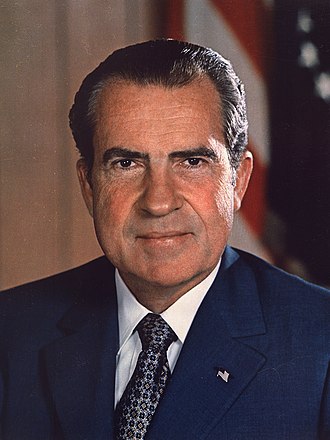
Nixon, Richard M. (President)
Richard M. Nixon served as the 37th President of the United States from January 1969 until his resignation in August 1974. In February 1971, he ordered the installation of a secret voice-activated taping system in the White House to preserve a historical record of his administration. Until the system's existence was revealed and dismantled in July 1973, the tapes captured Nixon directing major foreign policy initiatives, such as the opening to China, as well as his central role in the Watergate cover-up.
What Nixon talks about on the tapes
White House operations 4,718Presidential scheduling 2,225Public relations 1,784Presidential schedule 1,782Vietnam War 1,693Logistics 1,650Manolo Sanchez 1,626White House communications 1,400White House administration 1,399Presidential communication 1,243Henry Kissinger 1,191Foreign Policy 1,183
Conversations (21,010)
— Page 45 of 211President Nixon consulted with the White House operator to facilitate an outgoing call. This brief interaction served as a logistical step to connect the President with another party. No substantive policy discussions occurred during this exchange.
President Nixon and Patrick J. Buchanan briefly coordinate the administrative response regarding upcoming tax cuts and sanctions. The discussion focuses on ensuring consistency between the White House and E.P. Walker concerning these economic policy initiatives. The pair concludes the meeting by confirming the necessity of keeping these efforts aligned.
President Nixon consulted with John Ehrlichman to clarify the administration's official stance regarding a proposed amendment on prayer in schools. The two men discussed the nuances of supporting voluntary prayer initiatives as part of their legislative agenda. Ehrlichman remained non-committal about the political viability or certainty of the administration's position during the exchange.
President Nixon met with his personal aide, Manolo Sanchez, to locate a missing pen. After a brief search, they discovered the item tucked away in the pocket of the President's coat. The discussion was limited to the recovery of this personal possession and required no further administrative action.
President Nixon and H. R. Haldeman coordinate the President’s upcoming public schedule, specifically discussing the timing of meetings and the necessity of television coverage. They explore strategic messaging regarding US-Japan textile negotiations, including plans to leak information about George Ball and Edwin Reischauer to columnists. Additionally, the pair discusses managing the press narrative surrounding the relocation of the Washington Senators baseball team.
President Nixon met with Alexander P. Butterfield to coordinate adjustments to his official schedule and travel logistics. The discussion focused specifically on the timing and operational requirements for accessing the helicopter pad. This brief interaction served to finalize travel arrangements necessitated by changes to the President's upcoming itinerary.
President Nixon met with his personal valet, Manolo Sanchez, in the Old Executive Office Building to discuss personal arrangements. During the brief exchange, Nixon requested that Sanchez prepare tea for him. The discussion also touched upon the President's upcoming daily schedule and associated instructions for his staff.
President Nixon and H. R. Haldeman discussed the exclusion of Arthur Burns from an invitation list for a Japanese dinner event. To avoid personal friction with Burns, Nixon instructed Haldeman to shift the responsibility to the State Department, claiming the agency exclusively curated the guest list. The two agreed on this strategy to manage Burns's expectations and protect the White House from appearing at fault.
President Nixon initiated a brief telephone request to the White House operator to be connected with George P. Shultz, then the Director of the Office of Management and Budget. The call served as a logistical bridge to facilitate a direct conversation between the President and Shultz. No further substantive discussion occurred during this recording segment.
President Nixon and George Shultz discuss how to manage political opposition from labor leaders Leonard Woodcock and George Meany regarding the implementation of Phase II of the administration's economic program. While Shultz advises maintaining a pragmatic approach to secure labor cooperation, the President suggests a more aggressive stance, particularly in rebutting claims about excess corporate profits. To bolster their narrative, Shultz commits to providing data showing that real spendable earnings reached a historic high in 1971, contrasting current economic improvements with the wage-price stagnation of the previous years.
President Nixon requested that the White House operator place a follow-up telephone call to connect him with another party. This brief interaction served as a functional bridge to facilitate executive communication during the workday. No further substantive policy matters or decisions were recorded during this brief administrative exchange.
President Nixon met with George Shultz and Ron Ziegler to discuss public perception and strategic messaging regarding a specific administrative program. The group assessed national support levels for the initiative, noting strong backing from states like Ohio and Georgia. Nixon emphasized the necessity of maintaining a unified position to effectively promote the program and addressed specific comparative data regarding recent fiscal or programmatic growth.
President Nixon met with Ronald Ziegler and Stephen Bull to coordinate the administration's public response to the resignation of Supreme Court Justice John M. Harlan. The participants discussed talking points for Ziegler's upcoming press briefing, specifically regarding the criteria for new judicial nominees, the timing of vacancy announcements, and how to deflect questions about geographical or political pressures. Additionally, the President provided guidance on managing inquiries regarding domestic conditions in the People's Republic of China, instructing staff to emphasize the limitations of U.S. intelligence on the matter.
President Nixon met with his valet, Manolo Sanchez, to briefly discuss the arrival of a specific item or publication. The short exchange centered on the delivery of requested materials, prompting the President to reflect on the nature of the content. No substantive policy decisions were made during this brief personal encounter.
President Richard Nixon met with his longtime valet, Manolo Sanchez, in the Old Executive Office Building to handle a brief, personal administrative matter. The conversation was limited in scope, focusing on the retrieval or exchange of an unknown item. No substantive policy discussions or significant political developments occurred during this short interaction.
President Nixon met with his personal valet, Manolo Sanchez, in the Old Executive Office Building. The brief interaction focused on personal services, specifically the President's request for tea. The discussion also touched upon administrative logistics regarding Nixon's upcoming schedule and meetings with Henry Kissinger.
President Nixon and Henry Kissinger met to finalize the strategic communications plan regarding the upcoming announcement of Kissinger’s trip to the People's Republic of China. The discussion focused on coordinating the announcement timing to maximize geopolitical advantage, particularly in managing the Soviet Union's reaction, while determining which technical details should be withheld for the President's subsequent press conference. They successfully aligned the schedule to build momentum and ensure that staff remained tight-lipped, allowing the administration to control the narrative surrounding the normalization of relations with China.
President Nixon met with his personal valet, Manolo Sanchez, in the Old Executive Office Building to handle a brief personal matter. The primary purpose of the interaction was for the President to request that tea be prepared for him. No substantive policy or political discussions occurred during this brief exchange.
President Nixon met with his personal valet, Manolo Sanchez, to coordinate the President's upcoming schedule. The discussion centered on confirming the timing for a visit to the barbershop. The interaction concluded with the President clarifying that he would be ready for the appointment at 4:45 p.m.
President Nixon and Alexander Butterfield coordinate the agenda for an upcoming Cabinet meeting scheduled for September 24, 1971. They specifically discuss Secretary of the Treasury John Connally’s role, agreeing that Connally should provide a brief statement regarding the U.S. economic position. The President decides to personally contact Connally to ensure the presentation remains concise, limiting the discussion to ten minutes.
President Nixon held a brief meeting in his Old Executive Office Building suite with an unidentified individual. While official records and available audio segments offer no substantive discussion, the session included an administrative request involving a punch card or similar record. The meeting concluded without any documented policy developments or further recorded dialogue.
President Nixon met with his personal valet, Manolo Sanchez, in the Old Executive Office Building to discuss the time. The brief exchange primarily involved Sanchez fulfilling a request for a drink and confirming the late afternoon hour. No significant policy matters or administrative decisions were addressed during this interaction.
President Nixon held an undocumented meeting with one or more unidentified individuals in the Old Executive Office Building. Because no transcript or descriptive records are currently available for this exchange, the specific subject matter and any resulting policy decisions remain historically inaccessible. The nature of this interaction is categorized as a restricted personal communication.
President Nixon and H. R. Haldeman discuss logistical adjustments for the President's upcoming travel schedule, specifically deciding to cancel a proposed visit to a River Rouge plant. The conversation transitions into a critique of the length and clarity of White House press materials, with Nixon directing that all future statements and information papers be condensed to under 200 words. They agree that Patrick J. Buchanan should oversee this editing process to ensure brevity and focus in public messaging.
President Nixon and H.R. Haldeman discuss the strategic implementation of a media or public relations campaign, focusing on the brevity and impact of political messaging. They debate the utility of purchasing advertising space and the necessity of refining the President's public statements for media consumption. The conversation concludes with a consensus on the importance of distilling complex policy points into concise, effective soundbites for public delivery.
President Nixon held a private meeting with an unidentified individual in his Old Executive Office Building office. Due to the lack of an available transcript or administrative record, the specific topics of discussion, intended objectives, and potential outcomes remain undocumented. The interaction concluded within a twenty-seven-minute window, leaving no evidence of official policy shifts or administrative decisions.
President Nixon, Vice President Agnew, and members of his Cabinet met to coordinate a unified administration strategy ahead of critical International Monetary Fund (IMF) meetings and ongoing global trade negotiations. The discussion emphasized the necessity of maintaining the recently imposed 10% import surcharge and a firm bargaining stance to address the nation's economic balance of payments and reshape the international monetary system. Nixon and his advisors agreed that while foreign partners would likely criticize U.S. policy, maintaining domestic political support and correcting long-standing trade imbalances remained the administration's primary objective.
President Nixon and Stephen B. Bull discuss the final Washington Senators baseball game held at RFK Stadium and the potential political implications of a related vote. The conversation touches on the team's departure from the city and the administration's strategic response to the upcoming legislative or public matter. No formal policy decisions are recorded, but the exchange highlights the interplay between local cultural events and the President's political agenda.
President Nixon and H. R. Haldeman debrief the President's recent appearance at the Detroit Economic Club, evaluating the effectiveness of the television coverage and the overall effort required for the event. They analyze the impact of press interactions, the management of audience questions, and the logistical challenges of balancing domestic and foreign policy topics. Ultimately, Nixon concludes that evening events are rarely worth the intensive preparation effort unless they secure significant prime-time television exposure, and he decides to shift his strategy toward repeating key message points rather than constantly seeking new material.
President Nixon met with John B. Connally and Arthur F. Burns to establish a unified administration strategy for upcoming international economic negotiations. The President decided to avoid a formal speech to the International Monetary Fund, tasking Connally with presenting the administration's position while he focused on informal outreach to foreign delegates. They discussed the tactical use of the U.S. import surcharge, the potential for a transitional currency float, and the need to de-emphasize gold prices to maintain a firm negotiating stance against European and Japanese interests.
President Nixon met with H.R. Haldeman and later joined by Milton Friedman and George Shultz to discuss public relations, press strategy, and economic policy. The conversation focused on the President's upcoming appearances, particularly a speech at the Detroit Economic Club, and how to manage media coverage of his administration and international initiatives. Substantive economic discussions with Friedman and Shultz centered on the complexities of implementing Phase II wage and price controls, managing the gold standard and import surcharges, and the political necessity of avoiding a recession before the 1972 election.
President Nixon met with John Ehrlichman and William Magruder to discuss the administration's 'New Technology Opportunities Program,' which aims to stimulate American industry, improve national competitiveness, and address economic needs through bold, innovative initiatives. The participants focused on the importance of aggressive systems management—drawing parallels to the Manhattan and Apollo projects—to combat the complacency and limited vision currently found within traditional federal agencies. Magruder provided an update on ongoing research into trade, tax incentives, and antitrust policies, while the President emphasized the need for a high-visibility, psychological lift to revitalize American technological and industrial dominance.
President Nixon met with Alexander Butterfield in the Oval Office to conduct a brief review of the President's upcoming daily schedule. The discussion focused on logistical coordination and the management of administrative appointments. No major policy decisions were reached during this short interaction.
President Nixon met with Secretary of Defense Melvin Laird and several high-ranking Black military officers to discuss promoting equal opportunity and advancement within the armed forces. The President emphasized that officer promotions should be merit-based rather than tokenistic, citing historical precedents of minority groups finding success in specific professional fields. He encouraged the officers to serve as ambassadors for the military’s All-Volunteer Force, urging them to demonstrate that genuine career advancement for minority personnel is both possible and prioritized.
President Nixon met with sculptor Michael "White Antelope" Naranjo, his wife, and administration officials to view and discuss a bronze sculpture of a Pueblo Indian dancer. The discussion focused on Naranjo’s artistic process, his commitment to his Native American heritage, and the determination required to overcome his physical disability. The President expressed deep admiration for Naranjo's talent and character, concluding the meeting by presenting him with presidential mementos and offering words of encouragement regarding his future work.
President Nixon met with his aide Stephen B. Bull to review logistical details for an upcoming presidential schedule. The discussion focused on coordinating a photo opportunity involving a portrait of Dwight D. Eisenhower and managing a meeting with Mrs. J. Willard Marriott in the Cabinet Room. As an action item, they finalized arrangements to present Mrs. Marriott with a compact gift during her visit.
President Nixon and H.R. Haldeman review the positive public and political reception of the President's recent appearance at the Detroit Economic Club, noting the favorable impact on his economic policies. The conversation shifts to logistical planning for upcoming presidential travel to Montana and Alaska, as well as discussions regarding the strategic utility of disparaging remarks made by a media commentator. Haldeman and the President weigh the benefits of exposing the commentator's bias to CBS affiliates to diminish his influence.
President Nixon initiates a request for the White House operator to connect him with Attorney General John N. Mitchell. The call serves as a brief administrative interaction to facilitate direct communication with a key cabinet member. No further substantive discussion occurs during this exchange beyond the request to establish the connection.
President Nixon and Attorney General John Mitchell coordinate an afternoon golf outing at Burning Tree Country Club. Nixon directs Mitchell to reschedule an antitrust meeting with John Ehrlichman to accommodate their plans. The two men agree to meet at the course to tee off at 2:30 p.m.
President Nixon initiates a brief telephone exchange with the White House operator to facilitate a connection with Charles W. Colson. The call serves as a routine administrative request to place a priority communication through the executive switchboard. No further substantive policy matters are addressed during this brief interval.
President Nixon and Charles Colson reviewed the positive public and market reaction to the President's recent media appearance and discussed strategies to maintain political momentum. They assessed the diminishing impact of the Vietnam War as a campaign issue and strategized on how to leverage upcoming Supreme Court appointments to solidify support among conservatives. Colson also committed to orchestrating public pressure from the White House to ensure both judicial vacancies are filled by conservative candidates.
President Nixon contacted the White House operator to facilitate a telephone connection to his personal secretary, Rose Mary Woods. The brief exchange served purely administrative purposes to reach his staff member. No policy matters or significant executive decisions were discussed during this short communication.
President Nixon contacted the White House operator to facilitate an immediate connection with National Security Advisor Henry A. Kissinger. This brief interaction served solely as a logistical request to bridge communication between the President and his advisor. No further policy discussions or substantive developments took place during this brief exchange.
President Nixon contacted the White House operator to inquire about the availability and schedule of his personal secretary, Rose Mary Woods. Upon learning that Woods was currently at a beauty salon but expected home soon, the President acknowledged the update and ended the brief coordination call. This exchange served solely as a logistical check-in regarding staff availability.
President Nixon contacted the White House operator to request an outgoing call to Secretary of the Treasury John B. Connally. The brief exchange served as a logistical step to initiate a discussion between the President and his cabinet official. No substantive policy matters or further developments were recorded in this brief operator-assisted connection.
President Nixon and Treasury Secretary John Connally discussed administrative updates and the orchestration of economic and judicial policy. They coordinated a meeting with Federal Reserve Chairman Arthur Burns to ensure his alignment with the administration's economic program while managing his influence on public perception. Additionally, Nixon consulted Connally regarding his strategy for upcoming international trade negotiations and his decision to appoint two conservative judges to the Supreme Court to solidify a long-term ideological shift in the judiciary.
President Nixon consulted with the White House operator to determine the current status and location of Dr. Gibson. The conversation focused on tracking Gibson's movements to facilitate his arrival at the White House. No further policy decisions were made, as the exchange was limited to logistical updates regarding personnel scheduling.
President Nixon and H.R. Haldeman reviewed the President's upcoming schedule, focusing on balancing official duties with political optics. They discussed the President’s attendance at Justice Hugo Black's funeral, a potential unannounced visit to a POW wives' dinner, and logistics for recent and future travel, including concerns over the management of motorcades and press coverage. Nixon ultimately decided to maintain control over his public appearances, rejecting unnecessary speaking engagements and delegating travel details while prioritizing his focus on upcoming Phase II economic policy meetings.
President Nixon met with his aide Stephen B. Bull to discuss adjustments to his daily schedule. The primary focus of the brief meeting was the coordination of an upcoming appointment with Charles W. Colson. No major policy decisions were recorded during this logistical session.
President Nixon met with his senior advisors and Henry Kissinger to discuss pressing political, economic, and foreign policy matters, including the handling of Justice Hugo Black's funeral, the legislative challenge of the Mansfield amendment, and the upcoming strategy for Vietnam. Nixon expressed a desire to avoid the public exploitation of funerals and the visible presence of Secret Service agents on running boards, while also directing a low-key approach to his attendance at Justice Black's service. The conversation further addressed managing the economy to ensure a stable political environment and finalized scheduling for diplomatic meetings with the International Monetary Fund and Soviet official Andrei Gromyko.
President Nixon and Alexander P. Butterfield meet briefly to discuss a scheduling matter involving John Ehrlichman. The discussion centers on a specific communication or piece of correspondence, referred to as a "letter," and potential upcoming appointments. The participants conclude by exchanging brief thoughts on how to proceed with these administrative arrangements.
President Nixon met with his aide Stephen B. Bull to discuss the management of his daily schedule, specifically regarding upcoming meetings with President Moktar Ould Daddah and John D. Ehrlichman. Frustrated by the excessive time spent on photo sessions in the Cabinet Room, Nixon directed Bull to enforce a strict forty-five-second limit for these events moving forward. This change was implemented to streamline the President's itinerary and eliminate unnecessary delays in his busy calendar.
President Nixon met with H. R. Haldeman and Stephen B. Bull to vent his frustration regarding his recent attendance at the funeral of Supreme Court Justice Hugo L. Black. Nixon characterized the decision to attend as a significant political error, arguing that it provided no genuine benefit to his administration's relationship with the public or the judiciary while fueling liberal expectations for future judicial appointments. He explicitly instructed his staff to stop pressuring him into similar ceremonial appearances, labeling the advice to attend as poorly conceived.
President Nixon met with a delegation from the Organization of African Unity (OAU), led by Mauritanian President Moktar Ould Daddah, to discuss African decolonization and the liberation of southern Africa from minority rule. The delegation advocated for U.S. support in implementing UN resolutions regarding Namibia, South Africa, Rhodesia, and Portuguese territories, while specifically expressing concern over potential U.S. legislation to purchase chrome from Rhodesia. Nixon reaffirmed the administration's opposition to the legislative amendment and emphasized his personal commitment to African affairs, while the delegates expressed gratitude for the open, diplomatic dialogue.
President Nixon met with congressional leaders and administration officials, including John C. Stennis and Melvin R. Laird, to coordinate legislative strategy regarding HR 6531 and the broader Military Procurement Bill. The participants discussed the status of the bill in Congress, specifically focusing on managing the Mansfield amendment and navigating the conference committee process. The discussion emphasized building support for the administration's military objectives and preparing for legislative action items in the coming week.
President Nixon consulted with H. R. Haldeman, Stephen Bull, and Alexander Butterfield regarding the logistics and messaging for his upcoming attendance at the National League of Families convention. The group discussed the political optics of the President's public schedule, specifically balancing his concern for POWs with his potential attendance at Justice Hugo Black's funeral. Additionally, Nixon reviewed a draft statement concerning the draft extension bill and expressed his personal disdain for the ideological leanings of some judicial philosophies.
President Nixon contacted the White House operator to place a personal telephone call to his daughter, Julie Nixon Eisenhower. The brief interaction served as a formal request to connect the President with his daughter. No further policy or administrative matters were discussed during this exchange.
President Nixon initiates a request through the White House operator to place an urgent call to Special Counsel Charles W. Colson. This administrative interaction serves to facilitate direct communication between the President and a key advisor regarding ongoing executive business. No substantive policy discussions occur, as the dialogue is limited to the mechanical process of connecting the call.
President Nixon met with Republican congressional leadership, staff, and advisors to coordinate the administration’s legislative agenda for the final months of the 1971 session. The discussion focused on securing passage of the President's tax package, welfare reform, and revenue-sharing initiatives, while navigating difficult Senate opposition and House parliamentary hurdles. Nixon emphasized the urgent need for political pressure on Democrats regarding a federal wage deferral bill and outlined strategies for upcoming Supreme Court nominations to ensure successful confirmations.
President Nixon expressed urgent frustration to Charles Colson regarding the lack of public mail support reaching Congress for his proposed pay deferral legislation. Nixon noted that legislative leaders, including Gerald Ford, reported being overwhelmed by opposition from government unions while receiving no backing from business groups like the NAM or the Chamber of Commerce. The President directed Colson to immediately mobilize these organizations to generate a substantial letter-writing campaign before the upcoming Tuesday vote.
President Nixon met with Senator John L. McClellan and staff members to discuss Supreme Court vacancies, current economic policy, and pending copyright legislation. The group considered potential judicial nominees and discussed the administration's need to demonstrate control over corporate profits to maintain public support for economic initiatives. Furthermore, they reviewed the status of cable television regulations and the broader copyright bill, with McClellan seeking assurances that the White House was not improperly interfering with FCC proceedings or current legislative efforts.
President Nixon contacted the White House operator to place a personal telephone call to his daughter, Julie Nixon Eisenhower. The operator attempted to facilitate the request but informed the President that she was currently unavailable. No further actions were taken during this brief exchange.
President Nixon contacted the White House operator to inquire about the availability of his daughter, Julie Nixon Eisenhower. Upon learning that she was currently out, the President decided not to pursue further efforts to reach her at that time. The brief exchange served solely as an unsuccessful attempt to facilitate a personal communication.
President Nixon contacted the White House operator to facilitate a personal phone call to First Lady Pat Nixon. The exchange served as a brief administrative request to connect the President with his wife. No substantive policy matters or major political decisions were addressed during this short communication.
President Nixon consulted with the White House operator to facilitate an outgoing call. This brief interaction served as a routine administrative step to connect the President with another party. No substantive policy discussions or policy decisions occurred during this brief exchange.
President Nixon consulted with the White House operator to facilitate an outgoing call. The brief exchange served as a logistical step to connect the President with a third party. No substantive policy discussions occurred during this operator-assisted connection.
President Nixon requested that the White House operator connect him with a contact identified as the Inspector. This brief interaction serves as a routine administrative request to facilitate further communication. No substantive policy matters or major developments occurred during this brief exchange.
President Nixon, H. R. Haldeman, Henry Kissinger, and Charles Colson met to coordinate administration strategy regarding the upcoming Mansfield Amendment vote in the House, Kissinger’s secret trip to the People’s Republic of China, and the President’s scheduled address to the National League of Families. The participants discussed managing potential legislative defeats, minimizing the political fallout of the China announcement on the upcoming UN Taiwan vote, and addressing criticism from Senator Edward Kennedy regarding POWs. Nixon ultimately decided to maintain a low-profile approach for his visit to the POW families and affirmed his intent to control the China trip logistics without State Department interference.
President Richard Nixon and First Lady Pat Nixon engaged in a brief, one-minute telephone conversation. The majority of the recording consists of a withdrawn segment classified as personal, followed by a brief, informal exchange. No substantive policy discussions or administrative decisions were documented in the surviving transcript.
President Nixon contacted the White House operator to facilitate an outgoing call. The primary purpose of this brief communication was to request that the operator connect him with Charles W. Colson. No further substantive discussion took place during this administrative exchange.
President Nixon and Charles Colson discuss efforts to generate congressional mail support for the administration's economic program, specifically targeting legislative opposition to a proposed pay raise. Nixon stresses the necessity of pressuring business groups like the Chamber of Commerce to ensure compliance with the campaign. Additionally, the pair discusses political messaging against Senator Edward Kennedy regarding his criticisms of the administration’s handling of prisoners of war in Vietnam.
President Nixon contacted the White House operator to facilitate an urgent communication with his National Security Advisor, Henry Kissinger. The brief interaction served as a formal request to place a telephone call to Kissinger. No further substantive policy matters were recorded during this brief exchange.
President Nixon consulted with the White House operator to confirm the departure status of Henry Kissinger from the Executive Office Building. The brief exchange served to track Kissinger's movements as he exited the premises. No further policy discussions occurred, as the call focused exclusively on verifying the National Security Advisor's transit.
President Nixon contacted the White House operator to facilitate a telephone connection with his personal secretary, Rose Mary Woods. The brief exchange served as an administrative request to initiate this specific call. No further policy or substantive matters were discussed during this brief communication.
President Nixon and his personal secretary, Rose Mary Woods, exchanged brief remarks regarding the demanding nature of the President's schedule. Their conversation touched upon the President's recent travel and his attendance at a dinner for Prisoners of War (POWs). The dialogue reflects the exhaustion caused by the relentless pace of White House obligations.
President Nixon contacted the White House operator to facilitate a direct connection with his Chief of Staff, H.R. Haldeman. This brief administrative interaction served as a logistical request to establish communication between the President and his top aide. No further policy or strategic matters were addressed during this specific exchange.
President Nixon and Henry Kissinger discuss the President’s recent meeting with the National League of Families, where Nixon successfully addressed concerns regarding prisoners of war (POWs). The two strategize on how to respond to potential failures in peace negotiations, with Nixon expressing a willingness to implement a hard-line policy, such as a naval blockade, rather than withdrawing troops. Additionally, they coordinate plans to counter Senator Edward Kennedy's criticisms regarding POWs and discuss upcoming diplomatic maneuvering involving Soviet officials and UN Ambassador George H.W. Bush.
President Nixon and Charles Colson discuss the political fallout from Nixon's surprise appearance at a POW wives convention and coordinate a strategy to neutralize Democratic criticism. Nixon instructs Colson to mobilize Republican allies, specifically mentioning Barry Goldwater, to publicly attack Senator Edward Kennedy for his recent statements on the war. Additionally, they discuss intensifying pressure on Democrats regarding the administration's economic policies, with Nixon explicitly directing Colson to label those delaying federal economic legislation as being "out of step with the country."
President Nixon held an brief, unrecorded meeting with an unidentified participant in the Oval Office. Due to the lack of a transcript or descriptive records, the specific subject matter and any resulting actions remain unknown. The encounter lasted approximately eight minutes, serving as a placeholder in the historical record of the Nixon administration's daily operations.
President Richard M. Nixon met briefly with Deputy Assistant to the President Alexander P. Butterfield in the Oval Office. The primary purpose of this meeting was for the President to review and sign official administrative documents. No other substantive policy discussions were recorded during this brief encounter.
President Nixon and Henry Kissinger met to discuss diplomatic strategy, focusing on upcoming meetings with Soviet Foreign Minister Andrei Gromyko and the announcement of a planned presidential summit in the USSR. The conversation covered logistical arrangements for hosting Gromyko, including the use of the Roosevelt Map Room, and the framing of policy positions regarding a European Security Conference. Alexander P. Butterfield briefly joined the meeting to coordinate administrative details and document delivery for the scheduled diplomatic sessions.
President Nixon met with H. R. Haldeman, Stephen B. Bull, and an unidentified individual to coordinate the administration's scheduling, economic strategy, and public relations. Discussions focused on preparations for Phase II economic policies, including upcoming meetings with key economic advisors, and the management of the President's public appearances and travel schedule. The group also reviewed the reception of the President's recent appearance at the National League of Families convention and discussed the political impact of his entry methods and press coverage.
President Nixon met with Treasury Secretary John Connally, Federal Reserve Chairman Arthur Burns, and IMF Managing Director Pierre-Paul Schweitzer to discuss the evolving international economic landscape and the U.S. role within it. The discussion centered on balancing U.S. domestic economic policies, such as the 'Phase II' measures and import surcharges, with the need to maintain global leadership and monetary stability. The participants addressed the political and economic challenges of transitioning from the post-World War II order to a new system that accounts for the rising influence of nations like Japan and West Germany, while emphasizing the importance of cooperation and burden-sharing in international monetary affairs.
President Nixon met with an unidentified individual to discuss the scheduling of Treasury Secretary John B. Connally. The discussion centered on managing Connally's availability and organizational commitments within the administration. No further policy decisions were recorded during this brief encounter.
President Nixon met with his aide Stephen B. Bull to coordinate the scheduling of Treasury Secretary John B. Connally. The discussion centered on finalizing the timing and logistics for a specific upcoming meeting involving Connally. No further policy issues were addressed during this brief administrative session.
President Nixon met with Alexander P. Butterfield in the Oval Office to review and sign official administrative documents. The brief encounter focused primarily on the processing of these pending items requiring the President's immediate attention. No further substantive policy discussions were recorded during this brief meeting.
President Nixon communicated with a White House operator to facilitate an outgoing call. The interaction served as a routine administrative task to connect the President with another party. No substantive policy discussions or significant decisions occurred during this brief exchange.
President Nixon, H. R. Haldeman, and Henry Kissinger met to discuss domestic and foreign policy priorities, including the administration's upcoming economic 'Phase II' announcements, potential personnel changes, and the President's diplomatic strategy. The conversation focused on balancing the President's public image and economic messaging with the complexities of managing international relations, particularly regarding the Soviet Union and China. Nixon and Kissinger also evaluated the political implications of recent events, such as the funeral of Justice Hugo Black and the handling of the prisoner of war issue, while coordinating the President's schedule and approach for high-level meetings with foreign officials.
President Nixon initiates a brief telephone call to his daughter, Julie Nixon Eisenhower. The exchange serves solely as a request for the White House operator to connect the President to her. No other substantive political or administrative topics are discussed during this brief interaction.
President Richard Nixon engaged in a brief personal telephone conversation with his daughter, Julie Nixon Eisenhower. The discussion served as a private familial exchange, as the vast majority of the recording was designated as a personal, returnable item. No substantive policy matters or official administrative actions were captured in this interaction.
President Nixon contacted the White House operator to facilitate a telephone connection with his Chief of Staff, H.R. Haldeman. This brief administrative interaction served as a logistical step to initiate a high-level discussion between the President and one of his closest advisors. No further substantive conversation was captured in this recording.
President Nixon held a brief, informal meeting with his daughter, Julie Nixon Eisenhower, in the Oval Office. The two engaged in personal conversation, though specific substantive details remain unavailable due to the lack of a transcript and the withdrawal of a portion of the record. No official policy actions or significant governmental decisions were recorded during this two-minute exchange.
President Nixon consulted with an unidentified individual regarding the scheduling of a person named John. The call was briefly interrupted by the White House operator, though the brief transcript provides no substantive details beyond these logistical arrangements. No major policy decisions or significant developments were recorded during this exchange.
President Nixon met with his personal valet, Manolo Sanchez, in the Oval Office to discuss personal matters or administrative tasks related to the White House residence. While the specific substance of the brief interaction remains unrecorded, the discussion focused on routine household management or valet duties. No significant policy decisions or geopolitical developments resulted from this brief, private meeting.
President Nixon and H. R. Haldeman met to coordinate the President's upcoming schedule and address logistics regarding a specific meeting request. The discussion focused on the necessity and timing of a gathering held at the Executive Office Building. No formal decisions were recorded, but the exchange functioned as a brief administrative review of the President's daily agenda.
President Nixon and H. R. Haldeman met to discuss logistical preparations and publicity strategies for upcoming international trips, specifically focusing on Henry Kissinger’s mission to the People’s Republic of China and the President’s own travel to the USSR. The conversation addressed the selection of accompanying personnel, the management of press coverage, and the development of briefing materials to ensure effective decision-making during summit meetings. Additionally, the two discussed administrative protocols for an upcoming International Monetary Fund (IMF) reception, including the ranking of attendees like Arthur F. Burns and John B. Connally.
President Nixon met with his personal valet, Manolo Sanchez, to discuss the President’s upcoming schedule and engage in a casual exchange regarding international relations. The two touched upon foreign affairs, specifically referencing the political and economic sentiments held by France, West Germany, and Italy. The conversation serves as an informal reflection on global perceptions of U.S. economic aid and diplomatic standing.
President Nixon and Press Secretary Ronald Ziegler discuss scheduling protocols for upcoming photo opportunities with various foreign and domestic officials, including Soviet Foreign Minister Andrei Gromyko. The pair coordinate the administration's messaging strategy regarding the Accidental War Agreement and potential summit speculation involving the Soviet Union and China. Additionally, Nixon clarifies his preferences for media access, specifically requesting that press coverage at a forthcoming reception be limited to a pool of reporters without camera equipment.
President Nixon and Henry Kissinger met to coordinate strategy for an upcoming diplomatic engagement with Soviet Foreign Minister Andrei Gromyko. Their discussion focused on critical agenda items including Soviet missile production and the ratification of the Berlin Agreement. Following this, the President and H. R. Haldeman briefly addressed logistical arrangements for Nixon's schedule, specifically regarding the logistics of the meeting with Gromyko and an upcoming International Monetary Fund reception involving John B. Connally.
President Richard M. Nixon met briefly with his personal aide, Stephen B. Bull, to conduct administrative business in the Oval Office. The primary focus of the discussion concerned the President's upcoming schedule. The meeting concluded after one minute, with no further significant developments recorded.