Nixon, Richard M. (President)
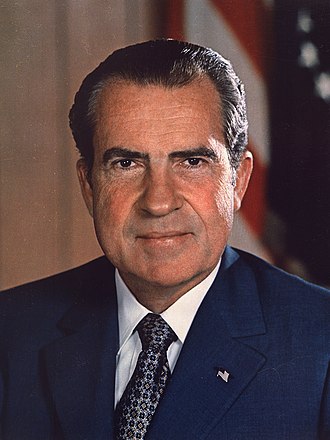
Richard M. Nixon served as the 37th President of the United States from January 1969 until his resignation in August 1974. In February 1971, he ordered the installation of a secret voice-activated taping system in the White House to preserve a historical record of his administration. Until the system's existence was revealed and dismantled in July 1973, the tapes captured Nixon directing major foreign policy initiatives, such as the opening to China, as well as his central role in the Watergate cover-up.
What Nixon talks about on the tapes
White House operations 4,718Presidential scheduling 2,225Public relations 1,784Presidential schedule 1,782Vietnam War 1,693Logistics 1,650Manolo Sanchez 1,626White House communications 1,400White House administration 1,399Presidential communication 1,243Henry Kissinger 1,191Foreign Policy 1,183
Conversations (21,010)
— Page 43 of 211President Nixon and his advisors, including H. R. Haldeman and Henry Kissinger, held this meeting to strategize on public relations, congressional management, and the administration's aggressive posture toward political opponents. The discussion focused on framing the President's economic policies, neutralizing criticism regarding the military draft and Vietnam, and managing press relations to better promote the administration's leadership. Key outcomes included a decision to escalate military pressure in the DMZ and a plan to utilize media allies and station owners to counter perceived bias in news coverage.
President Nixon calls newly appointed Senator Robert T. Stafford to offer personal congratulations on his transition to the Senate. The two discuss the logistics of a future White House photo opportunity to commemorate the appointment, with the President directing his staff to coordinate the scheduling through Clark MacGregor. The conversation also briefly touches upon Stafford's transition, including his recent swearing-in and his ongoing search for office space.
President Nixon directed the White House operator to place a congratulatory telephone call to professional tennis player Stan Smith. This request followed Smith's recent victory at the Forest Hills championship. The exchange was limited to arranging this ceremonial outreach to the athlete.
President Nixon directs the White House operator to place a telephone call to Kay Gardella, a television correspondent for the New York Daily News. The President identifies the journalist by her professional role to ensure the operator contacts the correct individual. This interaction serves as a brief administrative task to facilitate direct communication between the President and a member of the press.
President Nixon met with attorney Charles Rhyne and Alexander Haig to discuss the international reaction to Nixon’s recent foreign policy initiatives, specifically his opening of relations with the People's Republic of China. Rhyne provided a briefing on his recent trip to Yugoslavia, where he engaged with President Josip Broz Tito and various international legal figures regarding the role of world law in global diplomacy. Following this, the participants explored the potential for a presidential address or public statement emphasizing the rule of law as a cornerstone of U.S. moral leadership and a framework for managing international conflicts.
President Nixon held two distinct discussions: first, he met with Maurice Stans, George Shultz, and Kenneth Cole to strategize on economic policy, specifically debating the budget and political messaging for the Minority Business Enterprise program and the potential for controlling bank profits. He then met with Romanian Ambassador Corneliu Bogdan and Henry Kissinger to discuss international relations, including the desire for strengthened U.S.-Romanian economic ties and Romania's autonomy within the Eastern Bloc. Throughout the meeting, the President emphasized his firm stance on maintaining U.S. credibility and pressure regarding the ongoing Vietnam War negotiations.
President Nixon and Henry Kissinger discussed strategic options for ending the Vietnam War, including the possibility of a military blockade to force a settlement and address the plight of American prisoners of war. They evaluated the political timing of such actions in relation to the 1972 presidential election, with Kissinger advising that a firm stance against anti-war critics would bolster Nixon's leadership image. Furthermore, they coordinated efforts to influence domestic congressional support, particularly regarding the military draft, and discussed managing political opponents to maintain the administration's position.
President Nixon met briefly with Stephen B. Bull and an unnamed individual to discuss his schedule, specifically concerning Representative Jack F. Kemp. Following their departure, the President engaged in a cordial phone conversation with television critic Kay Gardella. Nixon praised Gardella’s review of a recent broadcast, specifically highlighting her coverage of his San Clemente residence, and engaged her in casual conversation regarding the television landscape, including the show 'Columbo.'
President Nixon called New York Daily News television critic Kay Gardella to personally express his appreciation for her positive review of a recent television broadcast featuring First Lady Pat Nixon. The discussion touched upon the production quality of the special, specifically praising the location footage from San Clemente. The two also engaged in casual conversation regarding mutual acquaintances at the New York Daily News and discussed upcoming television programming, with Gardella recommending the show "Columbo" to the President.
President Nixon instructed the White House operator to place an outgoing call to Chief Justice Warren E. Burger. The exchange focused exclusively on establishing this communication channel between the President and the Supreme Court. No further substantive matters were discussed during this brief operational request.
President Nixon met with Representative Jack Kemp and Alexander Haig to discuss Kemp’s recent fact-finding trip to Vietnam and Laos, where he countered domestic criticism regarding the effectiveness of Vietnamization. The participants discussed strategies for countering political opponents—specifically referencing Paul N. McCloskey, Jr.—and addressed domestic legislative concerns, including aid to parochial schools and defense funding. Nixon encouraged Kemp to take a firm public stance on supporting Israel and maintaining national defense, while the conversation also touched on Kemp’s legislative priorities and a scheduled visit to Buffalo.
President Nixon met with Press Secretary Ronald Ziegler and aide Stephen Bull to coordinate responses to potential press inquiries following the President's recent news conference. The discussion focused on maintaining a firm stance against political speculation regarding a Black vice-presidential candidate and clarifying U.S. economic relations with Japan. Additionally, the group finalized arrangements for the President to pose for photographs at the White House bowling alley.
President Nixon met with representatives from the National Bowling Council to discuss the sport's role in physical fitness and its growing international popularity. During the session, the President engaged in friendly conversation about his personal interest in bowling and his family's involvement, while also posing for photographs with the group. Nixon presented the attendees with presidential cufflinks and autographed programs, encouraging the guests to visit the White House bowling alley before departing.
President Nixon met with entertainer Ginger Rogers and Alexander P. Butterfield to discuss the arts, the entertainment industry, and cultural shifts in American media. They exchanged views on the architecture and acoustics of the Kennedy Center, the decline of moral values in contemporary films, and the challenges faced by conservative-leaning entertainers. The conversation concluded with Nixon gifting Rogers a presidential compact and expressing his appreciation for her political support.
President Nixon met with his aides Stephen B. Bull and Alexander P. Butterfield to finalize the President's daily schedule. The primary focus of the brief discussion was coordinating the logistics for an upcoming meeting with John H. Geiger. Following the review of these administrative arrangements, the aides departed the Oval Office.
President Nixon met with American Legion leaders, including John H. Geiger and William F. Hauck, to secure the organization's support for his foreign policy, military draft initiatives, and economic agenda. Nixon emphasized the necessity of maintaining military and economic strength to ensure national security and a favorable position in international negotiations, urging the Legion to pressure Congress to sustain the draft. Additionally, the participants discussed concerns regarding the Veterans Administration budget, specifically addressing funding for drug abuse and venereal disease programs, and Nixon promised to coordinate further on these issues through Charles Colson.
President Nixon met with Lorenzo and David Hoopes, along with H. R. Haldeman and a White House photographer, to facilitate a brief photo opportunity and exchange presidential cufflinks. The discussion touched upon Lorenzo Hoopes’s professional background at Safeway, his reactions to the President's economic policies, and regional matters regarding California education appointments. The encounter served primarily as a social engagement and a platform for establishing interpersonal connections with the business-affiliated guests.
President Nixon met with H. R. Haldeman, Stephen Bull, Ronald Ziegler, and Charles Colson to discuss administration strategy regarding press relations, Supreme Court vacancies, and pending legislation. The group analyzed the political impact of recent press interactions—specifically focusing on the benefits of in-office press conferences—and debated the utility of hosting various interest groups at the White House. Additionally, the President and his staff discussed reactions to the military draft extension bill, notably countering Democratic rhetoric regarding 'Nixon's war,' and finalized plans for managing upcoming media exposure to maintain effective political control.
President Nixon met with a bipartisan group of Congressional leaders to discuss the progress of the 90-day wage-price freeze and to seek input on the development of Phase II economic policies. Treasury Secretary George Shultz provided an overview of the administration's administrative efforts, including the roles of the Cost of Living Council and the IRS in enforcing the freeze. The discussion centered on the need for continued cooperation across sectors—including labor, business, and agriculture—and the development of a framework for economic stabilization once the initial freeze expired.
President Nixon consulted with George P. Shultz to coordinate strategy for an upcoming meeting with Congressional leaders regarding economic policy. They discussed the effectiveness of the current wage and price freeze, analyzed positive economic indicators such as rising housing starts and GNP projections, and debated the handling of upcoming economic legislation. The pair specifically addressed the need to secure a deadline extension for economic programs to ensure ongoing legislative support and administrative success.
President Nixon consulted with staff and Chief Justice Warren E. Burger regarding the public announcement of Supreme Court Justice Hugo Black's sudden resignation. The participants coordinated a messaging strategy for press secretary Ronald Ziegler to handle media inquiries, specifically emphasizing that the President would seek the "best qualified" successor rather than committing to geographic or ideological litmus tests. The discussion also addressed the timeline of when the White House received Black's formal letter and the necessary coordination with Attorney General John Mitchell.
President Nixon and Chief Justice Warren E. Burger discuss the impending retirement of Supreme Court Justices Hugo L. Black and John M. Harlan due to their declining health. Nixon decides to send handwritten notes to both justices rather than organize formal events, acknowledging their inability to receive visitors. Additionally, the two touch upon the potential political fallout of the resignations and review Burger’s recent diplomatic travel to Yugoslavia and England, with Nixon encouraging further foreign engagement to foster international relations.
President Nixon contacted the White House operator to place a routine telephone call to Press Secretary Ronald L. Ziegler. The brief interaction served exclusively as a connection request for administrative communication between the President and his press staff. No substantive policy discussions or decisions occurred during this brief exchange.
President Nixon met with Representative Robert T. Stafford, his wife Helen, and members of his staff to discuss political matters and engage in a photo opportunity with the press. During the session, the President formally announced the resignation of Supreme Court Justice Hugo Black. The participants also engaged in informal conversation regarding the President’s past experience in the House of Representatives and exchanged commemorative presidential gifts.
President Nixon met with his aide Stephen B. Bull in the Oval Office to discuss returning a telephone call from Stan Smith. The brief meeting focused exclusively on administrative coordination regarding this communication. No further policy or substantive issues were recorded during this short exchange.
President Nixon met with H.R. Haldeman and other staff members to review a wide range of administrative, political, and foreign policy matters, notably including the impending vacancy on the Supreme Court following Justice Hugo Black's resignation. The discussion addressed the political strategy for potential court nominees, the administration's stance on the Office of Economic Opportunity extension bill, and military maneuvers in Vietnam. Additionally, the President reviewed his upcoming travel schedule and press relations, and he met briefly with reporter Eugene Risher to bid him farewell before his departure for a fellowship.
President Nixon consulted with the White House operator to determine the whereabouts of Press Secretary Ronald L. Ziegler. The brief interaction served to facilitate an urgent return call to Ziegler. No substantive policy matters were addressed during this administrative exchange.
President Nixon called tennis star Stan Smith to congratulate him on a recent victory and commend his generous donation of prize money to the Davis Cup. The two discussed Smith's professional performance, including a tense match attended by Vice President Spiro Agnew, and the logistics of upcoming tournaments. Nixon also noted his own scheduling conflicts regarding an upcoming trip to Anchorage to meet Emperor Hirohito, which would prevent him from attending the Pacific Southwest Tournament.
President Nixon initiates a request to the White House operator to be connected with Clark MacGregor, his Counsel to the President for Congressional Relations. This brief communication serves as the administrative bridge to facilitate a direct discussion between the President and his congressional liaison. No further policy-related discourse or substantive decisions were recorded during this brief connection request.
President Nixon consulted with the White House operator to determine the whereabouts of Clark MacGregor. After receiving information regarding MacGregor's location, the President decided to postpone the contact. Nixon concluded the brief administrative exchange by instructing the operator that he would reach out to MacGregor the following day.
President Nixon instructed the White House operator to place a personal telephone call to his daughter, Julie Nixon Eisenhower. The brief interaction served as a logistical request to facilitate communication between the President and his family. No policy matters or official business were discussed during this brief exchange.
President Nixon and Julie Nixon Eisenhower discuss scheduling details for upcoming social events, including an astronauts' dinner and a meeting with the Bowling Congress National Champions. The conversation covers feedback on First Lady Pat Nixon's recent television appearance and the accompanying press reviews from major newspapers. They also exchange personal updates regarding the health of Rose Mary Woods and the President’s dog, King Timahoe.
President Nixon met with Alexander P. Butterfield to coordinate administrative tasks and facilitate communication with his staff. During the brief session, the President requested a phone call to Attorney General John N. Mitchell. Additionally, the meeting served to process various documents requiring the President’s signature.
President Nixon and First Lady Pat Nixon briefly discussed the President's upcoming schedule and travel logistics. The conversation touched upon the impending departure of Attorney General John Mitchell and potential candidates for the Supreme Court seat vacated by Justice Hugo Black. They also briefly conferred on weather conditions affecting their departure plans.
President Nixon spoke with the White House operator to facilitate a telephonic connection. This brief interaction served as a technical precursor to an outgoing call, as indicated by the President's instruction regarding the destination of the communication. No substantive policy discussions occurred during this brief administrative exchange.
President Richard Nixon and First Lady Pat Nixon met briefly in the Oval Office to finalize their departure schedule for the day. The discussion centered on confirming travel plans, specifically noting a two o'clock departure time. The exchange also included a brief administrative note regarding the handling of a piece of correspondence.
President Nixon initiates a call to Congressman Charles W. Wiggins of California. The conversation serves solely as a logistical request for the White House operator to connect the President with the Congressman. No further policy or political discussions occur during this brief administrative interaction.
President Nixon instructed the White House operator to place a call to Congressman Charles Wiggins. The brief interaction served as a logistical step to initiate direct communication with the legislator. No further substantive policy matters were discussed during this request.
President Nixon instructed the White House operator to facilitate a follow-up conversation with Congressman Charles E. Wiggins. The exchange served to coordinate communication, as Wiggins was currently unavailable due to his attendance at a funeral. Nixon directed the operator to hold the request until the Congressman returned and initiated contact.
President Nixon contacted the White House operator to place an outgoing call to Representative Roger H. Zion of Indiana. The brief interaction served as a logistical arrangement to facilitate direct communication between the President and the Congressman. No substantive policy discussions or further developments occurred during this administrative exchange.
President Nixon consulted with the White House operator to determine the whereabouts of Congressman Roger Zion. The President requested assistance in reaching Zion at his Indiana residence, where the Congressman was expected to remain until Monday morning. This exchange served as an administrative coordination effort to facilitate direct contact between the President and the Representative.
President Nixon consulted with the White House operator to determine the whereabouts of Congressman Roger H. Zion for an expected communication. The operator located Zion in Princeton, Indiana, and noted he was scheduled to speak at noon. Nixon instructed the operator to attempt contact if possible, though he acknowledged that reaching the Congressman was not a strict necessity.
President Nixon contacted the White House operator to facilitate a telephone connection with his personal aide, Stephen B. Bull. The brief communication served solely as a logistical request to initiate this contact. No further substantive policy matters or official developments were discussed during the call.
President Nixon and H. R. Haldeman met to discuss a wide range of political strategies, including the 1972 election, potential Supreme Court nominees, and campaign publicity. They addressed the necessity of countering negative press coverage regarding the President's security arrangements at public events and considered methods for managing the candidacies of political rivals like George Wallace and Edmund Muskie. Additionally, the two discussed using the IRS and FBI to investigate and harass political adversaries and media critics, while also vetting potential judicial appointments based on their ideological stances on issues like busing.
President Nixon instructed his aide, Stephen B. Bull, to escort Attorney General John N. Mitchell into the Oval Office. Nixon requested this arrangement while indicating that he needed to complete another telephone call before joining the meeting. The brief exchange served to coordinate the President's immediate morning schedule and visitor management.
President Nixon met with his inner circle, including John Mitchell, Henry Kissinger, and John Ehrlichman, to discuss a range of urgent issues including Middle East tensions, the SALT negotiations, and Supreme Court vacancies. The President directed that the Middle East situation be kept low-profile to avoid political complications, emphasized the need for a conservative nominee to fill the Supreme Court vacancy, and ordered his staff to secure comprehensive files on the Bay of Pigs and the Pentagon Papers to better manage political messaging. Additionally, the participants reviewed economic indicators, discussed the President's public relations strategy regarding J. Edgar Hoover, and brainstormed ways to capitalize on the Democratic Party's internal divisions.
President Nixon called Congressman Roger H. Zion to offer birthday greetings and encourage him to mention the President’s well-wishes during his upcoming speaking engagements in Indiana. The conversation also touched upon Zion reaching his fiftieth birthday, with Nixon jokingly remarking on his youthful appearance and expressing a playful frustration with the younger generation. The exchange served primarily as a gesture of political camaraderie and personal rapport between the two men.
President Nixon initiated this phone call to express his personal condolences to Representative Charles E. Wiggins following the recent death of Wiggins' wife. The two discussed the long-term illness leading to her passing and the upcoming funeral services scheduled at Rose Hills Memorial Park. Nixon noted that the location held personal significance, as several members of his own family are also interred there.
President Nixon contacted the White House operator to facilitate a telephone call to the First Lady, Thelma C. "Pat" Nixon. The exchange served primarily as a brief administrative request to connect the President with his wife. No policy matters or further developments were discussed during this brief communication.
President Nixon initiates a brief telephonic request through the White House operator to reach his personal secretary, Rose Mary Woods. The conversation serves solely as a logistical bridge to facilitate direct communication with a key staff member. No policy matters or further administrative actions were discussed during this brief exchange.
President Nixon and his personal secretary, Rose Mary Woods, held a brief personal telephone conversation to discuss scheduling and private matters. The dialogue covered updates regarding Woods's health and daily activities, alongside coordination for an upcoming family visit to Camp David involving Tricia Nixon Cox and Edward R. F. Cox. The exchange served as a routine check-in between the President and a close aide concerning personal and social arrangements.
President Nixon initiated a request through the White House operator to place calls to three specific individuals. The conversation served primarily as a brief administrative interaction to facilitate outgoing communications. The operator confirmed the request and proceeded to attempt the connections on the President's behalf.
President Nixon initiated this call with Senator Edward W. Brooke to express personal appreciation for the Senator's recent speech supporting the administration. Following this political discussion, the President inquired about Brooke's recovery from a recent bout of viral pneumonia. Nixon shared anecdotes regarding William P. Rogers' own experience with the illness to offer encouragement and emphasize the importance of medical recovery.
President Nixon reached out to William W. Keeler to express gratitude for his public support of the administration’s economic package, particularly regarding investment tax credits and the deferral of federal pay raises. Nixon emphasized the necessity of these policies to curb union wage demands and countered pressure from foreign nations to eliminate the import surcharge. To bolster Treasury Secretary John B. Connally against media criticism, Nixon requested that Keeler personally contact Connally to convey his continued support for the administration's firm trade stance.
President Nixon instructed the White House operator regarding the handling of two pending telephone calls. He explicitly stated there was no urgency for him to speak with either Edward J. Dwyer or William E. Walk, Jr. Consequently, no immediate action or connection was requested for these individuals.
President Nixon and Treasury Secretary John Connally met to strategize on the administration's upcoming economic initiatives, specifically regarding Phase II policies, the import surcharge, and the U.S. stance ahead of an International Monetary Fund (IMF) meeting. They discussed the necessity of maintaining a firm, unilateral negotiating position to counter foreign criticism and protect American economic interests, while also coordinating the timing of public announcements to maximize political control. Additionally, Nixon consulted with his staff on personnel matters, including the future of Robert McNamara at the World Bank, a campaign contribution from Armand Hammer, and the appointment of Romana A. Banuelos as Treasurer of the United States.
President Nixon initiates a request for the White House operator to place a telephone call to Attorney General John N. Mitchell. This administrative interaction serves as the preliminary step for the President to communicate directly with his cabinet member. No substantive policy discussions occur during this brief exchange.
President Nixon met with his aide Stephen B. Bull to coordinate logistical arrangements for an upcoming meeting with the White House Fellows. The discussion focused on scheduling, the physical location for the event, and the presentation of gifts. Additionally, they addressed the protocol for the President's speech and determined that official photographer Oliver F. Atkins would be present to document the occasion.
President Nixon met with the incoming class of White House Fellows to welcome them and discuss the value of public service. He emphasized the importance of anonymous, grueling work within the executive departments and encouraged the fellows to find fulfillment in their assignments despite the potential for early-career disillusionment. The meeting also included informal remarks on recent political events, such as the search for a Supreme Court nominee to replace Hugo Black, before concluding with the distribution of ceremonial presidential gifts.
President Nixon consulted with H. R. Haldeman, John Mitchell, and Ron Ziegler regarding the timing of the announcement of Justice John M. Harlan's resignation from the Supreme Court. The group discussed creating a 'double play' strategy by announcing two judicial appointments simultaneously to maximize political leverage. Additionally, Nixon reviewed his upcoming schedule—including potential trips to Florida and Disney World—and discussed public comments regarding the possible departure of the Washington Senators baseball team from the nation's capital.
President Nixon and Attorney General John Mitchell discuss the strategy for announcing the resignation of Supreme Court Justice John M. Harlan. Nixon aims to coordinate the announcement with the Chief Justice to prevent negative press speculation and secure a favorable news cycle. Mitchell agrees to contact the Chief Justice immediately to determine the status of the resignation and assess the feasibility of an afternoon press briefing.
President Nixon initiates a brief request for the White House operator to connect him to Attorney General John N. Mitchell. The conversation consists solely of administrative coordination to facilitate this telephone contact. No substantive policy matters or further developments are discussed during this brief exchange.
President Nixon and Stephen B. Bull met to coordinate a forthcoming photo opportunity and meeting with Miss America winners Phyllis George and Laurie Lee Schaefer. The discussion focused on logistical arrangements, specifically the presentation of ceremonial gifts including bow pins and compacts. The two also exchanged brief, lighthearted remarks regarding the guest list and event preparations before concluding the scheduling briefing.
President Nixon hosted a social visit in the Oval Office for Miss America titleholders Phyllis George and Laurie Lee Schaefer, alongside their family members and White House staff. The conversation touched upon the participants' professional aspirations in television and film, as well as the President's personal views on current trends in the entertainment industry. Nixon also engaged in lighthearted discussions regarding sports, specifically football and the potential relocation of the Washington Senators baseball team, before concluding the meeting by presenting presidential gifts to his guests.
President Nixon met with his aide, Stephen B. Bull, for a brief administrative check-in regarding the President's upcoming schedule. The discussion centered on arrangements for an impending meeting with representatives from the Jaycees, specifically mentioning Ronald G.S. Au. No major policy decisions were made during this short briefing.
President Nixon met with Ronald G. S. Au, the President of the U.S. Jaycees, along with Andre LeTendre and George T. Bell to host a formal photo opportunity in the Oval Office. The participants exchanged pleasantries and brief remarks regarding the photography session. Discussions touched upon Au’s recent trip and the scheduling of an upcoming meeting with Arthur F. Burns before the recording was interrupted.
President Nixon met with leaders of the U.S. Jaycees, including President Ronald G. S. Au, to discuss the organization's role in supporting his domestic and foreign policy agenda. The conversation focused heavily on the President’s upcoming diplomatic initiative with the People’s Republic of China, the status of Taiwan in the United Nations, and broader U.S. foreign relations. Au, who planned to visit Taiwan, received guidance on maintaining positive international ties while the President emphasized the importance of pragmatic diplomacy and communication with major world powers.
President Nixon met with his aide Stephen B. Bull to coordinate scheduling and communication logistics. The brief discussion focused on arranging a meeting with Arthur F. Burns and facilitating a telephone call for Attorney General John N. Mitchell regarding the timing of the President’s appearance with Miss America contestants. Additionally, the President initiated a follow-up call to William E. Walk, Jr.
Attorney General John Mitchell updates President Nixon on the health status of Supreme Court Justice John Marshall Harlan, who is currently undergoing medical tests. Mitchell reports that Chief Justice Warren Burger is coordinating the situation and intends to handle the matter with discretion to prevent premature leaks regarding Harlan’s potential departure. Nixon instructs Mitchell to ensure Burger manages the timing carefully, prioritizing both political sensitivity and speed.
President Nixon met with John Mitchell and Arthur Burns to discuss a range of sensitive political and economic issues, including potential Supreme Court appointments following Justice John Harlan's resignation and the administration's international economic strategy. The participants evaluated the challenges of currency realignment, the gold standard, and U.S. negotiating positions ahead of upcoming international meetings with central bankers and finance ministers. Additionally, they addressed the implementation of the administration's post-freeze 'Phase II' economic policies and the importance of securing labor cooperation to maintain public support for these initiatives.
President Nixon met with Alexander P. Butterfield in the Oval Office to discuss the handling and organization of specific documents. The brief conversation focused on the contents and management of a briefcase containing sensitive materials. No further details regarding the nature of these documents were established during the short session.
President Nixon and National Security Advisor Henry Kissinger met in the Oval Office to consult on pressing foreign policy matters and administrative scheduling. The discussion focused on coordinating upcoming executive priorities and managing diplomatic communications. The meeting served as a brief strategy session to align the President and his advisor on current international affairs.
President Nixon held a brief administrative interaction with the White House operator to facilitate an outgoing call. The discussion was limited to logistical coordination for establishing a connection to another party. No substantive policy matters or major political decisions occurred during this brief exchange.
President Nixon met with H.R. Haldeman and Henry Kissinger to navigate a complex array of domestic and foreign policy priorities, including Supreme Court nominations, upcoming economic press conferences, and the management of Vice President Agnew's public relations. The discussion heavily emphasized foreign strategy, particularly regarding Vietnam negotiations, the logistics of Nixon’s forthcoming summit in the People’s Republic of China, and international economic tensions involving currency flotation and Japanese textile quotas. The participants sought to coordinate a unified administration position on economic policy and military air strikes while ensuring that bureaucratic infighting did not undermine their primary diplomatic objectives.
President Nixon directs the White House operator to place an outgoing call to Judge William E. Walk, Jr. This interaction serves as a routine administrative request to facilitate direct communication between the President and the judge. No further substantive policy matters are discussed during this brief exchange.
President Richard Nixon spoke with William E. Walk, Jr. to acknowledge Walk's public support for his recent economic initiatives and to discuss the ongoing development of the Phase II economic plan. Walk took the opportunity to recommend Charles S. Rhyne for a potential Supreme Court appointment, prompting Nixon to explain that the primary challenge for such appointments is the age factor of prospective candidates. The two agreed that Walk would channel future feedback regarding economic support through George T. Bell for coordination with the White House.
President Nixon and Press Secretary Ronald Ziegler held a brief meeting to coordinate administrative scheduling and communications strategy. The discussion centered on aligning the President's upcoming availability with National Security Council meetings and legislative matters in the Senate. The participants concluded with an intent to finalize these logistical arrangements in the following week.
President Nixon met with the National Security Council and senior advisors to conduct an extensive assessment of the deteriorating political and military situation in South Vietnam, focusing on the stability of the Nguyen Van Thieu administration and the threat posed by opposition factions and communist forces. The discussion covered strategic military planning for the upcoming dry season in Cambodia and Laos, the progress of Vietnamization, and the implications of U.S. troop withdrawal timelines on both the battlefield and domestic public opinion. Participants also evaluated the potential impact of diplomatic initiatives, including the President's announcement regarding Henry Kissinger’s trip to Peking, on North Vietnam's strategic calculations and internal morale.
President Nixon and H.R. Haldeman met to coordinate media strategy and assess the political fallout from the President's recent trip to Detroit, where he faced significant labor-led demonstrations. They discussed managing upcoming television appearances and public relations regarding the administration's economic policies, specifically Phase II initiatives and a pending announcement by John B. Connally. Additionally, they reviewed the health condition of Supreme Court Justice Hugo Black and the potential implications of a personal visit from the President.
President Nixon contacted the White House operator to initiate a telephone call to Charles W. Colson. This brief communication served solely as a logistical request to establish a connection with his special counsel. No substantive policy discussions or decisions were recorded during this exchange.
President Nixon and Charles Colson reviewed positive public relations developments and favorable economic trends in the wake of the administration's recent policy initiatives. They discussed successful outreach efforts involving political endorsements from Miss America and US Jaycees members, as well as the positive reception of staff field trips in Columbus and Dallas. Additionally, they examined economic data from Albert Sindlinger and Harold Passer, concluding that consumer sentiment and retail metrics remained strong despite the impending release of the Consumer Price Index.
President Nixon met with Alexander P. Butterfield to coordinate a response to a call from Edward J. Dwyer. The discussion focused on drafting a reply to Dwyer and evaluating the necessity of sending a personal note from the President. This administrative meeting centered on managing external correspondence and determining appropriate executive communication protocols.
President Nixon and Henry Kissinger met to coordinate the schedule and activities of Treasury Secretary John B. Connally. The discussion focused on Connally's recent engagements and the logistical arrangements surrounding his ongoing policy work. No major policy shifts were recorded, but the exchange emphasized the internal administrative alignment between the White House and the Treasury Department.
President Nixon interacts with a White House operator to facilitate an outgoing telephone connection. The brief exchange serves as a logistical bridge to connect the President to another party. No substantive policy discussions or administrative decisions are recorded during this operational call.
President Nixon, Charles Colson, and Henry Kissinger met to discuss the strategic timing of military actions in Vietnam, the upcoming PRC summit, and the influence of these events on international negotiations and domestic political stability. The discussion emphasized leveraging air strikes against enemy supply lines, particularly in Cambodia, to apply pressure on North Vietnam. Kissinger and Nixon also analyzed how the 1972 election cycle might impact the willingness of North Vietnam and the Soviet Union to engage in serious diplomatic agreements.
President Nixon contacted the White House operator to facilitate a telephone connection with Attorney General John N. Mitchell. The brief exchange served as a routine administrative request to initiate official communication between the President and the head of the Department of Justice. No further substantive policy matters were discussed during this connection attempt.
President Nixon, H.R. Haldeman, and Ron Ziegler met to strategize the management of the President's public image and upcoming media appearances, specifically focusing on press coverage of a scheduled trip to Detroit. The conversation included a review of recent Gallup and White House polling data, debates over the efficacy of live versus filmed media formats, and the potential impact of economic policy announcements. Additionally, they discussed upcoming Supreme Court appointments and the political benefits of nominating a conservative candidate to pressure the Senate.
President Nixon and John Mitchell discuss the strategy for upcoming Supreme Court nominations, specifically evaluating potential candidates such as Richard H. Poff and Lawrence E. Walsh. The conversation centers on navigating the approval process within the House and Senate, ensuring the candidates meet conservative criteria, and considering the political advantages of appointing a Catholic jurist. Nixon tasks Mitchell with vetting candidates for these qualifications and coordinating with House leadership, specifically Jerry Ford, to secure support for the nominations.
President Nixon contacted the White House operator to initiate a telephone call to Secretary of State William P. Rogers. The primary purpose of this brief exchange was to facilitate communication between the President and the State Department regarding official government business. No further substantive details were captured during this short administrative interaction.
President Nixon and Secretary of State William P. Rogers discuss potential candidates for upcoming Supreme Court vacancies, focusing on the political challenges of securing confirmation for a Southerner and balancing ideological qualifications. They evaluate candidates including Richard H. Poff, Ed Walsh, and John N. Irwin, II, specifically weighing their age, law enforcement backgrounds, and stances on sensitive issues like busing and civil rights. Nixon tasks Rogers with privately vetting Walsh to ensure his judicial philosophy aligns with the administration’s views before proceeding.
President Nixon, H.R. Haldeman, and John Ehrlichman discussed the administration's strategy for releasing an expurgated version of the Pentagon Papers despite concerns raised by Henry Kissinger. The participants aimed to use the documents to turn the political narrative against the Democrats, ultimately deciding to proceed with the release while tasking Ehrlichman to coordinate with Richard Helms to declassify further sensitive intelligence records. Additionally, the group reviewed the staffing structure for the Council on International Economic Policy and finalized plans for the President's upcoming economic speech in Detroit.
President Nixon met with the White House Consumer Advisory Council to discuss the economic implications of the administration's recently implemented wage-price freeze and the planning for Phase II economic policies. The participants, including Virginia H. Knauer and various consumer advocates, addressed the need for consumer representation, effective enforcement mechanisms, and the impact of inflation on fixed-income groups. The meeting served as a forum for the council to express support for the President's economic stabilization efforts while emphasizing the importance of public participation and transparency in controlling costs.
President Nixon and Alexander P. Butterfield met to coordinate the details of the President’s upcoming schedule, specifically regarding a planned meeting with the consumer council. The brief discussion centered on managing the President's interactions with these stakeholders to ensure the tone and objectives of the engagement were appropriately addressed. Butterfield confirmed the logistics before exiting the Oval Office.
President Nixon met with King Olav V of Norway and members of his delegation to discuss diplomatic relations and international affairs. The conversation covered the special relationship between the United States and Norway, as well as broader geopolitical shifts, including the rise of Japan and Nixon’s strategic outreach to China. Nixon emphasized the necessity of maintaining strong economic and political ties with European allies while navigating the changing global power structure.
President Nixon met with his personal valet Manolo Sanchez and aide Alexander P. Butterfield in the Oval Office for a brief, two-minute discussion. Although the specific substance of the exchange remains largely obscured by withdrawn segments and undefined transcript data, the meeting focused on logistics involving personal staff. No major policy decisions were recorded during this abbreviated interaction.
President Nixon met with his aide Stephen B. Bull to review and manage his daily schedule. The primary focus of the discussion concerned arrangements for an upcoming meeting with Paul G. Hoffman. Bull subsequently departed the Oval Office after finalizing the details of the President’s itinerary.
President Nixon met with Paul G. Hoffman, outgoing administrator of the United Nations Development Programme (UNDP), and Col. Richard T. Kennedy to discuss the importance of UN economic programs and the transition to new leadership. Hoffman advocated for increased U.S. financial support for the UNDP, emphasizing that economic stability and pre-investment work are essential foundations for world peace. The conversation also touched upon broader concerns regarding American economic isolationism and the need to maintain competitiveness in international trade.
President Nixon and Stephen B. Bull met to coordinate logistical arrangements for an upcoming photo opportunity with attendees of the International Seminar on Illicit Drug Traffic and Abuse. Bull briefed the President on the group's composition, the requirement for French translation, and the expectation that the President provide brief remarks and commemorative cufflinks. The meeting served to finalize the brief protocol for the interaction, confirming that Nixon would not be expected to deliver an extensive address.
President Nixon met with aide Stephen B. Bull to coordinate scheduling and personal arrangements for Kenneth E. BeLieu. The discussion focused on BeLieu's upcoming work assignment and the logistical considerations involving his family. The brief meeting concluded with the President emphasizing the need for these arrangements to be finalized.
President Nixon met with Kenneth BeLieu, William Timmons, and Clark MacGregor to discuss BeLieu's transition to his new role as Undersecretary of the Army. The President emphasized the need for stronger leadership and management within the Army and stressed the importance of maintaining close coordination between the Pentagon and the White House on legislative defense matters. The participants further deliberated on potential military leadership candidates, including Gen. Creighton Abrams, and reflected on the ongoing political challenges regarding the military draft.