Nixon, Richard M. (President)
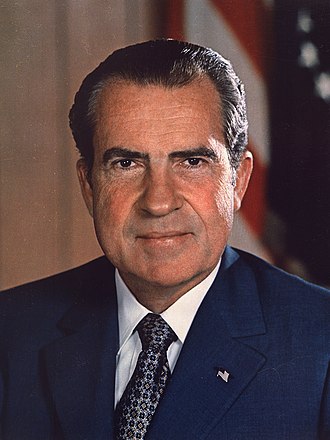
Richard M. Nixon served as the 37th President of the United States from January 1969 until his resignation in August 1974. In February 1971, he ordered the installation of a secret voice-activated taping system in the White House to preserve a historical record of his administration. Until the system's existence was revealed and dismantled in July 1973, the tapes captured Nixon directing major foreign policy initiatives, such as the opening to China, as well as his central role in the Watergate cover-up.
What Nixon talks about on the tapes
White House operations 4,718Presidential scheduling 2,225Public relations 1,784Presidential schedule 1,782Vietnam War 1,693Logistics 1,650Manolo Sanchez 1,626White House communications 1,400White House administration 1,399Presidential communication 1,243Henry Kissinger 1,191Foreign Policy 1,183
Conversations (21,010)
— Page 55 of 211President Nixon and television producer Paul W. Keyes discuss the positive reception of the President’s recent televised address regarding his Supreme Court nominations. Keyes commends Nixon’s strategic presentation of his nominees, which both men agree will lead to successful Senate confirmation. The call concludes with a brief, favorable discussion regarding Joseph H. Blatchford's character and professional capabilities.
President Nixon contacted the White House operator to place a personal telephone call to his close friend and confidant, Charles G. "Bebe" Rebozo. The brief exchange functioned solely as a request to connect the President with Rebozo. No substantive policy discussions or administrative decisions occurred during this communication.
President Nixon contacted the White House operator to place an outgoing call to Hobart D. “Hobe” Lewis. The brief interaction served exclusively as a logistical request to initiate communication with Lewis. No substantive policy discussions or decisions were addressed during this exchange.
President Nixon consulted with Hobart D. Lewis to celebrate the successful announcement of his Supreme Court nominees, Lewis F. Powell Jr. and William H. Rehnquist. Nixon expressed satisfaction with his strategy of misleading the press and the American Bar Association to secure appointments that prioritized conservative ideology over typical vetting pressures. The two discussed the long-term impact of these appointments on the Court's ideological balance, agreeing that the move successfully trapped critics who previously demanded judicial excellence.
President Nixon instructed the White House operator to place an outgoing call to U.S. Representative Charles W. Sandman, Jr. The primary purpose of this brief exchange was to facilitate communication between the President and the congressman. No further substantive policy matters were discussed during this initial connection phase.
President Nixon met with his personal valet, Manolo Sanchez, in the Oval Office to discuss routine personal matters. The brief exchange focused on addressing the President's immediate physical comfort or the condition of his attire. No significant policy decisions or administrative actions resulted from this interaction.
President Nixon met with his aide Stephen B. Bull to coordinate the distribution of materials he had recently dictated regarding his upcoming diplomatic trips to the USSR and the People's Republic of China. The conversation focused on the dissemination of these documents, which framed the administration's stance on the ideological differences between the United States and these communist powers. Nixon instructed Bull on the specific circulation of these records, including copies for his personal use and family members.
President Nixon met with his aide, Stephen B. Bull, to coordinate his schedule and administrative priorities. The primary objective of the brief meeting was to arrange a session with Charles W. Colson. Bull departed the Oval Office shortly after facilitating this request for the President.
President Nixon met with his aide Stephen B. Bull to coordinate his upcoming schedule and manage immediate logistical arrangements. The discussion focused on impending appointments with Charles W. Colson and Alexander M. Haig, Jr. Nixon expressed personal frustration regarding Joe Higgins, signaling a brief exchange on administrative personnel and scheduling priorities.
President Nixon and Alexander Haig discussed the U.S. strategy for the upcoming United Nations vote on the status of Taiwan and the People's Republic of China. Nixon emphasized the need for a firm diplomatic stance toward nations receiving U.S. aid, suggesting that future financial support should be contingent upon their voting behavior. Additionally, the President and Haig evaluated the diplomatic missions of John Connally to Japan and Henry Kissinger to China, specifically addressing the importance of maintaining economic pressure on the Japanese while avoiding public alienation of potential allies.
President Nixon met with Charles Colson to discuss public relations regarding his recent Supreme Court nominations and the effectiveness of his televised addresses. Following this, the President hosted a group of governors who had recently returned from a trip to the Soviet Union and Romania, briefing them on the diplomatic importance of their mission. Nixon emphasized the need for a professional security approach during future reciprocal visits and provided guidance on how the governors should frame their positive reports to the press while acknowledging the serious differences between the United States and the Communist bloc.
President Nixon initiated this call to extend birthday greetings to Representative Charles W. Sandman, Jr. The discussion briefly touched upon the President's upcoming meeting with state governors following his recent trip to Moscow. Nixon also highlighted his recent Supreme Court nominees, characterizing them as strong and conservative, while expressing appreciation for Sandman’s support in the House of Representatives.
President Nixon contacted the White House operator to facilitate a personal telephone call to First Lady Thelma C. “Pat” Nixon. This brief administrative interaction served as a logistical bridge to connect the President with his wife. No substantive policy matters or major political decisions were addressed during this exchange.
President Nixon consulted with Stephen B. Bull and Manolo Sanchez regarding logistical arrangements for an upcoming diplomatic communication. The discussion centered on coordinating an interpreter for a call involving Mexican President Luis Echeverria Alvarez and managing the status of Alexander M. Haig, Jr.'s involvement. Nixon ultimately decided to maintain the same interpretive support structure used during previous interactions to ensure the efficacy of the call.
President Nixon and Stephen B. Bull meet to coordinate logistics for a series of upcoming telephone calls. The discussion focuses on the estimated time required to complete these communications, with the participants evaluating scheduling projections. They conclude that the process will likely take approximately twenty minutes per call.
President Nixon met with his aide Stephen B. Bull to coordinate upcoming appointments and manage his daily schedule. The President specifically requested that Richard A. Moore be brought in for a meeting and inquired about the availability of an attorney named Carlson. The interaction functioned primarily as a brief administrative session to facilitate the President's immediate agenda.
President Nixon met with his aide, Stephen B. Bull, to discuss scheduling arrangements for an upcoming meeting with Richard A. Moore. The brief interaction served as a coordination session to manage the President's daily agenda. No other substantive policy matters were recorded during this brief exchange.
President Nixon and Richard A. Moore discussed the recent backlash and media speculation surrounding his Supreme Court nominations, specifically addressing leaks and the public reaction to his decision-making process. The President also held a telephone conversation with Mexican President Luis Echeverria Alvarez to lobby for Mexico's support during a critical upcoming United Nations vote regarding the status of Taiwan. Throughout the meeting, the participants emphasized the importance of maintaining confidentiality in high-level executive decisions and strategized on how to manage negative press coverage.
President Richard Nixon and First Lady Pat Nixon discussed upcoming administrative and social scheduling arrangements. The conversation focused on the President's scheduled telephone calls with the President of Mexico regarding a pending United Nations vote and the King of Morocco. They also coordinated plans for an upcoming weekend trip to Camp David with Tricia and Edward Cox.
President Nixon contacted Mexican President Luis Echeverria Alvarez to lobby for U.S. interests regarding the upcoming United Nations vote on Chinese representation. Nixon argued that the expulsion of Taiwan would set a dangerous precedent for the UN's survival and requested that Mexico support the U.S. position on making the expulsion an "important question" requiring a two-thirds majority. Echeverria expressed the complexity of Mexico's decision but reaffirmed his commitment to bilateral friendship, and the two leaders agreed to have Mexican Foreign Secretary Emilio O. Rabasa meet with U.S. Secretary of State William P. Rogers to discuss the matter further.
President Nixon initiates a brief telephone exchange, first speaking with an unidentified individual regarding an appeal for support or a vote. Following this, he requests the White House operator to connect him to First Lady Pat Nixon. The call serves as a routine administrative request to facilitate communication with his wife.
President Nixon initiates a brief interaction with the White House operator to facilitate an outgoing call. This exchange functions as a routine administrative request to connect the President with an external party. No substantive policy matters or critical decisions are documented in this short procedural communication.
President Nixon and First Lady Pat Nixon discussed the scheduling of upcoming social and official engagements. The conversation touched upon the President’s itinerary involving King Hassan II of Morocco and a scheduled lunch with Zosimo T. Monson. Additionally, the couple coordinated plans for a visit to Camp David accompanied by Tricia Nixon Cox and Edward R. F. Cox.
President Nixon and First Lady Pat Nixon coordinate their schedule and lunch plans in preparation for an upcoming departure. The President requests a light meal in the Oval Office while he awaits an anticipated phone call from Morocco. They discuss timing their exit to ensure the President is prepared for the next phase of his day.
President Nixon held a brief, informal meeting in the Oval Office with an unidentified individual. The interaction, which lasted less than five minutes, appears to have been social in nature rather than a formal policy deliberation. Following a short exchange regarding refreshments, the participant departed.
President Nixon held a brief meeting with an unidentified individual in the Oval Office to coordinate his official schedule. The conversation was limited in scope, focusing exclusively on administrative logistics regarding the President's upcoming appointments. No further substantive policy discussions were recorded during this brief interaction.
President Nixon contacted King Hassan II of Morocco to personally lobby for Moroccan support regarding the upcoming United Nations vote on the representation of China and Taiwan. Nixon argued that the expulsion of Taiwan by a simple majority would set a dangerous precedent for the UN, and he requested that Morocco vote with the United States on the 'important question' procedure. King Hassan expressed appreciation for the direct communication and promised to review the matter with his government and provide a formal response.
President Nixon contacted King Hassan II of Morocco to personally lobby for Moroccan support regarding the upcoming United Nations vote on the representation of China. The President argued that the expulsion of Taiwan by a simple majority would threaten the future stability of the UN and urged the King to support the U.S. position declaring the matter an 'important question.' Following the call, Nixon and Alexander Haig discussed the diplomatic strategy, expressing frustration over the necessity of presidential intervention and asserting that nations receiving U.S. foreign aid should be expected to align with American interests at the UN.
President Nixon initiated a call through the White House operator to contact Attorney General John N. Mitchell. The brief exchange served as a logistical request to establish communication with the Attorney General. No substantive policy discussions occurred during this short operator-assisted connection.
President Nixon communicated with the White House operator to facilitate an outgoing call. This routine interaction served as a bridge to initiate a separate, substantive conversation recorded elsewhere. No further policy or administrative developments occurred during this brief exchange.
President Nixon met briefly with an unidentified chief petty officer in the Oval Office. The conversation appears to be administrative or routine in nature, as it concluded in less than four minutes. No substantive policy matters or major decisions were recorded during this exchange.
President Nixon met with an unknown chief petty officer in the Oval Office to coordinate the retrieval of his personal overcoat. The President explicitly requested that the individual bring his gray top coat to the White House to ensure he could move comfortably around the grounds. No policy or administrative matters were addressed during this brief logistical exchange.
President Nixon met with his aide Stephen B. Bull in the Oval Office to conduct a brief administrative review of Charles W. Colson's upcoming schedule. The discussion served as a routine check on the President's staffing logistics and time management. No significant policy decisions were reached during this short interaction.
President Nixon met with Stephen Bull and Alexander Butterfield to coordinate logistics for an upcoming meeting with Vice President Spiro Agnew, specifically focusing on scheduling and arrival details. Following this, Charles Colson joined the President to discuss press reaction to recent Supreme Court nominations, including critical commentary from CBS newsman Dan Rather. The conversation concluded with a discussion on managing media relations and the administration's ongoing efforts to pressure news organizations regarding their reporting.
President Nixon consulted with Alexander M. Haig, Jr. regarding his upcoming schedule and an anticipated call from Secretary of State William P. Rogers. The discussion focused on international diplomatic pressures, specifically the ongoing India-Pakistan tensions and the impending United Nations vote concerning Chinese representation. They also addressed the influence of various nations, including Portugal and its interests in Macao, on the UN voting process.
President Nixon met with Alexander P. Butterfield to coordinate adjustments to his daily schedule involving upcoming meetings with John D. Ehrlichman and Secretary of State William P. Rogers. The discussion focused on logistical rearrangements, specifically addressing a request from the minister of security to move a scheduled appointment to an earlier time. Butterfield was tasked with facilitating these updates to ensure the President's calendar remained synchronized with his senior staff's needs.
President Nixon held a brief, undocumented discussion with an unidentified individual in the Oval Office. While the specific transcript remains undefined, the interaction served as a short administrative or informational exchange during the President's workday. No substantive policy shifts or historical developments are recorded from this brief encounter.
President Nixon met with an unknown individual to receive unspecified materials and discuss his upcoming schedule. The conversation included a brief exchange regarding the presence and recording capabilities of the taping system in the Oval Office. No major policy decisions were reached during this short interaction before the guest departed.
President Nixon and Alexander Haig discussed the status of a critical United Nations vote regarding the representation of the People’s Republic of China, specifically noting wavering support from Belgium and Luxembourg. While Secretary of State William Rogers expressed pessimism about the outcome, the President rejected the idea of calling these nations himself, opting to maintain presidential prestige if a loss appeared inevitable. Additionally, Haig provided a brief status update on Henry Kissinger’s ongoing trip and confirmed that there were no immediate crises concerning India or Pakistan.
President Nixon, Alexander Haig, and Alexander Butterfield met briefly to discuss personnel logistics and the administration's strategic response to an unidentified adversary. The participants addressed the handling of a specific individual who sought to confront the President and evaluated the potential fallout from a public relations strategy. Nixon emphasized the need for a decisive approach despite claims that the White House was not involved in the underlying dispute.
President Nixon instructed the White House operator to place an urgent call to Secretary of State William P. Rogers. This brief exchange served exclusively as a logistical step to initiate direct communication with the Secretary. No further policy discussions or substantive developments occurred during this interaction.
President Nixon consulted with the White House operator to facilitate an outgoing communication. This brief interaction served as a logistical step to connect the President with an outside party. No substantive policy discussions or significant political developments occurred during this brief exchange.
President Nixon and Secretary of State William Rogers discussed the precarious vote count regarding the admission of the People's Republic of China to the United Nations. They reviewed the effectiveness of the President's personal appeals to various foreign leaders, expressing frustration over uncooperative nations and the limitations of multilateral foreign aid. Ultimately, the two agreed that if the U.S. failed to secure the vote, they would avoid direct presidential involvement in the aftermath, prioritizing a pivot toward bilateral diplomacy that rewards supportive nations and penalizes those that oppose U.S. interests.
President Nixon and Secretary of State William P. Rogers discuss the implications of recent international voting, specifically focusing on the lack of alignment between the United States and various foreign nations within multilateral organizations like the United Nations and the World Bank. The pair expresses frustration regarding the lack of U.S. control over international financial institutions and suggests a strategic shift toward rewarding nations that support American interests while potentially withholding aid from those that do not. They conclude by acknowledging the political difficulty of these setbacks, particularly regarding domestic support, and emphasize a need to reevaluate foreign policy priorities to better serve American objectives.
President Nixon consulted with a White House operator to facilitate an outgoing call. This interaction served a logistical purpose to connect the President with another party for official communication. No substantive policy discussions or decisions were recorded during this brief administrative exchange.
President Nixon and John D. Ehrlichman held a brief meeting in the Oval Office to coordinate scheduling matters. The discussion centered on managing Ehrlichman's upcoming calendar and administrative availability. No substantive policy decisions were recorded during this short exchange.
President Nixon and his personal secretary, Rose Mary Woods, engage in a brief, informal discussion regarding an undisclosed personal matter or private situation. The participants exchange brief remarks about navigating a difficult circumstance, with Nixon expressing a sense of optimism regarding his ability to resolve the issue successfully. The conversation concludes with a mutual acknowledgment of the day's unpleasant nature.
President Nixon and John Ehrlichman met to coordinate domestic policy initiatives and staffing strategies, specifically focusing on the potential replacement of FBI Director J. Edgar Hoover and a proposed new tax structure. They discussed the political risks of introducing a Value Added Tax, exploring how it might support education funding and property tax relief without alienating middle-income voters. Furthermore, they reviewed internal management concerns regarding international economic policy and the need for greater cohesion among administration officials like George Shultz, Peter G. Peterson, and John Connally.
President Nixon met with his personal valet, Manolo Sanchez, to discuss the logistics of his immediate schedule. The brief interaction served to coordinate the President's departure from the Oval Office. No major policy decisions were reached during this short logistical exchange.
President Nixon held a brief, unscheduled meeting in the Old Executive Office Building with an unidentified individual. Due to the lack of a transcript and the extremely short duration of the recorded segment, the specific subject matter and any resulting actions remain undocumented. This recording represents a fragment of the President's administrative schedule that currently lacks contextual details regarding its purpose.
President Nixon consulted with an aide to adjust his upcoming diplomatic meeting schedule to accommodate personal travel plans. He requested the rescheduling of his meeting with Yugoslav President Josip Broz Tito from Saturday to Friday morning, citing a desire to clear his weekend. Additionally, Nixon directed staff to allocate an extra day for meetings with Indian Prime Minister Indira Gandhi, specifically prioritizing a Friday morning session.
President Nixon met with his personal valet, Manolo Sanchez, to discuss the President's upcoming schedule and personal arrangements. The brief interaction touched upon Nixon's need for rest, specifically mentioning a nap, as well as vague references to travel plans involving a potential trip to Lhasa. The conversation remained informal and focused on personal logistics rather than substantive policy matters.
President Nixon met with his personal valet, Manolo Sanchez, to discuss mundane household and logistical matters. The conversation focused on food preferences and the coordination of Sanchez’s upcoming professional schedule. No significant policy decisions were reached during this brief interaction.
President Nixon initiates a brief request for the White House operator to connect him with Secretary of State William P. Rogers. This call serves as an administrative bridge to facilitate direct communication between the President and the Secretary. No further policy discussion or substantive exchange occurs during this short connection process.
President Nixon coordinated with the White House operator to facilitate a follow-up telephone call with Secretary of State William P. Rogers. The exchange served to establish a precise timeframe for when Rogers would be back at his office to receive the President's call. No substantive policy matters were addressed, as the brief interaction functioned solely to organize the President's immediate communication schedule.
President Nixon instructed the White House operator to place an urgent telephone call to Charles W. Colson. This brief administrative interaction was intended to facilitate direct communication between the President and his special counsel. No further substantive policy matters were discussed during this brief exchange.
President Nixon contacted the White House operator to facilitate an urgent telephone call to Secretary of State William P. Rogers. This brief interaction served as a logistical step to initiate direct communication with the head of the State Department regarding ongoing foreign policy or diplomatic matters. No further substantive details are available due to the absence of a transcript.
President Nixon consulted with a White House operator to facilitate a telephone connection. The brief exchange served purely administrative purposes to reach another party. No substantive policy discussions or significant political developments occurred during this brief interaction.
President Nixon contacted the White House operator to facilitate a telephone connection. The primary purpose of the communication was to place a call to Charles W. Colson. No further substantive policy matters were discussed during this brief administrative interaction.
President Nixon and Charles Colson discuss the administration's favorable public reception to the Supreme Court nominations of Lewis F. Powell, Jr. and William H. Rehnquist, and the effectiveness of Nixon's recent radio address. They also review the looming political difficulty of the upcoming United Nations vote regarding the expulsion of Taiwan, expressing concerns about a potential loss while discussing damage control strategies. Finally, they analyze current political polling, focusing on the declining standing of Edmund Muskie and the administration's efforts to project strong leadership on economic issues.
President Nixon and Charles Colson discuss public relations strategies and the administration's political positioning regarding upcoming economic challenges and polling data. They review the potential negative impact of certain staffing losses while emphasizing the need to maintain a positive public narrative through effective media management. The conversation concludes with directives to bolster the visibility of Donald Rumsfeld and prepare for shifting political tides within the Democratic Party.
President Nixon and Secretary of State William P. Rogers discuss the urgent, high-stakes U.S. diplomatic effort to secure votes against the seating of the People's Republic of China at the United Nations. Frustrated by the lack of loyalty from allies like Belgium and Peru, Nixon and Rogers agree that countries voting against U.S. interests should face future repercussions, specifically regarding bilateral visits and foreign aid funding. The two decide to leverage congressional allies like Otto Passman and John Rooney to slash funding for multilateral organizations and the UN in retaliation for the lack of international support.
President Nixon and Secretary of State William P. Rogers discuss foreign policy challenges, focusing on U.S. relations with international organizations and foreign nations following recent legislative setbacks. They evaluate the shifting allegiances of countries like China and European allies, expressing frustration with Congressional opposition to foreign aid and trade surcharges. The President concludes that the administration must re-examine its reliance on multilateral organizations and pursue a more independent approach to foreign diplomacy.
President Nixon and Alexander Haig coordinated the President’s upcoming schedule, including meetings with Marshal Tito and Indira Gandhi. They also discussed a diplomatic strategy regarding Laos and the United Nations vote on the People’s Republic of China. Nixon directed Haig to deliver an oral message to Souvanna Phouma through G. McMurtie Godley, emphasizing that a vote against the U.S. position could jeopardize future congressional support for Laos.
President Nixon and Alexander Haig coordinate the delivery of a message to an unnamed recipient regarding the maintenance of critical congressional support. Nixon expresses a desire to present personal recommendations to the individual in question to ensure legislative backing for the administration. The conversation focuses on balancing the formality of a written letter with the tactical benefits of an oral message to secure necessary political cooperation.
President Nixon initiates a brief telephone call through the White House operator to connect with his speechwriter and advisor, Patrick J. Buchanan. The primary purpose of the communication is to facilitate a direct discussion with Buchanan regarding current administrative business. No other substantive policy or political matters are addressed during this short administrative exchange.
President Nixon and John Ehrlichman coordinate their late-afternoon scheduling, specifically focusing on arranging a meeting with George P. Shultz. The participants weigh various timing options to accommodate the President's availability. Ultimately, they decide to finalize a meeting time for later that evening.
President Nixon and his personal secretary, Rose Mary Woods, held a brief administrative check-in regarding the status of the President's correspondence. Woods confirmed that she was actively working on drafting a response to the President's current projects. The exchange served primarily as a status update to ensure organizational matters were being addressed without concern.
President Nixon met with his personal valet, Manolo Sanchez, to coordinate the President's upcoming schedule. During the brief interaction, the President instructed Sanchez to permit Rose Mary Woods to enter his office. This discussion focused on facilitating administrative access and managing the President's immediate appointments.
President Nixon contacted the White House operator to facilitate a telephone call to his advisor, Patrick J. Buchanan. The conversation served exclusively as a procedural request to initiate this communication. No further policy matters or substantive discussions were recorded during this brief exchange.
President Nixon and Patrick Buchanan discuss the positive reception among conservatives following the President's recent Supreme Court nominations. The two men mock the mainstream media's prediction of a constitutional crisis, noting how analysts like Eric Sevareid and Dan Rather were forced to walk back their commentary after the announcement. Nixon emphasizes the importance of maintaining conservative support and expresses confidence that the nominees, specifically William H. Rehnquist, will easily overcome political opposition in the Senate confirmation process.
President Nixon and Patrick J. Buchanan discuss the political implications of recent Supreme Court developments and their reception by the press. Nixon emphasizes that despite media distractions and criticism, the administration's conservative base should be satisfied with the current judicial trajectory. The brief exchange highlights the President's frustration with media coverage and his strategic focus on maintaining conservative support.
President Nixon contacted the White House operator to facilitate a telephone connection with Alexander P. Butterfield. This brief exchange served as a logistical instruction to reach the Deputy Assistant to the President. No substantive policy discussions occurred during this operator-assisted request.
President Nixon consulted with the White House operator regarding an attempt to locate Alexander P. Butterfield via page. Upon receiving an update on the search efforts, the President decided to cancel the request and instructed the operator to discontinue the call. No further action was taken regarding the contact.
President Nixon, Rose Mary Woods, and John Ehrlichman discussed the management of anti-war demonstrations, press relations, and personnel issues, including the logistical planning for the First Lady's participation in the upcoming trip to the People's Republic of China. The President expressed frustration with staff leaks to the media and emphasized the need for maintaining professional distance from reporters. Additionally, the group addressed the President's personal schedule, the costs and protocols regarding family visits to California and Camp David, and instructions for managing condolence correspondence.
President Nixon met with George Shultz and John Ehrlichman to strategize on international economic policy, specifically addressing the U.S. surcharge, currency convertibility, and the role of the Federal Reserve. A central goal of the discussion was managing the complex relationships between the Treasury Department, international allies like Japan and European nations, and domestic economic advisors. Nixon emphasized the need for a unified strategy that maintains U.S. independence, while Shultz was tasked with brokering better cooperation among staff to ensure policy decisions are implemented effectively and without bureaucratic interference.
President Nixon consulted with Alexander P. Butterfield to review and modify his upcoming schedule for October 26, 1971. The discussion centered on managing meetings with Vice President Spiro Agnew, Senator Wallace F. Bennett, Vietnam veterans, and a National Security Council budget session involving George P. Shultz and John B. Connally. Seeking to accommodate more time with Connally before his departure, the President evaluated potential adjustments to the timing of his morning and afternoon appointments.
President Nixon initiated a brief telephone request for the White House operator to connect him with his close friend and confidant, Charles G. "Bebe" Rebozo. This brief interaction served solely as a logistical bridge to facilitate a private communication between the President and Rebozo. No substantive policy matters or further actions were discussed during this specific operator-assisted connection.
President Nixon consulted with the White House operator to determine the whereabouts of his close friend, Charles G. "Bebe" Rebozo. After the operator reported that Rebozo was unavailable due to being out on a boat, the President decided to postpone the contact until the following morning. No further action was taken regarding the call.
President Nixon contacted the White House operator to facilitate an urgent communication with Alexander M. Haig, Jr. The brief exchange served as a logistical request to place a telephone call to Haig. No further substantive policy discussions occurred during this brief operator-assisted connection.
President Nixon and Alexander Haig discuss the rapidly evolving situation regarding the United Nations vote on Chinese representation, noting potential setbacks with Belgian and Peruvian positions. They review diplomatic efforts by Secretary of State William P. Rogers to influence Mexico and assess the impact of pending messages to Laos. The conversation concludes with scheduling arrangements for Henry Kissinger’s return and a brief acknowledgment of recent helicopter losses in Vietnam.
President Nixon initiates a call to the White House operator to facilitate a connection with his special counsel, Charles W. Colson. This administrative exchange serves as a brief logistical step to reach a key member of the White House staff. No substantive policy matters are addressed during this short communication.
President Nixon and Charles Colson reviewed the status of recent anti-war demonstrations, noting that poor weather and low turnout had minimized their impact. They discussed a strategy to weaken the organization Common Cause by pressuring administration officials associated with the group to resign. Additionally, the pair coordinated plans to boost the administration's public image through economic messaging, specifically regarding public service employment and the promotion of favorable economic indicators.
President Nixon initiated a call to the White House operator to be connected with Secretary of State William P. Rogers. The brief exchange served as a logistical request to facilitate communication between the President and the Secretary. No further policy discussions occurred during this specific interaction.
President Nixon requested that the White House operator connect him with Secretary of State William P. Rogers. This brief interaction served as a logistical step to facilitate direct communication between the President and his top diplomat. No further substantive policy discussions were recorded during this brief administrative request.
President Nixon and H. R. Haldeman met to review scheduling matters, including preparations for the President’s upcoming trip to the People's Republic of China and a meeting with John Connally. The discussion focused on the logistics of the China delegation, specifically regarding staff appointments, press representation, and the President's personal approval of all personnel traveling with the First Lady. Nixon emphasized his desire to keep the entourage minimal, avoid unnecessary backgrounders with the press, and maintain a disciplined schedule during the visit.
President Nixon and Secretary of State William P. Rogers discussed strategies for handling the proposed European Security Conference, with Nixon emphasizing the need to maintain a cautious, cool public posture to avoid Soviet leverage. They also coordinated talking points regarding the UN's admission of the People's Republic of China and the resulting expulsion of Taiwan, agreeing that Rogers should publicly frame the outcome as a negative precedent for the United Nations while maintaining a diplomatic tone. Additionally, the President updated Rogers on his upcoming scheduling priorities, noting that he needed to focus on economic and budget discussions with John Connally before meeting with Henry Kissinger.
President Nixon met with Vice President Spiro Agnew, H. R. Haldeman, and various staff members to coordinate strategy for upcoming foreign and domestic challenges. Key discussions focused on preparations for the President’s trip to the People’s Republic of China, managing media coverage, and ongoing frustrations regarding the recent United Nations vote on Taiwan. The participants also reviewed the administration's judicial appointments, the economic outlook, and strategies for handling dissent within Congress and the press.
President Nixon and Alexander Haig discuss the scheduling of a visit from an African head of state in light of recent United Nations voting on the status of Taiwan. Nixon instructs Haig to rescind any meeting invitations for leaders whose countries failed to support the U.S. position during the UN vote. Haig is directed to use the President's travel schedule as a pretext to cancel these engagements if necessary.
President Nixon initiates a brief request for the White House operator to place a telephone call to Peter M. Flanigan. This exchange serves as a routine administrative step to facilitate a direct conversation between the President and his Assistant to the President for International Economic Affairs. No substantive policy matters were discussed during this brief connection.
President Nixon directs Peter M. Flanigan to follow up on staffing changes following Vice President Spiro Agnew’s recent trip to Southeast Asia. Agnew communicated requests from foreign leaders regarding the replacement of U.S. ambassadors in Singapore and Kuwait, the latter due to concerns over the incumbent's personal issues. Secretary of State William P. Rogers has already committed to these personnel changes, and Flanigan is tasked with overseeing the execution of these appointments.
President Nixon and Alexander Haig coordinated public messaging strategies regarding an upcoming statement by Secretary of State William P. Rogers. The two men confirmed that Press Secretary Ronald Ziegler would reference the Secretary’s noon announcement to ensure consistency across the administration’s communications. This exchange served to finalize the tactical handling of the announcement, with both parties agreeing to maintain a minimalist approach in their public remarks.
President Nixon initiates a request for the White House operator to place a telephone call to California Governor Ronald Reagan. This brief administrative interaction serves as the preliminary step for the President to establish direct communication with the Governor. The call concludes immediately after the request is processed.
President Nixon consulted with the White House operator to facilitate an outgoing call. This brief interaction served as a logistical step to connect the President with another party. No substantive policy discussions or major decisions were recorded during this brief exchange.
President Nixon met with his personal valet, Manolo Sanchez, in the Oval Office to address routine household matters. The brief interaction primarily focused on the President's request for coffee. No significant policy discussions or major administrative decisions occurred during this brief exchange.
President Nixon and Governor Ronald Reagan discussed the recent United Nations vote to expel Taiwan and recognize the People's Republic of China. Reagan expressed strong frustration with the UN, proposing that the U.S. maintain its presence for debate while refusing to participate in future votes as a way to signal American dissatisfaction. Nixon acknowledged the political weight of the issue and the potential for congressional repercussions, while also briefing Reagan on his recent judicial nominees to the Supreme Court.
President Nixon and Ronald Reagan discussed the recent United Nations vote to expel Taiwan and recognize the People's Republic of China, expressing disappointment regarding the lack of support from various African nations. Nixon articulated concerns about the potential repercussions in Congress, particularly regarding foreign aid appropriations, while emphasizing the importance of remembering allies like Japan who stood with the U.S. during the vote. Additionally, the two men reviewed Nixon's recent Supreme Court nominations of Lewis Powell and William Rehnquist, focusing on the political necessity of balancing regional representation and professional background.
President Nixon, Press Secretary Ronald Ziegler, and Alexander Haig coordinate the administration's public relations strategy regarding the upcoming United Nations vote on the status of Taiwan and the People's Republic of China. Nixon instructs Ziegler to defer all media inquiries to Secretary of State William Rogers to ensure a unified message and explicitly forbids the disclosure of his personal disappointment regarding the UN situation. Additionally, the President expresses frustration with the press and demands a strict policy to stop the use of background briefings, insisting that all future official statements be made on the record.
President Nixon initiates a request to the White House operator to be connected with Secretary of State William P. Rogers. The brief exchange serves as a procedural step to facilitate an urgent communication between the President and the Secretary. No further details regarding the substance of the intended discussion were captured during this short administrative interaction.
President Nixon met with Senator Wallace Bennett and senior advisors to discuss legislative strategy for the upcoming Senate session, specifically focusing on a pending tax bill and the potential for a restrictive Senate vote to prevent extraneous amendments like H.R. 1. The participants analyzed the political landscape of the Senate Finance Committee, the influence of Chairman Russell Long, and the administration's cautious approach to welfare and social security reform. Additionally, the President briefly touched upon the United Nations vote regarding Taiwan and his frustration with international reactions toward U.S. policy.