Nixon, Richard M. (President)
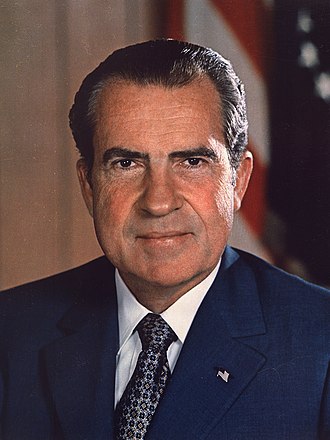
Richard M. Nixon served as the 37th President of the United States from January 1969 until his resignation in August 1974. In February 1971, he ordered the installation of a secret voice-activated taping system in the White House to preserve a historical record of his administration. Until the system's existence was revealed and dismantled in July 1973, the tapes captured Nixon directing major foreign policy initiatives, such as the opening to China, as well as his central role in the Watergate cover-up.
What Nixon talks about on the tapes
White House operations 4,718Presidential scheduling 2,225Public relations 1,784Presidential schedule 1,782Vietnam War 1,693Logistics 1,650Manolo Sanchez 1,626White House communications 1,400White House administration 1,399Presidential communication 1,243Henry Kissinger 1,191Foreign Policy 1,183
Conversations (21,010)
— Page 56 of 211President Nixon and Secretary of State William P. Rogers discuss the administration's public response to the United Nations vote to admit the People's Republic of China while expelling the Republic of China (Taiwan). Nixon advises Rogers to draft a statement that acknowledges the UN decision while clearly expressing American disappointment and noting that congressional support and future UN financing are at an all-time low. They weigh the delicate political balance of maintaining diplomatic composure while addressing widespread domestic outrage, exemplified by Ronald Reagan’s strong opposition to the outcome.
President Nixon initiates a call to the White House operator to be connected with Secretary of State William P. Rogers. The brief exchange serves as a procedural request to facilitate high-level communication between the President and his cabinet official. No substantive policy matters are discussed beyond the administrative placement of the outgoing call.
President Nixon met with Marjorie P. Acker to provide specific instructions regarding a photograph. The discussion focused on administrative details for labeling the image, specifically requesting the inclusion of the first name of Frances (Grant) Bennett. The meeting concluded quickly after these personal arrangements were clarified.
President Nixon and Alexander Butterfield met briefly to finalize logistical arrangements for an upcoming ten-person appointment. The discussion focused on confirming the format of the meeting, specifically establishing that it would be a brief, ten-minute 'stand-up' engagement. They also clarified the identities and personal relationships of the expected attendees to ensure the President was properly briefed.
President Nixon met with a group of Vietnam veterans and their guests to discuss their experiences, the status of the war, and the ongoing American effort in South Vietnam. The participants shared their perspectives on the conflict, including their involvement in local community projects and the challenges of accurately portraying the war effort to the American public. Nixon emphasized his commitment to the survival of South Vietnam and criticized media coverage and congressional efforts that he argued undermined the war's objectives and the morale of the armed forces.
President Nixon met with H. R. Haldeman, Charles Colson, and other staff members to discuss political strategies following the United Nations vote to expel Taiwan. The participants focused on channeling public frustration away from the administration and toward the United Nations itself, considering symbolic actions such as reduced funding or critical public statements. Additionally, the group reviewed the 1972 political landscape, potential Democratic presidential tickets, and the progress of upcoming Supreme Court confirmation hearings for Rehnquist and Powell.
President Nixon consulted with the White House operator to facilitate an outgoing call to Secretary of State William P. Rogers. This brief interaction served as a logistical step to establish communication with the Secretary for pending administration business. No further substantive details are documented regarding the specific nature of the conversation between the President and the operator.
President Nixon and Secretary of State William P. Rogers discuss the public and political fallout following the United Nations' vote regarding Taiwan, specifically addressing California Governor Ronald Reagan's outrage over the proceedings. The two men agree on the importance of framing the U.S. position as a principled defense and mitigating domestic frustration by emphasizing ongoing efforts to reduce U.S. financial support for the UN. Nixon directs Rogers to call Reagan to explain the administration's exhaustive lobbying efforts, including personal appeals, while cautioning that withdrawing from the UN would be impractical due to urgent diplomatic needs like the escalating India-Pakistan conflict.
President Nixon and Secretary of State William P. Rogers discuss the public and political fallout from a recent United Nations vote, specifically focusing on the negative emotional impact of televised footage depicting delegates celebrating the outcome. The conversation centers on how to manage public perception and formulate an official administration response that expresses dissatisfaction without unnecessarily escalating tensions or embarrassing the country. Nixon instructs Rogers to frame the narrative by emphasizing that the U.S. is strategically boxed in regarding its UN involvement, directing the criticism toward the institution rather than the presidency.
President Nixon initiates a request for the White House operator to connect him with Secretary of State William P. Rogers. This brief administrative interaction serves as a precursor to an intended high-level diplomatic consultation. The exchange establishes the communication channel necessary for the President to conduct official state business.
President Nixon held a brief administrative meeting with an unidentified aide to coordinate his upcoming schedule and communication flow. The President directed that specific materials remain accessible for a planned call from Bill Roberts and managed the scheduling of upcoming consultations with Secretary of State William P. Rogers and National Security Advisor Henry Kissinger. This brief exchange served to organize the President’s immediate agenda and ensure timely follow-up on key foreign policy discussions.
President Nixon consulted with the White House operator to initiate an outgoing call to Secretary of State William P. Rogers. The brief exchange served as a logistical step to facilitate direct communication between the President and the Secretary. No further policy discussions were recorded during this brief administrative interaction.
President Nixon met with his valet, Manolo Sanchez, in the Old Executive Office Building to briefly discuss the President's upcoming travel schedule. The interaction appears to have been a brief logistical check, during which Sanchez mistakenly initiated a suggestion regarding a flight attendant before correcting himself. No major policy decisions were made during this short exchange.
President Nixon directs Secretary of State William P. Rogers to emphasize during an upcoming call with Governor Ronald Reagan that the United States remains committed to recognizing Taiwan as a member of the international community. The President highlights that Reagan was recently impressed by a meeting with Chiang Kai-shek and seeks to ensure the Secretary's public stance on the impending United Nations vote aligns with this support. This guidance serves to manage Reagan's potential reaction to shifts in U.S. policy regarding Taiwan's status at the UN.
President Nixon instructed Secretary of State William P. Rogers to emphasize in an upcoming statement that a specific individual should remain regarded as a member of the international community. The brief discussion served to align the State Department’s official rhetoric with the President's preferred diplomatic stance. Rogers acknowledged the directive, confirming he would incorporate the requested language into his departmental communications.
President Nixon met with an unidentified individual in the Old Executive Office Building to discuss his daily schedule. Given the extremely short duration of the recorded segment, the conversation was limited to brief administrative or logistical planning regarding the President's itinerary. No substantive policy discussions or significant decision-making were captured in this recording.
President Nixon held a brief, informal meeting in the Old Executive Office Building with an unidentified individual. The discussion was limited to a casual inquiry regarding a dog. No significant policy decisions or official White House business were recorded during this segment.
President Nixon, John Connally, and George Shultz met to discuss a multi-faceted strategy for handling international economic and foreign policy challenges, specifically in response to the United Nations vote on Taiwan's expulsion. They agreed that the United States must move toward a more assertive, bilateral approach to foreign relations, prioritizing national interests over traditional multilateral institutions and the demands of European allies. Nixon decided to move forward with a new international economic offensive, tasking Connally with navigating trade negotiations during his upcoming trip to Japan while keeping the strategy tightly controlled to prevent bureaucratic leaks. The President also emphasized the need to bypass the State Department's traditional channels to ensure that U.S. interests, particularly regarding trade and monetary policy, were handled with greater efficiency and independence.
President Richard Nixon met with his personal valet, Manolo Sanchez, in the Old Executive Office Building to handle a brief, personal request. The meeting was exceptionally short, lasting only two seconds of recorded audio before concluding. No substantive policy discussions or administrative decisions were documented during this brief interaction.
President Nixon and H.R. Haldeman discuss the political fallout following the United Nations vote to expel Taiwan and readmit the People's Republic of China. The conversation focuses on managing domestic criticism from conservatives like Ronald Reagan and John Ashbrook, as well as coordinating the administration's messaging through Secretary of State William Rogers and UN Ambassador George H.W. Bush. Nixon decides to meet with Henry Kissinger at the residence to further deliberate on the administration's response to the diplomatic outcome.
President Nixon consulted with the White House operator to facilitate a telephone connection. The primary objective of the call was to reach the President's personal secretary, Rose Mary Woods. No further substantive policy discussions occurred during this brief interaction.
President Nixon contacted his personal secretary, Rose Mary Woods, shortly after she arrived home to discuss administrative preparations for his upcoming diplomatic trip to the People's Republic of China. The brief conversation served to initiate a discussion regarding logistics or planning associated with the visit. No specific policy decisions were finalized during this exchange, as the dialogue primarily functioned as a prompt to address itinerary or scheduling details.
President Nixon contacted the White House operator to facilitate a telephone connection with his Chief of Staff, H.R. Haldeman. The brief exchange served exclusively as a logistical request to initiate this high-level communication. No substantive policy matters were discussed during this operator-assisted interaction.
President Nixon and H.R. Haldeman discuss the political fallout of the United Nations vote on Taiwan and the administration's strategy to manage domestic reaction. The conversation centers on coordinating efforts to prevent influential figures like Ronald Reagan and William F. Buckley, Jr. from public dissent, with Henry Kissinger facilitating communications to keep them aligned. Nixon evaluates the performance of Secretary of State William P. Rogers during the crisis and confirms his reliance on John Mitchell to help manage key political stakeholders.
President Nixon directed H. R. Haldeman to arrange a breakfast meeting with Secretary of State William P. Rogers and Henry Kissinger to debrief on Kissinger’s recent travels. Haldeman subsequently coordinated the logistics with Rogers while also addressing the urgent need to finalize a nomination for the U.S. representative to NATO. The discussion highlighted the administration’s internal debate between selecting Walter J. Stoessel, Jr. or Charles D. Thornton for the vacancy ahead of an upcoming summit.
President Nixon contacted the White House operator to facilitate a personal telephone call to his daughter, Tricia Nixon Cox. The interaction was brief and served solely to manage the logistics of placing this private communication. No substantive policy matters or official developments were discussed during the exchange.
President Nixon met with his senior advisors, including Henry Kissinger, H.R. Haldeman, and Ronald Ziegler, to discuss the political fallout of the United Nations' vote to expel Taiwan and seat the People's Republic of China. Nixon expressed frustration with the State Department and perceived efforts by Secretary of State William Rogers to undermine his China policy and independent diplomatic efforts. The group focused on controlling the narrative regarding the UN vote, specifically by emphasizing the 'shocking' and 'disrespectful' conduct of delegates who celebrated the U.S. defeat, rather than dwelling on the vote itself, to channel public and Congressional anger away from the administration. Consequently, they decided to adopt a low-key approach regarding future announcements of Nixon’s China trip and to avoid a public, high-level meeting with Ambassador George H.W. Bush to minimize media speculation.
President Nixon held a brief, one-minute consultation with a White House operator to facilitate a connection for an outgoing telephone call. This interaction served purely administrative purposes to manage the President's immediate communications. No substantive policy discussions or decisions were recorded during this brief exchange.
President Nixon and his daughter Tricia Nixon Cox discussed the political optics and public perception surrounding the First Family's use of military Jetstar aircraft for personal travel. Fearing negative press inquiries or political criticism, the President advised Tricia and her sister Julie to limit their usage of the government planes to roughly once every three weeks. He encouraged them to utilize commercial flights for routine travel to ensure they were not vulnerable to accusations of abusing taxpayer resources.
President Nixon met with Rose Mary Woods and Tricia Nixon Cox to discuss administrative logistics and political concerns, including the appropriate frequency of the First Family's use of government JetStar aircraft to avoid public scrutiny. The group also addressed the recent United Nations vote regarding Taiwan, expressing frustration over the conduct of delegates during the proceedings. Additionally, they reviewed scheduling matters, campaign-related travel for Tricia, and the selection of an official portrait photograph for the President and First Lady.
President Nixon and Press Secretary Ronald Ziegler met to discuss the administration's public response to the United Nations vote expelling Taiwan. Ziegler reviewed his recent press briefing, during which he condemned the "shocking" behavior of delegates who celebrated the outcome, effectively distancing the White House from the issue to prevent further damage. They agreed to move past the topic quickly and focus on upcoming developments, specifically Henry Kissinger’s briefing regarding the President’s pending visit to the People's Republic of China.
President Nixon met with his aide, Stephen B. Bull, to finalize scheduling arrangements for an upcoming meeting with Charles W. Colson. The brief discussion served to coordinate the timing of Colson's arrival and manage the President's immediate calendar. Bull subsequently departed the Oval Office to facilitate these administrative tasks.
President Nixon met with Charles Colson and Ronald Ziegler to discuss the diplomatic and domestic fallout following the United Nations vote to expel Taiwan. The participants focused on managing public reaction to the behavior of UN delegates, potential legislative retaliation regarding foreign aid, and the strategic framing of the issue for American conservatives. Additionally, the group reviewed economic indicators, including wage and price policies, and discussed upcoming outreach strategies to mitigate political criticism.
President Nixon met with Charles Colson and Ronald Ziegler to discuss the strategic framing of the recent United Nations vote to expel Taiwan. They focused on leveraging public outrage regarding the perceived hostility of the UN delegates to bolster support for the President’s leadership and his new economic policy. Nixon and his advisors decided to have George H.W. Bush speak to friendly columnists to emphasize the administration's active efforts to fight the expulsion, while maintaining the President's public stance of supporting the UN institution despite his frustration with its actions.
President Richard M. Nixon met with his valet, Manolo Sanchez, in the Oval Office for a brief interaction. The meeting concluded quickly after a short, two-second segment of the recording was withdrawn for personal privacy reasons. No substantive policy discussions or administrative actions were recorded during this brief encounter.
President Nixon met with his aide Stephen B. Bull to review his daily schedule and coordinate logistics for upcoming appointments. The discussion focused on managing the workflow of the Oval Office, specifically addressing the seating requirements and protocol for a group of approximately one hundred visitors. They also touched upon the implementation of administrative policies and procedures regarding the management of these events.
President Nixon met with his aide Stephen B. Bull to coordinate the scheduling of a private meeting involving H.R. Haldeman. Nixon directed Bull to arrange for an individual named Bob Hogan to briefly step away from his desk to facilitate the encounter. The discussion focused on managing the President's afternoon appointments and maintaining discretion regarding these movements.
President Nixon met with his aide Stephen B. Bull to coordinate upcoming appointments and manage the flow of visitors to the Oval Office. The primary focus of the discussion was the scheduling of meetings involving Henry A. Kissinger and H.R. Haldeman. Nixon directed Bull to prioritize these arrivals and ensure their presence for a designated three o'clock session.
President Nixon met with his valet, Manolo Sanchez, to discuss the minimal impact of recent demonstrations and the United Nations' vote regarding the expulsion of Taiwan. Sanchez expressed significant concern over the state of international affairs, leading Nixon to characterize sixty percent of UN member nations as enemies of peace. The exchange highlights the President's skepticism toward the organization, with both men agreeing that the body serves primarily to stir up unnecessary global trouble.
President Nixon and his senior advisors, including H. R. Haldeman, Henry Kissinger, and John Connally, met to discuss defense budget strategies, the political fallout from Taiwan's expulsion from the United Nations, and preparations for upcoming foreign diplomacy. Nixon emphasized the need for a leaner, more effective military posture that focuses on strategic procurement rather than broad manpower, while also debating the risks of domestic political opposition and the impact of the defense budget on the economy. The group analyzed the necessity of maintaining a strong defense to bolster negotiating positions with the Soviet Union and China, while also coordinating the administration’s measured public response to the UN vote.
President Nixon met with his budget and domestic policy advisors, including John Ehrlichman and John Mitchell, to evaluate the political and economic feasibility of a proposed Value Added Tax (VAT) as a mechanism to fund public and private education. The primary objectives of the plan were to provide federal relief for local property taxes, address the California Supreme Court’s school funding ruling, and extend aid to parochial schools to appeal to blue-collar Catholic voters. The participants debated the political risks of proposing a new federal tax in an election year versus the potential benefits of offering tangible relief to homeowners and securing support from key constituencies.
President Nixon and George Shultz discuss labor leader George Meany’s request to allow alternates for Pay Board members during upcoming scheduling conflicts. Because Meany and colleague Floyd Smith are concerned that their absences will leave them without voting representation on critical issues, Nixon directs Shultz to coordinate with Judge George Boldt and Donald Rumsfeld to adjust the executive order accordingly. Shultz agrees to resolve the legal technicality and update Meany on the administration's progress to prevent any premature public remarks.
President Nixon and George P. Shultz discuss the inaugural meeting of the Pay Board and concerns regarding the necessity of allowing members to appoint proxies during absences. Due to the potential impact of pending economic discussions, including issues related to gold, Nixon instructs Shultz to coordinate with the Board to amend the executive order to authorize these proxy arrangements. This decision ensures continuity in board operations despite the impending unavailability of key members.
President Nixon met with H.R. Haldeman and Charles Colson to refine political strategies, focusing on the potential for federal tax relief to appeal to key demographics, specifically Catholics and homeowners, through a proposed property tax relief act. The discussion also addressed foreign policy, with Nixon expressing intense frustration over the UN's expulsion of Taiwan and authorizing a strategy of rewarding allies and punishing those who voted against U.S. interests. Finally, Henry Kissinger joined to brief the President on his recent press engagement, where he managed expectations regarding Nixon's upcoming trips to China and the Soviet Union while defending the administration's stance on the UN vote.
President Nixon met with his valet, Manolo Sanchez, for a brief informal interaction in the Oval Office. The discussion centered on a domestic matter involving the President's dog and a ball. No significant policy decisions or governmental actions occurred during this short exchange.
President Nixon held a brief, informal discussion with an unidentified individual regarding matters pertaining to Israel. Given the extremely limited duration and fragmented nature of the recording, no specific policy decisions or substantive diplomatic actions are discernable from the transcript. The exchange serves primarily as a brief point of contact concerning Middle Eastern affairs.
President Nixon met with his aide Stephen B. Bull to review and organize his daily schedule. The primary focus of the discussion was coordinating the President's upcoming interactions with Henry Kissinger. No major policy decisions were recorded during this brief administrative briefing.
President Nixon met with H.R. Haldeman and Henry Kissinger to discuss scheduling logistics for upcoming diplomatic engagements, specifically regarding the visit of Yugoslav President Josip Broz Tito. The participants addressed the handling of White House visitor lists, the potential inclusion of additional officials in diplomatic meetings, and the management of domestic political fallout regarding the United Nations vote on China. Nixon also reviewed his recent efforts to secure support from members of Congress for the foreign aid bill and debated the optimal timing for a public announcement regarding U.S. troop levels in Vietnam.
President Nixon met with his aide, Stephen B. Bull, to coordinate logistics for an upcoming meeting with Yugoslav President Josip Broz Tito. Nixon sought to clarify Tito’s schedule following their encounter to ensure sufficient time for a substantive conversation lasting between one hour and 75 minutes. Bull was tasked with immediately determining whether Tito had subsequent lunch plans to accommodate this lengthy engagement.
President Nixon met with Alexander P. Butterfield in the Oval Office to discuss scheduling matters. The brief encounter focused on administrative arrangements for the President's calendar. No substantive policy decisions were recorded during this exchange.
President Nixon met with Stephen B. Bull and First Lady Pat Nixon to coordinate personal scheduling, specifically regarding the First Lady's agenda and the status of Yugoslavian leader Josip Broz Tito. Following brief administrative updates from Bull, the President and Mrs. Nixon departed the Oval Office together. The exchange served primarily as a logistical check-in to align the President's meeting schedule with the First Lady's itinerary.
President Nixon met with Yugoslav President Josip Broz Tito to discuss international crises, specifically the escalating tensions between India and Pakistan and the ongoing conflict in the Middle East. The leaders examined the roles of the Soviet Union and China in these regional disputes, emphasizing the urgent need to prevent war and outlining the U.S. commitment to providing humanitarian aid to refugees. Additionally, they reviewed bilateral US-Yugoslav relations, including military cooperation and plans for further discussions on European security and strategic arms limitations.
President Nixon and Henry Kissinger met to discuss the administration's foreign policy challenges, particularly the United Nations vote to expel Taiwan and the potential for a new geopolitical dynamic involving the People's Republic of China and the USSR. They reviewed the political impact of the UN loss, dismissing it as an unavoidable setback while framing it as a catalyst for future organizational reform. Additionally, the participants touched upon regional tensions, specifically criticizing Indian demands regarding Pakistan, and coordinated the scheduling of an upcoming meeting with Yugoslav President Josip Broz Tito.
President Nixon and H.R. Haldeman review administrative and scheduling matters, including the search for a new Secretary of Agriculture and the management of upcoming political travel. The discussion shifts to foreign policy, where they assess the strategic impact of the UN vote to expel Taiwan and the potential for deflecting political backlash. They also coordinate on legislative strategy regarding the Cooper-Church amendment and evaluate the effectiveness of recent communications regarding the Vietnam War.
President Nixon and Alexander P. Butterfield discuss the logistical arrangements and entertainment choices for an upcoming State dinner. The conversation focuses on the technical aspects of film presentation and the duration of performance segments, with the President providing specific feedback on the proposed format. Nixon also critiques the quality of a specific entertainer, ultimately deciding against the inclusion of certain background sound options for the films.
President Nixon met with his economic advisors (the "Quadriad") and Henry Kissinger to discuss international monetary policy, trade negotiations, and the upcoming Asian trip for John B. Connally. The group addressed the urgency of trade concessions, the complexities of gold convertibility, and the need to manage currency realignments while maintaining a firm U.S. negotiating position. Nixon provided specific instructions for Connally’s itinerary, emphasizing the need to reassure allies in Japan, Thailand, and Indonesia of U.S. commitment while avoiding being sidelined by State Department staff during sensitive private discussions.
President Nixon, Henry Kissinger, and H.R. Haldeman met to discuss strategies for managing international relations, specifically navigating the complex diplomatic process surrounding the President's upcoming trip to the People's Republic of China (PRC). A primary focus was neutralizing Secretary of State William Rogers's potential interference and tendency to critique the administration's independent diplomatic initiatives. Nixon instructed Kissinger to engage with Rogers regarding the proposed communique while maintaining tight control over the process to prevent leaks and ensure the President's personal oversight remained paramount.
President Nixon met briefly with Alexander P. Butterfield to coordinate the President's evening schedule. The primary focus of the discussion was confirming logistical arrangements for a scheduled photograph opportunity with White House social aides. This brief exchange served to finalize the President's immediate commitments before the conclusion of his workday.
President Richard M. Nixon met with his personal valet, Manolo Sanchez, in the Oval Office. The brief interaction concluded with the two men departing the office together. No substantive policy discussions or administrative decisions were recorded during this segment of the tape.
President Nixon held a meeting in the Oval Office with unidentified participants to conduct official business. Although the specific transcript is unavailable, the session occurred within a standard morning timeframe at the White House. No substantive record of the discourse or formal decisions exists to verify the nature of the topics addressed during this engagement.
President Richard M. Nixon met with Alexander P. Butterfield for a brief one-minute session in the Oval Office. The majority of the recorded duration consists of a withdrawn segment classified as personal and returnable. No substantive policy discussions or administrative actions were captured or documented during this interaction.
President Nixon and Senator Hugh Scott discuss the political victory of defeating restrictive Senate amendments regarding Vietnam, which the President argued would have hindered ongoing negotiations and POW returns. They express frustration over the motives of congressional opponents, characterizing them as driven by a desire for political credit rather than strategy. Additionally, the pair discusses the recent UN vote on Taiwan, criticizing the perceived humiliation of the United States by smaller nations and noting the potential for further geopolitical instability regarding Israel, Portugal, and Greece.
President Nixon and Senator Hugh Scott discuss the political fallout regarding a recent UN vote concerning Taiwan's representation and the expulsion of the Republic of China. Nixon expresses frustration over the perceived humiliation of the United States by smaller nations that benefited from American support. Consequently, the President signals a shift in foreign policy, suggesting the administration should retaliate by reconsidering its relationships and diplomatic stance toward those nations.
President Nixon held a brief, ten-minute meeting in the Oval Office with an unidentified individual. The participants engaged in a short discussion regarding the provision of anonymous assistance or support. Due to the limited transcript and the brief duration of the exchange, no specific policy decisions or significant administrative actions were recorded.
President Nixon met with H. R. Haldeman and Henry Kissinger to navigate complex foreign and domestic policy challenges, including the recent UN vote to expel Taiwan and the administration's strategic approach to the People's Republic of China. The participants analyzed the political fallout of the UN vote, debated the professional conduct of Secretary of State William Rogers, and discussed strategies for the upcoming presidential trips to China and the Soviet Union. Nixon emphasized the necessity of maintaining control over sensitive diplomatic negotiations while managing public relations and domestic conservative opinion, ultimately directing his staff to streamline communication and prioritize the administration's primary foreign policy objectives.
President Nixon directed the White House operator to place a telephone call to Secretary of State William P. Rogers. This brief exchange served as a logistical bridge to facilitate a direct communication between the President and his Secretary of State regarding unspecified official business. No substantive policy discussions occurred during this brief request.
President Nixon initiates a brief administrative interaction with the White House operator to facilitate an outgoing call. The discussion serves a purely logistical purpose, functioning as a bridge to connect the President with another party for a separate, subsequent conversation. No policy matters or substantive political topics are addressed during this brief exchange.
President Nixon met briefly with his personal valet, Manolo Sanchez, in the Oval Office. The primary purpose of the interaction was for Sanchez to bring the President’s Irish Setter, King Timahoe, into the room. The conversation consisted of lighthearted praise and interaction with the dog.
President Nixon and Secretary of State William P. Rogers discussed intelligence regarding recent, strained diplomatic meetings between Yugoslav President Josip Broz Tito and Soviet leader Leonid Brezhnev. Rogers conveyed a confidential message from Tito, delivered via the Yugoslav foreign minister, emphasizing that the encounter with Brezhnev had gone poorly and expressing deep concern regarding future Soviet interference in Yugoslavia after Tito's departure. The two leaders agreed that the intelligence highlighted Yugoslavia's vulnerability and vulnerability to the Brezhnev Doctrine, and they reached an understanding to maintain a policy of encouraging regional independence through continued, discreet military cooperation.
President Nixon and Secretary of State William P. Rogers discuss intelligence gathered regarding the geopolitical anxieties of Yugoslavian officials. The conversation centers on Yugoslavia's fear of Soviet encroachment following the eventual departure of President Josip Broz Tito. Nixon reaffirms his commitment to respecting Yugoslavian independence and leveraging U.S. influence to deter external interference in the region.
President Richard Nixon met with his aide, Stephen B. Bull, to review and discuss the President's upcoming daily schedule. The brief consultation specifically focused on an appointment involving Winton M. "Red" Blount. No further actions or major policy decisions were recorded during this short administrative exchange.
President Nixon and his valet, Manolo Sanchez, briefly discuss King Timahoe, the President’s Irish Setter. This informal exchange appears to be a casual interaction regarding the dog, likely related to a reference from a film or media production. No policy decisions or significant administrative actions were taken during this very short encounter.
President Nixon initiates a request through the White House operator to place a telephone call to Congressman Glenn R. Davis of Wisconsin. The brief exchange serves as a logistical bridge to connect the President with the legislator for further discussion. No substantive policy matters are addressed in this short administrative communication.
President Nixon met with Postmaster General Winton M. "Red" Blount to discuss the confirmation of Post Office Board of Governors appointments and potential political strategies for Blount's planned Senate run in Alabama. The President offered instructions for Bryce Harlow to negotiate with Senator Hiram Fong to expedite the stalled confirmation process, while also evaluating the political viability of Alabama Senators John Sparkman and James B. Allen. They concluded by discussing the logistics of Blount’s impending resignation announcement and his electoral prospects, punctuated by informal remarks on Alabama college football.
President Nixon and Federal Reserve Chairman Arthur F. Burns met to discuss the national economy, international monetary policy, and upcoming personnel appointments to the Federal Reserve Board. The conversation focused on managing economic indicators, navigating liquidity concerns, and coordinating with Henry Kissinger on international financial diplomacy. They also strategized on handling labor relations and potential wage-price policy announcements, while Burns presented candidates for upcoming Board vacancies.
President Nixon and Stephen B. Bull met briefly to coordinate the President’s upcoming schedule and administrative engagements. The discussion focused on finalizing arrangements for meetings with John D. Ehrlichman and Clifford M. Hardin. Additionally, Bull briefed the President on an upcoming session with John Rawlings to review logistics for impending official discussions.
President Nixon directs the White House operator to place a telephone call to Congressman Glenn Davis of Wisconsin. This brief exchange serves as a routine administrative request to facilitate executive communication with a member of the legislative branch. No further substantive discussion or policy developments occur during this brief interaction.
President Nixon met with William Ruckelshaus, John Ehrlichman, John Whitaker, and later Clifford Hardin to discuss administrative personnel changes and pending agricultural policies. The group focused heavily on managing the timing of Secretary of Agriculture Hardin’s resignation and selecting a successor while avoiding political fallout from various farm interest groups. Additionally, Nixon directed his staff to resolve labor disputes and facilitate a grain sale to the Soviet Union, prioritizing the deal's completion despite resistance from unions.
President Nixon initiated this brief call to Congressman Glenn R. Davis to extend belated birthday greetings. The two men engaged in lighthearted personal banter, referencing information provided by Clark MacGregor regarding their respective ages. The conversation concluded with a casual discussion about golf and the President expressing his appreciation for Davis's legislative support.
President Nixon met with Stephen B. Bull to review his upcoming schedule, specifically regarding a planned meeting with Marjorie "Miss Wool" Sharp and Representative Sherman P. Lloyd. During the brief interaction, the President also issued direct instructions to Bull to install wiring within the Oval Office walls despite reservations. This exchange highlights the President's personal oversight of office logistics and surveillance-related technical modifications.
President Nixon held two separate brief, informal meetings in the Oval Office to host visitors including Sherman P. Lloyd, Marjorie Sharp, and the family of journalist Carroll Kilpatrick. These sessions primarily served ceremonial purposes, involving the exchange of gifts, photography sessions, and light conversation about regional backgrounds and university experiences. The President also engaged in casual discussions regarding medical practice, specifically emphasizing the importance of bedside manner and the high prevalence of psychosomatic illnesses in patient care.
President Nixon and Stephen B. Bull briefly met to discuss the potential placement of a sheepskin, weighing whether it should be utilized in one of the presidential cabins or if it might otherwise go to waste. The conversation reflects a casual administrative check-in regarding the disposition of personal or office items. No significant policy decisions were made during this brief exchange.
President Nixon, John D. Ehrlichman, and John R. Price, Jr. discuss Price's political future and the complexities of running for Congress in New York. The President emphasizes that unlike in California, New York politics requires working closely with local party leaders and organizations, even if it requires compromise. Nixon advises Price to secure support from party figures like Joseph M. Margiotta while maintaining his own ideological stance, and the group reviews strategies for handling specific political rivals and redistricting issues. The meeting concludes with the President presenting gifts to Price in appreciation of his service to the administration.
President Nixon met briefly with his personal valet, Manolo Sanchez, in the Oval Office to coordinate logistics regarding the President's upcoming schedule. The discussion focused on Nixon's movement to the Executive Office Building. The meeting concluded quickly with no substantive policy developments.
President Nixon met with James D. ("Don") Hughes and General Brent G. Scowcroft to discuss administrative transitions, specifically Hughes's forthcoming military assignment at Bergstrom Air Force Base and his departure from the White House staff. The conversation touched upon the management of military aides, including the recent addition of a Coast Guard representative, and the importance of maintaining staff relations with key personnel like H.R. Haldeman. Additionally, the group briefly addressed preparations for the President's upcoming trip to the People's Republic of China, confirming the inclusion of personnel to ensure continuity.
President Nixon and H. R. Haldeman discussed a variety of administrative and personnel matters, including the potential appointment of a new Secretary of Agriculture and the administration's preference for utilizing younger staff members for operational roles. The pair also assessed foreign policy challenges, specifically touching upon the United Nations vote regarding Taiwan and concerns over Secretary of State William P. Rogers's handling of Middle Eastern affairs. The conversation concluded with discussions regarding upcoming social engagements and the President's need for a brief respite.
President Nixon instructed the White House operator to place a call to Mamie Eisenhower to check on her health status. The operator advised that the President should first consult with Dr. Walter Tkach, as Mrs. Eisenhower was reportedly hospitalized. Nixon acknowledged this guidance before the operator proceeded to secure the necessary contact information.
President Nixon and Alexander Butterfield met briefly to discuss an individual’s letter of resignation. The discussion centered on a document referred to as a "blood letter." Butterfield departed immediately following this exchange.
President Nixon met with Alexander P. Butterfield in the Old Executive Office Building to discuss the scheduling of Manolo Sanchez. The brief exchange focused on administrative logistics regarding the President's personal aide. No significant policy decisions were recorded during this brief encounter.
President Nixon consulted with an unidentified individual regarding adjustments to his daily schedule. During the brief exchange, the President decided to postpone a planned telephone call to a woman, potentially Rose Mary Woods. No other substantive policy matters or major political decisions were recorded during this segment.
President Nixon summoned his personal valet, Manolo Sanchez, to his Old Executive Office Building workspace for a brief interaction. The discussion was informal and centered on the president's request for coffee. This brief exchange highlights the routine personal services provided by White House staff during the workday.
President Nixon met with an unidentified individual in the Old Executive Office Building to discuss administrative matters concerning his schedule. The brief interaction focused on the logistics of the President's upcoming appointments and potential agenda items. No major policy decisions were recorded during this segment of the discussion.
President Nixon expressed frustration regarding a missing return phone call while speaking with an unidentified individual, potentially his secretary Rose Mary Woods. The brief exchange highlights the administrative difficulties and communication lapses within the President's personal office staff. No major policy decisions were reached during this interaction.
President Nixon directed the White House operator to place a telephone call to former First Lady Mamie Eisenhower. The operator advised the President to first consult with Dr. Dikashi, noting that Mrs. Eisenhower was currently hospitalized. Consequently, the call to Mrs. Eisenhower was deferred pending further information regarding her condition.
President Nixon met with an unknown individual in the Old Executive Office Building to discuss matters related to his personal schedule. The exchange was brief, consisting largely of unintelligible dialogue. No significant policy decisions or substantive developments were recorded during this brief encounter.
President Nixon consulted with the White House operator to facilitate an outgoing call to an unidentified individual. The brief exchange focused on establishing a connection, though the transcript provides no context regarding the identity of the recipient or the specific subject matter intended for discussion. The conversation serves primarily as a procedural recording of the President initiating a telephone communication.
President Nixon and his valet, Manolo Sanchez, met to discuss personal errands and the well-being of the President's dog. The conversation primarily focused on logistics regarding a trip to a local shop to address dissatisfaction with a specific item or "rind" associated with the President's bed. The meeting concluded with plans to resolve the issue promptly later that evening.
President Nixon called Mamie Eisenhower to check on her recovery after she was hospitalized at Brooke General Hospital in San Antonio for bronchial complications. They discussed the quality of her medical care and her nostalgic return to the military post where she and Dwight D. Eisenhower once lived. Nixon offered the use of a government Jet Star to assist with her travel arrangements, emphasizing his commitment to ensuring she received the best possible care during her convalescence.
President Nixon held a brief, informal telephone conversation with former First Lady Mamie Eisenhower to check on her well-being while she was staying near an Army post in San Antonio. The President expressed his support for her medical care and offered to provide a military jet to assist with her travel arrangements, though she opted to continue traveling by train. The call concluded with the President sending his regards to her medical staff and confirming plans for their next meeting.
President Nixon initiates a brief telephone exchange with the White House operator to request a connection with Charles W. Colson. This administrative interaction serves as a bridge to a subsequent substantive conversation with a key staff member. No further policy or strategic details are discussed during this brief request for communication.