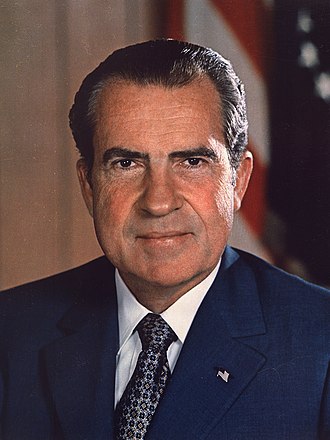
Nixon, Richard M. (President)
Richard M. Nixon served as the 37th President of the United States from January 1969 until his resignation in August 1974. In February 1971, he ordered the installation of a secret voice-activated taping system in the White House to preserve a historical record of his administration. Until the system's existence was revealed and dismantled in July 1973, the tapes captured Nixon directing major foreign policy initiatives, such as the opening to China, as well as his central role in the Watergate cover-up.
What Nixon talks about on the tapes
White House operations 4,718Presidential scheduling 2,225Public relations 1,784Presidential schedule 1,782Vietnam War 1,693Logistics 1,650Manolo Sanchez 1,626White House communications 1,400White House administration 1,399Presidential communication 1,243Henry Kissinger 1,191Foreign Policy 1,183
Conversations (21,010)
— Page 63 of 211President Nixon met with his aide Stephen B. Bull to coordinate an upcoming appointment with George P. Shultz. The primary focus was the President's requirement to review a specific briefing paper before proceeding with the meeting. Nixon ultimately directed Bull to facilitate the appointment once he had completed his preparatory reading.
President Nixon and Henry Kissinger met briefly in the Oval Office to coordinate their schedules and communication efforts. The discussion focused on managing access to the President and ensuring Kissinger was prepared for upcoming diplomatic requirements. No major policy shifts were recorded during this short encounter, which primarily served to confirm the availability of key personnel.
President Nixon met with his personal valet, Manolo Sanchez, in the Oval Office to receive refreshments. This brief interaction served a routine logistical purpose regarding the President’s personal service. No substantive policy discussions or significant political developments occurred during this five-second recording.
President Nixon held a brief administrative communication with the White House operator. The exchange functioned as a routine coordination check to facilitate telephonic connectivity within the Executive Office. No substantive policy matters or strategic developments were recorded during this brief interaction.
President Nixon initiated this brief telephone call to Senator Howard H. Baker, Jr. primarily to extend personal birthday greetings. The conversation remained cordial and informal, focusing on lighthearted exchanges regarding aging and Baker’s status as a young statesman. No substantive policy matters or political actions were addressed during the interaction.
President Nixon met with his Cabinet officers to discuss a variety of domestic and international issues, including transportation leadership, government funding through a continuing resolution, and the cultivation of opium poppies in Turkey. The conversation also touched upon administrative transitions, such as the departure of Secretary of Agriculture Clifford Hardin, and strategies for managing the national economy and price controls. Nixon emphasized the importance of maintaining clear leadership and coordination across departments to ensure the success of his domestic policy initiatives.
President Nixon initiates a request for the White House operator to place a telephone call to Secretary of the Treasury John B. Connally. This brief exchange serves as a logistical bridge to facilitate direct communication between the President and his Treasury Secretary. The call connects to a subsequent discussion recorded in a different segment of the White House taping system.
President Nixon and Treasury Secretary John Connally discussed the administration's aggressive legislative strategy with congressional leaders and the political opposition they faced. They reviewed the status of Phase II economic policies, including wage retroactivity and market perceptions, while expressing mutual confidence in their economic direction. The conversation also touched upon Connally's potential political vulnerability following his trip to Vietnam and concluded with arrangements for an upcoming Quadriad meeting.
President Nixon contacted the White House operator to initiate a telephone call to Senator Hugh Scott. The brief exchange served as a directive for the operator to connect the President with the Senate Minority Leader. No further substantive policy matters were discussed during this brief administrative request.
President Nixon instructed the White House operator to place an outgoing call to his daughter, Julie Nixon Eisenhower. This brief exchange served as a routine administrative request to facilitate a personal conversation between the President and a family member. No policy matters or official business were discussed during the brief operator-assisted connection.
President Nixon and Senator Hugh Scott discussed a strategy to resolve a legislative impasse regarding a continuing resolution for foreign aid. Scott reported that he secured an agreement among key senators, including J. William Fulbright, to extend the funding through December 1st while allowing Chairman Allen J. Ellender to move the resolution through committee. The participants noted that while Fulbright remained focused on including restrictive language like the Mansfield Amendment, he was willing to compromise on funding levels and drop demands regarding the Cooper-Church Amendment.
President Nixon and his daughter, Julie Nixon Eisenhower, held a brief personal discussion regarding their respective evening schedules. The conversation touched upon the President's dinner plans with John Connally and Stephen Bull, as well as Julie’s recent travel to Cleveland. They specifically discussed her impressions of Mayor Ralph Perk, her local media engagements, and feedback concerning a recent article by Paul Healy.
President Nixon contacted the White House operator to facilitate a telephone connection with Special Counsel Charles W. Colson. This brief administrative interaction served as a logistical step to initiate a private conversation between the President and his aide. No substantive policy matters were discussed during this brief exchange.
President Nixon and Charles Colson discuss the administration's successful efforts to exert pressure on congressional leaders regarding foreign aid legislation, viewing the confrontation as a necessary exercise of presidential authority. They also review positive media coverage of the President's recent press conference and evaluate the state of the national economy. Colson reports on encouraging retail and housing data, suggesting that the recent stock market fluctuations reflect a healthy adjustment as investors react to the administration's anti-inflationary policies.
President Nixon and Henry Kissinger discussed the People's Republic of China’s inaugural speech at the United Nations and the State Department's recommendation for an immediate, aggressive rebuttal. Both men agreed that a hasty response would be counterproductive, with Nixon specifically expressing suspicion that the State Department was attempting to sabotage his upcoming trip to China. Consequently, they decided to ignore the immediate pressure to respond and instead planned to study the speech carefully before issuing a measured, dignified statement later in the week.
President Nixon initiates a brief telephone exchange with the White House operator to request a connection with John D. Ehrlichman. The primary purpose of this communication is to facilitate a direct conversation between the President and his top domestic policy advisor. No further administrative or policy discussions occur during this brief request.
President Nixon and John Ehrlichman debriefed regarding a recent Cabinet meeting, specifically criticizing Secretary of Transportation John Volpe’s comical and repetitive presentation style. They discussed the logistics of 'Transpo '72,' with Nixon expressing concern that the event would lead to significant traffic issues. Additionally, they reviewed Secretary of Health, Education, and Welfare Elliot Richardson’s performance, concluding that he had received the President's firm message regarding budgetary constraints.
President Nixon contacted the White House operator to initiate a personal phone call to his brother, F. Donald Nixon, who was located in California. This brief administrative interaction served as a formal request to connect with his brother via the presidential telephone system. No substantive policy matters or political decisions were discussed during this exchange.
President Nixon consulted with the White House operator to determine the current status and whereabouts of his brother, F. Donald Nixon. Upon learning that Donald’s wife was returning from out of town and expected to arrive by 6:30, the President requested to be connected once his brother was available. This brief exchange served to facilitate a return call between the two family members.
President Nixon initiates a request through the White House operator to be connected with his close friend and confidant, Charles G. "Bebe" Rebozo. The brief exchange serves strictly as a procedural effort to establish a direct communication line with Rebozo. No further substantive policy matters or tactical decisions are discussed during this short administrative interaction.
President Nixon communicated with the White House operator to facilitate a return call to his close friend and confidant, Charles G. "Bebe" Rebozo. The brief exchange served as a logistical step to reconnect with Rebozo following a prior attempt at contact. No substantive policy matters were discussed during this brief administrative request.
President Nixon initiates a call to the White House operator to be connected with John W. Rollins, a businessman based in Delaware. The brief exchange serves as a standard administrative request to facilitate communication between the President and an external party. No substantive policy discussions occur during this brief operational interaction.
President Nixon instructed the White House operator to place a long-distance call to his brother, Edward C. Nixon, who was located in Seattle, Washington. This brief communication served solely to facilitate the connection between the President and his sibling. No further substantive policy or administrative matters were discussed during this request.
President Nixon consulted with the White House operator to facilitate a telephone connection with John W. Rollins. This brief administrative exchange served solely to coordinate the placement of an outgoing call to Rollins. No further substantive policy matters or political developments were discussed during the brief interaction.
President Nixon communicated with the White House operator to facilitate a telephone call with his brother, Edward C. Nixon. Upon learning that Edward was temporarily unavailable, the President agreed to the operator's suggestion to attempt the connection again in thirty minutes. No further policy or administrative matters were addressed during this brief exchange.
President Nixon and John W. Rollins reviewed the success of recent Republican fund-raising efforts, specifically evaluating the impact of the President’s November 9 speeches and television appearances. They discussed organizational challenges facing the Republican Party in Pennsylvania and Massachusetts, emphasizing the need for stronger local infrastructure. The conversation concluded with a brief reflection on regional donor engagement and the contributions of various committee members to the party’s financial operations.
President Nixon instructed the White House operator to place an outgoing call to Asa V. Call in Los Angeles, California. This brief interaction served solely as a logistical request to initiate communication with the prominent businessman and attorney. No further substance was discussed, as the exchange focused exclusively on connecting the President to his party.
President Nixon spoke with Asa V. Call to exchange pleasantries regarding personal health and to discuss the political landscape in California. The two addressed the need for a moderate voice in the state and evaluated the electoral prospects of Ronald Reagan. Additionally, they touched upon the President's upcoming schedule, including a meeting with Governor Reagan and general outreach strategies for the 1972 election.
President Nixon, John Connally, Donald Rumsfeld, and a delegation of Republican Congressional leaders met to coordinate legislative strategy regarding the administration's domestic economic program and various foreign policy concerns. The discussion focused on the implementation of wage and price controls, pending tax legislation, and the management of international trade negotiations, particularly regarding Japan and the import surcharge. Participants also addressed the confirmation of Supreme Court nominees Lewis F. Powell and William Rehnquist, as well as ongoing legislative battles concerning the Vietnam War and Defense Department appropriations.
President Nixon held a brief morning meeting in the Oval Office with an unidentified individual. The interaction consisted solely of routine morning greetings and did not involve substantive policy discussions or administrative decisions. Due to the limited duration of the engagement, no official actions or developments were recorded.
President Nixon met with his aide Stephen B. Bull to review and organize his daily schedule. The two men briefly discussed the upcoming appointments with Senators Norris Cotton and Margaret Chase Smith, as well as Representative Barber Conable. This meeting served as a routine administrative coordination to confirm the sequence and participants of the President's morning agenda.
President Nixon and John B. Connally met to coordinate strategy for an upcoming speech in New York, focusing on defending the Administration's economic program and international monetary policy. They discussed the importance of presenting the U.S. as a strong, outward-looking leader in the global economy while managing domestic concerns regarding inflation and stock market performance. Additionally, they touched upon political vulnerabilities, including internal Cabinet weaknesses, the necessity of firm leadership regarding Vietnam, and the ongoing strategy for securing the release of prisoners of war.
President Nixon met briefly with an unidentified individual in the Oval Office to coordinate his daily schedule. The two-minute interaction served as a logistics check before both parties departed the office together. No substantive policy discussions or policy decisions were recorded during this brief encounter.
President Nixon met with the President’s Committee on Mental Retardation to discuss the status of federal programs, research initiatives, and the ongoing efforts to integrate individuals with intellectual disabilities into community settings. The discussion emphasized shifting away from long-term institutionalization toward modern community-based care models, while also addressing advancements in prenatal diagnosis and genetic counseling for prevention. Nixon praised the committee's work and international outreach, culminating in a gesture of appreciation where he presented commemorative White House gifts to the participants.
President Nixon and Stephen B. Bull met briefly in the Oval Office to address the President's immediate scheduling constraints. The discussion centered on upcoming meetings involving Henry Kissinger, specifically regarding his engagement with Yitzhak Rabin, as well as the status of Paul W. McCracken. Ultimately, the participants concluded the meeting abruptly due to time limitations.
President Nixon and H. R. Haldeman met to discuss personnel issues within the Cabinet and the administration's frustration regarding Secretary of Defense Melvin Laird. The President expressed significant anger over a recent news leak concerning Vietnam troop withdrawal plans, which he viewed as a deliberate attempt by Laird to undermine administration policy. Consequently, the two evaluated the potential replacement of Laird and Secretary of State William P. Rogers, while also briefly touching upon upcoming presidential scheduling for meetings with foreign leaders.
President Nixon met with Paul McCracken and George Shultz to review current economic performance, particularly regarding GNP growth and unemployment, while also discussing the urgency of negotiations within the international monetary system. Nixon expressed deep frustration with the American business community, characterizing corporate leaders as timid and lacking the fortitude he observed in other nations. The meeting also addressed McCracken’s planned departure from his role and the search for a successor, with the group emphasizing the need to maintain pressure on the Federal Reserve regarding the money supply.
President Nixon met with Sadruddin Aga Khan and other officials to discuss the escalating tensions between India and Pakistan and the resulting humanitarian refugee crisis. The conversation centered on the political volatility in East Pakistan, specifically the role of Mujibur Rahman and the potential for President Yahya Khan to negotiate a peaceful power transfer to avoid an all-out war. President Nixon emphasized that any outbreak of war would necessitate a total cutoff of U.S. aid, while Aga Khan advocated for continued diplomatic engagement to prevent regional instability.
President Nixon and Stephen B. Bull briefly met in the Oval Office to coordinate the President's upcoming schedule. The conversation focused on logistical arrangements for an impending meeting with Arthur S. Flemming and other associates. This brief exchange ensured the President was prepared for the sequence of his afternoon appointments.
President Nixon met with Stephen B. Bull to coordinate logistical arrangements for an upcoming meeting with Arthur S. Flemming. The discussion centered on establishing a dedicated press line to manage media coverage of the event. The participants focused on ensuring that communications equipment was operational and ready for the President to interact with the press.
President Nixon met with NFL quarterback Johnny Unitas and other officials to discuss professional football and the influence of athletes on American youth. The conversation touched upon the role of football stars as positive role models, particularly regarding the dangers of drug use, and the importance of professional athletes in national life. The meeting concluded with a photograph session and the President's presentation of gifts to the attendees.
President Nixon met with his personal aide, Stephen B. Bull, to discuss administrative details regarding his upcoming schedule and daily operations. The conversation focused on the logistics of an 'Open Door' session and the distribution of presidential gifts, specifically tie clasps. This brief interaction served to finalize arrangements for scheduled appointments and presidential protocol.
President Nixon held a brief, one-minute meeting in the Oval Office with an unidentified individual to review his daily schedule. Given the extremely limited duration of the interaction, no substantive policy matters or executive decisions were recorded. The encounter served primarily as a routine administrative check regarding the President's upcoming appointments.
President Nixon met with James D. Hittle and John V. Brennan for a brief ceremonial session that included gift exchanges and official photographs. The participants engaged in lighthearted reminiscing about vintage automobiles and their shared professional history regarding the mission and role of the U.S. Marine Corps. The visitors also expressed their appreciation for the President’s advocacy and administrative support for American servicemen.
President Nixon met with Dr. K. Wayne Smith and Henry Kissinger, primarily to facilitate a photo session and present gifts to Smith in recognition of his service. During the brief exchange, Nixon expressed appreciation for the papers and work produced by Smith’s office. The President also briefly alluded to political criticism from his 'right-wing friends' regarding Kissinger, advising him not to comment on such detractors.
President Nixon met with his personal aide Stephen B. Bull to coordinate administrative details regarding the President's schedule. Their discussion focused on the logistics of an upcoming meeting with Kenneth M. Smith and the handling of contact information for Lyndon K. “Mort” Allin. The brief consultation concluded with instructions for managing these specific scheduling and personnel matters.
President Nixon met with Patrick J. Buchanan, Kenneth M. Smith, and Lyndon K. Allin for a brief Oval Office session that included a photo opportunity and gift presentation. The discussion focused on the ongoing Senate confirmation hearings for Supreme Court nominees William H. Rehnquist and Lewis F. Powell, Jr. Nixon and his advisors particularly addressed liberal opposition to these appointments, specifically criticizing the double standards of critics like Joseph L. Rauh, Jr. regarding past judicial selections.
President Nixon met with his personal aide, Stephen B. Bull, to review scheduling matters regarding James H. Hogue. The brief discussion focused on logistical details related to Hogue's future professional placement. No major policy decisions were reached during this short interaction.
President Nixon met with John H. Hogue, William E. Timmons, and Clark MacGregor to discuss administrative personnel, specifically Hogue's future role within the Treasury Department, and to conduct a brief photography session. The discussion pivoted to legislative strategy, focusing on the confirmation process for Earl L. Butz and efforts to manage congressional relations. Finally, the group addressed the administration’s political positioning regarding the Vietnam War, particularly the necessity of clearly communicating the President’s stance on prisoners of war to the press and Congress.
President Nixon met with his aide, Stephen B. Bull, to review the President’s upcoming schedule. The primary focus of the discussion was the pending appointment and future career plans of George L. Grassmuck. The brief meeting concluded with the finalization of these administrative arrangements.
President Nixon met with George L. Grassmuck and Alexander P. Butterfield for a brief, informal session that included a photo opportunity and the presentation of gifts. The discussion touched upon personal history, including past campaign experiences and health-related anecdotes from Nixon's time as Vice President. Additionally, the President briefly discussed the political future of Robert H. Finch, emphasizing the importance of his current work before pursuing a potential Senate bid.
President Nixon and Stephen B. Bull briefly discussed administrative scheduling matters, specifically focusing on the President’s upcoming Thanksgiving Day broadcast for the armed forces. They also touched upon preparations for Charles “Bebe” Rebozo’s birthday. The brief meeting concluded after the entry of unidentified individuals who exchanged formal greetings with the President.
President Nixon contacted the White House operator to place a personal telephone call to his daughter, Julie Nixon Eisenhower. The brief exchange served solely as a request to connect the President with his daughter. No further policy or administrative matters were discussed.
President Nixon and his daughter, Julie Nixon Eisenhower, held a brief personal conversation to coordinate their respective schedules. They discussed logistics for Julie’s upcoming lunch, dinner with First Lady Pat Nixon, and her recent visit to a mental health facility in Cleveland. The President also informed her of his upcoming obligation to record a Thanksgiving Day message for the Armed Forces.
President Nixon consulted with the White House operator to facilitate an outgoing call. The interaction was brief and focused exclusively on establishing a telephone connection with another party. No substantive policy discussions or significant political developments occurred during this administrative exchange.
In this extensive Oval Office meeting, President Nixon, Rose Mary Woods, H. R. Haldeman, Henry Kissinger, and others discussed a variety of administrative and policy matters, including the selection of guests for upcoming White House events, the management of Cabinet and sub-cabinet appointees, and the President's upcoming diplomatic trips to the USSR and the People's Republic of China. A significant portion of the conversation focused on congressional strategy regarding national security, specifically managing Democratic support for administration policies amidst ongoing debates over Vietnam and foreign aid. Additionally, the President and his advisers addressed the leakage of sensitive foreign policy information, the potential for an interim settlement in the Middle East involving Israel, and the political fallout of his Vietnam withdrawal strategy.
President Nixon contacted the White House operator to facilitate an urgent connection to his assistant, Peter M. Flanigan. This brief communication served solely as a logistical request to initiate a phone call with a senior member of the executive staff. No further substantive policy matters were discussed during this exchange.
President Nixon consulted with the White House operator to determine the whereabouts of his assistant, Peter M. Flanigan. Upon learning that Flanigan was working in New York until 5:00 p.m., the President requested his contact information at Chase Manhattan Bank. The conversation concluded with the operator providing the necessary details to facilitate reaching Flanigan.
President Nixon consulted with Peter M. Flanigan regarding potential diplomatic appointments, specifically inquiring about progress on the NATO ambassadorship and a position concerning Japan. Flanigan indicated he was awaiting feedback from Henry Kissinger regarding John J. McCloy’s interest in the NATO post and confirmed an upcoming meeting with Hoyt Ammidon to discuss the Japanese assignment. Additionally, the two discussed personnel vetting, with Flanigan noting that William S. Stuckey, Jr. had been deemed unsuitable for a specific role following advice from Clark MacGregor.
President Nixon contacted the White House operator to facilitate an urgent connection with Peter M. Flanigan, his Assistant to the President for International Economic Affairs. The brief interaction served as a logistical step to initiate a high-level administrative consultation. The primary outcome was the successful placement of the call to the Special Representative.
President Nixon instructed Peter M. Flanigan to recruit Walter N. Thayer and Hoyt Ammidon for administration positions. Nixon emphasized that both he and Treasury Secretary John B. Connally personally favored these candidates, directing Flanigan to apply significant pressure to secure their acceptance. Specifically, Ammidon was targeted for a role involving Japan, with Flanigan tasked to execute the outreach immediately.
President Nixon initiates a brief telephone request to the White House operator to be connected with his brother, F. Donald Nixon. The primary purpose of the communication is to facilitate this private family connection. No other substantive policy or political matters were discussed during this brief exchange.
President Nixon met with his personal valet, Manolo Sanchez, in the Old Executive Office Building. Although the official record designates this as a conversation, the audio recording contains no discernible dialogue beyond a brief, unintelligible utterance. No substantive policy matters or administrative decisions were documented during this brief encounter.
President Nixon met with his personal valet, Manolo Sanchez, in the Old Executive Office Building. The brief interaction focused on the President's personal requirements or a specific request directed to Sanchez. No major policy developments occurred during this short exchange.
President Nixon met with his personal valet, Manolo Sanchez, in the Old Executive Office Building. Given the extremely brief three-second duration of the recording, the exchange involves no substantive policy discussions or discernible developments. The interaction appears to be a routine logistical check-in or request involving the President's personal staff.
President Nixon met with unidentified individuals to discuss his potential address to the AFL-CIO. The conversation involved coordination with Charles W. Colson, George P. Shultz, and Donald H. Rumsfeld regarding the strategy and preparation for this labor organization engagement. The primary focus remained on navigating the administration's relationship with organized labor during this period.
President Nixon initiates a request to the White House operator to establish a telephone connection with his brother, Donald Nixon, in California. The brief exchange serves as a logistical directive to facilitate personal communication. No policy matters or administrative decisions are discussed during the interaction.
President Nixon summoned his personal valet, Manolo Sanchez, to the Old Executive Office Building for a brief meeting. While the specific nature of their discussion was not documented due to the lack of an available transcript and the extremely short duration of the recording, the interaction reflects the daily routine and personal staff management within the President’s inner circle. No significant policy decisions or actionable outcomes were recorded as a result of this brief engagement.
President Nixon and his brother, F. Donald Nixon, discussed family matters, the national economy, and a promising new industrial bilge water filtering system developed by an inventor from Oklahoma. F. Donald Nixon advocated for the technology, noting its success in Fort Belvoir tests and its potential for both environmental cleanup and jet fuel processing. The President agreed to facilitate the project by directing aide John Whitaker to consult with Navy contact Meyer Minchen to help move the proposal through government red tape.
President Richard Nixon met with his brother, F. Donald Nixon, to discuss personal matters, including family updates and upcoming travel arrangements. The two reviewed potential employment opportunities for associates in the Pacific Northwest and touched upon the President's scheduled appearance at a charity event for Bob Hope. The brief conversation also addressed logistical plans for future visits to California.
President Nixon initiates a brief telephonic request through the White House operator to be connected with his aide, Charles W. Colson. The exchange serves solely as an administrative coordination to facilitate a direct conversation between the President and Colson. No substantive policy matters or further developments occur during this brief operator-assisted bridge.
President Nixon and H. R. Haldeman briefly conferred regarding the President's schedule and the involvement of staff members John D. Ehrlichman and George P. Shultz. The discussion also addressed a memorandum involving Rose Mary Woods that had surfaced after being delayed for several weeks. Nixon ultimately dismissed the document as irrelevant to his current agenda, effectively closing the matter.
President Nixon recorded a brief memorandum for the file regarding a prior discussion with his brother, F. Donald Nixon. The conversation primarily addressed the development of a filtration system for bilge water, a project involving Edward C. Nixon. This recording serves as an official administrative note to document the status or details of the brothers' earlier consultation.
President Nixon and Henry Kissinger coordinated their schedules to facilitate a follow-up discussion later that afternoon. The brief exchange focused on managing current meetings to ensure time for a subsequent conversation. No substantive policy matters were addressed, as the focus remained on logistical planning for upcoming deliberations.
President Nixon instructed the White House operator to place a telephone call to an unspecified police department. This brief interaction served as a logistical bridge to initiate contact with law enforcement officials. No further details regarding the purpose or outcome of the requested call were recorded in this segment.
President Nixon and Charles Colson discuss the political risks and potential benefits of the President appearing at the upcoming AFL-CIO convention. While Colson suggests a speech focused on labor's patriotic support during the Vietnam War could be a successful political maneuver, Nixon expresses concern regarding potential hostile receptions from union leadership like George Meany and the danger of appearing to appease labor interests. The conversation also covers positive economic indicators, including rising consumer confidence, improved GNP projections, and ongoing White House lobbying efforts to secure the passage of the administration's tax bill.
President Nixon and Charles Colson discuss the political advisability of the President attending an upcoming labor event, with Nixon expressing skepticism about appearing alongside labor leaders like George Meany given the current contentious political climate. The conversation also shifts to economic performance, specifically analyzing third-quarter GNP growth figures as reported by Paul McCracken. Nixon concludes that the administration must focus its efforts on securing the passage of their desired tax bill.
President Nixon met with his aide Stephen B. Bull to coordinate logistical details regarding his daily schedule. The discussion focused on managing an upcoming meeting with Attorney General John N. Mitchell. Bull received instructions from the President to finalize arrangements for this engagement before departing the office.
President Nixon met with Peter G. Peterson, George P. Shultz, John D. Ehrlichman, H. R. Haldeman, and Henry Kissinger to discuss personnel changes and key policy initiatives. The President offered Peterson the position of Secretary of Commerce, emphasizing the need for a combative and effective advocate to handle public relations and congressional outreach. The group also deliberated on the political risks of the President addressing the AFL-CIO, explored strategies for upcoming international monetary negotiations, and reviewed the status of Vietnam peace talks following a leak regarding troop withdrawal numbers.
President Nixon initiates a request for the White House operator to place a telephone call to Assistant to the President Peter M. Flanigan. This brief interaction serves as an administrative bridge to facilitate direct communication between the President and a key White House staffer. No further substantive policy matters were discussed during this connection.
President Nixon met with John Mitchell and Henry Kissinger to coordinate Republican political strategy for the 1972 election cycle and discuss sensitive foreign policy matters. The participants evaluated the progress of local party organizations in key states and addressed personnel changes within the administration, including the potential reassignment of Peter Peterson. Nixon and Kissinger also reviewed the current state of Vietnam peace negotiations, determining to maintain a firm stance and continue troop withdrawals while preparing a public response should North Vietnamese negotiators break off talks.
President Nixon consulted with a White House operator to determine the whereabouts of advisor Peter M. Flanigan. Upon learning that Flanigan was returning from New York and not immediately available, the President decided to postpone his outreach. No further action was taken, and the brief exchange concluded with Nixon opting to place the call later.
President Nixon and Henry Kissinger coordinate a brief call to Clark MacGregor, the President's chief legislative aide. The primary objective is to facilitate this communication, though the specific substance of the exchange remains largely unrecorded due to the brief nature of the audio. This interaction highlights the internal logistics involved in managing White House legislative affairs during the Nixon administration.
President Nixon consulted with Clark MacGregor regarding the administration's strategy to defeat the impending Boland amendment during a scheduled congressional vote. MacGregor reported confidence in the outcome while noting efforts to suppress Howard W. Robison’s substitute proposal to ensure a clean up-or-down vote. Nixon emphasized the severe political consequences of the amendment, reinforcing the administration’s firm opposition previously communicated to Gerald R. Ford.
President Nixon contacted the White House operator to facilitate an urgent communication with presidential advisor Peter M. Flanigan. This brief interaction served solely as a logistical request to initiate a follow-up conversation with a key member of the administration. No further policy discussions or substantive developments occurred during this brief exchange.
President Nixon and Peter M. Flanigan discuss potential candidates for an unspecified high-level appointment, weighing the merits of various banking and finance figures. They express a preference for Gabriel Hauge due to his prestige and alignment with the administration, while also considering William S. Renchard as a viable alternative. Flanigan is tasked with prioritizing an outreach attempt to Hauge to determine his interest in the position.
President Nixon initiates a brief request for the White House operator to connect him with National Security Advisor Henry Kissinger. This communication reflects the President's ongoing need for direct, secure coordination with his chief foreign policy aide regarding high-level administrative or diplomatic matters. No further substantive discussion occurs during this connection attempt.
President Nixon and Henry Kissinger discuss the potential appointment of Paul H. Nitze to an administration role, specifically focusing on the value of his strong stance on arms control. Kissinger notes that he has vetted the idea with Stewart J.O. Alsop, who expressed support for the concept. The two agree to further evaluate the political implications of such an unconventional move and plan to revisit the decision during their next meeting.
President Nixon and H.R. Haldeman discussed a wide range of administrative and political concerns, including the management of White House dinner invitation lists and the potential political risks associated with a proposed address to the AFL-CIO. The President expressed skepticism about the value of speaking to labor leaders, weighing the potential for building support against the risk of appearing desperate or being misinterpreted. Additionally, the pair evaluated the political standing of Governor Ronald Reagan and reviewed personnel management strategies for the Cabinet and White House staff, emphasizing the need to recruit high-performing individuals for a potential second term.
President Nixon met with his aide Stephen B. Bull to coordinate logistical details and review the scheduling for upcoming high-level meetings. The discussion focused on finalizing arrangements for impending consultations with Henry Kissinger, Ronald Reagan, and Attorney General John Mitchell. Nixon emphasized the need for careful preparation to ensure these appointments were managed effectively.
President Nixon contacted the White House operator to initiate a telephone call to Treasury Secretary John B. Connally. The interaction was strictly procedural, serving to connect the President with a key cabinet official. No substantive policy matters were discussed during this brief exchange.
President Nixon consulted with the White House operator to coordinate the scheduling of Treasury Secretary John B. Connally. The President requested that Connally be informed of his expected arrival time and provided instructions for the operator to relay messages regarding his availability. This brief exchange served to facilitate direct communication and manage the President’s meeting agenda for the morning.
President Nixon met with Alexander P. Butterfield in the Oval Office to discuss administrative or scheduling matters regarding John D. Ehrlichman and Ronald W. Reagan. The brief meeting concluded within six minutes, though specific details regarding the nature of the deliberations remain undocumented due to the lack of an available transcript. No clear record of final decisions exists, as the interaction focused on high-level personnel coordination.
President Nixon consulted with the White House operator to facilitate an outgoing call. This brief interaction served as a logistical necessity to connect the President with a third party. No substantive policy or political discussions were recorded during this exchange.
President Nixon met with his personal valet, Manolo Sanchez, in the Oval Office to discuss logistical details regarding an upcoming trip. The conversation centered on the status and maintenance of a clock relevant to the travel itinerary. This brief exchange served to coordinate personal arrangements for the President's scheduled movements.
President Nixon held a brief administrative interaction with the White House operator to facilitate a telephonic connection. This routine contact served the logistical purpose of managing the President's communications during his morning schedule. No substantive policy matters or major developments occurred during this brief exchange.
President Nixon and John Connally discuss the positive reception to Connally's recent economic speech in New York City and the strategic importance of appearing firm against labor interests at the upcoming AFL-CIO convention. They shift focus to international economic policy, agreeing to minimize the involvement of Arthur Burns and Peter Peterson to maintain control over upcoming diplomatic negotiations. Nixon outlines a plan to meet individually with leaders from France, Germany, and Britain to discuss monetary and geopolitical strategy rather than engaging in large, multi-party forums.
President Nixon and John B. Connally met to discuss upcoming diplomatic strategies, specifically the President's plan to engage with key allies in France, Germany, and Great Britain prior to his scheduled trips to China and the Soviet Union. Nixon proposed a series of individual meetings with foreign leaders rather than a large multilateral summit to avoid being outnumbered, while also coordinating a separate diplomatic effort involving Latin American nations for January. Additionally, the pair discussed the need for better internal coordination between Connally, George Shultz, and Henry Kissinger to align their political and economic objectives.
President Nixon and Henry Kissinger discussed domestic political management, specifically addressing concerns raised by Ronald Reagan regarding conservative alienation and administrative patronage. The two also coordinated on filling high-level ambassadorships, including efforts to recruit David Kennedy for a NATO post and potential candidates for the Japan ambassadorship. Finally, they formulated a hardline strategy for upcoming Vietnam peace negotiations, directing U.S. representatives to walk away from talks lacking high-level North Vietnamese authority while considering a resumption of bombing to counter North Vietnamese military buildups.
President Nixon met with Alexander P. Butterfield to discuss the strategic handling of a pending military appropriations bill. The pair coordinated the release of a formal press statement to be issued by Press Secretary Ronald L. Ziegler regarding the legislation. This brief consultation focused on aligning the administration's messaging concerning the bill's advancement.