Nixon, Richard M. (President)
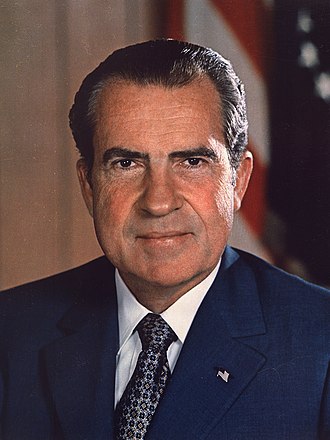
Richard M. Nixon served as the 37th President of the United States from January 1969 until his resignation in August 1974. In February 1971, he ordered the installation of a secret voice-activated taping system in the White House to preserve a historical record of his administration. Until the system's existence was revealed and dismantled in July 1973, the tapes captured Nixon directing major foreign policy initiatives, such as the opening to China, as well as his central role in the Watergate cover-up.
What Nixon talks about on the tapes
White House operations 4,718Presidential scheduling 2,225Public relations 1,784Presidential schedule 1,782Vietnam War 1,693Logistics 1,650Manolo Sanchez 1,626White House communications 1,400White House administration 1,399Presidential communication 1,243Henry Kissinger 1,191Foreign Policy 1,183
Conversations (21,010)
— Page 64 of 211President Nixon met with H.R. Haldeman, Ronald Ziegler, and Stephen Bull to coordinate strategy regarding his potential speech to the AFL-CIO convention and to manage personnel matters. The discussion centered on timing the announcement of the President's attendance to maximize media impact while maintaining operational secrecy. Additionally, the President issued directives to limit the number of White House officials speaking on international economic issues, specifically instructing Peter Peterson to cease unauthorized communications.
President Nixon met with his aide Stephen B. Bull to coordinate upcoming logistical arrangements for the President's schedule. The discussion focused on managing the timing for an appearance by Attorney General John N. Mitchell, specifically regarding the inclusion of a formal press photograph. The meeting served as a brief operational briefing to ensure the smooth transition of scheduled events within the Oval Office.
President Nixon met with California Governor Ronald Reagan to discuss the governor's recent Far East diplomatic trip and the administration's ongoing domestic and foreign policy challenges. They reviewed Reagan's interactions with leaders in Taiwan, Singapore, Thailand, and Japan, focusing on reassuring these allies regarding U.S. treaty commitments and the President's planned visit to the People's Republic of China. Additionally, the pair coordinated strategies for negotiating welfare reform experiments in California, addressing anti-trust concerns for U.S. firms in Asia, and solidifying support among conservative Republicans ahead of the 1972 election.
President Nixon and John Mitchell met to discuss strategies for managing relations with conservative political factions and address the political standing of California Governor Ronald Reagan. They examined the challenges of integrating right-wing supporters into the 1972 campaign organization while tempering their expectations, specifically noting the need to keep campaign management professional. Additionally, the pair discussed potential vetoes for legislation concerning child care, with Nixon expressing ideological opposition to federal interventions he believed would undermine the traditional family structure.
President Nixon met with his valet, Manolo Sanchez, in the Old Executive Office Building to discuss administrative details regarding the President's upcoming schedule. The conversation focused on managing the logistics and daily appointments of the executive office. No major policy decisions were recorded during this brief logistical meeting.
President Nixon consulted with a White House operator to facilitate a telephonic connection. The brief exchange served as a logistical step to initiate contact with another party. No substantive policy discussions or major administrative decisions occurred during this interaction.
President Nixon and H.R. Haldeman met to review recent polling data, discuss political appointments, and address various scheduling items. They analyzed a drop in the President's approval ratings, speculating on the impact of Phase II economic policy implementation and the recent United Nations vote regarding Taiwan. Additionally, the President reviewed a request to visit the Washington D.C. subway construction site to influence a forthcoming congressional vote, and Haldeman provided updates on upcoming labor-related meetings.
President Nixon contacted the White House operator to facilitate a direct connection with his aide, Stephen B. Bull. The brief communication served exclusively as an administrative request to reach a member of the White House staff. No further policy or strategic matters were discussed during this brief exchange.
President Richard M. Nixon met with his valet, Manolo Sanchez, in the Old Executive Office Building to coordinate the President's personal schedule. The discussion focused on logistical arrangements and administrative planning for upcoming presidential activities. No significant policy decisions were recorded during this brief administrative briefing.
President Nixon met with his personal valet, Manolo Sanchez, to discuss their respective schedules. The participants focused on pending information related to timing and logistics, noting that certain arrangements remained uncertain until a 7:00 pm deadline. No major policy decisions were made during this brief administrative check-in.
President Nixon consulted with a White House operator to facilitate an outgoing communication. This brief interaction served administrative purposes to connect the President with another party. No substantive policy matters or major political decisions were recorded during this brief exchange.
President Nixon contacted Stephen B. Bull to coordinate his personal schedule. The brief discussion focused exclusively on arranging for a barber to visit the White House at 5:30 p.m. Bull acknowledged the request and confirmed the appointment.
President Nixon met with his aide Stephen B. Bull for a brief discussion regarding a specific strategic response. The dialogue focuses on the President's instructions to avoid escalating a conflict by countering "fire with fire." No specific subsequent action items were recorded beyond this directive for restraint.
President Nixon and John Ehrlichman discuss a political strategy to neutralize a proposed amendment to the Tax Bill by Senator Charles Percy, which would provide federal subsidies to states for welfare costs. Fearing the amendment’s $2.8 billion price tag and its potential to undermine administration revenue-sharing goals, the pair decides to offer a political concession to Percy—an agreement to support his initiative later if H.R. 1 moves forward—to prevent the amendment from being introduced. They agree that a veto of the tax bill is not a viable option due to other critical provisions like the investment tax credit and auto excise reductions, ultimately opting to make a deal to avoid the fiscal impact of the amendment.
President Richard Nixon met with his personal valet, Manolo Sanchez, in the Old Executive Office Building. The brief interaction, which included a segment restricted from the public record, involved personal matters between the President and his longtime aide. No substantive policy discussions or administrative decisions were documented during this exchange.
President Nixon and John Ehrlichman met to discuss the administration's legislative strategy regarding HR1 and a problematic amendment threatening the broader tax bill. The discussion focused on the political necessity of avoiding a presidential veto of the tax package while managing potentially unfavorable legislative amendments. They ultimately decided to pursue negotiations with Senator Charles Percy to mitigate the amendment's impact and effectively handle the political leverage involving state governors and Governor Ronald Reagan.
President Nixon and Clark MacGregor briefly discussed ongoing personnel matters and administrative tasks. The conversation centered on ensuring the retention of Miller and confirming that Secretary of Defense Melvin Laird was actively managing the situation regarding Stetson. The exchange concluded with the President signaling that no further immediate action was required from MacGregor regarding the discussed efforts.
President Nixon and H. R. Haldeman met to review recent polling data and coordinate scheduling matters. The discussion focused on analyzing public opinion trends and managing the President’s upcoming calendar commitments. No specific policy decisions were finalized, but the exchange served as a routine administrative review of political strategy and time management.
President Nixon met with his personal valet, Manolo Sanchez, to discuss logistical arrangements regarding an upcoming trip to California. The conversation centered on the President's travel schedule to Palm Springs and the delivery of specific items for the excursion. During the brief exchange, Nixon inquired about Sanchez's readiness to assist with these tasks, mirroring procedures from previous trips.
President Nixon requested that the White House operator determine the specific time and location for a practice session involving the White House residents scheduled for the following day. This brief interaction functioned as an administrative directive to coordinate logistics for an upcoming event or rehearsal. No further policy or political discussions were recorded during this brief exchange.
President Nixon held a brief meeting with his personal aide, Stephen B. Bull, in the Old Executive Office Building. While no transcript exists for this exchange, the meeting occurred as part of Bull's routine administrative support role. The interaction served as a quick coordination point between the President and his staff regarding daily scheduling or immediate logistical tasks.
President Nixon met with his valet, Manolo Sanchez, in the Old Executive Office Building to address the location of missing personal items. The brief exchange focused on the search for these misplaced belongings within the office space. No major policy developments occurred, as the dialogue was limited to coordinating the retrieval of these objects.
President Nixon met with H.R. Haldeman and other staff members to review the political impact of Treasury Secretary John Connally's recent press conference and the broader public perception of the administration’s economic and foreign policies. The discussion focused on analyzing negative polling data, evaluating the administration's tense relationship with George Meany and the AFL-CIO, and strategizing on how to manage legislative priorities, specifically the pending tax bill. Nixon decided to pressure Congress to finalize the tax legislation, potentially calling a special session to force the issue and hold lawmakers accountable for its passage.
President Nixon met with his personal secretary, Rose Mary Woods, to coordinate his upcoming itinerary and administrative schedule. The brief discussion focused on managing the President's professional appointments and logistical planning within the Executive Office Building. No major policy decisions were reached, as the dialogue remained limited to routine organizational matters.
President Nixon and H. R. Haldeman coordinate the scheduling of an upcoming meeting with Treasury Secretary John B. Connally. The discussion touches upon the President's calendar, the review of recent polling data concerning public sentiment on the Vietnam War, and administrative personnel matters. The participants finalize plans to reconnect later in the day to address these pending policy and staffing items.
President Nixon met with his personal secretary, Rose Mary Woods, and assistant Manolo Sanchez to review administrative matters, correspondence, and upcoming scheduling details. They discussed a variety of topics, including logistics for the President's planned trips to China and the Soviet Union, arrangements for White House Christmas entertainment, and the handling of various letters and gifts. The conversation also touched upon administrative decisions regarding Nixon's past law school applications and potential donations of materials to the Eisenhower Foundation.
President Nixon and John Ehrlichman discuss the strategic implications of Senator Charles Percy’s proposed amendment to H.R. 1, the pending tax bill. Nixon argues that yielding to Percy on the amendment creates a legislative scenario where the bill might fail or require a presidential veto, whereas avoiding the amendment ensures the passage of a bill he is obligated to sign. After confirming that George Shultz concurs with this assessment, they reach a consensus to prioritize the bill's passage over legislative confrontation.
President Nixon consults with John Ehrlichman regarding the strategic implications of incorporating specific provisions into H.R. 1, a major legislative proposal. Nixon expresses concern over the risks of being forced to sign an undesirable tax bill and emphasizes the necessity of avoiding such a scenario. Ultimately, the President decides to postpone further action on tax legislation to maintain control over the administration's fiscal agenda.
President Nixon and H.R. Haldeman met briefly in the Old Executive Office Building to coordinate schedules. The President explicitly requested that Haldeman join him for further discussion. No specific policy or strategic decisions were recorded during this brief encounter.
H. R. Haldeman coordinates with the White House operator to locate and establish contact with General James D. “Don” Hughes. After confirming that Hughes is currently at Andrews Air Force Base, Haldeman confers with President Nixon regarding the logistics of the call. The discussion centers on the immediate need to reach Hughes for an unspecified purpose.
President Nixon and H. R. Haldeman met to discuss pending tax legislation, including the politically sensitive Percy amendment and the potential for a presidential veto. The conversation shifted to strategic planning for the President’s upcoming address to the AFL-CIO, where they aimed to balance a message of economic dignity with a clear-eyed defense of the administration's policies. Additionally, they reviewed recent polling data to assess the President's regional approval ratings and determined the timing and methodology for future surveys to measure public sentiment on economic and foreign policy initiatives.
President Nixon consulted with the White House operator to facilitate an outgoing call. The discussion served primarily as a logistical step to connect the President with another party. No substantive policy matters or major decisions were recorded during this brief administrative interaction.
President Nixon consulted with a White House operator to facilitate an outgoing telephone communication. This brief interaction served administrative purposes, as the President requested assistance in establishing a connection for an unrecorded conversation. The exchange highlights the standard operational procedures for presidential telecommunications during this period.
President Nixon met briefly with his personal valet, Manolo Sanchez, in the Old Executive Office Building. The conversation, which lasted only four minutes, appears to have been a functional exchange regarding the President's immediate needs. The meeting concluded with both men departing the office together to adhere to the President's schedule.
President Nixon initiates a request through the White House operator to reach John D. Ehrlichman. The brief exchange serves as a procedural step to facilitate an urgent communication between the President and his Assistant for Domestic Affairs. No further policy discussions or substantive developments occur during this brief operator connection.
President Nixon consulted with an unidentified individual to review historical precedents regarding his previous appearances at American Federation of Labor-Congress of Industrial Organizations (AFL-CIO) conventions. The discussion focused on evaluating the President's past engagement with labor leadership and assessing the political implications of these interactions. No specific decisions or forward-looking action items were recorded in the available documentation of this meeting.
President Nixon met with his personal valet, Manolo Sanchez, in the Old Executive Office Building to locate specific personal items. The discussion focused on retrieving and examining a collection of gold family belongings, including pieces Nixon believed to be stored in his desk or within the Oval Office. The conversation concluded with the President reviewing these items with Sanchez’s assistance.
President Nixon held a private meeting in the Old Executive Office Building with an unidentified individual. Given the lack of a transcript or supplemental documentation, the specific subject matter and objectives of this discussion remain unknown. Consequently, no actionable items or policy developments can be attributed to this exchange.
President Nixon met with an unidentified male visitor in the Old Executive Office Building for a private consultation. Due to the lack of a transcript or specific descriptive metadata, the exact nature of the discussion remains undocumented. This interaction serves as an example of the frequent, unrecorded meetings conducted by the President during his tenure, highlighting a gap in the historical record regarding his daily decision-making process.
President Nixon held a brief, informal exchange with a White House operator in the Old Executive Office Building. The interaction lacks substantive policy discussion, serving primarily as a routine administrative or logistical contact. No major decisions or developments were recorded during this brief communication.
President Nixon and John Ehrlichman discuss the successful negotiation of a memorandum of understanding with Senator Charles Percy regarding welfare reform legislation. The administration agrees to support an amendment to avoid a broader legislative defeat, while maintaining that this position does not necessitate including the program in the federal budget. They also address the political motivations of Governors Ronald Reagan and Nelson Rockefeller, and finalize plans to provide financial assistance to Governor Richard Ogilvie by shifting welfare costs into the current fiscal year.
President Nixon and John Ehrlichman discuss the political challenges of advancing welfare reform, specifically addressing concerns raised by Governor Ronald Reagan regarding rising costs. The pair strategizes on how to handle Senator Charles Percy's involvement and reconcile the conflicting interests of Republican governors like Nelson Rockefeller. Nixon ultimately instructs Ehrlichman to proceed with managing these legislative hurdles despite the difficult political landscape.
President Nixon met with Alexander P. Butterfield in the Old Executive Office Building to discuss administrative details regarding the President’s personal schedule. The discussion specifically focused on coordinating a haircut appointment for the President. No significant policy decisions were recorded during this brief administrative interaction.
President Nixon consults with an aide regarding his upcoming address to the AFL-CIO convention to ensure his economic messaging is accurate. He specifically requests research data comparing wage and price increases between 1965 and 1969 to support his argument that labor gains were consistently offset by inflation during that period. The President instructs staff to expedite this research, mentioning speechwriter William Safire, to solidify the economic narrative for his presentation.
President Nixon met with an unidentified individual in the Old Executive Office Building to facilitate the receipt of undisclosed materials or information. While the specific nature of the items exchanged remains undocumented due to the lack of an available transcript, the brief encounter concluded with the departure of the visitor before 5:44 pm. This meeting represents a private, undocumented interaction within the President's administrative offices.
President Nixon met with his personal valet, Manolo Sanchez, in the Old Executive Office Building. The brief interaction centered on the President receiving a gold pen from Sanchez. The meeting concluded shortly thereafter as the two men departed the office together.
President Nixon contacted the White House operator to place an outgoing call to Chief of Staff H.R. Haldeman. This brief administrative interaction served as a logistical request to establish communication with his top aide. No substantive policy matters were discussed during this brief exchange.
President Nixon and H. R. Haldeman coordinate a high-priority telephone outreach to AFL-CIO leader George Meany. Nixon expresses frustration with potential delays, insisting that the call be framed as a direct communication from the President. They ultimately finalize plans to schedule a conversation with Meany for the following day at noon.
President Nixon initiates a brief telephone call to the White House operator to request a connection to Charles W. Colson. The interaction serves solely as a logistical bridge to facilitate communication with his special counsel. No substantive policy matters or further developments occur during this brief exchange.
President Nixon and Charles Colson discuss public relations strategies, specifically instructing staff to frame the Boland Amendment as the equivalent of the Mansfield Amendment to demonstrate the administration's increased legislative strength. The conversation also covers the manipulation of economic statistics, with Nixon expressing frustration over errors in Commerce Department and Bureau of Labor Statistics data and suggesting that political influence might be at play. Additionally, they review polling data from Gallup and Harris, agreeing to highlight more favorable figures to boost the President's image while coordinating efforts to engage AFL-CIO leader George Meany.
President Nixon and H. R. Haldeman coordinate efforts to locate AFL-CIO President George Meany for an urgent meeting. Haldeman secures a standby aircraft to maintain the flexibility of traveling to Florida either that evening or the following morning. They decide to wait thirty minutes to see if Meany can be reached before finalizing departure plans.
President Nixon instructed the White House operator to connect him with special counsel Charles W. Colson. The brief exchange served as a request to facilitate a telephone communication between the President and his aide. No further policy or substantive matters were discussed during this short administrative interaction.
President Nixon consulted with the White House operator to facilitate a telephone connection with special counsel Charles W. Colson. The operator informed the President that Colson was currently at a location identified as Bootholm and would be available for the call within five minutes. Nixon acknowledged these logistics to coordinate the upcoming discussion.
President Nixon and Charles Colson discuss efforts to locate AFL-CIO leader George Meany to secure an invitation for the President to attend the labor organization's upcoming convention. The pair coordinates with George Shultz and Willie Usery to facilitate the request. Additionally, they review the timing of a Louis Harris public opinion poll to determine if it reflected the public's response to a recent Vietnam troop withdrawal announcement.
President Nixon and H. R. Haldeman discuss the logistics and political strategy regarding the President's potential appearance at the AFL-CIO convention. They deliberate on whether to accept George Meany's invitation for a Friday morning session, contingent upon the outcome of the AFL-CIO's executive committee vote on the Pay Board. The President decides to keep his schedule open and authorizes a potential cancellation of the trip if the union's decision on the Pay Board proves to be hostile.
President Nixon initiated a brief administrative call to the White House operator to facilitate a connection with his close friend and confidant, Charles G. "Bebe" Rebozo. The interaction was limited to this routing request, highlighting the President's reliance on operator services to manage his personal communications. No further policy or substantive matters were discussed during this brief exchange.
President Nixon and Bebe Rebozo discussed logistical plans for Rebozo’s upcoming birthday celebration, including the presence of guests Jane Lucke and Carmen Rebozo. The conversation shifted to scheduling, specifically coordinating the President’s travel to Florida around his scheduled speech at the AFL-CIO convention. Additionally, they touched on historical trivia regarding Samuel Gompers and the reception of a recent television appearance by Julie Nixon Eisenhower.
President Nixon and his daughter, Julie Nixon Eisenhower, discussed her recent public engagements, including a television appearance related to the 'Legacy of Parks' program and her interactions with figures like Bebe Rebozo and Nelson Rockefeller. The President also reviewed his upcoming schedule, which included a potential trip to Florida and his planned address to the AFL-CIO convention. The conversation served primarily as a personal check-in between the two, touching on family matters and the political climate surrounding his administration.
President Nixon consulted with an associate regarding his potential attendance at the upcoming AFL-CIO convention and his interactions with union leader George Meany. The discussion focused on coordinating the administration's messaging concerning the Pay Board, particularly regarding the timing and content of an announcement to be handled by George Shultz. Nixon deliberated on whether he should personally address the convention to mitigate political speculation, ultimately emphasizing the need for strategic control over the administration's public declarations.
President Nixon initiates a request through the White House operator to be connected with his National Security Advisor, Henry A. Kissinger. This brief administrative exchange serves the purpose of facilitating urgent executive communication. No substantive policy discussions occur, as the call functions solely to establish contact between the President and his advisor.
President Nixon held a brief, early-morning meeting in the Oval Office with an unidentified male visitor. The recorded segment contains no discernable dialogue, as the encounter was immediately followed by a five-second withdrawal of material designated as personal and returnable. No substantive policy decisions, instructions, or political developments can be determined from the available records of this interaction.
President Nixon held a brief, informal meeting in the Oval Office with Alexander Haig and an unidentified individual. The discussion primarily focused on logistical matters regarding the President’s daily schedule. No major policy decisions were reached during this short administrative check-in.
President Nixon met with his aide, Stephen B. Bull, to review and finalize the President’s daily schedule. The primary focus of the discussion concerned upcoming engagements, specifically highlighting a meeting with Alexander M. Haig, Jr. No major policy decisions were recorded during this brief administrative briefing.
President Nixon consulted with a White House operator to facilitate an outgoing communication. This brief interaction served as a procedural step to initiate a telephone call to an external party. No substantive policy discussions or significant political decisions were recorded during this brief administrative exchange.
President Nixon met with his valet, Manolo Sanchez, to coordinate the President's morning schedule. The primary focus of the brief discussion was the logistics of Nixon’s transition to his office in the Old Executive Office Building. The conversation concluded with arrangements for a scheduled meeting with National Security Advisor Henry Kissinger.
President Nixon initiates a brief administrative call with the White House operator to facilitate communication. The exchange serves as a routine procedural step to connect the President with other individuals or offices. No substantive policy matters or major decisions are recorded during this short telephonic interaction.
President Nixon held a brief morning meeting in the Old Executive Office Building with an unidentified individual. The discussion primarily focused on the scheduling and coordination of an upcoming meeting. No further substantive details regarding the conversation's content are available due to the lack of a transcript.
President Nixon consulted with a White House operator to facilitate an outgoing telephone connection. The brief exchange focused on establishing a direct line to an unspecified party. The conversation concluded with the operator taking instructions to process the request.
President Nixon initiates a brief telephone call through the White House operator to contact his special counsel, Charles W. Colson. The conversation serves solely as a logistical request to establish a line of communication with Colson. No further policy or administrative matters are addressed during this brief exchange.
President Nixon and Charles Colson coordinated their schedules to facilitate a follow-up discussion regarding an ongoing labor matter. Nixon instructed Colson to prioritize his staff meeting before reconvening to review the specifics of the labor situation. They agreed to reconnect via telephone around 10:00 am to address these internal business concerns.
President Nixon and Charles W. Colson briefly discuss the scheduling and coordination of an upcoming staff meeting. The conversation serves primarily as a logistical check-in to align their respective agendas prior to the session. Nixon expresses his desire to review specific items with Colson before the morning proceedings commence.
President Nixon and H. R. Haldeman coordinate the timing of a critical phone call between George Shultz and AFL-CIO leader George Meany regarding the organization's participation in the Pay Board. They discuss whether to pre-emptively announce a meeting time to curb public speculation or wait for the outcome of the AFL-CIO convention proceedings. Ultimately, the pair decides to postpone the announcement until the labor union's position becomes clearer later that afternoon.
President Richard M. Nixon and H.R. Haldeman met briefly in the Old Executive Office Building for a discussion that remains officially unrecorded or unintelligible in the provided transcript. The extremely short duration of the meeting suggests a quick administrative exchange or the relaying of urgent logistical information. No substantive policy decisions or action items can be verified from the available documentation.
President Nixon and H.R. Haldeman discussed a wide range of administrative, legislative, and scheduling matters, including the President's upcoming travel, speech revisions for the AFL-CIO convention, and the confirmation of Earl Butz. They reviewed the status of Supreme Court nominees and potential Congressional hurdles, such as the Mansfield Amendment and various tax-related legislation. Later, Henry Kissinger joined the meeting to coordinate on foreign policy announcements, specifically regarding the President's trip to the People's Republic of China, and to plan meetings with various world leaders.
President Nixon initiates a request through the White House operator to be connected with his Special Counsel, Charles W. Colson. This brief administrative exchange serves solely to facilitate a direct line of communication between the President and a key advisor. No substantive policy discussions or policy-related decisions occur during this segment.
President Nixon initiates a brief interaction with the White House operator to facilitate an outgoing call. The conversation serves as a routine administrative request to connect the President with a specific party. No further policy-related discussions or significant decisions occur during this short exchange.
President Nixon initiates a brief telephone call to Special Counsel Charles W. Colson to confirm his immediate availability. After verifying that Colson is free, the President directs him to come to the Oval Office for a meeting. The brief exchange serves primarily as a logistical check to coordinate their schedules for an upcoming discussion.
President Nixon met briefly with Charles W. Colson to discuss scheduling or immediate availability for a follow-up conversation. The exchange appears to be a procedural check-in to determine if the President was occupied or ready to engage in further discussion. No substantive policy matters or specific directives were documented during this minute-long interaction.
President Nixon instructed the White House operator to place a call to Herbert Stein, a member of the Council of Economic Advisers. The President expressed uncertainty regarding Stein’s current location, noting he might be recuperating at home rather than the hospital. The conversation served as a brief administrative coordination to facilitate direct communication with his economic advisor.
President Nixon contacted the White House operator to facilitate an urgent communication with his speechwriter and advisor, Patrick J. Buchanan. The primary purpose of this brief call was to initiate a telephone connection with Buchanan to discuss ongoing administrative or political matters. This exchange served as a routine procedural step to manage the President's internal communications.
President Nixon consulted with the White House operator to facilitate a connection with Herbert Stein, a member of the Council of Economic Advisers. The brief interaction served to establish communication with Stein, presumably to discuss ongoing economic policy matters. No further substantive policy decisions were documented during this short exchange.
President Nixon contacted the White House operator to facilitate an outgoing call. The brief exchange served as a logistical step to connect the President with another party for official business. No substantive policy matters or major developments were recorded during this brief administrative interaction.
President Nixon and Charles Colson met to discuss various administration concerns, including the President's upcoming address to the AFL-CIO convention and strategies for managing press coverage regarding the national economy and Supreme Court nominations. The conversation also covered coordination with other officials, such as John Connally and Henry Kissinger, regarding international monetary policy, sanctions on Rhodesia, and the timing of future press conferences. The two also analyzed historical polling data to gauge public perception and formulate communication tactics for the President's policy agenda.
President Nixon calls Herbert Stein to check on his recovery following eye surgery and to express the administration's need for his return. During the informal exchange, Stein shares a humorous anecdote about Dean Acheson and a Harvard reunion. The conversation concludes with Nixon advising Stein not to rush his return to work and lightheartedly joking about maintaining a political bias to the right.
President Nixon tasked Patrick J. Buchanan with conducting historical research into Abraham Lincoln’s post-Civil War amnesty policies. The President specifically requested clarification on whether these amnesty provisions excluded deserters. Buchanan was directed to verify the historical details and report his findings back to Nixon.
President Nixon initiates a request for the White House operator to connect him with presidential advisor Peter M. Flanigan. This brief administrative interaction serves as a bridge to facilitate further internal communication. The conversation concludes with the operator acknowledging the directive to place the outgoing call.
President Nixon and Henry Kissinger met to coordinate the President's upcoming professional schedule and administrative agenda. A key focus of the discussion involved evaluating the potential appointment and future role of David M. Kennedy within the Nixon administration. The brief session served to align staffing priorities and manage the executive calendar.
President Nixon consulted with the White House operator to facilitate an outgoing call. This brief interaction served administrative purposes to connect the President with another party for official business. No substantive policy discussions or significant political developments occurred during this short communication.
President Nixon consulted the White House operator to locate aide Peter M. Flanigan for a scheduled communication. Upon learning that Flanigan was unavailable, the President explicitly rescinded his request to track him down. Nixon decided to delay the call until later in the afternoon, emphasizing that there was no immediate urgency to contact his aide.
President Nixon requested that the White House operator place a telephone call to his daughter, Tricia Nixon Cox. The conversation served strictly as a logistical bridge to facilitate this personal communication. No policy matters or substantive political topics were addressed during the brief exchange.
President Nixon consulted with a White House operator to facilitate the scheduling of an important, mandatory meeting. The President emphasized the necessity of the gathering, though the specific subject matter and participants remain obscured by the Welsh-language transcription and lack of clear contextual detail. The discussion concluded with the President tasking the operator with making the necessary arrangements.
President Nixon met with his personal valet, Manolo Sanchez, in the Old Executive Office Building to discuss personal logistics and administrative matters. The conversation focused on the President's upcoming travel schedule, specifically regarding a planned trip to Florida. The two also coordinated arrangements for an upcoming dinner engagement.
President Nixon met with staff members John D. Ehrlichman and George P. Shultz to coordinate his upcoming schedule and administrative priorities. The discussion centered on managing the President's calendar to accommodate these key advisors and address pending domestic or economic policy objectives. No further records of the specific deliberations exist, marking this as an administrative planning session.
President Nixon met with his personal valet, Manolo Sanchez, in the Old Executive Office Building for a brief exchange. The conversation, conducted largely in Welsh, centered on the President's personal plans for the evening, specifically regarding his scheduled attendance at a dinner or social engagement. No substantive policy or administrative decisions were reached during this interaction.
President Nixon met with his personal aide, Manolo Sanchez, in the Old Executive Office Building for a brief and informal interaction. The dialogue, recorded in Welsh, consists of fragmented exchanges regarding staff movements and general administrative observations. No significant policy decisions or substantive political developments were recorded during this encounter.
President Nixon consulted with his personal secretary, Rose Mary Woods, regarding logistical arrangements for his upcoming travel to Florida. The discussion focused on coordinating his attendance at the AFL-CIO convention, specifically addressing potential interactions with George Meany and scheduling constraints related to college football games. The two also addressed general administrative concerns and the President's personal travel itinerary.
President Nixon consulted with a White House operator regarding logistical coordination, specifically referencing the timing of a future commitment. The exchange appears to be a brief administrative interaction focused on scheduling arrangements. No substantive policy decisions or political developments occurred during this short communication.
President Nixon and his daughter, Tricia Nixon Cox, discuss various personal and professional matters, including their upcoming schedules and the public relations surrounding First Family speaking engagements. They review recent activities involving Julie Nixon Eisenhower and the media coverage of her appearances, as well as the status of Pat Nixon's goodwill tour to Africa. Additionally, the President touches upon his planned trip to Florida and his anticipated address to the AFL-CIO convention.
President Nixon held a brief, informal meeting with his daughter, Tricia Nixon Cox, in his office at the Old Executive Office Building. While the specific details of their discussion remain restricted or absent from the record, the meeting served as a personal interaction between the President and his family member. No significant policy decisions or official action items were documented during this private encounter.
President Nixon initiates a brief telephonic request through the White House operator to be connected with his assistant, Peter M. Flanigan. The exchange serves as a logistical bridge to facilitate an immediate follow-up conversation between the President and a key policy advisor. No substantive policy matters are addressed in this short administrative connection.