Nixon, Richard M. (President)
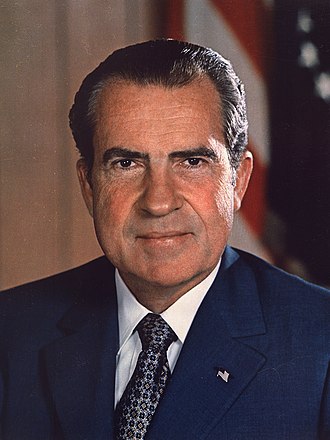
Richard M. Nixon served as the 37th President of the United States from January 1969 until his resignation in August 1974. In February 1971, he ordered the installation of a secret voice-activated taping system in the White House to preserve a historical record of his administration. Until the system's existence was revealed and dismantled in July 1973, the tapes captured Nixon directing major foreign policy initiatives, such as the opening to China, as well as his central role in the Watergate cover-up.
What Nixon talks about on the tapes
White House operations 4,718Presidential scheduling 2,225Public relations 1,784Presidential schedule 1,782Vietnam War 1,693Logistics 1,650Manolo Sanchez 1,626White House communications 1,400White House administration 1,399Presidential communication 1,243Henry Kissinger 1,191Foreign Policy 1,183
Conversations (21,010)
— Page 62 of 211President Nixon met with his personal aide, Manolo Sanchez, in the Old Executive Office Building for a brief administrative consultation. The primary purpose of the meeting was to provide specific instructions regarding the placement of an unidentified object within the office. No further policy or political developments were recorded during this brief interaction.
President Nixon and Henry Kissinger deliberated on the messaging strategy for an upcoming announcement regarding U.S. troop withdrawals in Vietnam. They assessed how to respond to potential press inquiries concerning the pace of the withdrawal and specifically debated whether to explicitly characterize the policy as an increased rate of removal. The two agreed on a strategy for managing follow-up questions from the media to ensure the administration's narrative remained controlled.
President Nixon met with his aide, Stephen B. Bull, to review and coordinate the President's daily schedule. The primary focus of the discussion centered on arranging an upcoming meeting with National Security Advisor Henry A. Kissinger. No specific policy decisions were recorded during this brief administrative briefing.
President Nixon and Henry Kissinger strategized on the public messaging surrounding the forthcoming troop withdrawal announcement in Vietnam. They focused on anticipating challenging press inquiries from figures like Ronald Ziegler, specifically concerning the size of a residual force and its connection to the release of prisoners of war. Nixon ultimately decided to maintain ambiguity regarding specific withdrawal numbers to avoid premature commitments during negotiations.
President Nixon and Henry Kissinger discussed the messaging strategy regarding an upcoming troop withdrawal announcement in Vietnam. They focused on how to handle potential press inquiries, specifically addressing whether or not to disclose specific numbers or dates related to the withdrawal. The conversation concluded with the President deciding to withhold specific figures to maintain leverage in ongoing negotiations with North Vietnam.
President Richard M. Nixon met with his valet, Manolo Sanchez, in the Old Executive Office Building. The brief interaction consisted entirely of a personal, non-substantive exchange that was subsequently withdrawn from the public record. No policy discussions or administrative decisions were documented during this private encounter.
President Nixon met with an unidentified individual in the Old Executive Office Building to review his daily schedule. The discussion focused primarily on coordinating upcoming appointments and engagements involving John D. Ehrlichman. No significant policy decisions were recorded during this brief administrative session.
President Nixon and Henry Kissinger met to discuss potential personnel changes within the administration, specifically debating the merits of Elliot Richardson versus Nelson Rockefeller for future roles, including potential State Department leadership. The discussion emphasized maintaining administrative control and managing political expectations for the 1972 campaign. Additionally, Nixon instructed Kissinger to ensure John B. Connally receives prominent credit for his contributions to the administration's economic policy initiatives.
President Nixon and Henry Kissinger met to coordinate the messaging for an upcoming troop withdrawal announcement and to assess the status of ongoing negotiations with North Vietnam. They discussed the tactical use of 'protective reaction' bombing raids in North Vietnam and the strategic communication of US offers regarding the potential resignation of South Vietnamese President Nguyen Van Thieu. The conversation also touched on managing domestic political credibility and the importance of maintaining flexibility in public policy regarding the South Vietnamese military's defensive capabilities.
President Nixon met with his aide Stephen B. Bull to review and organize the President’s upcoming schedule. The discussion focused specifically on finalizing arrangements for a meeting with Caspar W. Weinberger. Bull was directed to confirm the logistical details for this appointment.
President Nixon and an unidentified interlocutor engage in a philosophical reflection regarding the heavy psychological and political burdens faced by wartime presidents. The discussion centers on the historical examples of Lincoln, Wilson, and Roosevelt to illustrate the challenges of maintaining public support during armed conflict. The dialogue emphasizes the necessity of navigating wartime leadership to achieve victory despite significant personal and public strain.
President Nixon met with key Congressional leaders and administration officials to address an impending budget crisis caused by the lack of a continuing resolution for several federal agencies, including the OEO, foreign aid, defense, and the District of Columbia. The participants debated the legality of continuing government operations without explicit authorization, with Nixon expressing a firm reluctance to engage in practices he deemed legally questionable. To resolve the standoff before the December 1st pay deadline, the group discussed legislative strategies to expedite authorization bills and tentatively set a target adjournment date of December 4th to allow Congress time to complete essential business.
President Nixon and John Ehrlichman discuss the President’s firm intention to veto an education bill due to philosophical objections regarding the role of government in child-rearing. Nixon addresses his tactical frustrations with Secretary Elliot L. Richardson, who disagrees with the administration's stance and has been hesitant to align with the President's position. Ehrlichman agrees to coordinate with Richardson while acknowledging the political pressure on the Secretary and the President's resolve to ultimately reject the legislation.
President Nixon and John Ehrlichman briefly discussed the political challenges of public support for wartime leadership before transitioning to an upcoming energy policy meeting. Ehrlichman advised the President to adopt a listening role during the session while setting a specific agenda to address ATM-level control. The pair finalized the meeting's structure, with Ehrlichman proposing to introduce the key participants and issues sequentially.
President Nixon consults with Alexander P. Butterfield regarding a pending piece of legislation involving child welfare and family policy. Nixon expresses a firm philosophical objection to government-run child-rearing and explicitly states his refusal to sign the bill. He further discusses Secretary Elliot Richardson’s position on the matter, ultimately resolving to find a pretext to veto the legislation while maintaining his public stance.
President Nixon met with his personal aide, Manolo Sanchez, in the Old Executive Office Building to conduct private or personal business. The conversation was brief and is categorized as a personal returnable item, indicating it did not involve formal policy or administrative decision-making. No official transcript or record of the discussion remains available for historical analysis.
President Nixon met with his valet, Manolo Sanchez, in the Old Executive Office Building for a private engagement. Given that the available recording consists primarily of a withdrawn segment classified as personal, the interaction reflects a routine administrative or service-related meeting between the President and his staff. No substantial policy developments or historical decisions were recorded during this brief encounter.
President Nixon met with his longtime personal valet, Manolo Sanchez, at the Old Executive Office Building. The primary focus of the brief interaction involved the coordination of personal effects and necessary logistical materials for an upcoming trip to Camp David. Sanchez subsequently departed the office to assist with these arrangements.
President Richard M. Nixon met with his longtime valet, Manolo Sanchez, in the Old Executive Office Building for a private engagement. Given that the entirety of the recorded duration was withdrawn for personal privacy reasons, the discussion involved no substantive policy matters or official administrative business. The interaction concluded when the President and Sanchez departed the office together.
President Richard M. Nixon met with his longtime valet, Manolo Sanchez, in the Oval Office for a brief, informal interaction. The exchange consisted of brief pleasantries and personal matters, largely obscured by withdrawn segments and minimal transcribed content. No significant policy discussions or official executive actions were recorded during this short meeting.
President Nixon met with his personal valet, Manolo Sanchez, in the Oval Office to address routine personal needs. During the brief interaction, the President requested tea. The meeting concluded quickly without any substantive policy discussions or administrative action items.
President Nixon and Press Secretary Ronald L. Ziegler met to coordinate the public communication strategy for an impending troop withdrawal announcement. They discussed the logistics of Nixon’s televised address and the supporting materials, specifically photographs, to be released by the press office. The meeting served to finalize Ziegler’s role in managing the official announcement and ensuring that the media strategy aligned with the President’s planned delivery.
President Nixon and Press Secretary Ronald Ziegler consulted regarding the logistical details of an upcoming presidential announcement concerning troop withdrawals. The discussion focused on establishing the duration of the withdrawal process and setting a definitive cutoff date for the initiative. They also addressed how to manage media inquiries from journalists, specifically citing Frank Cormier, alongside brief mentions of Henry Kissinger's role in the planning.
President Nixon and Donald Rumsfeld met to discuss the administration's strategic management of the Pay Board, specifically addressing the contentious issue of wage retroactivity. They reviewed the President's recent interactions with Congress, including feedback from Clark MacGregor, and coordinated upcoming personnel meetings involving key cabinet members and foreign diplomats. The conversation centered on maintaining a firm stance regarding economic policy and ensuring that administration representatives on the Pay Board continued to exert influence to achieve desired outcomes.
President Nixon met with H. R. Haldeman, Henry Kissinger, and Clark MacGregor to review the effectiveness of his recent press conference and discuss the political messaging surrounding troop withdrawals from Vietnam. The participants assessed public and press reactions to the President's responses regarding amnesty, POWs, and the Vietnamization policy. Additionally, the group coordinated strategy for an upcoming National Security Council meeting focused on the Strategic Arms Limitation Talks (SALT) and pending negotiations with the Soviet Union.
President Nixon and Henry Kissinger met with Pakistani Ambassador Sultan Mohammad Khan to discuss the escalating tensions between India and Pakistan and the U.S. goal of preventing a full-scale war. Nixon emphasized that the U.S. is working diplomatically with the Soviet Union and China to encourage a peaceful resolution while navigating a hostile American press and domestic political pressure. The participants addressed the complexities of leveraging the UN Security Council, with potential support from the People's Republic of China, to protect Pakistani interests.
President Nixon met with his Cabinet and staff to discuss high-stakes domestic and foreign policy issues, including the administration's stance on school desegregation and busing, and potential vetoes regarding child development and welfare legislation. The President also briefed Secretary of Commerce Maurice Stans on his upcoming trip to the Soviet Union, emphasizing that trade should be treated as a strategic tool rather than an over-eager pursuit. Nixon instructed Stans to maintain a shrewd bargaining position and to subtly convey the administration's political strength to Soviet leadership to influence diplomatic negotiations.
President Nixon met with John J. McCloy in the Oval Office to discuss undisclosed matters. Due to the brevity of the recording and the lack of a transcript, the specific agenda remains unconfirmed. No definitive policy decisions or action items were documented during this brief encounter.
President Nixon, Henry Kissinger, and H.R. Haldeman met with John J. McCloy to recruit him for a high-level diplomatic role intended to reassure European allies and manage complex economic and security matters. The discussion centered on the necessity of a seasoned diplomat to handle Mutual and Balanced Force Reduction (MBFR) negotiations and broader NATO relations without downgrading the importance of these alliances. McCloy expressed reservations about the traditional bureaucratic structure of NATO and agreed to further consult with Kissinger to refine the strategic approach before formally committing.
President Nixon and members of the National Security Council met to coordinate the United States' strategy regarding ongoing arms control negotiations with the Soviet Union. The discussion centered on the complexities of Anti-Ballistic Missile (ABM) systems, the status of Safeguard and hard site defenses, and the comparative capabilities of Soviet and American submarine-launched ballistic missiles (SLBMs) and ICBMs. Participants evaluated potential congressional reactions and internal administration messaging while addressing the strategic implications of Soviet negotiating positions.
President Nixon met with his personal aide, Stephen B. Bull, in the Oval Office to discuss administrative logistics and potential requests. The brief interaction concluded as Bull departed the office immediately following the discussion. No specific policy decisions were recorded during this short engagement.
President Nixon held a brief exchange with the White House operator to facilitate an outgoing connection. The interaction served as a functional administrative request to initiate a phone call. No substantive policy discussions or significant political decisions occurred during this brief communication.
President Nixon met with Deputy Assistant to the President Alexander P. Butterfield in the Oval Office to conduct a brief administrative review of the presidential schedule. The discussion focused on upcoming appointments and commitments requiring the President's attention. No major policy developments occurred during this short meeting, which served primarily to organize the executive calendar.
President Nixon and Treasury Secretary John Connally confer on domestic economic policy, specifically the implementation and market reception of Phase Two of the administration's stabilization program. The discussion touches on the political necessity of adopting a firmer stance in public negotiations and the complexities of handling wage-price retroactivity. The two also coordinate upcoming meetings and communication channels with Henry Kissinger regarding international monetary and foreign policy issues.
President Nixon met with Henry Kissinger to discuss urgent administrative and foreign policy matters, including the passage of a continuing budget resolution and the management of ongoing congressional harassment regarding war powers amendments. The pair reviewed the status of international monetary policy negotiations involving John Connally and the positive diplomatic reception of the Chinese delegation at the United Nations. Additionally, Kissinger provided a briefing on the strategic mindset of Zhou Enlai ahead of the President’s upcoming visit to the People's Republic of China.
President Nixon and H. R. Haldeman met to review scheduling matters, address administrative frustrations, and discuss the public relations strategy for the White House. They evaluated the President's upcoming schedule, including a potential appearance at the AFL-CIO convention and the handling of congressional relations through birthday calls. Additionally, the conversation touched on personnel shifts within the Council of Economic Advisors and the strategic management of media coverage for Julie Nixon Eisenhower.
President Nixon, William P. Rogers, and Henry Kissinger met to deliberate on the escalating military tension between India and Pakistan and the potential necessity for UN intervention. The President expressed concern that a conflict would jeopardize his upcoming trip to the People's Republic of China, leading the group to discuss the delicate balance of diplomatic timing and the constraints of working with the UN Security Council. They ultimately reached a consensus to defer immediate action until after key upcoming events, including a scheduled speech by Indira Gandhi and further consultations regarding Chinese interests.
President Nixon initiates a request through the White House operator to place a telephone call to Treasury Secretary John B. Connally. The brief exchange serves as a logistical bridge to facilitate direct communication between the President and the Secretary. No further policy discussions or substantive developments occurred during this specific interaction.
President Nixon initiates a brief interaction with the White House operator to facilitate a telephonic connection. The exchange serves as a routine administrative step to reach another party. No substantive policy discussions or significant political developments occur during this short bridge in the recording.
President Nixon held a brief meeting with his longtime valet, Manolo Sanchez, in the Old Executive Office Building. The exchange appears to be a casual or routine interaction regarding personal staff tasks or administrative items. No substantive policy matters or major historical developments occurred during this short 41-second segment.
President Nixon and Secretary John B. Connally coordinated their schedules to meet at the Executive Office Building at 5:00 p.m., followed by a social engagement at 6:30 p.m. This dinner meeting included their spouses, Nellie Connally and Pat Nixon, along with an invitation for Julie Nixon Eisenhower to host a movie screening. Additionally, Nixon acknowledged and approved of Connally’s recent contact with former President Lyndon B. Johnson.
President Richard Nixon and John B. Connally coordinated their schedules to facilitate a series of meetings and social engagements. The discussion focused on establishing specific times for briefings or consultations throughout the evening, while also incorporating plans for dinner and a movie. The exchange served primarily as a logistical update to ensure their professional and personal calendars aligned for the remainder of the day.
President Nixon met with his personal valet, Manolo Sanchez, in the Old Executive Office Building for a brief discussion regarding his personal attire. The interaction focused on the selection and suitability of specific clothing items for the President. No major policy decisions or political matters were addressed during this short exchange.
President Nixon met with an unknown individual in the Old Executive Office Building to discuss unidentified matters. The brief recording captures the two parties turning on a television set. No further substantive dialogue or policy decisions are documented in this segment.
President Nixon met with his personal aide, Manolo Sanchez, to discuss personal logistics and routine maintenance of his belongings. The President specifically requested additional leather goods, emphasizing the need for items that resist drying out. The brief exchange concluded with a discussion regarding the acquisition of new neckties and a fleeting mention of sports.
President Nixon consulted with his valet, Manolo Sanchez, to coordinate plans for watching a Washington Redskins football game. The brief exchange focused on verifying the game's start time and broadcast channel. No significant political or administrative decisions were made during this personal interaction.
President Nixon met with his personal valet, Manolo Sanchez, to briefly coordinate arrangements for viewing a Washington Redskins football game. The exchange centered on technical scheduling logistics, specifically confirming the channel and timing for the broadcast. No substantive policy or political matters were addressed during this short interaction.
President Nixon met briefly with his personal valet, Manolo Sanchez, in the Old Executive Office Building. The primary purpose of this encounter was a simple request for coffee. No significant policy discussions or administrative decisions occurred during this brief interaction.
President Nixon met with his personal valet, Manolo Sanchez, in the Old Executive Office Building to handle a routine administrative request. During this brief interaction, the President requested that Sanchez provide him with coffee. No other substantive political or policy-related matters were discussed during this brief exchange.
President Nixon met with his valet, Manolo Sanchez, to discuss the outcome of a recent Washington Redskins football game. The conversation touched upon the team's loss and a missed field goal attempt. Additionally, the two briefly addressed the President's upcoming schedule, specifically mentioning Secretary John B. Connally.
President Nixon held a private meeting with First Lady Pat Nixon in his Old Executive Office Building workspace. The discussion served as an informal check-in during an afternoon of presidential duties. No formal policy decisions or administrative actions were recorded as a result of this personal engagement.
President Nixon held a brief, unscheduled meeting with an unidentified individual in his Old Executive Office Building workspace. Due to the limited length and poor audio quality of the recording, the specific subject matter and any potential outcomes remain unknown. No substantive discourse or actionable directives were documented from this interaction.
President Nixon held a brief exchange with the White House operator to facilitate a telephonic connection. The interaction was limited to the logistical coordination of placing an outgoing call to an unspecified party. No substantive policy discussions or executive decisions occurred during this brief administrative contact.
President Nixon contacted the White House operator to facilitate a personal telephone call to First Lady Pat Nixon. The brief interaction served solely as a request for the operator to connect the President to his wife. No policy matters or administrative business were discussed during this brief communication.
President Richard Nixon and First Lady Pat Nixon discussed the logistical arrangements for an upcoming dinner with Treasury Secretary John Connally and his wife, Nellie. They reviewed potential locations for the event, specifically evaluating the suitability of the Red Room, the Oval Room, and the Map Room. The brief call served to finalize these social planning details for the evening engagement.
President Richard Nixon and First Lady Pat Nixon held a brief, informal telephone conversation to coordinate their evening plans. They agreed to meet at a restaurant to decide on their itinerary and established a rendezvous point in the 'math room.' This exchange served purely as a personal logistical coordination between the couple.
President Nixon and Secretary of the Treasury John B. Connally reviewed the results of Connally's recent diplomatic tour through several Asian nations, including South Vietnam, Thailand, Indonesia, the Philippines, and Japan. The discussion focused on bolstering foreign allies' confidence following the United States' recent economic policy shifts and the impending presidential visit to the People's Republic of China. The two leaders also addressed domestic economic concerns, specifically the administration's Phase II stabilization program and the ongoing struggle to secure foreign aid legislation against isolationist opposition in the Senate.
President Nixon contacted the White House operator to request a telephone connection with George Allen, the head coach of the Washington Redskins. The brief communication was initiated solely to facilitate this personal call. No further substantive policy matters or administrative actions were discussed during the exchange.
President Nixon consulted with the White House operator to facilitate contact with George E. Allen, who was currently in transit. Upon learning that Allen was diverted to Dulles Airport, Nixon instructed the operator to have Allen return his call later that evening once he had arrived. The exchange served primarily as an administrative effort to coordinate a direct communication between the President and Allen.
President Nixon initiates a request for the White House operator to place a telephone call to Congressman John H. Terry. The exchange is purely administrative, serving as a brief directive to establish communication with the Representative. No further policy discussions or political developments are recorded during this brief interaction.
President Nixon consulted with Washington Redskins head coach George E. Allen to review the team’s recent performance and discuss personnel updates. The two analyzed individual player statistics, injury reports, and strategic outcomes from previous games. They also considered the outlook for an upcoming matchup against the Dallas Cowboys, including a potential attendance by the President.
President Nixon initiated a brief telephone call to Congressman John H. Terry to offer birthday greetings. During the conversation, the President acknowledged Terry’s loyal political support and expressed appreciation for his performance as a first-term congressman. The call served as a gesture of goodwill to cultivate a positive relationship with a reliable ally in Congress.
President Nixon contacted the White House operator to arrange a personal telephone call to Captain Ralph Sambuchi. The President specifically requested that the operator reach out to the captain, who was currently admitted as a patient at Walter Reed Hospital in Washington, D.C. This interaction functioned as a administrative request to facilitate a direct communication between the President and a hospitalized servicemember.
President Nixon contacted the White House operator to request a telephone connection to Willis O. Preston, Jr. in Wilmington, Delaware. The President confirmed that Mr. Preston’s contact information was already available on his established call list. The brief exchange served solely to facilitate this administrative outreach.
President Nixon contacted the White House operator to place a personal telephone call to Donald Smith in Dublin, Georgia. The President provided specific details regarding the recipient's location to assist the operator in facilitating the connection. No further policy or administrative matters were discussed during this brief request.
President Nixon telephoned Willis O. Preston, Jr. to commend him for his courage in the face of public adversity and to acknowledge a recent newspaper story about him. During the brief conversation, the President confirmed he had personally reviewed a letter Preston sent to the White House regarding his situation. Nixon expressed his support for Preston and took a brief interest in his family, concluding the call with words of encouragement.
President Nixon initiated this call to personally commend Captain Ralph A. Sambuchi after reading a favorable article about him in the Washington Star. The President expressed his profound gratitude for Sambuchi's service and sacrifices, highlighting the inspiration the Captain's high morale provided to the administration. This brief interaction served as a gesture of moral support and public recognition for a wounded veteran.
President Nixon called Donald Smith at a Veterans Center in Dublin to personally congratulate him on being named one of Georgia's Outstanding Young Men of the Year. The President commended Smith for his resilience following personal hardship and praised his ongoing dedication to coaching a Little League baseball team. Nixon utilized the call to express national support for Smith’s efforts and to encourage him to continue serving as an inspirational figure for local youth.
President Nixon and the Cost of Living Council convened to discuss the efficacy of the administration's economic stabilization program, specifically the transition from Phase I to Phase II. Participants evaluated the success of existing price and wage controls and addressed the future of the Pay Board and Price Commission ahead of the 1972 calendar year. The meeting concluded with a formal vote to adopt an amendment to 'Option 2' regarding economic policy adjustments.
President Nixon held a brief meeting in the Oval Office with an unidentified individual to discuss administrative assignments. The discussion focused on coordinating tasks involving staff members Marjorie P. Acker and Rose Mary Woods. No further details regarding the substance of these assignments were recorded before the unidentified party departed.
President Nixon and Alexander P. Butterfield met to coordinate the President's upcoming daily schedule, specifically reviewing appointments with John B. Connally and George E. Allen. They discussed the logistics for an upcoming Cabinet meeting, which included agenda items concerning John A. Volpe's reports and Phase II economic policies. Additionally, the pair coordinated the scheduling and press strategy for the Cost of Living Council meeting involving Donald Rumsfeld and other economic officials.
President Nixon met with his aide Stephen B. Bull to coordinate his daily schedule. The primary focus of the discussion was managing an upcoming meeting with Henry Kissinger. No further policy developments were recorded during this brief administrative briefing.
President Nixon met with his aide, Stephen B. Bull, to discuss administrative matters. During this brief interaction, the President specifically requested the presence of Peter M. Flanigan. The meeting concluded shortly thereafter with Bull's departure from the Oval Office.
President Nixon met with his senior advisors and officials, including H. R. Haldeman, Henry Kissinger, and John Connally, to deliberate on key personnel appointments, administrative strategy, and foreign policy maneuvers. The discussion focused on filling Federal Reserve Board and ambassadorial vacancies, managing the political fallout from budget disputes with Senate Democrats, and curbing the excessive overseas travel of Cabinet members. Nixon and his team also weighed the potential risks and benefits of the President attending the AFL-CIO convention and evaluated strategies for the upcoming 1972 campaign, including fundraising and managing leakers within the administration.
President Nixon contacted the White House operator to place an outgoing call to Secretary of the Treasury John B. Connally. The brief exchange served as a logistical step to facilitate direct communication between the President and his Treasury Secretary. No substantive policy discussions occurred during this brief request for a connection.
President Nixon calls Treasury Secretary John B. Connally to coordinate logistics for a meeting with Henry Kissinger and to adjust the agenda for an upcoming Cabinet session. Nixon advises Connally to refrain from making extensive remarks regarding major policy issues during the Cabinet meeting to avoid overshadowing Secretary John A. Volpe’s report and potential friction with Secretary of State William P. Rogers. Consequently, they decide that Connally will limit his Cabinet contribution to a discussion on Phase II economic policy.
President Richard Nixon met with his valet, Manolo Sanchez, in the Oval Office for a brief, informal encounter. The exchange consisted of pleasantries regarding the favorable weather conditions. No significant political matters, policy decisions, or official actions were discussed during this brief interaction.
President Nixon met with his personal secretary, Rose Mary Woods, to refine the administration's approach to White House social functions and manage the President's demanding schedule. They discussed shifting toward more efficient public engagement strategies, such as replacing time-consuming handshake lines with personal phone calls to veterans and paraplegics, and limiting social guests at church services and dinners. Additionally, Nixon encouraged Woods to take a vacation in California to recover from the stress of recent work and to prepare for the rigorous demands of upcoming diplomatic summits in China and the Soviet Union.
President Nixon and Alexander P. Butterfield briefly met to coordinate the President’s daily schedule. The primary focus of the discussion was confirming the timing for a meeting with George P. Shultz. The conversation concluded with no major policy decisions, serving only as a logistical check-in regarding administrative appointments.
President Nixon consulted with an unidentified staff member regarding the delivery and handling of an article written by journalist Paul F. Healy. The discussion focused on confirming that the document had been properly transmitted to its intended recipient. Nixon sought verification to ensure the article reached Julie Nixon Eisenhower, though the full context of the material remains ambiguous.
President Nixon met with his aide Stephen B. Bull to coordinate the delivery of personal photographs taken by White House photographer Oliver F. Atkins. The discussion focused on ensuring that copies of these images, particularly those featuring First Lady Pat Nixon, were properly routed to the White House residence. Nixon emphasized the importance of established distribution protocols for these materials to avoid oversight.
President Nixon and Alexander P. Butterfield held a brief morning meeting to review and confirm the President’s daily schedule. The discussion centered on upcoming appointments with key advisors, specifically John D. Ehrlichman, George P. Shultz, and H. R. Haldeman. No substantive policy matters were addressed during this administrative check-in.
President Nixon met with his personal secretary, Rose Mary Woods, to coordinate administrative tasks regarding the filing and transcription of personal recordings and presidential notes. The discussion also addressed a forthcoming television appearance by Julie Nixon Eisenhower and the President’s reflections on her teaching career and recent injury. The meeting concluded with a brief administrative call placed by the President to the White House operator.
President Nixon contacted the White House operator to facilitate a telephone call to Paul F. Healy, a correspondent for the New York Daily News. The brief exchange served as a logistical request to connect the President with the reporter. This action indicates an effort by the administration to initiate direct communication with a member of the press.
President Nixon consulted the White House operator to determine the current whereabouts of journalist Paul F. Healy. The operator informed the President that Healy was traveling in Spain and would not return until November 17. Nixon acknowledged the information, concluding the brief inquiry regarding the reporter's schedule.
President Nixon met with John Ehrlichman and H. R. Haldeman to deliberate on urgent fiscal and political strategies as the administration faced a looming deadline regarding a continuing resolution for federal funding. The group discussed the political risks of taking a hardline stance against Congress, specifically targeting the Senate's perceived irresponsibility, while weighing the potential consequences of a government shutdown. Ultimately, the President decided to adopt a confrontational approach with Congressional leaders to avoid being forced into signing unfavorable legislation, prioritizing his image as a decisive leader over compromising with legislative opponents.
President Nixon met with Stephen B. Bull in the Oval Office to coordinate details regarding an upcoming presentation involving White House photographer Oliver F. “Ollie” Atkins. The discussion focused primarily on administrative scheduling and arrangements for this specific event. No further substantive policy decisions were documented during this brief encounter.
President Nixon met with legal scholars Paul A. Freund, Julius Goebel, Jr., and Charles Fairman, along with Librarian of Congress Quincy Mumford and aide John Dean, to discuss book preservation and library contributions. The conversation focused on the physical handling of historical legal volumes, the nuances of the President's writing and dictation process, and historical anecdotes regarding Supreme Court justices Oliver Wendell Holmes, Jr. and Louis Brandeis. During the meeting, the President presented the guests with official gifts, including signed pens and presidential cufflinks.
President Nixon met with his aide Stephen B. Bull to coordinate his upcoming daily schedule. The primary purpose of the brief discussion was to finalize arrangements for meetings with George E. Allen and Henry A. Kissinger. No significant policy decisions were recorded during this brief logistical briefing.
President Nixon met with political confidant George E. Allen to discuss a range of topics, including the President's legislative agenda, economic strategy, and historical anecdotes regarding previous administrations. Nixon specifically sought Allen's support in lobbying Southern congressmen regarding the administration's budget and foreign aid priorities amid ongoing congressional negotiations. The conversation also touched upon the 1972 political landscape, with Nixon expressing confidence in his economic policies and addressing potential electoral challenges.
President Nixon held a brief, informal discussion with an unidentified individual in the Oval Office. The participants engaged in a cursory exchange regarding the status and completion of a prior meeting. No substantive policy matters or major historical developments were addressed during this short interaction.
President Nixon recorded a memorandum to memorialize a recent discussion with George E. Allen regarding the political dynamics of the Harry S. Truman and Franklin D. Roosevelt administrations. Allen characterized Truman as a well-meaning but impressionable leader whose policy direction was heavily influenced by intelligent advisors like Dean Acheson. The conversation also detailed the historical maneuvering by Democratic party figures to successfully remove Henry A. Wallace from the 1944 presidential ticket by controlling access to Roosevelt.
President Nixon and Henry Kissinger met to discuss Treasury Secretary John Connally's recent activities, including his role in international monetary negotiations and his candid assessments of the administration's performance. Kissinger reported that Connally expressed frustration with internal disloyalty and the perceived lack of resolve within the State and Defense Departments, suggesting that the administration's failure to defend the President's policies left them politically vulnerable. The two also addressed legislative concerns regarding the Boland Amendment and future strategies for re-engaging with the international economy, specifically regarding gold convertibility and potential monetary policy shifts.
President Nixon held a brief, eight-second meeting in the Oval Office with an unidentified individual. Due to the extremely short duration of the interaction and the absence of a transcript, the specific purpose and substantive details of the discussion remain undocumented. The encounter concludes without record of any decisions or policy developments.
President Nixon and H. R. Haldeman discuss the preparation of briefing materials regarding the Pay Board and upcoming meetings. Nixon emphasizes his desire to maintain political independence, explicitly stating that he does not want to feel beholden to the individuals or entities involved. The discussion also touches upon the coordination of legal opinions from John Mitchell and John Dean to support these administrative objectives.
President Nixon met with his personal valet, Manolo Sanchez, in the Oval Office for a brief exchange. The conversation lacks substantial recorded content, as the primary segment was designated as a personal returnable item and subsequently withdrawn from the public record. No significant policy decisions or administrative actions were documented during this short encounter.
President Nixon dictated a memorandum summarizing a previous discussion with George E. Allen regarding political strategy and the upcoming 1972 election. The two men reflected on historical anecdotes concerning Harry Truman, FDR, and Nikita Khrushchev to frame their thoughts on the efficacy of public works programs and the limited political impact of vice presidential running mates. Nixon concluded the dictation by assessing the state of the economy, specifically noting that the stock market's recent performance reflected a positive outlook on the success of his Phase II inflation control program.
President Nixon and Stephen B. Bull met to finalize the logistics and scheduling for an upcoming interview involving Judge Boldt and other administration officials. The discussion focused on the coordination of a filmed session in the Cabinet Room and the subsequent meeting with Congressional leaders. Bull confirmed that the briefing materials for the 2:30 p.m. training session would be prepared and ready on the President’s desk upon his return.
President Nixon met with Pay Board Chairman George H. Boldt and Price Commission Chairman C. Jackson Grayson to discuss the ongoing challenges of Phase II of his economic stabilization program. The discussion focused on the political and economic friction surrounding the issue of retroactivity for labor contracts and the necessity of prioritizing public policy over individual contract enforcement to curb inflation. The participants also coordinated their strategy for an upcoming public meeting with the Cost of Living Council, emphasizing the need for brief, unified messaging to demonstrate the stability and progress of their efforts to the American public.
President Nixon directs the White House operator to place a telephone call to Senator Howard H. Baker, Jr. This brief administrative interaction serves as a routine coordination step to facilitate communication between the President and the Senator. No further substantive policy discussions occurred during this exchange.