Nixon, Richard M. (President)
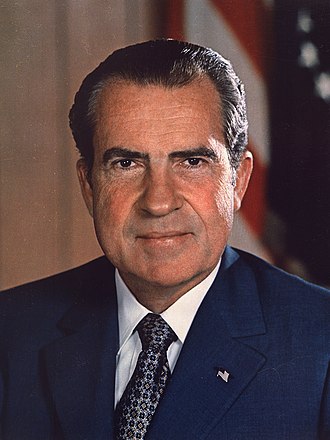
Richard M. Nixon served as the 37th President of the United States from January 1969 until his resignation in August 1974. In February 1971, he ordered the installation of a secret voice-activated taping system in the White House to preserve a historical record of his administration. Until the system's existence was revealed and dismantled in July 1973, the tapes captured Nixon directing major foreign policy initiatives, such as the opening to China, as well as his central role in the Watergate cover-up.
What Nixon talks about on the tapes
White House operations 4,718Presidential scheduling 2,225Public relations 1,784Presidential schedule 1,782Vietnam War 1,693Logistics 1,650Manolo Sanchez 1,626White House communications 1,400White House administration 1,399Presidential communication 1,243Henry Kissinger 1,191Foreign Policy 1,183
Conversations (21,010)
— Page 80 of 211President Nixon contacted the White House operator to place an outgoing call to his personal secretary, Rose Mary Woods. The brief exchange served as a logistical coordination to facilitate communication between the President and a key member of his staff. No further policy or administrative matters were addressed during this specific telephonic interaction.
President Nixon met with Vice President Agnew and Republican congressional leaders to discuss strategy regarding his recent speech on Vietnam and the administration's upcoming FY 1973 budget. The President and Henry Kissinger briefed the attendees on the Vietnam peace negotiations, emphasizing that the U.S. had made comprehensive offers while denouncing North Vietnamese intransigence and political maneuvering. Economic advisors, including George Shultz and Herbert Stein, presented the administration's fiscal plans, highlighting the importance of balancing the budget while supporting a transition to a peacetime economy through controlled spending and wage-price stabilization. Participants agreed on the necessity of maintaining a firm stance on defense and economic policy to solidify public support and improve the administration's negotiating leverage.
President Nixon held a brief, informal meeting with an unidentified woman to discuss the whereabouts of an unnamed individual. The participants confirmed that this person had not yet arrived at his office and verified his safety. No formal policy decisions were made, as the discussion focused solely on logistical coordination and staff status.
President Nixon summoned his personal aide, Stephen B. Bull, to the Oval Office for a brief morning meeting. The primary purpose of the discussion was the President's explicit request for the presence of special counsel Charles W. Colson. Bull complied with the instruction, marking the meeting as a logistical coordination effort to facilitate immediate contact with Colson.
President Nixon met with his aide Stephen B. Bull to coordinate administrative logistics regarding an upcoming engagement. The discussion focused on scheduling details and the timing of a meeting involving John B. Connally. This brief exchange served to finalize arrangements for the President's calendar.
President Nixon met with his economic advisors, John Connally, George Shultz, and Herbert Stein, to review the state of the economy and coordinate administration messaging. The discussion focused on addressing business confidence, managing the federal budget and spending, and navigating upcoming international trade and monetary negotiations. Nixon emphasized the need for a unified administration front to present an optimistic economic outlook while preparing for legislative battles, including the debt ceiling and potential gold policy changes.
President Nixon and Charles W. Colson met briefly to discuss scheduling matters involving H. R. Haldeman. The conversation focused on the necessity of increasing political involvement and urgency in their upcoming agenda. No specific policy decisions were finalized during this brief exchange.
President Nixon consulted with his personal secretary, Rose Mary Woods, to gauge the reception of his recent Vietnam speech among guests at a social gathering held the previous evening. Woods reported that attendees responded positively to the televised address, noting that it successfully diverted conversation away from political controversies. The discussion confirmed that the President’s messaging was well-received by his inner circle and supporters.
President Nixon met with Charles Colson and H.R. Haldeman to discuss the unfavorable media coverage regarding his recent Vietnam peace proposal. Nixon expressed frustration with the press, specifically criticizing newspapers like the New York Times and Washington Post for their negative framing and lack of objective reporting. The President directed his staff to proactively challenge these narratives by mobilizing friendly journalists and political allies to attack the media's divisive tone and emphasize positive public support for the administration's policy.
President Nixon initiates a call to Senator Paul J. Fannin of Arizona through the White House operator. The primary purpose of this brief interaction is for the President to request that the operator connect him directly with the Senator. No further substantive policy matters are addressed in this short exchange.
President Nixon held a brief meeting with his personal valet, Manolo Sanchez, in the Oval Office. The discussion functioned as a routine check-in between the President and a member of his domestic staff. No formal policy deliberations or substantive administrative decisions were recorded during this brief encounter.
President Nixon consulted with the White House operator to facilitate a telephonic communication with Senator Paul J. Fannin. This brief interaction served as a logistical precursor to a direct policy discussion between the President and the Senator. The conversation focused primarily on establishing this line of contact to address legislative or political matters of mutual interest.
In this Oval Office meeting, President Nixon, H. R. Haldeman, and Henry Kissinger discussed the political strategy surrounding Nixon’s recent Vietnam peace proposal speech, focusing on managing congressional and media reaction to the offer of unilateral troop withdrawal. The group also coordinated a defense against critics, such as Senator George McGovern, by highlighting evidence of North Vietnamese intransigence. Later, the President met with Dutch Prime Minister Barend W. Biesheuvel to review international relations, the strategic landscape in Asia and Europe, and the geopolitical implications of Nixon's upcoming trips to the People's Republic of China and the Soviet Union.
President Nixon called Senator Paul J. Fannin to extend birthday greetings before the Senator's planned trip to Europe. Fannin explained that he had canceled his travel plans due to the death of former Senator Carl T. Hayden. The two also briefly touched upon the President’s recent speech on Vietnam and acknowledged the bipartisan praise it received.
President Nixon initiates a brief telephone call through the White House operator to connect with Secretary of State William P. Rogers. The exchange serves as a logistical bridge to facilitate direct communication between the President and the Secretary. No substantive policy discussions occur, as the conversation is limited to the operator executing the President’s request to establish the connection.
President Nixon initiated this brief call to commend Secretary of State William P. Rogers for his recent performance and to vent frustrations regarding Vice President Spiro Agnew’s negativity during administration meetings. Nixon compared Agnew’s critical behavior unfavorably to his own loyal conduct while serving under President Eisenhower, noting that Agnew’s demeanor seemed to undermine the administration’s public messaging. The two also briefly touched upon Senator Barry Goldwater’s recent comments regarding North Vietnam.
President Nixon initiates a brief request for the White House operator to connect him with Alexander M. Haig, Jr. This interaction serves as a logistical bridge to facilitate a direct conversation between the President and his Deputy Assistant for National Security Affairs. No substantive policy matters are addressed in this short exchange beyond the logistical placement of the call.
President Nixon directs Alexander Haig to have Ambassador J. William Middendorf II join his upcoming meeting with the Prime Minister of the Netherlands to minimize the time commitment required from the President. By including the Ambassador, Nixon seeks to characterize the visit as a social call and create a scheduling buffer that allows him to excuse himself afterward. This arrangement serves to streamline the President's schedule by avoiding a planned individual follow-up session with the Ambassador.
President Nixon, Alexander Haig, and J. William Middendorf, II discussed the logistics surrounding Middendorf's upcoming resignation from his post. The participants coordinated the timing of the announcement and the transition process, with the President advising Middendorf to work out specific details with Maurice Stans. The meeting concluded with the President presenting a presidential money clip to Middendorf as a token of appreciation for his service, particularly regarding U.S.-Dutch relations.
President Nixon and Alexander P. Butterfield met to briefly review the scheduling logistics for H.R. Haldeman’s upcoming commitments. The discussion focused specifically on the timing and arrangements for a board of trustees meeting. The meeting concluded quickly after these scheduling details were addressed.
President Nixon directed the White House operator to place a telephone call to California Governor Ronald Reagan. This brief administrative interaction served as the initiation of a direct communication line between the President and the Governor. No further substantive discussion took place during this specific segment of the recording.
President Nixon initiated a telephone call to California Governor Ronald Reagan following a brief briefing from aide Stephen B. Bull regarding Henry Kissinger's schedule. While the specific substance of the discussion with Reagan is captured elsewhere, the interaction reflects the ongoing coordination between the White House and prominent Republican leaders. Bull’s presence served to facilitate administrative logistics ahead of the President's engagement.
President Nixon contacted the White House operator to place a telephone call to Cornelius A. Scott, the editor of the Atlanta Daily World. During the brief exchange, Nixon provided Scott's phone number to facilitate the connection. The primary purpose of this interaction was to arrange a direct communication between the President and the publisher of the prominent African American newspaper.
President Nixon initiated a phone call to Cornelius A. Scott, the editor of the Atlanta Daily World, to facilitate a direct line of communication with the influential African American newspaper executive. This outreach underscores the administration's efforts to engage with Black media leadership during the Nixon presidency. The primary action item was the successful establishment of this contact for a subsequent, more substantive discussion.
President Nixon and Alexander P. Butterfield met to review administrative scheduling matters and finalize items requiring the President’s signature. They briefly discussed the public and diplomatic reception of Nixon's recent Vietnam peace proposal speech delivered the previous day. The session concluded with logistical arrangements involving H.R. Haldeman and the management of the President's immediate calendar.
President Nixon consulted with Rose Mary Woods to coordinate logistical details regarding his schedule and pending communications. The discussion centered on tracking the location of Governor Ronald Reagan and managing a scheduled call with Cornelius Scott. These administrative arrangements reflect the President's ongoing efforts to streamline his outreach and appointments with key political figures.
President Nixon placed this personal telephone call to Cornelius A. Scott to offer condolences following the death of Scott's brother. During the exchange, the President also took the opportunity to commend the performance of Scott’s son, Stanley S. Scott, for his service on the White House staff. Mr. Scott expressed his gratitude for the call, noting that it provided him with significant personal relief and comfort.
President Nixon met with Henry Kissinger, Ronald Ziegler, and Rose Mary Woods to assess the domestic and political reception of his January 25 Vietnam peace proposal. Kissinger provided a detailed briefing on his efforts to explain the complexities of the proposal to congressional leaders and the press, specifically focusing on the administration’s strategy to maintain a unified front despite opposition. Nixon emphasized the importance of aggressive communication to counter critics and directed his staff to combat misinformation, reinforcing that the administration's current proposal represented the maximum extent of their concessions.
President Nixon and Governor Ronald Reagan discussed the need for national unity regarding U.S. peace proposals in Vietnam, emphasizing that a unified front is essential to force North Vietnam to negotiate. Following this strategic discussion, Reagan advocated for the appointments of William French Smith and Caspar Weinberger to potential roles within the administration, specifically the Supreme Court or Attorney General. Nixon explained his preference to nominate Richard Kleindienst as the immediate successor to John Mitchell due to the logistical challenges of transitioning a new official into the Justice Department, while acknowledging the high qualifications of Reagan's candidates.
President Nixon consulted with California Governor Ronald Reagan to coordinate political messaging regarding a new Vietnam peace proposal, emphasizing the need for a unified national voice to force North Vietnamese negotiations. Nixon also discussed personnel decisions within the Justice Department, explaining his preference for Richard Kleindienst to serve as Attorney General for the remainder of the term rather than installing a new appointee who would lack the necessary institutional knowledge. The two leaders additionally touched upon internal administrative personnel and ongoing political dynamics in California.
President Nixon instructed the White House operator to initiate a telephone call to Los Angeles County Sheriff Peter J. Pitchess. Upon realizing that the call could not be completed prior to his next scheduled appointment, Nixon directed the operator to postpone the attempt. No further policy or administrative business was conducted during this brief scheduling exchange.
President Nixon instructed the White House operator to place an outgoing telephone call to Representative M. Gene Snyder of Kentucky. The interaction served as a brief administrative coordination to facilitate direct communication between the President and the Congressman. No further policy discussion or substantive deliberation occurred during this brief exchange.
President Nixon met with Alexander P. Butterfield to provide specific instructions regarding the retrieval of an unidentified item. The discussion focused on the logistics and handling of this sensitive object. No further details regarding the nature of the item or subsequent actions are documented.
President Nixon and Alexander Haig discussed the preparation of a briefing book based on Henry Kissinger's recent work to effectively manage anticipated public and political inquiries. The President directed that a concise two-to-three-page list of questions and answers be drafted, specifically identifying William Safire or James Gannon as potential authors to refine the material. This document was intended for strategic distribution to members of Congress and the press to ensure a controlled and consistent administration message.
President Nixon consulted with an unidentified woman regarding the arrival of Treasury Secretary John B. Connally. He requested that Connally be brought to the Oval Office immediately upon arrival for a private briefing before the participation of other scheduled attendees. This directive prioritized Connally's input as the President managed his administrative agenda for the afternoon.
President Nixon consulted with the White House operator to initiate a telephone call with Los Angeles County Sheriff Peter J. Pitchess. The President ultimately decided to defer the call to a later time, determining that an immediate attempt would not be productive. No substantive policy discussions occurred during this brief interaction.
President Nixon consulted with Representative M. Gene Snyder of Kentucky following a brief connection through the White House operator. The discussion focused on legislative matters pertaining to the state of Kentucky. The conversation served as a preliminary coordination point for political developments within Snyder's district.
President Nixon contacted the White House operator to facilitate an immediate connection with Charles W. Colson. This brief administrative interaction served as a directive to reach a key member of the President's staff for consultation. No further discussion occurred during this short bridge to the subsequent call.
President Nixon consulted with the White House operator to facilitate a phone call with Congressman M. Gene Snyder. Upon learning that Snyder was currently unavailable, the President opted to postpone the outreach until he became free later in the hour. The exchange served as a brief administrative coordination to manage the President's upcoming schedule.
President Nixon attempts to initiate a call through the White House operator to an unspecified individual. The operator informs the President that the desired party is unavailable due to an ongoing meeting. No further substantive business is conducted during this brief exchange.
President Nixon instructed the White House operator to place all incoming calls on hold for the next ninety minutes. This directive served to clear the President's schedule for an upcoming private engagement or meeting. The operator confirmed the request, effectively ensuring a period of uninterrupted time for the President.
President Nixon initiated a brief telephone request to the White House operator to be connected with Special Counsel Charles W. Colson. This communication served as a logistical bridge to facilitate a direct conversation between the President and a key advisor. No substantive policy matters were discussed during this specific operator-assisted connection.
President Nixon consulted with the White House operator to facilitate a telephone connection with his special counsel, Charles W. Colson. The brief exchange served as an administrative bridge to initiate direct communication between the President and Colson. No substantive policy matters were addressed during this initial operator-assisted call setup.
President Nixon met with his aide Stephen B. Bull in the Oval Office to coordinate his official schedule. The discussion focused primarily on arranging a meeting with John B. Connally. Following the brief briefing, the session concluded with Bull’s departure.
President Nixon met with John Connally and key economic advisors Arthur Burns, George Shultz, and Herbert Stein to conduct an extensive review of the U.S. economy, including unemployment data, retail sales, and the federal budget. The participants discussed strategies to accelerate federal spending to stimulate growth, concerns regarding the lack of confidence among international financial institutions, and the delicate nature of ongoing trade negotiations with Europe, Japan, and Canada. Nixon directed his team to prioritize the rapid deployment of authorized funds and ordered a follow-up analysis on identifying the specific demographics of the unemployed.
President Nixon and H.R. Haldeman briefly conferred regarding the President's upcoming schedule at the Executive Office Building. The discussion focused on logistical arrangements for Nixon's movements within the White House complex. No major policy decisions were reached during this short administrative exchange.
President Nixon met with his valet, Manolo Sanchez, in the Oval Office to coordinate the President's immediate schedule. The brief discussion served to finalize plans for Nixon's departure from the office. Following this exchange, the two men exited the room together.
President Nixon initiates a request through the White House operator to place an outgoing telephone call. The exchange is brief, serving strictly as a logistical interaction to establish a connection with an unspecified party. No substantive policy discussions or administrative decisions are recorded during this brief communication.
President Nixon and Henry Kissinger discuss the positive public and political reception to the President’s January 25 Vietnam speech, specifically noting the effectiveness of their late-night preparation sessions. Nixon directs Kissinger to formalize a Q&A document drafted by William Safire and Patrick Buchanan for distribution to the Cabinet and Congressional leaders to clarify administration policy. Additionally, the two analyze North Vietnamese intentions regarding POWs, with both men concluding that Hanoi is unlikely to offer a prisoner release in exchange for a U.S. troop withdrawal.
President Nixon and Charles Colson discuss strategies to sustain public support and national unity following the President’s recent televised speech on the Vietnam peace plan. Nixon directs Colson to coordinate with Alexander Haig to have Patrick Buchanan or William Safire draft a Q&A document highlighting the plan’s benefits regarding POWs to shape public messaging. They also discuss leveraging Vice President Agnew and other administration officials for further public outreach and mobilizing media support to neutralize critics.
President Nixon, H.R. Haldeman, Charles Colson, and other staff members discuss communication strategy following a televised speech, specifically focusing on the favorable public reaction and the need to capitalize on it. They coordinate the dissemination of a Q&A document to help the press and administration officials defend the President's peace plan. Additionally, the group brainstorms a publicity stunt involving a surprise live telephone call from the President to Henry Kissinger during a public dinner to highlight the administration's unity and focus.
President Nixon instructed the White House operator to place a call to Bryce N. Harlow on behalf of Chief of Staff H. R. Haldeman. This administrative interaction was a routine request to facilitate communication between the President's senior staff and Harlow. The operator successfully initiated the process to connect the two parties as directed.
President Nixon contacted the White House operator to facilitate a telephone call to Frank Stanton, the president of Columbia Broadcasting System (CBS). This interaction served as a logistical step to initiate direct communication between the President and the broadcasting executive. No further policy discussions occurred during this brief exchange.
President Nixon called CBS President Frank Stanton to offer formal commendation for the professionalism of the technical crews who produced recent broadcasts, specifically citing Julie Nixon Eisenhower's Christmas special, Dan Rather's interview, and his own January 25, 1972, Vietnam address. Stanton reciprocated by sharing positive viewership ratings for the President's recent speech and noting the high public engagement. The conversation concluded with Nixon requesting that Stanton document his praise in the employees' personnel files and convey his appreciation to CBS Chairman William S. Paley.
President Nixon instructed the White House operator to facilitate telephone calls with Secretary of the Treasury John B. Connally and Office of Management and Budget Director George P. Shultz. The President specifically requested that Connally not be interrupted if he was currently in a meeting, but prioritized reaching both men for subsequent consultations. This exchange reflects Nixon's routine coordination of high-level administrative communication regarding economic policy.
President Nixon contacted George P. Shultz to request an immediate, in-person meeting at the Executive Office Building. Nixon intended to consult with Shultz briefly prior to a scheduled meeting with Congressman Page Belcher. Shultz agreed to the request and promptly headed to the President's office.
President Nixon directs the White House operator to contact Secretary of the Treasury John Connally immediately. He emphasizes that if Connally is occupied in a meeting, he must be interrupted to take the call. This request highlights the urgent priority Nixon placed on communicating with his Treasury Secretary during this period.
President Nixon contacted George P. Shultz to request an immediate, brief meeting at the Old Executive Office Building. The primary purpose of the call was to coordinate a discussion between the two men regarding an unspecified matter. Nixon indicated that he had a prior commitment with Page Belcher but intended to consult with Shultz directly afterward.
President Nixon initiates a brief telephone call to the White House operator to facilitate a connection with Secretary George W. Romney. The conversation is strictly logistical, serving as a functional request to reach the Secretary of Housing and Urban Development. No further substantive policy discussions occur during this brief interaction.
President Nixon held a brief, informal interaction with the White House operator while located in the Old Executive Office Building. The exchange remained lighthearted and limited in scope, focusing on a playful remark regarding the operator's service. No substantive policy matters or administrative decisions were addressed during this short communication.
President Nixon initiated this call to thank Secretary of Housing and Urban Development George Romney for his supportive reaction to the President's recent televised speech regarding Vietnam. Romney expressed his approval of Nixon’s decision to disclose previously secret peace negotiations, noting that the transparency provided national reassurance. The conversation concluded with Nixon affirming his commitment to the diplomatic strategy despite anticipated initial rejections from the North Vietnamese.
President Nixon met with George Shultz, John Connally, and other advisors to assess the administration's economic policy and strategy regarding the Federal Reserve. The participants discussed the money supply (M-1 and M-2), the lack of currency convertibility as a strategic advantage, and the necessity of pressuring the banking community to increase lending. Additionally, they reviewed potential personnel appointments to the Council of Economic Advisers and the Federal Reserve Board, specifically focusing on the goal of ensuring more favorable policy alignment with the White House.
President Nixon and Secretary of the Treasury John B. Connally discussed strategic U.S. positions regarding international monetary policy, specifically maintaining firm control over dollar convertibility despite dissent from Federal Reserve Chairman Arthur Burns. They coordinated plans to exert economic pressure on Canada in trade negotiations to signal strength to Japan and Europe, with Nixon suggesting he might postpone a meeting with Prime Minister Pierre Trudeau to show dissatisfaction. Additionally, Connally briefed the President on India's financial aid to Bangladesh, prompting a plan to challenge National Security Advisor Henry Kissinger on U.S. foreign aid priorities during their next meeting.
President Nixon initiated a brief telephone communication through the White House operator to request a call with Peter M. Flanigan. The interaction served as a logistical coordination to facilitate a direct conversation between the President and his assistant. No further policy or administrative matters were addressed during this short exchange.
President Nixon and Peter Flanigan discussed the status of school enrollment efforts for the children of Marina von N. Whitman, a priority appointment for the administration. They confirmed that one child was accepted at Sidwell Friends while the other was pending at Landon, with backup plans in place for the National Cathedral School. The conversation highlighted the coordinated intervention of administration officials, including Secretary of State William P. Rogers, to secure these placements and ensure Whitman's successful recruitment.
President Nixon met with Henry Kissinger to discuss the administration's strategic response to North Vietnam's rejection of the latest U.S. peace proposal, agreeing to maintain a tough, offensive public relations stance. Following this, the President held an extensive session with Representative Page Belcher, Secretary of Agriculture Earl Butz, and Clark MacGregor to address agricultural policy, congressional relations, and the political necessity of better maintaining ties with key legislative allies. During the meeting, Nixon authorized a mortgage guarantee for a Tulsa hospital and emphasized his desire for more frequent, direct communication with his congressional supporters to improve morale and political coordination.
President Nixon contacted the White House operator to facilitate a telephone connection with Clark MacGregor. The brief exchange served as an administrative request to reach the President's former Congressional liaison and campaign advisor. No further substantive policy matters were discussed during this short communication.
President Nixon directed Clark MacGregor to contact officials in Tulsa, Oklahoma, to authorize the finalization of an pending agreement. Nixon clarified that this move followed his meeting with Congressman Page Belcher, who was present during the call. MacGregor committed to immediately instructing the Tulsa parties to proceed with signing the necessary documentation.
President Nixon contacted the White House operator to facilitate an urgent outgoing call to special counsel Charles W. Colson. The interaction served as a logistical bridge to initiate a direct line of communication between the President and a key political aide. No substantive policy discussions occurred during this brief exchange, which functioned solely to connect the two parties.
President Nixon consulted with the White House operator to locate Charles W. Colson, who was reportedly attending an event at the Sheraton Park Hotel. Upon learning Colson's location, the President opted against interrupting him during the function. He ultimately directed the operator to convey that he would contact Colson the following day instead.
President Nixon instructed the White House operator to place a telephone call to his close friend and confidant, Charles G. “Bebe” Rebozo. The interaction served as a brief administrative request to facilitate private communication between the two. No substantive policy matters or further developments were discussed during this short exchange.
President Richard Nixon and his close associate Charles G. "Bebe" Rebozo held a brief telephone conversation that was largely redacted for personal privacy. Given the limited available transcript and the withdrawal of the primary content, no substantive policy or political decisions are discernable from the public record. The exchange appears to be a private check-in between the President and a trusted confidant.
President Nixon contacted the White House operator to place an outgoing call to Hobart D. “Hobe” Lewis. The exchange was a brief administrative interaction focused on connecting the President with the publisher of Reader's Digest. No substantive policy discussions occurred during this brief operator request.
President Nixon and Hobart D. Lewis discuss the logistics and ceremonial details for an upcoming dinner and Medal of Freedom presentation honoring DeWitt and Lila Wallace. Beyond social arrangements, the conversation shifts to foreign policy, where Nixon expresses confidence that North Vietnam will eventually negotiate after a failed offensive. He emphasizes that his administration has already offered a comprehensive peace proposal, including prisoner of war releases and a ceasefire, despite ongoing rejection from Hanoi.
President Nixon initiated this brief telephone call to check on Henry Kissinger's current whereabouts and coordinate his return to the White House. Nixon directed Kissinger to prioritize his immediate obligations before reporting back for a debriefing session. The President jokingly remarked that he intended to admonish Kissinger upon his arrival to discuss ongoing matters.
President Richard M. Nixon met with his valet, Manolo Sanchez, in the Oval Office to discuss personal administrative concerns. The brief exchange focused primarily on the ambient temperature settings within the office. No significant policy decisions or executive actions resulted from this interaction.
President Nixon and Alexander P. Butterfield met to coordinate administrative details regarding upcoming honors and official representation. They reviewed citations for the Presidential Medal of Freedom to be awarded to Raymond K. Price, Jr. and John K. Andrews, Jr. Additionally, they discussed the selection of Deputy Attorney General Richard G. Kleindienst to serve as the President’s representative at the funeral of former Senator Carl T. Hayden.
President Nixon met with H.R. Haldeman and Henry Kissinger to discuss the administration’s strategy for managing negative press coverage regarding Vietnam negotiations and the upcoming trip to the People's Republic of China. Nixon emphasized the need to frame his political opponents, particularly Democrats like Edward Kennedy and Clark Clifford, as favoring "surrender" and communism, while rejecting their criticisms of his ceasefire proposals as factually inaccurate. Additionally, Nixon directed staff to exclude The Washington Post from press pool invitations for the China trip and tasked his team with coordinating a more aggressive, unified media counter-attack against Democratic critics.
President Nixon, Rose Mary Woods, and Stephen B. Bull discussed the reception of a recent dinner event, contrasting Henry Kissinger's successful performance against the perceived hostility of Senator Frank Church. The conversation touched on the President's frustrations with antagonistic press coverage and his refusal to attend future industry dinners. Additionally, they reviewed legal updates regarding a stock case involving Charles Rebozo and coordinated Woods's upcoming attendance at the DeWitt Wallace dinner and her work preparations for the President's forthcoming trip to the People's Republic of China.
President Nixon met with political analyst Richard Scammon and aide Charles Colson to discuss strategies for appealing to the American majority, particularly regarding social issues like school busing, crime, and housing. The participants explored how these issues influence electoral coalitions and analyzed the perceived disconnect between the values of the public and the views held by the intellectual elite. Nixon reflected on the importance of national leadership, the role of political courage, and the necessity of maintaining American influence and strength in a global context.
President Nixon and Stephen B. Bull briefly met in the Oval Office to coordinate the President’s schedule, specifically regarding a forthcoming meeting with Secretary of Commerce Maurice H. Stans. The conversation also touched upon broader political themes, with the President reflecting on the perceived moral decay of Washington and his belief in a silent majority that remained aligned with traditional American ideals. No major policy decisions were reached during this brief administrative exchange.
President Nixon met with Maurice Stans to discuss the formal announcement of Stans’s resignation from his cabinet position and his subsequent transition to a new political role. The participants reviewed the status of the economy and business policy, specifically addressing the Federal Trade Commission's actions toward cereal companies and the administration's relationship with the business community. Toward the conclusion of the meeting, Peter G. Peterson and Peter M. Flanigan joined the President to finalize the protocol and media strategy for the forthcoming personnel announcements.
President Nixon contacted the White House operator to place an outgoing call to Secretary of the Treasury John B. Connally. The brief exchange served as a routine administrative request to facilitate direct communication between the President and his cabinet member. This short interaction was preparatory to a more substantive discussion regarding executive branch business.
President Nixon held a brief administrative interaction with the White House operator to facilitate telephonic communications. The dialogue served to manage outgoing connections from the Oval Office, reflecting the President's routine reliance on switchboard staff for official outreach. No substantive policy discussions or major strategic decisions occurred during this brief exchange.
President Nixon met with Alexander P. Butterfield, John B. Connally, and various aides to manage administrative matters, sign official documents, and coordinate the President’s daily schedule. The participants discussed staffing appointments, including the potential liaison role of J. Willard Marriott and the selection of personnel for government positions. Additionally, the group reviewed upcoming meetings involving Charles W. Colson and H.R. Haldeman at Camp David to facilitate future policy planning.
President Nixon and John Connally discuss the success of Connally’s recent speech in Richmond, which drew significant crowds and positive reception by emphasizing populist, anti-bureaucratic themes. The conversation shifts to economic strategy, specifically the Administration's desire to encourage bank lending and address bankers' fears regarding Federal Reserve monetary policy and inflation. Additionally, they coordinate on staffing, including the appointment of Peter G. Peterson and the recruitment of new talent for administrative posts.
President Nixon met with H. R. Haldeman and Charles Colson to discuss administration political strategy, specifically focusing on labor relations, social issues like busing, and the President's upcoming campaign schedule. They explored potential outreach to AFL-CIO leader George Meany, debated how to best leverage public sentiment regarding the Vietnam War, and reviewed polling insights from Richard Scammon. The participants also finalized decisions regarding personnel shifts, including the replacement of military aides and the potential appointment of Richard V. Allen to a foreign policy or political advisory role.
President Nixon contacted the White House operator to place an outgoing call to Senate Majority Leader Mike Mansfield. The President specifically requested that the operator reach both the Senator and his wife, Sandra Mansfield. This brief administrative exchange served as the preparatory step for a personal or professional communication between the President and the Senate leadership.
President Richard M. Nixon met with Deputy Assistant to the President Alexander P. Butterfield in the Oval Office to conduct administrative or operational business. While the specific content of the discussion remains unintelligible due to a lack of transcript records, the meeting involved the routine coordination of White House activities. No definitive decisions or policy outcomes can be determined from the available documentation.
President Nixon consulted with the White House operator to facilitate an outgoing call. The interaction served strictly as a logistical bridge to connect the President with another party for a separate conversation. No substantive policy matters or administrative decisions were addressed during this brief exchange.
President Nixon met with his aide Stephen B. Bull to review and manage Henry A. Kissinger’s upcoming schedule. The conversation focused on the logistical coordination of Kissinger's itinerary. No further actions were recorded regarding this administrative briefing.
President Nixon and his aide, Stephen B. Bull, met to coordinate and review administrative logistics regarding the President's personal schedule and Henry Kissinger's upcoming agenda. The discussion focused on managing the President's availability for reading time and ensuring alignment between executive calendar requirements and Kissinger's travel or meeting itinerary. No major policy decisions were recorded during this brief administrative session.
President Nixon called Senate Majority Leader Mike Mansfield to express appreciation for his public support of the administration's recent Vietnam peace proposal and to discuss the ongoing secret negotiation strategy. Nixon emphasized that the U.S. continues to engage with both the Soviet Union and China regarding Vietnam while maintaining strict confidentiality to protect sensitive diplomatic channels. Additionally, Nixon outlined his upcoming travel itinerary for his historic trip to China, requested a bipartisan leadership breakfast for February 17, and proposed facilitating a visit for Mansfield to China during future discussions with Chinese officials.
President Nixon met with Senate Majority Leader Mike Mansfield to express gratitude for Mansfield’s recent public support regarding the administration's ongoing diplomatic efforts. The discussion centered on maintaining domestic and legislative momentum for a forthcoming peace proposal intended for international negotiations. Nixon emphasized the importance of keeping these proposals at the forefront of public discourse to maximize their impact and prospects for acceptance.
President Nixon instructed the White House operator to place an outgoing call to AFL-CIO President George Meany. This brief exchange served as a logistical directive to facilitate communication between the President and the labor leader. The conversation concluded with the operator confirming the request to connect the two parties.
President Nixon discusses the risks of releasing records of secret negotiations, emphasizing the need to protect sensitive diplomatic communications to maintain the possibility of future private talks. He explains his strategic decision to disclose only the facts of the discussions rather than full transcripts to safeguard national security interests. Additionally, Nixon touches upon the administration's delicate efforts to manage relationships with China and the Soviet Union regarding ongoing international issues.
President Nixon consulted with the White House operator to determine the whereabouts of AFL-CIO President George Meany, who was scheduled to host the White House Fellows. Nixon requested to be notified immediately upon Meany’s return to his office. This brief administrative exchange served to coordinate a pending communication or meeting between the President and the labor leader.
President Nixon contacted the White House operator to facilitate an official call to Jerry V. Wilson, the Chief of the Washington Metropolitan Police Department. The brief interaction served strictly as a logistical request to initiate communication with the Chief. No further policy discussions or substantive developments occurred during this exchange.
President Nixon consulted with the White House operator to facilitate communication regarding George Meany's schedule. The brief interaction focused on organizing a return call to the labor leader. The conversation underscores the administrative coordination required to manage high-level external relationships during the President's term.
President Nixon discusses scheduling logistics with the White House operator regarding a planned trip, emphasizing the need to adjust to Hawaii time zones before an event on the 17th. He specifies his intent to arrive early to ensure he is properly acclimated for the transition. Additionally, the President expresses a desire to organize a bipartisan event, though the details of this gathering remain brief.