Nixon, Richard M. (President)
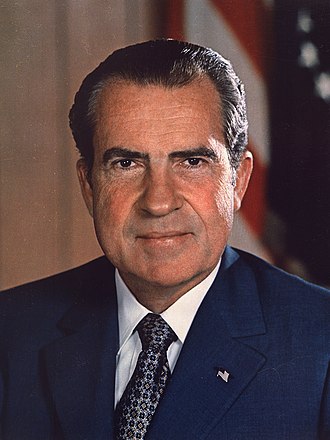
Richard M. Nixon served as the 37th President of the United States from January 1969 until his resignation in August 1974. In February 1971, he ordered the installation of a secret voice-activated taping system in the White House to preserve a historical record of his administration. Until the system's existence was revealed and dismantled in July 1973, the tapes captured Nixon directing major foreign policy initiatives, such as the opening to China, as well as his central role in the Watergate cover-up.
What Nixon talks about on the tapes
White House operations 4,718Presidential scheduling 2,225Public relations 1,784Presidential schedule 1,782Vietnam War 1,693Logistics 1,650Manolo Sanchez 1,626White House communications 1,400White House administration 1,399Presidential communication 1,243Henry Kissinger 1,191Foreign Policy 1,183
Conversations (21,010)
— Page 81 of 211President Nixon met with his aide, Stephen B. Bull, to coordinate logistics for upcoming presidential activities, including the scheduling of photography sessions. They discussed the necessity of managing the President's itinerary to prevent exhaustion, referencing past experiences where fatigue impacted staff performance. This discussion served to refine the planning for upcoming travel and high-profile public appearances.
President Nixon initiated this call with D.C. Police Chief Jerry V. Wilson to commend him on a 13% reduction in the District’s crime rate, a milestone the President highlighted in his recent State of the Union address. Nixon requested that Wilson convey his personal appreciation to the police inspectors for their contributions to this success. The brief discussion also touched upon Nixon's recent meeting with Frank Rizzo and concluded with the President extending well-wishes for the health of Wilson’s wife.
President Nixon and Metropolitan Police Chief Jerry V. Wilson briefly discussed the logistics and feasibility of facilitating personal meetings regarding ongoing law enforcement or administrative matters. The two agreed to initiate these discussions, with Wilson expressing confidence that the involved parties would be receptive to the proposed direct approach. The conversation concluded with a plan to proceed with coordinating these interactions.
President Nixon instructed the White House operator to place a telephone call to Los Angeles County Sheriff Peter J. Pitchess. The President noted that the Sheriff was currently hospitalized and directed the operator to locate the appropriate contact number. This interaction served solely as a logistical request to facilitate communication between the President and the Sheriff.
President Nixon instructed the White House operator to strictly limit the number of press photo opportunities during his daily schedule to avoid repetitive and unnecessary media coverage. He requested that the operator monitor his calendar and alert him whenever multiple photo requests arise so that he can consolidate or decline them. Additionally, the President commended the operator for her role in achieving a recent 13% reduction in crime within the district and requested that she convey his appreciation to the relevant staff.
President Nixon initiated this phone call to check on the recovery of Los Angeles County Sheriff Peter J. Pitchess following a recent surgery. The two men discussed their mutual health, with Pitchess noting the positive impact of a personal note sent by the President. Nixon concluded the conversation by encouraging Pitchess’s recovery and jokingly requesting that the Sheriff represent him at the Bohemian Grove once he returns to duty.
President Nixon held a brief meeting with Los Angeles County Sheriff Peter J. Pitchess to discuss administrative coordination and personal matters. During the exchange, the President acknowledged the presence of Philadelphia Police Commissioner Frank Rizzo and expressed his well-wishes regarding the health of Pitchess’s wife, who was undergoing surgery. The conversation served primarily as a professional courtesy to maintain relations with prominent law enforcement officials.
President Nixon initiates a brief telephone call through the White House operator to contact Attorney General John N. Mitchell. The primary purpose of the communication is to establish a direct line of dialogue between the President and his Attorney General regarding official business. This interaction serves as a routine administrative request to facilitate an urgent or scheduled consultation.
President Nixon consulted with the White House operator to facilitate an urgent telephone call to an unidentified individual. The communication attempt proved unsuccessful, as the operator was unable to complete the connection. No further developments occurred during this brief interaction.
President Nixon consulted with a White House operator to facilitate an outgoing telephone connection. The interaction served as a routine logistical step to establish communication for an intended call. No further substantive policy or strategic discussions occurred during this brief exchange.
President Nixon and John Mitchell discussed the positive reception of the President's recent Vietnam speech, agreeing that media coverage was unexpectedly favorable compared to the hostile reaction from some congressional leaders. The pair also coordinated the integration of Maurice Stans into administration activities to boost his morale and affirmed the strategic appointment of Kenneth Rush to the Defense Department. The conversation concluded with Nixon confirming their upcoming Friday meeting despite his temporary departure for Camp David.
President Nixon met with John N. Mitchell to offer well wishes following Mitchell's recent surgery and recovery. Beyond these personal pleasantries, the two discussed administrative confidence in their current political and legislative strategy, specifically referencing cabinet and legislative leadership meetings. The conversation concluded with Nixon emphasizing his reliance on Mitchell's continued involvement in the administration.
President Nixon met with aides Alexander P. Butterfield and Stephen B. Bull to finalize logistical arrangements, including helicopter transport for a trip to Camp David and upcoming photography opportunities. Following these internal briefings, the President conducted a brief follow-up telephone call with AFL-CIO President George Meany. The discussion primarily focused on administrative scheduling and coordinating personal travel plans prior to the President's upcoming engagements.
President Nixon reached out to AFL-CIO President George Meany to offer private briefings regarding ongoing Vietnam peace negotiations and defense budget priorities. Nixon proposed that Henry Kissinger and George Shultz meet with Meany to provide detailed insights into the administration's strategic efforts, specifically emphasizing the necessity of an honorable withdrawal from Vietnam and the need to counter the growing Soviet naval threat. Meany agreed to the briefings, and both parties discussed the importance of maintaining a firm stance against congressional deadline amendments that could undermine the administration's bargaining position.
President Nixon initiated a call to the White House operator to be connected with George P. Shultz. The conversation served as a brief administrative request to facilitate this communication with the Director of the Office of Management and Budget. No policy discussions took place during this short exchange.
President Nixon met with aide Stephen B. Bull to coordinate his daily schedule and upcoming meetings. The discussion centered on finalizing a 3:30 p.m. appointment and arranging for Henry Kissinger to brief the President on recent diplomatic talks with Canadian officials. Additionally, the pair touched upon scheduling a small press panel event and addressed the President’s ongoing interest in the defense budget.
President Nixon initiated a brief communication with the White House operator to facilitate an outgoing call. The conversation serves primarily as a logistical exchange to connect the President with another party. No substantive policy discussions or administrative decisions were recorded during this brief interaction.
President Nixon received an update from the White House operator regarding the location of Office of Management and Budget Director George P. Shultz, who was currently testifying on Capitol Hill. Upon learning that Shultz would not return until late afternoon, the President declined the offer to track him down. Nixon decided to pursue an alternative method for handling the matter instead of waiting for Shultz's return.
President Nixon held a brief, informal check-in with the White House operator to verify operational status and telephone connectivity. The interaction served as a routine administrative confirmation regarding the President's immediate communication capabilities. No substantive policy matters or strategic decisions were addressed during this brief exchange.
President Nixon and H. R. Haldeman met to coordinate administrative scheduling and discuss George P. Shultz’s upcoming testimony. They evaluated the President's recent outreach to AFL-CIO leader George Meany, specifically analyzing Meany’s reaction and the potential for a follow-up meeting with Shultz. The conversation touched upon broader labor relations, including comparisons between labor leaders and business executives, alongside the political implications of recent legislative amendments.
President Nixon and Henry Kissinger discussed the political fallout from Nixon's recent peace proposal speech regarding Vietnam, emphasizing the need to portray Democratic critics as advocating for surrender. They analyzed the effectiveness of Kissinger's media briefings in countering skepticism and noted that the President's personal involvement in negotiations required a more aggressive, unified public relations strategy. Additionally, the pair reflected on the administration's foreign policy achievements, including upcoming trips to the Soviet Union and the People's Republic of China, while expressing disdain for intellectuals and media figures who they felt consistently maligned the President's leadership.
President Nixon held a brief meeting with Stephen B. Bull to discuss broad geopolitical themes and the perceived ideological threats posed by the Soviet Union and China. The conversation focused on Nixon's concerns regarding the national character of these nations and the potential dangers of intellectual stagnation or complacency within the American government. No formal policy decisions were reached, as the discussion primarily consisted of the President articulating his critical views on international relations and political leadership.
President Nixon and H.R. Haldeman met to coordinate White House public relations strategies, focusing on the announcement of Marina von Neumann Whitman to the Council of Economic Advisers and potential attendance at a sickle cell anemia fundraiser. The discussion pivoted to a broader political strategy involving a 'vicious' counterattack against Vietnam critics, framing them as advocates of surrender and supporters of a communist government. Nixon stressed the importance of aggressive, unified messaging and expressed frustration with Henry Kissinger’s reluctance to utilize staff expertise—specifically that of John Scali—in refining public communication regarding peace initiatives.
President Nixon and Henry Kissinger met to discuss managing media optics and political criticism surrounding the administration’s Vietnam policy and upcoming diplomatic activities. Kissinger addressed North Vietnam’s use of selective record excerpts to manipulate the narrative on POW negotiations, and the pair planned a briefing for Ronald Ziegler to clarify the U.S. position on cease-fire terms versus the enemy’s demands. Additionally, they reviewed strategy regarding Rainer Barzel’s opposition to West German treaties, agreeing to maintain a neutral stance to avoid unnecessary involvement in German domestic affairs while leveraging the situation for future diplomatic gains with the Soviet Union.
President Nixon met with Henry Kissinger and West German politician Rainer Barzel to discuss the current state of Vietnam peace negotiations, Soviet foreign policy, and U.S.-European relations. Nixon emphasized a pragmatic, unsentimental approach to diplomacy, warning that the Soviet Union remains focused on fragmenting European unity and neutralizing West Germany despite superficial changes in tone. The discussion also addressed the upcoming presidential trips to China and the Soviet Union, with Nixon reaffirming that the U.S. would not compromise its commitments to NATO or the security of the Federal Republic of Germany.
President Nixon, Henry Kissinger, and Stephen Bull met to coordinate the administration's public relations strategy following Nixon’s January 25 Vietnam peace proposal speech. They discussed favorable French press coverage and planned media engagement, specifically regarding upcoming *Time* and *Life* magazine features and interviews with journalist Jerrold Schecter. Additionally, the group reviewed administrative scheduling, including the signing of executive orders and updates regarding the health of Secretary of the Treasury John Connally.
President Nixon met with administration officials, including Myles J. Ambrose, John N. Mitchell, and Dr. Jerome H. Jaffe, to formalize the launch of a comprehensive federal drug enforcement initiative. The discussion focused on a three-pronged strategy involving international supply control, treatment and prevention programs, and intensified law enforcement efforts against drug traffickers. Nixon formally appointed Ambrose to lead these consolidated enforcement activities, emphasizing the administration's commitment to aggressively pursuing drug pushers as a top priority.
President Nixon met with John Ehrlichman and various guests to preside over the presentation of the Encyclopedia Judaica, which included discussions on U.S.-Israeli relations and the significance of Jewish heritage. Following the ceremony, Nixon and Ehrlichman transitioned into a private strategy session regarding domestic policy, specifically addressing the administration's stance on busing, the potential for a constitutional amendment, and the political implications of housing integration. They also evaluated ongoing projects, including the Bicentennial park proposal and the political viability of implementing a Value Added Tax (VAT) in an election year.
President Nixon met with Stephen B. Bull to coordinate logistics for a White House dinner honoring DeWitt and Lila Acheson Wallace, focusing on protocol, lighting, and the President's toast. The discussion also addressed the administration's stance on magazine postal subsidies, specifically ensuring industry support for the legislative package. Furthermore, Nixon and his staff decided to postpone efforts to revive the Supersonic Transport (SST) project until after the upcoming election, prioritizing it instead as a key initiative for his potential second term.
President Nixon contacted the White House operator to place an urgent personal call to Joanne Goldwater Ross, the daughter of Senator Barry Goldwater. He requested the operator reach her in Arizona to extend well-wishes prior to her impending wedding ceremony. The conversation functioned solely as a logistical request to facilitate this brief outreach.
President Nixon consulted with the White House operator regarding a previously requested telephone call to Joanne Goldwater Ross. Upon learning that the operator was unable to reach her, the President decided against further attempts. He concluded the brief exchange by instructing the operator to drop the matter.
President Nixon consulted with the White House operator to finalize the logistics and program details for an upcoming formal dinner involving the Wallaces. They discussed the sequence for toasts, the handling of the musical entertainment, and the necessity of preparing a typed script to ensure the President could read his remarks clearly during the event. The conversation also included a brief administrative request to facilitate a phone call for Joanne Goldwater Ross regarding her wedding.
President Nixon and his valet, Manolo Sanchez, discuss the climate settings within the Oval Office. The conversation centers on a disagreement regarding the room's temperature, with the President suggesting it feels warm while Sanchez perceives it as cold. No policy or administrative decisions were made during this brief exchange regarding the environment of the workspace.
President Nixon met with Rose Mary Woods and Stephen B. Bull to finalize the seating arrangements and logistics for a White House dinner honoring DeWitt and Lila Wallace. The discussion focused on balancing the guest list to ensure a lively atmosphere while navigating the last-minute attendance changes caused by a flu outbreak. Additionally, the President reviewed various administrative matters, including incoming correspondence, potential fundraising requests, and his own upcoming travel and scheduling preferences.
President Nixon and Rose Mary Woods confer to finalize the guest list for an upcoming White House dinner honoring DeWitt and Lila Wallace. The discussion focuses on balancing the attendance of high-profile political figures, such as the Mitchells and various cabinet members, with the logistical challenge of filling remaining tables. Nixon and Woods deliberate on potential last-minute additions to ensure the event's social success and political utility.
President Nixon met with his aide Stephen B. Bull to discuss personal logistical arrangements and social planning. The conversation focused on identifying suitable individuals for a specific event or engagement while ensuring the details remained confidential to maintain an element of surprise. Nixon provided instructions regarding potential attendees, specifically expressing interest in including single men and specific associates of the Walson family.
President Nixon met with Stephen B. Bull and an unidentified individual to facilitate a brief introduction. The primary purpose of this encounter was to introduce Frank A. Bonadio, a prominent labor leader, to the President. The meeting concluded shortly after these formalities were exchanged without significant policy discussion.
President Nixon met with the Construction Industry Collective Bargaining Commission to review the progress of labor-management relations and wage stabilization efforts in the construction sector. The discussion focused on the success of the Commission's voluntary approach to curbing inflation, the role of craft boards in fostering industry cooperation, and the broader integration of productivity goals. Nixon commended the participants for their responsible leadership and collaborative efforts, emphasizing the importance of keeping the industry's management in the hands of construction professionals while continuing to modernize labor practices.
President Nixon and Press Secretary Ronald Ziegler met briefly to coordinate logistical details regarding the President’s schedule and an upcoming photography session with Oliver F. Atkins. The discussion focused on managing the timing of these commitments, with the President directing that the session occur following his meeting with the Attorney General. The participants reached a consensus on the scheduling adjustment before Ziegler concluded the meeting.
President Nixon met with his aide, Stephen B. Bull, to review and finalize the President’s upcoming daily schedule. The primary focus of the discussion was coordinating logistics for a scheduled meeting with John N. Mitchell. Bull departed the Oval Office shortly thereafter, having completed the administrative briefing.
President Nixon consulted with an unknown individual regarding a birthday acknowledgment for Foster G. McGaw. The discussion centered on a reminder provided by Maurice H. Stans to ensure the President recognized the milestone. The brief meeting concluded with instructions to facilitate a meeting with the individual in question.
President Nixon, John Mitchell, and H.R. Haldeman met to coordinate the transition of the Attorney General’s office, specifically timing Mitchell’s resignation to coincide with the President's upcoming trip to the People's Republic of China. Mitchell advocated for the simultaneous Senate confirmation of Richard Kleindienst as his successor and L. Patrick Gray as Deputy Attorney General, expressing confidence in their approval despite potential political opposition. The participants also discussed administrative matters, including the presentation of the Encyclopedia Judaica to Martha Mitchell and the political outreach efforts involving Max Fisher.
President Nixon met with his aide Stephen B. Bull to coordinate logistical arrangements for an upcoming photo feature in Life magazine. They discussed the inclusion of Press Secretary Ronald L. Ziegler and National Security Advisor Henry A. Kissinger in the session. The brief meeting focused on integrating these photography sessions into the President's existing schedule.
President Nixon met with his personal valet, Manolo Sanchez, in the Oval Office for a brief exchange. Their conversation focused on mundane logistical matters, specifically regarding a briefcase and the residence, alongside a casual comment about the current weather. No significant policy decisions were recorded during this short interaction.
President Nixon met with Stephen B. Bull to review photographs intended for an upcoming Life magazine feature. The discussion centered on images of Henry Kissinger and those taken by White House photographer Oliver Atkins. The President evaluated these visual materials to finalize selections for the publication.
President Nixon and Henry Kissinger met with photographer Ollie Atkins to pose for promotional images before transitioning to a strategic review of foreign policy and public relations. Kissinger updated the President on recent discussions with Soviet Ambassador Anatoliy Dobrynin regarding the upcoming Moscow summit, arms control, and potential Vietnam peace proposals. The pair also analyzed the domestic political response to Nixon's recent peace plan, expressing frustration with press criticism while noting broad public support despite media preoccupation with Kissinger's role as a secret emissary.
President Nixon contacted the White House operator to facilitate an outgoing call to his personal secretary, Rose Mary Woods. The brief exchange served as a routine administrative request to connect the President with a member of his inner staff. No other substantive policy or political discussions took place during this brief telephonic interaction.
President Nixon and his personal secretary, Rose Mary Woods, discuss the guest list for an upcoming dinner hosted by DeWitt and Lila Acheson Wallace. They coordinate final invitations for administration officials and their spouses, including the Secretary of State, while balancing the attendance numbers. Nixon specifically suggests inviting Henry Kissinger to increase the event's prestige, prompting Woods to facilitate the invitation following Kissinger's briefing with POW wives.
President Nixon contacted the White House operator to facilitate a telephone connection with his Chief of Staff, H.R. Haldeman. This brief administrative interaction served as a logistical request to initiate contact between the President and a key senior advisor. No further discussion occurred during this recording segment.
President Nixon and H.R. Haldeman discuss administrative appointments, specifically exploring the potential role of Caspar Weinberger as a successor to George Shultz at the Office of Management and Budget. They also coordinate communication strategies regarding Henry Kissinger’s recent meeting with Soviet Ambassador Anatoliy Dobrynin to ensure Secretary of State William Rogers remains informed without disclosing excessive detail. Finally, the two review recent polling data that shows a slight uptick in the President's approval ratings following his January 25th speech on Vietnam.
President Nixon contacted the White House operator to facilitate a telephone connection with his Chief of Staff, H.R. Haldeman. This brief administrative interaction served as a logistical step to initiate a direct line of communication between the President and his top aide. No substantive policy discussions occurred during this exchange.
President Nixon and H.R. Haldeman reviewed public opinion polling data following the President's recent speech on Vietnam peace negotiations. The discussion focused on the favorable public reception toward the administration's decision to disclose secret negotiations and the President's efforts to reach a settlement. Additionally, the pair briefly touched upon public support for proposed defense spending, property tax reform, and anti-busing legislation, while concluding with a discussion regarding upcoming social events and administrative appointments.
President Nixon contacted the White House operator to facilitate an urgent connection with Charles W. Colson. This brief administrative interaction served as the necessary step to bridge communication between the President and his special counsel. No substantive policy matters were discussed during this request for a telephone transfer.
President Nixon and Charles Colson discussed public relations and political strategy following the President's recent Vietnam peace initiatives. They reviewed positive polling data, media management tactics, and the effectiveness of surrogates like Hugh Scott in countering Democratic criticism. Additionally, the pair assessed the political benefits of ongoing labor relations and discussed recent economic indicators, including a decline in insured unemployment claims and labor surplus areas, to frame a positive narrative for the administration.
President Nixon initiates a request to the White House operator to connect him with National Security Advisor Henry Kissinger. The brief communication reflects the President's immediate need to reach his foreign policy advisor, despite potential availability conflicts. No substantive policy discussions occur as the call remains limited to the logistical arrangement of the connection.
President Nixon instructed the White House operator to place a telephone call to Idanell “Nellie” Connally, the wife of Treasury Secretary John Connally. This brief exchange served as a logistical request to facilitate direct communication with Mrs. Connally. No further substantive discussions occurred during this specific interaction.
President Nixon met with his valet, Manolo Sanchez, to coordinate the logistics for the departure of Dewitt and Lila Acheson Wallace from the White House. The President instructed Sanchez to ensure the Wallaces departed at 9:00 a.m. and to facilitate a final farewell meeting by bringing their driver to the Oval Office.
President Nixon instructed the White House operator to place a telephone call to Mrs. John Connally. The request was intended to facilitate communication between the President and the wife of the Secretary of the Treasury. No further substantive matters were discussed during this brief administrative interaction.
President Nixon and Stephen B. Bull met to coordinate logistics regarding the departure of Reader's Digest founders Dewitt and Lila Acheson Wallace. The discussion focused on scheduling the President's personal valet, Manolo Sanchez, and finalizing the protocol for the Wallaces' exit from the White House. The conversation concluded with Nixon ensuring that his staff was prepared for the upcoming logistical transition.
President Nixon held a phone conversation with John and Nellie Connally to exchange get-well wishes following a flu outbreak that affected both the Connallys and several guests at a recent White House dinner. The President and John Connally discussed current economic conditions, specifically the strength of the stock market and the appointment of Marina von N. Whitman to the Price Commission. Additionally, Nixon recounted a protest incident at the dinner involving a member of the Ray Conniff Singers who spoke out against the Vietnam War, and the two finalized plans to reschedule their upcoming trip to Texas to later in the spring.
President Nixon and Nellie Connally discuss the health of John Connally, who is recovering from the flu, while also touching upon recent economic trends and market sentiment. Nixon recounts a tense incident at a White House performance where a singer disrupted the event with a protest against the Vietnam War and the Nixon administration, noting that the performer was subsequently removed. The two conclude by briefly coordinating personal scheduling matters and upcoming social engagements.
President Nixon tasked the White House operator with initiating a phone call to evangelist Billy Graham. The two consulted on the likely location of Graham's accommodations, ultimately identifying the Madison Hotel as the site where he was staying. This interaction served as the administrative logistical step required to connect the President with his advisor.
President Nixon consulted with the White House operator to determine the current whereabouts of Billy Graham, who was reportedly visiting Washington, D.C. The brief exchange focused on identifying the specific hotel where Graham was staying. The conversation concluded without any significant policy developments or further action items beyond locating the prominent evangelist.
President Nixon and H. R. Haldeman met to discuss the work habits, health, and potential resignation pressures facing Treasury Secretary John B. Connally. The discussion touched upon Connally's social integration in Washington, his staffing challenges, and the increasing media scrutiny surrounding his role in international economic policy. Additionally, the President expressed concerns regarding an impending Supreme Court decision on the death penalty and the potential impact on death row inmates.
President Richard Nixon and First Lady Pat Nixon hosted Reader’s Digest founders DeWitt and Lila Wallace in the Oval Office for a brief social visit. The conversation focused on hospitality, the Wallaces' appreciation for their stay, and shared reflections on White House history, including the President's desk and artwork. The meeting concluded with the Nixons ensuring the couple had arranged transportation for their departure.
President Nixon coordinated with the White House operator to facilitate personal communications with his daughter, Julie Nixon Eisenhower, and Reverend Billy Graham. The operator provided a status update regarding a message left for Graham at his hotel after he proved unreachable. This brief exchange served primarily as a logistical check-in to manage the President's scheduled private calls.
Julie Nixon Eisenhower consulted her father, President Nixon, for advice on remarks she was scheduled to deliver at a Puerto Rican-Hispanic Sports Council baseball awards banquet. The President suggested she highlight the value of sports in fostering citizenship, fair play, and camaraderie, while reflecting on his own lifelong interest in athletic competition. Additionally, the pair discussed incorporating a humorous anecdote regarding the President's public football team preferences and their political implications in Texas.
President Nixon held a wide-ranging meeting with H.R. Haldeman and several other key staff members to discuss political strategy, personnel matters, and public relations. Key topics included the appointment of Marina von Neumann Whitman to the Council of Economic Advisors, the political fallout and press handling of a protest at a recent White House dinner, and the administration’s strategy regarding potential 1972 Democratic presidential challengers. Additionally, Nixon and his staff reviewed polling data and preparations for his upcoming trip to the People’s Republic of China, emphasizing the positive reception of his recent Vietnam peace proposals.
President Nixon initiates a request through the White House operator to be connected with Attorney General John N. Mitchell. The call serves as a brief administrative bridge to facilitate direct communication with the Attorney General regarding pending official business. No substantive policy discussions or decisions occur during this brief exchange with the operator.
President Nixon and Attorney General John Mitchell discuss the fallout from a protest during a recent White House dinner, where singer Carol Feraci made anti-war statements praising Daniel Ellsberg and the Berrigan brothers. The two men analyze whether the outburst was a deliberate political plant and express relief that the incident was not captured by television cameras. They ultimately conclude that the performer's poor manners and radical remarks will likely turn public opinion against her rather than the administration.
H. R. Haldeman contacts Nellie Connally on behalf of President Nixon to extend an invitation for John and Nellie Connally to join the President at Camp David for a change of pace. The discussion focuses on checking the recovery status of John Connally's health to determine if he is well enough to travel. Mrs. Connally agrees to consult with her husband and promises a return call to confirm whether they will accept the invitation.
President Nixon initiated a brief telephone request through the White House operator to be connected with his personal secretary, Rose Mary Woods. This administrative exchange served as the precursor to a subsequent, substantive conversation between the President and Woods. No policy matters or major political decisions were addressed during this brief operational connection.
President Nixon calls his personal secretary, Rose Mary Woods, to discuss her potential visit to Camp David and her weekend plans. During the conversation, the two address a prior instance of interpersonal tension or frustration, with Woods expressing her belief that a specific individual involved in a recent incident may have been a political plant. The exchange concludes with mutual well-wishes and acknowledgment of their working relationship.
President Nixon met with Alexander P. Butterfield to address administrative matters regarding White House communications. The discussion centered on handling specific letters and providing instructions related to National Security Advisor Henry A. Kissinger. No further details were recorded, and Butterfield departed shortly after the meeting commenced.
President Nixon met briefly with an unidentified individual in the Oval Office to discuss scheduling matters. The interaction lasted no more than two minutes, concluding when the visitor departed. No specific policy decisions or significant substantive developments were documented during this short engagement.
President Nixon consulted with a White House operator to facilitate an outgoing telephone connection. This brief interaction served administrative purposes to establish communication with an external party. No significant policy discussions or substantive developments occurred during this brief exchange.
President Nixon held a brief two-minute meeting in the Oval Office with an unidentified individual to discuss the President's personal schedule. Given the brevity of the encounter and the lack of a transcript, the specific agenda remains undocumented. No significant policy decisions or further actions were recorded during this session.
President Nixon, H. R. Haldeman, and Henry Kissinger met to discuss domestic political strategy and preparations for the President's upcoming trip to the People's Republic of China. Haldeman advised against holding a press conference, warning that the administration would face aggressive questioning on sensitive issues like the budget deficit, Vietnam, and various controversies involving George Romney and Jack Anderson. The group also addressed recent press criticism, specifically discussing Kissinger's interactions with Washington Post publisher Katharine Graham.
President Nixon contacted the White House operator to request a telephone connection with his personal secretary, Rose Mary Woods. He specified that she should be located outside of the reception hall. This brief administrative interaction facilitated direct communication between the President and a key staff member.
President Nixon contacted the White House operator to facilitate a telephone connection with his Chief of Staff, H.R. Haldeman. The brief exchange served as a routine administrative request to bridge the President to his top aide for further communication. No substantive policy matters were discussed during this initial connection phase.
President Nixon and H.R. Haldeman discussed the President's upcoming schedule and workload. Nixon expressed a specific desire for a quiet day to manage his agenda. The brief exchange focused primarily on organizing these personal time requirements.
President Nixon contacted the White House operator to cancel a previously requested call to his personal secretary, Rose Mary Woods. He informed the operator that the matter he intended to discuss had already been resolved through alternative means. No further action was required regarding the communication.
President Nixon instructed the White House operator to place a telephone call to Special Counsel Charles W. Colson. The brief exchange focused solely on establishing this connection for the President. No further substantive matters were discussed during this request.
President Nixon and Rose Mary Woods discussed the fallout from an incident involving Carol Feraci, a member of the Ray Conniff Singers, who had publicly criticized the Vietnam War during a recent White House dinner. The conversation addressed the necessity of a background check on Feraci and the broader implications for White House security protocols. Additionally, the pair touched upon administrative matters, including support for the President and logistical details regarding his memoir, 'Six Crises.'
President Nixon and Charles W. Colson discussed domestic political strategy, focusing on public reaction to Nixon’s recent Vietnam policy speech and the polling strength of Democratic presidential candidates. The two evaluated the impact of anti-war protests, specifically criticizing a recent demonstration by a member of the Ray Conniff Singers at a White House dinner as poorly timed and counterproductive. Additionally, they reviewed economic indicators and campaign logistics regarding potential primary challengers.
President Nixon contacted the White House operator to initiate an urgent telephone call to George P. Shultz, who was serving as the Director of the Office of Management and Budget. The brief exchange served exclusively as a procedural request to establish a line of communication with Shultz. No substantive policy matters or further details were discussed during this short administrative interaction.
President Nixon calls George Shultz to commend his performance on 'Face the Nation,' particularly his confrontation with journalist Daniel Schorr. The two discuss positive economic trends, specifically a drop in insured unemployment, while expressing skepticism regarding the reliability of volatile monthly economic statistics. Nixon also mentions his plan to send a firm note to Federal Reserve Chairman Arthur Burns concerning the money supply and praises the recent appointment of Marina von N. Whitman to the Council of Economic Advisers.
President Nixon contacted the White House operator to facilitate a telephone connection with his Chief of Staff, H.R. Haldeman. This brief interaction served solely as an administrative bridge to initiate a discussion with a key advisor. No substantive policy matters or decisions were transacted during this specific exchange.
President Nixon and H. R. Haldeman discussed the performance of Secretary of Defense Melvin Laird during his recent appearance on 'Face the Nation.' The President followed up on an earlier conversation with Charles Colson regarding George Shultz's potential involvement in similar media appearances. Haldeman committed to investigating the status of the situation and reporting back to the President.
President Nixon held a brief meeting in the Oval Office with an unidentified individual to address administrative tasks. The discussion focused primarily on matters involving Rose Mary Woods, the President's personal secretary. The encounter concluded shortly thereafter with the departure of the participant.
President Nixon and H. R. Haldeman met to discuss various political and administrative issues, including managing a potential media scandal involving Jack Anderson, coordinating a rest period for John Connally at Camp David, and assessing the 1972 campaign strategy. They addressed the public relations fallout from a recent protest at a Reader's Digest dinner and analyzed demographic shifts in voter support. Additionally, the President and his staff coordinated the messaging for an upcoming North Vietnamese press conference and reviewed the ongoing secret peace negotiations handled by Henry Kissinger.
President Nixon met with members of the President’s Cancer Panel, including Benno C. Schmidt, R. Lee Clark, and Robert A. Good, alongside Secretary of Health, Education, and Welfare Elliot Richardson to discuss the administration's cancer research initiative. The discussion focused on organizational strategies, the need for international cooperation, and the importance of balancing clinical and scientific perspectives to maximize research efficacy. Nixon emphasized his support for the panel’s mission and suggested that if the current model proves successful, it could serve as a template for tackling other major diseases in the future.
President Nixon met with his personal valet, Manolo Sanchez, in the Oval Office for a brief, informal interaction. The exchange consisted of a compliment directed toward Sanchez. No substantive policy matters or administrative decisions were addressed during this short encounter.
President Nixon met with his aide Stephen B. Bull in the Oval Office to conduct a brief administrative review of the President's upcoming schedule. The discussion focused on coordinating arrangements and logistics for a forthcoming meeting. No further details were recorded, and Bull departed the office shortly after their brief consultation.
President Nixon consulted with the White House operator to facilitate a telephone call to Congressman Stewart B. McKinney. The interaction served solely as a logistical request to establish communication with the Connecticut representative. No further policy discussions or substantive developments occurred during this brief exchange.
President Nixon and Henry Kissinger met with NATO Secretary General Joseph Luns to discuss alliance strategy, European security, and U.S. outreach to China and the Soviet Union. The President emphasized that his diplomatic engagements with Communist powers were grounded in pragmatic, reality-based security concerns rather than sentimental détente, and he sought to reassure Luns that NATO allies would be consulted. They also addressed specific regional issues, including the British-Malta dispute and the necessity of West German steadfastness within the alliance to avoid 'Finlandization.'
President Nixon met with H.R. Haldeman and John Ehrlichman to coordinate the administration's stance on welfare reform, including strategies to manage Senator Abraham Ribicoff's involvement. The group discussed managing negative media inquiries regarding F. Donald Nixon, specifically focusing on his ties to the Howard Hughes loan scandal and press relations for the upcoming trip to the People's Republic of China. Additionally, Nixon reviewed his personal financial and property arrangements, including the potential sale of his papers to a foundation, and finalized preparations for gift-giving and press coverage for the China summit.
President Nixon instructed the White House operator to place an outgoing call to Senator Abraham A. Ribicoff. This request was a brief administrative interaction initiated by the President to facilitate direct communication with the Senator. No further discussion or policy matters were captured during this brief exchange.
President Nixon and Senator Abraham Ribicoff discussed the legislative impasse surrounding the administration’s welfare reform efforts within the Senate Finance Committee. Ribicoff advised that the proposal to include the "working poor" was politically non-viable and recommended shifting toward a pilot program to test the initiative before full-scale implementation. Nixon agreed to have John Ehrlichman and Secretary Elliot Richardson coordinate with Ribicoff to evaluate this alternative strategy, with the possibility of a future meeting between the President, Ribicoff, and key committee leaders to resolve the deadlock.
President Nixon met with Dr. James R. Schlesinger and Alexander M. Haig, Jr. to discuss the management and strategic direction of the Atomic Energy Commission (AEC). The conversation focused on staff appointments, the political and environmental challenges surrounding nuclear projects like the 'Plowshare' natural gas program, and the importance of maintaining U.S. technological supremacy in nuclear applications and laser defense. Nixon urged Schlesinger to navigate political and environmental opposition strategically, particularly by timing controversial activities to avoid disrupting the 1972 election cycle.