Nixon, Richard M. (President)
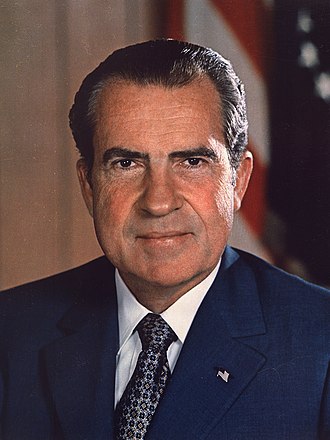
Richard M. Nixon served as the 37th President of the United States from January 1969 until his resignation in August 1974. In February 1971, he ordered the installation of a secret voice-activated taping system in the White House to preserve a historical record of his administration. Until the system's existence was revealed and dismantled in July 1973, the tapes captured Nixon directing major foreign policy initiatives, such as the opening to China, as well as his central role in the Watergate cover-up.
What Nixon talks about on the tapes
White House operations 4,718Presidential scheduling 2,225Public relations 1,784Presidential schedule 1,782Vietnam War 1,693Logistics 1,650Manolo Sanchez 1,626White House communications 1,400White House administration 1,399Presidential communication 1,243Henry Kissinger 1,191Foreign Policy 1,183
Conversations (21,010)
— Page 9 of 211President Nixon and First Lady Pat Nixon coordinate their schedules for an upcoming evening engagement. The brief discussion focuses on clarifying the timing of their meeting and confirms the First Lady's status as the President prepares to depart his office. The interaction serves as a routine logistical check-in between the couple regarding their personal itinerary.
President Nixon and H. R. Haldeman met to discuss political strategy, the administration's public image, and potential personnel changes within the Cabinet. They analyzed the President's recent leadership on key policy decisions, such as the troop withdrawal from Vietnam, contrasting his approach with the political advice he received. Furthermore, Nixon evaluated the effectiveness of various staff members and Cabinet secretaries, expressing a desire for more enthusiastic and effective 'salesmen' to represent his administration's agenda.
President Nixon and H.R. Haldeman discuss the historic performance of the stock market and the strategic value of meeting with key financial industry leaders to signal economic confidence. Nixon instructs Haldeman to expand a proposed meeting with Bernard Lasker into a larger gathering of influential Wall Street figures, such as Gustave Levy and Donald Regan, to maximize the political impact. The President emphasizes that a broader group of “real wheels” would better project national buoyancy than a solitary meeting with a single associate.
President Nixon initiates a request to the White House operator to place a telephone call to National Security Advisor Henry A. Kissinger. This brief administrative interaction serves as a logistical bridge to facilitate a direct discussion between the President and his advisor on matters of state. No further policy deliberations or substantive developments occur during this brief exchange.
President Nixon requested that the White House operator place a telephone call to George P. Shultz, then serving as the Director of the Office of Management and Budget. The brief exchange served as a logistical step to facilitate direct communication between the President and Shultz. No substantive policy discussions occurred during this initial request.
President Nixon and Henry Kissinger discussed the administration's ongoing diplomatic initiatives, specifically focusing on the recent outreach to the People's Republic of China and the resulting reactions from the Soviet Union and the press. Kissinger provided an update on his interview with Newsweek, asserting that the China initiative had successfully overshadowed Vietnam in the media, and expressed optimism that a breakthrough in Vietnam negotiations could occur suddenly due to Asian negotiation patterns. The two also addressed concerns regarding Soviet agitation and potential future diplomatic moves, with Nixon emphasizing the necessity of maintaining forward momentum despite the delicate international climate.
President Nixon directs the White House operator to place a call to Treasury Secretary John B. Connally. During the exchange, Nixon briefly reflects on the political effectiveness of his firm stance against his opposition, noting that he has successfully unsettled the liberals. The conversation serves as a preparatory step for further consultation with his administration on strategic policy matters.
President Nixon contacted the White House operator to determine the whereabouts of Treasury Secretary John B. Connally. The brief exchange served as an inquiry to establish communication or locate the Secretary. No further developments were recorded in this short administrative coordination.
President Nixon and Treasury Secretary John B. Connally discuss the positive impact of the President’s April 7th Vietnam speech on global perception and market confidence. They reflect on how the speech’s firm tone signaled a long-term commitment to the conflict, effectively dissuading adversaries who feared a premature American withdrawal. The brief dialogue serves to reinforce the administration's belief that a resolute stance on foreign policy was essential to maintaining international leverage.
President Nixon consulted with George P. Shultz regarding the administration's public messaging on recent positive economic indicators, specifically GNP growth and the rise in the stock market. The discussion focused on leveraging these favorable statistics to build public confidence without appearing to overstate the data or alienate CEA Chairman Paul McCracken. Shultz briefed the President on his upcoming speech, which would emphasize a steady economic course rather than reactionary policies like tax cuts.
President Nixon initiates a brief telephone request for the White House operator to connect him with his Chief of Staff, H. R. Haldeman. This exchange serves strictly as an administrative bridge to facilitate a subsequent conversation between the President and his top aide. No substantive policy discussions or decisions occur during this brief communication.
President Nixon met with his personal valet, Manolo Sanchez, in the Old Executive Office Building to discuss the daily care and exercise of the President’s Irish Setter, King Timahoe. The brief exchange focused exclusively on coordinating a walk for the dog, reflecting the informal and personal nature of their interaction. No policy or administrative decisions were addressed during this short discussion.
President Nixon met with an unidentified individual in the Old Executive Office Building to review a daily news summary. The discussion focused on current media coverage and political developments as reported in the press. No specific policy decisions or significant administrative actions were recorded during this brief exchange.
President Nixon and H. R. Haldeman reviewed the President's upcoming schedule, including a Rose Garden reception for the Rio Grande City High School Student Council and a meeting with business leaders Bernard Lasker, John Connally, and Gustave Levy. They discussed press management regarding a Commerce Department consumer buying study and recent controversies surrounding the Vietnam War, particularly involving George McGovern and William Saxbe. Nixon also instructed Haldeman to facilitate a meeting with an unidentified individual, likely Senator Saxbe, to address these ongoing political disputes.
President Nixon and his valet, Manolo Sanchez, engage in a brief, informal discussion regarding Sanchez's schedule and the current weather conditions. The conversation highlights the President's demanding workload and his perception of being confined to the office throughout the weekends. No formal policy decisions or official actions are recorded during this exchange.
President Nixon and Henry Kissinger met to strategize for an upcoming press conference with the American Society of Newspaper Editors and to coordinate their diplomatic approach toward the People's Republic of China, Vietnam, and the Soviet Union. The President emphasized a cautious, step-by-step strategy for diplomatic normalization with China to avoid appearing overly anxious, while also discussing the ongoing conflict in India and Pakistan and the necessity of maintaining neutrality. Kissinger was instructed to coordinate with Senator Mike Mansfield regarding these initiatives, and the two men reviewed communication tactics for managing the press and potential congressional inquiries.
President Nixon initiates a brief telephone call through the White House operator to contact special counsel Charles W. Colson. This communication serves as a standard administrative request to facilitate a direct conversation between the President and his aide. The call concludes immediately after the operator receives the instruction to connect the line.
President Nixon initiates a brief, informal check-in with the White House operator, addressed as Bertie, to facilitate outgoing communications. The exchange serves as a routine administrative interaction typical of the President’s daily management of telephone access. No substantive policy discussions or significant decisions occur during this brief contact.
President Nixon and Charles Colson discuss strategies for securing congressional support for the administration's policies, specifically focusing on neutralizing opposition to the Vietnam War and the China initiative. They review the loyalties of Republican senators like Edward Brooke and William Saxbe, noting that these members' public support is effectively confusing and stalling liberal critics. Furthermore, they discuss the political utility of forthcoming poll data and the potential for anti-war protests to inadvertently strengthen the administration's core coalition.
President Nixon and Charles Colson discuss strategies for managing legislative relationships within the House and Senate. The conversation touches on the necessity of maintaining firm positions with lawmakers and addresses concerns regarding public or political sentiment. Colson notes his intention to handle specific tasks, including a planned trip to Seattle, as part of the administration's broader outreach and political strategy.
President Nixon and H. R. Haldeman convened in the Old Executive Office Building to coordinate the President's immediate agenda. The brief discussion served primarily as a check-in to determine the President's availability for further administrative business. No specific policy decisions were recorded during this initial administrative exchange.
President Nixon and H. R. Haldeman met to discuss political strategy, staffing needs, and the administration's ongoing foreign and domestic initiatives. They focused on leveraging the recent "ping-pong diplomacy" with the People's Republic of China, evaluating the positive public response to the initiative, and coordinating future Cabinet changes to better align with the President's policy goals. Additionally, the pair strategized on managing political opposition, including handling potential protests on college campuses and addressing issues related to Prisoners of War.
President Nixon and Stephen B. Bull discussed logistical details regarding travel routes in the vicinity of Mexico City. The brief exchange focused on identifying the most direct path for an upcoming trip or transit. No major policy decisions were recorded during this procedural consultation.
President Nixon met with Stephen B. Bull and Mark I. Goode to coordinate logistics for upcoming White House events. The discussion focused on managing the scheduling and photography sessions for visiting student council members from Rio Grande, Texas, as well as a subsequent meeting with securities industry leaders. The participants reviewed the flow of these activities to ensure smooth operations for the day's appointments.
President Nixon met with Mark I. Goode to briefly discuss logistics regarding the President's schedule and the handling of upcoming visitors. The primary objective of the meeting was to coordinate the arrival of an organized group for a scheduled appearance at the Oval Office. Nixon instructed Goode to ensure the visitors were lined up and processed promptly.
President Nixon met with a delegation of Wall Street leaders, including Bernard Lasker, Albert Gordon, and Donald Regan, to discuss the state of the economy and the recent upswing in the stock market. The group presented the President with a bull statue as a gesture of their confidence in his economic policies and the administration's performance. Nixon and his guests analyzed positive economic indicators, such as growth in GNP, retail sales, and automobile manufacturing, while also touching upon the geopolitical implications of his foreign policy initiatives toward the People's Republic of China and the Soviet Union.
President Nixon met with his aide Stephen B. Bull in the Oval Office to discuss administrative logistics and the President's upcoming daily schedule. The primary focus of the brief meeting involved coordinating a future appointment with Alexander P. Butterfield. The conversation concluded with Bull departing the office shortly thereafter.
President Nixon hosted Alexander P. Butterfield, Jon M. Huntsman, and David Haight along with their spouses for a brief, informal social meeting in the Oval Office. The participants engaged in light conversation regarding weather, local dining, and Stanford University before transitioning into a ceremonial photo session with White House photographer Ollie Atkins. During the exchange, the President presented the guests with official cufflinks as commemorative gifts before concluding the visit.
President Richard M. Nixon met with personal aide Stephen B. Bull in the Oval Office to discuss administrative and scheduling matters. The brief two-minute session focused exclusively on organizing the President's upcoming work agenda. No major policy developments occurred, as the conversation served as a routine coordination of the President's daily schedule.
President Nixon met with his longtime personal valet, Manolo Sanchez, in the Old Executive Office Building. The brief interaction focused on facilitating Sanchez’s access to the President's office. This conversation highlights the routine administrative and personal arrangements required to manage the President’s daily schedule and inner circle.
President Nixon met with his aide Stephen B. Bull in the Old Executive Office Building to handle a minor administrative task. The brief interaction focused on a specific request for paint in cans. No other policy or political matters were discussed during this short exchange.
President Nixon met with an unidentified woman in his Old Executive Office Building suite to discuss her professional schedule. The brief interaction focused on the logistics of her current commitments and availability. No substantive policy matters or major administrative decisions were recorded during this session.
President Nixon and H. R. Haldeman discussed the management of interaction with the wives of American Prisoners of War to prevent the issue from becoming politically unmanageable. The President provided instructions to Haldeman regarding the oversight of this group and specifically designated Secretary of State William P. Rogers to lead the administration's handling of the matter. Major General James D. Hughes was also identified as a key figure in coordinating these efforts.
President Nixon met with an unidentified individual in the Old Executive Office Building to review the President’s daily schedule. Due to the extremely brief duration of the recorded segment and the lack of a transcript, no substantive policy discussions or significant administrative decisions were captured. The interaction appears to have been limited to logistical coordination regarding the President's upcoming appointments.
President Nixon met with Press Secretary Ronald Ziegler to strategize for an upcoming meeting with news editors regarding media criticism of FBI surveillance practices. Nixon expressed frustration over what he deemed irresponsible reporting by the Washington Post and the New York Times, particularly allegations of domestic spying on innocent citizens. He instructed Ziegler to forcefully defend the administration's policy by contrasting it with historical wiretapping practices during the Robert Kennedy era and emphasizing the necessity of surveillance for national security and crime prevention.
President Nixon and H. R. Haldeman discussed the political implications and costs associated with recent bombings of federal buildings and university campuses, specifically referencing arson at the University of California, Santa Cruz. Nixon expressed frustration regarding the prevalence of radical leftist activities and sought to compile comprehensive statistics on such incidents through the FBI and GSA. The conversation also touched upon press reporting, the rising stock market, and scheduling matters for upcoming meetings with figures such as Mike Mansfield.
President Nixon and H. R. Haldeman discuss preparations for an upcoming editors' meeting, specifically focusing on technical logistics like the use of a rostrum and the presidential seal. The President emphasizes the need for a more relaxed attitude toward press relations, arguing that his ability to answer questions directly provides a significant political advantage. Additionally, the pair briefly touches upon the President's diplomatic policy regarding the USSR and the domestic political landscape involving "hawks" and Senator Mike Mansfield.
President Nixon met with an unidentified individual to examine a specific, unspecified item. The brief interaction focused on the physical inspection of this object, which the President prompted the visitor to observe. No further substantive policy discussions or administrative actions were recorded during this segment.
President Nixon consulted with an unidentified individual regarding the retrieval of a specific record album. The participant offered to secure the item provided it could be obtained discreetly without requiring an official identification number. This brief exchange focused on the logistics of acquiring this personal or administrative material.
President Nixon met with Alexander P. Butterfield to coordinate administrative logistics regarding an upcoming meeting with newspaper editors. The discussion focused on the role of Director of Communications Herbert G. Klein in managing these press relations. The participants evaluated the necessity of formal procedures for the event, ultimately determining that no further action was required at that time.
President Nixon and Henry Kissinger discuss managing journalist John Scali, who is pushing for a more aggressive public relations campaign regarding the administration's China policy and Vietnam withdrawal plans. Nixon firmly rejects Scali's suggestions for premature withdrawal announcements, insisting that any public pronouncements on Vietnam be delayed until after Kissinger's scheduled meetings in Paris and consultations with South Vietnamese President Nguyen Van Thieu. Kissinger confirms he is maintaining contact with Scali to keep him aligned with administration strategy without adopting his disruptive proposals.
President Nixon and Henry Kissinger discuss the tactical management of a sensitive diplomatic channel, specifically cautioning against pressuring an unnamed intermediary. The conversation centers on maintaining operational control while ensuring the intermediary is adequately informed of the administration's progress. They align their strategy to prioritize an upcoming meeting in Paris before advancing to subsequent phases of the diplomatic process.
President Nixon held a brief, informal meeting with one or more unidentified individuals in his Old Executive Office Building office. The recording primarily captures administrative logistics related to the President's immediate schedule. No substantive policy discussions or significant executive decisions are documented in this brief exchange.
H. R. Haldeman briefed President Nixon on the latest housing start figures to ensure the President was accurately informed prior to any public remarks. They clarified that the figure of 1,918,000, while strong, did not constitute an all-time monthly record as it was surpassed in December and several months in 1950. With the data officially released, the President confirmed the specific statistics for his subsequent use.
President Nixon directs H. R. Haldeman to coordinate a meeting between Henry Kissinger, Ronald Ziegler, and journalist John Scali to manage Scali’s views on Vietnam and the administration's China initiative. Nixon expresses frustration with Scali’s perspectives and Kissinger’s handling of the situation, insisting that Haldeman facilitate the discussion to align their messaging. The President explicitly tasks Haldeman with managing these communications to shield himself from the direct conflict and ensure policy consistency.
President Nixon met with his personal valet, Manolo Sanchez, in the Old Executive Office Building to handle a brief, routine request. The conversation lasted only three seconds, precluding any substantive discussion of policy or political strategy. No significant developments or administrative decisions resulted from this limited interaction.
President Nixon met with his personal valet, Manolo Sanchez, in the Old Executive Office Building to handle personal affairs. The brief interaction focused on a specific request involving the handling or transport of personal items referred to as "drops." No significant policy decisions were recorded during this short, private engagement.
President Nixon consulted with an associate regarding labor statistics to analyze the status of the steel industry workforce. The discussion focused on comparing employment figures from 1960 against 1971 to evaluate long-term trends. This data review served to inform the administration's understanding of shifts within the industrial sector.
President Nixon met with his personal valet, Manolo Sanchez, in the Old Executive Office Building to request refreshments. The brief interaction focused solely on the President's request for coffee. No policy matters or significant administrative decisions were addressed during this short exchange.
President Richard Nixon met with his personal valet, Manolo Sanchez, in the Old Executive Office Building. The brief interaction consisted of a specific request made by the President to his aide. No further details regarding the nature of the request or subsequent policy developments are available due to the limited duration of the recording.
H. R. Haldeman briefed President Nixon on employment statistics within the steel industry to support a specific administration narrative. They confirmed that while the total number of steelworkers union members had increased, the actual number of employees working in the steel industry had declined by approximately 5% since 1960. Nixon intended to use these figures to emphasize the contraction of the industry's workforce during public discourse.
President Nixon and H. R. Haldeman met briefly to discuss follow-up actions related to a previous conversation with Henry Kissinger and the administration's strategic response to media coverage. The discussion also touched upon preparations for an upcoming meeting with news editors. The dialogue remained informal, focusing on administrative coordination and media management tactics.
President Nixon held a brief, informal discussion with one or more unidentified individuals in the Old Executive Office Building. The dialogue is fragmentary, consisting primarily of acknowledgments and vague assurances regarding a sensitive matter. No concrete policy decisions, specific names, or identifiable subjects can be determined from the available transcript.
President Nixon summoned his personal valet, Manolo Sanchez, to his office in the Old Executive Office Building for a brief, informal interaction. The exchange was extremely short in duration and lacked substantive discussion regarding policy or administrative matters. No formal decisions or significant actions were recorded during this brief encounter.
President Nixon met with his personal valet, Manolo Sanchez, in the Old Executive Office Building to coordinate administrative logistics. The discussion centered on the President's upcoming schedule and the handling of his briefcase. The interaction concluded with the pair departing the office together shortly after 8:00 pm.
President Nixon consulted with his aide Manolo Sanchez regarding the strategic significance of retail sales data. The brief exchange highlights the President's focus on economic indicators as a priority for his administration. No major policy shifts resulted from the call, though it emphasizes the President's direct involvement in monitoring economic trends.
President Nixon instructs the White House operator to connect him with National Security Advisor Henry Kissinger to discuss the significance of recent retail sales data. The brief exchange highlights the President’s focus on monitoring economic indicators as a matter of policy priority. No further developments were recorded in this short telephonic transition.
President Nixon and Henry Kissinger discussed the positive reception to the President’s recent interview with a group of newspaper editors and influential figures. They reviewed how Nixon maintained firm, non-committal positions on sensitive foreign policy issues, specifically Vietnam and China, while successfully defending the administration's stance on figures like J. Edgar Hoover and Spiro Agnew. The pair also addressed a minor technical discrepancy regarding the President’s announced Vietnam withdrawal date and exchanged pleasantries regarding guests at a dinner event.
President Nixon contacted the White House operator to facilitate an outgoing call to Press Secretary Ronald L. Ziegler. The brief interaction served as a logistical bridge to connect the President with a key member of his communications staff. No substantive policy matters were discussed during this request for an operator-assisted connection.
President Nixon contacted the White House operator to facilitate an outgoing call to Herbert G. Klein, the White House Director of Communications. The brief exchange served as a routine administrative request to establish a line for professional correspondence. No substantive policy discussions or decisions were recorded during this brief logistical interaction.
President Nixon contacted the White House operator to facilitate a personal telephone call to his daughter, Julie Nixon Eisenhower. The brief interaction served as a logistical bridge to connect the President with his family late in the evening. No substantive policy matters or official administrative decisions were discussed during this brief request.
President Nixon and Julie Nixon Eisenhower discuss their reactions to a recent media appearance or interview, specifically evaluating the President's performance in addressing younger generations. The President reflects on the effectiveness of his messaging regarding family values, ending the Vietnam War, and encouraging youth engagement in the American system. The brief exchange concludes with the President instructing the operator to place calls to Ron Ziegler and Herb Klein, indicating ongoing efforts to manage the administration's public relations.
President Nixon contacted the White House operator to facilitate an urgent connection to National Security Advisor Henry A. Kissinger. This administrative call served to establish communication with Kissinger late at night for undisclosed high-level deliberations. No further substantive dialogue was recorded between the President and the operator beyond the request to initiate the bridge.
President Nixon instructed Henry Kissinger to contact Otis Chandler to praise the quality of Chandler’s questions during a recent interview with newspaper editors. The discussion highlighted the administration’s strategy of cultivating positive relations with influential media figures following a session where topics like Asian policy, China, and environmental issues were addressed. Kissinger agreed to place the call immediately, noting the importance of the gesture in managing the press.
President Nixon contacted the White House operator to place a personal telephone call to his daughter, Julie Nixon Eisenhower. This brief administrative interaction served the purpose of facilitating private family communication late in the evening. No policy discussions or official business were conducted during the exchange.
President Nixon held a brief telephone conversation with his daughter, Julie Nixon Eisenhower, late in the evening. The primary purpose of the call was to coordinate plans for Julie to visit the President in the Lincoln Room. No substantive policy matters were discussed during this short administrative exchange.
President Nixon contacted the White House operator to place a personal telephone call to Herbert G. Klein, who served as his Director of Communications. This brief administrative interaction facilitated direct communication between the President and a key member of his public relations team. No substantive policy discussions or decisions were captured during this short exchange.
President Nixon contacted the White House operator to facilitate a telephone connection with his National Security Advisor, Henry A. Kissinger. This brief administrative interaction served as a logistical step to initiate a direct communication line between the President and Kissinger late in the evening. No substantive policy discussions were recorded during this brief operator exchange.
President Nixon and Henry Kissinger debrief following the President's interview with newspaper editors, evaluating the public reception of his comments on the People's Republic of China and Vietnam policy. They discuss the strategic framing of residual forces in Vietnam and the potential for a historical diplomatic breakthrough with China. Kissinger is tasked with contacting journalist Otis Chandler to relay the President’s appreciation for the quality of the interview questions and to emphasize that the President’s remarks regarding China were aspirational rather than formal policy shifts.
President Nixon and Press Secretary Ronald L. Ziegler discussed the positive reception among newspaper editors regarding the President’s recent press conference performance. Ziegler relayed feedback from various attendees, including Robert M. White and Newbold Noyes, noting that the editors viewed the session as a masterful display despite their professional hesitation to applaud. The conversation served to gauge the press corps' reaction to the President's public messaging and to monitor the influence of his recent media appearance.
President Nixon initiates a brief telephone call through the White House operator to contact Dr. William D. Lukash. This communication serves as an administrative effort to establish a direct line with the President's personal physician. No substantive policy discussions occur during this short exchange, as it is limited to the operator connecting the requested party.
President Nixon consulted with the White House operator to facilitate an outgoing call. This interaction served a logistical purpose, as the President utilized the operator's services to establish a secure line for further communication. No substantive policy matters or political discussions were recorded during this brief exchange.
President Nixon consulted with his personal physician, Dr. William M. Lukash, in a brief telephone exchange. The conversation focused on the President’s health and medical well-being. Due to the presence of withdrawn material and limited transcript availability, specific details regarding any prescribed medical action items remain restricted.
President Richard Nixon met with his personal physician, Dr. William M. Lukash, for a brief one-minute session in the Oval Office. Due to the withdrawal of the recorded segment as a personal returnable item, the specific substance of their medical consultation remains unavailable for public review. The meeting reflects routine executive health oversight during the Nixon administration.
President Nixon and H. R. Haldeman debriefed the President's appearance before the American Society of Newspaper Editors, focusing on the effectiveness of his responses regarding Vietnam, J. Edgar Hoover, and foreign relations with the People's Republic of China. The discussion also addressed the technical presentation of the event, including the use of a rostrum and the impact of the President's speaking style. Additionally, the participants coordinated preparations for an upcoming meeting involving Henry Kissinger and John A. Scali to further discuss diplomatic outreach to China.
President Nixon met with George Shultz and Peter Peterson to discuss personnel appointments and pressing foreign economic policy, specifically regarding trade negotiations with Japan and Southeast Asia. The group deliberated on the roles of various cabinet members, including David Kennedy and William Rogers, in coordinating trade strategy and managing the State Department's economic responsibilities. They also explored broader themes of U.S. economic competitiveness, the People's Republic of China initiative, and the necessity of preventing American isolationism in the post-Vietnam War era.
President Nixon met with his economic advisors and Henry Kissinger to strategize on managing mounting domestic and international pressures regarding textile, steel, and shoe import quotas. The discussion focused on leveraging diplomatic and economic inducements, such as trade initiatives and aid, to secure favorable voluntary restraint agreements with Japan, Taiwan, Hong Kong, and Korea. The participants concluded that a coordinated strategy involving high-level diplomatic outreach followed by technical negotiations was necessary to address industry concerns and prevent restrictive legislative action.
President Nixon met with Secret Service agents in the Oval Office to discuss internal security and logistics. The recording consists primarily of room noise and muffled dialogue, offering no substantive record of specific policy decisions or strategic instructions. Consequently, the interaction remains inconclusive regarding the primary objectives of the security detail's visit.
President Nixon spoke with J. Edgar Hoover to offer personal support following recent public criticism and media speculation regarding the FBI Director's potential resignation. Nixon reassured Hoover that he had publicly defended him during a recent interview with newspaper editors, framing the attacks as malicious and unwarranted. The call concluded with Henry Kissinger joining the conversation to echo his admiration for the President’s stance and provide further support to Hoover.
President Nixon met with Senate Majority Leader Mike Mansfield and National Security Advisor Henry Kissinger to discuss U.S. foreign policy toward the People's Republic of China (PRC). The President sought to use Mansfield as a private channel to gauge interest in a potential high-level visit to China, aiming to initiate a dialogue while maintaining a step-by-step approach regarding trade and travel restrictions. The participants emphasized the importance of conducting these overtures privately to avoid public rejection and to manage the delicate balance of power between the U.S., China, and the Soviet Union.
President Nixon and Henry Kissinger discuss the travel status of Director of Communications Herbert G. Klein, who is currently en route to Dallas. Following an brief update from the White House operator, the President determines that no immediate action is necessary regarding Klein. Nixon concludes the brief coordination call by deciding to delay any further communication with Klein until the following day.
President Nixon consulted with his aide, Stephen B. Bull, to coordinate his upcoming daily schedule. Following this internal consultation, the President utilized the White House operator to place an outgoing call to his personal physician, Dr. William M. Lukash. This exchange reflects the administrative management of the President's personal and official appointments.
President Nixon met with H.R. Haldeman and Ronald Ziegler to review the success of his recent televised session with the American Society of Newspaper Editors (ASNE) and coordinate upcoming scheduling matters. They discussed the positive impact of his performance, specifically his handling of sensitive topics like J. Edgar Hoover and foreign policy, while also finalizing plans for visits from agricultural editors, the Jaycees, and various congressional loyalists. Additionally, the President decided to proceed with a meeting with the Building Trades Council executive committee, despite internal warnings regarding the group's opposition to his administration, as part of an effort to demonstrate leadership.
President Nixon consulted with H. R. Haldeman and White House physician Dr. William M. Lukash to address personal health concerns. The discussion focused on the President's physical well-being and necessary medical attention. Due to the sensitive nature of the information, the specific details of the medical assessment remain restricted as a personal returnable item.
President Nixon met with H. R. Haldeman, Henry Kissinger, and other staff members to discuss political messaging, media relations, and administrative strategy. A primary focus was neutralizing the political threat posed by Congressman Paul McCloskey, whose public dissent regarding U.S. operations in Southeast Asia and accusations of misconduct in Vietnam were causing friction. The group agreed to handle such dissent by having Congressional allies—rather than the White House—directly refute these claims to avoid elevating the critic's profile. Additionally, the President reviewed his public schedule, emphasizing the need to maintain a composed, energetic appearance to manage perceptions of his stamina and leadership.
President Nixon consulted with Stephen B. Bull and a White House operator to confirm the whereabouts of his daughter, Julie Nixon Eisenhower. The exchange established that Julie was attending a wedding and would return to the White House by 2:00 pm. No other significant policy or administrative business was conducted during this brief coordination call.
President Nixon consulted with a White House operator in an attempt to reach his daughter, Julie Nixon Eisenhower. After confirming she had not yet returned, the President briefly coordinated with Henry Kissinger regarding the call. No substantive policy or political developments occurred during this brief administrative exchange.
President Nixon consulted with the White House operator to confirm the current whereabouts of his daughter, Julie Nixon Eisenhower. The brief exchange focused on establishing her proximity to the executive residence. No further policy or administrative actions were initiated during this logistical check-in.
President Nixon and his daughter, Julie Nixon Eisenhower, coordinate logistics for a dinner scheduled to take place on the presidential yacht, the Sequoia. They discuss concerns regarding inclement weather and evaluate potential contingency plans, including relocating the event to Camp David or the White House. The conversation focuses on ensuring the evening's arrangements remain feasible given the weather-related uncertainty.
President Nixon initiates a call to the White House operator to be connected with Chief of Staff H.R. Haldeman. This brief administrative interaction serves as a bridge to facilitate communication between the President and his senior advisor. No substantive policy discussions occur during this exchange.
President Nixon received a brief status update from the White House operator regarding the travel plans of H.R. Haldeman. The operator informed the President that Haldeman was currently en route to his residence. This exchange served solely to relay information about a key staff member's location following the President's previous request.
President Nixon and H. R. Haldeman discussed the positive reception among Cabinet members to the gifts recently distributed by the White House. The pair also coordinated the President's upcoming schedule, specifically planning to clear minor administrative tasks by scheduling brief, half-hour meetings with various individuals throughout the week. Haldeman committed to managing these appointments to ensure the schedule proceeded efficiently.
President Nixon initiates a brief telephone request to the White House operator to be connected with his Chief of Staff, H. R. Haldeman. This interaction serves as a routine administrative coordination step to facilitate communication between the President and his senior aide. No substantive policy discussions or decisions are recorded during this brief exchange.
President Nixon and H. R. Haldeman deliberate on how to effectively counter political criticism from Representative Pete McCloskey regarding administration policies. They reject the idea of using Gerald Ford, instead concluding that Secretary of State William Rogers should defend his ambassador and Secretary of Defense Melvin Laird should directly confront McCloskey. Haldeman is tasked with coordinating with Laird and ensuring Rogers takes a more aggressive public stance against the congressman.
President Nixon contacted the White House operator to initiate a telephone call to his speechwriter and aide, Patrick J. Buchanan. The brief exchange served as a logistical step to connect the President with his advisor. No policy decisions or substantive discussions occurred during this operator interaction.
President Nixon and Patrick J. Buchanan review the President’s recent hour-long interview with newspaper editors, focusing on the prevalence of foreign policy questions over domestic issues. Nixon reflects on his public defense of FBI Director J. Edgar Hoover and discusses the effectiveness of the radio format for his interactions with the press. The pair concludes that the event was a success, with Buchanan noting that the audience’s reactions and the President's deliberate pacing played well for radio listeners.
President Nixon contacted the White House operator to place a direct phone call to his speechwriter and aide, Patrick J. Buchanan. The brief exchange served solely as a functional request to connect the President with Buchanan. No further policy discussions or significant substantive developments occurred during this short communication.
President Nixon and aide Patrick J. Buchanan discuss the political fallout of the administration's new initiative toward the People's Republic of China. They observe that the move has successfully disrupted the liberal press, drawing attention away from the Vietnam War and causing confusion among political 'doves.' Nixon emphasizes his cautious approach regarding formal UN recognition and his ongoing commitment to maintaining relations with Taiwan.
President Nixon contacted the White House operator to request a direct connection to the Usher's Office. This brief administrative call served as a routine communication relay to facilitate internal White House logistics. No substantive policy discussions took place during this exchange.
President Nixon contacted military aide Nelson C. Pierce, Jr. to inquire about the whereabouts of the military and naval aides on duty. After learning that Pierce had not seen either official, the President opted to forgo further immediate assistance. Nixon decided to resolve his inquiry through an alternative contact, concluding the brief administrative check.