Nixon, Richard M. (President)
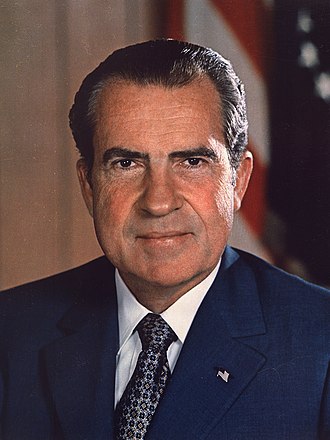
Richard M. Nixon served as the 37th President of the United States from January 1969 until his resignation in August 1974. In February 1971, he ordered the installation of a secret voice-activated taping system in the White House to preserve a historical record of his administration. Until the system's existence was revealed and dismantled in July 1973, the tapes captured Nixon directing major foreign policy initiatives, such as the opening to China, as well as his central role in the Watergate cover-up.
What Nixon talks about on the tapes
White House operations 4,718Presidential scheduling 2,225Public relations 1,784Presidential schedule 1,782Vietnam War 1,693Logistics 1,650Manolo Sanchez 1,626White House communications 1,400White House administration 1,399Presidential communication 1,243Henry Kissinger 1,191Foreign Policy 1,183
Conversations (21,010)
— Page 10 of 211President Nixon initiates a series of administrative calls through the White House operator to coordinate communication with key staff members. He first attempts to reach National Security Advisor Henry Kissinger and subsequently requests a call to personal aide Stephen B. Bull. These requests serve to facilitate the President's immediate access to his core advisors for ongoing official business.
President Nixon instructed aide Stephen B. Bull to coordinate logistics for professional boxer Joe Frazier’s upcoming visit to the White House. The President specified that Frazier should be brought to the Yellow Oval Room for photographs, explicitly excluding him from the formal receiving line. Nixon emphasized that the photo opportunity must be managed carefully to ensure Frazier is included while keeping the receiving line limited to himself and Haley.
President Nixon contacted the White House operator to facilitate a telephone connection with his Chief of Staff, H.R. Haldeman. This brief interaction served as a logistical bridge to initiate a direct conversation between the President and his top aide. No further substantive policy matters were discussed during this request for assistance.
President Nixon and H. R. Haldeman discuss political strategies for managing public perception regarding upcoming anti-war demonstrations and media coverage. They analyze the impact of recent polls and the potential political fallout for Congress members, with Nixon expressing a desire for protesters to target the Capitol. Additionally, they review the success of Nixon's recent radio-based outreach and finalize plans to utilize television media in future communications to avoid overexposure.
President Nixon and Henry Kissinger discussed strategies for managing public perception regarding the Vietnam War, specifically the fallout from General Creighton Abrams' speculative comments about military operations in Laos. Nixon instructed Kissinger to ensure White House Press Secretary Ronald Ziegler and military leadership refrain from further commentary to prevent the press from manufacturing negative headlines. Additionally, the pair coordinated on high-stakes diplomatic negotiations with China, ultimately deciding to delay Kissinger’s meeting with Romanian ambassador Corneliu Bogdan to maintain flexibility for potential high-level communications.
President Nixon and Henry Kissinger discuss managing public and press perceptions regarding recent foreign policy developments, specifically focusing on clarifying the Administration's position on Vietnam and countering Democratic criticism surrounding the President's initiative toward the People's Republic of China. Kissinger updates the President on efforts to coordinate a consistent response with White House and Defense officials to avoid misinterpretation of abstract military capabilities. They also review the historical timeline of the China opening, noting that Nixon had initiated secret channels as early as February 1969, a fact they intend to use to discredit political opponents who claim the policy lacks foresight.
President Nixon initiates a request to the White House operator to be connected with Herbert G. Klein, the White House Director of Communications. This brief exchange serves as a logistical bridge to facilitate direct communication between the President and his communications chief. No substantive policy discussions or decisions occur during this brief operator-assisted request.
President Nixon directs the White House operator to place a telephone call to National Security Advisor Henry Kissinger. This brief interaction serves as a routine administrative request to facilitate direct communication between the President and his advisor. No substantive policy discussions occur, as the call functions solely to connect the two parties.
President Nixon instructed the White House operator to facilitate a sequence of urgent communications with key advisors. He requested to speak with Henry Kissinger regarding ongoing matters and specified that he also needed to contact Treasury Secretary John B. Connally. The exchange served as a logistical coordination effort to secure immediate consultations with these high-level officials.
President Nixon and Henry Kissinger discuss strategies to contain political fallout following a controversial, off-the-cuff remark made by General Creighton Abrams regarding military operations in Laos. To avoid granting the issue undue prominence or prompting a restrictive Senate resolution, they agree to distance the White House from the incident by referring all press inquiries to the Department of Defense. The conversation also touches upon shifting Soviet military dispositions in Eastern Europe and the broader geopolitical implications of U.S.-Soviet relations on the People's Republic of China.
President Nixon consulted with the White House operator to facilitate contact with Secretary of the Treasury John B. Connally. The operator reported that Connally had recently departed his residence, prompting the President to request a callback once the Secretary could be reached via his vehicle. Nixon clarified that the matter was not urgent, requesting the connection at Connally's convenience.
President Nixon directs the White House operator to place a telephone call to Charles W. Colson. This brief administrative interaction serves as an initiation of communication between the President and his special counsel. No further substantive discussion occurs during this recording.
President Nixon and Charles Colson discuss strategies for managing political dissent, focusing on silencing Republican "doves" who oppose the administration’s Vietnam policy and China initiative. The two evaluate the effectiveness of various spokesmen, including Treasury Secretary John Connally, and coordinate the President's upcoming meeting with "hard hat" workers to shore up blue-collar support. Nixon emphasizes maintaining a firm public stance on the war and economic issues while directing his staff to avoid dignifying critics like Rep. Pete McCloskey through high-level engagement.
President Nixon and H.R. Haldeman discussed strategies to counter anti-war protests, specifically focusing on the involvement of Trotskyist groups within the movement and the perceived political opportunism of Representative Paul N. McCloskey, Jr. The President sought to leverage public support from traditional segments of the electorate, such as student groups and working-class supporters, while tasking staff with shaping media narratives to discredit the anti-war opposition. Additionally, they reviewed scheduling logistics for upcoming speeches and appearances designed to build enthusiasm among influential constituencies like the Chamber of Commerce and the Daughters of the American Revolution.
President Richard Nixon met with Alexander P. Butterfield in the Oval Office for a brief four-minute session. The primary purpose of the meeting was for the President to complete the signing of various administrative documents. No major policy discussions or significant political developments were recorded during this brief administrative encounter.
President Nixon and Henry Kissinger met to discuss urgent foreign policy matters, specifically the status of Vietnam negotiations and ongoing relations with the Soviet Union and the People's Republic of China. Kissinger briefed the President on planned communications with Soviet Ambassador Anatoliy Dobrynin regarding the Vietnam conflict, while the two analyzed political fallout from domestic media coverage and recent anti-war demonstrations. Additionally, they reviewed poll data on the administration's Vietnam policy and discussed the political necessity of maintaining a firm stance against partisan criticism from Democrats.
President Nixon and H.R. Haldeman met to coordinate logistics for upcoming political events, including the Republican Governors' Conference and the President's scheduled address to the U.S. Chamber of Commerce. They discussed administrative personnel changes, specifically the mandated firing of a poorly performing official, and reviewed strategies for managing press relations and controlling media narratives. Additionally, the pair coordinated guest list protocols for Tricia Nixon’s wedding to maintain political decorum and addressed the optics surrounding public demonstrations and welfare policy.
President Nixon held a private, undocumented meeting with an unidentified male visitor in the Oval Office. The lack of a transcript or meeting logs prevents a definitive determination of the discussion's subject matter or specific outcomes. The interaction remains a brief, unverified engagement within the broader context of the President's daily schedule.
President Nixon met with an unknown individual in the Oval Office to conduct brief official or personal business. The recording is primarily notable for documenting a request for coffee made by the President. No substantive policy discussions or significant political developments were captured during this brief exchange.
President Nixon met with Stephen B. Bull and Alexander P. Butterfield to coordinate scheduling logistics and administrative briefings. The discussion centered on upcoming meetings with Republican senators, specifically regarding a planned session in the Executive Office Building the following day. Additionally, the group reviewed the status of Henry Kissinger’s schedule and relevant briefings involving John L. McClellan.
President Nixon met with his aide, Stephen B. Bull, in the Oval Office to discuss the scheduling of an unidentified individual. The brief session focused on logistical coordination regarding the President's calendar. No further specific developments or action items were documented in the available records for this interaction.
President Nixon, H. R. Haldeman, and Henry Kissinger met to discuss political strategy, the administration's public image, and the challenges posed by entrenched liberal opposition within the federal bureaucracy and the media. The participants analyzed recent military developments in Vietnam and Laos, affirming that success on the battlefield—such as in Firebase 6—remains the most effective tool for neutralizing critics who prioritize ideological opposition over national interest. Nixon emphasized the necessity of a future purge of the federal government to dismantle the long-standing Democratic influence, particularly within the State Department and other agencies.
President Nixon instructed the White House operator to place an outgoing call to Deputy Attorney General Richard G. Kleindienst. This brief exchange served solely as an administrative coordination to facilitate direct communication between the President and the Department of Justice official. No policy matters or substantive discussions occurred during this connection.
President Nixon met with John Ehrlichman and George Shultz to discuss aggressive strategies for managing the federal bureaucracy and suppressing unwanted antitrust litigation. Nixon issued a direct order to halt the Justice Department's antitrust proceedings against ITT, expressing frustration with Richard McLaren's pursuit of conglomerates and demanding personnel changes for those failing to follow administration directives. Additionally, the group reviewed legislative tactics for rural revenue sharing and considered methods for securing political cooperation on economic policy from key members of Congress.
President Nixon directed Deputy Attorney General Richard G. Kleindienst to halt the Department of Justice's antitrust proceedings against IT&T. Nixon explicitly ordered that no legal brief be filed in the case and threatened to fire Assistant Attorney General Richard McLaren if he failed to comply with the directive to drop the matter. The conversation reflects Nixon's intense frustration with the Justice Department’s aggressive pursuit of conglomerates and his desire to personally dictate the administration's antitrust strategy.
President Nixon and Stephen B. Bull discussed the logistics and participant arrangements for an upcoming photo opportunity and press conference. Bull outlined instructions regarding the limited number of individuals permitted in the official photograph, specifically identifying the President, Senator Tom Huddleston, and Mrs. Dean. The President acknowledged these arrangements before concluding the brief planning session.
President Nixon met with Senator Robert A. Taft, Jr. and representatives from the Robert A. Taft Institute of Government to formally accept an award and certificate honoring the late Senator Robert Taft, Sr. During his remarks, Nixon praised the elder Taft's dedication to the two-party system and his courageous defense of the Taft-Hartley Act during the 1950 campaign. Following the presentation, the President hosted the group for a photo session in the Rose Garden and presented them with presidential mementos.
President Nixon met with his aide, Stephen B. Bull, to review administrative logistics regarding upcoming appointments. The discussion focused on coordinating the President's schedule, specifically regarding a meeting with Senator John L. McClellan and staff members Kenneth E. BeLieu and Clark MacGregor. The brief exchange centered on finalizing these arrangements before Bull concluded the meeting.
President Nixon and H. R. Haldeman met to discuss strategies for exerting greater control over the federal bureaucracy and addressing perceived disloyalty within various agencies. The President emphasized his desire to "clean house" at the United Nations, specifically targeting associates of Charles W. Yost, and expressed frustration with Attorney General John Mitchell's reluctance to handle the ITT antitrust case and the resignation of Richard McLaren. Throughout the conversation, Nixon underscored the necessity of making public examples of officials to instill discipline across the administration, particularly as he prepared for the 1972 election cycle.
President Nixon met with Senator John L. McClellan, Clark MacGregor, and Kenneth E. BeLieu to discuss legislative priorities, national defense, and the President's political standing. The participants addressed concerns regarding U.S. military strength relative to the Soviet Union, the importance of maintaining nuclear deterrent credibility, and the economic necessity of supporting American industries like steel and aviation. Additionally, the President and Senator McClellan reviewed the progress of the Arkansas River navigation project and discussed pending appointments and committee activities within Congress.
President Nixon held a brief meeting in the Oval Office with an unidentified individual regarding his official daily schedule. The discussion concluded immediately upon the arrival of the visitor, lasting only a moment before the individual departed. No substantive policy matters or administrative decisions were captured in this brief exchange.
President Nixon and H.R. Haldeman discuss the necessity of adopting a more aggressive, partisan political strategy to defend against opposition, while critiquing staff members who favor compromise over confrontation. Nixon expresses a desire to remove disloyal administration officials and suggests using Vice President Agnew to publicly attack Senate critics. The meeting also covers logistical planning for upcoming events, including an appearance before the Daughters of the American Revolution and a meeting with AFL-CIO leadership.
President Nixon met with the executive council of the AFL-CIO Building and Construction Trades Department to discuss the state of the construction industry, economic growth, and the administration's recent suspension of the Davis-Bacon Act. The discussion addressed concerns regarding job stability, the rising costs of land and construction, and the need for continued labor-management cooperation under the administration's new wage stabilization policies. Nixon emphasized his support for the trades and sought their partnership in fostering economic stability, while also pivoting to broader topics of national security, international defense commitments, and the strategic importance of U.S. economic and military strength in the global landscape.
President Nixon and Alexander Haig discussed the Israeli proposal for a Suez Canal withdrawal, a diplomatic development encouraged by Henry Kissinger to secure a temporary period of stability in the Middle East. Haig expressed concern that the State Department might react negatively to the proposal's initial toughness, potentially leading to a premature rejection by the Egyptians. They concluded that the administration should allow the diplomatic process to play out for now, with the President reserving potential intervention with Israeli leadership for a later stage.
President Nixon consulted with his aide Stephen B. Bull regarding the current whereabouts and activities of Charles W. Colson. The President specifically inquired whether Colson was still present at the White House and if he had completed his review of a particular file. This brief administrative inquiry served to coordinate staff movements and track the progress of ongoing research or document review tasks involving senior personnel.
President Nixon met with H.R. Haldeman, Charles Colson, and other staff members to discuss political messaging strategies and the management of congressional relations. The group focused on fostering a more optimistic, disciplined tone among Republican supporters while strategizing ways to critique opposition figures like Senator Edmund Muskie. Additionally, they deliberated on media presentation tactics, specifically regarding public appearances with members of Congress and how to effectively highlight the administration's policy successes.
President Nixon instructed the White House operator to place an outgoing call to Secretary of State William P. Rogers. The communication served solely as a logistical request to connect the President with his Secretary of State for an undisclosed discussion. No policy decisions or substantive conversations occurred during this brief administrative exchange.
President Nixon and Secretary of State William P. Rogers discuss a proposed diplomatic tour of the Middle East, which would follow Rogers' scheduled attendance at SEATO and CENTO meetings in London and Ankara. Nixon encourages the trip, noting its potential to shift media focus away from Vietnam and capitalize on invitations from Israel, Egypt, and Jordan. Additionally, the two touch upon labor relations, specifically regarding Nixon’s recent outreach to George Meany and building trades leaders, as well as the positive impact of the President's recent China initiative on public discourse.
President Nixon initiates a call to his Chief of Staff, H. R. Haldeman, by requesting assistance from the White House operator. The brief interaction serves as a logistical bridge to facilitate an immediate discussion between the President and his senior advisor. No substantive policy matters are addressed in this short administrative exchange.
President Nixon and H.R. Haldeman discuss preparations for an upcoming meeting with legislative leaders, specifically regarding the administration's economic messaging. Nixon instructs Haldeman to have George P. Shultz, rather than Paul McCracken, deliver a brief and intentionally optimistic presentation on the economy to instill confidence. The President notes recent positive trends in the stock market as evidence that the public is beginning to favor optimistic long-range economic projections.
President Nixon met with his aide Stephen B. Bull in the Oval Office to coordinate his daily schedule. The brief discussion centered on the presence of H.R. Haldeman, who was waiting to see the President. The meeting concluded quickly as Bull facilitated the transition for Haldeman's upcoming appointment.
President Nixon met with H.R. Haldeman to discuss strategies for tightening executive control, specifically ordering a mass resignation of all government holdovers—excluding J. Edgar Hoover and Richard Helms—prior to the next school year. Nixon directed the administration to increase its public visibility regarding disaster relief and mandated that Secretary of State William P. Rogers publicly defend administration policies on Vietnam and Laos during his upcoming press conference. Furthermore, the President expressed intense frustration with staff performance and internal dissent, ordering the immediate dismissal of specific personnel in the Bureau of Indian Affairs and urging a purge of disloyal staffers at the United Nations.
President Nixon met with Vice President Agnew and Republican Congressional leaders to discuss the administration's legislative and economic agenda. The participants analyzed current economic indicators, including inflation and productivity, and evaluated the implementation of the Task Force for International Development's recommendations regarding foreign and military aid. Additionally, the group addressed the future of the military draft, focusing on pay increases and the transition toward an all-volunteer force while assessing potential legislative hurdles in Congress.
President Nixon met with H. R. Haldeman, Henry Kissinger, Stephen Bull, and Ronald Ziegler to manage various administrative priorities, focusing heavily on controlling the narrative surrounding Vice President Spiro Agnew’s recent unauthorized remarks regarding the administration's China policy. The group also discussed the logistics of upcoming public appearances, including a strategic approach to a recent Supreme Court ruling on school busing and the management of high-level personnel changes. Furthermore, they coordinated foreign policy messaging, specifically addressing Secretary of State William Rogers’s upcoming Middle East trip and the need to establish a discreet, direct communications channel with the People's Republic of China.
President Nixon and Stephen B. Bull met to finalize logistical details regarding an upcoming Rose Garden event for a group of agricultural editors. They discussed the coordination of the visit, including tour arrangements and the presentation of gifts for the attendees and their spouses. The conversation also touched upon press relations and the role of Gerald R. Warren and Ronald L. Ziegler in managing media communications for the event.
President Nixon met with H.R. Haldeman and Stephen Bull to discuss administrative personnel changes, media strategy, and his upcoming public schedule. The group focused on replacing a Small Business Administration official, navigating negative press coverage, and coordinating potential televised appearances and radio addresses to maximize public support. Additionally, they reviewed logistical plans for hosting the Jaycees at the White House and engaged in a broader discussion regarding the deteriorating quality of life in New York City.
President Nixon and H. R. Haldeman coordinated the President's upcoming address to the U.S. Jaycees, emphasizing the need for an optimistic tone to inspire the audience rather than focusing on technical policy details like revenue sharing. They discussed using the event as a strategic opportunity to subtly promote the Supersonic Transport (SST) program. The President stressed that the speech should aim for a "ripple effect" through media coverage rather than a direct, intense confrontation, prioritizing an uplifting message about the country.
President Nixon met with Henry Kissinger and International Committee of the Red Cross (ICRC) representatives Marcel Naville and Melchior Borsinger to discuss humanitarian concerns, particularly the treatment of prisoners of war (POWs) and civilian populations in the Vietnam conflict. The participants addressed the difficulties the ICRC faces in gaining access to North Vietnamese facilities and discussed U.S. efforts to enforce rules of engagement and investigate alleged military atrocities. Nixon emphasized his commitment to humane conduct while the ICRC representatives advocated for universal standards and the establishment of new international protocols for internal conflicts.
President Nixon held a brief, unscheduled meeting with an unidentified individual in the Oval Office. Although the conversation lasted only a moment, it immediately preceded a scheduled meeting with National Security Advisor Henry Kissinger. No record of the discussion exists, leaving the nature and purpose of this brief encounter undocumented.
President Nixon met with his valet, Manolo Sanchez, in the Oval Office to discuss the President's daily schedule. The brief interaction focused primarily on coordinating logistics for the President's lunch. No significant policy decisions were recorded during this brief encounter.
President Nixon and Henry Kissinger discussed a recent meeting between the President and Marcel Naville of the International Red Cross, during which Naville attempted to lecture the administration on the conduct of American soldiers in Vietnam. Nixon expressed strong indignation at this perceived lack of neutrality and instructed Kissinger to maintain a firm stance against international officials who criticize U.S. policy. The two also addressed broader geopolitical strategy, focusing on leveraging relations with the USSR and the PRC to protect American interests and prevent domestic political opposition from weakening the nation's global military posture.
President Nixon met with an unknown individual to coordinate his afternoon schedule. The brief discussion centered on managing the timing of his official commitments for the remainder of the day. No substantive policy matters or major decisions were recorded during this logistical exchange.
President Nixon met with his personal valet, Manolo Sanchez, in the Old Executive Office Building to review the President's upcoming schedule. The discussion centered on logistics and travel arrangements for the President's departure from the office. No significant policy decisions were recorded during this brief administrative exchange.
President Nixon directed the White House operator to place a telephone call to Congressman Leslie C. Arends. This brief administrative interaction served as a logistical step to connect the President with the House Republican Whip. No substantive policy discussions occurred during this exchange.
President Nixon instructed the White House operator to place a personal telephone call to his daughter, Tricia Nixon. The brief interaction served exclusively to facilitate this private communication. No substantive policy matters or administrative actions were discussed during the exchange.
President Nixon instructed the White House operator to remain in his office to assist with immediate communication needs. This brief interaction served as a logistical arrangement to facilitate upcoming telephone calls. No further substantive policy matters were discussed during this exchange.
President Nixon met briefly with his personal valet, Manolo Sanchez, in the Old Executive Office Building to discuss the President’s upcoming schedule and personal comforts. The conversation centered on the ambient temperature on the porch, leading to Nixon’s decision to relocate his activities there. Sanchez also provided the President with a cigar during the brief interaction.
President Nixon met with his personal valet, Manolo Sanchez, in the Old Executive Office Building to address logistics regarding a telephone located outside the office. The brief exchange focused on verifying the location and accessibility of the phone. No significant policy decisions were made during this logistical consultation.
President Nixon held a brief, non-substantive interaction with a White House operator in the Old Executive Office Building. The exchange served primarily as a functional administrative check to facilitate telephonic communications. No policy matters or significant decisions were addressed during this brief encounter.
President Richard Nixon engaged in a personal telephone conversation with his daughter, Tricia Nixon Cox. The recording consists almost entirely of a withdrawn segment categorized as a personal returnable item. Due to these privacy restrictions, no substantive political or administrative details are available for review.
President Richard M. Nixon met with his daughter, Tricia Nixon Cox, in the Old Executive Office Building for a brief personal conversation. While the majority of the discussion remains restricted as a personal returnable item, the interaction serves as a record of their private communication during the spring of 1971. No substantive policy decisions or administrative actions were documented in the available record for this meeting.
President Nixon called Representative Leslie Arends to thank him for his supportive remarks during a recent meeting regarding the administration’s handling of the Vietnam War. The two discussed the disparity between the pessimistic outlook of Washington politicians and the underlying stability of the country. They concluded with a mutual agreement on the political necessity of communicating the administration’s strategy for ending the war to the American public, specifically noting that Democrats were worried the President's approach would ultimately succeed.
President Nixon met briefly with Congressman Leslie C. Arends to express gratitude for Arends’ supportive remarks during an earlier meeting. The two men briefly discussed the public's changing perception of the Vietnam War and the administration's progress in achieving its objectives. Nixon emphasized his determination to maintain control over the war effort despite opposition from Democrats who feared the administration's policies might succeed.
President Nixon and H.R. Haldeman discuss administrative logistics, including the scheduling of upcoming appointments and a photo session with Attorney General John Mitchell. They deliberate on potential candidates for Cabinet positions and the necessity of utilizing the Office of Emergency Preparedness to promote the administration’s economic and foreign policy agendas. The conversation centers on staff coordination and strategic messaging to improve the public perception of the administration's goals.
President Nixon and Press Secretary Ronald Ziegler consulted to coordinate a consistent public response regarding whether the administration had discussed upcoming protest demonstrations during a recent meeting. Seeking to mitigate negative press coverage, the two men verified that the Vietnam War and related demonstrations were not on the formal agenda and had not been addressed by the President. Nixon prioritized identifying the source of unauthorized leaks or misinformation regarding these meetings to ensure the official narrative remained uniform.
President Nixon and H. R. Haldeman discussed the recent Vietnam veterans' anti-war demonstration, specifically addressing the lack of mention regarding the protests during a morning leadership meeting. Nixon expressed frustration that the media's focus on the demonstration had not been effectively countered or addressed by administration officials. The two participants sought to clarify whether the topic had been raised by anyone present at the meeting, concluding that it had been deliberately avoided.
President Nixon met with George Shultz to discuss personnel changes within the administration and determine the government's stance on Social Security tax adjustments. They evaluated the fiscal impact of alternative wage base increases, ultimately opting for a strategy that prioritizes long-term revenue over short-term political expediency. Additionally, the President reviewed Shultz’s upcoming economic address, emphasizing the need for rhetoric that highlights steel industry productivity and improves the quality of U.S. economic representation abroad.
President Nixon instructed the White House operator to place a conference call to Treasury Secretary John B. Connally and Abe Fortas. This brief communication served solely as a logistical request to connect the President with these two individuals. No further policy discussions or substantive developments occurred during this exchange.
President Nixon met with Secretary of Agriculture Clifford Hardin, General George A. Lincoln, and Peter Flanigan to coordinate a strategic response to a severe drought in Texas and Oklahoma. The President emphasized that the administration must appear highly responsive and concerned to mitigate political fallout, even if a full disaster declaration was not yet legally or fiscally advisable. Nixon directed the team to facilitate a high-profile visit to the region, including securing appropriate aircraft and media presence, to reassure farmers and political allies like John Connally and John Tower that the administration was proactively exhausting all available relief channels.
President Nixon and Treasury Secretary John Connally coordinated a briefing for a delegation including Secretary of Agriculture Clifford Hardin, General George Lincoln, and Peter Flanigan regarding a scheduled federal response to the Texas drought. The President directed Connally to meet with these officials to review their itinerary and logistical maps before their departure. Furthermore, Nixon advised Connally to remain in Washington rather than join the trip to avoid unfavorable political optics.
President Nixon consulted with a White House operator to facilitate a telephone connection with General James D. "Don" Hughes. The conversation served strictly as a logistical bridge to initiate a formal call between the President and the General. No substantive policy discussions or decisions occurred during this brief interaction.
President Nixon consulted with General James D. Hughes to arrange a larger aircraft for an upcoming trip to Texas, specifically for Secretary of Agriculture Clifford M. Hardin and his delegation. Hughes confirmed that they would utilize the backup aircraft, designated '970,' which shares the same presidential paint scheme and capacity as Air Force One. Nixon authorized this change to accommodate an expanded party of approximately 60 people.
President Nixon directs the White House operator to place an outgoing call to Congressman George H. Mahon. This brief interaction serves as the administrative bridge to facilitate a direct conversation between the President and the Chairman of the House Appropriations Committee. No substantive policy discussions occur during this initial request.
President Nixon consulted with Congressman George H. Mahon regarding an upcoming visit by Secretary of Agriculture Clifford Hardin and General George A. Lincoln to evaluate the drought conditions in Texas. While the administration aimed to provide assistance through loans, grain, and feed, Nixon explicitly rejected declaring the region a major disaster to avoid setting a broad federal precedent. Mahon expressed his support for this approach, agreeing that federal over-commitment should be avoided while maintaining necessary support for the cattle market.
President Nixon met with Rose Mary Woods, Ronald Ziegler, and others to discuss administrative matters, personal gifts, and the President's public image. The conversation touched upon the positive public reception of the President's recent remarks on welfare and foreign policy, as well as the need to monitor political rivals like Ted Kennedy through informal channels. Additionally, the group coordinated scheduling details and reviewed logistics regarding upcoming travel and correspondence.
President Nixon met with H.R. Haldeman, John Mitchell, and John Dean to discuss the administration's strategic response to a recent unanimous Supreme Court ruling on school busing. The group focused on distancing the White House from the controversial decision, emphasizing that enforcement should remain the responsibility of local school authorities and district courts rather than federal agencies like HEW. Nixon firmly instructed his staff to avoid taking credit for the ruling, express no personal endorsement of it, and ensure that HEW officials do not overstep their authority in implementing desegregation plans.
President Nixon instructed the White House operator to connect him with Sue Morrison, the secretary to Attorney General John N. Mitchell. The call was initiated specifically to facilitate communication with Mitchell’s office rather than to cancel any existing arrangements. This brief exchange served as a logistical step to establish direct contact between the President and the Attorney General's staff.
President Nixon consulted with Attorney General John Mitchell’s assistant, Sue Morrison, to coordinate a meeting with Mitchell. The President reviewed Mitchell's morning schedule, specifically ensuring he would not miss an HEW staff meeting, before ultimately deciding to schedule the appointment for the afternoon when his own workload with other officials would be lighter. Nixon directed Morrison to clear time in Mitchell’s calendar to accommodate the meeting.
President Nixon met with Alexander P. Butterfield, John N. Mitchell, and H. R. Haldeman to briefly review matters following a photo session. The discussion focused on logistical details regarding a planned trip by Butterfield to Puerto Rico, specifically concerning the duration and base of operations for the visit. The brief exchange concluded before any further administrative or political business could be addressed.
President Nixon met with a group of Republican senators and key advisors, including Henry Kissinger, to discuss the political landscape surrounding the Vietnam War and national defense policy. The conversation focused on the erosion of public support for the war, the impact of various congressional anti-war resolutions, and the importance of maintaining American preeminence despite shifting domestic and international pressures. The participants strategized on how to manage the political fallout of the Vietnamization policy and addressed concerns regarding defense preparedness and the administration's foreign policy initiatives in the Soviet Union and China.
President Nixon, Henry Kissinger, and H.R. Haldeman discuss strategies for managing political support and public opinion regarding the Vietnam War, particularly in light of recent legislative concerns. They emphasize the necessity of conveying a sense of progress to Congress to maintain support for the administration's broader policy agenda. The group also reviews the strategic distribution of favorable poll results to Republican lawmakers and touches upon ongoing surveillance regarding Congressman Hale Boggs.
President Nixon initiates a brief telephone call through the White House operator to contact his Chief of Staff, H.R. Haldeman. The primary purpose of the communication is to facilitate a direct line of contact for administrative or scheduling coordination. No substantive policy discussions occur, as the call is purely logistical in nature.
President Nixon expressed frustration to H. R. Haldeman regarding a meeting with Republican Senators, specifically criticizing Clark MacGregor for allegedly prompting legislators like Howard Baker to push for an end to the Vietnam War. Nixon felt MacGregor mistakenly believed the President was uninformed on congressional sentiment and failed to effectively manage the discussion to better align with administration goals. Haldeman was tasked with holding a candid debriefing with MacGregor to address this tactical failure and was also instructed to expedite the release of relevant poll data.
President Nixon initiates a brief telephone call through the White House operator to contact his National Security Advisor, Henry Kissinger. The purpose of the communication is to establish a direct line of connection between the President and Kissinger to facilitate immediate discussion of official business. No substantive policy matters are addressed in this short segment beyond the operational request to place the call.
President Nixon received a status update from the White House operator regarding the location of National Security Advisor Henry Kissinger. The operator informed the President that Kissinger was attending a meeting in the Situation Room and confirmed that a message was being delivered to him. Nixon acknowledged the report and requested that Kissinger contact him once he became available.
President Nixon and Henry Kissinger discuss the need to manage Secretary of Defense Melvin Laird, whom Nixon accuses of distancing himself from the administration's Laos policy while speaking with Republican senators like Howard Baker and Edward Gurney. Nixon expresses frustration that Defense and State Department officials are attempting to shift blame for the Laos operation, insisting that Laird must publicly support the administration's decision. To address this, the President decides to schedule a breakfast meeting with Laird for the coming Thursday to ensure internal alignment and improve communication.
President Nixon instructed the White House operator to connect him with special counsel Charles W. Colson. This brief administrative exchange served as the precursor to a direct consultation between the President and one of his key political advisors. No substantive policy matters were discussed during this initial connection request.
President Nixon and Charles Colson discussed strategies to bolster support for the administration, focusing on efforts to discredit anti-war veteran demonstrations by highlighting the presence of non-veteran infiltrators. They also reviewed political outreach, expressing frustration with Republican senators who remained pessimistic despite positive polling on the economy, the China initiative, and the Vietnam War. Consequently, Nixon directed Colson to instruct Clark MacGregor to share these favorable poll results directly with key lawmakers to discourage them from aligning with opposition positions.
President Nixon and aide Stephen B. Bull met briefly in the Oval Office to coordinate the President's daily schedule. The primary focus of the discussion concerned an upcoming meeting with Henry A. Kissinger. This administrative check-in served to facilitate the flow of personnel and high-level briefings for the President.
President Richard M. Nixon met briefly with his personal valet, Manolo Sanchez, in the Oval Office. The recording consists entirely of a withdrawn segment, precluding any substantive discussion of policy or administrative action. No significant decisions or developments were captured during this brief interaction.
President Nixon met with his aide, Stephen B. Bull, to review the President's daily agenda and upcoming obligations. Bull briefed Nixon on his remaining schedule for the day and promised to provide the President with further documentation. This brief encounter served as a routine administrative coordination of executive appointments.
President Nixon met with his administration officials, including John Mitchell, Elliot Richardson, and George Shultz, to coordinate the White House's response to a recent Supreme Court ruling on school desegregation. Concerned about the ruling's political impact and the potential for a "double standard" between the North and South, Nixon directed his subordinates to remain disciplined and avoid proactive initiatives, emphasizing that the administration would comply with the law without going beyond what was strictly required by the courts. The President also instructed his team to keep a low profile on the Ribicoff amendment to avoid further legislative complications while managing upcoming political optics regarding Southern school policies.
President Nixon met with Alexander P. Butterfield in the Oval Office to address routine administrative tasks. The discussion focused on the President's upcoming schedule and the processing of various documents requiring his signature. The meeting concluded promptly after the necessary papers were reviewed and signed.
President Nixon and H. R. Haldeman met to coordinate media strategy regarding the administration's China initiative, focusing on countering news reports that suggested a rift between Henry Kissinger and Secretary of State William Rogers or that the State Department deserved primary credit. They discussed using journalist John Scali to correct the narrative and emphasized that the China policy was fundamentally driven by the President. Additionally, the pair reviewed the President's upcoming schedule, including a meeting with the U.S. table tennis team, and considered potential administrative personnel reassignments for Clifford Hardin and Bryce Harlow.
President Nixon met with Graham B. Steenhoven, leader of the U.S. table tennis team, along with Henry Kissinger, Ronald Ziegler, and John Scali to discuss the team's recent historic trip to the People's Republic of China (PRC). Steenhoven provided detailed accounts of his interactions with Chinese officials, including Chou En-lai, and the team's experiences navigating the culture and political atmosphere of China. The group discussed the logistical and diplomatic considerations for a reciprocal visit by a Chinese table tennis team to the United States, emphasizing the need for a well-planned, dignified exchange to avoid a media circus or political embarrassment.
President Richard M. Nixon met with his aide, Stephen B. Bull, to review and finalize details regarding the President's upcoming schedule. The primary focus of the discussion centered on coordinating a meeting with George P. Shultz. The brief interaction concluded with Bull departing the Oval Office immediately following these logistical arrangements.
President Nixon and George Shultz met to review favorable Consumer Price Index (CPI) figures for March, which indicated inflation was slowing to its lowest quarterly rate since 1967. They analyzed the positive economic data, noting it was significantly lower than the previous year's performance. The President decided to have Paul McCracken handle the public briefing on these results to maintain a professional, low-profile presentation of the improved economic indicators.
President Nixon met with his aide, Stephen B. Bull, to coordinate his daily schedule and upcoming appointments. The discussion centered on logistics for meetings with Richard A. Moore, Mary Lou Grier, and Antonina Uccello, the former mayor of Hartford, Connecticut. Bull facilitated these scheduling updates before concluding the brief administrative session.
President Nixon met with Richard A. Moore, Antonina Uccello, and Mary Lou Grier for a ceremonial visit involving gift exchanges and discussion of the President's public image. Following this, Nixon consulted with Press Secretary Ronald L. Ziegler regarding the administration’s strategy for handling press inquiries about the recent "ping-pong diplomacy" outreach to the People's Republic of China. The conversation concluded with Nixon and Moore reviewing the efficacy of recent speeches and the importance of maintaining an appropriate tone and frequency in television appearances to avoid perceived overexposure.
President Nixon, Henry Kissinger, H.R. Haldeman, and John Dean discussed strategies for managing political fallout from the ongoing Vietnam War, particularly regarding public and congressional perception. The President expressed frustration with military leadership and the impact of war protests, deciding to prioritize a definitive end to U.S. ground combat and the draft to stabilize his political position. Additionally, the group reviewed internal polling data and economic messaging, agreeing to leverage improved consumer price index figures to bolster support among Republican legislators and conservative constituencies.