Nixon, Richard M. (President)
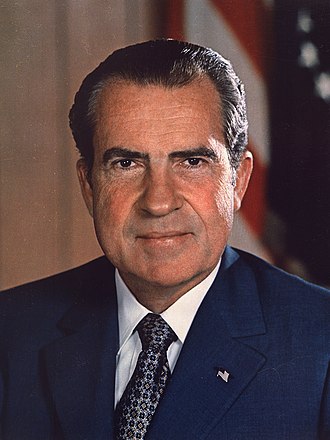
Richard M. Nixon served as the 37th President of the United States from January 1969 until his resignation in August 1974. In February 1971, he ordered the installation of a secret voice-activated taping system in the White House to preserve a historical record of his administration. Until the system's existence was revealed and dismantled in July 1973, the tapes captured Nixon directing major foreign policy initiatives, such as the opening to China, as well as his central role in the Watergate cover-up.
What Nixon talks about on the tapes
White House operations 4,718Presidential scheduling 2,225Public relations 1,784Presidential schedule 1,782Vietnam War 1,693Logistics 1,650Manolo Sanchez 1,626White House communications 1,400White House administration 1,399Presidential communication 1,243Henry Kissinger 1,191Foreign Policy 1,183
Conversations (21,010)
— Page 8 of 211President Nixon and H. R. Haldeman discuss the perceived lack of assertiveness and public impact of the Nixon administration's cabinet and staff. The President expresses frustration with the team's inability to effectively "attack" political opponents or command public attention, suggesting that significant personnel changes may be necessary to improve the administration's political image. They explore strategies for better projecting the President's personality and policy priorities, including evaluating potential Cabinet reshuffles and deliberating on the political optics of military-related public appearances.
President Nixon and Henry Kissinger discuss ongoing South Vietnamese military operations and recent diplomatic back-channel communications with Soviet officials regarding Berlin and potential summit prospects. Kissinger reports on his briefing of Senator Mike Mansfield concerning the President's upcoming announcement regarding China policy. The pair finalize plans for Clark MacGregor to notify key congressional leaders, including Gerald Ford, Carl Albert, and George Aiken, about the impending policy shift.
President Nixon and Henry Kissinger discuss recent shifts in elite public opinion toward the administration, specifically noting a surprising consensus of respect and support expressed during a social dinner. Kissinger highlights the administration's strategic gains regarding China and Vietnam as key drivers of this improved standing, while Nixon focuses on the importance of maintaining a firm, decisive course. The two also coordinate efforts to finalize SALT negotiations with the Soviet Union, prioritizing direct, high-level communication to prevent bureaucratic leaks or delays.
President Nixon met with key members of the Senate Armed Services Committee, including Senators John Stennis and Margaret Chase Smith, to coordinate legislative strategy on defense priorities. The discussion centered on securing a two-year draft extension, managing military manpower reductions, and timing the submission of the military procurement bill to avoid unfavorable Senate floor votes during a sensitive period of international negotiations. Nixon emphasized the importance of maintaining a firm military position amid changing Soviet leadership and discussed his recent intervention in the Lt. William L. Calley Jr. case to maintain military judicial process.
President Nixon met with H. R. Haldeman to discuss political strategy for the Anti-Ballistic Missile (ABM) vote, emphasizing the need to avoid early deals and keep the administration's position firm until the final vote. Following the swearing-in of William J. Casey as SEC Chairman, Nixon conferred with his staff and Arthur F. Burns on domestic economic management, public relations, and the importance of projecting a more passionate and committed image to the public. Finally, Nixon met with Dr. Rainer Barzel of the German Christian Democratic Union to discuss the status of Berlin negotiations and the political implications of Willy Brandt's Ostpolitik, during which Nixon reaffirmed the United States' commitment to maintaining a federal presence in Berlin.
President Nixon, John Ehrlichman, and Arthur Burns held this discussion to coordinate economic strategy and review the administration's political management of upcoming challenges. They focused on strengthening the partnership between Burns and John Connally, particularly regarding balance-of-payments policies, interest rates, and the political handling of potential steel industry inflation. Nixon also sought Burns’ perspective on international concerns, including the Berlin negotiations and German political stability, before Burns departed for a diplomatic trip to Europe.
President Nixon met with his aide Stephen B. Bull to coordinate a meeting with Press Secretary Ronald L. Ziegler. The President directed Bull to locate Ziegler and bring him to the Oval Office for a discussion regarding his official schedule. The brief interaction concluded with Bull departing to carry out the President's instructions.
President Nixon met with his personal aide, Stephen B. Bull, in the Oval Office to address administrative matters. The primary focus of the discussion concerned the scheduling and coordination of press briefings for Press Secretary Ronald L. Ziegler. This meeting served as an operational check-in to ensure the alignment of the President's public communications strategy.
President Nixon met with H. R. Haldeman, Henry Kissinger, and Ronald Ziegler to review internal polling data regarding his popularity and the administration's handling of the Vietnam War following his April 7, 1971, address. The discussion highlighted the positive impact of the speech on public opinion, specifically noting a shift toward support despite ongoing challenges related to the My Lai massacre trials. Additionally, the President and his staff discussed diplomatic initiatives with the People's Republic of China, emphasizing that recent trade and travel relaxation announcements were deliberate, long-term strategic decisions rather than spontaneous gestures, and planned future public relations strategies involving upcoming events such as the wedding of Tricia Nixon.
President Nixon directed the White House operator to place an outgoing call to Press Secretary Ronald L. Ziegler. The conversation was purely administrative, serving as the bridge to connect the President with his press office. No substantive policy discussions or decisions occurred during this brief exchange.
President Nixon met with his personal valet, Manolo Sanchez, in the Old Executive Office Building for a brief, informal interaction. The exchange focused on minor personal logistics and the status of the President's wristwatch. No significant policy decisions or historical developments resulted from this brief communication.
President Richard Nixon met with his longtime personal valet, Manolo Sanchez, at the Executive Office Building for a brief private exchange. While the specific details of their discussion remain undocumented due to the brevity and lack of transcript for this encounter, the meeting reflects the routine administrative and personal interactions between the President and his primary valet. No significant policy decisions or executive actions are recorded as stemming from this brief engagement.
President Nixon met with Mark I. Goode to discuss the logistical planning and personnel requirements for an upcoming reception for the diplomatic corps. The conversation centered on establishing strict protocols and managing the guest list, which included considerations for staff, William P. Rogers, various members of Congress, and White House communications aides. No definitive policy decisions were recorded, though Nixon emphasized the necessity of implementing a hard rule regarding event management.
President Nixon met with unidentified individuals in the Old Executive Office Building to discuss his official schedule. The dialogue remains minimal and lacks substantial policy substance beyond the logistical coordination of the President's appointments. No significant policy decisions or strategic shifts resulted from this brief encounter.
President Nixon met with his personal valet, Manolo Sanchez, in the Old Executive Office Building to review the President's upcoming daily schedule. The brief discussion served as an administrative check-in to coordinate official movements and time management. No significant policy decisions were recorded during this brief encounter.
President Nixon held a meeting with an unidentified individual in his Old Executive Office Building office. The brief exchange consists of a logistical request for the President to receive a follow-up phone call. No substantive policy matters or further developments were recorded in this segment of the conversation.
President Nixon instructed the White House operator to place an outgoing call to an unnamed Senator. This brief interaction served as a logistical step to facilitate direct communication between the President and a member of the legislative branch. No substantive policy matters were discussed during this request.
President Nixon met with his personal valet, Manolo Sanchez, to discuss the logistics of the President's upcoming schedule and personal arrangements. The brief interaction focused on timing and environmental conditions, specifically referencing a recent issue involving smoke or fire in a chimney. The conversation concluded with the President preparing to depart his office.
President Nixon and Press Secretary Ronald Ziegler discuss the dissemination of a press release regarding the President's bowling activities. Ziegler confirms that the information was successfully distributed to wire services, noting that the media appeared receptive to the item. The conversation concludes with the President acknowledging the update, reflecting a minor effort to cultivate a relatable public image.
President Nixon and Press Secretary Ronald L. Ziegler held a brief meeting in the Old Executive Office Building. The recording contains no substantive discussion, consisting only of informal exchanges. No policy decisions, strategic planning, or significant action items were documented during this session.
President Nixon and Press Secretary Ronald Ziegler discuss the political fallout and public perception surrounding the Vietnam War policy and the recent trial of Lieutenant William L. Calley, Jr. The President expresses interest in analyzing polling data, particularly Gallup results, to gauge public approval of the war. They further deliberate on the logistics of releasing polling information and address potential administrative support regarding legal costs related to the Calley trial.
President Nixon and John Ehrlichman discuss the need to adopt a 'hard-line' public stance on welfare reform to address rising public frustration and secure support for H.R. 1. The President emphasizes shifting the narrative away from expanding welfare rolls toward promoting work requirements and personal responsibility, utilizing striking anecdotes similar to those used by Governor Ronald Reagan. To implement this communication strategy, Nixon instructs Ehrlichman to coordinate with speechwriter William Safire to develop tough, persuasive rhetoric that highlights the systemic problems with the current welfare apparatus.
President Nixon and H. R. Haldeman coordinate the media strategy and logistical planning for Tricia Nixon’s upcoming wedding. The discussion focuses on managing press coverage, including a potential feature in Look magazine, to ensure the event is captured and presented according to the President's vision. Nixon instructs Haldeman to assemble a specialized team to execute these plans and oversee details that fall outside the purview of the First Lady’s staff.
President Nixon met with his personal valet, Manolo Sanchez, in his office at the Old Executive Office Building. The brief interaction focused on the President requesting the retrieval of his briefcase from another location. Sanchez complied with the instruction before departing the office.
President Nixon and H. R. Haldeman met to coordinate upcoming administrative and public relations objectives, specifically focusing on the President's planned visit to the U.S. Marines at Camp Pendleton. The discussion included tasking Haldeman with providing specific instructions to staff members, including John Scali and Raymond K. Price, Jr. Additionally, the pair addressed personnel matters regarding Rose Mary Woods.
President Nixon and H. R. Haldeman consulted to review public opinion polling data regarding the ongoing Vietnam War effort. They specifically evaluated how current approval ratings might influence congressional legislative strategies and public perception. The discussion focused on synthesizing these poll results to determine the most effective political messaging for the administration's policy goals.
President Nixon, Henry Kissinger, and Ronald Ziegler met to discuss the administration's ongoing diplomatic overtures to the People's Republic of China, press relations, and the political implications of the Vietnam War ahead of the 1972 election. Kissinger reported on his recent meeting with journalist Eric Sevareid and analyzed how the administration could leverage foreign policy successes—specifically the China opening and potential Vietnam settlements—without appearing to be politically motivated. The discussion emphasized maintaining a firm negotiating stance to secure the release of American prisoners of war while ensuring that the transition of U.S. policy in Southeast Asia remained insulated from partisan interference.
President Nixon consults with Press Secretary Ronald Ziegler and aide Richard Moore to prepare a response to Senator Edmund Muskie’s accusations regarding FBI surveillance during Earth Day. Nixon directs Ziegler to frame these allegations as politically motivated, emphasizing that the administration employs surveillance more sparingly than its predecessors and exclusively for national security or criminal investigations. Furthermore, Nixon authorizes Ziegler to clarify that the President personally ordered the cessation of Army intelligence gathering related to domestic civil disturbances.
President Nixon requested that the White House operator place a telephone call to Patrick J. Buchanan. The operator acknowledged the request and proceeded to facilitate the connection. No further discussion or substantive policy matters were recorded during this brief administrative interaction.
President Nixon consulted with a White House operator to facilitate an outgoing connection. The brief exchange focused exclusively on the mechanics of establishing a phone call. No substantive policy matters or significant executive decisions were addressed during this interaction.
President Nixon directed Patrick Buchanan to compile specific, compelling data points to bolster the administration's messaging on key domestic issues. The President requested dramatic statistics regarding the growth of minority-owned enterprises and the competitive standing of the American steel industry. Furthermore, he tasked Buchanan with consulting George Shultz and Paul McCracken to identify strong economic indicators, such as retail and automobile sales, housing starts, and record-breaking stock market performance, to project a narrative of upward economic momentum.
President Nixon directed Patrick Buchanan to compile dramatic, high-impact data points to bolster the administration's messaging on minority enterprise, steel industry competitiveness, and economic recovery. Nixon requested specific, positive statistics on housing starts, retail and automobile sales, and stock market performance to illustrate public confidence. The President tasked Buchanan with coordinating with advisors George Shultz and Paul McCracken to finalize these talking points for upcoming public use.
President Nixon met with his aide Stephen B. Bull to coordinate administrative logistics for an upcoming meeting. The discussion focused on scheduling arrangements involving Senator Robert J. Dole and Chief of Staff H. R. Haldeman. Bull was instructed to finalize the logistics for this session before departing the office.
President Nixon met with his aide Stephen B. Bull to coordinate logistical arrangements for an upcoming meeting with Senator Robert J. Dole and Chief of Staff H. R. Haldeman. Nixon explicitly instructed Bull to ensure the participants understood the President’s rigid departure time of 6:00 p.m. This brief exchange served to adjust the scheduling expectations for the evening to accommodate the President's prior commitments.
President Nixon, Senator Robert Dole, and H. R. Haldeman met to coordinate political messaging regarding the Vietnam War and the administration's withdrawal strategy. The participants discussed strategies to deflect criticism from Democrats by emphasizing that the previous administration was responsible for initiating the conflict and that Nixon's plan ensures a responsible exit without a communist takeover. They decided to highlight the administration's commitment to achieving a 'generation of peace' and to pivot toward publicizing positive economic indicators as a counter-narrative to war-related concerns.
President Nixon initiates a request to the White House operator to place a telephone call to special counsel Charles W. Colson. This brief interaction serves as a routine administrative bridge to facilitate a direct conversation between the President and his aide. The call establishes the logistical connection necessary for Nixon to discuss pending business with Colson.
President Nixon and Charles Colson discussed recent positive economic indicators, including stock market growth and a favorable Gross National Product increase, as a means to boost public confidence. The conversation then shifted to managing political opposition regarding the Vietnam War, with Nixon instructing Colson to pressure congressional "doves" and specifically requesting that Senator Edward Brooke hold off on public criticism for 30 days. Nixon planned to offer Brooke a private briefing on May 15, 1971, to secure this short-term cooperation while downplaying the administration's recent overtures toward the People's Republic of China as a concern to his political rivals.
President Nixon requested that the White House operator reconnect him with Charles W. Colson. The brief exchange served as a logistical instruction to facilitate a follow-up conversation with his Special Counsel. The operator acknowledged the request and initiated the process to bridge the call.
President Nixon directs Charles W. Colson to contact Senator Edward W. Brooke to secure public support for the administration's initiative toward the People's Republic of China. Nixon instructs Colson to encourage Brooke to deliver a speech on the Senate floor praising the policy as a long-term strategic vision for future generations. Colson confirms his intention to execute this request, leveraging background information from journalist Howard K. Smith to bolster the argument.
President Nixon contacted the White House operator to place a personal telephone call to his daughter, Julie Nixon Eisenhower. The brief exchange served as a routine request to facilitate communication with a family member. No policy matters or official business were addressed during this interaction.
President Nixon held a wide-ranging, informal discussion with Julie Nixon Eisenhower and David Eisenhower regarding the public and political reception of his recent foreign policy initiatives. The conversation covered domestic reactions to his April 7 Vietnam address, including polling data and editorial commentary, as well as the administration's efforts toward outreach with the People's Republic of China. Additionally, the participants engaged in a lighthearted dialogue concerning professional baseball, specifically discussing Carl Yastrzemski’s career and the President’s receipt of an MVP award.
President Nixon initiates a brief telephone call to White House staffer Peter M. Flanigan. The exchange serves as a logistical coordination for the President to reach his aide. No substantive policy discussions or decisions are recorded during this short connection.
President Nixon and Peter M. Flanigan discuss the recent rise of the Dow Jones Industrial Average, noting that it has surpassed its January 1969 levels. Nixon expresses frustration that industry leaders like Donald Regan and Bernard Lasker are not publicly vocalizing optimism regarding this economic recovery. Consequently, Nixon tasks Flanigan with encouraging these figures to take a more positive public stance and potentially communicate their support to the White House.
President Nixon contacted the White House operator to facilitate a telephone connection with his Chief of Staff, H.R. Haldeman. This brief exchange served exclusively as a procedural step to initiate an official communication between the President and his top aide. No substantive policy matters or decisions were discussed during this brief administrative interaction.
President Nixon and H. R. Haldeman discussed economic recovery, specifically citing the performance of the stock market as a signal of public confidence that could bolster the administration's image. They focused on political strategy, emphasizing the need for Senator Robert Dole to champion the President's policies and effectively manage Republican criticism in the Senate regarding the China initiative. Finally, the President urged Haldeman to ensure active administration intervention in the Texas drought and grain shipment crisis to maintain a public perception of decisive, activist leadership.
President Nixon instructed the White House operator to place a telephone call to National Security Advisor Henry A. Kissinger. This brief administrative interaction served as the initiation of a high-level consultation between the President and his advisor. No substantive policy discussions were recorded during this connection phase.
President Nixon and Henry Kissinger discuss the positive media reception of the administration's recent initiative toward the People's Republic of China, noting that it successfully shifted public attention away from Vietnam. They evaluate the geopolitical implications of this diplomatic opening, emphasizing the necessity of maintaining a strategic balance between China, the Soviet Union, and Taiwan. Additionally, the pair discusses domestic concerns regarding POW wives, agreeing to monitor the situation closely to prevent political exploitation by critics like George McGovern.
President Nixon directs the White House operator to place an outgoing telephone call to Henry Kissinger. The brief exchange serves as a logistical bridge to facilitate communication between the President and his National Security Advisor. No further policy discussions or significant decisions occur during this short connection process.
President Nixon and Henry Kissinger discuss the recent positive performance of the stock market, noting that the Dow Jones Industrial Average has reached 932, surpassing its level from January 1969. Nixon directs Kissinger to contact Howard Stein to highlight this economic progress and influence public perception among Stein’s associates. Kissinger agrees to place the call the following day as requested.
President Nixon contacted the White House operator to place a personal telephone call to his son-in-law, David Eisenhower. The brief interaction served solely to initiate a connection for a private conversation between the two men. No policy matters or official administrative business were discussed during this request.
President Nixon initiated a brief social call to his son-in-law, David Eisenhower, to discuss their respective bowling performance and habits. The conversation centered on the President’s record high score of 229, which he compared against Eisenhower’s personal best. The exchange concluded without any official business or political developments, focusing entirely on leisure activities at Camp David.
President Nixon met with his valet, Manolo Sanchez, to coordinate administrative directives for his staff. The President tasked Sanchez with relaying instructions to Rose Mary Woods, Marjorie P. Acker, and a third individual identified as 'Muck' to initiate a parade process. Additionally, the brief exchange included a request for coffee.
President Nixon met with his aide, Stephen B. Bull, in the Old Executive Office Building to review and manage the President’s daily schedule. The brief consultation served to coordinate logistics and appointments for the morning's agenda. No further administrative actions were recorded beyond the management of the executive calendar.
President Nixon and personal secretary Rose Mary Woods coordinate administrative logistics, including a memorandum for Ray Price and Woods' upcoming travel. Woods informs the President of Ambassador John S.D. Eisenhower's intention to resign by July 1, citing personal reasons regarding his housing. They also discuss positive public reception to a recent presidential speech and share concerns regarding the ongoing criticism and political vulnerability of J. Edgar Hoover.
President Nixon and his personal secretary, Rose Mary Woods, discuss administrative matters and potential security concerns regarding electronic surveillance. The brief exchange touches upon the activities of J. Edgar Hoover and the presence of monitoring devices within the office environment. No definitive policy decisions were reached during this informal check-in regarding office security protocols.
President Richard Nixon met with an unidentified individual in the Old Executive Office Building to discuss his official daily schedule. Given the lack of a transcript or detailed record, the specific content of the briefing remains unknown beyond the routine administrative coordination of the President's morning activities. This brief meeting represents a standard interaction within the President's internal scheduling operations.
President Nixon met with an unidentified individual in the Old Executive Office Building to briefly discuss an unspecified logistical arrangement or plan. The brevity of the recording and the provided transcript fragment suggest the participants reached an immediate consensus regarding a proposed course of action. No further substantive details regarding the nature of the request were preserved in the remaining segment.
President Nixon met with H.R. Haldeman and Henry Kissinger to strategize on public relations, presidential image, and the management of sensitive foreign and domestic policies. The discussion focused on projecting an image of "courage, boldness, and guts" in response to anti-war sentiment and the upcoming May Day demonstrations, while simultaneously planning for the administration's recent trade initiatives with the People's Republic of China. Nixon also expressed frustration with his Cabinet's lack of outspoken loyalty and instructed his staff to push a more coordinated, positive narrative regarding his leadership and the state of the economy.
President Nixon held a brief, three-minute meeting with Henry Kissinger in the Oval Office. The conversation functioned as a short administrative check-in or unscheduled consultation between the President and his National Security Advisor. Given the lack of a transcript, no specific policy decisions or action items were documented for this encounter.
President Nixon met with unknown individuals to discuss an upcoming trip to Europe involving Robert H. Finch and Donald Rumsfeld. The dialogue focused on managing press relations and coordinating report delivery, with specific instructions to be provided by Henry Kissinger. No formal decisions were reached during this brief organizational discussion.
President Nixon met with Moroccan Foreign Minister Moulay Ahmed Laraki and other officials to coordinate the timing and nature of King Hassan II's upcoming visit to the United States. The discussion focused on balancing the King's diplomatic role in the Middle East crisis and potential Arab summit meetings with the complexities of the President's domestic schedule. Ultimately, the participants decided to postpone and restructure the visit as a private event to maintain diplomatic flexibility, while Nixon and his staff also briefly reviewed broader foreign policy issues including the Vietnam War and diplomatic relations with the People's Republic of China.
President Nixon and Stephen B. Bull met to finalize logistical details regarding an upcoming public event held during the President's Open Door Hour. The discussion focused on scheduling procedures for a Rose Garden ceremony involving the presentation of a plaque and photographs with guests, specifically Robert and Richard Santin from Nebraska. The meeting served as a brief coordination session to ensure proper protocol for the interaction with the press and the gift presentation.
President Nixon and Stephen B. Bull reviewed press coverage regarding Sammy Davis, Jr. during a brief meeting in the Oval Office. They also coordinated the President's upcoming schedule, specifically finalizing arrangements for the arrival of Robert H. Finch and Donald H. Rumsfeld. The discussion served as a logistical update to ensure the President was prepared for his afternoon appointments.
President Nixon met with Robert H. Finch and Donald H. Rumsfeld to discuss the potential appointment of John A. McCone, the status of anti-ballistic missile (ABM) policy, and racial discrimination within the armed forces. A primary focus of the meeting was preparing Finch and Rumsfeld for an extensive international diplomatic tour, including attendance at a World Health Organization meeting and high-level engagements regarding US policy toward the People's Republic of China, international drug control, and the POW issue. The group also coordinated on sensitive political matters, including soliciting overseas campaign contributions and managing relations with various European and Mediterranean leaders.
President Nixon and First Lady Pat Nixon discussed adjustments to the President's daily schedule and upcoming social obligations. The conversation specifically addressed the President's farewells to departing officials Donald Rumsfeld and Robert H. Finch. Additionally, they confirmed the cancellation of a scheduled evening event at the White House honoring the King of Morocco.
President Richard Nixon met briefly with First Lady Pat Nixon in the Oval Office to discuss personal matters. The conversation served as a private exchange between the couple, though the specific details were not preserved in a transcript. No major policy decisions or formal administrative actions resulted from this short interaction.
President Nixon held a brief, unscheduled meeting in the Oval Office with one or more unidentified individuals. Due to the lack of an available transcript or audio log, the specific nature of the discussion remains undocumented. Consequently, no policy decisions, significant developments, or concrete action items can be attributed to this interaction.
President Nixon met with his personal aide, Stephen B. Bull, to coordinate administrative logistics regarding staff schedules. The discussion focused specifically on the scheduling requirements for Henry A. Kissinger and the President himself, including arrangements for a barber. No major policy decisions were recorded during this brief administrative session.
President Nixon and his senior staff, including H.R. Haldeman and John Ehrlichman, review strategies for managing press relations and controlling the public narrative regarding federal budget figures. The discussion emphasizes the importance of carefully timing news cycles—specifically balancing press conferences with television appearances—to ensure maximum impact. The group also deliberates on how to frame economic data to counter potential negative interpretations by the media and political opponents.
President Nixon met with his personal aide, Manolo Sanchez, in the Old Executive Office Building to discuss the current weather conditions. The brief exchange focused on evaluating the temperature and precipitation outside, serving as a casual check-in regarding the day's environment. No major policy decisions or administrative actions were addressed during this brief interaction.
President Nixon and his valet, Manolo Sanchez, engage in a brief, informal discussion concerning the etymology and cultural associations of certain words and religious institutions. The exchange focuses on the President's curiosity regarding the origins of specific terminology and the nuances of religious identity. No major policy decisions or significant administrative actions result from this personal dialogue.
President Nixon met with an unidentified individual to discuss scheduling matters and administrative appointments. The brief, informal dialogue centered on the potential advancement or placement of a specific staff member. No formal decisions were finalized during the exchange, which focused on internal personnel dynamics.
H. R. Haldeman advises President Nixon on the importance of managing a scheduled meeting with editors by employing a strategic outreach program similar to political party outreach. Haldeman suggests that beyond Herbert Klein, staffers like Leonard Garment and Richard Moore should actively cultivate relationships with these editors to better advance the administration's interests. The President agrees to follow up with staff to ensure a more comprehensive, systematic engagement plan is implemented.
President Nixon and H. R. Haldeman briefly discuss the handling of personnel or administrative appointments, specifically expressing concern over the treatment of political allies. The two leaders consider the fairness of the current selection process and identify a potential conflict regarding how certain individuals are prioritized over others. The conversation ends with an informal assessment of whether a third party had previously addressed the issue.
President Nixon initiates a request through the White House operator to be connected with Robert H. Finch. This brief administrative interaction serves as the precursor to a subsequent discussion between the President and his Counselor. No substantive policy matters are addressed during this specific segment of the telephone recording.
President Nixon initiates a brief communication through the White House operator to facilitate a connection to another party. This interaction serves as a routine administrative step to bridge the President to an external call. No substantive policy discussions or decisions are recorded in this brief exchange.
President Nixon consulted with the White House operator to determine the whereabouts of Robert H. Finch. The operator informed the President that Finch had departed for New York and would not return until the following morning. Nixon inquired if any other staff could assist him in Finch's absence.
President Nixon held a brief administrative interaction with the White House operator to facilitate the management of his communication workflow. The conversation focused on the logistics of handling incoming calls or materials. No major policy decisions were reached, as the discussion was limited to operational coordination.
President Nixon directs Donald Rumsfeld to contact Congressman Charles Rangel before Rumsfeld’s upcoming European trip to demonstrate the administration's commitment to addressing the international drug trade. Nixon instructs Rumsfeld to frame the trip—which includes attendance at the World Health Conference—as a direct response to Rangel’s concerns, tasking the congressman with providing any relevant intelligence or suggestions for the mission. Furthermore, Rumsfeld briefs the President on the successful coordination of their strategy with Henry Kissinger.
President Nixon directs Donald Rumsfeld to contact Ted Husky, a community leader from Central Harlem, to cultivate a line of communication regarding local intelligence and feedback. Nixon instructs Rumsfeld to emphasize that the President personally values Husky’s input and wants him to report any significant developments directly. This outreach serves as an effort to gather grassroots political information and maintain a channel for community insights.
President Nixon initiates a request to the White House operator to be connected with aide Patrick J. Buchanan. The brief exchange serves as a logistical coordination to establish communication between the President and his advisor. No further substantive policy matters are addressed in this short administrative segment.
President Nixon met with Press Secretary Ronald L. Ziegler to coordinate strategy for an upcoming press briefing. The discussion focused on preparing for a specific, albeit vaguely referenced, topic set for the following day. Nixon sought to determine the optimal timing for finalizing these remarks, prioritizing effective communication of the administration's messaging.
President Nixon and John Ehrlichman met to review talking points prepared by Patrick Buchanan for the President's upcoming address to the American Society of Newspaper Editors. The discussion focused on justifying the necessity of government surveillance for security purposes—citing threats to public officials and recent media coverage of White House cameras—and refining economic messaging to better highlight positive indicators like retail sales. Nixon directed Ehrlichman to coordinate with George Shultz and Paul McCracken to ensure the presentation of economic data utilized specific, impactful examples rather than generalized statistics.
President Nixon and Henry Kissinger met to coordinate strategy for an upcoming press conference and address ongoing geopolitical challenges. They reviewed the status of the administration's China policy, focusing on how to defend the President's personal leadership against bureaucratic resistance from the State Department. Additionally, they discussed negotiations concerning the Vietnam War, particularly the priority of prisoner-of-war issues, and analyzed potential communication tactics regarding the press.
President Nixon consulted with the White House operator to facilitate an outgoing telephone connection. This brief interaction served administrative purposes to establish a line for a subsequent conversation. No further substantive policy matters or decisions were recorded during this exchange.
President Nixon and Patrick J. Buchanan coordinate the collection of favorable economic data to highlight a positive turnaround in the economy during March 1971. The President emphasizes the need to isolate March statistics—such as retail sales, housing starts, and automobile production—from the broader, more moderate first-quarter figures to demonstrate upward momentum. Buchanan is tasked with delivering these reports to the President, along with a newspaper column by James J. Kilpatrick, Jr., which Nixon’s daughter, Julie, had recommended.
President Nixon met with Patrick Buchanan to strategize on how to frame recent economic indicators to emphasize a positive turnaround in the economy during the month of March. Nixon specifically directed Buchanan to isolate March data to demonstrate growth in retail sales and demand, countering negative media narratives focused on sluggish industrial production. Additionally, the two briefly touched upon a recent positive column by James J. Kilpatrick that had been recommended to the President by his daughter, Julie.
President Nixon initiated a brief telephone exchange with the White House operator to place an outgoing call to Stephen B. Bull. The President provided specific instructions to connect him with the individual, identified in the transcript as Mr. Bowe or Steve Bowe. No further policy or substantive matters were discussed during this connection attempt.
President Nixon initiated a brief, informal communication with the White House operator to place an outgoing call. The exchange serves as a functional recording of administrative support rather than a discussion of substantive policy or political matters. No significant decisions were recorded during this short interaction.
President Nixon directed his aide, Stephen B. Bull, to ensure that Patrick J. Buchanan’s upcoming wedding was recorded in the President's official calendar. The President emphasized the need for this entry to facilitate scheduling discussions with H. R. Haldeman. Bull was tasked with confirming the specific date of the Saturday event in May to ensure the President's attendance.
President Nixon directs his aide, Stephen B. Bull, to ensure that the Pat Buchanan wedding is formally noted in his personal records. The brief exchange highlights the President’s focus on administrative details regarding social engagements and maintaining his professional calendar. No further policy-related actions were taken during this short meeting.
President Nixon and Patrick Buchanan met to discuss media strategy for an upcoming interview with the American Society of Newspaper Editors and to address recent negative press regarding White House surveillance. The two reviewed reports from The Washington Post concerning security cameras at San Clemente and Camp David, framing the surveillance as a necessary security measure rather than an invasive practice. Additionally, they touched upon the political impact of the administration's recent People's Republic of China initiative and the role of the FBI in managing civil unrest.
President Nixon and Alexander P. Butterfield met briefly to discuss routine administrative matters, including upcoming scheduling for meetings with Robert D. Murphy and Henry A. Kissinger. They reviewed travel updates regarding Butterfield’s recent trip and addressed the processing of pending materials awaiting the President's signature. The discussion concluded with the handling of various documents and a brief confirmation of an Air Force promotion.
President Nixon met with an unidentified individual in the Old Executive Office Building to review and discuss the details of the President’s upcoming schedule. The conversation focused on logistics and arrangements for his official calendar, though specific appointments or strategic implications remain obscured by the lack of a transcript. No significant policy decisions or administrative actions were recorded during this brief administrative briefing.
President Nixon met with his valet, Manolo Sanchez, in the Old Executive Office Building to discuss personal staff matters. During the brief interaction, the President inquired about the identity of a woman he had encountered or considered for entry into his office space. The conversation reflects the President's internal administrative oversight regarding visitors and the management of his personal quarters.
President Nixon met with Faith Sutton to facilitate an administrative request involving White House aide Stephen B. Bull. The primary objective of the meeting was to secure or arrange for a specific article. No further policy discussions or significant political developments were recorded during this brief interaction.
President Nixon met with H.R. Haldeman to discuss public relations strategies, including the handling of press inquiries and the use of favorable polling data to counter political opposition. Following this, Nixon met with Robert D. Murphy and Henry Kissinger to provide instructions for Murphy's sensitive, unofficial mission to Taiwan. Nixon emphasized the need for absolute secrecy regarding his China initiative and tasked Murphy with managing Chiang Kai-shek's expectations while exploring flexible diplomatic approaches to the United Nations issue.
President Nixon contacted the White House operator to request a telephone connection to the First Lady, Pat Nixon. The call served as a routine administrative request to facilitate private communication with his wife. The conversation concluded once the operator initiated the transfer.
President Nixon interacts with a White House operator to initiate a telephone connection. The brief exchange serves as a procedural prelude to a subsequent communication, identified as a follow-up to a related conversation. No substantive policy or political discussions occur during this short administrative interaction.
President Nixon and First Lady Pat Nixon engaged in a brief telephone conversation to discuss scheduling matters. The exchange specifically concerned the agendas of Tricia Nixon Cox and Robert H. Murphy. The President also requested the current time to conclude the brief logistical coordination.