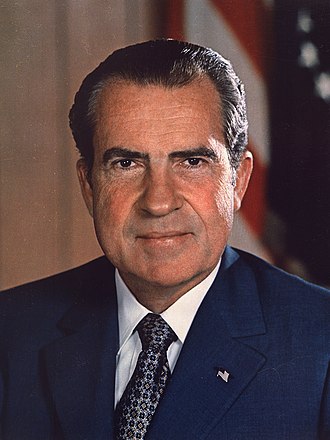
Nixon, Richard M. (President)
Richard M. Nixon served as the 37th President of the United States from January 1969 until his resignation in August 1974. In February 1971, he ordered the installation of a secret voice-activated taping system in the White House to preserve a historical record of his administration. Until the system's existence was revealed and dismantled in July 1973, the tapes captured Nixon directing major foreign policy initiatives, such as the opening to China, as well as his central role in the Watergate cover-up.
What Nixon talks about on the tapes
White House operations 4,718Presidential scheduling 2,225Public relations 1,784Presidential schedule 1,782Vietnam War 1,693Logistics 1,650Manolo Sanchez 1,626White House communications 1,400White House administration 1,399Presidential communication 1,243Henry Kissinger 1,191Foreign Policy 1,183
Conversations (21,010)
— Page 180 of 211President Nixon hosted Representative Corinne "Lindy" Boggs and her extended family for a courtesy visit and photo session in the Oval Office. The meeting served as a social engagement during which the President introduced his guests to various historical artifacts and presidential mementos located in the room. Conversations centered on casual exchanges, family introductions, and observations regarding the office's decor, including the Roosevelt seal and the Rose Garden.
President Nixon met with an unidentified individual in his Old Executive Office Building suite to discuss matters pertaining to his official schedule. The brief dialogue concludes with an acknowledgment that the line is secure, though no substantive policy decisions or specific agenda items are discernible from the recording. The exchange appears to be a procedural check to establish a secure communication environment.
President Nixon and H. R. Haldeman met briefly to coordinate an upcoming meeting between the President and Secretary of State William P. Rogers. The discussion focused on scheduling and the potential necessity of a telephone call to facilitate communication regarding this engagement. No further substantive actions or policy decisions were recorded during this short interaction.
President Nixon and Secretary of State William P. Rogers met to discuss the mounting political pressures of the Watergate scandal and the administration's strategy for managing public perceptions. Nixon sought counsel on how to address allegations of a White House cover-up, specifically exploring the possibility of using the judicial system, such as a special grand jury, to handle investigations rather than submitting to an independent congressional committee. The two men also discussed the importance of full disclosure, the potential waiver of executive privilege to maintain credibility, and the necessity of distinguishing legitimate campaign intelligence activities from criminal conduct.
President Nixon discusses logistical arrangements for an upcoming public appearance or procession in Los Angeles. The brief dialogue focuses on the security and coordination requirements for his travel itinerary in the city. No further substantive policy decisions or developments were recorded during this short exchange.
President Nixon met with his senior advisors—including H.R. Haldeman, John Dean, and Charles Colson—to strategize on how the White House should respond to the mounting pressure of the Watergate investigation, specifically focusing on the legal jeopardy of White House staff and the potential for staff members to testify. The group debated whether it would appear as an overreaction to engage directly with Judge Sirica to offer total cooperation and the potential appointment of a special prosecutor. Ultimately, the discussion centered on controlling the narrative, managing potential testimony from staff, and navigating the risks posed by James McCord's ongoing cooperation with investigators.
Julie Nixon Eisenhower calls her father to provide a positive update on the completion of the White House bowling alley and the installation of a new entertainment system in the solarium. The President expresses appreciation for these personal updates amid his busy schedule. They also briefly coordinate the timing of Pat Nixon's upcoming departure.
President Nixon and H. R. Haldeman discussed strategies for navigating the escalating Watergate scandal, specifically addressing the legal dangers of perjury and potential sentencing outcomes for the defendants under Judge John Sirica. They evaluated the political viability of invoking executive privilege against the Senate and weighed the risks of establishing an independent investigative panel modeled after the Warren Commission. Manolo Sanchez joined the meeting briefly toward the end to coordinate administrative logistics regarding Haldeman’s upcoming schedule.
President Nixon initiates a brief telephone call through the White House operator to contact Press Secretary Ronald L. Ziegler. The primary objective of the communication is to facilitate a direct conversation between the President and his chief spokesperson. No further policy discussions or substantive developments occur during this administrative exchange.
President Nixon initiates a brief request with the White House operator to be connected to a Mr. Zecker. The recording serves as a standard administrative exchange to facilitate official communication between the President and an outside party. No further substance or policy decisions were documented during this short interaction.
President Nixon and Press Secretary Ronald Ziegler discussed public relations strategy regarding the intensifying Watergate scandal and questions about the bombing of Cambodia. They analyzed the pros and cons of having the President address the nation on Watergate, ultimately deciding against a high-profile televised speech to avoid appearing defensive or making the President a direct defendant. Instead, they agreed to issue an operative statement announcing that White House staff would voluntarily testify before the grand jury while continuing to assert executive privilege against the Ervin Committee to maintain control over the investigative narrative.
President Nixon and Press Secretary Ronald Ziegler meet to discuss a strategy for managing intensifying public and legal scrutiny surrounding White House staff and potential testimony. They weigh the merits of having officials voluntarily appear before committees versus limiting testimony to the grand jury to avoid further escalation of the controversy. Ultimately, they decide on a defensive communications line emphasizing that White House staff will cooperate with proper legal forums while avoiding premature or broad disclosures that might serve as a "cover" or ignite further media interest.
President Nixon initiates a request for the White House operator to connect him with National Security Advisor Henry Kissinger. This brief administrative exchange serves as the logistical precursor to an urgent consultation with his key foreign policy advisor. No substantive policy matters are discussed, as the interaction is limited to the mechanics of establishing the telephone link.
President Nixon consulted with the White House operator to facilitate an outgoing call. This brief interaction served as a technical bridge to connect the President with another party for official business. No substantive policy discussions or policy decisions were recorded during this exchange.
President Nixon recorded a memorandum for the file to document his internal deliberations regarding the escalating Watergate scandal. He analyzed the political viability of appointing an independent commission or special prosecutor, weighing those options against the potential for White House cooperation and the impact of a televised public address. The discussion also addressed potential legal vulnerabilities for key administration officials, including John Mitchell, Jeb Magruder, and John Ehrlichman, while drawing historical parallels to the political challenges faced by the Lyndon B. Johnson administration.
President Nixon and Henry Kissinger discuss political strategy regarding the administration's aggressive stance on bombing in Cambodia and the enforcement of the Vietnam cease-fire. Nixon emphasizes the importance of maintaining an offensive posture against congressional opponents who threaten to cut funding, while also commending Ron Ziegler’s handling of the press. Additionally, the pair discusses scheduling conflicts for an upcoming Soviet summit, ultimately deciding to propose a June date to avoid interference with a concurrent NATO meeting.
President Nixon and Henry Kissinger met to coordinate media strategy and public messaging regarding ongoing military operations in Cambodia and South Vietnam. They discussed managing the press, specifically focusing on how Press Secretary Ron Ziegler should handle challenging inquiries during briefings to maintain a firm, offensive posture. Despite internal concerns over mounting political pressure, both men agreed on the necessity of staying disciplined and unified in their public defense of administration policy.
President Nixon held a brief, unscheduled meeting in the Old Executive Office Building with an unidentified individual. The nature of the discussion remains undocumented due to the lack of a transcript for this recording. No specific policy developments, decisions, or significant action items can be verified from the existing historical record of this brief exchange.
President Nixon dictated a memorandum for the file to capture his thoughts on recent sensitive diplomatic and foreign policy matters. The recording addresses the status of the Vietnam cease-fire agreement, concerns regarding the actions of Nguyen Van Thieu, and the ongoing complexities surrounding the U.S.-Soviet Union relationship, including scheduling for upcoming visits and the Strategic Arms Limitation Talks (SALT). Nixon emphasized the need for consistent administration policy and strategic positioning regarding these international negotiations.
President Nixon and John Ehrlichman discuss the potential resolution of the Wounded Knee occupation, which appears to be collapsing due to reports that leadership absconded with donated funds. Ehrlichman updates the President on the scheduling of Attorney General Richard Kleindienst, noting that logistical conflicts require postponing their meeting until Kleindienst's upcoming trip to Los Angeles. Furthermore, the two coordinate a follow-up with L. Patrick Gray to address his recent silence and discuss reports provided by Senator Howard Baker.
President Nixon met with his senior aides H. R. Haldeman and John D. Ehrlichman for a brief, informal check-in at the Executive Office Building. While the specific details remain obscured by the transcript's lack of substantive dialogue, the participants signaled mutual agreement on preparing for an unspecified political or legal "fight." The exchange concludes with a general confirmation of strategy, highlighting the pressurized atmosphere within the White House inner circle during this period.
President Nixon and H.R. Haldeman met to discuss crisis management strategies regarding the Watergate scandal, specifically focusing on the mounting legal threats from the grand jury and potential criminal charges against White House staff. They evaluated the merits of appointing a special counsel and the necessity of retaining an experienced criminal defense lawyer to navigate the vulnerability of White House aides. The conversation centered on the potential danger of a 'runaway' grand jury and emphasized maintaining executive privilege while managing the perceived risk of a 'cover-up' versus the impact of full public disclosure.
President Nixon and his valet, Manolo Sanchez, met in the Old Executive Office Building to troubleshoot issues with the recording equipment. The discussion centered on a technical malfunction regarding the setup of the taping system. The exchange suggests the equipment failed to operate as intended, prompting a brief assessment of the technical status of the recording apparatus.
President Nixon met with his personal valet, Manolo Sanchez, in the Old Executive Office Building. The brief interaction centered on the provision of cigars for the President. No further policy or political developments were recorded during this engagement.
President Nixon dictates a memorandum for the file to document his internal deliberations regarding the escalating Watergate scandal. The recording reflects his concerns over the potential appointment of a special prosecutor, the creation of an independent commission, and the ongoing investigation into White House staff involvement, including Charles Colson. The President further considers the political fallout of potential testimony and the strategic response to the Ervin Committee's inquiries into campaign activities.
President Richard Nixon met with his personal aide, Manolo Sanchez, in the Old Executive Office Building for a brief, informal interaction. The discussion did not address significant policy matters or substantive political developments, serving primarily as a routine personal check-in. The meeting concluded without recorded directives or formal action items.
President Nixon met with an unidentified individual in the Executive Office Building to discuss the operation of White House recording equipment. The brief exchange focused on technical matters related to the taping system's functionality. No significant political developments were documented during this short, equipment-focused encounter.
President Nixon contacted the White House operator to facilitate a connection with his personal aide, Stephen B. Bull. The brief communication served exclusively as a procedural request to initiate a follow-up conversation. No further policy or administrative matters were discussed during this exchange.
President Nixon met with his aide Stephen B. Bull to coordinate his upcoming schedule and manage various diplomatic and administrative priorities. The discussion covered arrangements for meetings with the Indian ambassador, scheduling a briefing with Roger Shields regarding the return of prisoners of war, and preparations for Nguyen Van Thieu’s visit. Additionally, the two reviewed logistical details concerning presidential appointments, internal White House communications, and correspondence from Julie Nixon Eisenhower.
President Nixon met with his aide Stephen B. Bull to coordinate administrative logistics, specifically regarding a meeting with H.R. Haldeman and John Mitchell. The two discussed scheduling requirements and reviewed the status of pending nominations requiring the President's signature. Nixon emphasized the importance of streamlining the signing process and expressed a preference for minimizing Friday night work commitments.
President Nixon and H. R. Haldeman met to coordinate White House strategy regarding the escalating Watergate investigations and the pressure for increased congressional cooperation. They discussed the political necessity of deflecting accusations of a cover-up, specifically exploring the possibility of offering informal, non-recorded testimony to committee members as a means of stalling or mitigating formal demands. Additionally, the President directed a focus on declassifying sensitive historical documents, such as those related to the Bay of Pigs, to influence public narrative and contrast current controversies with past administration actions.
President Nixon directs Stephen Bull to follow up with Brent Scowcroft regarding a requested compilation of patriotic statements made by returning prisoners of war. These quotes are intended for inclusion in the President's upcoming March 29 speech. Bull is instructed to secure the materials directly from Scowcroft rather than Henry Kissinger and to deliver them to the President as soon as they are available.
President Nixon consulted with the White House operator to facilitate an outgoing call. This routine interaction served as a logistical bridge to connect the President with another party for official business. No substantive policy discussions or policy decisions occurred during this brief exchange.
President Nixon met with his aide Stephen B. Bull to coordinate the delivery of specific materials or documents for review. The President requested that Bull check on the status of these items and ensure they were forwarded to him promptly. Bull agreed to follow up on the request and manage the administrative transfer of the requested information.
President Nixon contacted the White House operator to facilitate a telephone call to Press Secretary Ronald L. Ziegler. The conversation serves strictly as an administrative request to establish a connection with a key staff member. No substantive political or policy discussions took place during this brief interaction.
President Nixon interacts briefly with a White House operator to request assistance with placing a phone call. The exchange serves as a functional coordination effort to facilitate communication between the President and an external party. No substantive policy or political discussions occur during this brief administrative interaction.
President Nixon and Press Secretary Ronald Ziegler coordinate their strategy for upcoming press briefings, agreeing to maintain a 'stonewall' stance on the Watergate scandal while James W. McCord, Jr. testifies before the grand jury. They plan to deflect media attention from Watergate by announcing an upcoming presidential speech focused on national security and domestic policy, specifically withholding details about impending price controls to avoid market anticipation. Additionally, Nixon instructs Ziegler to maintain a firm 'hardline' position regarding the enforcement of the Vietnam cease-fire agreement in Cambodia.
President Nixon and Press Secretary Ronald Ziegler discuss media strategy and the timing of a forthcoming administration announcement. They deliberate on how to deflect expected press inquiries regarding the Watergate scandal by emphasizing national security and economic concerns. The conversation focuses on managing public perception and coordinating the release of information to minimize political damage.
President Nixon initiates a phone call to request a conversation with political commentator Walter Lippmann. During the exchange with the White House operator, the President acknowledges reports of Lippmann’s recent health struggles, specifically noting a heart condition. The operator confirms the request, proceeding to facilitate the contact despite the journalist’s precarious medical status.
President Nixon requested a glass of water from the White House operator during a brief administrative interaction. The exchange served as a mundane service request rather than a substantive policy discussion. No further actions or significant developments resulted from this brief communication.
President Nixon initiated this brief exchange to offer personal encouragement to prominent political commentator Walter Lippmann following reports of his health struggles. Nixon emphasized the importance of Lippmann continuing to share his public commentary, acknowledging the influential role the journalist held. The conversation served primarily as a gesture of professional respect and well-wishes during Lippmann's convalescence.
President Nixon initiated this phone call to check on the health of renowned journalist Walter Lippmann following his recent recovery from a medical procedure. The two engaged in a brief, cordial exchange focused on Lippmann's recuperation and his continued influence in public discourse. Nixon offered words of encouragement, affirming Lippmann's resilience and strong spirit during his convalescence.
President Nixon initiates a call to the White House operator to be connected with Press Secretary Ronald L. Ziegler. The conversation serves solely as a brief administrative request to facilitate communication with his primary spokesperson. No further policy or strategic matters are addressed during this brief exchange.
President Richard Nixon met with his personal aide, Manolo Sanchez, in the Old Executive Office Building. The brief interaction centered on the provision of refreshments. No significant policy decisions or administrative actions were recorded during this encounter.
President Nixon dictated a memorandum for the file to document his recent schedule and official activities. The recording notes his meeting with H. R. Haldeman, where they addressed Watergate-related issues and press coverage, as well as a telephone conversation regarding the declining health of journalist Walter Lippmann. This dictation served as an administrative record of the President's internal discussions and external communications.
President Nixon met with his personal valet, Manolo Sanchez, in the Old Executive Office Building. The brief discussion primarily concerned logistical details regarding the President's daily schedule and an appointment for a haircut. No other substantive policy or administrative matters were recorded during this segment of their interaction.
President Nixon recorded a memorandum to memorialize his internal thoughts on various administrative and political matters. The dictation covered an eclectic range of topics, including White House impressions, press relations, and newspaper coverage. He specifically addressed the political fallout from the ongoing Watergate scandal and summarized a recent discussion with John D. Ehrlichman.
President Nixon recorded a memorandum for the file regarding a private telephone call involving John D. Ehrlichman and William P. Rogers. The discussion centered on an exchange of congratulations between the participants. No further substantive policy decisions or action items were documented in this brief dictation.
President Richard Nixon met with his personal valet, Manolo Sanchez, in the Old Executive Office Building to practice delivering a formal address. Nixon utilized the session as an opportunity to rehearse a portion of an upcoming speech for broadcast. No further official business or policy decisions were recorded during this interaction.
President Nixon met with his aide Stephen B. Bull to review and refine his daily schedule. The discussion focused on coordinating upcoming appointments, specifically regarding potential meetings with John D. Ehrlichman. Nixon expressed a desire to conclude his administrative tasks efficiently to manage his time moving forward.
President Nixon and John Ehrlichman met to discuss the administration's budgetary strategy and the escalating Wounded Knee standoff. The President sought to refine a simplified public messaging strategy regarding spending ceilings and the broader fiscal situation. Furthermore, Nixon expressed concern over the longevity of the occupation at Wounded Knee and directed Ehrlichman to formulate a clear communication approach to manage public perception of the crisis.
President Nixon consulted with his aide Stephen B. Bull to discuss the creation and implementation of a procedural checklist. The primary objective of the meeting was to formalize a systematic approach for administrative or executive tasks through the development of this new tracking mechanism. The discussion focused on the necessity of this tool for improving organizational oversight within the President's office.
President Nixon consulted with the White House operator to facilitate an outgoing call. This brief interaction served administrative purposes to connect the President with another party. No further substantive policy matters or decisions were recorded during this brief exchange.
President Nixon and Press Secretary Ronald Ziegler coordinate the scheduling and strategy for an upcoming presidential address. Ziegler advises postponing the announcement until the following morning to avoid unnecessary press speculation regarding potential topics like the economy or the Watergate scandal. The two agree to request a 9:00 a.m. time slot for the briefing, with Ziegler tasked to manage the logistics.
President Nixon consulted with Press Secretary Ronald L. Ziegler regarding the day's challenging political environment and media optics. The two discussed a potential strategy for Ziegler to frame upcoming narratives, with the President soliciting Ziegler's advice on how to manage the current situation. The brief exchange focused on coordinating their public messaging approach in response to mounting pressures.
President Nixon contacted the White House operator to facilitate an outgoing call. The brief exchange served primarily as a functional request to connect with another party. No substantive policy discussions or significant political developments occurred during this interaction.
President Nixon consulted with a White House operator to facilitate an outgoing telephone connection. This brief interaction served administrative purposes to establish contact with another party. No substantive policy matters or political developments were discussed during the brief exchange.
President Nixon placed a brief telephone call to the White House operator requesting to be connected with his aide, Stephen B. Bull. This exchange served solely as a logistical step to facilitate direct communication with a staff member. No further substantive policy matters or decisions were recorded during this brief administrative interaction.
President Nixon initiates a brief telephone call to be connected with First Lady Pat Nixon. The purpose of the communication is purely personal, as the President requests the operator to place the call on his behalf. No substantive political or administrative matters are addressed during this short exchange.
President Nixon and First Lady Pat Nixon discussed logistical arrangements for their upcoming travel schedules and social obligations. The President confirmed he would not attend a Soviet-related social function scheduled for Thursday evening, citing his need to focus on preparations for a nationally televised speech on March 29. The conversation concluded with the couple coordinating their plans to reunite by Friday night.
President Nixon and First Lady Pat Nixon held a brief check-in regarding her upcoming travel plans to Korea. The exchange served to coordinate their respective schedules, specifically noting the First Lady's departure and the President’s obligation to conduct a broadcast on Friday night. The conversation concluded with plans to reunite after their separate commitments.
President Nixon directed his aide, Stephen B. Bull, to calculate the exact number of formal, televised addresses he had delivered from the Oval Office regarding the Vietnam War during his presidency. The President sought this data to contextualize his public communication efforts over the previous four years. Bull was tasked with finalizing this count, including the most recent address, for the President's review.
President Nixon instructed Stephen B. Bull to compile a statistical record of his Oval Office addresses concerning the Vietnam War over the previous four years. The President sought to quantify and categorize these appearances to better understand how he utilized the office to communicate his policy. Bull was tasked with researching the frequency and specific audiences targeted during these televised speeches.
President Nixon, H.R. Haldeman, and John Dean met to discuss the growing legal and political risks surrounding the Watergate scandal, specifically focusing on the emerging testimony of Jeb Magruder and the potential for perjury charges. The participants examined the inconsistencies in Magruder's story regarding prior knowledge, the intelligence budget, and the involvement of high-ranking White House staff, including Charles Colson. The discussion centered on developing a legal strategy to protect the President and his staff, focusing on the use of executive privilege and the management of future appearances before the Ervin Committee to prevent further damaging disclosures.
President Nixon initiates a brief telephone call through the White House operator to contact Stephen B. Bull. The interaction serves solely as a connection request for the President to reach his aide. No substantive policy discussions or administrative decisions occur during this brief exchange.
President Nixon held a brief, unscheduled meeting in the Old Executive Office Building with an unidentified individual to discuss matters related to the President's daily calendar. The discussion was extremely short, lasting no more than four minutes, and concluded without any recorded substance regarding significant policy or administrative decisions. The exchange serves primarily as a record of the President's logistical scheduling activities.
President Nixon initiated a brief interaction with the White House operator to facilitate a telephonic connection. This exchange served a purely administrative purpose, as the President required assistance in reaching an intended party. No substantive policy discussions or significant political developments occurred during this short communication.
President Nixon contacted his personal aide, Stephen B. Bull, to request a scheduling adjustment for a personal grooming appointment. Nixon directed Bull to delay his scheduled barber visit by fifteen minutes to 2:45 p.m. and explicitly instructed that the barber be told he was free to leave if the timing became inconvenient.
President Nixon directs his aide, Stephen B. Bull, to adjust his scheduled appointment with his barber. The brief interaction serves solely to reschedule the grooming session to 2:15 pm. No substantive policy matters or administrative decisions were addressed during this exchange.
President Nixon instructed the White House operator to place an outgoing telephone call to National Security Advisor Henry A. Kissinger. The brief interaction served exclusively as a logistical step to initiate communication between the President and his advisor. No substantive policy matters or decisions were discussed during this specific segment of the recording.
President Nixon met with an unknown staff member to discuss his afternoon schedule. During the brief exchange, the President communicated his intention to take a nap. No substantive policy or political matters were addressed during this interaction.
President Nixon met with an unidentified individual in his Old Executive Office Building office to discuss items on the President's schedule. Due to the limited nature of the record, the specific details of their discussion remain undocumented. The meeting concluded when the unknown visitor departed prior to 2:52 pm.
President Nixon met with an unidentified man and woman in the Executive Office Building to discuss matters regarding the President’s official schedule. While the specific content remains largely obscured due to the lack of a transcript, the meeting served as a brief administrative or logistical review. The participants concluded their discussion and departed the office mid-afternoon.
President Nixon met with his aide, Stephen B. Bull, in the Old Executive Office Building to review and coordinate the President's upcoming daily schedule. The brief discussion focused on logistical planning and specific arrangements regarding Nixon's calendar requirements. No major policy developments occurred during the session, which concluded with Bull departing the office after three minutes.
President Nixon met briefly with an unidentified individual in the Old Executive Office Building to handle a mundane administrative matter. The discussion centered on an unspecified supply order requested by the President. No further policy or political developments were recorded during this brief interaction before the participant departed.
President Nixon and Henry Kissinger discussed the messaging and content for an upcoming presidential speech regarding the Vietnam War, focusing on the enforcement of the cease-fire agreement. They collectively decided to remove references to economic aid for North Vietnam while incorporating stronger language to threaten consequences for ongoing cease-fire violations and infiltration. Additionally, they addressed the need to pressure the bureaucracy to take a more vigilant stance against potential Communist offensives and coordinated on Kissinger's upcoming diplomatic meeting with Soviet Ambassador Anatoliy Dobrynin.
President Nixon and Henry Kissinger discussed public communication strategy regarding the ongoing enforcement of the Paris Peace Accords in Vietnam. Nixon aimed to frame the administration’s narrative by emphasizing that the U.S. has achieved its core goals while warning against further North Vietnamese violations of the agreement. The President decided to adopt a firm public stance, asserting that the administration would not tolerate non-compliance and dismissing the need for extensive public justification regarding aid to South Vietnam.
President Nixon contacted the White House operator to facilitate a connection with his personal aide, Stephen B. Bull. The brief call served exclusively as an administrative request to reach Bull for further communication. No substantive policy discussions or decisions were addressed during this interaction.
President Nixon met with an unidentified individual in the Old Executive Office Building to discuss the placement of specific items. The nature and context of these items remain obscure due to the lack of a formal transcript. The meeting concluded when the unknown participant departed the office shortly before 4:11 pm.
President Nixon spoke with the White House operator to facilitate an outgoing connection. The brief interaction focused solely on administrative communication logistics to establish a phone call. No substantive policy discussions or significant political developments occurred during this exchange.
President Nixon directs Stephen Bull to schedule a private breakfast meeting with Senate Majority Leader Mike Mansfield for the morning of April 8, 1973. The President intends to brief Mansfield personally on his upcoming travel to California and his plans for future bipartisan meetings. Nixon explicitly mandates that the meeting be restricted to just the two of them, with no other staff members or aides present.
President Nixon directs Stephen Bull to coordinate the scheduling of an upcoming meeting with bipartisan congressional leaders. The President emphasizes the need for proactive communication to ensure all participants are fully informed of the planned agenda before the event. This discussion reflects Nixon’s effort to manage legislative relations and maintain transparency regarding his strategic objectives.
President Nixon and H.R. Haldeman discussed legal strategy and damage control regarding the Watergate scandal, specifically focusing on potential testimony from aides like John Dean and Jeb Magruder. They explored the use of executive privilege to limit testimony, the possibility of presidential pardons for various individuals involved, and the challenge of managing public perception regarding White House involvement. The conversation underscored the administration's efforts to contain the investigation and suppress further damaging disclosures.
President Nixon interacts briefly with a White House operator to facilitate an external connection. The exchange serves a purely logistical purpose, functioning as a routine communication task rather than a substantive policy discussion. No significant developments or decisions occur during this brief administrative interaction.
President Nixon initiates a brief request for the White House operator to connect him to H. R. Haldeman. This administrative call serves as a logistical bridge to facilitate direct communication with his Chief of Staff. No further substantive policy matters are discussed during this brief exchange.
President Nixon consulted with the White House operator to coordinate a return call from H.R. Haldeman. The President requested that the operator leave a message for Haldeman to contact him once he arrived home. Nixon specified that the matter was not urgent and could wait until it was convenient for his Chief of Staff.
President Nixon and H. R. Haldeman discuss the political fallout of the Watergate scandal following Haldeman’s recent meeting with Republican congressmen, focusing on the importance of maintaining a unified, affirmative message to the public. They review plans for the President’s upcoming televised speech on Vietnam and economic policy, with Nixon opting for a direct, prepared format over a memorized address to ensure a confident, presidential appearance. The two also coordinate internal communications regarding the Watergate investigation, specifically involving Charles Colson and John Dean, while briefly considering the President's upcoming travel and public schedule.
President Nixon initiates a call to the White House operator to be connected with domestic affairs advisor John D. Ehrlichman. The brief exchange serves as a logistical bridge to facilitate a direct conversation between the President and Ehrlichman. No substantive policy matters are addressed in this short administrative segment.
President Nixon and John Ehrlichman discuss the status of a pending presidential statement currently being drafted by staff. Nixon emphasizes his desire for brevity, explicitly instructing that the document should be concise despite his expectation that the final output will likely exceed his preferred length. Ehrlichman agrees to follow up with the staff to secure the draft and deliver it to the President for review.
President Nixon and John Ehrlichman held an extremely brief exchange to discuss the management of ongoing inquiries, likely related to the burgeoning Watergate scandal. The conversation centers on maintaining a strategic distance from external parties, with Nixon emphasizing his desire to avoid direct confrontation or engagement with them at that moment. Ehrlichman affirms this approach, confirming that he will adhere to the President's preferred line of conduct.
President Nixon and H.R. Haldeman discuss the escalating legal fallout of the Watergate scandal, specifically focusing on the recent grand jury immunity granted to E. Howard Hunt and Judge John Sirica's decision to subpoena James W. McCord, Jr. They explore strategies for managing John Dean’s legal exposure and potential testimony, including the advisability of Dean hiring his own criminal defense counsel. Additionally, they discuss the need to establish a secure liaison with Senator Howard Baker while expressing concerns regarding Martha Mitchell's erratic public statements and their potential impact on John Mitchell's legal defense.
President Richard M. Nixon and H. R. Haldeman met to discuss the circumstances surrounding an individual’s recent government-sanctioned travel. The exchange focuses on the subject's good fortune in being assigned to this official mission and the urgency of the timing involved. No major policy decisions were reached during this brief, largely informal administrative check-in.
President Nixon held this meeting in the Old Executive Office Building to discuss ongoing administrative or political matters. While the specific substance of the dialogue remains largely inaudible or undefined in the provided transcript, the session reflects the President's routine engagement with internal White House business. No concrete policy decisions or actionable directives were captured during this particular segment of the recording.
President Nixon dictated a formal speech to be broadcast to the nation regarding the conclusion of the Vietnam War and domestic economic policy. The address emphasized the achievement of 'peace with honor,' honored the sacrifices of veterans, and defended controversial military actions taken in Cambodia and Vietnam. Additionally, the President articulated his administration's efforts to combat inflation, characterizing the stabilization of the economy as a key post-war priority.
President Nixon met with his personal valet, Manolo Sanchez, in the Old Executive Office Building to handle administrative tasks regarding the President's dictation equipment. The conversation focused on the practical instruction for installing a new tape into a dictabelt machine. Following these instructions, the President transitioned to a separate discussion with H. R. Haldeman.
President Nixon engages in a discussion regarding federal fiscal policy, specifically addressing the conflict between administration spending goals and Congressional budget proposals. The participants debate the economic implications of increased federal spending, the necessity of maintaining national strength to ensure peace, and the political friction surrounding presidential vetoes. Nixon emphasizes the importance of fiscal responsibility and executive accountability while reflecting on the necessity of strength in international negotiations.
President Nixon initiates a request to the White House operator to place a telephone call to Treasury Secretary George P. Shultz. The brief exchange serves as a logistical bridge to connect the President with a key member of his cabinet. No substantive policy matters are discussed beyond the establishment of this communication.
President Nixon met with his aide, Stephen B. Bull, to coordinate his daily schedule and manage the distribution of news summaries and administrative materials. The discussion focused on confirming the timing of a meeting with George P. Shultz and determining which briefing materials were necessary for the day. Nixon ultimately decided to delay most administrative tasks until the following day, prioritizing his personal schedule and upcoming appointments.
President Nixon consulted with the White House operator to facilitate a telephone connection. The primary purpose of the brief interaction was to locate George P. Shultz. No substantive policy discussions occurred during this exchange.
President Nixon initiated a brief telephone request to the White House operator to be connected with his aide, Stephen B. Bull. This interaction served solely as a logistical bridge to facilitate direct communication with a staff member. No substantive policy discussions or administrative decisions were conducted during this brief exchange.