Nixon, Richard M. (President)
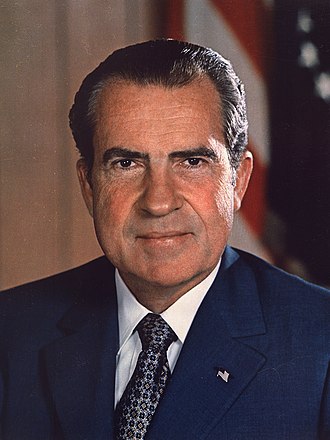
Richard M. Nixon served as the 37th President of the United States from January 1969 until his resignation in August 1974. In February 1971, he ordered the installation of a secret voice-activated taping system in the White House to preserve a historical record of his administration. Until the system's existence was revealed and dismantled in July 1973, the tapes captured Nixon directing major foreign policy initiatives, such as the opening to China, as well as his central role in the Watergate cover-up.
What Nixon talks about on the tapes
White House operations 4,718Presidential scheduling 2,225Public relations 1,784Presidential schedule 1,782Vietnam War 1,693Logistics 1,650Manolo Sanchez 1,626White House communications 1,400White House administration 1,399Presidential communication 1,243Henry Kissinger 1,191Foreign Policy 1,183
Conversations (21,010)
— Page 179 of 211President Nixon spoke briefly with a White House operator to place an outgoing call. The interaction served as a functional administrative step to facilitate presidential communication. No substantive policy discussions or significant political developments occurred during this brief exchange.
President Nixon and Alexander Haig discuss whether to escalate military action against North Vietnam in response to ongoing cease-fire violations and the slow progress of POW releases. After reviewing the political risks, the lack of significant military gains, and the potential for a negative public backlash, Nixon decides to defer further action for now. They conclude that the President's recent warning has achieved a level of caution from Hanoi and agree to continue monitoring the situation while maintaining the legal justification for military involvement in Cambodia based on the original cease-fire agreements.
President Nixon and Alexander Haig meet to coordinate administration messaging and policy regarding ongoing conflicts in Southeast Asia, specifically referencing the withdrawal of forces from Laos. The two discuss the political implications of recent presidential statements and the necessity of maintaining credible warnings to foreign actors despite domestic media scrutiny. The conversation serves as a strategic check-in on foreign policy posture and the management of public perceptions concerning Vietnam-era defense commitments.
President Nixon instructed the White House operator to contact Press Secretary Ronald L. Ziegler. The purpose of the call was to direct Ziegler to report to the Executive Office Building for an immediate meeting. This brief interaction served as a logistical arrangement to facilitate a high-level briefing.
President Nixon instructed the White House operator to place a telephone call to his personal aide, Stephen B. Bull. This brief exchange served as a logistical coordination to facilitate direct communication with a member of the President's staff. No substantive policy matters were discussed during this request.
President Nixon consulted with a White House operator to facilitate a secure communication. The brief exchange focused on establishing a safe, private line for an undisclosed purpose. This interaction serves as an administrative bridge to subsequent, more substantive discussions held by the President.
President Nixon interacted briefly with a White House operator to facilitate a telephonic connection. This administrative exchange served as the precursor to a subsequent, more substantive discussion. No specific policy matters or political decisions were addressed during this brief connection.
President Nixon and Stephen B. Bull discussed the scheduling of an upcoming Organization of American States (OAS) meeting in relation to the President's calendar. Nixon sought to clarify the exact dates of the event and expressed a preference for attending on April 13th rather than the 12th. Bull agreed to verify the specific event dates and follow up with the President accordingly.
President Nixon held a brief, informal meeting with his aide, Stephen B. Bull, in the Old Executive Office Building. The exchange consisted of mutual well-wishes and brief greetings between the two men. No substantive policy discussions or administrative actions were recorded during this brief encounter.
President Nixon met with his personal secretary, Rose Mary Woods, in the Old Executive Office Building to discuss administrative matters regarding incoming correspondence. The brief discussion centered specifically on a letter from Hobart D. ("Hobe") Lewis. No significant policy decisions or major strategic developments were recorded during this exchange.
President Nixon contacted the White House operator to place a direct call to Secretary of State William P. Rogers. This brief exchange served as an administrative request to facilitate immediate communication between the President and the Secretary. No further policy discussions or substantive developments occurred during this brief request.
President Nixon met with key advisors, including John Dean, H.R. Haldeman, and John Ehrlichman, to develop a strategic defense against the escalating Watergate scandal and the formation of the Senate's Ervin Committee. The participants debated whether to issue a formal presidential statement or commission an internal investigation to preempt Senate hearings and maintain control over the narrative. The conversation focused heavily on the need to distance the White House from the scandal, manage public perception, and potentially utilize a grand jury or a targeted disclosure to limit the scope of external investigations.
President Nixon and Secretary of State William P. Rogers discuss political strategy, specifically focusing on building congressional and public support for aid to North Vietnam. They review the potential for support from key Democrats like Hubert Humphrey and George McGovern, noting the importance of framing the aid within the defense budget to minimize domestic backlash. Additionally, they touch upon historical precedents for handling executive staff controversies and manage the President’s upcoming schedule of diplomatic meetings and receptions.
President Nixon and General Brent Scowcroft discussed potential military responses to North Vietnamese infiltration and supply efforts in violation of existing agreements. The conversation focused on the strategic timing for resuming bombing campaigns, weighing the value of current military action against the ongoing status of American prisoners of war. Nixon and Scowcroft evaluated whether a limited, signal-based bombing campaign would effectively establish a foundation for future military escalation should North Vietnamese provocations continue.
President Nixon initiates a brief telephone call to reach General Brent Scowcroft. The conversation consists solely of the President providing instructions to the White House operator to connect him with the National Security Advisor. No further substantive discussion occurs during this recording.
President Nixon spoke with General Brent Scowcroft to expedite the delivery of a misplaced administrative document. The President directed Scowcroft to have the message retyped and handed to Manolo Sanchez for personal delivery to the residence. This brief coordination ensured the efficient physical transfer of official materials between the Executive Office Building and the President.
President Nixon contacted the White House operator to request a telephone connection with Brigadier General Brent Scowcroft. This brief administrative interaction was initiated to facilitate official communication between the President and his National Security Advisor. No further substantive matters were discussed during this request.
President Nixon and General Brent Scowcroft engaged in a brief telephone exchange to coordinate the handling of a specific document brought over by the General. The President confirmed that a previously contemplated action would not proceed and sought verification that the relevant orders had been successfully rescinded. Scowcroft acknowledged the directive, confirming that the instruction had been carried out.
President Nixon initiates a brief request for the White House operator to connect him with Alexander M. Haig, Jr. This communication serves as a routine administrative step to facilitate a direct discussion between the President and his top aide. No further substance or policy deliberations were recorded during this brief logistical exchange.
President Nixon and Alexander Haig discussed a proposal from Henry Kissinger regarding potential U.S. military strikes against North Vietnam in response to ceasefire violations. Both men expressed skepticism toward the proposal, agreeing that the military impact of such strikes would be negligible and that the timing could provide North Vietnam with a propaganda pretext to stall the release of American POWs. Ultimately, Nixon decided against authorizing the strikes, concluding that the action lacked the necessary strategic justification or 'gut' conviction that had characterized previous successful military decisions.
President Nixon instructed the White House operator to place an outgoing call to John D. Ehrlichman. This brief exchange served solely as an administrative step to initiate direct communication between the President and his Assistant for Domestic Affairs.
President Nixon consulted with the White House operator in an attempt to reach John D. Ehrlichman to discuss urgent business. Upon learning that Ehrlichman was attending a dinner at the Metropolitan Club with Jean Bradlee, the President opted against interrupting him. No further action was taken regarding the call.
President Nixon contacted the White House operator to facilitate an outgoing call to his former special counsel, Charles W. Colson. The interaction served as a logistical bridge to initiate private communication with Colson. No further substantive policy or strategic discussions took place during this brief exchange.
President Nixon and Charles W. Colson discuss strategies for managing the unfolding Watergate scandal, focusing specifically on coordinating with Senator Howard Baker to ensure his loyalty while he manages the Senate committee investigation. Colson warns that White House staff involved in the cover-up, particularly John Dean, may face legal risks regarding potential charges of obstruction of justice. To mitigate these risks and provide a layer of separation from the White House, the two men evaluate the potential appointment of a respected special counsel to handle the administration's legal response.
President Richard Nixon met with his valet, Manolo Sanchez, in the Oval Office to receive personal refreshments. This brief interaction served as a routine service encounter within the President's daily schedule. No substantive policy or political matters were discussed during this exchange.
President Nixon met with his aide Stephen B. Bull in the Oval Office to facilitate the delivery of specific items or documents. The discussion centered on the logistics of these materials and Bull’s administrative responsibilities regarding their distribution. No further details are available, but the meeting served to coordinate staff-level support for executive tasks.
President Nixon and Stephen B. Bull reviewed the President's upcoming daily schedule, focusing primarily on a briefing for subcabinet officers. The discussion covered logistics for the briefing, including the room configuration, and addressed administrative tasks such as a scheduled call to Lindy Boggs and various meetings with staff and Cabinet members. Bull confirmed his attendance at the subcabinet briefing to assist with proceedings as the session commenced.
President Nixon and Stephen B. Bull discussed the logistics and strategic purpose of an upcoming briefing for subcabinet officers. The primary goal of the session was identified as a form of "therapy" for the attendees rather than a forum for substantive policy speeches. They addressed necessary coordination efforts, including the involvement of Secretary of State William P. Rogers, press coverage arrangements, and the structure of the agenda regarding budget and tax matters.
President Nixon telephoned Representative Corinne “Lindy” Boggs to offer his congratulations on her recent special election victory. The two discussed the challenges of her campaign, with Nixon offering encouragement regarding her future electoral prospects. The conversation concluded with pleasantries exchanged regarding their respective families and political outlooks.
President Nixon held a brief introductory meeting with newly elected Representative Lindy Boggs to congratulate her on a decisive electoral victory. The discussion centered on pleasantries regarding her successful campaign and the prospect of her future visits to the White House. The conversation served primarily as a formal, cordial welcome to the incoming congresswoman.
President Nixon met with his aide Stephen B. Bull in the Old Executive Office Building to discuss the President’s daily schedule. The brief interaction focused on logistical coordination for the day's upcoming appointments and obligations. No specific policy decisions or significant developments were recorded during this short administrative exchange.
President Nixon and H.R. Haldeman coordinate the timing of an upcoming meeting to ensure a discussion occurs prior to a scheduled 10:00 a.m. appointment. The conversation serves primarily to expedite Haldeman's arrival at the Oval Office. No substantive policy matters were discussed during this brief administrative exchange.
President Nixon and H. R. Haldeman met briefly to coordinate their schedules before an upcoming 10:00 a.m. meeting. Nixon requested Haldeman's presence specifically to discuss preparation for this later engagement. The brief exchange served primarily as an administrative check-in to ensure alignment prior to the day's scheduled business.
President Nixon met briefly with Zosimo Monson in the Old Executive Office Building. The primary purpose of the brief interaction was the provision of coffee for the President. No significant policy discussions or administrative decisions were recorded during this exchange.
President Nixon and H.R. Haldeman met to discuss public relations strategies and the administration's response to the growing Watergate scandal. They debated the merits of potential public addresses, such as a speech to Congress or a press conference, while assessing how to maintain control over the narrative and protect the White House from entanglement in the investigation. The conversation focused on the need for a containment strategy, the handling of sensitive campaign funds, and managing potential leaks or witness testimony, ultimately weighing the political risks of various disclosure scenarios.
President Nixon and General Brent Scowcroft met to coordinate the public messaging regarding the return of U.S. prisoners of war and the administration’s strategy for handling North Vietnamese violations of the peace agreement. They discussed the necessity of maintaining the durability of the settlement, weighing the potential psychological effects and political risks of resuming U.S. military action or bombing campaigns. Additionally, the President provided instructions on managing public relations, specifically regarding statements on POWs and the scheduling of a related event for military leadership.
President Nixon and General Brent Scowcroft discussed the strategic deployment of an aircraft carrier to the Philippines and the potential psychological impact of this move following the Vietnam settlement. They analyzed reports of North Vietnamese foot-dragging, specifically regarding Pathet Lao activity in Southern Laos, and deliberated on the effectiveness of existing communication channels. Nixon instructed Scowcroft to coordinate with Henry Kissinger to address these developments and evaluate the Defense Department's notification requirements.
President Nixon met with Carlos Sanz de Santamaria and William J. Jorden to discuss the declining relevance of the Organization of American States (OAS) and the future of U.S.-Latin American relations. Santamaria proposed restructuring the OAS to prioritize economic development over obsolete security mandates and suggested creating an organization similar to the OECD to foster regional cooperation. Nixon expressed interest in reexamining institutional goals and indicated a willingness to work toward a new, pragmatic policy approach, provided it aligns with his 'Nixon Doctrine' of encouraging self-help and respecting national diversity.
President Nixon met with George H.W. Bush, William Timmons, William Brock, and Robert Michel to coordinate Republican strategy and candidate recruitment for the 1974 midterm elections. The President emphasized a shift in focus toward recruiting younger, high-quality candidates rather than relying solely on incumbents, while urging the attendees to improve organizational cooperation and resource sharing among campaign committees. Nixon also provided guidance on navigating complex state-level political dynamics, including advising a non-interventionist approach in certain gubernatorial races and streamlining fundraising efforts.
President Nixon and Stephen B. Bull met briefly to review the President’s upcoming schedule and coordinate administrative logistics. The discussion focused on arrangements for meetings with Raymond P. Shafer, representatives from the Cable Television Association, and Clay T. Whitehead. The two also addressed the scheduling of a photo session involving photographer Oliver F. Atkins before concluding the meeting.
President Nixon met with Geoffrey C. Shepard to receive a formal presentation of the final report from the National Commission on Marijuana and Drug Abuse. During this brief interaction, the President acknowledged the commission's work and provided them with presidential cufflinks as a gesture of appreciation. The discussion served as the official handover of the commission's findings to the executive office.
President Nixon met with Raymond P. Shafer and members of the National Commission on Marijuana and Drug Abuse to express his appreciation for their work and discuss the commission's reports. The conversation focused on the challenges of addressing drug dependency, the necessity of moving beyond public controversy to prioritize substantive research, and the potential for future drug and alcohol studies. Nixon emphasized the importance of the commission's non-partisan contributions to national drug policy before concluding the meeting by presenting the members with commemorative presidential gifts.
President Nixon met with Stephen B. Bull and Michael J. Farrell to verify the list of former presidents he had previously met for an upcoming photo opportunity with Mrs. Bruce Bedford. The participants confirmed that Nixon had encountered five former presidents, ranging from Herbert Hoover through Lyndon B. Johnson. They also discussed logistical arrangements for the meeting, including the specific seating configuration at the President's desk for the session.
President Nixon held a brief, ceremonial meeting with Mrs. Bruce Bedford, III and Michael J. Farrell, which included a photo session with members of the press. The discussion focused on pleasantries regarding Mrs. Bedford's longevity, her personal history with former presidents, and her general well-being. The President presented Mrs. Bedford with commemorative gifts, including items bearing the presidential seal, and exchanged well wishes for the future.
President Nixon met with Congressman Caldwell Butler and staffer Max L. Friedersdorf to facilitate the presentation of letters from school children and coordinate the distribution of photographs taken during the visit. The discussion centered on fostering community goodwill following Butler’s election and identifying specific needs for Hardy Road Elementary School. The participants concluded by briefly touching upon the logistical arrangements for Butler’s upcoming travel and social schedule.
President Nixon met with Representative Jack Edwards and an Alabama delegation to discuss regional development projects and demonstrate support for his administration’s policies. The participants highlighted the Tennessee Tombigbee River project and exchanged praise regarding the repatriation of prisoners of war, specifically citing the strength and patriotism of Captain Jeremiah Denton. Nixon also used the session to cultivate political ties in the South, discussing the recoveries of Senator John C. Stennis and Governor George Wallace while coordinating legislative outreach through Secretary George Shultz.
President Nixon met with his aide, Stephen B. Bull, for a brief administrative discussion regarding the President's daily schedule. The conversation focused on logistical planning for upcoming appointments and obligations. No major policy decisions were recorded during this brief administrative interaction.
President Nixon hosted Herbert G. Klein, his wife, and the Hall family in the Oval Office for a brief social visit. The primary purpose of the meeting was to facilitate photographs taken by White House photographer Ollie Atkins and to arrange for copies to be sent to the guests. The conversation remained informal, touching upon family relations, the Hall family’s residence in San Diego, and lighthearted exchanges regarding the Spanish language.
President Nixon and Stephen B. Bull met briefly in the Oval Office to coordinate the President's upcoming schedule. The primary focus of the discussion concerned the President's meeting with General Brent G. Scowcroft. Bull departed the office immediately following this administrative briefing.
President Nixon met with his personal valet, Manolo Sanchez, to coordinate a midday meal. The discussion centered on logistics for the President's lunch, specifically requesting cottage cheese to be delivered to his Executive Office Building (EOB) workspace. This brief interaction served to manage the President's immediate administrative and dietary arrangements.
President Nixon met with Gen. Brent Scowcroft to discuss the ongoing status of the Vietnam settlement, specifically focusing on the cease-fire in Laos, the handling of North Vietnamese provocations, and the critical importance of securing the return of American POWs. Following this, Press Secretary Ronald Ziegler joined the discussion to coordinate the administration's public messaging regarding these foreign policy challenges and to address domestic concerns, including rising food prices and media coverage of the White House. The participants emphasized the necessity of a unified communication strategy to maintain public support while finalizing troop withdrawals and managing sensitive negotiations.
President Nixon held an undocumented meeting with unidentified individuals in the Oval Office to address internal administrative matters. The discussion centered on an unspecified presidential request regarding personnel or operational logistics. The interaction concluded with a directive involving a call to a duty station, though the lack of a transcript prevents further clarification of the participants or specific policy objectives.
President Nixon initiates a brief telephone request through the White House operator to be connected with Stephen B. Bull. The interaction serves as a functional directive to facilitate communication with his aide. No further policy or administrative matters are addressed during this brief exchange.
President Nixon held a brief interaction with the White House operator to facilitate a telephonic connection. The exchange served administrative purposes related to the routing of calls from the Executive Office Building. No further substantive policy or political discussions occurred during this recording.
President Nixon instructed his aide, Stephen B. Bull, to postpone a scheduled meeting with H.R. Haldeman and other associates by approximately twenty minutes. The President requested the delay to allow himself sufficient time to complete several pending telephone calls. Consequently, the meeting time was officially rescheduled for 1:50 p.m.
President Nixon contacted the White House operator to place a personal telephone call to his daughter, Tricia Nixon Cox. The conversation was strictly administrative, focusing on connecting the President to his daughter. No substantive policy discussions or political developments occurred during this brief interaction.
President Nixon and Stephen B. Bull briefly met to confirm the status of a specific matter, with the President indicating that they had successfully secured control over the situation. This exchange served as a concise directive regarding a sensitive issue, though the transcript remains too limited to identify the specific subject matter. The meeting concluded immediately after this brief verification of progress.
President Nixon interacts with a White House operator to facilitate an outgoing call. This brief exchange serves primarily as a logistical step in managing the President’s communications from the Old Executive Office Building. No substantive policy matters or political strategy discussions occur during this short administrative interaction.
President Nixon consulted his daughter, Tricia Nixon Cox, regarding administrative arrangements for an upcoming dinner honoring returning prisoners of war (POWs). The President informed her that Press Secretary Ron Ziegler would contact First Lady Pat Nixon to coordinate the event's public relations strategy, specifically regarding the timing of announcements for the dinner and the entertainment. To maintain exclusivity and control the guest list, the President decided to delay the public announcement of celebrity participants like Bob Hope.
President Nixon held a brief, informal meeting with his daughter, Tricia Nixon Cox, to check on her well-being. The conversation was personal in nature, focusing on her health and general state of mind. No official business or substantive policy matters were addressed during this short exchange.
President Nixon and Stephen Bull met briefly to review the President’s daily schedule and pending administrative tasks. The discussion focused on arrangements for a phone call to Canadian Prime Minister Pierre Trudeau regarding the International Commission of Control and Supervision (ICCS) in Vietnam, following a recommendation from General Brent Scowcroft. Nixon ultimately directed that the call be prioritized to address the status of his correspondence with the Prime Minister.
President Nixon instructed the White House operator to place an outgoing call to Secretary of State William P. Rogers. The brief exchange served as a logistical arrangement to facilitate direct communication between the President and the Secretary. No substantive policy matters were discussed during this request.
President Nixon instructed his valet, Manolo Sanchez, to transport his briefcase to the Oval Office and coordinate with Stephen B. Bull regarding the day’s professional schedule. The brief exchange focused on logistical arrangements for the President's personal belongings and the management of his upcoming appointments. Sanchez was directed to ensure the briefcase was properly handled and integrated into the operational flow for the remainder of the day.
President Nixon consulted with the White House operator to facilitate a telephonic connection. This brief interaction served as a logistical step to initiate an external call during the President's workday. No substantive policy matters or major developments occurred during this brief administrative exchange.
President Nixon consulted Secretary of State William P. Rogers regarding the most effective way to persuade Canadian Prime Minister Pierre E. Trudeau to keep Canada in the International Commission of Control and Supervision (ICCS). The two agreed that Nixon would send a personal letter to Trudeau followed by a telephone call to emphasize that global leadership depends on continued Canadian participation, while avoiding the appearance of undue American pressure. Rogers also cleared a joke with the President regarding executive privilege to be used during an upcoming social event with the diplomatic corps.
President Nixon and Secretary of State William P. Rogers consult on the appropriate method for communicating a sensitive recommendation, debating whether a formal letter or a direct phone call is more suitable. Nixon expresses hesitation regarding the timing and nature of the call, ultimately seeking Rogers’s advice on the matter. Following their brief exchange, the President decides to proceed with the communication.
President Nixon and Stephen Bull met briefly to address administrative logistics regarding the President's personal belongings and correspondence. The discussion focused on the status of a letter dispatched to Canadian Prime Minister Pierre E. Trudeau, which had been coordinated through Secretary of State William P. Rogers. The conversation concluded with Bull confirming the handling of the dispatch and the President preparing for his subsequent scheduled engagement.
President Nixon met with John Dean, John Ehrlichman, H.R. Haldeman, and John Mitchell to strategize on managing the escalating Watergate investigation. The group discussed how to assert executive privilege regarding FBI files and staff testimony to limit the scope of congressional inquiries. They reached a decision to have legal counsel open a dialogue with Senators Ervin and Baker to establish a controlled format for cooperation that avoids public confrontations while protecting presidential authority.
President Nixon directs the White House operator to place an outgoing call to Attorney General Richard G. Kleindienst. This brief administrative interaction serves as the precursor to a direct consultation between the President and the head of the Department of Justice. No further substantive discussion occurs during this segment of the recording.
President Nixon and Attorney General Richard Kleindienst discuss the need for Kleindienst to serve as the primary point of contact for Senator Howard Baker, who has expressed frustration over communication lapses regarding the Watergate investigation. Nixon explicitly directs Kleindienst to "babysit" Baker to ensure he receives proper guidance and stays aligned with White House strategy. Additionally, they discuss the confirmation prospects of L. Patrick Gray as FBI Director, considering potential alternatives like a judicial appointment if his Senate support falters, and confirm the details of a limited policy regarding the release of raw FBI files to the Ervin Committee.
President Nixon directs the White House operator to place an outgoing call to Canadian Prime Minister Pierre E. Trudeau. The brief exchange serves as a logistical coordination to facilitate diplomatic communication between the two leaders. No substantive policy discussions occur during this short administrative interaction.
President Nixon coordinated a return telephone call with Canadian Prime Minister Pierre E. Trudeau via the White House operator. The operator informed the President that Trudeau was currently at the House of Commons and would be available in ten minutes. Nixon confirmed the proposed timeframe, establishing the schedule for the upcoming diplomatic communication.
President Nixon met with his aide Stephen B. Bull in the Oval Office to handle administrative tasks and manage the President's immediate agenda. During this brief encounter, they processed official papers and documents requiring signature. The meeting concluded with preparations for the President's subsequent appointment with George P. Shultz.
President Nixon met with his aide Stephen B. Bull in the Oval Office to conduct administrative business and manage the presidential schedule. The discussion focused on coordinating a scheduled telephone call with Canadian Prime Minister Pierre E. Trudeau and processing various official documents requiring the President’s signature. This brief interaction served primarily to facilitate executive workflow and ensure the President remained current with his immediate appointments.
President Nixon initiated this call to urge Prime Minister Pierre Trudeau to maintain Canada's participation in the International Commission of Control and Supervision (ICCS) in Vietnam, arguing that Canada's presence was essential for ensuring compliance with peace agreements. Trudeau expressed concern about the political feasibility of an indefinite commitment given opposition within the Canadian Parliament and suggested that a temporary extension might be the only viable compromise. The two leaders also discussed managing U.S.-Canadian trade relations to avoid public perceptions of pressure, with Nixon promising that Treasury Secretary George Shultz would coordinate directly with his Canadian counterpart to foster cooperation.
President Richard Nixon met with Canadian Prime Minister Pierre Trudeau in the Oval Office to facilitate a brief diplomatic exchange. During the conversation, Trudeau noted his busy schedule while managing parliamentary duties, and Nixon confirmed the delivery of a personal message sent via courier. The brief interaction served to maintain open channels of communication between the two leaders regarding ongoing bilateral correspondence.
President Nixon initiates a request for the White House operator to connect him with Secretary of State William P. Rogers. The brief exchange serves as a logistical coordination step to facilitate a high-level diplomatic or administrative consultation. The operator confirms the attempt to reach the Secretary, setting the stage for the subsequent discussion between the two officials.
President Nixon consulted with the White House operator to facilitate an outgoing call. This brief interaction served an administrative purpose, functioning as a routine request to connect the President with an external party. No substantive policy discussions or policy-related decisions occurred during this brief communication exchange.
President Nixon met with his aide Stephen B. Bull in the Oval Office to conduct routine administrative business regarding his daily schedule. During the brief interaction, the two reviewed various documents requiring the President’s signature and discussed arrangements for an upcoming meeting with Treasury Secretary George P. Shultz. The conversation concluded immediately following these logistical updates.
President Nixon briefed Secretary of State William P. Rogers on a telephone conversation with Canadian Prime Minister Pierre E. Trudeau regarding Canada’s participation in the International Commission of Control and Supervision (ICCS). Nixon pressed for Canada to remain in the commission for at least a few more months to avoid the appearance that their departure caused the mission’s collapse. Rogers was instructed to follow up with Canadian Foreign Minister Mitchell Sharp to finalize this commitment after the Canadian cabinet reviewed the matter.
President Nixon briefed Secretary of State William P. Rogers on the conclusion of a lengthy telephone conversation he had just held with Canadian Prime Minister Pierre Trudeau. The exchange served primarily as a status update regarding the diplomatic communication, with no further substantive details recorded. The interaction concluded quickly after this brief notification.
President Nixon met with George Shultz, John Ehrlichman, and others to discuss various administrative and economic policy challenges, including the status of an industrial commission and potential adjustments to farm subsidy programs. The conversation emphasized a desire for proactive political positioning on upcoming legislative issues rather than reactive policymaking. Additionally, the group reviewed personnel matters, specifically the resignation of Henry Kearns and the potential reappointment of Pierre-Paul Schweitzer at the IMF.
President Nixon met with his aide Stephen B. Bull to coordinate an extensive list of upcoming White House events, travel logistics, and scheduling requirements. They reviewed details for California appearances, including ceremonial remarks and meetings with state legislators, while also discussing entertainment planning for a forthcoming POW dinner and official state visits. Nixon provided specific directives regarding social protocol, such as seating arrangements and head table designs, to ensure upcoming White House functions maintained an appropriate level of elegance and formality.
President Nixon and Henry Kissinger met to coordinate strategy for the President's upcoming public address and evaluate the status of the Vietnam settlement, including the release of prisoners of war (POWs) and ongoing military enforcement. The discussion emphasized the necessity of a strong, firm posture to deter further North Vietnamese aggression and maintain the credibility of U.S. foreign policy. Additionally, they reviewed plans for future diplomatic outreach, including potential summits with European and Latin American leaders, and discussed the political landscape surrounding the Watergate investigation.
President Nixon met with his aide, Stephen B. Bull, to conduct routine administrative business in the Oval Office. The primary focus of the discussion concerned the processing of documents requiring the President’s signature and the final scheduling details for the upcoming swearing-in ceremony of Congresswoman Corrine C. (“Lindy”) Boggs. The meeting concluded after these brief logistical arrangements were addressed.
President Nixon and H.R. Haldeman discuss the President's upcoming schedule and the political fallout from the Watergate scandal. They evaluate the necessity of a dramatic, high-level commission to investigate the scandal as a means to regain control over the narrative and counter the growing credibility crisis facing the White House, FBI, and Department of Justice. Amidst reports that key figures like Jeb Magruder and E. Howard Hunt may soon implicate senior staff, Nixon instructs Haldeman to gather facts and consult with others to manage the potential damage to his administration.
President Nixon held a brief meeting with an unidentified individual, potentially related to a requested call from domestic affairs advisor John D. Ehrlichman. The discussion remains largely undocumented due to the limited transcript, though it appears to focus on coordinating administrative communications. No specific policy decisions or significant developments are discernable from the available record of this brief interaction.
President Nixon held a brief, informal meeting with unidentified individuals in his Old Executive Office Building workspace. The encounter was limited to a casual inquiry regarding the President’s current activities and an exchange of pleasantries. No substantive policy discussions or administrative decisions were recorded during this brief interaction.
President Nixon met with John Ehrlichman, H.R. Haldeman, and others to discuss management strategies for the ongoing Wounded Knee incident and the unfolding Watergate scandal. The participants deliberated on whether to involve White House staff directly in PR for Wounded Knee, weighing the benefits of projecting control against long-term political risks. Regarding Watergate, they explored the possibility of the President appointing a special commission or cooperating with a grand jury to regain the initiative, while also addressing concerns about potential testimony from staff members like John Dean and Jeb Magruder.
President Nixon and John Ehrlichman coordinate a follow-up meeting after Ehrlichman finishes his current obligations. The brief exchange centers on the status of the ongoing Wounded Knee occupation and Ehrlichman's immediate availability to consult with the President. They agree to meet in person at the White House following the conclusion of Ehrlichman's current duties.
President Nixon and John Ehrlichman briefly coordinate a meeting to discuss the ongoing occupation of Wounded Knee. The conversation serves as a logistical check-in to ensure Ehrlichman is prepared to report on the situation. The brief exchange concludes with an instruction for Ehrlichman to proceed to the President's office immediately.
President Richard M. Nixon and Prime Minister Pierre E. Trudeau discussed Canada's ongoing participation in the International Commission of Control and Supervision (ICCS) in Vietnam. Trudeau informed the President that his cabinet decided to postpone any immediate withdrawal of Canadian personnel, opting instead to reevaluate their commitment in May to allow more time for the peace process to stabilize. Nixon expressed his gratitude for this decision, emphasizing the diplomatic symbolism of Canada's presence, while acknowledging the political challenges this posed for Trudeau domestically.
President Nixon utilized the White House operator to place a personal telephone call to his daughter, Tricia Nixon Cox. The recording serves as a brief procedural connection for a private family communication. No substantive policy discussions or administrative actions were conducted during this interaction.
President Nixon spoke with his daughter, Tricia Nixon Cox, to check on her well-being and coordinate their upcoming social schedule. During the brief check-in, the President clarified that he would be unavailable for dinner that evening due to pressing work obligations, including a meeting with Secretary of State William P. Rogers. They concluded the call by confirming plans to reunite the following day.
President Nixon held a brief, informal interaction with a White House operator to facilitate communication. The exchange served primarily as a functional administrative request to initiate an external phone call. No substantive policy discussions or significant political developments occurred during this brief contact.
President Nixon and his daughter, Tricia Nixon Cox, held a brief personal check-in regarding the President's health and upcoming schedule. They confirmed plans to meet at a dinner later in the week while the President noted his need to work with Secretary of State William Rogers that evening. The interaction served as a coordination of social and professional commitments rather than a discussion of policy.
President Richard Nixon met with his personal valet, Manolo Sanchez, in the Old Executive Office Building. The meeting centered on the provision of refreshments for the President. No substantive policy discussions or significant political developments were recorded during this brief encounter.
President Nixon utilized the recording system to dictate a memorandum for his personal files regarding the activities of the day. This action served to formalize the President's internal record-keeping process during a period of intense administrative activity. No other participants were present for this dictation, and the specific subject matter of the memorandum remains undefined in the available transcript.
President Nixon met with his personal aide, Manolo Sanchez, in the Old Executive Office Building to organize and secure sensitive documents. The pair focused on identifying and removing specific items from active files to be relocated into the President's private collection. This administrative task resulted in the formal separation of personal materials from official White House records.
President Nixon consulted with an unidentified staff member regarding administrative arrangements for an upcoming meeting with Corinne “Lindy” Boggs. The discussion focused on scheduling logistics involving First Lady Pat Nixon, who was occupied with preparations for a California trip, and determining the appropriate size of the attendee group. They also addressed the requirements for press coverage surrounding the event.