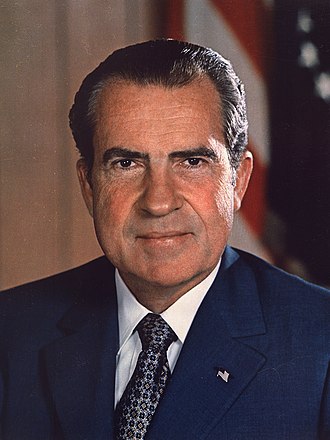
Nixon, Richard M. (President)
Richard M. Nixon served as the 37th President of the United States from January 1969 until his resignation in August 1974. In February 1971, he ordered the installation of a secret voice-activated taping system in the White House to preserve a historical record of his administration. Until the system's existence was revealed and dismantled in July 1973, the tapes captured Nixon directing major foreign policy initiatives, such as the opening to China, as well as his central role in the Watergate cover-up.
What Nixon talks about on the tapes
White House operations 4,718Presidential scheduling 2,225Public relations 1,784Presidential schedule 1,782Vietnam War 1,693Logistics 1,650Manolo Sanchez 1,626White House communications 1,400White House administration 1,399Presidential communication 1,243Henry Kissinger 1,191Foreign Policy 1,183
Conversations (21,010)
— Page 24 of 211President Nixon and H. R. Haldeman briefly conferred regarding the status of John Ehrlichman. The discussion focused on confirming that Ehrlichman was in good standing and effectively managing his responsibilities. No further policy actions or significant administrative shifts were recorded during the exchange.
President Nixon contacted the White House operator to facilitate an urgent connection to National Security Advisor Henry A. Kissinger. This administrative interaction served as a logistical bridge to initiate a direct line of communication between the President and his top foreign policy aide. The call highlights the established protocol for the President to secure private, immediate access to senior staff during the workday.
President Nixon and Henry Kissinger discuss diplomatic progress regarding the People's Republic of China, expressing optimism that a response from the Chinese leadership is forthcoming. The conversation shifts to managing relations with the press, with Nixon proposing a conciliatory, personal outreach to media figures like William Paley to alleviate institutional tensions. Additionally, they touch upon political maneuvers involving figures such as Clark Clifford, Edward Kennedy, and Hubert Humphrey, alongside logistics concerning potential wheat shipments to the USSR.
President Nixon contacted the White House operator to facilitate a telephone connection with his personal secretary, Rose Mary Woods. The primary objective of the call was to establish communication with Woods for administrative or personal coordination. No substantive policy or political matters were discussed during this brief exchange.
President Nixon initiates a brief communication with the White House operator to facilitate a call to his personal aide, Stephen B. Bull. The primary purpose of this administrative exchange is to coordinate logistics regarding Rose Mary Woods' current location aboard the presidential yacht, the Sequoia. No substantive policy decisions are reached during this brief logistical coordination.
President Nixon consulted with his aide, Stephen B. Bull, to coordinate logistics for an upcoming wedding reception, specifically regarding the selection and quantity of presidential gift items for guests. Bull confirmed the inventory of compacts and key chains, verifying their quality and appropriate value for the event. The two also finalized the President's departure time and location, ensuring Colonel Vernon C. Coffey, Jr. was briefed on the arrangements.
President Nixon contacted the White House operator to facilitate a telephone connection with his personal secretary, Rose Mary Woods. This brief administrative call served to initiate communication between the President and his primary aide. No substantive policy matters or major developments were discussed during the exchange.
President Richard Nixon and his personal secretary, Rose Mary Woods, engaged in a brief late-night telephone call. The conversation consisted entirely of segments categorized as personal and returnable, resulting in no official policy discussions or administrative actions being recorded. Consequently, the substance of this interaction remains restricted due to its private nature.
President Nixon communicated with the White House operator to facilitate a telephone connection to his personal secretary, Rose Mary Woods. This brief administrative interaction served to initiate a call for private or professional assistance. No substantive policy discussions or policy-related decisions occurred during this brief exchange.
President Nixon initiates a brief request to the White House operator to be connected to a specific individual. The interaction serves as a functional communication bridge to facilitate an upcoming call. No substantive policy matters or broader administrative decisions were addressed during this brief exchange.
President Nixon met with his personal secretary, Rose Mary Woods, for a brief administrative consultation in the Oval Office. While no transcript exists to detail the specific content, such meetings typically involved coordinating the President's private schedule, managing confidential correspondence, or handling sensitive personal files. No major policy developments were recorded during this brief three-minute interaction.
President Nixon met briefly with Alexander P. Butterfield and Ronald L. Ziegler to coordinate his daily schedule and review logistics for an upcoming event. The discussion centered on final preparations for a White House lawn ceremony, specifically addressing the weather forecast and the physical appearance of the site. The participants ensured that all arrangements were set to proceed as planned for the day's activities.
President Nixon and Henry Kissinger discussed the ongoing diplomatic efforts to end the Vietnam War, focusing on the strategic movements of North Vietnamese negotiator Le Duc Tho and the potential for a breakthrough in negotiations. Kissinger briefed the President on logistics for secret travel to facilitate these talks, while both men assessed the impact of the domestic political climate and media opposition on their foreign policy initiatives. Additionally, they reviewed progress regarding upcoming summits with the Soviet Union and the People's Republic of China, emphasizing the need for discretion and timing to maintain diplomatic leverage.
President Nixon and his personal secretary Rose Mary Woods held a brief telephone conversation to exchange pleasantries. The discussion consisted primarily of social discourse and personal logistics. No substantive policy matters or administrative decisions were addressed during this exchange.
President Richard Nixon met with his personal secretary, Rose Mary Woods, to briefly discuss a prior telephone communication. The exchange remains largely obscured due to withdrawn material, but the dialogue suggests a follow-up on a specific matter previously handled via phone. Further context for this brief interaction is linked to a subsequent conversation, 5-20.
President Nixon and H.R. Haldeman met to discuss sensitive foreign policy and political strategy, specifically regarding the Middle East, the Vietnam War, and the role of Secretary of State William P. Rogers. They reviewed reports from John N. Mitchell concerning Israel, the Jewish community’s political influence, and Henry Kissinger’s covert diplomatic backchannels. Nixon expressed frustration with Rogers' management of the State Department, questioning his effectiveness and loyalty, while contemplating how to utilize his staff to better monitor foreign affairs.
President Nixon and H. R. Haldeman met to discuss various political and administrative issues, specifically focusing on the upcoming wedding of Tricia Nixon Cox and the associated media management. The conversation moved to strategic foreign policy concerns, including the status of Vietnam negotiations, the potential for a breakthrough with China, and the management of sensitive Middle East relations despite friction with Secretary of State William Rogers. Additionally, they reviewed domestic political tactics, such as the strategy for handling the hostile press establishment and the use of the drug initiative to build public support.
President Nixon and H. R. Haldeman met to discuss a wide-ranging agenda of administration business, primarily focusing on managing press relations, staffing decisions, and public perception. A significant portion of the discussion centered on logistics and symbolic management of Tricia Nixon Cox's upcoming White House wedding, including strategies for handling potential rain and maximizing positive television coverage. The participants also reviewed internal friction regarding Secretary of State William P. Rogers, the expansion of the speechwriting office to better appeal to 'Middle America,' and strategies to improve the administration's image through carefully coordinated events and outreach to specific interest groups.
President Richard Nixon spoke with his daughter, Tricia Nixon Cox, regarding personal matters shortly before her wedding. The conversation occurred in a brief, informal context typical of the family's pre-nuptial communications. Because the substance of the discussion was classified as a personal record, no substantive policy or administrative developments were recorded.
President Nixon instructed the White House operator to place a telephone call to Chicago businessman Edward L. Ryerson. The operator informed the President that Ryerson was currently hospitalized following a recent medical operation. Nixon provided the spelling of Ryerson's name to ensure the operator could locate the correct contact information to facilitate the communication.
President Nixon consulted with a White House operator to facilitate communication regarding administrative concerns. The brief interaction focused on the necessity of routing specific inquiries and problem-solving efforts to the appropriate subject matter experts. No significant policy decisions were recorded during this logistical exchange.
President Richard Nixon engaged in a brief telephone conversation with Edward L. Ryerson. The content of this interaction remains restricted due to the withdrawal of the primary recorded segment. Consequently, no substantive discussions, policy decisions, or official actions are available for historical analysis from this specific recording.
President Richard Nixon met with businessman Edward L. Ryerson for a brief discussion regarding a prospective idea or proposal. Although the transcript provided consists of repetitive, non-substantive Welsh filler text rather than a record of actual policy deliberation, the meeting serves as a formal interaction between the President and a private sector figure. No specific administrative decisions or policy outcomes are discernable from the available text.
President Nixon contacted the White House operator to place a direct phone call to his Press Secretary, Ronald L. Ziegler. The conversation was brief and strictly functional, serving only to facilitate communication with a key staff member. No substantive political issues or policy decisions were discussed during this exchange.
President Nixon held a meeting with an unidentified male visitor in his Old Executive Office Building suite to discuss matters of an unspecified nature. The conversation remained private, with no transcript available and a brief six-second segment designated as a personal returnable item. No significant policy decisions or administrative actions were recorded for this encounter.
President Nixon contacted the White House operator to secure the location of his personal secretary, Rose Mary Woods. The operator informed the President that Woods was currently staying at the Taylor House. This brief administrative exchange facilitated the President's attempt to reach a key staff member.
President Nixon and Rose Mary Woods discuss the successful execution of Tricia Nixon Cox’s wedding ceremony held at the White House. The participants praise the efforts of the White House staff, specifically commending Rex Scouten and the military aides for their logistical contributions. They characterize the event as visually stunning and superior in presentation to the traditional White House Christmas decorations.
President Nixon directed the White House operator to facilitate an outgoing call to an unspecified party. The brief interaction focused solely on establishing a connection, with the President providing a directive to reach the individual. No further policy or administrative decisions were documented during this exchange.
President Nixon met with White House photographer Oliver F. Atkins and personal valet Manolo Sanchez to review and discuss personal photographs from the recent wedding of his daughter, Tricia Nixon. The participants examined various candid and official images, sharing positive feedback on the visual documentation and the favorable media coverage surrounding the ceremony. Nixon directed that specific photographs be delivered to his daughter, reflecting the informal and personal nature of the gathering.
President Nixon met with various aides and associates, including Charles G. Rebozo and General Alexander M. Haig, Jr., to address administrative matters and ongoing policy concerns. The discussions involved managing the President's schedule, press coverage, and broad economic considerations regarding business leadership and market influences. The participants reviewed draft materials and organizational strategies for future meetings while ensuring the alignment of public messaging with internal policy objectives.
President Nixon coordinated with Press Secretary Ronald Ziegler to secure copies of AP and UPI news coverage for Julie Nixon Eisenhower. The discussion also touched upon a recently aired ABC-TV news special regarding Tricia Nixon Cox's wedding. Nixon expressed satisfaction with the television coverage, and Ziegler committed to facilitating the delivery of the requested press clippings.
President Nixon contacted the White House operator to request a telephone connection with Press Secretary Ronald L. Ziegler. The brief interaction served as a logistical bridge to facilitate direct communication with his primary spokesperson. No further policy discussions or substantive developments occurred during this specific exchange.
President Nixon and Press Secretary Ronald Ziegler discuss media coverage of Tricia Nixon Cox's wedding, evaluating the performance of various television networks and newspapers. While expressing general satisfaction with television coverage, the President strongly criticizes a Washington Post article by Judith Martin for its negative tone. Consequently, Nixon orders a total ban on Washington Post reporters from attending future White House social and residential functions, instructing Ziegler to exclude them from coverage pools while maintaining a veneer of professional discretion.
President Nixon instructs the White House operator to connect him with his Chief of Staff, H.R. Haldeman. This brief call serves as a logistical bridge to initiate a direct conversation between the President and his top aide. No substantive policy matters or decisions are discussed beyond the request to establish the line.
President Nixon and H.R. Haldeman discuss the media coverage surrounding Tricia Nixon Cox's wedding, evaluating the performance of various television networks and the print coverage in the Washington Post. They express satisfaction with the overall quality of the televised event while criticizing a negative newspaper article. The conversation concludes with a strategic recommendation to improve future White House event coverage by adjusting camera angles to capture the faces of guests in receiving lines.
President Nixon contacted the White House operator to facilitate a call to his personal secretary, Rose Mary Woods. The brief exchange served as an administrative request to establish communication with a key member of his staff. No further substantive policy matters were discussed during this brief connection.
President Richard Nixon and his personal secretary, Rose Mary Woods, engaged in a series of telephone discussions that were entirely designated as personal in nature. Because the entirety of the communication was classified as a personal returnable item, no official administrative or political content is available for historical record. Consequently, no substantive policy decisions or executive actions were documented during these segments.
President Nixon contacted the White House operator to facilitate a private telephone connection with his daughter, Julie Nixon Eisenhower. The brief exchange served exclusively as a logistical step to place the outgoing call. No substantive policy matters or political discussions were addressed during this interaction.
President Nixon and his daughter, Julie Nixon Eisenhower, engaged in a brief personal telephone conversation. The discussion was limited in scope, focusing on short-term scheduling or personal arrangements. No significant policy decisions or administrative actions resulted from this exchange.
President Nixon instructed the White House operator to connect him with his personal secretary, Rose Mary Woods, to facilitate a call with his close friend, Charles G. “Bebe” Rebozo. This brief administrative interaction served to initiate a private communication between the President and Rebozo. No substantive policy matters were discussed during this exchange.
President Nixon contacted the White House operator to place a personal telephone call to Carol Finch, the wife of his advisor Robert Finch. The brief communication served solely as a logistical request for the operator to connect the President with Mrs. Finch. No further policy or administrative matters were discussed during this interaction.
President Richard M. Nixon engaged in a brief telephone conversation with Carol (Crothers) Finch. The recording of this exchange is currently restricted, as the entirety of the dialogue is classified as a withdrawn personal item. Consequently, no information regarding the topics discussed or specific decisions made is available for review.
President Nixon initiates a brief telephone call through the White House operator to contact National Security Advisor Henry A. Kissinger. The exchange serves solely as a connection request to facilitate a discussion between the two men. No substantive policy matters or decisions are addressed during this administrative interaction.
President Nixon met with his personal valet, Manolo Sanchez, in the Old Executive Office Building. The conversation, which consists of unintelligible segments in Welsh, appears to have been an informal interaction regarding logistical or personal matters. No significant policy decisions or substantive administrative actions were recorded during this brief encounter.
President Nixon received a brief briefing from the White House operator regarding the travel status of Henry Kissinger and Alexander Haig. The operator confirmed that Kissinger was en route to Los Angeles for an afternoon arrival. Nixon ultimately decided to speak directly with General Haig rather than leaving a message for Kissinger.
President Richard Nixon and General Alexander Haig discussed the publication of the Pentagon Papers by the New York Times, characterizing the leak as a massive security breach. Haig suggested the documents were likely stolen during the transition from the Johnson administration, aiming to influence the Hatfield-Mansfield Amendment vote. Nixon expressed frustration over the security failure and speculated that the internal Democratic discord caused by the documents might ultimately damage the reputations of Kennedy and Johnson.
President Nixon initiated a brief telephone call to his daughter, Julie Nixon Eisenhower. The operator facilitated the connection to reach her directly. This interaction served purely personal communication purposes between the President and his family.
President Nixon spoke briefly by telephone with his daughter, Julie Nixon Eisenhower, while First Lady Pat Nixon listened in the background. The interaction was personal in nature, reflecting a routine check-in between family members. No substantive policy discussions or administrative decisions were recorded during this brief exchange.
President Richard Nixon met with his personal aide, Manolo Sanchez, in the Old Executive Office Building. The brief interaction consisted primarily of personal matters, as indicated by a ten-second segment withdrawn from the public record for privacy reasons. No substantive policy discussions or administrative decisions were documented during this short encounter.
President Nixon contacted the White House operator to be connected with First Lady Pat Nixon. The brief interaction served as a routine administrative request to facilitate a personal phone call between the President and his wife. No policy matters or significant executive decisions were discussed during this short communication.
President Nixon initiated a brief telephone call to his wife, Pat Nixon, to coordinate with his personal secretary, Rose Mary Woods. The conversation primarily served as a logistical bridge to facilitate an exchange of information or instructions. No substantive political or policy matters were recorded, as the dialogue remained focused on administrative coordination.
President Nixon contacted the White House operator to facilitate a telephone connection with his personal secretary, Rose Mary Woods. This brief administrative interaction served as a logistical step to reach a key member of the President's inner staff. No policy discussions or substantive developments occurred during this short call.
President Nixon held a brief telephone conversation with his personal secretary, Rose Mary Woods, to address personal administrative matters. The discussion was categorized as a personal returnable item and did not involve substantive policy or governmental business. Consequently, no significant political developments or official action items resulted from this exchange.
President Nixon instructed the White House operator to place a telephone call to Secretary of State William P. Rogers. This brief exchange served as a logistical bridge to connect the President with his Secretary of State for an unspecified official consultation. No further substantive discussion occurred during this connection phase.
President Richard Nixon met briefly with First Lady Pat Nixon in the Executive Office Building to discuss personal reflections. The conversation, which appears to contain recurring, unintelligible, or non-English speech patterns, did not yield any recorded policy decisions or administrative actions. The exchange remains historically obscure due to the lack of coherent substantive dialogue regarding White House operations.
President Richard Nixon met with his personal valet, Manolo Sanchez, in the Old Executive Office Building. The conversation primarily consisted of personal matters rather than substantive policy discussions or administrative business. Due to the presence of withdrawn material and the non-contextual nature of the remaining transcript, no significant political decisions were recorded during this brief interaction.
President Richard Nixon met with his personal secretary, Rose Mary Woods, to discuss administrative and strategic planning regarding upcoming personnel or policy cycles. The conversation focused on managing timelines and expectations for institutional goals, specifically referencing the need to align internal processes for the following year. The discussion highlights the President's concern with organizational discipline and the strategic pacing of objectives.
President Nixon and Secretary of State William P. Rogers discuss the successful media coverage of Tricia Nixon's wedding and the positive trend of declining U.S. casualties in Vietnam. The conversation shifts to the recent Pentagon Papers leak in the New York Times, which Nixon characterizes as a massive security breach that reflects poorly on the previous administration. They coordinate a strategy to publicly discredit Clark Clifford, specifically planning for Rogers to address Clifford's recent political maneuvers with measured criticism.
President Richard Nixon met with Secretary of State William P. Rogers to discuss administrative and strategic coordination regarding unspecified ongoing developments. The conversation focused on the necessity of managing institutional processes and identifying effective personnel to address these matters. Despite the unintelligible nature of the provided transcript, the exchange centered on the implementation of policy objectives and the evaluation of effective communication strategies.
President Nixon held a private meeting in the Old Executive Office Building with an unidentified participant. The audio recording contains unintelligible Welsh speech, providing no discernible context regarding policy, political strategy, or administrative decision-making. Consequently, no substantive actions or developments can be identified from this exchange.
President Nixon and Henry Kissinger discuss the publication of the Pentagon Papers by The New York Times, framing the leak as an unconscionable act of treason that primarily indicts the Kennedy and Johnson administrations. Nixon expresses frustration over the security breach and directs Kissinger to consult with Attorney General John Mitchell regarding potential legal or congressional investigations, albeit noting the political need to delay action until after upcoming legislative votes. Beyond the leak, the two briefly touch upon current Vietnam casualty statistics and the ongoing diplomatic efforts involving North Vietnamese negotiator Le Duc Tho.
President Richard Nixon and Henry Kissinger met to discuss international political developments and foreign policy strategy. The conversation focused on the challenges of interpreting foreign actors' intentions and the necessity of maintaining strategic clarity while navigating complex geopolitical shifts. They emphasized the importance of effective communication and ensuring that U.S. actions remain consistent with their long-term foreign policy objectives.
President Nixon contacted the White House operator to request a telephone connection with his personal secretary, Rose Mary Woods. This brief communication served a purely administrative purpose to facilitate official correspondence or scheduling. No other substantive policy or political matters were discussed during this brief exchange.
President Nixon met with his cabinet, diplomatic staff, and intelligence officials to declare drug abuse 'public enemy number one' and to coordinate a comprehensive strategy for eradicating the international supply of narcotics. The participants evaluated the effectiveness of current interdiction programs in Southeast Asia, the Middle East, and Europe, ultimately concluding that despite increased law enforcement efforts, the drug problem was expanding. The President directed his team to prioritize the escalation of foreign pressure, including potential subsidies for poppy crop eradication in Turkey, and announced the centralization of domestic drug policy under a new White House office.
President Nixon met with H.R. Haldeman and other staff members to address the political fallout from the publication of the Pentagon Papers and to plan the administration's defensive response. The discussion centered on delegitimizing the leaks by implicating the Brookings Institution and framing the disclosure as a moral failure of the intellectual community and the previous administration. Additionally, the President and his staff managed logistical details regarding his upcoming summer schedule, including travel to California, Florida, and Camp David, while coordinating his public relations strategy for a television documentary on his drug initiatives.
President Nixon met with Stephen B. Bull in the Oval Office to briefly coordinate the President's daily schedule. The primary focus of the discussion was confirming an upcoming appointment with John D. Ehrlichman. The brief exchange served as an administrative check-in to manage the President's immediate agenda.
President Nixon and John Ehrlichman held a brief, cryptic discussion regarding potential personnel changes involving CIA Director Richard M. Helms. The conversation centers on the administration's skepticism regarding Helms's ability to fulfill specific requirements or maintain a desired focus. No formal decision was finalized during this one-minute exchange.
President Nixon met with various railway union leaders, accompanied by Secretary of Transportation John A. Volpe and Secretary of Labor James D. Hodgson, to discuss the economic challenges facing the railroad industry. The discussion focused on the necessity of industry modernization, the impact of outdated government regulations, and the need for tax reforms to incentivize the reinvestment of profits into infrastructure and equipment. Both the administration and union representatives emphasized the importance of labor-management stability and the potential for a unified approach to ensure the future prosperity of the industry.
President Nixon met with Peter G. Peterson, Harry S. Dent, and Peter M. Flanigan to formulate a strategy for ongoing international textile trade negotiations. The participants discussed securing favorable import terms with Taiwan and Japan while navigating the political interference of Representative Wilbur D. Mills, who was reportedly pushing for a quota bill to bolster his own political ambitions. The group decided to pursue a conditional agreement that secures the best possible terms for the industry, followed by a coordinated effort to pressure domestic industry leaders into public and legislative support to avoid a politically damaging confrontation with Congress.
President Nixon and his personal secretary, Rose Mary Woods, discussed administrative arrangements regarding his upcoming schedule and communication with First Lady Pat Nixon. Nixon directed Woods to inform the First Lady that his afternoon meeting with the Quadriad and a subsequent dinner with Secretary John B. Connally would delay his return home. The two also briefly reviewed plans for an upcoming dinner with Willy Brandt scheduled for the following day.
President Nixon directs the White House operator to place a telephone call to his personal secretary, Rose Mary Woods. This brief administrative exchange facilitates direct communication between the President and his long-time aide. No substantive policy matters were discussed during this brief connection.
President Nixon held an Oval Office meeting with Jayne B. Spain, Robert E. Hampton, and several guests to preside over the swearing-in ceremony for Spain as a Civil Service Commissioner. Following the ceremony, the President emphasized the importance of eliminating sex discrimination in federal hiring. He directed the commission to ensure fairness and actively identify talented women for advancement into senior government positions.
President Nixon met with his aide Stephen B. Bull to review and organize his daily schedule. The brief discussion focused on coordinating upcoming meetings with General Alexander M. Haig, Jr. and Secretary of State William P. Rogers. The encounter concluded quickly after these logistical arrangements were confirmed.
President Nixon met with William P. Rogers, Alexander M. Haig, Jr., and Ronald L. Ziegler to coordinate an administration response to the publication of the Pentagon Papers. The participants discussed strategies to minimize the perceived impact of the leaks by emphasizing that the papers represented an internal Department of Defense study rather than a consensus view of the administration, while concurrently highlighting the President's commitment to a new, independent Vietnam policy. They also addressed broader diplomatic issues, including NATO relations, arms limitation negotiations with the Soviet Union, and personnel transitions involving key foreign service positions.
President Nixon and H.R. Haldeman reviewed the President's upcoming schedule, focusing on legislative management regarding Vietnam-related amendments and securing unanimous Republican support. They also coordinated meetings with congressional leadership, various cabinet members, and administrative staff to address political strategy and media narratives. Additionally, the pair discussed private logistical concerns regarding the President’s travel to California and expressed personal frustrations regarding family acquaintances, specifically Helene and Jack Drown, whose presence the President wished to minimize during his time at the San Clemente residence.
President Nixon, Rose Mary Woods, and Alexander P. Butterfield met to coordinate the President's upcoming travel and social schedule while managing personal frustrations regarding certain acquaintances, specifically Jack and Helene Drown. The discussion focused on changing travel plans to avoid the Drowns, balancing the President’s need for privacy with First Lady Pat Nixon's social obligations, and addressing media criticism regarding the President’s workload. Nixon and Woods also briefly touched upon White House gift policies and past administrative practices.
President Nixon met with Alexander P. Butterfield for a brief, one-minute administrative interaction in the Old Executive Office Building. While the transcript remains undefined, the brevity of the exchange suggests a routine scheduling matter or the relaying of a quick directive between the President and his Deputy Assistant. No significant policy decisions were recorded during this short encounter.
President Nixon met with his valet, Manolo Sanchez, to receive updates regarding the logistics of his personal residence. The conversation focused on the arrival of Helene Drown, who had reached the residence approximately ten minutes prior. This brief interaction served to confirm the President's schedule and the status of his personal guests.
President Nixon met with his personal aide, Manolo Sanchez, to briefly discuss details regarding the Queen's Room. The exchange was informal, focusing on the movement and whereabouts of a queen within the White House facilities. No significant policy decisions or official actions were recorded during this short interaction.
President Nixon consulted with the White House operator to facilitate an outgoing call. This interaction served a logistical purpose to connect the President with another party for official communications. No further details regarding the substance of the subsequent conversation are documented in this specific recording.
President Nixon consulted with his personal secretary, Rose Mary Woods, to coordinate his upcoming schedule regarding the presidential yacht Sequoia and a meeting with Secretary of Defense Melvin R. Laird and various members of Congress. The brief discussion served to finalize logistical arrangements and ensure the President’s agenda remained aligned with his legislative priorities. No further substantive policy shifts were noted during this brief administrative exchange.
President Nixon and his personal secretary, Rose Mary Woods, discuss personal staff frustrations and the management of office dynamics. The exchange reflects tension regarding internal personnel issues and concerns about the behavior of individuals with access to the President's inner circle. Woods and Nixon touch upon the difficulty of delegating these sensitive staffing matters while maintaining professional boundaries.
President Nixon directed the White House operator to place a call to his personal secretary, Rose Mary Woods. This brief administrative interaction facilitated direct communication between the President and a key staff member. No further policy or substantive matters were discussed during this connection.
President Nixon and General Alexander Haig met to discuss diplomatic strategies and the handling of the war in Vietnam, specifically focusing on the roles of Secretary of State William Rogers and National Security Advisor Henry Kissinger. The conversation touched upon the administration's relationship with South Vietnamese President Nguyen Van Thieu and the necessity of coordinated messaging from U.S. officials like Ellsworth Bunker and Vice President Spiro Agnew. They further evaluated the impact of Soviet military interests on American policy objectives and the internal management of administration communication regarding the conflict.
President Nixon met with Stephen B. Bull and an unidentified individual to briefly discuss matters regarding the President's daily schedule. The interaction was limited to administrative logistics and scheduling coordination. No substantive policy discussions or significant political decisions were recorded during this brief exchange.
President Nixon met with his key economic advisors—John Connally, George Shultz, Paul McCracken, and Arthur Burns—to assess the sluggish state of the economy and deliberate on potential government interventions. The discussion centered on rising inflation, the psychological impact of economic news, high interest rates, and the growing public frustration regarding wage costs. The group debated the timing and feasibility of implementing wage and price controls, ultimately reaching a consensus to maintain a defensive posture while preparing to apply pressure on the steel industry and other key sectors to curb inflationary expectations.
President Nixon held a meeting in the Oval Office with an unidentified individual, though the specific nature of their discussion remains obscured due to the lack of a transcript and the unintelligible audio recording. Given the total absence of documentation regarding the substance of the exchange, no specific policy developments, directives, or action items can be verified from this interaction. Consequently, the meeting stands as a lacuna in the historical record of the Nixon administration.
President Nixon met with staff members Stephen Bull, Alexander Butterfield, and Secretary of Labor James Hodgson to discuss the television coverage of a recent wedding. The participants reviewed the broadcast, with the President expressing particular satisfaction regarding the production quality and timing of the footage. Nixon concluded the brief meeting by requesting that the segment be replayed for an additional thirty minutes.
President Nixon and his personal secretary, Rose Mary Woods, discussed administrative scheduling matters and a gesture of condolence. They agreed that the White House should send flowers for the funeral of Lieutenant Governor J. Sargent Reynolds, a Democrat, to maintain positive political optics. Additionally, Nixon coordinated his upcoming schedule, including a meeting with union officials and a subsequent 6:00 p.m. appointment with Kenneth Rush.
President Nixon consulted with Office of Management and Budget Director George Shultz to review the current economic climate and address concerns regarding inflation and business confidence. The discussion focused on analyzing labor costs, productivity metrics, retail sales performance, and the complexities of monitoring unemployment trends, particularly regarding veterans. Nixon sought clarification on these economic indicators to better inform his upcoming meetings with the Quadriad and other advisors regarding potential wage and price control policies.
President Nixon initiates a brief request for the White House operator to place a call to George Shultz. This interaction serves as a functional step to facilitate communication with the Director of the Office of Management and Budget. No policy discussions or substantive developments occur during this brief administrative exchange.
President Nixon met with Republican congressional leaders, including Gerald Ford and Leslie Arends, to discuss strategies for defeating proposed legislative amendments that would mandate a withdrawal date for U.S. troops in Vietnam. The President emphasized that setting a legislative deadline would undermine sensitive, ongoing, and potentially critical negotiations, while also damaging the U.S. position regarding the return of prisoners of war. Nixon and the leadership agreed to maintain a firm stance against these anti-war resolutions to protect executive authority and preserve bargaining power, while assuring the lawmakers that the administration remained committed to ending the war and ensuring political success for the party.
President Nixon met with Henry Kissinger and U.S. negotiator Kenneth Rush to review high-stakes foreign policy developments, including progress on secret channels regarding the People's Republic of China and sensitive negotiations over Berlin. The discussion emphasized the need to link various diplomatic issues, such as the Berlin Agreement and Mutual and Balanced Force Reduction (MBFR) talks, to prevent the Soviets from isolating or dividing Western allies. Nixon directed the team to maintain strategic pressure and prepare for an upcoming meeting with West German Chancellor Willy Brandt, while acknowledging the importance of Rush's role in the ongoing negotiations.
President Nixon and George Shultz discuss a recent, gloomy economic briefing given by Arthur Burns and Paul McCracken. Shultz argues that the administration's economic outlook is being overly pessimistic and explains that while businessmen express anxiety, actual data on sales and profits suggest a more positive trajectory. They agree on the need to better analyze wage settlements and labor costs, with Shultz committing to a new project to track these figures to better counter calls for wage and price controls.
In this meeting, President Nixon and Rose Mary Woods discuss personal and administrative matters, including the recent wedding of Tricia Nixon Cox and Edward R. F. Cox. The President and Woods exchange views on positive media coverage, specifically a recent Life magazine cover, while criticizing negative press commentary from reporters. Additionally, the President discusses upcoming scheduling logistics and expresses a desire to minimize future social contact with individuals he views as difficult, such as the Drown family.
President Nixon met with his aide, Stephen B. Bull, to conduct a review and discussion regarding the President’s upcoming daily schedule. The conversation focused on logistical planning and the arrangement of official appointments within the White House calendar. No major policy decisions or significant developments were recorded during this brief administrative briefing.
President Nixon and John Ehrlichman discuss the administration's potential legal response to The New York Times' publication of the Pentagon Papers. Attorney General John Mitchell seeks authorization to serve notice to the newspaper to prevent the waiver of future prosecution rights, though Nixon expresses a stronger preference for identifying and prosecuting the source of the leak. Ultimately, the President agrees to speak directly with Mitchell to evaluate the political ramifications and determine the administration's legal strategy.
President Nixon and John Ehrlichman discuss the administration's aggressive response to the publication of the Pentagon Papers. Nixon expresses a strong preference for prosecuting the individuals who leaked the classified documents rather than the newspaper outlets themselves. The two strategize on managing the ongoing media fallout from the unauthorized disclosures.
President Nixon consulted with the White House operator to facilitate an urgent call to Attorney General John Mitchell regarding the New York Times' recent publication of the Pentagon Papers. This discussion initiated high-level deliberations on potential legal action against the newspaper and the development of a strategy to address the unauthorized release of classified documents. The conversation set the stage for subsequent consultations involving Henry Kissinger, Secretary of Defense Melvin Laird, and former President Lyndon B. Johnson concerning the investigation into Daniel Ellsberg.
President Nixon and Henry Kissinger discussed the administration's response to the New York Times' publication of the Pentagon Papers. Nixon expressed a firm intent to take legal action against the newspaper despite anticipated criticism regarding freedom of the press. The pair also briefly reviewed the status of Vietnam negotiations and Kissinger's recent consultations with other administration officials regarding foreign policy and staffing.