Nixon, Richard M. (President)
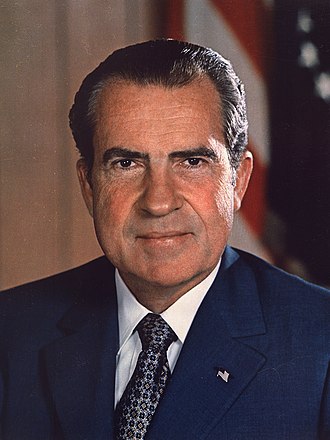
Richard M. Nixon served as the 37th President of the United States from January 1969 until his resignation in August 1974. In February 1971, he ordered the installation of a secret voice-activated taping system in the White House to preserve a historical record of his administration. Until the system's existence was revealed and dismantled in July 1973, the tapes captured Nixon directing major foreign policy initiatives, such as the opening to China, as well as his central role in the Watergate cover-up.
What Nixon talks about on the tapes
White House operations 4,718Presidential scheduling 2,225Public relations 1,784Presidential schedule 1,782Vietnam War 1,693Logistics 1,650Manolo Sanchez 1,626White House communications 1,400White House administration 1,399Presidential communication 1,243Henry Kissinger 1,191Foreign Policy 1,183
Conversations (21,010)
— Page 57 of 211President Nixon met with the White House operator to place an outgoing call to Charles W. Colson. This brief interaction served solely as a logistical request to connect the President with his special counsel. No further substantive policy discussions occurred during this exchange.
President Nixon, Charles Colson, and Henry Kissinger discuss recent political developments, focusing on the public reaction to the U.N. vote regarding Taiwan and the President's upcoming trip to China. They analyze Senator Hugh Scott's effective leadership, the political fallout from the U.N. proceedings, and the ongoing public interest in the Harris Poll. Additionally, Nixon instructs Colson to coordinate a private, off-the-record meeting between Arthur Burns and a group of influential business leaders to communicate an optimistic outlook on the national economy.
President Nixon met with Henry Kissinger and Charles Colson to discuss foreign policy developments, specifically focusing on the unstable future of Yugoslavia following the eventual departure of Josip Broz Tito. They examined concerns regarding Soviet interference in the region and evaluated recent diplomatic communications with Yugoslav foreign minister Mirko Tepavac. Additionally, the group reviewed the domestic and international political fallout concerning United States policy toward the People's Republic of China, including recent congressional reactions.
President Nixon consulted with his personal secretary, Rose Mary Woods, to finalize changes to his upcoming personal schedule. He informed Woods of his decision to cancel a planned trip to Florida due to unfavorable weather conditions. Instead, the President pivoted to a potential visit to Camp David, noting that he had already coordinated these scheduling adjustments with his daughter, Julie Nixon Eisenhower.
President Nixon initiates a call to his assistant for domestic affairs, John D. Ehrlichman, through the White House operator. After a brief internal confusion regarding the recipient and the operator's involvement, the President confirms he is attempting to reach Ehrlichman as requested by Rose Mary Woods. The conversation serves solely as a logistical bridge to facilitate communication between the President and his advisor.
President Nixon consulted with the White House operator to facilitate a telephone connection. The primary purpose of the brief interaction was to request a call to senior advisor John D. Ehrlichman. No substantive policy discussions occurred during this brief administrative exchange.
President Nixon consulted John Ehrlichman regarding a potential call to Nelson Rockefeller to discuss the status of Rockefeller's welfare experiments. Ehrlichman reported that recent tensions between Rockefeller and the Department of Health, Education, and Welfare had been successfully resolved following a meeting with Elliot Richardson and John Veneman. Nixon subsequently decided to proceed with the call and scheduled a follow-up meeting with Ehrlichman for shortly thereafter.
President Nixon consulted with John Ehrlichman regarding an upcoming interaction with New York Governor Nelson Rockefeller to prepare for potential requests for financial assistance. Ehrlichman agreed to monitor the situation and screen future communications to manage Rockefeller's expectations. The discussion focused on maintaining administrative control over the President's engagement with the Governor.
President Nixon instructed the White House operator to place an outgoing call to New York Governor Nelson A. Rockefeller. The conversation serves solely as a logistical request to initiate communication with the Governor. No substantive policy discussions occurred during this brief exchange.
President Nixon initiated a request for the White House operator to place a telephone call to New York Governor Nelson A. Rockefeller. The brief exchange served as a logistical step to facilitate direct communication between the President and the Governor. No further substantive policy matters were addressed during this short administrative interaction.
President Nixon and Nelson Rockefeller discussed the political impact of Robert Finch’s upcoming trip to Latin America in the context of the U.S. 10 percent import surcharge. Rockefeller advised the President that the surcharge's removal should be announced prior to the trip to ensure Finch receives a positive reception. Nixon agreed with the strategy, noting his administration's plan to prioritize Western Hemisphere nations for trade concessions and pledging to have George Shultz coordinate the timing and negotiations.
President Nixon and Nelson A. Rockefeller discuss a strategy to leverage the lifting of U.S. import surcharges as a diplomatic tool to reward allies, specifically focusing on Latin American countries and Canada. Nixon outlines a plan to negotiate oil security commitments with Canada while considering a staggered removal of trade barriers to benefit cooperative nations like Mexico following their support in a recent U.N. vote. The two agree to coordinate these efforts with George Shultz and Robert Finch to ensure that diplomatic visitors can announce the policy changes during upcoming international tours.
President Nixon initiates a request to the White House operator to place a telephone call to George P. Shultz, then serving as the Director of the Office of Management and Budget. The conversation serves solely as a brief administrative coordination to facilitate direct communication between the President and Shultz. No substantive policy discussions occur during this brief operator-assisted exchange.
President Nixon met with John Ehrlichman and George Shultz to discuss a wide range of personnel, legislative, and economic policy matters. The conversation covered judicial and administrative appointments—specifically regarding Robert Kunzig and potential Supreme Court candidates—the status of welfare reform legislation, and political strategy for the 1972 election. They also reviewed economic initiatives, including a possible value-added tax, the Pay Board's handling of labor contracts, and the status of international trade negotiations, with Nixon emphasizing the need to maintain strong control over federal spending and policy direction.
President Nixon consulted with George P. Shultz to coordinate a meeting regarding the Department of Agriculture. Shultz informed the President that he and John D. Ehrlichman were concluding their current deliberations on the matter. Nixon instructed them to take their time finishing the session, confirming he would be available to meet with them later in the afternoon.
President Nixon contacted the White House operator to place an outgoing call to John C. Whitaker. This brief administrative interaction served as a logistical step to facilitate direct communication with a member of the White House staff. No further substantive discussion or policy deliberations occurred during this exchange.
President Nixon consulted with John C. Whitaker regarding ongoing negotiations with labor leader Thomas W. 'Ted' Gleason. The administration sought to strike a deal that would utilize American ships for Venezuelan oil imports in exchange for a 50-50 shipping arrangement for grain exports to the Soviet Union. Nixon emphasized the importance of the effort, noting the potential political benefits for both foreign policy and domestic agricultural legislation.
President Nixon met with Alexander Butterfield, H.R. Haldeman, Charles Colson, and Henry Kissinger to discuss a range of domestic and foreign policy issues, with a significant focus on the public and political fallout from the United Nations vote to expel Taiwan. The participants evaluated the effectiveness of recent administration outreach and media appearances, specifically addressing criticisms from the John Birch Society and the reactions of various UN delegates captured on film. Additionally, they reviewed economic concerns, including interest rates and housing, and coordinated communications strategies to manage the 1972 political landscape.
President Nixon and Henry Kissinger met to discuss the political fallout from the United Nations' recent vote to expel Taiwan and the potential impact of Nixon's upcoming initiative to visit the People's Republic of China. The two reviewed U.S. diplomatic efforts, assessed public and political reaction among domestic critics, and discussed strategies for managing international relations ahead of the 1972 election. They also addressed coordination with figures like Ronald Reagan regarding his recent Asia trip and finalized arrangements for upcoming scheduling and correspondence.
President Nixon and personal secretary Rose Mary Woods met to discuss the management of various administrative matters and personal property within the White House. The conversation covered the placement of presidential gifts, including items from the Shah of Iran, and addressed logistical planning regarding the President's upcoming schedule and meetings with guests. Additionally, the pair touched upon political reactions to the recent United Nations vote to expel Taiwan and reviewed official portraiture.
President Nixon and Henry Kissinger discuss the Senate's unexpected vote to reject the foreign aid program and the lack of reconsideration. Kissinger advises issuing a strong public statement condemning the action as an irresponsible departure from 25 years of bipartisan foreign policy. Nixon approves the plan, agreeing that the administration should demand immediate reconsideration and hold the Senate accountable for the potential consequences.
President Nixon directed Henry Kissinger to coordinate with Senate Republican Leader Hugh Scott and legislative aide Clark MacGregor regarding the administration's response to an impending Senate vote on the foreign aid program. Kissinger was instructed to ensure both men were aligned with the White House's messaging strategy. He agreed to contact Scott and MacGregor immediately to finalize these efforts.
President Nixon held a brief, informal meeting in the Oval Office with an unidentified individual to discuss scheduling matters. The exchange focused on confirming that current tasks or projects would remain timely until the upcoming January deadline. No substantive policy decisions were documented during this short interaction.
President Nixon met with his aide, Stephen B. Bull, to review and finalize the President's upcoming schedule. The discussion focused specifically on logistical arrangements regarding Henry A. Kissinger and the strategic timing for a planned television broadcast. No further developments were recorded, as the meeting concluded shortly thereafter.
President Nixon met with H. R. Haldeman, Henry Kissinger, and Charles Colson to discuss the fallout from a surprise Senate defeat of the foreign aid bill, which the administration attributed to bipartisan disloyalty and the recent UN vote on Taiwan. The participants analyzed the political motivations of opponents, particularly Senator Edward Kennedy, whose recent criticism of the President’s China initiative and Taiwan policy was characterized by Nixon as opportunistic and inconsistent. The President directed his staff to counter these attacks by highlighting Kennedy's political maneuvers and leveraging press coverage to discredit his reliability, while simultaneously strategizing on how to resurrect foreign aid through parliamentary maneuvering.
President Nixon met with his Deputy Assistant Alexander P. Butterfield to discuss routine administrative matters and staff operations within the Oval Office. Although specific details of the dialogue remain undocumented due to the lack of a transcript, such meetings typically focused on the management of presidential correspondence and internal White House procedures. Butterfield’s departure shortly after the meeting began suggests a brief exchange regarding executive scheduling or operational oversight.
President Nixon and Stephen B. Bull coordinated the logistical details for the upcoming visit of Yugoslavian President Josip Broz Tito. They reviewed scheduling conflicts regarding the arrival of First Lady Pat Nixon and Mrs. Tito, as well as the timing of helicopter transport and press photo opportunities. Nixon ultimately decided to set the departure time for 11:00 a.m. to streamline the transition and facilitate a controlled photo event on the White House lawn.
President Nixon met with his aide, Stephen B. Bull, to coordinate his daily schedule and logistical arrangements. The discussion focused on upcoming travel plans and the necessary preparations required for the President's departure. The meeting concluded with confirmation of the President's immediate itinerary.
President Richard Nixon met with Yugoslav President Josip Broz Tito to discuss bilateral economic relations, international investment policies, and global foreign policy strategy. Nixon candidly addressed U.S. relations with the Soviet Union and China, emphasizing that he sought peace but would maintain American military strength and defense posture. The President also provided a detailed update on the Vietnam War, signaling that the U.S. had made a final, significant peace offer and would be forced to pursue other military options if North Vietnam did not respond or return American prisoners of war by the end of November.
President Nixon and Press Secretary Ronald L. Ziegler discussed the political fallout from a recent Senate vote on the foreign aid program, specifically noting the roles of Hubert H. Humphrey and Edward M. Kennedy. The conversation also touched upon a speech delivered by Kennedy regarding Taiwan and the Republic of China in the context of Henry Kissinger's upcoming trip to the People’s Republic of China. The meeting served to coordinate the administration’s response to these legislative and diplomatic challenges.
President Nixon met briefly with his personal aide, Stephen B. Bull, to coordinate his immediate schedule. During this short interaction, Nixon issued a specific directive for Bull to summon Henry Kissinger to the Oval Office. The meeting concluded promptly after this request was relayed.
President Nixon and Press Secretary Ronald L. Ziegler held a brief meeting to address the aftermath of a recent Senate vote concerning the foreign aid program. The discussion focused on the political implications of the legislative defeat, specifically noting the roles played by Senators Hubert H. Humphrey, Edward M. Kennedy, and Edmund S. Muskie. No further actions were recorded during this one-minute exchange.
President Nixon and Henry Kissinger met to discuss the legislative failure of the foreign aid bill, the recent UN vote on Taiwan, and the broader implications for the President's foreign policy initiatives. Nixon expressed profound frustration with congressional Democrats and the liberal press, asserting that he would take a hard line on foreign policy, including potential military action in Vietnam, regardless of political opposition. Kissinger and the President also planned a series of high-level diplomatic meetings with European leaders and strategies to manage the U.S. economic import surcharge. Finally, Nixon directed that the responsibility for presenting diplomatic credentials be delegated to the Vice President to avoid personal meetings with representatives of countries that voted against U.S. interests.
President Nixon and his valet, Manolo Sanchez, discuss the management of personal belongings and professional correspondence, specifically regarding the handling of sensitive documents. The conversation briefly touches on the progress of ongoing external negotiations, with both parties expressing confidence that a breakthrough will occur by the beginning of the new year. The exchange concludes with an agreement on the importance of maintaining direct control over these matters rather than delegating them to staff.
President Nixon met with H.R. Haldeman, Charles Colson, and Ron Ziegler to coordinate political attacks against Senator Edward M. Kennedy and formulate strategies regarding controversial legislative issues. The group discussed utilizing negative publicity, such as an anti-busing cartoon and polling data, to damage Kennedy’s standing and national image. Additionally, they strategized on foreign policy matters, specifically coordinating a response to the recent United Nations vote on Taiwan and addressing potential foreign aid legislation through public messaging and Senate maneuvering.
President Nixon instructed the White House operator to place an outgoing call to his close friend and confidant, Charles G. "Bebe" Rebozo. The brief exchange served strictly as an administrative request to facilitate communication between the President and Rebozo. No substantive policy discussions or further actions were recorded during this connection.
President Nixon consulted with the White House operator to determine the best method for contacting Charles G. "Bebe" Rebozo. The operator informed the President that Rebozo was expected to return to his boat shortly. Nixon deliberated on whether to leave a message for a return call or attempt to reach Rebozo directly on the vessel.
President Nixon and Charles "Bebe" Rebozo discussed scheduling for an upcoming Florida trip, including the attendance of Julie Nixon Eisenhower and meetings with international leaders like Indira Gandhi. The conversation also addressed negative press coverage regarding Rebozo’s business activities in the Miami Herald and the public backlash concerning his financial dealings. Furthermore, the two men reviewed the recent United Nations vote on Taiwan, with Rebozo expressing alignment with Barry Goldwater’s criticisms of the diplomatic outcome.
President Nixon initiates a brief request for the White House operator to connect him with Chief of Staff H. R. Haldeman. This short exchange serves as a routine administrative step to establish communication with a key advisor. No substantive policy discussions or decisions occur during this brief operator-assisted connection attempt.
President Nixon and H.R. Haldeman discuss political messaging strategies in response to a recent Senate vote on foreign aid. Nixon praises George H.W. Bush’s media performance, contrasting his loyalty with the perceived deficiencies of Charles Yost, while dismissing Henry Kissinger's recommendation for a presidential television address on the complex, technical topic. The two also coordinate upcoming cabinet scheduling and explore the possibility of inviting Ronald Reagan to an official dinner for Indira Gandhi.
President Nixon initiates a brief request for the White House operator to connect him with Charles W. Colson. This communication serves as a standard administrative coordination to facilitate a direct conversation between the President and his Special Counsel. No further substantive policy matters or decisions were discussed during this brief exchange.
President Nixon and Charles Colson discussed the administration's public relations strategy, specifically praising George H.W. Bush's recent aggressive media appearances against Senator Edward Kennedy and his effective defense of White House policies. The two analyzed the political benefits of framing current foreign policy controversies, such as the U.N. vote on Taiwan and the Senate's rejection of the foreign aid program, as evidence of Democratic partisan obstructionism rather than presidential failure. Looking forward, they coordinated plans to have Vice President Spiro Agnew deliver a speech highlighting this partisan shift, while also planning to influence press coverage at the Washington Star by engaging with columnist Smith Hempstone.
President Nixon met with Charles Colson and H.R. Haldeman to coordinate the administration's political strategy regarding recent foreign policy setbacks, specifically the U.N. vote to expel Taiwan and impending congressional action on foreign aid. The discussion focused on managing media narratives, securing support from key legislators like George Mahon and Gale McGee, and leveraging the President's upcoming international trips to bolster his leadership image. Colson and Nixon reviewed public relations tactics, including the potential for direct presidential communication to address legislative challenges and mitigate domestic political criticism.
President Nixon met with Marjorie P. Acker in the Oval Office to discuss a specific assignment involving Charles W. Colson. The brief exchange includes cryptic references to a potential explosive incident. The conversation serves primarily to facilitate a task for Colson, though the details of the assignment remain obscure.
President Nixon held a brief, private meeting in the Oval Office with an unidentified individual. The interaction, which included a two-second segment later withdrawn as a personal returnable, lacks a transcript or documented record of discussion. Consequently, no substantive policy decisions or administrative developments can be attributed to this exchange.
President Nixon met with his personal secretary, Rose Mary Woods, to discuss private administrative or personal matters. The conversation was brief, lasting less than thirty seconds, and did not involve substantive policy discussions or executive decision-making. The interaction reflects the routine nature of their professional relationship within the Oval Office.
President Nixon met with his senior staff, including H. R. Haldeman, Henry Kissinger, and John Ehrlichman, to coordinate a strategy for countering Congressional opposition to the foreign aid program and to manage the administration's public relations. The participants discussed the necessity of adopting an aggressive offensive stance against partisan critics who threatened national security initiatives, while also planning for a future Cabinet meeting focused on the 1972 campaign. Furthermore, they reviewed internal personnel shifts, including potential changes within the Justice Department and the FBI, and aligned on the timing and messaging for upcoming Vietnam troop withdrawal announcements to maximize political impact.
President Nixon initiates a request for the White House operator to place a telephone call to Lloyd J. Christie in Santa Fe Springs, California. The President provides the necessary location details to ensure the operator can locate the party. This brief interaction serves as a routine administrative request to facilitate direct communication with an external individual.
President Nixon contacted the White House operator to facilitate a telephone connection to First Lady Thelma C. (“Pat”) Nixon. The brief exchange served as a logistical step to initiate personal communication between the President and his wife. No substantive policy discussions or administrative decisions were recorded during this brief administrative interaction.
President Nixon met with an unknown individual to discuss scheduling matters concerning Secretary of Defense Melvin R. Laird. The conversation focused on coordinating the President's upcoming agenda in relation to Laird's availability. No major policy decisions were reached beyond the logistical management of the executive calendar.
President Nixon and his valet, Manolo Sanchez, briefly discuss observations regarding the social interactions and gaze of an unidentified individual. The exchange focuses on interpreting specific interpersonal behaviors, likely involving Julie Nixon Eisenhower’s social schedule. No official policy or administrative decisions resulted from this informal, personal interaction.
President Nixon met with his personal valet, Manolo Sanchez, to discuss logistical arrangements regarding an event or activity taking place within the White House complex. The brief exchange focused on coordinating the setup or execution of this task. No further substantive policy matters were addressed during this short administrative interaction.
President Nixon met with his personal valet, Manolo Sanchez, in the Old Executive Office Building to discuss personal scheduling and logistics. The brief exchange focused on coordinating the itinerary for Julie Nixon Eisenhower. No major policy decisions were recorded during this session.
President Nixon met with an unidentified individual in the Old Executive Office Building to review the President’s upcoming schedule. The discussion focused on managing the logistical requirements and logistical planning of his official calendar. No specific policy decisions or significant developments were recorded during this brief administrative meeting.
President Nixon and his personal secretary, Rose Mary Woods, met to discuss the scheduling of Dr. W. Kenneth Riland, the President's personal physician. The brief exchange focuses on determining Riland's current whereabouts and confirming his availability for an upcoming appointment. No major policy decisions were reached, as the discussion was limited to administrative logistics and personnel coordination.
President Nixon consulted with Henry Kissinger regarding the scheduling and coordination of an upcoming meeting with Secretary of Defense Melvin Laird. The President instructed Kissinger to attend the session, which was slated for that afternoon at the Executive Office Building. This conversation served to organize the administrative logistics and ensure the national security advisor's presence for the consultation with the Defense Secretary.
President Nixon consulted the White House operator to facilitate a telephone call to First Lady Pat Nixon. The brief interaction served as a logistical arrangement to establish communication with his wife. No substantive policy matters or major political decisions were addressed during this exchange.
President Richard Nixon and First Lady Pat Nixon engaged in a brief, personal telephone call. The majority of the interaction consists of withdrawn personal material, leaving only concluding remarks. No official policy decisions or substantive political matters were discussed.
President Richard Nixon and First Lady Pat Nixon coordinate a brief personal visit to their residence. The First Lady proposes a tour of the house to take place later that afternoon following her scheduled visit with Ryan. The conversation serves as a routine scheduling check between the couple regarding their personal activities.
President Nixon initiates a brief telephone exchange through the White House operator to be connected with his Press Secretary, Ronald L. Ziegler. The call serves as a logistical administrative request to facilitate direct communication with a key staff member. No policy matters or substantive discussions occur during this brief operational contact.
President Nixon met with his personal valet, Manolo Sanchez, to discuss administrative matters or potential materials contained within a folder related to Secretary of Defense Melvin R. Laird. The brief exchange focused on verifying the contents of specific documents brought to the President's attention. No major policy shifts or substantive executive decisions were recorded during this brief encounter.
President Nixon and H. R. Haldeman discussed the necessity of establishing regular weekly political meetings to improve coordination within the administration. The conversation focused on the role of Republican National Committee Chairman Robert Dole and the importance of integrating key figures like John Mitchell, Ronald Reagan, and Nelson Rockefeller into these strategic sessions. Nixon emphasized the urgency of managing these political relationships and schedules to ensure unified party messaging and preparation for future electoral challenges.
President Nixon initiates a brief request for the White House operator to place a telephone call to Press Secretary Ronald L. Ziegler. The interaction serves as a routine administrative task to establish communication between the President and his press office. No further substantive policy matters or decisions are recorded during this brief exchange.
President Nixon and Press Secretary Ronald Ziegler coordinate media strategy regarding the administration's foreign aid program, specifically emphasizing its role as a pillar of the Nixon Doctrine. They plan to have Secretary of Defense Melvin Laird and Secretary of State William Rogers present the defense and policy justifications for foreign assistance to counter recent Senate opposition. Additionally, the President arranges a photo opportunity with Laird and Henry Kissinger to signal a unified executive front and confirms the timing for an upcoming announcement regarding the First Lady’s schedule.
President Nixon and Press Secretary Ronald Ziegler coordinated a media strategy regarding the public relations management of international affairs, specifically involving Mexico and Haiti. The discussion centered on staging photo opportunities and controlling the administration's messaging narrative to ensure foreign agents or observers are not perceived as dominating the situation. Nixon emphasized the importance of projecting success and directed Ziegler to manage press inquiries by emphasizing that specific international movements are not occurring.
President Nixon met with Henry Kissinger and Melvin Laird to discuss legislative strategies for securing foreign aid funding and maintaining support for the administration's defense and foreign policy agenda. They addressed the challenges of navigating congressional opposition while managing alliance relationships, particularly regarding German financial contributions to U.S. forces in Europe. The group also evaluated the timing of Vietnam troop withdrawals and personnel staffing needs within the Department of Defense.
President Nixon contacted the White House operator to facilitate a direct communication with his Press Secretary. The primary purpose of this brief telephone call was to request that Ronald L. Ziegler be connected to the President. This administrative interaction serves as a routine coordination of White House internal telecommunications.
President Nixon and Henry Kissinger discussed strategies to counter media narratives, particularly articles in the New York Times, that diminished the President’s role in the China initiative. They also addressed the potential political ramifications of granting executive clemency to Jimmy Hoffa, weighing the possibility of gaining support from the Teamsters against potential public and political backlash. Finally, the two men examined the internal disputes within the Pay Board concerning wage controls and contingency planning for labor resistance.
President Nixon met with an unknown individual, likely Dr. W. Kenneth Riland, in the Oval Office shortly after concluding a series of consultations with key advisors regarding labor policy, executive clemency, and 1972 campaign planning. While the participants of this specific brief encounter remain officially unidentified, it occurred in the immediate wake of high-level discussions involving John Mitchell, George Shultz, and H.R. Haldeman. These preceding deliberations focused on the potential pardon of Jimmy Hoffa and the administration's management of the Pay Board's economic policies, though the content of this final recorded exchange was not preserved.
President Nixon initiates a brief telephone request to the White House operator to be connected with special counsel Charles W. Colson. The exchange serves as a procedural call to facilitate communication with a key member of the President's staff. No further substantive policy matters or decisions are discussed during this connection attempt.
President Nixon and Charles Colson discussed strategies for maintaining the administration's economic 'Phase II' program and managing labor relations with the AFL-CIO and Teamsters. They explored leveraging oil and wheat trade policies to secure support from labor leaders like Paul Hall and Frank Fitzsimmons against potential opposition from George Meany. Additionally, they considered the political implications and potential public reaction to granting clemency to Jimmy Hoffa, specifically regarding his eligibility for parole and the potential for leveraging his release to ensure labor cooperation.
President Nixon contacted the White House operator to initiate a call to his National Security Advisor, Henry Kissinger. The brief communication served solely as a request to connect with Kissinger to discuss high-level national security matters. This interaction reflects the standard procedural workflow for the President to reach his primary foreign policy aide.
President Nixon and Henry Kissinger discuss the political strategy surrounding the administration's foreign aid program following a recent legislative setback. They coordinate efforts to ensure Secretary of State William P. Rogers publicly reinforces a hard-line stance, similar to recent statements made by Melvin Laird, to avoid compromising on security versus development assistance. Additionally, they review Vietnam casualty reporting and strategize the push for a 30-day continuing resolution to maintain legislative authority.
President Nixon met with his personal valet, Manolo Sanchez, in the Oval Office to coordinate logistics for an upcoming departure. The discussion focused on the preparation and handling of a briefcase necessary for the President's travel. Sanchez confirmed the tasks were completed, and the conversation concluded with instructions to prepare for the immediate transition.
President Nixon initiated a brief administrative call to the White House operator to facilitate a connection with his Press Secretary, Ronald L. Ziegler. The interaction served solely as a logistical step to reach a senior staff member for an upcoming consultation. No further substantive policy matters were discussed during this brief exchange.
President Nixon and H.R. Haldeman met to discuss a wide range of administrative and political concerns, including the status of foreign aid, the national economy, and pending legislation. They evaluated staff dynamics and policy planning, specifically addressing Henry Kissinger’s strategic influence compared to the State Department and William P. Rogers's role. Additionally, the President reviewed his schedule for a forthcoming trip to Florida, planned upcoming meetings with Cabinet members regarding reorganization, and explored potential strategies for media engagement through cable television.
President Nixon and Press Secretary Ronald Ziegler coordinated the timing of a post-meeting press briefing for Secretary of State William P. Rogers, ensuring his availability following a morning session. The two also discussed the logistical preparations for First Lady Pat Nixon’s upcoming trip, which required final clearance from the National Security Council. Nixon directed Ziegler to coordinate with Connie Stuart and hold a joint announcement regarding the trip to ensure the presentation was handled effectively.
President Nixon and Secretary of State William Rogers met to address the administration's strategy following a recent defeat of the foreign aid bill in the Senate, which threatened national security programs in Southeast Asia and beyond. They discussed the necessity of securing a continuing resolution to sustain foreign operations while avoiding a full-scale authorization battle with a recalcitrant Senate. Additionally, the President reviewed his plans for accelerated troop withdrawals from Vietnam and his upcoming diplomatic schedule, including potential summits with foreign leaders and his trip to the People's Republic of China.
President Nixon and Charles Colson met to discuss strategies for managing the Pay Board and negotiating wage contracts amid the administration's new economic policy. They evaluated the political risks of labor strikes and the potential for a confrontation with George Meany, emphasizing the necessity of maintaining the stability of the economic program. Additionally, they reviewed the timing and strategy for potential executive clemency for James R. Hoffa to bolster support among building trades unions and labor leaders like Frank Fitzsimmons.
President Nixon met with Australian Prime Minister William McMahon to reassure him regarding U.S. foreign policy and the recent, confidential initiative to normalize relations with the People's Republic of China (PRC). Nixon emphasized that these diplomatic overtures were driven by pragmatic geopolitical balancing against the Soviet Union rather than a shift in ideology, and he affirmed that U.S. commitments to key allies, including Japan and Australia, remained steadfast. The two leaders established a secure, private channel for future communication to bypass standard diplomatic channels, and Nixon provided private updates regarding his administration's upcoming strategy for Vietnam troop withdrawals and ongoing POW negotiations.
President Nixon met with Stephen B. Bull, accompanied by Alexander P. Butterfield and a group of visitors, to conduct a brief tour of the Oval Office. The discussion focused on administrative logistics, including the President's schedule and the presentation of presidential gifts like golf balls. The visit concluded with an introduction of Bull and a brief observation of the presidential seal on the office carpet.
President Nixon met with Press Secretary Ronald L. Ziegler to verify the status of a recent communication involving the Soviet Union. The discussion centered on confirming that a specific individual had received a phone call as intended. The brief exchange served to finalize this logistical matter before the two departed the Oval Office.
President Nixon met with aide Stephen B. Bull to review logistical details regarding upcoming administrative appointments and scheduling. The discussion focused on confirming the location of a meeting involving Congressman Gerald R. Ford and reviewing the background of Alexander R. Larzelere, a new Coast Guard representative. Nixon specifically requested information regarding Larzelere’s family to facilitate appropriate protocol during their professional engagement.
President Nixon met with Alexander R. Larzelere and James D. Hughes to facilitate a ceremonial meeting and the presentation of gifts to Larzelere’s family. The discussion remained informal, focusing on the presence of the Coast Guard and the recognition of Larzelere’s professional background. The interaction concluded with the President ensuring that photographic mementos and copies of the event were provided to the attendees.
President Nixon met with his personal aide, Stephen B. Bull, to discuss urgent administrative adjustments to the President's schedule. The brief interaction focused on coordinating meetings with Frederic V. Malek and John N. Mitchell, alongside finalizing details regarding recent presidential appointees. The primary objective was to ensure the efficiency and logistical integrity of the President's upcoming engagements.
President Nixon met with a group of new administrative appointees, including Stanley M. Greenfield and others, to welcome them to the administration and acknowledge their upcoming roles. The brief, informal meeting served as an opportunity for the President to express his appreciation for their loyalty and dedication, emphasizing the importance of their work to the success of his office. The discussion included casual anecdotes about football rules and previous travels in Texas, concluding with the President presenting gifts to the appointees.
President Nixon met with his aide Stephen B. Bull to coordinate logistical details regarding his daily schedule. The brief discussion primarily concerned appointments with Michael R. Schrauth, Ronald H. Walker, and their respective parents. No major policy decisions were reached, as the conversation focused strictly on managing the President's immediate calendar requirements.
President Nixon hosted a brief social meeting in the Oval Office with Michael and William Schrauth and their spouses to facilitate personal introductions and photograph arrangements. During the short engagement, the President acknowledged Michael Schrauth’s professional work and presented the guests with gifts. The conversation concluded with pleasantries before the party departed.
President Nixon contacted the White House operator to initiate a call to Representative John H. Rousselot of California. This interaction served as an administrative request to facilitate communication between the President and the Congressman. No substantive policy discussions occurred during this brief exchange.
President Nixon instructed the White House operator to initiate a telephone call to Congressman Barber B. Conable, Jr. The brief exchange served solely as a logistical request to establish communication with the New York representative. No substantive policy discussions or decisions occurred during this brief request.
President Nixon contacted the White House operator to facilitate a telephone connection. The primary purpose of the brief communication was to place a call to Representative Clarence E. Miller. No further policy discussions or significant political developments occurred during this administrative exchange.
President Nixon consulted with his aide, Stephen B. Bull, to review and adjust his daily appointment schedule. The primary focus of the discussion concerned the timing of a scheduled meeting with a barber. Following the brief briefing, the President confirmed the adjustment to his agenda for the remainder of the day.
President Nixon instructed the White House operator to redirect a call, specifically requesting to be connected with an individual identified as Grislo. The brief exchange focused on coordinating outgoing telecommunications, though the underlying purpose of the call remained unstated. The conversation concluded with confirmation that the requested party was being reached.
President Nixon met with his aide, Stephen B. Bull, to coordinate his schedule and facilitate a meeting with National Security Advisor Henry A. Kissinger. The President specifically requested that Kissinger be summoned from the State Department to join him for a discussion. The brief interaction focused primarily on administrative logistics regarding the President’s upcoming appointments.
President Nixon met with his personal aide Manolo Sanchez and staffer Stephen B. Bull to briefly discuss the logistics and plans for the President’s upcoming schedule. The conversation focused on coordination for a planned outing, including the President's intention to walk across the street and visit an associate. The participants concluded their discussion by finalizing these casual logistical arrangements.
President Nixon held a brief administrative interaction with the White House operator to facilitate an outgoing call. This communication served to establish a connection to another party, consistent with standard White House telecommunications procedures. No substantive policy matters or official business discussions occurred during this brief exchange.
President Nixon consulted with the White House operator to facilitate a telephonic communication with Congressman Clarence Miller of California. This brief interaction served as a logistical step to initiate contact between the President and the lawmaker. No further substantive policy discussions were recorded during this connection.
President Nixon and Henry Kissinger discussed the scheduling of upcoming international travel, including potential visits to Australia, New Zealand, and Japan, to reassure allies following the President's planned trip to the People's Republic of China. The conversation also touched upon the recent United Nations vote regarding Taiwan, foreign policy management, and the necessity of maintaining personal correspondence with global leaders to preserve diplomatic relations. Additionally, they reviewed strategies for managing political optics during meetings with international figures, specifically addressing tensions in Pakistan and India.
President Nixon initiated this call to Congressman Clarence Miller to offer birthday well-wishes, prompted by a briefing from William E. Timmons. The two discussed Miller's age and the President's personal connection to Ohio, Miller's home state. The conversation concluded with Miller reaffirming his general support for the administration's agenda despite local political pressures from his constituency's universities.
President Nixon consulted with the White House operator to determine the availability of Congressman Barber B. Conable, Jr. for a scheduled discussion. Upon learning that the Congressman would be returning to his office shortly after lunch, the President authorized the operator to arrange a return call. No substantive policy matters were addressed during this brief logistical exchange.