Nixon, Richard M. (President)
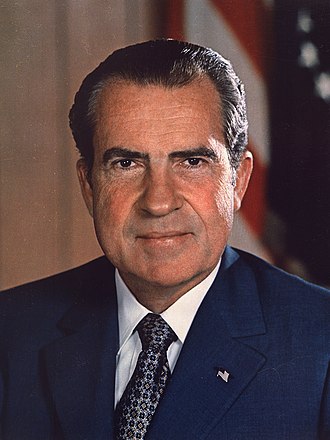
Richard M. Nixon served as the 37th President of the United States from January 1969 until his resignation in August 1974. In February 1971, he ordered the installation of a secret voice-activated taping system in the White House to preserve a historical record of his administration. Until the system's existence was revealed and dismantled in July 1973, the tapes captured Nixon directing major foreign policy initiatives, such as the opening to China, as well as his central role in the Watergate cover-up.
What Nixon talks about on the tapes
White House operations 4,718Presidential scheduling 2,225Public relations 1,784Presidential schedule 1,782Vietnam War 1,693Logistics 1,650Manolo Sanchez 1,626White House communications 1,400White House administration 1,399Presidential communication 1,243Henry Kissinger 1,191Foreign Policy 1,183
Conversations (21,010)
— Page 58 of 211President Nixon telephoned Congressman John H. Rousselot to extend birthday greetings and express appreciation for his legislative support. The two discussed Rousselot’s reservations regarding the administration’s shifting policy toward the People's Republic of China. Nixon acknowledged the Congressman’s concerns and suggested a future meeting to provide further context on the diplomatic strategy.
President Nixon initiated this brief call to Congressman Barber Conable, Jr. specifically to offer birthday wishes as Conable turned 49. Diverging from their typical interactions regarding legislative lobbying, the conversation remained lighthearted and personal. The exchange concluded with the President expressing his appreciation for Conable’s service.
President Nixon directed the White House operator to place an urgent call to Secretary of State William P. Rogers. Despite being informed that Rogers was attending a lunch, the President insisted that the Secretary be pulled from the event to speak with him. This brief exchange serves as a logistical bridge to a subsequent conversation between the two men.
President Nixon met with his valet, Manolo Sanchez, in the Old Executive Office Building to coordinate his professional agenda. The discussion focused primarily on the logistics of the President's daily schedule and time management. No significant policy decisions were recorded during this brief encounter.
President Nixon consulted with a White House operator regarding concerns about a specific individual’s frequent telephone activity from the State Department. The President sought information about a woman who had been placing an unusually high volume of calls, suggesting internal oversight or suspicion regarding her communications. The brief interaction focused on identifying the caller and monitoring her use of State Department facilities.
Secretary of State William P. Rogers briefed President Nixon on his recent discussion with Australian Prime Minister William McMahon regarding confidential plans for future U.S. troop withdrawals in Vietnam. Rogers emphasized that he shared these sensitive details under the condition of strict secrecy, ensuring the President could reference this information during his own upcoming engagement with the Prime Minister. Furthermore, the two discussed positive reactions from press secretary Ronald Ziegler and correspondent John Scali regarding a recent public statement made by Rogers.
President Nixon held a brief, informal discussion with the White House operator to facilitate a connection with Secretary of State William P. Rogers. The conversation included brief, candid observations regarding an unnamed individual’s temperament, characterizing him as a 'fightsy' and 'impulsive' person. The exchange served primarily as a logistical intermediary step to initiate further official communication with the Secretary of State.
President Nixon met with an unidentified individual in the Old Executive Office Building to review the President’s daily schedule. The brief interaction consisted primarily of administrative coordination regarding upcoming appointments and logistical planning. No substantive policy discussions or significant decisions were recorded during this brief exchange.
President Nixon met with an unidentified individual in the Old Executive Office Building to review matters pertaining to his daily professional schedule. This brief engagement served as a routine administrative coordination of the President's upcoming activities and time management. No significant policy decisions or external developments resulted from this specific interaction.
President Nixon contacted the White House operator to place an outgoing call to George P. Shultz. The brief interaction served exclusively as a logistical request to connect the President with Shultz for further discussion. No substantive policy matters were addressed during this short exchange.
President Nixon initiates a request to place a telephone call to an individual identified only as "Shots." The interaction is brief, serving strictly as a logistical communication between the President and the White House operator to facilitate a connection. No substantive policy matters or political developments are addressed during this exchange.
President Nixon and George Shultz discussed an upcoming meeting between Shultz and Pay Board member Benjamin Biaggini regarding management's proposal for handling deferred wage increases with labor representatives. Nixon emphasized that while his preference was to reach a negotiated settlement that avoids a public confrontation with labor leader George Meany, he was prepared to publicly challenge labor if they refused to cooperate. Both agreed that the administration's leverage was limited and that a mutually agreed-upon deal was preferable to a high-stakes failure of the Pay Board.
President Nixon and George Shultz discuss the administration's strategy regarding labor negotiations during the ongoing wage and price freeze. The President emphasizes a preference for reaching a settlement but expresses a firm willingness to engage in a public political battle against labor unions if they attempt to undermine the administration's economic plan. Nixon highlights the importance of leveraging public opinion to frame obstructionist labor leaders as the primary obstacle to national economic stability.
President Nixon contacted the White House operator to initiate an outgoing call to George P. Shultz. The brief exchange served as a procedural request to connect the President with his Office of Management and Budget Director. No further substantive policy matters were discussed during this brief communication.
President Nixon consulted with a White House operator to facilitate a communication connection. This administrative interaction served as a brief technical coordination to initiate a subsequent telephone call. No significant policy decisions were reached during this exchange.
President Nixon directs George P. Shultz to maintain direct communication with Treasury Secretary John B. Connally regarding Pay Board negotiations to ensure the administration presents a unified front. The conversation highlights concerns over impending Pay Board decisions concerning deferred wage increases and the potential for labor-management friction. Nixon emphasizes that the administration must anticipate union resistance while securing the support of business leadership to validate any forthcoming economic policy decisions.
President Nixon and George Shultz discussed the necessity of maintaining consistent communication and political alignment with a key official currently away from the White House. They emphasized the importance of keeping this individual fully informed of ongoing policy developments, particularly regarding pay adjustments, to ensure his future support and prevent potential political friction upon his return. The President stressed that proactive transparency is vital to avoid scenarios where the absent official could later claim ignorance or dissatisfaction with administration decisions.
President Nixon and the White House operator discuss the President’s past travel history to Algeria. The brief exchange serves as a logistical check to verify details regarding his previous international itineraries. No significant policy decisions are reached, as the call functions primarily as an administrative inquiry regarding scheduling records.
President Nixon and H.R. Haldeman discuss strategies for maintaining presidential control over the credit for major foreign policy successes, specifically regarding impending diplomatic trips to the People's Republic of China and the USSR. They express frustration with the press and intellectual liberals, whom Nixon characterizes as inherently inconsistent and prone to writing premature obituaries for his political career. The conversation emphasizes that while Henry Kissinger and William Rogers are instrumental to these foreign policy initiatives, all public credit must remain firmly centered on the President.
President Nixon met with his Cabinet Committee on Executive Reorganization to coordinate strategy for the administration's departmental restructuring proposals. The discussion focused on overcoming bureaucratic resistance, navigating complex Congressional committee jurisdictions, and addressing concerns regarding constituency-based programs like the Rural Electrification Administration. To advance these reforms, Nixon directed his Cabinet members to personally engage with key Congressional leaders and exert stricter control over their respective bureaucracies to ensure support for the legislative agenda.
President Nixon consulted with his personal secretary, Rose Mary Woods, to clarify the specific dates and details regarding his past international travels to Australia. The President sought to verify whether he had visited the country in 1965 or 1967 to resolve a discrepancy in his historical itinerary. Woods was tasked with reviewing his scheduling records to confirm these details and report back to him.
In this Oval Office meeting, President Nixon, John Ehrlichman, and Henry Kissinger discussed various administrative and political priorities, including government reorganization, the replacement of Cabinet Secretaries, and the management of the Agriculture Department. The participants also reviewed strategies for handling the Pentagon Papers controversy, addressed the status of the FBI under J. Edgar Hoover, and debated the implementation of a Value Added Tax (VAT). Additionally, the group strategized on domestic legislative hurdles, specifically the pending Congressional vote on school busing, and coordinated their approach to upcoming meetings regarding Vietnam troop withdrawal policies.
President Nixon met with his legislative leaders and foreign policy advisor Henry Kissinger to discuss the precarious political situation in the House of Representatives regarding Vietnam troop withdrawal legislation and foreign aid. Facing pressure from the Mansfield Amendment and potential legislative deadlines, the President emphasized the need to maintain negotiating leverage—specifically to ensure the return of POWs—and urged his team to prevent the House from forcing an early withdrawal deadline. Nixon directed his allies to reward Democrats who supported his Vietnam policy while instructing them to leverage Justice Department intervention in the Grand Rapids school busing case to gain political favor.
President Nixon met with an unidentified individual to coordinate scheduling logistics for an upcoming trip involving unknown participants. The discussion focused on finalizing specific dates for the itinerary and managing expectations regarding potential counter-proposals from outside parties. The brief exchange concluded with an agreement to initiate the planning process while awaiting further feedback on the proposed timeline.
President Nixon contacted the White House operator to initiate an urgent telephone call to National Security Advisor Henry A. Kissinger. The conversation served solely as a logistical request to establish communication between the President and his advisor. No further substantive policy matters were discussed during this brief exchange.
President Nixon and Henry Kissinger debriefed on the success of the recent State Dinner for Australian Prime Minister William McMahon and discussed potential diplomatic travel to Australia, New Zealand, and Japan. They also evaluated recent diplomatic messages from the People's Republic of China regarding the President’s forthcoming visit and the aftermath of the United Nations vote on Taiwan. Additionally, the President proposed appointing Clare Boothe Luce to a government advisory board as a strategic move to honor her support and increase female representation in his administration.
President Nixon met with his personal valet, Manolo Sanchez, in the Old Executive Office Building to handle a routine personal request. The primary purpose of the brief interaction was for the President to request coffee. No significant policy discussions or administrative decisions occurred during this brief exchange.
President Nixon held a brief, informal meeting with an unidentified individual in the Old Executive Office Building. While the audio quality of the transcript is largely unintelligible, the discussion primarily concerned logistical coordination regarding the President's daily schedule. No significant policy decisions or actionable directives were recorded during this brief exchange.
President Nixon contacted the White House operator to place a congratulatory call to Frank L. Rizzo following his victory in the Philadelphia mayoral election. The President provided the operator with brief background information, identifying Rizzo as the newly elected mayor and former police chief. This administrative request initiated the process of reaching out to a key political figure immediately after his successful campaign.
President Nixon initiated a brief telephone request for the White House operator to connect him with Charles W. Colson. This communication served as a logistical coordination to facilitate a direct conversation between the President and his special counsel. No further substantive policy matters were discussed during this brief administrative exchange.
President Nixon directs the White House operator to place a congratulatory phone call to newly elected Philadelphia Mayor Frank Rizzo. The President notes Rizzo’s background as the city's former chief of police, underscoring the political significance of his victory the previous night. This action initiates a prompt effort to establish a direct line of communication with the incoming mayor.
President Nixon held a brief, nine-second meeting with an unidentified individual in the Old Executive Office Building. The interaction concluded quickly after the visitor presented an unspecified item or document to the President. No substantive policy discussions or administrative decisions are captured in the audio recording.
President Nixon met with his personal aide, Manolo Sanchez, to address the misplacement of his eyeglasses. Nixon instructed Sanchez to retrieve a spare pair from the Executive Office Building to resolve the issue. The brief interaction focused entirely on this logistical matter regarding the President's personal belongings.
President Nixon held a brief exchange with the White House operator to facilitate a telephonic connection. The interaction served as a functional task for the President to initiate a call to an unnamed party. No substantive policy discussions or significant administrative decisions were recorded during this brief logistical contact.
President Nixon and Charles Colson discussed ongoing negotiations with labor leaders regarding the Pay Board and the economic freeze. Colson reported progress in securing a commitment from Frank Fitzsimmons to maintain labor participation on the board, provided the sanctity of contracts is recognized. Additionally, the pair reviewed recent election results—highlighting victories by Rizzo, Perk, and Heinz—and analyzed Louis Harris’s polling data concerning public sentiment on Vietnam, the United Nations, and the political opposition.
President Nixon and H.R. Haldeman reviewed the results of the 1971 mayoral elections, specifically discussing the victories of Pete Wilson in San Diego and Frank Rizzo in Philadelphia, and the benefits of aligning with candidates who effectively exploited local 'law and order' issues. The conversation addressed the political fallout of the United Nations vote on Taiwan and the administration's ongoing struggle to manage the negative perception of the war in Vietnam, with Nixon emphasizing a desire for a low-key, steady withdrawal strategy. Additionally, they touched upon the political utility of using the administration's influence to intervene in court-ordered busing cases and the management of sensitive personnel matters, including the future roles of Roger Johnson and the handling of the President's family members' public schedules.
President Nixon telephoned newly elected Philadelphia Mayor Frank L. Rizzo to offer congratulations on his victory and express support for his law-and-order platform. Nixon emphasized his desire for a nonpartisan working relationship with the new administration, designating John Ehrlichman as the primary White House liaison for federal assistance. The two also briefly touched upon planning for the upcoming Bicentennial celebration in Philadelphia.
President Nixon initiates a brief telephone exchange via the White House operator to request a call with his personal secretary, Rose Mary Woods. The conversation serves as a logistical bridge to connect the President with a key staff member. No further policy or substantive matters are discussed during this brief request.
President Nixon attempted to reach his personal secretary, Rose Mary Woods, via the White House operator to discuss an unspecified matter. After learning that both Woods and her colleague Marjorie Acker were briefly unavailable, the President declined offers for assistance from other staff members. He ultimately instructed the operator to have Woods return his call at her earliest convenience.
President Nixon instructed the White House operator to place a congratulatory telephone call to Ralph J. Perk, who had recently been elected mayor of Cleveland. The President provided specific instructions for locating Perk to ensure the call could be facilitated promptly. This administrative exchange served to acknowledge and recognize a political victory for a key regional official.
President Nixon received a brief status update from the White House operator regarding the whereabouts of his personal secretary, Rose Mary Woods. The operator informed the President that Woods was at a dental appointment and expected to return by 10:00 am. Nixon declined the offer to contact her at the dentist's office, choosing to wait for her return.
President Nixon telephoned newly elected Cleveland Mayor Ralph J. Perk to offer his congratulations on Perk's electoral victory. The two discussed their mutual desire to establish a productive working relationship between the White House and the municipal government. Additionally, Perk expressed his appreciation for a recent invitation to attend church services at the White House.
President Nixon instructed his personal secretary, Rose Mary Woods, to contact Ambassador Walter H. Annenberg regarding recent election results and the administration's political positioning. Nixon specifically requested that Woods inform Annenberg of his congratulatory call to Frank L. Rizzo, emphasizing the importance of Rizzo's victory over William Thacher Longstreth. The conversation also touched upon favorable electoral outcomes for Republicans Richard G. Lugar and Ralph J. Perk, reflecting the President's satisfaction with these results.
President Nixon instructed the White House operator to place a congratulatory telephone call to Pete Wilson. This outreach followed Wilson's successful election as the new mayor of San Diego the previous night. The conversation served as a logistical request to facilitate communication between the President and the newly elected official.
President Nixon telephoned newly elected San Diego Mayor Pete Wilson to congratulate him on his electoral victory and establish a framework for future cooperation. The President directed Wilson to inform the press that the White House, specifically through John Ehrlichman and the Domestic Council, would assist San Diego with its municipal challenges on a non-partisan basis. The conversation served to solidify a professional relationship between the administration and the incoming mayor while acknowledging Wilson’s long-standing political career.
Rose Mary Woods informs President Nixon that Frank Rizzo successfully contacted Ambassador Walter H. Annenberg following the President’s earlier intervention. The conversation confirms that the Ambassador was pleased with the interaction and encourages Nixon to personally follow up with him. Consequently, Nixon agrees to place a call to Annenberg to discuss matters further, noting that the Ambassador will no longer be attending a specific upcoming dedication.
President Nixon, H.R. Haldeman, and John Ehrlichman coordinated with Attorney General John Mitchell to discuss scheduling for an upcoming trip to Florida. The group reviewed recent election results, specifically analyzing the political implications of mayoralty races for national coalitions. Mitchell agreed to align his schedule to join the President in Florida following his commitment to attend a dinner for Senator Robert P. Griffin.
President Nixon initiates a request through the White House operator to place a telephone call to Attorney General John N. Mitchell. The brief exchange serves as a logistical bridge to facilitate direct communication between the President and Mitchell. No further substantive policy matters were addressed during this specific connection.
President Nixon and Attorney General John Mitchell discuss the possibility of the Department of Justice intervening in a Grand Rapids, Michigan, school busing case following concerns raised by Representative Gerald Ford and Senator Robert Griffin. The President urges Mitchell to signal administration opposition to busing during upcoming appearances with Michigan lawmakers and to investigate similar intervention potential in Detroit. Additionally, the pair reviews the positive results of the recent November 2nd mayoral elections, specifically noting the strong support from Philadelphia's Frank Rizzo and the successful reelection of mayors in Cleveland, Indianapolis, and San Diego.
President Nixon instructed the White House operator to place an urgent call to Walter H. Annenberg, the United States Ambassador to the United Kingdom. This brief exchange served as a logistical step to initiate direct communication with the Ambassador. No further discussion occurred during this recording segment.
President Nixon instructed the White House operator to place an outgoing call to Charles W. Colson. This brief administrative interaction served as a logistical step to facilitate direct communication between the President and his Special Counsel. No further substantive policy matters were discussed during this brief connection.
President Nixon directs the White House operator to place an urgent call to Ambassador Walter Annenberg in London. The brief administrative exchange focuses on establishing direct communication with the U.S. embassy. This interaction reflects the President's immediate need to consult with his diplomatic representative regarding ongoing foreign policy matters.
President Nixon and John Ehrlichman discuss political outreach strategies, focusing on the potential benefits of engaging with Democratic mayors like Boston's Kevin White. The two men deliberate on how to manage these relationships to bolster the administration's image of bipartisan cooperation. Additionally, they briefly touch upon administrative scheduling and the status of ongoing court-related matters.
President Nixon and his personal secretary, Rose Mary Woods, met briefly to coordinate administrative logistics regarding Press Secretary Ronald Ziegler. The primary objective of the discussion was to arrange a briefing involving Ziegler. This interaction reflects the routine management of press relations and staff scheduling handled by the President’s inner circle.
President Nixon and Henry Kissinger met briefly to coordinate their schedules regarding a meeting with former French Prime Minister Jacques Maurice Couve de Murville. The discussion served as a logistical check-in to ensure the President was prepared for the upcoming engagement with the French diplomat. Kissinger confirmed the arrangements, and the two finalized their plans for the immediate succession of meetings.
President Nixon initiates a brief administrative communication with the White House operator from his office in the Old Executive Office Building. The exchange serves as a functional request to facilitate an external telephone connection. No policy matters or substantive political developments are addressed during this short interaction.
President Nixon met with Ronald Ziegler and H.R. Haldeman to devise a strategic media relations plan that would bypass standard reporters in favor of targeting editorial boards and influential figures. The President emphasized that Henry Kissinger should shift his focus from routine press backgrounders to high-level meetings with network and major newspaper editorial leadership to better influence public opinion. The team specifically discussed plans for Kissinger to visit New York to engage with media executives following the legislative vote on foreign aid and the upcoming Vietnam announcement.
President Nixon contacted Charles Colson to discuss a meeting Colson was currently holding with maritime union representatives. Nixon instructed Colson to return to the negotiations and emphasize the President's personal interest and appreciation for their cooperation. The brief call served to coordinate the administration's messaging and maintain political momentum with the union leadership.
President Nixon and Ambassador Walter Annenberg discussed a range of political matters, beginning with the positive reception of Nixon's congratulatory call to newly elected Philadelphia Mayor Frank Rizzo. The two also addressed the administration's strategic legislative outlook, specifically the Senate's foreign aid setback and the upcoming confirmation of Supreme Court nominees Lewis F. Powell, Jr. and William H. Rehnquist. Furthermore, they reviewed diplomatic tensions regarding British Prime Minister Edward Heath's reaction to the announcement of Nixon's Moscow trip and U.S. policy toward international issues.
President Nixon met with his personal valet, Manolo Sanchez, in the Old Executive Office Building to discuss personal arrangements. The brief interaction focused primarily on the President's request for lunch. No significant policy developments or administrative decisions were recorded during this brief encounter.
President Nixon met with his personal valet, Manolo Sanchez, in the Old Executive Office Building to attend to routine personal requests. The brief interaction primarily concerned the President’s preference for refreshments, specifically requests for tea or coffee. This exchange reflects the informal and service-oriented nature of their daily professional relationship.
President Nixon met with his personal aide, Manolo Sanchez, to discuss logistical arrangements for an upcoming trip to Florida. The conversation focused on the President's travel itinerary, including departure details and appropriate clothing requirements for the visit. No broader policy decisions were reached, as the discussion remained strictly confined to administrative preparations.
President Nixon contacted the White House operator to place a telephone call to Frank S. "Hap" Farley, a state senator from Atlantic City, New Jersey. The President provided the operator with the necessary identifying information to locate Farley and facilitate the connection. No further discussion occurred during this brief exchange regarding the purpose of the call.
President Nixon directs the White House operator to place two urgent telephone calls to Senator Farley in Atlantic City, New Jersey, and Senator Hackett. This brief administrative interaction serves to facilitate direct communication between the President and the two legislators for undisclosed purposes. The exchange concludes with the operator initiating the requested connections.
President Nixon met with his valet, Manolo Sanchez, to coordinate the First Lady’s upcoming travel arrangements and social commitments. They discussed Pat Nixon's inability to attend a scheduled event, resulting in a decision to prioritize a potential trip to Camp David instead. The President instructed Sanchez to remain flexible regarding these plans pending any further changes to the First Lady's itinerary.
President Nixon calls New Jersey political leader Frank S. "Hap" Farley following his recent election loss. Farley attributes his defeat to negative publicity orchestrated by Senator Clifford P. Case, who he claims is targeting him over a Florida-related federal investigation. Farley requests that the President speak with Attorney General John Mitchell to express his view that the ongoing investigation is unnecessary and politically motivated.
President Nixon met with New Jersey political boss Frank S. “Hap” Farley to offer consolation and encouragement following a recent electoral defeat. The brief exchange focused on maintaining morale and looking toward future political recovery despite the loss. No substantive policy decisions were made, as the conversation served primarily as a gesture of personal political support.
President Nixon initiates a brief telephone call through the White House operator to connect with his special counsel, Charles W. Colson. The interaction serves as a functional request to facilitate direct communication with a key staff member. No substantive political or policy discussions occur during this short exchange, as it is limited to the operator connecting the requested party.
President Nixon and Henry Kissinger reflect on the second anniversary of Nixon’s November 3, 1969, speech regarding the Vietnam War, assessing its long-term political significance and role in stabilizing a deteriorating situation. The discussion touches upon the endurance required during their tenure and briefly incorporates a favorable perspective from Clare Boothe Luce concerning the administration's current trajectory. No formal policy decisions were made during this brief retrospective exchange.
President Nixon and his secretary, Rose Mary Woods, met to discuss administrative scheduling, including managing telephone calls to supporters and planning White House social functions. They reviewed recent electoral trends, specifically the importance of ethnic voting blocs and the political implications of outreach to Black voters. The conversation concluded with discussions regarding future invitations for high-profile political figures and State Dinner logistics, including the potential inclusion of Democratic Mayor Frank Rizzo.
President Nixon initiated a brief interaction with the White House operator to facilitate an outgoing call. The conversation was purely administrative, serving as a mechanical step to connect the President to another party. No substantive policy discussions or significant decisions occurred during this brief exchange.
President Nixon calls Charles Colson to inquire about the status of a high-priority meeting Colson is currently attending. Nixon emphasizes that the meeting cannot be rushed and requires Colson to remain present to manage the participants personally. Colson agrees to the President's directive and confirms he will head to the Oval Office immediately following the conclusion of his current engagement.
President Nixon and Charles Colson held a brief, informal check-in to confirm the conclusion of an earlier meeting. During the short exchange, Nixon emphasized the need for Colson to provide personal support to an unnamed individual, suggesting he must "sit and hold her hand." The two agreed to review several outstanding matters following this interaction.
President Nixon and Henry Kissinger discussed coordinating talking points for Robert Finch's upcoming diplomatic trip to Latin America to ensure they aligned with White House policy rather than just State Department directives. The President also tasked Kissinger with monitoring progress on the U.S. import surcharge regarding Latin America and Canada. To facilitate this, Nixon requested an interim status briefing involving himself, Kissinger, George Shultz, Peter Peterson, and Paul McCracken prior to Finch's departure.
President Nixon and Charles Colson reviewed the economic landscape, focusing on Phase II stabilization policies, the positive stock market reaction to dividend announcements, and strategies for managing labor relations through the Pay Board. The pair discussed political maneuvers for the 1972 election, specifically targeting working-class constituencies by highlighting alignment with leaders like Philadelphia's Frank Rizzo. Additionally, they coordinated a messaging strategy for Vietnam, planning to couple a continued, gradual troop withdrawal with a firm commitment to the issue of prisoners of war (POWs) to maintain public support.
President Nixon initiates a request for the White House operator to place a telephone call to Senator Russell B. Long. The conversation serves solely as an administrative coordination to facilitate direct communication between the President and the Senator. No further substantive policy matters were addressed during this brief exchange.
President Nixon held a brief, six-minute meeting in the Oval Office with one or more unidentified individuals. Due to the lack of an available transcript or audio clarity, the specific subject matter and any resulting policy decisions remain unknown to researchers. The meeting concluded without recorded documentation of its purpose or participants.
President Nixon and Alexander P. Butterfield met to finalize administrative details for upcoming White House events, including a state dinner for Indira Gandhi. They discussed the guest list for the dinner and reviewed potential speakers for a religious service scheduled for November 14, 1971. The President evaluated recommendations from Charles Colson and Robert Finch regarding the service, ultimately addressing the logistical difficulties of securing guests for the event.
President Nixon requested that the White House operator place a call to Senator Russell Wong. This brief interaction served as a logistical step to facilitate direct communication between the President and the Senator. No further substantive discussion or policy developments were recorded during this brief exchange.
President Nixon called Senator Russell B. Long primarily to extend birthday greetings and encourage him to take the evening off from his legislative work. During the conversation, Long pivoted to a proposal he was advancing in committee regarding tax deductions for domestic help, which he argued would incentivize higher wages for low-income workers and potentially reduce welfare rolls. Nixon expressed interest in the potential economic and political benefits of the plan, requesting that the details be reviewed further.
President Nixon met with Henry Kissinger, Alexander Haig, and Robert Finch to coordinate administrative strategy, specifically focusing on Finch's upcoming Latin American trip and the management of sensitive foreign policy issues. The group discussed diplomatic messaging for Latin American heads of state, the handling of the U.S. import surcharge, and the importance of military assistance programs. Additionally, the President reviewed his upcoming meeting with Indira Gandhi regarding the India-Pakistan crisis and evaluated political developments, including the impact of recent local election results on his administration's economic agenda.
President Nixon initiated a brief telephone request to the White House operator to be connected with Robert H. Finch. The conversation served solely as an administrative bridge to facilitate this communication with the Counselor to the President. No substantive policy matters were discussed during this brief exchange.
President Nixon directs Robert Finch to convene with Henry Kissinger and Alexander Haig to discuss the details of Finch's recent trip. The President requests that the three men meet with him immediately to debrief on the mission. This meeting serves as a follow-up to a memorandum Finch had previously submitted to the White House.
President Nixon initiated a brief telephone request through the White House operator to be connected with Congressman Philip M. Crane of Illinois. This communication served as a logistical step to facilitate direct contact between the President and the Representative. No substantive policy discussions occurred during this operator-assisted connection.
President Nixon placed a brief courtesy call to Congressman Philip M. Crane to extend personal birthday wishes. The conversation served to foster rapport between the President and the congressman, with Nixon offering encouragement regarding Crane's legislative work. The President concluded the call by playfully insisting that Crane leave the Capitol to enjoy a birthday dinner with his wife.
President Nixon directs the White House operator to place an outgoing call to Clark MacGregor. This brief administrative exchange serves as the logistical initiation of a conversation between the President and his Congressional liaison. No further substantive policy matters were discussed during this connection.
President Nixon and Clark MacGregor discussed legislative strategies for managing a critical continuing resolution for government funding, which included appropriations for the Office of Economic Opportunity and the District of Columbia. They assessed the likelihood of overcoming restrictive amendments proposed by Senate Democrats in upcoming legislative battles, noting that House leadership remained confident in their ability to strip such provisions. The two also addressed diplomatic efforts with key Senators and decided that while Nixon would decline a request to view a film related to Senator Allen J. Ellender, they would assign Henry Kissinger and Robert Finch to review it instead.
President Nixon and Alexander P. Butterfield met to discuss the administration's policy regarding the use of the White House taping system. Nixon expressed a clear intent to restrict the recording of meetings, stating he would only authorize tapings for exceptionally urgent matters. This exchange reflects the President's growing concerns regarding the scrutiny and potential fallout associated with the secret recording apparatus.
President Nixon met with Alexander P. Butterfield to facilitate a meeting with key members of his administration. Nixon explicitly directed Butterfield to summon George P. Shultz and Charles W. Colson to the Oval Office. This brief interaction served as a logistical coordination effort to convene the President's advisors for immediate consultation.
President Nixon met with his senior staff and economic advisors to manage the ongoing national economic stabilization program, focusing specifically on the Pay Board's negotiations and the administration's messaging strategy. Amidst concerns regarding the money supply and Federal Reserve policy, Nixon dictated a firm memorandum to Arthur Burns, stressing the electoral importance of economic expansion and the dangers of restrictive monetary policy. The President also discussed diplomatic and personnel matters, including upcoming meetings with world leaders, media relations, and potential staffing changes within public broadcasting and the executive branch.
President Nixon, First Lady Pat Nixon, and Alexander Butterfield engaged in a brief, informal discussion regarding upcoming travel and communication preparations. The conversation touched upon language training programs and the potential use of instructional techniques to facilitate the President's ability to speak foreign languages. The participants concluded the meeting after confirming logistics for these preparatory efforts.
President Nixon met with Prime Minister Indira Gandhi to discuss escalating tensions in South Asia, particularly the refugee crisis in East Pakistan and the potential for military conflict between India and Pakistan. Nixon sought to reassure Gandhi of U.S. commitment to humanitarian aid while explaining his administration's strategic efforts to maintain diplomatic channels with Pakistan, including pressure on General Yahya Khan to moderate his approach. The two leaders explored potential de-escalation measures, such as a mutual military pullback and the release of Sheikh Mujibur Rahman, to stabilize the region and prevent wider instability involving China or the Soviet Union.
President Nixon and Press Secretary Ronald L. Ziegler coordinated the administration's public messaging following the President's meeting with Indian Prime Minister Indira Gandhi. The discussion focused on drafting a press statement that would emphasize American accountability regarding the refugee crisis and signal a commitment to avoiding military conflict. They also evaluated how to address geopolitical tensions involving Pakistani President Agha Muhammad Yahya Khan and potential public statements from Gandhi.
President Nixon met with his personal aide, Stephen B. Bull, to review and finalize details regarding the President's upcoming daily schedule. The discussion focused on managing the President's agenda and time commitments during a period of intense administrative activity. No significant policy decisions were recorded during this brief administrative check-in.
President Nixon contacted the White House operator to place a telephone call to Congressman Joel T. Broyhill. The brief exchange served as a logistical request to initiate communication with the representative. No further substantive policy matters were discussed during this brief administrative interaction.
President Nixon contacted the White House operator to facilitate a telephone call to Representative Robert H. Steele of Connecticut. The conversation served as a routine administrative request to establish a line of communication with the congressman. No substantive policy matters were discussed during this brief exchange.
President Nixon requested that the White House operator place a telephone call to Congressman Brian Hall. This brief exchange served as a routine administrative request to facilitate communication between the President and the Representative. No further discussion or substantive policy matters were recorded during this brief interaction.
President Nixon met with his personal valet, Manolo Sanchez, in the Oval Office to address personal service needs. The brief exchange focused specifically on a request for tea. No policy matters or significant administrative decisions were recorded during this interaction.
President Nixon consulted with a White House operator regarding an unspecified telephonic matter. The brief interaction reflects routine administrative coordination necessary for managing presidential communications. No significant policy decisions or substantive developments were recorded during this brief exchange.
President Nixon and H. R. Haldeman met to coordinate public relations strategy, review upcoming presidential toasts and events, and manage guest lists for White House social functions. They discussed the effectiveness of recent media appearances and arrival statements, particularly the need to move beyond routine diplomacy toward crafting a more deliberate public "mythology." The conversation also touched on the President's upcoming schedule, including trips to Florida, and a critical reassessment of White House guest lists to prioritize strategically significant invitees over routine military or administrative staff.